Tag Archives: Parenting

The Dentist

“Go see new dentist,”  Emma said, when I told her she had an appointment.

I am always unsure what Emma intends when she makes statements like this.  Does this mean she doesn’t like her dentist?  She wants to go to a different dentist?  For some reason she is associating him as the “new dentist” even though she’s been seeing him for the past four years?  Or is she saying this for some other reason I have yet to figure out?

“You have an appointment with Dr. L.”  I waited to see if she would respond.  “Do you like Dr. L.?”  As I asked her this I thought about the question.  This is the guy who put a mask over her face and asked her to breathe in fumes until she was unconscious in the hospital to fill two cavities a few years ago.  His was the face she saw when she came to with a sore throat from having a tube put down it.  This was the man who was responsible for the two metal caps on her teeth, the metal caps that, upon waking, she tried to physically pry off with her fingernails.  Was that really a fair question?  Why would she like her dentist?  I’m not even sure I like him.  Okay, so that’s unfair.  I am grateful to him.  He’s a good dentist, he is kind and respectful of her.  He tells her what he’s going to do before he does it, even though he has a habit of asking her if she’s okay when he’s got both hands in her mouth and she clearly cannot speak in any recognizable way.  Or if she tries to nod her head yes, he then tells her to hold still.  I think they must teach this at dentistry school as a way of keeping the patients mind off of what’s actually happening.  I’ve never met a dentist who didn’t try to carry on a conversation while you sit there with a bunch of tools and hands in your mouth.  Doesn’t anyone ever tell them?   We cannot answer you.  Can’t you see our mouths are open and we are unable to speak?

But let’s get back to the appointment – Emma ran into the office, saw a stuffed beast of some unidentifiable species with a full set of teeth and plopped herself down in the chair while cradling the stuffed thing in her arms.

“What is that?”  I asked, trying to figure out if it was a horse, a giraffe or something else.  Frankly it was creepy whatever it was.  The full set of teeth looked frighteningly real, as though they’d been plucked from some poor unsuspecting person’s jaws.

“I don’t know,” the dental hygenist answered.

“Monkey,”  Emma stated matter-of-factly.

Case closed.

This from a child who does not typically show even a passing interest in toys of any kind, including all manner of stuffed animals.  But for whatever reason, this thing had captured her fancy.  Emma sat still holding the toothy “monkey”  while the dentist explained how her teeth are particularly porous and so food tends to adhere to her teeth, meaning it is essential she floss better than she already does.  In other words we need to help her more than we are.  She tolerated having her teeth scraped, her gums poked at and then her teeth cleaned with a bubblegum flavored toothpaste.  She let the dentist spray her mouth with water and allowed them to use the little hose that sucks all that water out again from her mouth.  For the first time the technicians were even able to take x-rays that resembled teeth and not a blurred image one might see in a Chelsea art gallery.  Emma brought the “monkey” in with her for the x-rays.

I was told some teeth (including that shark tooth) would have to be pulled, but we need to make an appointment with the orthodontist when we return from Colorado in January.  We will have to revisit the whole braces idea at that time too.   And throughout this whole process I kept thinking about how our insurance won’t cover any of this.  The good news is – she didn’t have a single cavity.

At the end of the appointment Emma put the monkey back on the shelf and said, “Bye, bye monkey.  It’s time to go home now.”  Then she skipped out, waving to everyone as she went.

For more on Emma’s journey through a childhood of autism, go to:  Emma’s Hope Book

An Epiphany

I was thinking about progress, Emma’s specifically.  Through the literacy program we embarked on just exactly a year ago now, Emma is reading and writing in full sentences, we are also working on comprehension.  Her language is beginning to change as a direct result of all of this work.  As I was thinking about this yesterday, I realized something that probably seems obvious.

Drum roll please.

If Emma continues to make the sort of progress she’s made in the past year, we have nothing to worry about.

(Richard is yawning right about now.  He has maintained this for years and continually reminds me of it, but when he says it, it seems hard to believe.  Okay, now he’s rolling his eyes and probably has walked away.)

I know this may seem like less an epiphany and more a random thought that anyone who’s been reading this blog will have come to, and probably quite a bit sooner than I have.  But here’s the thing.  Sometimes I am just too close to it all.  I’m in the trenches, working with her, everyday, observing and noting.  But pulling back, taking the longer view, seeing Emma from a distance, well, it’s just much harder for me to gain that perspective.  Whenever I am able to and do though, I can see how far she’s come.  I am filled with excitement with her progress.  And yes, it feels as though I’ve had an epiphany.

Unfortunately I have a short memory.  So it’s important I write this down.  Maybe I’ll even remember to reread this post some day when I have forgotten and am feeling discouraged again.

On April 9th, 2011 we began her first literacy session.  We began with the word “sit.”  Prior to that we had worked on letter formation and sequencing with colored tiles.  From that day in April, Emma is now writing sentences in answer to questions such as – “What is this?”  “What is she doing?”  “What does she want to do?”

This is a sample of Emma’s writing answering those questions from this morning’s “literacy session.”

For more on Emma’s journey through a childhood of autism, go to:   www.Emma’s Hope Book.com

There’s Always Hope

There’s hope and then there’s desperation.  Often I am not sure which one is pushing me more.  The feeling that with each year Emma grows older, the farther she is from her neuro-typical peers or the knowledge that others have progressed and come so far, therefore so shall she with various interventions.  At what point does hope turn into desperation?  At what point do you say, okay this is crazy, let’s stick with what we know works and stop pursuing the next treatment option.  How do you quell that irritating voice that is always urging you on?  Or am I being presumptuous?  Perhaps that voice is MY voice and not shared.  I always look to the couple of parents I know whose children have made massive leaps in progress.  The ones who have bypassed Emma, what did they do, that I haven’t?  And many times it seems to be a combination of things they did, often things we’ve tried, but that haven’t helped.  I even found myself saying this morning – I’ll keep this appointment with the thyroid doctor, but after this, no more!  That will be the last alternative thing we try.  But I’ve said this before.  I said that after the stem cell treatments.  I said that after the QiGong Master and again after the homeopathic doctor.  I’m pretty sure I said that after the Cranial Sacral/Shaman too, but I can’t remember for sure.  It’s my own version of Emma’s carousel.  Around and around we go, where will it stop, nobody knows.

This morning I stood in the shower with Emma, coaching her on washing her hair and body.  We’ve done this countless times before.  “Okay Em.  Grab the shampoo.”  Wait while she takes the bottle of shampoo, opens the top and pours some into her hand. Wait to see if she will lather the shampoo all over her head or just on the ends.  “Good, Em.  Now make sure you get the shampoo all over your head too.”  Wait.  “Go like this Em.  Do what I’m doing.”  Demonstrate how to get the shampoo lathered all over, including the hair just behind the ears.  Wait to see if she’ll do this on her own.  When she does not, help her.  “That’s great Em.  Now rinse the shampoo out of your hair.”  Wait to make sure she gets all the shampoo out.  “You have to rinse it all out, Em.  You have to make sure you get the shampoo out up here too.”  Point to her scalp.  Wait.  Try to ignore the urge to do it for her.  “There, now rinse.”  Wait.  Wait some more.  Wait to see if she will do it on her own.  Try not to help if it isn’t needed.  Try not to do things for her because it will be easier, faster or because I’m tired or just don’t want to watch her painstakingly try, only to still require help.

At what point will these instructions no longer be required?  And then the question that is a lesson in futility and despair, the question that always manages to creep into my thinking, even though I know better than to ask it because it’s a waste of time and only makes me feel the beginnings of panic – What if that point never comes?

Don’t go there – I tell myself the minute that question enters my mind.  Do not go there.

So I won’t.

A friend of mine’s husband was just diagnosed with Alzheimers.  “This story isn’t over yet,” she said to me the other night.

And neither is ours.  Not by a long shot.  Emma has her entire life ahead of her.  An entire life of one day at a time, one step at a time.  And that’s where there’s hope.

There is always hope.

For more on Emma’s journey through a childhood of autism, go to:   www.Emma’s Hope Book.com

The Diet

Emma has been on “the diet” for exactly seven weeks and two days now.  Because Emma did not test intolerant for gluten, last Wednesday we introduced gluten back into her diet, but stayed the course with all the other foods she tested an intolerance for.  Here is what we have seen:  nothing.  There has been no significant change since we began this, she has not expanded her choices of foods.  I’m starting to have an increasingly difficult time explaining to myself or to Richard why we are continuing.  Everything I’ve read, including her doctor tells me we should stick with it.  Give it at least another month.  One mother I spoke with told me I should give it at least six months!  So here’s my question – Why?  What could possibly happen in the next four weeks?  The idea that suddenly we are going to see some significant cognitive leap seems highly unlikely.  If one just looks at this practically, how is it possible that a child would show no signs of any improvement, but if we just kept on this diet, suddenly at some point in the foreseeable future the diet would kick in?  Kind of like an engine roaring to life despite having been jump started countless times.

The argument given as a reason to stay on the diet, goes something like this – these children have what’s called a porous intestinal wall also known as – leaky gut.  The leaky gut means foods, particularly foods with gluten and casein, are not properly metabolized or digested.  Some believe these foods become peptides or even opiates, which then leak into the bloodstream causing neurological problems.  So the thinking goes –  the leaky gut needs to heal and can only heal if the child does not continue to consume foods they cannot digest.  The only children I have personally heard about who have been helped by adhering to the GFCF diet, showed significant change very quickly, usually within the first few weeks, but more often within the first few days.  I have yet to hear from anyone who saw nothing, but stuck with it, then months later saw improvement.  If anyone reading this knows of anyone who’s child showed nothing, but much later improved as a result of the GFCF diet, please write me.

If this diet were easy to stay on, didn’t require a massive amount of time and energy, I would stay with it.  But that isn’t the case.  It has taken up hours and hours of time.  I have made batches and batches of gluten free baked goods only to have Emma refuse all of them.  We have thrown enough gluten-free, casein-free products away to feed a small village.  Emma’s diet, instead of expanding has become even more restrictive as a result.  She now seems to exist solely on applesauce, the occasional slice of ham and peeled Fuji apples.  She will eat one particular sheep’s milk cheese that I can only buy at the Farmer’s Market in Union Square on Saturday mornings, but shuns any other.  She will eat one specific brand of goat’s milk yogurt from Whole Foods, but will eat no other.  Because she cannot have many fruits and vegetables, only green, orange or yellow skinned are allowed on this diet, she now will only eat peeled Fuji apples, very occasionally I’ve been able to get her to eat a piece of honeydew.  She loved green grapes, but one week Whole Foods had a batch that tasted differently and now she refuses to eat them, even though they are like the ones she used to like.

When we put Emma on this diet the first time, when she was only two-years old, we saw the same thing happen.  Previously she was still eating scrambled eggs, hot dogs, pizza, grilled cheese sandwiches, pasta with pesto sauce, raisins, a wide variety of nuts, bananas, the list went on.  And while, at the time, I saw her diet as limited, it became much more so on the diet.  When we reintroduced foods after three plus months on it, she didn’t go back to many of those favored foods.  As the years continued, Emma has limited her foods to some half dozen.  She seems impervious to sensations of hunger or fullness.  If I find ten containers of the goat’s milk yogurt that she likes, she will eat all ten if allowed.  The next day, upon seeing there is no more goat’s milk yogurt left (or whatever it is that she’s eaten all of) she appears unconcerned.  She simply doesn’t eat.  There is a complete lack of drama one way or the other.  If it’s there she’ll eat it and if it’s not, she just doesn’t eat.

On a side note, a friend of mine asked, “What’s next?”  That will be the topic of tomorrow’s post.

I am taking Emma to the naturopath/physician this Friday and will report back.

For more on Emma’s journey through a childhood of autism, go to:   www.Emma’s Hope Book.com

Merlin

I rarely have the opportunity to post anything about Merlin, our beloved kitty, because Emma routinely ignores him and this blog is about Emma and autism.  Despite the fact we got Merlin because of increasing pleas from both children.  Nic was lobbying for a dog, while Emma kept saying things like – “Go to pet store, pet the kitty?”  and “go to animal shelter, bring kitty home?”  Richard, a self-professed “dog man” was adamant – No CATS!  As I too, much prefer dogs and felt his argument about the care required in having any animal was more than we should voluntarily take on, I agreed.  However a few months later, Richard said, “Do you think we should get the kids a cat?  Emma seems to really want one.”  I smiled and tried not to nod my head too enthusiastically.

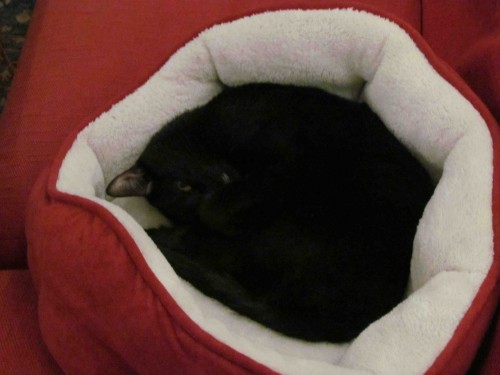
On the designated day, we went to the animal shelter together to choose a kitty.  Several hours later we returned home with the aptly named Merlin.   I went to the pet store to buy the essentials, including a soft cat bed (which he refused to sleep in.)  Merlin, being a cat who knows a thing or two about survival, immediately glommed onto Richard as though he were the anchor to his ship.  Wherever Richard went, Merlin was within a few feet.  By the second day Richard was extolling Merlin’s virtues, by the third day it was all over, Merlin and Richard were inseparable, it was love.  Ironically, the children, who after all were the ones vying for a cat to begin with, appear to have little more than a passing interest in Merlin.  Emma continues to say, as we pass a pet store, “Go in and pet the kitty?”  It seems she is only interested in petting other people’s cats, which we have found baffling.

Then this past weekend Emma found a stuffed cat I’d bought for the children after my cat Bertie of over twenty years, died.

“Oh Em!  You found the kitty!”

“Yeah.”  And for the rest of the morning Emma carried the kitty and her string with her wherever she went.

I keep hoping this affection for the stuffed kitty will translate to the real kitty, but so far it has not.  Still, I can now post this adorable picture of Merlin, who has finally decided he likes his cat bed after ignoring it for two years.   And who knows, maybe some day Emma will fall in love with Merlin just as the rest of us have.

For more on Emma’s journey through a childhood of autism, go to:   www.Emma’s Hope Book.com

The Missing Survival Instinct

This morning Emma asked for “toast with cheese” for breakfast.

“How about toast with almond butter?”

“No toast with almond butter.  Cheese.  Here.”   She thrust a wedge of sheep’s milk cheese at me.

When she was first beginning to speak she would say a phrase, usually not a single word, such as “All done” or something that sounded like, “bye-bye, see you later” and then the next week we would hear a different phrase, but the new words weren’t added to the previous, instead the previous phrase was never heard again.  Like her pickiness with food, she seems only able to tolerate a set number of things.  Out with the almond butter and in with the melted cheese.  I’ll keep pushing her to have the almond butter, but she’s nothing if not determined.

People often remark, when hearing about Emma’s limited food, “Well, she’ll eat if she’s hungry enough.”

While this is true, it isn’t true in the way one would suppose.  Emma will say no to something and if that’s all that’s offered, she’ll wander off, seemingly not concerned.  The idea that she’s really hungry doesn’t seem to cause her much anxiety.  It’s as though Emma doesn’t have the basic survival instincts the rest of us come innately equipped with.  I have since read on a number of websites about other children with autism who simply do not eat if the food they are comfortable with isn’t offered.  Emma will eat whatever it is once, but then not again.

When Emma was a baby she appeared utterly unconcerned when one of us would leave the room.   If we were at the playground she would wander off, never looking back to see where we were.  It was as though the thought that she actually depended on us for survival was not programmed in.  Even before she could walk, she seemed unable to comprehend that she needed us to take care of her.  She behaved as though she were a fully grown, perfectly capable and independent adult.  It was like that with all kinds of things.  She would dash into the raging surf at the beach, as though she were a seasoned swimmer, before she knew how to swim.  There were numerous occasions when Richard or I would glance up and see her disappearing into the ocean, her blonde curls floating on the water’s surface, waves crashing around her and Emma oblivious to any danger, barely able to keep her head up, laughing.  It was with this same insouciance that she left our hotel room one night at around 2AM when she was three, only to be found 30 minutes later wandering the halls of an enormous hotel we were staying in for a weekend get-away.  All of us were terrified and I still remember that feeling of dread, as though I might throw up, when we still hadn’t found her after the first ten minutes.  The hotel was like something out of a Stephen King novel, old and creepy, with cliffs on one side dropping into an ice covered lake.  The panic was all encompassing; it was as though my mind and body had separated from one another, a sensation almost every parent of a child with autism has experienced.

Last night I gave Emma a small bowl of my “Thanksgiving Soup”.  She whimpered when she saw it, then dutifully tasted it, before putting the spoon down and saying, “It’s all done now.”

When I offered her another spoonful she took it, but as she held the broth in her mouth, she began to gag.

Joe who was standing nearby said, “She can take a huge spoonful of cod liver oil with no problem, but not your soup.”

Yup.  That’s our girl.

For more on Emma’s journey through a childhood of autism, go to:   www.Emma’s Hope Book.com

Cheerios

Yesterday morning I asked Emma if she’d like to have some Cheerios for breakfast.

“Yes!  Cheerios!” she shouted.

I poured some into a bowl and then gave them to her with vanilla unsweetened rice milk.  She hesitated before digging in.  “I like Cheerios,” she announced.  “Cheerios for dinner?”

“No Em.  We’re not going to start having Cheerios for every meal again.”

“Just for breakfast,” Emma said, nodding her head up and down.

When I came into the kitchen this morning, Emma had placed the box of cheerios with a half gallon container of regular organic cow’s milk on the kitchen counter next to a bowl and spoon.  “Oh no, Em.  You can’t have this milk.  You can have your Cheerios with this one.”  I handed her the rice milk.

“I don’t like that one.”  She turned away and said, “No more Cheerios.  Have toast with cheese in the bakery instead.”

“In the bakery” is what Emma says when she wants something heated up in the oven.  When she first said it last summer while we were in Aspen, we were all confused.  I even took her to a restaurant in town called – Main Street Bakery.  Eventually we figured it out – she wanted to have two slices of bread, lathered with butter, put on a cookie sheet and then baked in the oven.  She likes to sit on the floor next to the oven door, periodically peering through the window into the oven until it’s done.

But this time she added that she wanted cheese, which was a first.

“Here Em, which cheese do you want?”  Barely able to contain my excitement that she was asking for something different, I showed her the three different kinds of sheep’s milk cheese and one goat’s milk cheese so she could choose.

“This one!”

“You wore her down,” Richard said.  “What happened to the Cheerios?”

“She doesn’t like the rice milk, so she won’t eat them.  Anyway, I noticed they have corn starch and she shouldn’t have anything with corn.”

Richard nodded his head and kept walking.  Richard has never been a huge proponent of this second round on the GFCF diet.  His feeling is – we tried it when she was two with no change, why would it do anything now?  But being the kind, supportive and generally awesome guy that he is, he has gone along with it.

I know none of this makes any real sense.  Emma has shown no significant uptick from taking all these various foods away and it’s been almost seven weeks.  But still I hold out hope, against all reason, against all evidence, against anything rational.  If I’m being honest, I have always wondered whether I didn’t do the GFCF diet right the first time around.  Maybe I wasn’t strict enough, maybe there was a food that she shouldn’t have had that I didn’t know about.  One can drive oneself crazy with this kind of thinking.  I know.  My husband knows.  Definition of crazy:  Doing the same thing over and over again and expecting a different result.  So yes, I get it.  But, for what it’s worth, here’s my (crazy) thinking – she didn’t test intolerant for gluten, so we’re putting it back in, but staying away from all the things she did test an intolerance for just in case some of those might be causing her problems.   I cannot imagine there will be any change, though.  Hope doesn’t rest on rational thinking however.  At this point I’ve downgraded my expectations to the idea that she’ll expand her diet.  It would be so nice to go out occasionally to a restaurant as a family.

It would also be so nice to have a personal chef – and that wish hasn’t transpired either.

For more on Emma’s journey through a childhood of autism, go to:   www.Emma’s Hope Book.com

Emma’s Literacy

Today Emma wrote the following sentences:

It is a good visual reminder of how nicely she is progressing.  After she wrote these sentences she became frustrated with two longer sentences she was suppose to remember and write.  I finally had to break them down into smaller pieces.  We then worked on reading comprehension.  The idea being – it won’t matter how well she reads if she cannot understand what it is she’s just read.  Like many children on the spectrum, Emma has a tough time saying what a story is about.  So we are slowly trying to build a foundation for her to be able to do so with increasing ease.  At the moment it remains very difficult for her.

Yesterday and this morning have been hard for Emma.  Her routine was interrupted, I spent a good part of yesterday cooking, we had guests for Thanksgiving and though Emma loved having family and friends over and sitting with us at the dinner table, I think the disruption proved tough.  She’s been out of sorts, a little crankier than usual.  This morning she kept insisting she go to the Central Park zoo and the big carousel; all things Richard did with her yesterday.

I never know what the reason is for her steps backwards, particularly when we can also see her many steps forward.  I keep hoping things will just move forward with no steps back, but this is unrealistic.  I know.  I have to keep my eye on the bigger picture and not get weighed down with the little daily upsets.  As we worked together this morning we had to stop several times as she became too upset to continue.  Her frustration is in glaring evidence during these moments.  She clenches her fist, hits her legs or pinches herself, so we had to stop each time and wait.  I understand how frustrating it must be to not be able to make the words come out right, to not be able to retain a seven or eight word sentence, to want to give up.

“We have to keep trying, Em.  I know it’s hard, but you can’t give up.”

“I know,” she said, nodding her head and looking sad.  “I know.  We have to do it again.”

“That’s right, Em.  You’re doing great.”

“Last time.”

“We’ll do it until you get it.”

“Okay.  Last time.”

And then she did it perfectly.

For more on Emma’s journey through a childhood of autism, go to:   www.Emma’s Hope Book.com

Another Mom’s Comment

This comment from the “On Engagement” post was so beautiful I wanted to share it.  Her daughter is also named Emma.

“I love your Utopian world. I wish it existed. I avoid going to events sometimes because I just don’t want to have to have Emma deal with the looks, or me at times. Her tantrums are nothing like that of a two year old either. She is eight, and carrying an eight year old out of a store spitting and biting and screaming in a piercing , gut wrenching manner gets many looks. One time Emma lost it in a fabric store. I should have known better because it is overstimulating. She loves textures, but does horrible in overstimulating environments. Anyway, it ended abruptly when I had to take her screaming and kicking out of the store. I held onto her for dear life, wishing I had parked closer, hoping no one would see me. I almost accomplished this endeavor when a woman started approaching me as I was desperately getting Emma to buckle her seat belt. I was sure she was coming over to tell me what a horrible mom I was, how social services should be called on me because it felt so violent as I held onto Emma and I imagined it looked violent as well. But instead, she came over and asked if she could hug me. She told me her son was autistic and has been a participant in much worse tantrums and just wanted me to know I was loved. I felt an angel had been sent to me. What a world of difference it would make if people were less worried about judging others and more concerned about helping others. A smile to a parent that is in need can make such a difference. We are all mothers, or daughters, or fathers, or sons. That is something that binds us all. Why not honor that in our daily encounters and help a struggling parent, not shun her, and refrain from assuming.”

Happy Thanksgiving!

For more on autism and Emma’s journey through a childhood of it, go to:   www.Emma’s Hope Book.com

Literacy, Diets, Progress

Dr. Marion Blank has written a terrific piece for the Huffington Post regarding the 60 minutes segment on APPs for autism and the current ways in which language is taught.  For anyone with even a passing interest in language or autism, I encourage the reading of it.

An update on Emma, her diet, her progress:

Emma ate about three tablespoons of chicken and brown rice two nights ago and tasted the pumpkin mousse I made.  I will attempt to make coconut milk whipped cream this evening in preparation for our Thanksgiving feast.  I want to have several things Emma might like, so I am planning to prepare Maple Syrup glazed Turkey, roasted carrots and sweet potatoes and some kind of desert she might enjoy (she didn’t love the pumpkin mousse or pumpkin scones, so I’ll try some other recipes) as well as things the rest of us will enjoy – we are having between 12 – 15 people, many of whom are bringing things!  I am thinking of writing a cookbook entitled All The Delicious Things I’ve Made That Emma Won’t Eat.

I worried the other day (someone pointed out that I am always worrying about something – I blame my mother for this – she is a known worrier, plus I’m a New Yorker so there’s no hope for me) that Emma is just as rigid now as she was before the diet.  Instead of only eating six things, all of which were dairy or wheat, she now eats six other things, but as Richard pointed out, at least they aren’t dairy and wheat.  I think my expectations were high (they tend to be) when we began the diet; I had read in many cases the child, once off dairy and wheat, expanded their diet dramatically.  Don’t get me wrong, it is wonderful to see Emma eating brown rice and roasted chicken.  In fact it’s a huge achievement on her part.  I’m taking a deep breath now and will bask in the glow of brown rice and chicken.

Okay.  Now that I am filled with gratitude, to continue –

To date we have seen no identifiable cognitive or behavioral progress as a result of this diet.  We see her doctor in another three weeks.  I am still hopeful we might see something by then.

We received a report from her school that Emma threw a chair across the room on at least two occasions and pulled one of the TAs hair.  Obviously this is not good news.

Another deep breath, focusing on the joys of brown rice and roasted chicken.

For more on Emma’s journey through a childhood of autism, go to:   www.Emma’s Hope Book.com

A Little Gratitude

There is a lot of great news out there regarding autism.  Many families have tried biomedical and therapeutic interventions with terrific results.  The website, autism.com has great information about treatments that have worked for many children on the spectrum.  No one can predict whether any of these will help your child.

When I was in my early thirties I sought help from the medical community for my bulimia.  I was depressed, could not stop the destructive cycle of binging and throwing up.  There seemed little to live for.  I phoned several rehabs and after speaking with several doctors and eating disorder specialists, I was told the longer a person had an eating disorder, the more intractable and harder to treat it became.  When I mentioned I had been bulimic for going on two decades there was silence.  I remember hanging up the phone and feeling utter despair.  I felt a similar despair when Emma was diagnosed.  But then, as I had when I was still bulimic, I became determined.  That determination served me well during those difficult years.  I never gave up and eventually found enough people who were able to help me, hold my hand and advise me.  I learned I couldn’t recover on my own.  I learned how to ask for help.  I learned to lean on others.  And I learned that in my darkest moments, if I remembered to reach out to someone else in need, to offer to help them, my own problems diminished.  I have tried to live my life in this way ever since.

Sometimes when I read about other people’s successes with their children, while happy for them, I feel sad for Emma.  I believe it’s natural to feel this.  I will never give up on Emma.  I will continue to do all I can to help her and while I do, I continue to work on my impatience while remembering to be grateful for each moment with her.

A little gratitude goes a long way.

For more on Emma’s journey through a childhood of autism, go to:   www.Emma’s Hope Book .com

Bruno Bettelheim

Most of us have heard, and many may have even read, some of Bruno Bettelheim’s ideas and work.  For those of you unfamiliar – Bruno Bettelheim, born in Austria, came to some prominence when he became director of the Orthogenic School, in connection with the University of Chicago for children with a variety of emotional and neurological issues.  His book, The Empty Fortress was published in 1967; read by many and touted as the final word on autism and its cause – the aloof and emotionally withholding mother.  At the time, his views on the subject became widely known and the treatment for autism was to put the mother in psychoanalysis.  The belief that the mother, in her lack of love for her child, caused the child to withdraw from the world was adopted by many.  Bettelheim claimed a high success rate of children with autism in his school.  It was only until after his suicide that many of his former students came forward with harrowing tales of abuse.  Much of Bruno Bettelheim’s work and ideas have since fallen into question.  The concept of the “refrigerator mom,” something he was an advocate of, has proven to have no validity.

Last week I had a piece published in the Huffington Post – http://www.huffingtonpost.com/ariane-zurcher/children-with-autism_b_1080076.html – a woman, now in her nineties wrote to me about her experience of being the mother of a child with autism, diagnosed in 1961.  Rather than examine her child when she sought help, she was put into analysis and blamed for her child’s neurological issues.  She wrote a book, A Few Impertinent Questions, http://301­45.myautho­rsite.com/, that tells of her painful journey.  It is a powerful story.

As I read her book, I reflected on what we think we know now about autism and what will come to light in the future.  Fifty years from now how will we view what we think we know?  What ideas will seem almost comical because we will have learned so much more.  What therapies will have fallen out of favor?  What new therapies will have taken their place?  What will be proven and seem obvious in fifty or sixty years from now, but are not obvious to us now?  I, most likely, will not be around in another fifty years to know the answers to these questions, but I am sure much will be revealed.

For more on Emma’s journey through a childhood of autism, go to:   www.Emma’s Hope Book.com

Isolation, Autism and a New Camera!

It’s interesting to note that autism, something defined by a lack of social skills, which in turn can lead to isolation in the children who are diagnosed with it, can have an isolating affect on the parents of those children for very different reasons.

How many of us have lost friends, seen some slip away after our child’s diagnosis while others we chose to avoid because they seemed unable to understand?  And what about family members?  When Emma was first diagnosed I felt such fear and worry and turned to a number of girlfriends I had at the time.  A couple of them were suddenly too busy to get together, while others just didn’t reach out.  Perhaps it was too much for them, too painful, who knows, but I felt incredibly sad when I realized those friendships were not able to withstand the diagnosis.

Now seven years later since we received Emma’s diagnosis I have new friends, many I’ve never met, others are from my life before, some even came back after having left for awhile.  What is wonderful though, is that those that are no longer in my life, I rarely miss and those that are in my life I am grateful for.

On an entirely separate note – Richard, my wonderful husband, bought me an early Christmas present, a new camera!

Emma at gymnastics on Sunday

Getting a little help from Brett

This morning waiting for the school bus

This is a hawk we saw in Union Square Park on Sunday!  (This has nothing to do with autism, I know, but isn’t he beautiful?)

For more on Emma’s journey through a childhood of autism, go to:  Emma’s Hope Book.com

The Diet

It’s been a month.  Last Monday I wrote that it had been four weeks and two days, I was wrong.  It just felt like it had been a month.

One month ago, on October 16th we began Emma on a GF/(modified) CF/ soy free and a great many other free diet.  This is our second go around with this diet.  The GFCF diet was the first thing I did when Emma was still two years old, to no noticeable change.  However, that first time she began eating a great deal of soy – soy yogurt being her favorite.  I was working with a DAN doctor at the time who tested her for hundreds of foods but never said anything about all the soy she was eating.  So after three months we took her off the diet and again saw no change.  This time I’m working with a naturepath/physician who also tested her for hundreds of foods.  This time, the list of foods to avoid was much longer than the first: cocoa, corn, potatoes, chicken egg whites, all red skinned fruits and vegetables, bananas, peanuts, onions and garlic.   Emma did not test negatively for wheat, but he advised we take her off it anyway, just to be safe.  Oddly, she also didn’t test negatively for sheep and goat’s milk, so we’ve allowed her to have sheep’s milk cheese, sheep’s milk yogurt and duck eggs.

Still we have witnessed very little change in Emma.  We’ve grown used to this.

I keep thinking I’m going to find something, something that other families have tried with significant results, but so far, other than Emma’s literacy program, we have not.  It’s frustrating to try various things and see little, if any, change.  As I’ve written before, we think we are seeing an increase in physical affection, but it’s hard to say this with certainty.  We have definitely not seen a profound change of any kind causing us to feel without a doubt that this diet has done anything.  Still I will give it more time.

Why some of these interventions work for some children and not others is something that’s been debated for awhile.  Why is it some children are mainstreamed after a few years of intensive 40 hour a week ABA, yet for children like Emma, they were not helped?  How is it that some children go on a GFCF diet and within days are transformed from a screaming, frustrated, incoherent child to one who is speaking in full sentences, playing with toys in an “appropriate” manner and displaying a never before seen curiosity of those around them?

It is easy to blame oneself, but I don’t believe that is the answer.  I know of too many cases where the parent has tried a great many things only to find their child did not respond.  I wonder whether it is the children who do respond, who are the exception.  While this thought depresses me, I have to wonder whether it isn’t more accurate.

For more on Emma’s journey through a childhood of autism, go to – www.Emma’s Hope Book.com

What is

A Zen buddhist teacher told me once – anything that happens in life is an opportunity to practice.  I remember my feeling of irritation when she first said that to me.  As the years pass I think of her and her statement often.  Whatever it is that is happening – if I can suspend my judgement and not label it as good or bad, but just as what is, I have taken away one more obstacle.

I think of Emma, beautiful, amazing Emma, who is unique and like no other child.  Her autism is neither good nor bad, but what is.   Even as I write this I can feel the tug in my chest, the little voice whispering to me, no – it is bad.  As though by accepting I will have given up.  As if my judgement will somehow make it go away.  As though the label will somehow change it.  I am not in the we-must-accept-and-do-nothing group.  I am in the – my labeling her autism or anything else for that matter as bad does not take it away – camp.  It just adds one more thing that I am fighting.

My practice is to continue the fine art of balancing what is with what I wish to be. What I wish for, what I hope for, what I work so hard for is to help Emma become more independent.  To celebrate her strengths, to encourage her to sing, to join her in her joy of music, to push her to work on her spelling, reading, writing, typing, math and language.  To gently lead her away from her rigidity, to embrace her silliness, to urge her to explore and be curious.  While I am doing that, I continually remind myself that each moment is a moment that simply is.

Emma is and for that I am eternally grateful.

For more on Emma’s journey through a childhood of autism, go to:   www.Emma’s Hope Book.com

New York City Empire State Building taken from the High Line last night.