Tag Archives: Parenting

A Letter to You (who wrote – “I Wish I Didn’t Have Aspergers”)

You are beautiful.

It doesn’t matter that we’ve never met.  It doesn’t matter that you do not know who I am.

You are beautiful.

You are beautiful exactly as you are, at this moment, no matter how sad, how angry, how confused or lonely you may feel, you are beautiful.  We live in a world and in a society, which fears that which it does not understand.  The majority of those people are different from you.  That does not make you wrong or bad or any other derogatory word that you may have heard directed at you, it simply makes you different.

You are beautiful.

There are others, others who are similar to you who also inhabit this world.  My daughter, Emma is one of them.  Emma is ten.  Emma does not know what google is or if she does, she cannot communicate that she does.  She, like you, is wired differently.  Emma is autistic.  She has many challenges.  There are things that are much, much harder for her to do, like reading and writing and speaking.  She has lots of sensory issues that cause her tremendous discomfort and even pain, but there are other things that are easy for her.  She is honest and full of love.  She is without guile, she does not bully or condemn, judge or gossip.  She is without inhibitions.  Emma loves music.  I think music speaks to her in a way that conversational language cannot.  When she dances to her favorite songs she becomes an extension to that music.  She incorporates it into her being and it brings her tremendous joy.  She is a free spirit and her beauty emanates from her without censorship.

She, like you, is beautiful.

Find your place in this crazy world.  Speak out and while many may not want to listen or may even try to silence you, do not let them.  Do not remain silent.  Add your voice to the chorus of others who are here with you, who are like you, who also have Aspergers.  Say what you feel.  Say what it is like to be you.  We need your voice, I need your voice.  My daughter cannot tell me these things, so I listen to others who are like her, but who can speak.  Each one of their voices is beautiful.  There are many, many people, like me who want to hear from you, who want to listen.

You are beautiful.

If people say things to you or about you that are cruel and hurtful, do not believe them.  Their words are not a reflection of you, they are a reflection of them.  There are many sad, angry, troubled people in this world who hurt others because of their rage and sadness.  No matter how much they may want you to believe that you had something to do with their unhappiness, you did not.

You are beautiful.

Someone typed into google – “I wish I didn’t have Aspergers.”  From that google search they found the blog Outrunning the Storm, a blog written by a mother of an  Aspergers child.  A number of bloggers got together and reached out to many of us, asking that we each write something, which will be posted on the newly created – AutismPositivity Day Flash Blog.  The above is my contribution.

For my latest piece in the Huffington Post – Running With Mermaids

To read Emma’s profile in The Thinking Person’s Guide to Autism, click ‘here.’

A Fantasy For Autistics

Last Monday Emma was profiled in A Slice of Life Series that the blog Thinking Person’s Guide to Autism has been running through the month of April.  This is the blog I wish had been around when Emma was first diagnosed, but that I am so grateful exists NOW, because it is by and for Autists and those who care for them.  Almost all the comments were from Autists who have blogs of their own and I recognized almost every single one of their names.  One of the people who reached out, Savannah, has a terrific blog called, Cracked Mirror in Shalott.  After she commented on this blog, I went to hers and read a powerful post, entitled Payment about teaching life skills to young Autistics.  The first sentence of her post is:  “I don’t want younger Autistics to learn some of the skills I have- or, at least, not the way I learned them.”

I will do her writing a disservice by trying to relate it here, so I urge anyone reading this to go to the link I’ve provided.  I commented on her post and inquired if it would be okay to ask for any thoughts on how to help Emma learn to wash and rinse her hair, which we’ve been working on for close to a year now, with on-again-off-again success.  In reply I received not only a lovely and thoughtful response from Savannah, but another from someone else, who had some terrific suggestions and also has a blog, Chavisory.  As I pondered the various responses I began to formulate a fantasy.  A fantasy of what I would love to see, what I hope I will live long enough to see, a vision of a different sort of world.  A world in which adult Autists were mentoring and helping younger Autists.  A world where adult Autists were involved in every aspect of society, education, government, policy.  I imagined a world where Autistic writers had columns in every major newszine, newspaper and magazine.  A world in which every single school had Autists teaching, devising curriculum, training and teaching neurotypicals how to best teach children on the spectrum and as I allowed this fantasy to develop I felt a surge of energy and excitement.  I literally felt like jumping up and down.  When Richard appeared, bleary-eyed and slowly reached for his cereal bowl, unable to contain my excitement any longer, I blurted out, “Can I tell you about my dream?”

“Can you tell me?” Richard asked, with a dazed expression.

“Yes.  Can I tell you?”  Unable to hold back any longer I launched into my fantasy, while Richard was still forming the words – “Yes, of course. Tell me.”

“Can you imagine what it would be like if adult Autists were writing books, teaching us, training us parents how we could best help our Autistic kids?  Can you imagine how amazing that would be?  Can you imagine how helpful that would be?  Autists have insights that we can’t possibly have, they understand better than anyone the various sensory issues, delays in motor skills that might be making it harder for children like Emma to learn how to do some of these things.  Can you imagine?  Can you imagine a world where schools were created and run for and by Autistics?”

And before Richard could reply I kept going. I was on a roll.  The excitement I felt just thinking about all of this was so great I couldn’t sit down.

“Think about it.  It would be so amazing, unlike anything we’ve ever experienced.”

As I considered this fantasy world I felt the stirrings of determination.  Why does this have to remain a fantasy?  Why can’t this be a reality?  What would have to happen for this to go from far-fetched fantasy to reality?   I’m sure others have had this thought.   What would need to happen?  What are the next steps?  I bet others have begun to make this a reality and if so, I’d love to know about them.

Thoughts?

For my latest piece in the Huffington Post – Running With Mermaids

To read Emma’s profile in The Thinking Person’s Guide to Autism, click ‘here.’

What Wasn’t Said and Other Omissions

I just received a call from Richard who told me after I left to take Nic down to his school bus, Emma went into her room and began crying.  When Richard asked her what was wrong, she said, “I miss Mommy.   See Mommy tomorrow.”

For the past two nights I have been out, not coming home until well after Emma has already gone to sleep.  It is unusual for me to go out two nights in a row and clearly it made Emma sad.  While Nic is now at the age when he looks forward to our evenings out, so much so that he offered Richard $100.00 of his own hard earned allowance (generous and thoughtful boy that he is), “so you and Mommy can go out on a date,” Emma does not share his enthusiasm.

This morning Emma appeared in our bedroom at 5:28AM.  “Emmy, it’s too early.  You have to go back to your bed.”

Emma pointed out the window and protested, “But it’s light out!”

She was technically correct.  The first morning light was just beginning to show itself and though it wasn’t full daylight, you couldn’t argue that it was exactly dark, either.

“Em, look at the clock.  It has to say 6:30 before you come in and wake us.”  But I knew, even as I said this, that I was changing the “rules” on her.  Emma knows she isn’t to come into our bedroom until “it’s light out.”  As the seasons change, this is a dubious “rule” and one far too vulnerable to interpretation to really be meaningful.  Still Emma was doing her best to honor it.

Emma morosely trudged out of our bedroom and I, now wide awake opened up my ipad and began checking my email.  Five minutes later Emma appeared again.  “It says five and three and three.”

“Yes, but it has to say six, three, zero.”

“Okay. Okay.”  Emma said and looking forlorn she made her way out of the room.

I could hear her in the living room reciting various arbitrary “rules.”  “Lauren’s class.  No you can’t sit on the ledge, that’s dangerous.  You have to get down or you’ll bump your head.  No not going to hang on the pipe.  You might fall down and hurt your head.  Ouch!  That hurts, you have to go see nurse.  Be careful.  But listen, if you go on the ledge, you might fall down…”  this went on for quite some time and then there she was again.  “It says six, zer0, seven,” she informed me, while peering at the clock.

“Okay Em.  You can stay, but you have to be quiet.”  I scooted over so that she could crawl under the covers next to me.  She lay her head on my shoulder and picked up from where she’d left off.  “Have cereal and toast?  Then play the Wii?  School bus, Lauren’s class, study room with Joe, sleep, wake up…”

As I listened to her, it never occurred to me to note what she wasn’t saying.  In her list of what she expected would take place in the next 24 hours, I was not one of the things she included.  It never occurred to me that that omission was intentional and because she didn’t expect to see me again when she returned home, just as she hadn’t for the past two evenings.

This afternoon, I will be waiting for her when she returns home.

To read Emma’s profile in The Thinking Person’s Guide to Autism, click ‘here.’
To read my most recent Huffington Post, click ‘here.’


The Path Leading Away From Hell – Continued

Yesterday when I began writing The Path Leading Away From Hell I knew halfway in, I wouldn’t have time to finish, but I plowed along anyway and at a certain point had to stop.  To pick up where I left off  – until recently finding a “cure” to my mind, was synonymous with helping Emma overcome all the things that caused her such pain and misery.  “Curing” her meant finding a way to help her read and write, figuring out how to help her with her GI issues, helping her with language and speech so that she might have an easier time making friends, helping her with her vast and varied sensory issues, helping her tolerate change, finding alternate ways for her to cope when she was overwhelmed so that she would not bite herself and punch herself in the face, helping her stay engaged and focused so that she might progress academically, helping her be in the world so that she might one day have the opportunity to live independently should she want to, surrounded by people she loved and who loved her.  I was intent on finding ways to help give her the tools she would need to travel if she wanted to, find a job and career she found interesting and close friends so that she might never feel alone.  These were/are my goals for Emma, and the word “cure” seemed to sum up all of these points, succinctly, in one compact word.

When I began reading blogs written by adult autists who objected vehemently to the word, “cure,” I was surprised.  At first I didn’t understand and reasoned that they objected because they were functioning at a much higher level than Emma is and does.  They spoke and articulated what they thought.  Emma cannot do any of that.  I felt sure that if they were unable to make their opinions and feelings known, they too would seek a “cure.”  But then I read some posts by autists who were not able to live independently, who had tremendous difficulty keeping a job, who found social situations impossible, yet they too objected to the use of the word “cure.”

I knew I was missing something, so I kept reading.  I wanted to understand.  I have always wanted to understand.  After days spent reading blogs and comments, many of which I’ve listed in past posts and some that are featured on the blogroll on this site,  I came upon an autistic woman who described two general types of parents, the first who wanted their autistic child to function as best they could and would do everything in their power to help them accomplish this and the second was a parent who wanted to cure their child of their autism so that they might have a “normal” child instead.  It was in reading her description that I began to understand, this wasn’t an argument about “cures” in the way I had understood and interpreted that word to mean regarding Emma, this was about the potency of words and how they can be used to dehumanize, discriminate and hurt.

No one was saying – Don’t help your child.  On the contrary, almost every single autist who wrote on the subject, spoke of the many challenges they faced and of the help they often required.  The argument was not about debating the merits or worthiness of who needed help, this was not a debate about needs, challenges, being non-verbal or verbal, being independent or dependent, the number that accompanied ones IQ or where on the autism spectrum one was.  What most of the autists I read objected to, was the use of the word “cure” because it implied who they fundamentally are, needed to be excised.

Many spoke of the shame they felt growing up, the alienation, and punishment they endured because of how they were perceived.  Almost everyone mentioned being bullied, being abused, being subjected to insults, derision and criticism.  All because they were autistic.  Add to that the various erroneous theories regarding autism and how autists lack empathy, do not feel as neuro-typicals do and you can begin to see how destructive this type of thinking is.  Dehumanizing and marginalization are the ways of war.  It is how people have justified acts of violence against others throughout history.  Dehumanizing autists with talk of “cures” and theories regarding how they do not feel are ways in which people can rationalize abuse.

It is human nature to want to be understood, to be listened to, and to connect with others.  But first there must be a conversation, a dialogue in which we all participate, in which each person is listened to and given the chance to voice their opinion.  Who knows, we may learn all sorts of things.

I certainly have.

To read Emma’s profile in The Thinking Person’s Guide to Autism, click ‘here.’
To read my most recent Huffington Post, click ‘here.’

The Path Leading Away From Hell

In the last few months, Richard and I have been hit with a surge of information, ideas, alternate ways of thinking that have completely upended our goals for Emma and our thinking regarding autism.  (In the best possible way.) I have written about these shifts in past posts – The Evolution of  a Perception and A Different World, prior to that Waging War where I was still straddling the fence but was getting close to seeing Emma and autism in a new and, I believe, improved way.

A few things have occurred to me in recent weeks, please read this as it is meant, which is as a description of the process, a process I am grateful for.  Some of the words I use are often misunderstood, they have been by me, this is the beginning of that process.  Tomorrow I’ll try to finish this post, but for now this is the beginning…

There were a number of factors that increased my terror at the word “autism” beyond the grim way in which the diagnosis was delivered, the less than hopeful and helpful “advice” given to us.  There were a couple of things I read or was told that have remained etched in my mind.  Such as the pediatrician who advised me to – “Get on with your life.  There’s nothing you can do,” was equally as destructive as reading Catherine Maurice’s book, Let Me Hear Your Voice about how her two children on the spectrum lost their diagnosis with an aggressive ABA program.  That book was the first of many “recovery” books I consumed like a starving person confronted with an all-you-can-eat-buffet.

Whether it was a diet, the vast number of biomedical interventions we tried, behavioral therapies, 40 hours of ABA, 10 twenty minute sessions of DIR/Floortime every day…  you name it, we tried it.  Pursuing these interventions was akin to hitting my head against a brick wall over and over and over again.  In fact, nothing seemed to make much of a difference, and it was that fact that continued to propel us down the “searching for recovery” road for as long as it did.  Because nothing we did seemed to cause any long term continuous progress, in fact at certain points during her ABA program Emma actually regressed, we started looking for more and more radical “alternatives.” Until finally I remember feeling, exhausted, utterly exhausted, physically, emotionally, spiritually, it was as though I’d come to the end of a grueling trek and faced yet another mountain range, there was no breathtaking view from atop some majestic peak, just more of the same and I just couldn’t do it any more.  I was spent.  We had just returned from a third trip to Central America for stem cell treatments, saw very little change and weighed the risks (which were enormous and like a flashing red question mark in neon lights) we said to each other, how much longer can we do this and at what cost?

It was at this point that we found a literacy program that seemed to really help Emma beyond anything we had tried thus far.  At the same time that we embarked on the literacy program, I continued to hold out hope that some sort of biomedical intervention would help her as well. *I am adding this now a year and a half later. –  It is with great regret that we embarked on the literacy program instead of using RPM as this has been what has worked more than anything else.*

This past fall like a burst, one final spark of frantic energy I took Emma to a Naturopath who’d been recommended to me, and put Emma on one more radical “diet” not GAPS, but damn close, pulled the few things that she loved to eat from her diet, saw her lose so much weight it frightened me as she refused to eat anything, and after six weeks of hell, said, enough.  We put everything back into her diet, saw no change at all, and then felt all the guilt that accompanies these failed interventions all over again.  I just couldn’t believe I’d put her through that yet again, (the first time was when she was first diagnosed and two years old.)  All those “suggestions,” the well meaning advice, the referrals to the “miracle” doctors who were recovering kids left, right and center, it was a pandora’s box I just kept going to and opening over and over and over again.  You’d think someone with intelligence (I like to think of myself as that hypothetical someone) would have said, if this guy is such a genius why isn’t he on the cover of Time Magazine, why is it that no one has actually heard of this person, this intervention, this whatever it was?  But I didn’t.  I kept trying different things.  The allure, the seduction of finding the “thing,” the miracle was so great, all rational thinking was suspended again and again.  Add to that – desperation, which actually doesn’t describe what I felt, I was beyond desperation.  I was beyond crazed.  I was on a mission from some other universe.  Nothing was going to stop me from “fighting” for my child. I was determined; I was going to find the thing that would “cure” my daughter.

And after all of that, I didn’t.
And after all of that, it turns out, I couldn’t.
And somewhere deep, deep down, I felt I’d failed her.  To stop trying to find a cure that would remove what plagued her, what caused her to not be able to articulate what she was thinking, was to give up on her.  To stop the search was like leaving her to a future of wordless, silent dependence.  Institutionalization, upon Richard and my death, was her future.  Of that I felt certain.  Who would take care of her?  Who would help her?  Who would hold her when she was sad?  Who would be there to sing and dance with her?  Who would even allow her to listen to the music that seems to feed her soul?  Who?
We are fortunate in that Emma’s long time therapist, Joe and his wife, had agreed that for as long as they were alive they would take care of her  should something happen to us, but that did little to quell my fears.  What about when they both died?  I asked myself.  What about then?
To be continued….
To read Emma’s profile in The Thinking Person’s Guide to Autism, click ‘here.’
To read my most recent Huffington Post, click ‘here.’

Fear = Feel Everything And Remain

Fear.  It creeps up on me, seemingly without warning.  Sometimes I get hit with it while brushing my teeth or waiting with my son, Nic, for his school bus or when I am walking to my studio.  Like a person suddenly appearing in front of me, it startles me every time.

There are phrases using fear as an acronym, such as:  F*ck Everything And Run, or False Evidence Appearing Real, or Failure Expected And Received, or Frantic Effort to Appear Real.  I like some of those, but the thing that I’ve found helps the most is to admit I’m feeling fearful out loud.  To “out” it.  To not allow it to sit, twisting and turning in my gut, while pretending it isn’t there.  Pretending it isn’t there rarely helps.  On the other hand, allowing myself to go into intricate detail about it often makes it worse, like feeding a dragon, or adding fuel to a fire, (pick a cliche) so it seems there’s a balance needed.  Feeling the fear, acknowledging it, and then trying to trudge along anyway, or do as my favorite saying regarding fear – feel the fear and do it anyway.  The “it” is often a moving target, particularly as this morning’s fear is all around future thinking involving Emma.

Which leads me to the two most detrimental things that lead me to despair faster than anything else when it comes to my daughter – future thinking and comparing her to others.  Compare and despair, they say.  Deadly.  It is deadly and it doesn’t matter whether I am comparing her to another autistic child or a neuro-typical, it is deadly.  I try to cut that one off at the pass.  If I see it coming I try to turn my back.  “Don’t go there,” I tell myself.  Sometimes it’s impossible, large gatherings with other children are the worst and sometimes it’s impossible  to avoid.  Sometimes I have to sit and hope it just washes over me and leaves.  I hope there will only be a few waves of it.  I hope I’ll be able to stay upright.  I hope that I’ll be strong enough not to cave under the weight.

That’s the thing about fear, it can be so all encompassing, so random, so…  sprawling.

Make a list.  This is an action step I take when I feel as though I can’t breathe.  Make a list.  Prioritize.  What needs to be done?  This past month I have not been as diligent with Emma’s “study room” and she has not been progressing as rapidly as she had been, so I’ll need to figure out how to manage my time better to get back to that.  Emma’s literacy program is one that continues to fill me with hope and gives me energy.  Seeing her progress with her reading and writing has been the single most helpful thing in keeping the fear at bay.  When Emma was stalled out, not moving forward, those were the darkest times.  As long as she continues to progress, her self-portrait, her letter, her writing about going to the zoo, are examples and the things I cling to like so many scraps of wood in the middle of an ocean of fear.  Just keep my head above the water, just hold on, keep treading, keep breathing, it will be okay.  It will be okay.

Make a list.  Check.

Don’t pretend I’m not feeling the fear.  Out it.  Check.

Feel it.  Check.

Keep moving forward.  Check.

I know these things won’t remove the fear, I know they won’t completely eradicate it, but they are the things I know to do that will help, even if not in this next moment, but in the next few hours, the next few days, the fear will dissipate.  It always does.  Take a deep breath.

FEAR = Feel Everything And Remain

To read my most recent Huffington Post, click ‘here.’

To read my guest post on Special Needs.com, click ‘here

Emma and the Puffin – A Moment of Connection

As promised – Emma’s zoo excursion was this past Sunday.  As I’ve written before, the zoo holds a particular appeal to Emma, an appeal that, frankly, is often lost on me.  Still, I had agreed to go with her and because I had had a couple of days in which to mentally prepare myself, I felt eager and excited in anticipation of our little adventure together.

As predicted Emma wanted to visit the bats first, then made her way outside to watch the polar bear do his perseverative laps.  He has been doing the same routine for years.  He swims on his back to one side of his enclosure, then braces himself against the wall, pushes himself off and propels himself through the water to the opposite wall, before flipping over, diving down and doing the whole thing over again to the ooohs and ahhhhs of the admiring and curious crowd of humans standing against the thick plate of glass separating them from him.  Emma watched silently and then, like Howard Cosell reporting from ringside, (does anyone remember Howard Cosell?) began narrating.  “The polar bear is swimming!  He is under the water!  Uh!  Where did he go?  There he is!  He came back!”  After awhile Emma had had enough of the polar bear and off we went to her favorite perch where she likes to sit and watch the various ducks and other aquatic birds. (Truthfully I have no idea what types of birds were swimming around and as I was keeping my eye on Em, couldn’t find any plaque telling me what we were viewing, I’m afraid, “aquatic birds” is the best I can do at the moment.)

“Time to see the penguins!”  Emma announced and grabbing my hand she made off for the penguin house.  The penguin house has an unfortunate odor. I must hold my breath when we are inside because the smell is one I cannot cope with.  But Emma doesn’t seem to notice the smell and loves the penguins.  She presses her body and face right up to the glass as she watches them swim and strut about on the artificial land mass.

The puffins were next, a lesser attraction and so relegated to a tiny enclosure.  In the past the puffins have been no more than an exit marker, but this time she did something I’ve never seen her do.  She went right up to the window and stood perfectly still with her up-stretched arms flat against the pane.  A single puffin swam up to her and put his beak to the glass and then idled there, barely moving.  It was bizarre and beautiful.  I was so excited this photo is horribly out of focus!

Emma and the puffin stayed facing each other for a couple of minutes before Emma was pulling me out the door just in time for the 4:00PM feeding of the sea lions.

I wanted to ask Emma about the puffin.  I wanted to know what she thought of him.  What was she thinking and feeling as she stood there?  What was the experience like for her?  But other than to say, “Puffin.  I like it.”  I could get no more from her. Perhaps there are no words for what she felt standing there face to face with this curious creature who seemed so intent on being as close to her as was physically possible.

Stay tuned tomorrow for Emma’s self portrait!

To read my most recent Huffington Post, click ‘here.’

To read my guest post on Special Needs.com, click ‘here

Handwriting and the Joy of the Yellow R Train

First off, you’ll notice to the right of these words a blue “badge,” which, if you click on it, will show you a line up of all the blogs nominated for the “Top Autism Blogs for 2012.”  To vote for Emma’s Hope Book, click on the “like” button.  At the time of this writing Emma’s Hope Book was in the #4 position!  Very exciting.

Below is the “story” Emma wrote yesterday morning in preparation for our much anticipated day.

I had to help Em with some of the words such as shower, Elite Gymnastics and she wanted to write – After lunch will go zoo – so I had to help her with that too, but otherwise Emma did most of this on her own.  To recap, a year ago Emma had just finished learning how to form all the letters of the alphabet and we were in the initial phase of beginning to work on reading, writing and typing actual short words.  She’s come a long way, baby!

As her writing stated, after lunch Emma and I went to the zoo.  “Just Mommy and me, together,” Emma reiterated several times that morning. “Yes, just you and me,” I confirmed each time.  “Going to take the yellow R train,” Emma said matter-of-factly.  Emma loves the R train.  She refers to it as the “yellow R train,” because the letter R is in the middle of a yellow circle.  All the subway trains here in New York City are designated with a number or letter within a colored circle.  Whenever possible, Emma requests the R train, which is fine, except that this is not the train closest to our home and a few months ago the R train wasn’t running on the weekend, much to Emma’s consternation.  As we made our way to the station, I cautioned Emma that we had to take whichever train came first.  “Yellow R train!” she insisted.  The very prospect of riding the R train, almost more than she could cope with, caused her to bounce up and down.  She beamed at me.  “Okay, but Em, if a Q or N train comes, then we’ll take either of those too.”  “Take the yellow R train,” she responded.  “Em…” I started, but before I could say more she cut me off and said, “Okay, okay, okay.  Maybe take the yellow R train, maybe not.”  Then quietly she muttered, “Take the yellow R train!”

Another train flew by on the express tracks, so fast I couldn’t tell which train it was.  But Emma knew with barely a glance. “Look, there’s the yellow Q train,” Emma said, pointing as the train whizzed by.  “Yeah, that’s the yellow Q train with blue seats,” she said.

“What?”

“The yellow Q train has blue seats.”

This was news to me, not the sort of details I notice, but exactly the kind of details Emma notices.  As I was pondering this, Emma said, “Look!”  Then she grinned.  “It’s the yellow R train,” she said with a kind of reverence, as though greeting an adored and much admired friend.  As the train slowed to a stand still, Emma found us both a seat and giggling said, “We’re sitting in orange and yellow seats!”

“Is that why you like the R train?” I asked.

“The yellow R train makes me happy,” Emma said, before peering out into the dark tunnel and grinning at her own reflection.

And so it does.

Coming tomorrow – The Central Park Zoo and The Puffin.

To read my most recent Huffington Post, click ‘here.’

To read my guest post on Special Needs.com, click ‘here


Top Autism Blogs

Emma’s Hope Book has been nominated and is hovering somewhere in the single digits.  Vote by clicking on the “like” button!

Very exciting.

On Autism, Honesty and the Art of Not Yelling

Be honest.  This is what Richard reminds me when I feel stuck.  Whether its regarding my writing or when we are discussing something that is difficult or when I simply feel confused.

Be honest.

Sometimes it’s easy, like when I feel sad and a little frightened that Richard threw his back out again and is in so much pain he can barely walk or I’m annoyed because while waiting for the subway this morning a woman cut me off and sat in the only vacant seat, forcing me to stand or how happy I felt last night when Nic asked me to watch an episode of ‘Chopped’ with him and then pulled a blanket up around us both and said, “I love this, Mommy.  We’re having a son and mom moment.”  Or the sadness that tempered that joy because my next thought was – Emma cannot say that, does not say that, has never said that and then scolded myself for having had that thought because Emma can and does talk, while so many other kids cannot speak, let alone express more complex thinking.

Be honest.

Sometimes I just want to yell and say exactly what comes to mind, because, after all, wouldn’t THAT be more honest?  I already know the answer.    Not yelling is highly underrated, it seems to me.

Be honest.

I want people to love Emma exactly as she is.  I want people to understand when they meet her that in her short life she has already known more pain and discomfort than any young child should have to feel.  I want people to speak to her as they would any ten year old and not like she’s an animal.

I want people to be nicer to each other, which means I have to do my part.  A recent study came out saying autism may be due to older male sperm.  That evening I said to Richard, “Well that gets me off the hook.  It turns out all of Emma’s suffering is your fault.  It’s a huge relief.”  Luckily Richard loves me anyway, even when I say things like that and replied, “I’m so glad I could help you out with that, honey.”

And he did and does.

I’ll end with the conversation I had with Emma last night, showcasing her negotiating skills, inherited from her amazing dad.

“Mommy?”

“Yes Emma?”

In a sing-songy voice, she said, “Mommy takes me to the zoo tomorrow?” (It’s from a picture book entitled Going to the Zoo, from the Peter Paul and Mary song of the same name.)

“Not tomorrow, Emmy.  I can’t take you tomorrow, but you and Joe could go.”

“No!  Just Mommy,” she pointed to me and then pointing to herself, she added, “and me.  Go to the zoo together.  Maybe this weekend?”

“Yes.  We can go this weekend.”

“Just Mommy.”

“Yes.”

“Together.”

“Yes.”

“Time to read a story now.”

“Okay, Em.  I love you.”

“So much.”

(As my mother pointed out after I posted this, this conversation was a perfect demonstration of Emma expressing her desire for a – Mommy and daughter moment!)

To read my most recent Huffington Post, click ‘here.’

To read my guest post on Special Needs.com, click ‘here

Bedtime Stories, Memories and Love

Almost every night after Emma has brushed her teeth and flossed, she will find me and say a version of – “Mommy time to read stories now.”  Last night I found her in her bed.  I stood in the doorway and waited to see if she would say anything.  “Mommy read stories?”  she said.

“Em, do you like The Wind in the Willows?  Or should we find something else to read?”

“I like Wind Wills,” she answered.

So I picked up from where we’d left off the night before and began reading about Mole, who having smelled his old home returns to it with Rat accompanying him, despite the fact that it’s late and a snow storm is threatening.

Emma nestled against me, as she almost always does, with her head on my shoulder, sucking her thumb, about thirty tiny shreds of what was once a down stroller blanket strewn about her neck.  The Wind in the Willows, for those not familiar with it was published in 1908.  The lyrical language tells a beautiful story about four friends – Mole, Rat, Toad and Badger – and their various adventures along the Thames river.  I don’t ask Emma questions about the stories I read to her during bedtime.  I don’t want her to have to work.  I want her to feel no pressure.  I have no idea what she takes in or even understands, the only thing I know is that she enjoys being read to, just as I did when I was young.

My mother read to my sister and me Winnie the Pooh, Mary Poppins, My Family and Other Animals, while my father could be heard reading to my brothers in the living room, such tales as The Three Musketeers, King Arthur and other stories involving sword fighting and adventure.  I much preferred the stories my mother read and would lay my head on her shoulder, just as Emma does with me.

I used to pause occasionally and make a comment such as, “Oh I wonder what Ramona will do.  She seems sad that her Mom has to work and isn’t home when she gets home from school.”  Emma usually said nothing or if I lingered for too long, would say, impatiently, “Keep reading.”  or “Don’t stop.”

Being read to still conjures up fond memories of snuggling in my parents bed with my mother and sister, sometimes falling asleep, other times, listening to the antics of various animals and characters while feeling safe and loved.  I can only hope I am providing Emma with similar memories.

To read my most recent Huffington Post, click ‘here.’

To read my guest post on Special Needs.com, click ‘here


Soap Suds, Jokes, Literalism and Autism – Stir

A couple months ago as I was standing outside the shower coaching Emma who was inside the shower, I said, “Okay, good, Emma.  Now wash the soap off.”

Dutifully Emma took the bar of soap in her hand and held it under the shower spray.

That action is pure Emma.  And it is also pure autism.  It’s both and they are inextricably bound together and enmeshed.  So when people say – I love my child, but I hate their autism – I know what they mean, I know they love their child completely, I know they are expressing their frustration and sadness that their child suffers in a variety of ways because of their various sensory issues and difficulties with language causing them to be self-injurious, tantrum and feel untold frustration.  I know what they are trying to say, but I don’t believe we get to pick out the “autism” piece and remove it.  Autism is like an ingredient added to a recipe.  Thinking that we can find that one ingredient mixed in with everything else will be a painful and ultimately destructive pursuit.  The ingredients are all stirred together and together they are what makes Emma, Emma.

It helps me to clarify in my mind what I want to help Emma with, by being specific.  Such as – help her learn how to cope better when she is overloaded sensorially, help her with transitions, push her to work on her reading, writing, typing skills, math.  Help her understand the concept of time and money (these are future goals, we are certainly not there yet.)  Help her with comprehension and grammar.  Help her find alternate ways to cope with her frustrations.  Help her when she feels the need to hit herself or bite herself. All of these things are what I try to help her with.

That literalism, (something I share, by the way) is as much a part of Emma as anything else.

The other day Nic and Richard were laughing over some joke.  “What’s so funny?” I asked.

Nic looked at his dad and gave him a look.  A look that said –  Should we tell her?  Should we bother, cause this could take some time.

Richard smiled at me and told me the joke.  When I didn’t respond immediately Nic began to try and explain.  “Get it?”  he ended.

“Um.  Okay.  But I still don’t get why that’s funny.”

Again Nic tried to explain, until I interrupted him, “No I understand what the words mean, I just don’t get why that’s funny.”

“Oh poor Mommy,” Nic said giggling and rolling his eyes at his dad.  Then he patted me on the head!

My inability to understand all but the most obvious jokes has become, in and of itself, a running joke.  I rarely tell jokes because I can’t remember them.  I can’t remember them because most of the time I don’t understand why people think they’re funny.  I just don’t get it.  So when Emma thrust the bar of soap under the spray of water, I got it and I was filled with admiration.  No, I’m not kidding.  I really was.  We say all kinds of things that “literally” don’t mean what we mean.  As Emma did as she was told, I amended my comment, “Hey Emmy.  Wash the soap suds off of your body.”

And so she did.

To read my most recent Huffington Post, click ‘here.’


Running with Mermaids

When Emma was a toddler she had a mermaid finger puppet.  It had long black hair, sported a blue bikini top and had a blue sequined tail.  At the time, I thought it was the first of what would be many dolls.  I loved dolls when I was little.  My favorite doll was named Maribelle.    Her left hand, the victim of my rage when I was four and hacked off three of her fingers with a pair of pruning shears was a reminder of anger gone awry.  I immediately regretted my actions and attempted to glue her fingers back on.  Crazy glue was not the common item found in every tool box as it is today.  My options were Elmer’s and rubber cement, neither of which could repair the damage.  I then tried tape with no better results.  At some point the fingers were lost or I threw them away, I can no longer remember.  Mirabelle’s fingers, while physically gone, are forever etched in my conscience, an impulsive act I could not undo.  Still, I loved Mirabelle and though I eventually moved on to a series of other baby dolls, little girl dolls and finally Barbie dolls, my first love was Mirabelle.  All these years later Maribelle resides in the blue and silver striped trunk she originally came in, now in an upstairs closet  in my mother’s house.  I have never been able to part with her, my thinking was that if I had a daughter, perhaps she would one day want to have her.

When Emma showed interest in the mermaid, I had high hopes for Mirabelle’s return.  Only, it turns out, Emma’s mermaid did not hold the same sort of feelings as Mirabelle had for me.  The mermaid was the beginning of a series of objects that Emma was fascinated by.  The item that eventually replaced Emma’s mermaid was The Corpse Bride from the Tim Burton movie with the same name.  Then it was Jessie from Toy Story and after that a long stick picked up from the playground.  From there she gravitated to a series of sticks, balloon strings and her current favorite: packing string.  The packing string is a work in progress, held together in the middle with masking tape, then scotch tape, which was then covered in reinforced packing tape and finally covered in turquoise duct tape.  When we were at Granma’s house, Emma covered the turquoise duct tape in masking tape she found in a drawer in my mother’s kitchen.  When we returned home, Emma covered the masking tape with yet another layer of the turquoise duct tape.  It has a certain heft to it and looks like this.

I know a little more than I did when Emma first ran back and forth from our front door through the house and back to the front door with the finger puppet held between her thumb and index finger, the mermaid’s black hair swinging to and fro as she ran.  Today Emma holds her “string” as we call it, in her hand while dancing.  Her string serves as part security object, part stim object, part something else that I am still trying to figure out.  “An attachment to peculiar objects…” is one of many characteristics of autism, but when Emma was little, it was just a mermaid.  Who knew?

To read my most recent Huffington Post piece, click ‘here.’

An Easter Party and An Excuse to Wear a Pretty Dress

Emma and I did some work yesterday morning, on her reading, writing and typing.  This is the “story” she wrote:

“I can’t wait for our Easter party!

I am going to wear a pretty dress.

I love to wear pretty dresses.

I am excited to see Max. I am excited to see cousin Alexandra and Jackie too.”

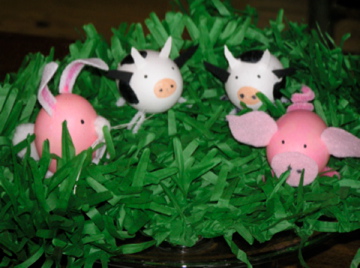
Sadly, I do not have a photograph of Emma wearing her pretty party dress because I got a late start on cooking, what with decorating Easter eggs to resemble farm animals…

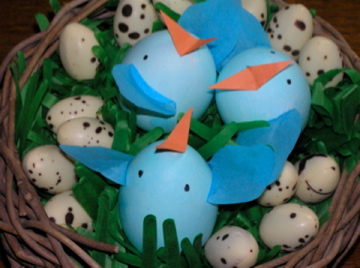
and birds…

bird's nest

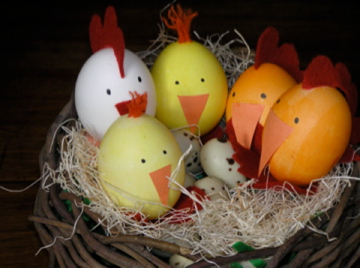
of all types…

There were chocolate eggs that needed to be hidden for the Easter “Egg” hunt, thankfully Richard did a superb job with that and came up with some very creative places to hide them, including inside one of our speakers, where they will remain lodged forever.  We invited 13 people over due to arrive at 5:00PM  and I was way behind schedule, hadn’t prepared the roasted vegetables, fixed the leg of lamb, prepared the biscuits, the appetizers or the berries and whipped cream and it was already 3:00PM. (Gulp!)

Emma donned her pretty party dress and whirled about while listening to a medley of her current favorites, MIchael Jackson, Dionne Warwick, The BeeGees and Led Zeppelin.  You have to hand it to her, the kid has a wide and varied taste in music!

Emma had been looking forward to our “Easter Party” for weeks.  We had gone over the list of people countless times.  She fixated on a few of those people, talking about them over and over again.  We did a countdown of how many hours until they would arrive.  And then when the first person arrived Emma squealed in delight and raced to the door.  When cousin Alexandra arrived, Emma could barely look at her, she was so overwhelmed.  The same happened when Jackie appeared.  It was as though it were all too much.  The very sight of these much anticipated arrivals was more than she could take.  “Max is coming!” she said over and over again.  Max had called ahead to inform us that he would be late.
“Yes.  Max will be here in another 20 minutes or so,” we answered.

“Max is late,”  Emma stated, nodding her head and looking sad.

“But he’ll be here soon,” we reassured her.

When Max finally arrived, Emma put her hand in front of her eyes, as though he were as bright as the sun and the glare was too much for her.  Meanwhile I was busy getting the leg of lamb out of the oven and serving everyone a cheddar-chive biscuit.  “Where’s Em?” I asked Richard at one point.

“She’s hiding,” he said.

I found Emma crouched behind the couch, her head down, almost touching the floor.  “Emmy, what are you doing?”  I asked.  When she didn’t respond I said, “Come sit with us at the table.”  Reluctantly she sat down, next to Jackie and across from Max.  She kept her head and eyes lowered and wouldn’t look at either of them.

After an hour or so, Emma was able to raise her head and began playing various games with Max.  By the end of the evening she was beside herself with excitement, fully engaged and talkative.  She said good bye to each guest as they departed, and when Max left she walked him to the door and said, “Bye Max!”  and then she blew him kisses.

For more on Emma’s journey, go to:   Emma’s Hope Book


Sleepovers, Siblings and Autism

I have to begin by pointing out our redesigned, upgraded and improved site!  (If you could see me I look like Carol Merrill in front of door #1 on Let’s Make a Deal.  I’m waving my arm up and down, pausing at all the new, awesome features, while smiling invitingly.  Okay, totally dating myself on that one.)

A few months ago my cousin, Peter and his wife invited Emma’s older brother, Nic to come to their home for a “sleepover.”  On the designated and much anticipated afternoon, Nic and I took the subway uptown to their home.  I got Nic settled and discussed when we should come to retrieve him.   It was decided that we would all come the following morning for a breakfast of pancakes and then be on our way.  (My cousin is actually close to my mother’s age, yet I feel particularly close to him and his wife.)

When I returned home Emma had just returned from a full day of activities.  We had told Emma that Nic would be spending the night with “cousin Peter and Susan” several days before and she seemed to take it all in stride.  The next morning as planned we went to pick up Nic, ate a lovely breakfast that Susan had prepared for us, and left, thanking them profusely.

Yesterday, now at least a month later if not more, Emma announced, “Go sleep over at Susan and Peter’s house.”

Thinking she meant that she wanted Nic to go there again and that she had so enjoyed our night with Richard and me all to herself, I said, “Oh!  You want Nicky to go back to Peter and Susan’s house?”

“Yeah!”  she said, nodding her head vigorously.  Then she came closer to me and said, “Go with Nicky?”

“You want to go with Nicky to Peter and Susan’s house?”

“No.  Just Emma.”

Confused, I said, “You want to go to Peter and Susan’s by yourself?”

“Yes.”  She looked at me expectantly.  “Spend the night at Susan and Peter’s!  Nicky stay home.”

It was one of those moments when you feel overjoyed, but also filled with sadness.  How could I tell her this was unlikely to happen?  How could I explain that Peter and Susan might not invite her?  How could I explain that this was not something I could ask them to do?  As my mind whirled around trying to figure out how to respond, Emma began to cry.

“Go to Peter and Susan’s house.  Sleep at Susan and Peter’s house.  Tonight.”

The longer I remained silent the more she upped the ante.  I glanced over at Richard with a look of desperation.  A look that said – how are we going to deal with this?

Richard explained that tonight we were going to have dinner and then go up on the roof.  We brought out a calendar and ticked off the upcoming activities we had planned.  We tried to explain to her that we couldn’t invite ourselves over to people’s homes.  (This was way to complicated and too much information.)  And the whole time I kept thinking how do we explain?  How do we say this simply?  As she became more fixated on the idea, she began repeating it over and over again in between tears.  Everything we said, “Not tonight, Em.”  or “Maybe over the summer,”  did little to satisfy her.

Eventually I brushed her and did joint compressions.  She seemed calmed by this and we talked about pressure and how she prefers firm long strokes, not light strokes.  We both did some breathing exercises together and the fixation on going to her cousin’s house seemed to dissipate.  Later Richard put on music for her and we danced.

After I had put Emma to bed and read stories to her, I said to Richard, “You know there’s a really positive side to this.  She’s showing her desire for independence.  It’s pretty amazing.”  We discussed how this represented so many terrific leaps forward for Emma.  She is eager for more independence, is cognizant of Nic having sleepovers, and wants to have that experience too.

It’s all good.  (Where did that expression originate, by the way?!)  But it is.  It’s all good.

For more on Emma’s journey through a childhood of autism, go to:   Emma’s Hope Book

For my latest Huffington Post:  HuffPo