Tag Archives: Parenting

Oddities, Quirks and Other Family Traits I’ve Come to Recognize

Let’s just say, for the sake of this post, that we all agree genetics play a role in autism.  (I know – many do not believe this, but let’s pretend we all do because otherwise this post will go off onto so many different tangents I may never get back to what I really want to talk about – inherited traits – and it will require a time commitment many of you may not have or want to give.  So let’s just pretend we agree.  Ten minutes, then you can go back to believing whatever it is you believe, which by the way, this post is not a criticism of, oh God, you see?  I’m already getting side tracked.  Suffice it to say, what used to strike me as alien about Emma, is, I now believe, a version of the genes that have been passed down to her.)  And that, as you’ve undoubtedly noticed, is one of the longest parenthetical sentences ever written.

I am going to keep this personal because I don’t have permission to review my parents various genetic traits, nor my husband’s, though I’m guessing he’d give me permission had I thought to ask before leaving for my studio this morning, but I didn’t and it’s too early to call my mother.  So this is going to be about things I’ve learned and see in myself that I identify with Em.  And by the way, this preface of over 300 words, is a perfect starting point because  I do not think in a linear fashion.  This is actually something I’ve been accused of, not in a oh-you’re-so-wonderfully-creative-in-your-weird-thinking kind of way, but more in a what-the-hell-is-wrong-with-you? way.  For more on non-linear thinking and autism, there’s a wonderful discussion on the blog Wrong Planet.

Sensory issues –  None of mine cause me tremendous pain as so many of Emma’s do, but I do have some.  One benign example is my auditory issues.  For a long time I thought I had a hearing problem because there are certain sounds I do not notice.  If someone calls out to me, but is standing out of my range of vision, I cannot hear them, much to the amusement of both Richard and my son Nic.  Until I get a visual and am able to see them both doubled over in laughter because they’ve been shouting my name for the past ten minutes while I, oblivious, continue to do whatever it is I’m doing, I have no idea anything is amiss.  My husband uses a ring tone on his cell phone which I cannot hear.  Suddenly he’ll start rummaging around looking for his phone and I’ll ask, “What are you doing?”

“My phone’s ringing,” he’ll reply, while I strain to hear his phone, only to hear silence.

I have a friend whose voice I cannot hear.  I literally have to put my head about three inches from his mouth in order to hear anything he’s saying.  I’ve had my hearing checked.  My hearing is all within what’s considered the “normal” range.

I have spoken before of my literalness.  There are certain jokes I just do not understand.  That in and of itself has become something of a joke in my family.  There’s a group of bloggers who participate in an ongoing “Special Needs Ryan Gosling” joke where they take a picture of the movie actor and then write something – like “Hey Girl, how about I deal with Joey’s sensory induced meltdown while you grab that bottle of wine I just opened for you.”  (I just made that up, but am not sure that would actually be a good one, because I don’t really get the joke to begin with.)  Not to be a total kill-joy here, but it’s not a joke I’m capable of understanding and I have to admit, I really wish I did, because all the other bloggers are having so much fun with it and I admit, I feel left out.  Reminds me of how I used to feel in high school.  Laughing along, but not really understanding what was funny.  Though I knew enough to not let on that I didn’t get it.  And I really do have a good sense of humor.  Really.  I do.  No.  Seriously.

For more than two decades of my adult life, I engaged in self injurious behavior.  My self injury was in the form of an eating disorder and in dermatillomania, also known as face picking.

I am obsessive and though I do not have OCD, (Obsessive Compulsive Disorder) I can be extremely obsessive and compulsive around a wide variety of things.  When I find something that interests me, often design related or subject matter, like autism, I become obsessive and will study and work for hours without realizing how much time has passed.  Jewelry design is like that for me and it helps that I have been able to disguise my obsession with it by turning it into a business.

In the past I have used words like alien and other in describing Emma.  But I haven’t found that thinking helpful.  As long as I see her as so very different from me, I abandon my instincts, my maternal knowing, my own quirks and feel almost constantly confused by so many of her actions.  When confused I rely on others who do not and cannot know my daughter as well as I do, to tell me what I actually already know.  Which isn’t to say that any and all advice isn’t helpful or is to be rejected, but more that I need to remind myself, Emma is actually a great deal like me in many, many ways and I need to trust myself more in knowing how best to help her by tapping into my own traits, obsessions and sensory issues.

I could go on and on about all of this, but the point I’m trying to make is that the alien analogy, rather than helping me help my daughter, has actually served to distance me from her.  When I am able to identify and tap into my own oddities I am better able to come up with strategies and ways to help her whether that is in her reading and writing or helping her tolerate frustrations or teaching her life skills.

What do you think?

Latest piece My Fear Toolkit published in the Huffington Post
“You Have To See The Horror, But Not Be Defeated By It.”

Yesterday I had lunch with the inspirational and brilliant James Cone, also known as the “father” of black theology, and a professor at Union Theological Seminary. For those of you who aren’t familiar with James and his work, he is the man who wrote the powerful book, The Cross and the Lynching Tree.  Sometimes in life you meet people, people who are special, for whatever reason, they reach us in ways that most people do not.  James is one of those people in my life.

Over lunch, as we got on the topic of various movements:  the civil rights movement, the disabilities movement, the LGBT (Lesbian, Gay, Bisexual, Transgender) movement, he said, “You cannot let your circumstances define you, who you are, your race, your gender or what others say about you.”  And I thought about Emma and how autism is perceived by many as a tragedy.  I thought about how I don’t ever want her to define herself by the way some may see her.  I thought about how that perception does damage to so many, how the way we perceive people is how we justify our treatment of them, how we treat them differently without even realizing it.  I thought about how I want to protect Emma from that.

I thought about the neurodiversity movement and how so many Autists are speaking out, asking for acceptance, asking for respect, asking to just be heard.  I thought about all those Autists who cannot speak, who are non-verbal and cannot communicate their thoughts, ideas and opinions at all.  I thought of those who are called “severely Autistic” and I thought of those who are, at this moment, in institutions or group homes run by people who may not understand them.  People who will use their ideas and perceptions of who they think they are to treat them in ways that will hurt them.  Who fights for them?  Who ensures their rights are respected and considered?   As I thought about all of this, I felt myself falling into despair.  And then James reached over and took my hand.  He said, “You have to see the horror, but not be defeated by it.”

I thought about all the stories I’ve read of Autistics who have been abused, often by their own family members, caregivers, or in homes where they were placed.  The people who cannot fight back because they do not have words.  The people who cannot fight back because even by communicating through other devices they are viewed as less than and so their words are disregarded.  I thought of those who have risen up and despite their challenges are blogging about their experiences.  I thought of the unimaginable horrors they have endured.  “You have to see the horror, but not be defeated by it.”

Those people have lived the horror, the rest of us are only witnesses to and only if we choose to be.  And that is a critical and striking difference.  We have a choice.  We can turn away if we choose.  We do not have to read their stories.  We do not have their memories etched into our brains, their experiences scarring our bodies.  We will not get triggered by those who behave in similar ways to the perpetrators of their abuse.  “You have to see the horror, but not be defeated by it.”

One blog I read not long ago, described in graphic, terrifying detail the abuse she was subjected to at the hands of her stepfather, mother, siblings and cousins.  As I read her post, I thought, this isn’t abuse, this is torture.   I felt nauseous reading her blog.   When I wanted to click the little red button on the top left corner of the page to delete it forever, I had to remind myself that this is her life, the least I could do was read what she’d written.  How do you take what you’ve read and continue living your life as you had been, before you knew what you now know?

“You have to see the horror, but not be defeated by it.”

And I know.  I know I have to keep writing about all of this.  I have to keep reading the stories, they aren’t going to disappear just because I’ve made the choice not to read them.

“Strive toward an ideal,” James said at one point.  He paused and then he said, “Write where the hurt is most.”

And so I will.  I will try.  It’s the least I can do.

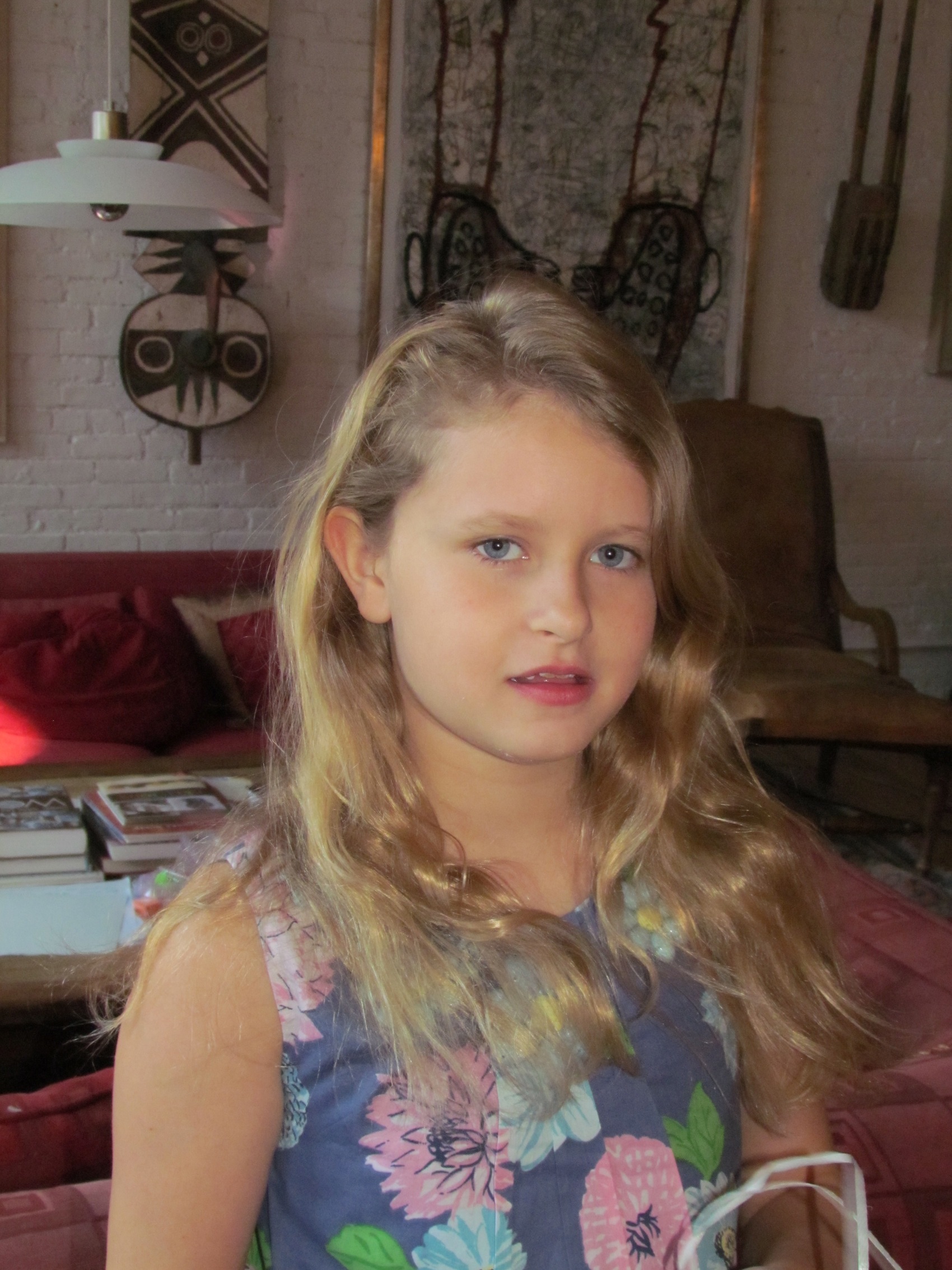
Emma in one of her “pretty summer dresses.”

Read My Fear Toolkit published in the Huffington Post
“Come Dance With Me!”

Those were Emma’s exact words.  She beckoned to me, then to her brother, Nic and then to her dad.  “Come on.  Come dance with me!”

This sort of utterance is something we have waited for, helped Emma with, hoping that one day, some day she would say something like – “Come dance with me.”   For those of you who know all about the issues of pronoun reversal, the difficulties in initiating and maintaining interactions, the challenges of expressive language and the importance of Emma’s words, skip down to the last paragraph, but for the rest of you, stay with me as I try to explain.

A defining characteristic of autism is pronoun “confusion/reversal.”  I have problems with the “confusion” assertion, as it seems pretty clear to me that when Emma says “Do you want pancakes?” she knows I don’t want pancakes, but is expressing her desire to have pancakes.  Either these are the words she would like me to say to her or these are the words she can locate to express her desire to have pancakes.  I don’t think Emma is “confused” about who loves pancakes.  I don’t for a second believe that when she asks such a question it is her intention to invite me to eat pancakes, while she foregoes eating them herself.  So no, I think that part of the whole “confusion” piece is actually incorrect.  However, I do think the idea that when speaking English, she is “me” when referring to herself and I am “you” when she is speaking, but that that is reversed when the other person speaks, is confusing.  And if you aren’t confused yet, try explaining all of that to someone whose first language isn’t a spoken language.  And after you’ve tackled that, move on to possessive pronouns.   Good luck to you, good luck.

One of my favorite quotes from someone I know who is Autistic is:  “My first language is written, my second is music, my third is math and a distant fourth is spoken.”  It perfectly describes that person’s loves, challenges and neurology.

Emma voiced her desire to have us dance with her, not simply asked that we watch her perform (something she also loves to do) but wanted to dance together, is also worth mentioning.   All of us love to dance.  When I was single and in my twenties, I used to go to Studio 54 with my girlfriends.  Our preferred night was Sunday as it was designated “gay night” with the best music and we knew we could dance all night without worrying about guys hitting on us.   Let’s just say –  the apple doesn’t fall far from the tree.  Still, dancing by yourself is one thing, it’s quite another to invite a group to join you.  For Emma, it was even more significant as parallel play is the norm for her, though recently we’ve seen an increase in her desire for interaction and playing games.  Interacting requires much more expressive language and an ability to tolerate a lessening of control over any given situation.

So last night we danced.  First to Gwen Stefani, then Michael Jackson, back to Gwen Stefani and Emma, ever the dancing DJ, even threw in some Lady Gaga.  It was a great night.

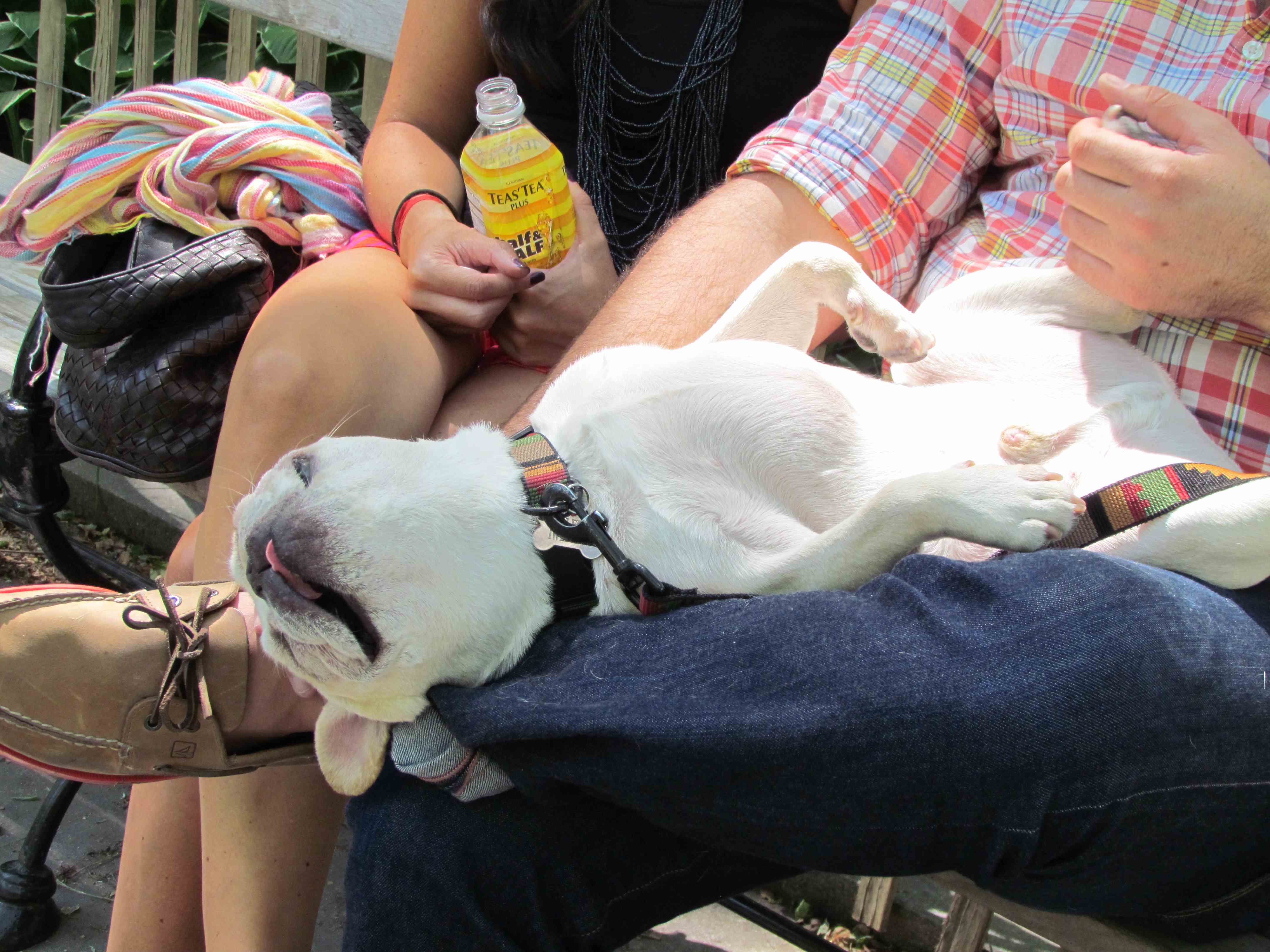
*I have been trying to figure out a way to work into this post the photograph below.  No opportunity presented itself, so I’m just going to post it, completely off topic, but it was too good to pass up.  Emma is terrified of dogs.  Even this dog.  He was adorable.  “Emma don’t you want to pet him?  Look how cute he is.  Don’t you think he’s cute?”

“No.”

But he really was cute, don’t you think?

Read My Fear Toolkit published in the Huffington Post
“Umbrella, Umbrella, Raincoat!”

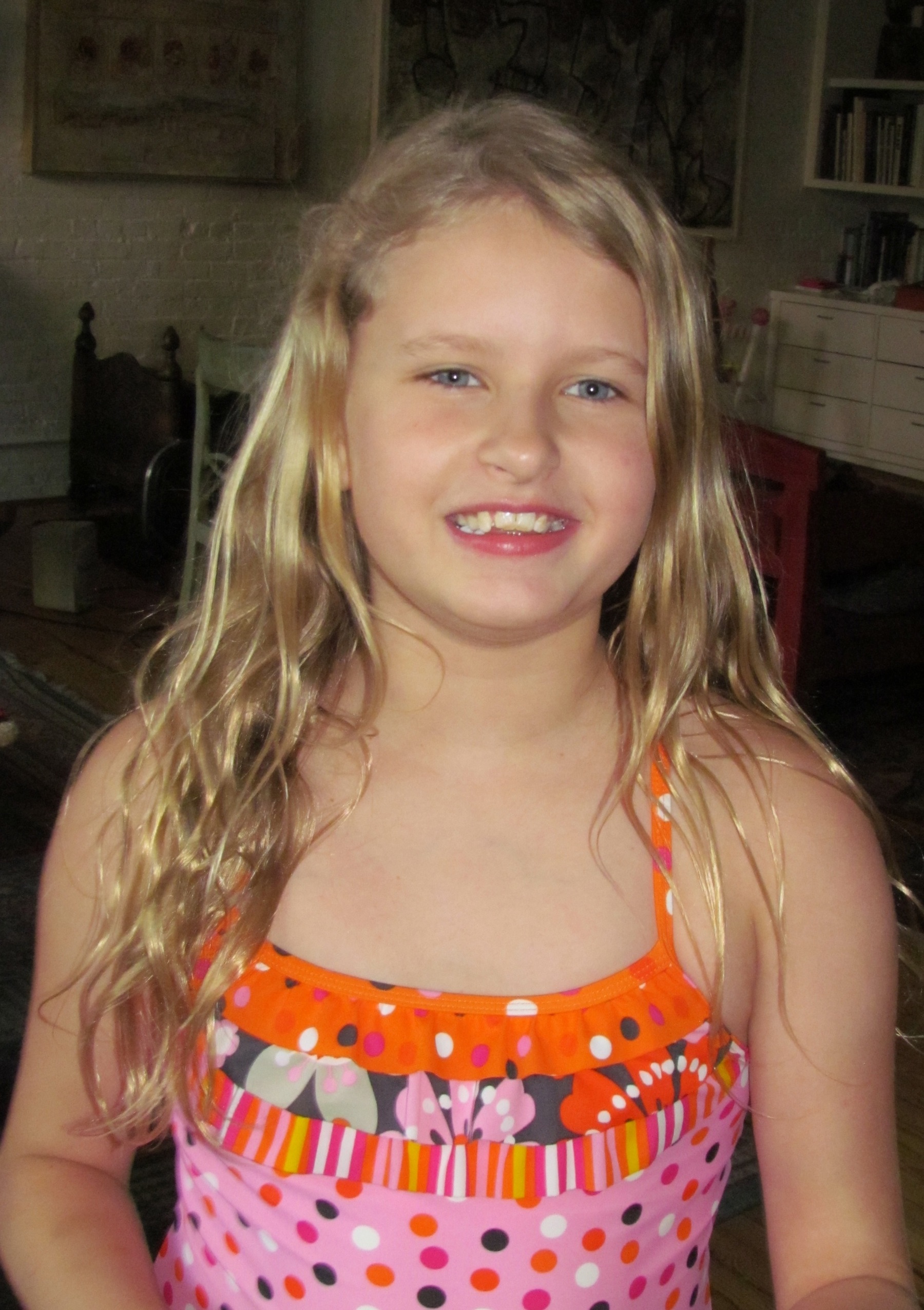
Yesterday Emma, wearing one of her eight bathing suits, (Emma goes through bathing suits the way runners go through running shoes) requested that we play a game of “Duck, Duck, Goose.”
“Mommy!  I want to play duck, duck, goose, please!”  Without waiting for an answer she ran to find her brother.  “Nicky, I want to play duck, duck, goose with Nicky please!”  Again she shot out of the room to find her dad.  I could hear her muttering under her breath, “Haveta, gotta find Daddy.  Gotta ask Daddy!”  There was a moment of silence as I imagined she located her father and stood in front of him.  I heard her  say, “Daddy!  I want to play duck, duck, goose please!”

For most parents this sort of request from their child is commonplace, however, with Emma it is far from the norm.   In the past year she has increasingly asked us to engage with her, usually in the form of a chase game, hide and go seek or other activity involving lots of running and ending with tickling and loud utterances of “You better run!  I’m going to get you!”  followed by maniacal laughter – Woooohahahahahaha – done in a creepy, deep sounding voice.  These sorts of activities necessitate a lot of lung power and is how I justify not having a gym membership in an area of the city that is purported to have more gyms than any other.  I know it’s a stretch, but allow me to cling to my lame reasoning.

Within minutes Emma had managed to pry her brother away from his favorite TV show, Chopped, me from my emails, Richard from his book and gathered us together on the floor where we sat in a circle as Emma stood over us and began.  “Umbrella.  Umbrella.  Umbrella,” she said as she pushed down on each of our heads.  She even pretended there were more of us than there actually were and mimed patting at least three more heads of imaginary people seated in our circle with us.  “Raincoat!” she shouted after a third orbit around us and pushing on my head.

The whole, shouting out “Goose!” while patting the chosen person on the head then running as they manage to upright themselves from a cross-legged position and chase her, is the one part of the game Emma hasn’t quite gotten down.  However, it must be said, she is at an advantage as both Richard and I are in our golden years aka members of  AARP and careening rapidly into senior citizen status and so bounding from sitting position to standing takes us a tad bit longer than it once did.  Still, Emma is easily caught, but other than this small adjustment to the game, she gets it and loves it.

I’d like to point out her creative amendment to the game in using variations on the duck, duck, goose theme.  I loved “Umbrella, umbrella, raincoat,” which is a variation on her other favorite, “Carousel, carousel, horsey!”

What an awesome kid!

To read my latest piece, Emma’s New Shoes, in the Huffington Post, click ‘here

And if you haven’t already done so, do vote for Emma’s Hope Book by clicking this ‘link‘ and clicking on the “like” button opposite Emma’s Hope Book.

Parenting and The Depiction of Autism in the Media

We are inundated with disturbing imagery regarding autism in the media.  Perhaps one of the most famous is a video Autism Speaks made.  It is a video montage with a number of parents speaking of their distress and the difficulties they face while raising an autistic child.  Their children are almost always present as the parents speak.  The camera cuts to these same children in full meltdown, stimming or sitting alone in a playground in stark contrast to their neurotypical peers who are running around shouting and laughing, while playing with one another.  At one point a parent discusses how, for a brief moment she allowed herself the fantasy of driving off the George Washington Bridge with her autistic child.

The video is disturbing on many, many levels.  I’m sure it was successful in raising a great deal of money.  However, as someone who once viewed images such as these through the lens of ignorance and as a result was paralyzed with the fear these images induced, I am aware of the underlying emotional manipulation that is so obviously being employed.   It is propaganda, whether intentional or not, biased, deeply prejudiced and intended to create fear.  And it is doing tremendous damage to Autists.  These types of imagery perpetuate the marginalization and unfortunate stereotyping of people on the spectrum.  In using the images of Autistic children it negates and ignores the effect these depictions have on those same children in ten or fifteen years from now, when they grow up to be autistic adults.  Sadly it is not just Autism Speaks who is engaged in this kind of negativity and bias.  News programs routinely air shows about “savants” who are seen as fascinating curiosities or programs about the tragedy and horrors of autism, citing statistics and the growing numbers, with shrinking resources etc.  How did we get here?  What happened to ethics in journalism?  What happened to the idea that journalists have a moral responsibility?

For those who do not have an autistic person in their life or have never met one, these images are the only things you have to base your perceptions on.  Just as when I was first told Emma was autistic, my mind grabbed onto the image of Dustin Hoffman rocking back and forth while muttering in his role as Raymond Babbitt in the movie Rainman.  Raymond Babbitt and Emma are as dissimilar to each other as I am to Raymond Babbitt.  But at the time of Emma’s diagnosis I knew of no other autistic person, so this was who I immediately thought of and then felt confused as to how my daughter could possibly be autistic.  Many years later, when I met Temple Grandin at a lecture she gave, I again found myself looking for similarities.  There were very few.

Over the years there have been countless news programs showing autistic children, teens and adults and while some of the people depicted share one or two behavioral similarities to Emma, I have yet to see any, where I think – Oh, that’s what Emma will certainly be like in 15 or 20 years.  Comparing Emma to adults on the spectrum is something I have been doing for years without realizing it. This is not something I do with my son Nic.  In fact it never occurs to me to compare him to adults.  I know and trust that Nic will continue to mature and grow up to be the responsible, kind, thoughtful, intelligent human being that he is already showing himself to be.  Why do I not do this with my daughter?   Clearly this is where my work lies.  It’s a double standard that I hold, one for my neurotypical son and another for my autistic daughter.  Here is where using the word neuromajority really is appropriate and more accurate.  Nic is in the neuromajority and therefore I understand and assume things about his future that I cannot know any more than I can predict my daughter’s.  But because he is in the neuromajority I am able to lull myself into a calm state of thinking that I know, or feel that the chances are at least better than good that he will grow to be the person I can see him becoming now.

With Emma, her future, in my mind, remains a giant question mark and so I can fall easily into fearful thinking.  The one thing, the single most important thing that is making an enormous difference in my thinking regarding my daughter, is communicating with Autistic adults.  There are a number of them that I particularly like and admire, that I reach out to and who are kind enough to take the time out of their busy lives to communicate with me.  I do not assume Emma will grow up to be just like any one of them, but in communicating with them I am given tremendous hope because unlike the media coverage of autism and autistic people, they do not live their lives from one dramatic sound bite to another.  They are complicated, interesting, intelligent people working, studying and living their lives.

As a result the frightening portrayals the media seems so enamored with are softened, I am able to be logical in my thinking when confronted with those images and now even choose to avoid those programs.  I do not need these depictions to compete with the very real autistic person in my life who struggles, yes, but who also progresses, who is funny and happy, smart and kind and loving, sensitive and unique, who will continue to grow and mature to become a young woman with all of those qualities and more.   If there is one thing I can cite, which has changed how I think more than anything else, it is in being in contact with these kind strangers who are autistic.  I’ve written about this before, and I will continue to write about this, because it is the thing that has changed everything that I believe and has opened my mind to the very real infinite possibilities that exist and has given me hope.  I fall easily into fearful thinking, but I was capable of that long before my autistic daughter came into my life.

Frustration, Self Injurious Behavior & Autism

To all who reached out yesterday – Thank you.  The feeling of  being overwhelmed that I was experiencing, receded and by the afternoon I was feeling back to my old energetic self.  Amazing how something so simple as admitting out loud how you’re feeling can elicit such an outpouring of support which in turn can transform all those feelings into something positive.  It made me think about how we – those of us who are caregivers and autistics should have a place where we could go to get support, ask questions, a place where we could come together as a community and just be, with no leaders or hierarchy, just a place anyone who wanted or needed could gather and reach out to like minded people.   If such a place exists, please let me know.

Hunter College, here in New York City, is hosting the 12th Annual International Conference in Disability Studies in Education, May 25th – 27th and I will be attending one of the presentations – Autistic and Female:  They say That’s Rare, and so many other things – with Elizabeth J. Grace.  I am very excited!

The program looks fascinating and if I could, I would have liked to have attended the entire conference.  Who knows, perhaps next year I will be able to.

On a separate note, Emma became frustrated yesterday while at school and bit herself.  This has been an ongoing issue, one that began when she was at her special-ed ABA based preschool when she was just three.  A boy bit her, on three different occasions, causing the skin to break and each time this happened we would get a call from the school telling us that this same child had bitten her, that they were doing everything they could to monitor him, but that while it obviously hurt her, no real harm had been done.  Not long after that, Emma began biting herself.

It is horrifying to witness your small child, in such obvious pain, attempting to manage their upset by harming themselves.  Emma bites her arm or hand or in extreme cases will punch herself hard in the face.  We have used a variety of techniques hoping to stop the behavior, but so far none have worked, though she does not bite herself as much as she once did and rarely punches herself in the face any more.

A few weeks ago I reached out to a couple of Autists I know asking for their suggestions and one had some great ideas about things that might help, such as chewy tubes, which we have bags of and had all but forgotten, and having a favorite stuffed animal with her. I decided to ask Emma whether she would like to have a stuffed animal to take with her to school, and while she declined, she did say she wanted to have two chewy tubes in her backpack.  We discussed how when she becomes frustrated she can chew on the chewy tube and Emma nodded and shouted, “I’m so frustrated!” then grabbed the chewy tube I was holding and jammed it into her mouth, gnawing at it furiously.  I took her response as a positive sign.

I don’t know if anyone at her school remembered to remind her about her chewy tubes or if in the heat of the moment they were forgotten, but we will continue to remind Emma that the chewy tubes are with her and she can bite them instead of herself.

Telling her, “We do not bite!”  or “You may not hurt yourself!” while well meaning and said with good intentions has NOT proven remotely helpful.

To read my latest piece, Emma’s New Shoes, in the Huffington Post, click ‘here

And if you haven’t already done so, do vote for Emma’s Hope Book by clicking this ‘link‘ and clicking on the “like” button opposite Emma’s Hope Book.

Overwhelmed

Overwhelmed.  That’s how I’m feeling at the moment, with no real right to be.  Nothing has happened, Emma continues to make nice strides, yet even as I say that, a little voice is muttering, “Really?  Is she really making strides or are you just grasping at straws to make yourself feel better?”

Sometimes I just want to rant and whine and complain, yet as I write this, I know that’s not really what I want.  Okay, maybe a little. But it’s more the feeling of wanting to turn the volume down in my head.  If they had a worry lobotomy I think I’d sign up.  Or maybe that’s what a lobotomy is.  I just don’t want all that other nasty stuff that comes with a full lobotomy, just take the worries away, thank you very much.  What I really want is to not feel this way.

When Emma was diagnosed and still two-years old I remember after a long training session in which Richard and I were supposed to continue with her ABA program after the seventh or eighth therapist left our home for the evening, I thought – I don’t want to be my daughter’s therapist.  I want to be her mother.  Being her mother doesn’t seem to rate high on the importance scale of most of these methodologies.  A few years later when Richard and I went down to Bethesda and trained with the late Stanley Greenspan in his DIR/floortime, I felt the same way.  After Stanley advised us that we should each be doing seven or eight 20 minute floortime sessions with her a day, I thought – I don’t want to run interference, constantly launching questions at her to encourage language like rounds fired from a .44 magnum.  (Yeah, I just googled that, because I’m completely insane AND a stickler for accuracy in the similes I use.)

The point is – if I’m being perfectly honest – I’m feeling a little lazy at the moment.  But laziness with an autistic child is really not something I can afford to be.  I mean her life is hanging in the balance while I’m whinging about how I don’t want to take the time to map out her next study session.  (Don’t you love it when people use words such as “if I’m being perfectly honest,” and “frankly” and “truthfully” or my personal favorite, “if truth be told” ?  To preface a comment with “Truthfully” implies that one is NOT usually truthful, which, for some reason, strikes me as hysterically funny.  Okay.  I’ve had my moment..)

I know that feeling of overwhelm is like fear, or worry or any number of other emotions that do nothing positive, in fact serve only to keep me deeply embedded in the stagnating cycle of fear and worry, like air that’s being recycled through a dirty filter.  (Stop with the similes!  This should be said in a high pitched Monty Pythonish voice.  But I can’t help myself!)  I know the only way to break out of this is to do the thing I keep putting off doing.

Just do it.

I know.  I know.

I think I’ll go make a list.

It will be a very long list.

I hate long lists.

Ugh.

To read my latest piece, Emma’s New Shoes, in the Huffington Post, click ‘here

And if you haven’t already done so, do vote for Emma’s Hope Book by clicking this ‘link‘ and clicking on the “like” button opposite Emma’s Hope Book.

A Story About The Lady at the Zoo

Emma was confounded yesterday when she was told by one of the Central Park Zoo employees that she could not sit on the railing to watch the sea lions being fed.  She was very upset and wanted to go home.  However, instead of biting herself or doing herself injury, she came up with the following story, which is yet another example of her delightful temperament, personality and a wonderful display of the progress she is making in being able to turn something upsetting into a story that was both poignant and very funny.

Before we got on the subway, Emma verbally preseverated in her attempt to work through what had happened.  “Mommy says no.  Mommy go home, Emma stay at the zoo with just Daddy.”   Emma reasoned immediately after leaving the zoo.

“But Em.  This isn’t about Mommy or Daddy, this is about the zoo employees.  This is their rule now.  They won’t let anyone sit on the railing any more.  It’s a new rule,” We told her.

“I want to sit on the railing!”  Emma wailed over and over again as we made our way to the subway.  “You have to ask Daddy!  Daddy! I want to sit on the railing please!”

“Emmy, this isn’t up to me.  This is a rule that the zoo has.  You can’t sit on the railing.”

“But I want to sit on the railing!”  Emma cried.  Then Emma flung both arms around me and buried her head into my side.  “I know, I know.  You’re so upset,” Emma said, mimicking words I often say to her.

“Oh, Em.  I know you’re sad.  I know how hard this is for you.  But I’m also really proud of you for the way you’re handling this and talking about it.”

When her beloved R train arrived Emma secured seats for us by the window and then told the following story.

“The lady said, You have to get off the railing!  You have to get down!  Yeah,” Emma nodded her head and frowned.  Then she said,  while stomping her foot on the floor of the subway, “The lady stomped her food and said, You.  Stomp.  Have.  Stomp.  To.  Stomp. Get.  Stomp.  Down!  Stomp.  You get down right now!  Then the lady said, I’m going to get you!  I’m going to tickle you!”  Emma demonstrated being tickled.  She stomped her foot and continued.  “Yeah.  The lady is going to tickle you.  Then the lady had to go home.  She hurt her back.  Bye!  Bye, bye lady.  Lady gotta go home!  Bye!”  Emma waved her hand, like a Queen waving to her adoring subjects.  “The lady had to go.”  Emma nodded her head and feigned looking sad.  “The lady went home and Emma got up on the railing to watch the seal show!  She had to go home because she hurt her back and she has to put on a bandaid.  Now it’ll feel better.”  Emma finished and looking triumphant said, “Emma got to sit on the railing!”

“Wow, Em.  I love that story!”  I said.  “How did the lady hurt her back?”

“She tickled you!”  Emma said and then collapsed into giggles.

Earlier in the day, playing on the High Line

To read my latest piece, Emma’s New Shoes, in the Huffington Post, click ‘here

And if you haven’t already done so, do vote for Emma’s Hope Book by clicking this ‘link‘ and clicking on the “like” button opposite Emma’s Hope Book.

A Fantasy for Parents of Newly Diagnosed Autistic Children

I wrote about some of these ideas before in the Fantasy For Autists post a couple of weeks ago.  This is a follow up post, a fantasy for parents of newly diagnosed autistic children.

When Emma was first diagnosed I felt fear more than any other emotion.  It was overwhelming and crushing.  The word “autism” carried with it a weighty sense of doom.  People have described it as akin to receiving a “life sentence,” it was a word I knew almost nothing about, and what I did know wasn’t good. “We don’t know what causes it,” “There is no cure” were the words we were told many, many times by the various specialists we went to, seeking help for our beautiful, happy, fiercely independent daughter.  Those words were said matter-of-factly, but the grim set of the lips by those who spoke those words belied the truth, it seemed.  Some specialists would follow those words with a sad shake of their head, often done while uttering, “I’m sorry”  as they ushered us out of their office.  The doctor’s appointment now over, we were left standing alone, confused, terrified and overwhelmed by what we could not understand, by what could not be explained, by what seemed like a dark cloud enveloping every aspect of our lives.

Then there were the depictions in the media of the devastated families struggling to make ends meet, the scary images of the perseverative, stimming children in full meltdown, family members run ragged, siblings, silent and resentful, spouses angry and argumentative, and the autistic child, always somewhere in the background, seemingly oblivious to all the chaos they supposedly had created within, what would otherwise have been, the perfect American family, had they not been born.  While this may help with fund raising by preying on people’s fears and pity for those less fortunate than themselves, it is these depictions that the newly diagnosed child and her family will see.

Can we take a moment and consider how these depictions make the newly diagnosed child feel?  What message is being sent?  This child that everyone is so sure isn’t picking up on any of this, but perhaps is.  What if that child understands a great deal, even at the young age of a year and a half ?  What if that child is extremely intelligent and feels the overwhelming sadness their very existence seems to be causing their family?  What if these feelings are then intensified by the things that are said between family members in front of the child or within hearing distance of the child?  How would this affect the CHILD?  Think if you grew up feeling you were a mistake, damaged and broken?  What if the words that were used about you and to you were said with anger, exasperation and annoyance?  What if instead of being given the help you so desperately needed, you were told that the things that helped you concentrate and focus were wrong?  What if you were told almost everything you did was wrong?  Would that help you do things differently?

These negative images are also what will flash through the minds of the parents as they are given the “dreaded” diagnosis.  Listen to any newscast about autism.  The way the news anchors say the word – “autism” – the voice lowers, there is often a hesitation before the word is spoken.  Look at the statistics, the alarming statistics that cause everyone to feel frightened, because we know so little, so we fall into fear, fear of the unknown, fear of what might be, fear of the future, fear of the present, fear.  Is all of that fear helping any of us?  Does fear help us as parents do a better job parenting our autistic children?  Does the fear give you patience, does it help you when your child is unable to express themselves and so acts out?  Does that fear make any of us behave better, more appropriately?  Does the rampant fear help us sleep at night?  How’s all that fear working out for you?  Does it help?  And if you think it does, I’d love to know, how?

But what if this was not the way families were introduced to autism?  What if instead of sitting with the sympathetic, yet professionally aloof specialist the family was introduced to a group of self appointed adults, all of whom were autistic. What if these adults were verbal and nonverbal, women and men, spanning a wide range of ages?  What if each Autist “spoke,” whether through language or by typing or through a voice activated device?  What if the families were able to ask questions and were allowed to approach these Autists and even were able to have one or two or more assigned to them, the way a social worker is now, during Early Intervention?  What if those Autists were available to the family and their autistic child?  What if these were the people the family could turn to when they had questions, needed help finding resources, schools, methodologies or just wanted to check in with someone who might understand their child better than any pediatrician, psychologist, developmental pediatrician or neurologist could?

What if each Autist was given an opportunity to discuss what it was like for them growing up, the things that helped, the things that didn’t?  What if those Autists discussed how to teach life skills?  What if each family went away from this initial “welcoming” meeting with a folder that included a handbook written by Autists, a list of resources of Autistic doctors, neurologists, pediatricians, Autistic run schools with curriculum approved by Autists and others designed by Autists, and a list of  some of the essential things parents need to know and remember as they help their autistic child live and thrive?   What if, instead of being bombarded with frightening stories of self injurious nonverbal children we were shown videos of nonverbal Autists helping those children learn how to cope?  What if we were shown videos and news programs about all the Autistic adults who are pursuing their passions?   What if there were Autistic lawyers, neurologists, accountants, pediatricians, veterinarians, Occupational Therapists, Speech Therapists, Teachers, Educators, Head Masters, scientists, musicians, singers, performers, painters, writers, that we were all exposed to and knew about?  How would this change how we viewed our own children?  What if we were given the support we needed to help our children reach their potential without sadness, fear and pity?  What if?

My wish for Mother’s Day is that one day this will no longer be a far-fetched fantasy, but will be a reality.

To read my latest piece, Emma’s New Shoes, in the Huffington Post, click ‘here

And if you haven’t already done so, do vote for Emma’s Hope Book by clicking this ‘link‘ and clicking on the “like” button opposite Emma’s Hope Book.

The Gift of a Molar

Like many Autistics, Emma has a multitude of sensory issues.  I’ve written before about Emma’s amazing ability to tolerate certain types of pain, particularly when it comes to her teeth.  The idea that she was suppose to present us with her still bloodied tooth in exchange for money from some unknown and dubious entity called the tooth fairy was a concept Emma found unpersuasive.  Go ‘here‘ for more on Emma’s teeth and our attempts to explain the tooth fairy.

Blisters on her feet are another example of Emma’s high pain level.   As a toddler I remember taking off her shoes, having spent the day running around and playing in various parks, only to see both of her feet had opened blisters rubbed raw so much so that her shoes were stained with her blood.  This was before we had a diagnosis and I can still remember sitting on the carpet in our hallway, her bloodied foot in my hand and thinking, how is this even possible?  Why wouldn’t she have cried?  That the pain must have been intense and unbearable seemed a given.  How she spent the entire day not noticing or worse, noticing, but not saying anything, was something I could not fathom.

Yet it seemed that the opposite was also true.  If Emma’s ears hurt from the changing air pressure, she cannot tolerate the pain and will cry out in agony.   The one thing I know without any doubt, is that my understanding of pain is very different from hers.  What I find mildly irritating can be the source of tremendous pain for Emma and things that would cause me to grumble and grouse to anyone within shouting distance are, for Emma, met with no comment.

This morning at 5:30AM Emma appeared in our bedroom.  She leaned over as I opened my eyes and placed something slightly wet and cold in my hand.  Then she stood upright and beamed at me, waiting expectantly.  “What is it, Em?  What did you give me?” I asked managing to pull myself into a sitting position.

Emma said nothing, she just stood there smiling.  I turned on the light and saw in my hand a shiny metal capped tooth.  “Oh Em!  It’s your molar!”

This was the molar that Emma had to be hospitalized, anesthetized and kept for six hours before she finally regained consciousness to have capped as she could not tolerate having the cavity filled in the conventional way.  This was the tooth that upon waking, Emma cried and tried to pry the metal cap off with her fingers while screaming, “Take it off!  Take it off!”  This was the tooth that whenever she smiled, the light would reflect off of it, a glistening reminder of the pain she had had to endure.

“Pulled it out!”  Emma confirmed, grinning proudly.

I know I shouldn’t have, but I decided to let her stay with us in our bed, even though it was far too early, even though we’ve been working hard at having her go back into her bedroom until it’s 6:30AM, even though by letting her stay with us, I knew I was undoing weeks of work.  But I couldn’t send her away.  She was so proud of herself and I knew that tooth, that tooth I felt a particular aversion for as it represented untold pain for Emma, had been barely loose just a day ago.  How she managed to wrench it from her mouth is something I am unable to truly understand.

I meant to take a photograph of it, but forgot in the rush to get ready this morning.  It sits, next to the other molar she yanked out of her mouth just last week, on my bedside table.  These are the only two teeth Emma’s ever given me.  New York City is littered with Emma’s baby teeth, carelessly tossed wherever she happened to be when she extracted them from her gums.  These two molars are little gifts, just in time for Mother’s Day, that I intend to find a special container for.

To read my latest piece, Emma’s New Shoes, in the Huffington Post, click ‘here

And if you haven’t already done so, do vote for Emma’s Hope Book by clicking this ‘link‘ and clicking on the “like” button opposite Emma’s Hope Book.

Cobra aka Daddy

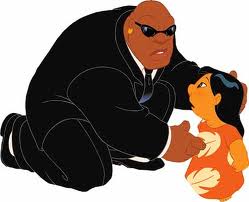
Emma began calling her dad, Cobra a few weeks ago.  When she first said it, as in, “That’s Cobra!” while laughing and pointing to Richard, I had no idea why she was calling her father a venomous snake.  It wasn’t until later when someone said, “Isn’t that the social worker in Lilo and Stitch?”  that the mystery was solved, or at least one part of the mystery.  Why she thinks Richard, in any way, resembles Cobra is something we are still pondering, though I have a couple of thoughts. (As usual..)

Cobra, or Cobra Bubbles, as he is known in the movie Lilo and Stitch is a social worker, though he looks more like he’s in the CIA, with his dark suits and dark glasses, which he wears regardless of whether he’s inside or out and is bald.  He is also African American, is huge and speaks in a baritone booming voice and is in a state of perpetual displeasure, which he expresses with lines like, “And in case you were wondering,” said while looking over his dark glasses, “this meeting. Did. Not. Go. Well.”

Emma loves Lilo and Stitch.  She mimics Lilo’s bratty, high pitched voice and recites whole sections of the movie sometimes to comical effect.  Such as when the upstairs neighbor’s kid was running back and forth early one morning, Emma looked up at our ceiling and said in a perfect imitation of Lilo’s voice, “Aliens are attacking my house!”  It was a hilarious moment.  Emma, being the ham that she is, loved that I was laughing so hard I could barely breathe.  So when Emma pointed to Richard last Sunday on the way to the number 2 train, and said, “That’s Cobra,” then pointed to me and said, “That’s Mommy!” we asked her why Daddy reminded her of Cobra.  She grinned and said, simply, “Cobra,” before weaving her arm through her dad’s and then mine.  The three of us walked that way as Emma spoke in Lilo’s whiny voice, “We’re going to go home now.  Take the number 2 train and then eat dinner.”

By the end of the movie Cobra has become very much the family friend and is no longer threatening to put Lilo in foster care.  On the contrary he is intent on keeping the family together and has become their protector.  Which, my guess is, where the association with her dad lies.  Daddy, the larger than life protector of the family, kind and loving.

Daddy aka Cobra (Bubbles.)

To read my latest piece, Emma’s New Shoes, in the Huffington Post, click ‘here

And if you haven’t already done so, do vote for Emma’s Hope Book by clicking this ‘link‘ and clicking on the “like” button opposite Emma’s Hope Book.

Autism and the Neuromajority

I am wading into murky waters with this post.  I know this, but I’m going to do it anyway…

I really dislike the word “neurotypical.”  It’s one of those words that has always bothered me because, in my opinion, it doesn’t really mean what it’s meant to mean.  Neurotypical is the word coined by many in the neurodiversity movement, (a word I like – neurodiversity – by the way, kind of like biodiversity, there’s no pejorative, underlying meaning) because it does mean what it’s meant to.  But I don’t think neurotypical goes far enough.  I understand that it was created as an upgrade and improvement from the word “normal” (a word which really, really bothers me.)  The word normal being completely subjective and arguably something none of us could really say we are if anyone is being brutally honest.  But neurotypical, while certainly preferable to “normal” just doesn’t do it for me.

Last weekend, Richard and I were talking about autism, and I said, “the neuromajority…”  Richard said, “I like that, neuromajority.  That’s good.”  Yup, these are the kinds of conversations we often have with each other…  He agreed with me that he didn’t like the word neurotypical either.   The word “typical” has a slightly positive spin to it, kind of like a private club.  Having always been unconventional (and proud of it) I’m not a big believer or fan of clubs, never have been.  The word neurotypical is also vague, open to interpretation, completely subjective and ultimately confusing.  I don’t like that.  So I started using the word neuromajority.  It doesn’t roll off the tongue as easily as neurotypical, but at least it is more accurate in that it means what it’s meant to mean.  Neuromajority – It is the neurological state the majority of humans have, neither good nor bad.

Flushed with pride in having come up with such a brilliant new word, a word I felt I alone had coined, it hadn’t occurred to me that others may have already used this word.  Until I began writing this post.  As I was writing, right around the end of the last paragraph, I suddenly thought – I should Google – neuromajority – and see if anything comes up.  There were three instances of neuromajority being used, one of them was a comment left on an interview with Temple Grandin for 60 minutes.  The commenter wrote:  “Like most of the neuro-majority you reached beyond her statement and arrived at the conclusion this means she’s faking her eye contact” and the other was from a blogger with the blog – 1uppitywoman where she writes:  “Asperger’s has complicated life for me only so far as the neuromajority bristles at people like myself because we’re different from them.”  The last was another comment left on the blog AspieWeb.  So I went from feeling pleased with myself for my tiny stroke of brilliance in having come up with a word I prefer to use in describing myself and others like me, to the humility of realizing I had NOT come up with this word all on my own, to indignation that only three sites came up where the word was used.  My thinking is, since it’s been used, then why hasn’t it taken off and been used by a great many?  After all it’s a really good word, isn’t it? (!)

So I’m putting it out there – does anyone else dislike the word “neurotypical?”  Is there a better word we can use?  What does everyone else think?  Or is all of this way too political and therefore weighty and fraught with unseen implications that I’ve missed?

Tomorrow’s post will be about Emma’s new name for her dad.

For my latest piece in the Huffington Post, click ‘here‘.

Sunday in Williamsburg with Emma

After Nic and Emma had their gymnastics lesson Sunday, we dropped Nic off in Williamsburg, taking the “blue A train with yellow and orange seats” much to Emma’s delight, (while disproving my theory that she prefers taking trains with corresponding seat colors) so he could spend the afternoon with a friend of his who lives there.  Richard, Emma and I originally had planned to go to the Metropolitan Museum, followed by a stroll through Central Park before ending up at the zoo, as per Emma’s request.  However it was suggested we walk to the East river and visit the thriving Williamsburg flea market before heading back into the city.

The day was lovely and as I’d never spent any time in Williamsburg I loved this idea and suggested we walk around and explore.  Richard was game and Emma, who really only cared about going to the zoo, was content to go along with this new set of plans as long as we found her some Nestle’s chocolate milk before we began our walk.  It was so warm that all of us shed our jackets within the first few minutes of walking.  Emma had a black fleece, which I helped tie around her waist.  She then shoved the unopened bottle of chocolate milk into the “waist” her fleece created, as though it were a gun being thrust into a holster.  Every now and again she would grab the sleeves of the fleece and tighten it around her belly, ensuring that the chocolate milk remain in position.  I wish I had a photograph, I can’t think now why I didn’t take one, it was such a powerful look and one she was able to carry off effortlessly.

For those unfamiliar with New York City and it’s nearby environs, Williamsburg, once occupied by large industrial companies such as, Pfizer, Domino Sugar and Standard Oil, was also a coveted resort for many of New York’s wealthy elite in the 1800’s.  In the early 1900’s it became home to Hasidic Jews escaping Nazi, Germany and much later to Puerto Ricans lured there by the abundance of factory jobs.  Williamsburg is now going through a gentrification, with hipsters and artists populating the unoccupied enormous factory buildings and loft spaces.  Though many artists have already begun moving east, unable to afford the rising rents in Williamsburg, it still retains a certain “hip” allure with almost everyone under the age of 50 showing off elaborate tattoos and unconventional hairstyles.

By the time Emma, Richard and I reached the East River, Emma enthralled with the notion we would take a water taxi back into Manhattan never once mentioned the zoo.  When I explained to her that we would only have time to wander along the piers before the water taxi arrived and would then have to head home she nodded her head and said, “Go on water taxi, then take number 1 train home!”

“Yes, except we can’t take the number 1 train, we’ll have to take the number 2 train.”

“Take the number 2 train,” Emma confirmed.

Emma was ecstatic when we boarded the water taxi and sat on a seat closest to the window.  “Mommy sit here,” she said, patting the seat directly in front of her.

“No, Em.  I’m going to sit next to you here.”

“Mommy sit here?”  Emma said looking slightly distressed.

I knew she wanted me to sit in front of her because she wanted to suck her thumb without any comment from me.  “It’s okay Em,” I said, before sitting down.

Another family sat directly in front of us, with two small children no older than three.  One of the little girls turned around in her seat to stare at Emma and then mimicked her by jamming her thumb into her mouth, just as Emma was.

When we arrived at South Seaport Emma said, “Go get Nicky.”

“No Em.  Nicky’s friends are going to drive him back into the city later. But we could walk a little bit and take the number 1 train.”

“NO!” Emma cried.  “Take the number 2 train.”

Which is exactly what we did.

“Hey Em.  This was such a great day.  Did you have fun?” I asked as we shot uptown on the number 2 train.

“Yes!  I had so much fun with just Mommy and Daddy!”

For my latest piece in the Huffington Post, click ‘here‘.

“Six and Three and Zero”

We are working with Emma on time.  For the last few weeks she has been waking at 5:30AM.  I’m just grateful she isn’t also waking us at 2:00AM.  It’s all relative.  She has an analog clock in her room and we’ve discussed how she isn’t to wake us until 6:30AM.  Two nights ago she appeared at exactly 6:30AM.  “It says six and three and zero,” Emma announced before claiming her place next to me in our bed.

This morning however she appeared at 5:30AM and when I said, “Hey Em.  It’s too early. Look at the clock. Do you see what it says?” she didn’t answer.  “Look Em.  It says five thirty.”  I sat up and pointed.  “You have to go back to your room.  You can come back when it says six thirty.”

“Six and three and zero,” Emma confirmed.

“That’s right Em.”

Moving very slowly, she wandered back to her room, or more accurately, out of ours.  When Emma reappeared later she said, “Make cereal and toast?”  Then she corrected herself, “Dadddy?  I’d like to make cereal and toast, please.  May I have some cereal and toast?”

After breakfast she ran back to find me.  “Mommy!” she said bouncing up and down.

“Hi Emma.  I’m coming out.  I just had to take a shower.”

“Mommy!  I miss you,” she said, leaning her head into me.

“Oh Emmy!  I miss you too.  Whenever I’m not with you, I miss you!”  I told her.

She beamed at me.  “I miss Mommy.”  Then she pointed at me and said, “Mommy and me,” she pointed to herself, “go into the living room together.”

“Yes.  I’m coming.  Do you want to wait for me?  I’m just getting my shoes on.”

“I’m waiting,” Emma said.

I live for conversations like this.  I take for granted so many things, little quick conversations I have hundreds of times throughout a day, and yet, this one with Emma will carry me through the day like nothing else could or would.

Waiting for her school bus.

For my latest piece in the Huffington Post, click ‘here‘
Anyone can contribute! To be a part of the change, contribute to the Autism Positivity Blog click ‘here‘

The Language of Music

Sunday morning Emma wanted to listen to music and dance.  There was nothing extraordinary about this, except that her ipod wasn’t charged and Richard’s iphone was with him in the back where he was still asleep.  Both of these devices hold Emma’s favorite songs.  However, Emma picked up my iphone, a poor and unfamiliar substitute, but she was in desperate straits and realized this was not the time to be picky.  “Mommy?  Can I listen to Mommy’s iphone please?”  Emma asked.

Fortunately I have a number of Gwen Stefani albums programmed in.  It took no time for Emma to find one she liked, which I’d never heard before, Hella Good.  “You hold me like I should so I’m going to keep on dancing.”  It’s got an electronic sound infused with a great beat, blending rock and funk and makes you want to dance.  Which was exactly what Emma proceeded to do.  When the song began Emma got an intense look in her eyes, a look of concentration and focus.  I knew she knew I was watching because she looked over at me in the middle of a particularly complicated set of twirls with her arms raised high, her new string (I call it her starter string as it has no tape on it at all) she held in her right hand and twirled as the tempo picked up.  Emma went from twirling slowly to adding her head to the swirling movement, as her hand twirled the string, her upper body moved from side to side as she spun around.  The bass line reverberated and Emma suddenly thrust both arms up toward the sky and threw her head down while she spun.


This is how all of us would dance if we could.  Emma’s body, the expression on her face, the way she moves, the string extended out from her hands as though it were part of her.  She raised one arm and twirled, faster, her hair fanned out, her nightgown billowed around her ankles. Emma incorporated the music into her being, it was a part of her, it was her language.  She had taken it and made it her own.
For my latest piece in the Huffington Post, click ‘here
To contribute to the Autism Positivity Blog click ‘here

*A quick aside about Emma’s “string.”  After she covered it in red duct tape, she then covered just one end in purple duct tape and then left it in her brother, Nic’s room.  When she reappeared from her own bedroom, she was carrying two pieces of this new string.  I asked her what happened to her old string and she said, “No more.”