Tag Archives: Education

Soma Mukhopadhyay ~ Training Day 2

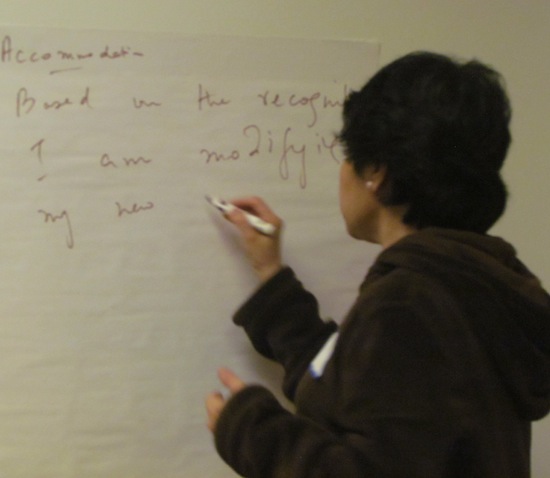
I’m halfway through a four-day training with Soma and I have filled more than half a legal sized notepad with notes.  Yesterday we covered Mental Mapping/ the different stages of RPM and Implementation.  I told Soma about my encounter with the child who didn’t want to work and immediately hit themselves.  I described how I’d had them spell “hitting” on the letter board and how this had immediately diffused the situation.  Soma then gave me more terrific suggestions on how to devise a lesson plan around an action such as hitting.  An example of this is (I”m making this up) “I would like to know more about hitting.  What else can you hit?  Do you hit the sky or a ball?”  Soma spoke of how when emotions are running high, switching to numbers and math, which have no emotion can be helpful during emotional outbursts.  “How many times can you hit the ball? Here let’s count.  1, 2, 3, 4, 5.  You hit 5 times and if you hit once more, that would be 87 times or 6 times?”

We spent a great deal of time discussing the ways in which one can learn about a student through their preferences, stims, what they’ve been exposed to, skill levels and abilities, tolerance levels, acquired knowledge and defenses.  Soma then covered how one goes about implementing all of this through lesson plans.  Each step of the way one presumes competence in the student’s ability to learn and be taught without presuming that they already know how to read, write, add and subtract.  Through the various activities it quickly becomes clear whether the student needs to be shown how to spell a word such as “hitting” or whether they already know the word.  On the first day one of the students, whom Soma had never met before, sat down and after working with her for fifteen minutes or so, was asked what his favorite color was.  She had him choose from one of two stencil boards for the first letter.  From that board he chose the letter “r”.  He then proceeded to type ‘r’, ‘e’, ‘d’.  The following day a number of the people  taking the training expressed skepticism that the student actually could read or write.  One suggested that red may not have been his favorite color.

When asked how they knew that he couldn’t read or write, they weren’t able to give specific reasons, it seems many just assumed he could not.  It reminded me of the years and years I spent believing a whole variety of things about my own child, which turned out to be untrue.  I had no proof that the things I thought were actually true, I had just assumed and then behaved toward her as though it were fact.  Perhaps one of the single most destructive things we can do to our children, students, the people we meet is to make assumptions about their intelligence and abilities.  Beliefs based in nothing other than unfounded assumptions and our own biases of those who look or seem to us as not being capable.  These assumptions are dangerous and can do real harm.  As I’ve said before ~ to presume competence and be wrong will do no harm, to presume incompetence and be wrong can and will do tremendous damage.

Soma – 2013

Soma

A Training with Soma Mukhopadhyay

I am taking a four-day training that Soma Mukhopadhyay is giving this week.  Yesterday was the first day and Soma covered the stages of development and different learning styles.  Throughout the entire day Soma demonstrated how one teaches while presuming competence, though she never said those two words or even mentioned this, it is, in fact, what she was doing.  She does not assume a person she’s never met will know how to read or write, but she does presume that the person can and will learn regardless of whether they speak or not.  Rapid Prompt Method teaches skills that create a strong foundation for all learning to take place.

Soma walked us through stims that are excitatory and calming and how to tell the difference.  She demonstrated how one can work with them and how they give us clues about whether the person is auditory, visual, tactile and kinesthetic.  I asked a great many questions about things such as, what do you do when the person you’re working with hits, bites, slaps or pinches themselves or you.  Later after the training had ended I had the opportunity to work with someone who almost immediately hit themselves in the chest and they shouted, “No hitting!”  Fresh from the day’s training, I grabbed a letter board and said, “Oh here.  Spell hitting.”  I held the letter board out and shoved a pencil in their hand.  Immediately they stopped hitting themselves and pointing to first the ‘h’ then the ‘i’ and so on until they’d spelled “hitting” at which point they were able and willing to move on to do some other things.

Afterwards I reflected on what had just happened and remembered something else Soma did when one of the children she was working with tried to bite her.  I am paraphrasing as I didn’t write down exactly what she said. In a very calm, matter of fact voice, she said something like ~ Oh you’re trying to bite my arm.  My arm is not lunch. What else can you bite?  No judgment, no scolding, shaming or anger, there was nothing in her voice to suggest she was speaking of anything out of the ordinary or that this was something to get upset about.

For years I have been baffled by how to respond or even if one should respond to such actions.  I have written about “self-injurious” actions ‘here‘, ‘here‘ and ‘here‘.  I’ve never completely known how to respond and have responded in a variety of different ways, but today… today was the first day I saw someone model a response in an academic setting that made sense to me.  It isn’t that this response will eradicate the need or desire to hit or bite, but it was the first time I’ve seen someone respond in a way that didn’t make it worse, either by scolding, shaming or reinforcing.  As was the case this afternoon, the child I was with, immediately stopped hitting themselves and we were able to get back to work without further comment.

Today is day 2 of the training and it’s very exciting!

An Interview With an Autistic Teacher Who Teaches Autistic Students

What follows is my interview with a teacher.  A teacher who teaches Autistic students.  A teacher who is Autistic.  

When were you diagnosed with Autism?

 I self-diagnosed as having NLD (Nonverbal Learning Disability) (which I mistakenly thought was mutually exclusive to Autism – a good reason to get a professional diagnosis, not a web diagnosis) in college, which brought me a lot of peace of mind and self-understanding. (And helped me make peace with a lot of my past.)  I was in my 30s when I finally made the decision to get the formal diagnosis. (I was both right and wrong: I do have NLD, but I’m also on the Autism Spectrum.)

I got the diagnosis because I was having a lot of trouble communicating effectively at work, and I was getting written up for it.  My supervisors were trying to work with me, but I was afraid I was going to lose my job.  It wasn’t the first job I’ve had that happen at.  The problems my coworkers were going to administration about were hauntingly familiar: my voice tone, my inability to read others voice tone, my quick answers that don’t make sense and sound frustrated.  It was a pattern I’d seen before and had never had any success stopping or changing.  I knew I needed help if I wanted to save this job.

Why do you prefer remaining anonymous?

 For now, at least, I want to maintain control over disclosure.  Also, privacy.  The web is public and it stays there forever.  I’m not comfortable with anything about me, disability related or not, being out there like that.  I don’t have anything meaningful out on the web under my real name, and I’ll keep it that way, thanks.

How did you get into teaching?

 I think it’s in my blood.  My dad is a teacher.  I remember being in first grade, when everyone wants to be police officers and firemen: I wanted to be a special education teacher.  I got a BA in Psychology and spent 5 years doing direct care before moving to work in the schools.  I worked as a paraprofessional while I got my M.Ed.  I’m certified in intensive special needs and deaf/blind education.

Would you talk about your childhood and how autism affected it?

 I did the stereotypical “little professor” thing.  My mom says my favorite word as a kid was “actually.” I had friends growing up, and if my parents thought my relationships with them were a little off, I never noticed.  I had no other standard of relations, and I was happy with what I had.  My mom tried vainly to model more appropriate social interactions (my poor mother) but it all went right over my head (I do not learn from environmental cues or social models.)

Middle and high school were rough.  I was the victim of significant bullying. Kids are mean.  I considered changing schools (I went to public school) but decided against it.  Instead, I dove into my interests: computers, foreign languages, band, technical theater. Bullying happens during the unstructured times of the school day.  I was never unstructured, participating in more classes and extracurriculars than there were hours in the day. (I seriously could have used Hermione’s time turner back then….) Not only did it give me structure and purpose, but it successfully buffered me from my would-be tormentors.

Are you concerned that if the school where you work knew you were Autistic your job would be in jeopardy?

 I’d be worried about an employer learning that I was Autistic before I had a chance to prove myself as a teacher, yes.  The concerns about my communication problems at this job came in the context of “we love your passion, but…” I had already proven myself, multiple times over, as a good teacher getting excellent results with students who are considered difficult.  Afterward, I could see I had to re-prove myself because the words of my NT (neurotypical) paraprofessionals (sometimes not just in the area of classroom communication) carried more weight than mine did.  I have reason to believe we’ve gotten past that now, but it lingers in the back of my mind.  I know I have to work harder and sometimes that makes me mad.  Luckily, I have an administration and paraprofessionals who support me in the work I do and who respect that I am approaching it from an Autistic perspective (even if they don’t always understand that perspective.)  I haven’t always been that lucky, and I am continuously grateful for it.

You say, “with the right accommodations..” can you give an example of a couple that are helpful?

 Using written communication when possible.  This frees me up to only address questions that need to be addressed, which is means I am more likely to be clearer because I can devote the needed resources to perspective taking and processing time.  Regular meetings.  I don’t pick up on things incidentally unless I’m working hard to pay attention to everything that is going on.  That’s impossible when your class is spread between multiple locations.  Regular meetings give me a chance to make sure we’re all on the same page at the end of every day and put out any fires before they get out of hand.  However, the effectiveness of these meetings is predicated on….

Direct communication from staff. This is quite possibly the hardest accommodation to get and the most important.  I ask everyone I work with to be direct with me and everyone says they will. But saying and doing are not the same thing.  Most NTs find being as direct as I need them to be as impossible as I find reading their non-verbal language.  It’s a real communication gap.  I’m incredibly fortunate that I have a para that can bridge the gap.  Some of my new paras are starting to learn as well, and I’m starting to learn to read their individual cues.  Translation is never as good as reading the original, but we get by.

Having communication support people I can turn to.  I have 2 coworkers I can trust to run things by when I’m concerned about how I’m coming across or not sure if I missed a cue from someone else.  This doesn’t help, of course, when I’m oblivious to the fact that there was something I should be concerned about in the first place, but it reduces the pool of potential landmines, at least.  Also, these are people who can listen for what I’m not hearing on the rumour mill (because I’ll never hear it) and potentially warn me of landmines I’m not aware of.  They’ve definitely saved me from several potential disasters already this year.

What are the most common misperceptions you face in trying to teach this population?

Top five misconceptions held by administrators, paraprofessionals, parents, and community members that make my job harder:

  1. That my students cannot possibly be capable of having control over (or a meaningful say in) what will happen with their lives.
  2. That the fact that most of my students may never be fully independent (living alone, working full-time) means that we should not bother teaching them community living and vocational skills.
  3. That my students are unpredictable or dangerous.
  4. That a student who may exhibit challenging behavior in the school environment shouldn’t be allowed in the community because he might exhibit the same challenging behavior.  (This one really makes me angry, because it doesn’t teach the kid anything useful. Give me appropriate staffing to handle the behavior; don’t penalize the kid.)
  5. That my students should be pitied.

Have you been surprised by any child’s ability?

 Have I have taught a student who had more skills than their assessments claimed? Absolutely.  Have I ever had a student make more progress in a year than I anticipated and had to amend the IEP part way through? I love it when that happens!  Have I ever taught a student who may not have a lot of skills that can be formally assessed, but who enriched my classroom in so many other ways?  All the time.  I don’t like the word “surprised” – it’s an autism thing, I guess.

How do you deal with self-injurious behavior?

 Behavior does not occur in a vacuum and all behavior is communication.  SIB (self-injurious behavior) usually has a sensory component, but a FBA (functional behavior assessment) will give clearer answers.  We need to look at the environment, the student’s communication strategies, and antecedents and consequences.  What is the cause of the stress?  How can we teach the student to deal with it more effectively?  Generally, positive behavior supports are most effective, but they have to be individualized in order to be effective.  What is reinforcing to one student may be aversive to another.  Behavior does not occur in a vacuum, and we cannot try to treat it in one.

Can you describe some of your own sensory issues and how they impact your life and work?

 I only recently really mastered reliable daily living skill routines.  Showering was a difficult sensory experience for me for years.  I still have trouble with toothbrushing and flossing, but I’m working on it.  I eat pretty bland foods (though, due to food allergies, my diet is both more varied and more monotonous than average) because I don’t care much for significant smells or tastes.  I’ve gotten more tolerant of different clothing textures than I was when I was younger.  I still freak out at certain textures, but my repertoire has expanded significantly from the “cotton/poly blend only” I wore when I was younger.

At work, I’m in control over the visual environment, since I’m the classroom teacher.  So I keep it pretty visually quiet, both for my own sake and that of my students.  Any conversations go out of the room, which really helps all of us focus.  My para knows to ignore when I’m self-talking, which is my primary self-calming strategy (I try to take that out of the room too, when I can.)  I stim when I need to.  So do my students. I don’t see that (the stimming) as particularly impacting our work.  I bring figits or sit on the floor during meetings (I sit in the back so it’s not disruptive.)

In previous years, when I was trying to pass and having more communication problems, I needed more sensory breaks and did a lot more self-talk (which in turn cased more communication problems.)  Now that I’m not trying to pass, I’m more comfortable and less stressed, which means I’m generally more sensory regulated – and if I’m not, dealing with it is no big deal.

Are there specific things you suggest schools can do to help their students?

 I think a lot of schools do the first half of this puzzle really well.  They have proactive sensory programs: do this activity after this interval for this amount of time.  And they have reactive programs: if you see this behavior, offer these choices for this amount of time.  The good ones have a mixture of the two.  Where the programs tend to miss the mark is in taking it to the next level: teaching the student to recognize when their sensory system is starting to become disregulated and what to do about it.  There are some good programs out there for teaching this skill: The Alert Program(TM) is probably the most popular.  I’m a fan, personally, of the Incredible 5-Point Scale, because the students can apply it to more than just their sensory system and because it has a more flexible metaphor (colors, numbers, can use pictures) and it ties into emotional regulation and understanding.

What is your opinion regarding stimming?

 I stim. My students stim. I won’t stop a student from stimming. My para (the only NT  in the room, poor guy) frequently points out that everyone stims, it’s just that society has declared NT stims socially acceptable and autistic stims unacceptable.  That said, there are also students who demonstrate self-stimulatory behaviors that are not self-calming but rather a precursor to or the beginnings of further stressed or out of control behavior. It is extremely important to know your student and to know the difference between these two types of behaviors. In one situation, the student is using their own coping strategies to de-stress, and in the other the student is indicating the beginning of losing control, and the environment or stressors needs to be addressed to prevent further escalation.

Have you ever witnessed treatment of a student that you objected?

 I’d love to say “no,” but yes, I have. Most of the time it’s things like not giving enough wait time and over-prompting. I get incredibly frustrated by the way that students who are not socially engaging, especially if they have challenging behaviors, tend to get left out in favor of the “easier” kids. But also, yes, I’ve seen what you’re really asking about. I’ve seen students physically moved or restrained when they shouldn’t have been.  I’m trained in the use of physical restraint, and yes, I’ve had to use it. Do I like it? No. Is it ever my preference to use it? No. Will I use it as a last resort to keep students safe? Absolutely. And I would 100x prefer to be called in and asked to do so then to have people who are untrained and don’t know what they are doing try to make do.  That way only leads to injury, trauma, and possibly death.  And I’m not afraid to call it like I see it.  I’ve reported coworkers to administration and when needed I’ve filed 51a reports (reports of abuse or neglect.) There are certain benefits to having an overarching sense of right and fair and not feeling bound by social conventions, at least where the students rights and safety are concerned.

Is there any methodology that you prefer and why is that?

The short answer to this question is no.  I am very wary of any program that says that a particular methodology is right for all students with diagnosis x.  I don’t believe that to be true.  The role of the teacher is to be familiar with the breadth of instructional tools that are out there and to find (or adapt) the right tool for the individual student to learn the specific skill.  For one student, that might be Discrete Trial Training to learn to attend to directions given in ASL.  For another student, that may be a phonics curriculum to learn to read.  A third student might be learning vocabulary in the natural context of a community work placement.  The one thing that all of these methods have in common is data.  I need reliable data taken daily on student achievement to know if the methodology is effective and the student is making progress, or if the instructional method needs to be changed.  There is no right or wrong method; I don’t even believe there is a best method. The question is whether the method being used is effectively teaching the student the desired skill, and there is only one way to answer that question: data.

Are there any methodologies that you believe are harmful?

Aversives, repeated use of any form of punishment (including time outs,) restraint used as a programming tool as opposed to an emergency procedure. If you’re doing it on a regular basis, something is wrong.

How do you work with a curriculum given your student’s disparate needs?

 The short answer is good staffing ratios and competent paras.  Also, using the principles of Universal Design for Learning.  By differentiating how I engage each student, and with paraprofessional support for behavior and data-taking, I can have three students engaged in a group setting.  I can have a fourth student, with additional paraprofessional support, engaging in the same material with us and connecting to the group as able. If you’re counting, that’s 3 staff and 4 students.  I’ve just described to you what my classroom looks like most days.

In an ideal world where Autism carried no stigma and you were able to be open about being Autistic, are there specific things that would allow you to do your job better?

 I would like to be able to work with my students on understanding Autistic culture and the Autism community.  My school does very well teaching our Deaf students about Deaf Culture and their Deaf identity.  I believe we could do the same for the Autistic students.  I would like to make that happen, and I know that no one else will lead it, but it would require being open about being Autistic and I’m not ready for that yet.  I trust my administration and those I’ve told, but I am not comfortable working with the rest of my co-workers as an Autistic person, which I’d need to do in order to make that happen for these students.  It’s something I want to do, but not yet.  One day, I hope.

What do you advise people who are thinking about entering the field of special education?  Is there anything you wish you’d known when you were just starting out?

 Work with kids with disabilities before you go into the schools.  Work at multiple schools (or with kids from multiple programs) before you start teaching.  One of the downsides to being in the schools, especially since most teachers work as paraprofessionals while they get their degree, is that you work with one student, or one group of students, for years.  There is frequently only one or two special education classrooms in the building, so there aren’t a lot of models to observe.  I have had too many experiences of people singing the praises of teachers I know to be mediocre at best, because they have no standard to compare them to.  See as many different students and teachers as you can before you settle on a specific subset of the population, a school, and a classroom where you want to work.  Most importantly, spend time working with typically developing children.  You’ll need that reference to fall back on so you can recognize what’s typical age-appropriate nonsense and what is actually behavior that needs to be addressed.  We tend to acquire tunnel vision in special education; make sure you don’t put the blinders on until you have to.

What do you advise parents look for of non-speaking children seeking a good school?

 Without knowing the specific student or her goals, it is impossible for me to say what program is best.  I can tell you what I look for in a school where I would consider working.  The one thing that sends up red flags and makes me stay far away is a school that believes there is one right method to teach all students.  Simply put, there isn’t.  Beyond that, I look for evidence that the people there know how to use picture supports and both high and low tech communication supports, not just for schedules but integrated into everyday activity: academics, leisure/social time, specials, lunch, etc.  For an older student, I look for evidence of functional skills and community based learning, not just using pictures to represent and role-play functional community activities, but actually getting out into the school and local community and learning the skills in the real environment.

If you could create a “dream school” what would it be like?

My dream school would have the physical environment, educational methodologies, peers, and teachers and paras with appropriate training and ratios to give each student access to both the general educational curriculum and any related services she needs to be successful as an adult: whatever that looks like for each individual student.  My dream school is not one school, but a range of options for every student so that the right option is always available.  That option would naturally change over time as the child grows and her needs change, and no one would question the need for that change.

Have you had parents or other staff question the competence of a child in your class?

 I had a former administrator tell me a student didn’t matter because his family would take care of him after graduation and to focus all my attention and resources on another student who, she said, actually had a chance of being fully independent. I basically ignored her. They are now both working in the community with support.

 Have you had a parent question their child’s competence?

 Not directly, but I certainly have known parents who have underestimated their child’s academic or independence skills.

 How have you dealt with that?

 I don’t judge, because I can’t.  I don’t walk in their shoes.  I only see their child at school.  I only know what their child does in one environment and I understand well that students will present differently in different environments. I will encourage bridging to home; I will provide support; I will provide information and data. But I will not judge, because I do not, I cannot, really know.

Reading and Reading Comprehension

Emma’s teacher and I have been brainstorming new ways to increase Emma’s reading comprehension.  We have tried the standard reading comprehension questions, which, as my friend Ibby pointed out, are typically filled with inconsistencies and problems.  We’ve tried the more standard reading comprehension questions such as a story about a boy named Peter who takes a taxi to the airport.  He gets on an airplane, buckles his seat belt and the plane takes off.  The questions are then, “Who took a taxi?” The answer, obviously is Peter took a taxi.  But the second question, “Where was he going?” is tougher to answer because we aren’t given the destination other than he took a taxi to the airplane and that isn’t actually accurate as he took the taxi to the airport, but the airport isn’t part of the story.  It tells us he took a taxi and then got onto the airplane where he buckled his seat belt, so Emma answered, “Going to visit Granma in Aspen!”  And while this isn’t the answer the creators of the questions were presumably looking for, it demonstrates that Emma certainly understands what the story is about and she is adding her own personal experience to the gaping holes the story provides.  In addition, the story has been dumbed down so completely, if we are “presuming competence” then Emma must be going out of her mind with boredom.

So this is the question I come up against almost constantly – how do we make the material interesting and engaging, but not so difficult it becomes frustrating.  How do we set Emma up to succeed and not fail without boring her?  How do we deal with her resistance to reading and writing?  I’ve made some headway by trying to do some playacting and using some of her favorite songs, but reading itself remains difficult for Em and she certainly doesn’t enjoy it.  Maybe I am making it too complicated. Maybe I’m over-thinking the whole thing.  Maybe it’s better to just present reading material and have her read it silently.  Then type questions that she types the answers to.  Maybe having her read aloud is causing problems.

What I am seeing over and over is that when she has trouble with a text we make the text easier, but I don’t believe that’s the answer.  I’m not sure making it “simpler” is better.  My biggest challenge with all of this is that this is not my area of expertise and I have no idea how to proceed.  Emma’s teacher continues to try different things, but we haven’t found anything that seems to captivate, motivate or particularly interest her.  I have to think about this more.  I’ve printed out some of her favorite song lyrics, but there were too many words she couldn’t read and so much slang, I quickly abandoned the idea.  I need to find reading material that isn’t so easy it’s boring and not so difficult it makes her frustrated.  Looking back  over the past year, I can see how well she was doing and how so much of that progress has stopped.  I need to revisit those earlier concepts and see if I can find material that will pick up where we left off.

Henry Makes Waves & Everyone’s An “Expert”

Yesterday the interview (published on Huffington Post, click ‘here‘) with Henry, the 13-year old non-speaking Autistic boy, son, brother, friend, student and all around amazing kid who has been denied enrollment to the public school across the street from his house went viral.  At the moment it has 152 comments and over 1,000 people have “liked” it, with almost 400 people sharing it on Facebook.  The comments began pouring in yesterday afternoon.  A few were particularly troubling for a couple of reasons.  The first being that a completely uninformed person(s) made broad sweeping generalizations about autism while bolstering their opinions with statements like this:  “and then there are the non verbal Autistic who need constant care.  One can’t tell if they understand language, but they can’t speak for some reason. I do know this as a fact from the Autistic that I’ve worked with in my youth.”  Another commenter suggested, “Maybe he should consider speaking …..If he wants to go to that school so badly…”  And yet another said something about how Autistic kids “drag” the rest of the students down.  All of these comments were uninformed, but the thing that was actually frightening  was when another commenter then referred to the first commenter as an “expert”.

So I lost it.  Completely.  Utterly.  Lost.  It.  Heart racing, hands shaking, head pounding, throat constricted, feeling nauseous, lost it…  Which is how many who are marginalized and live with prejudice, feel all the time.  That feeling of terror that their lives are threatened and in real danger as a result of incredible ignorance.  I should have walked away.  I should have done some breathing exercises.  I should have meditated.  But I didn’t.  Instead I reached out with words and hit back.  I used words to hurt.  I used words to wound.  I didn’t ask questions.  I didn’t wait for more information.  And here’s the thing, I don’t know that I was wrong to do so.  I feel ambivalent.  I feel I should regret my actions more than I do.

I responded with this: “…the degree to which you misunderstand Autism is actually more than frightening, it is terrifying. That you also worked with this population says more about the tragic state of the place you worked and their hiring policies, not to mention their training, which appears to be none, than your profound ignorance.”  To which he responded, “I wasn’t hired to do anything. The camp/school had normal and special kids and they had that one Autistic boy. I was nine. I wasn’t hired.”

People in the comment thread were describing a man as an “expert” who claimed knowledge of autism because he met an Autistic boy when he was nine years old.  At camp.  Nine.  And I thought of Joe Scarborough and his comment about the Aurora shooter.  I thought of Simon Baron-Cohen who actually is something of an “expert” and yet I completely disagree with his conclusions.  I thought of all the doctors, researchers, neurologists and “autism specialists” I’ve met, spoken with and consulted over the years, many of whom I do not agree with and some whom I do.  But the point is, so much of this is up for grabs.  There is a great deal of information out there that all of us have access to, but how do we know what is correct?  We’ve got doctors drawing conclusions that seem illogical and even irresponsible, while others whom we might agree with.  There are some very smart people out there working hard, publishing their work, making informed opinions, but how do we know who to believe?

I don’t.  What I do know is that anyone I read or hear I try (usually) to find out more about.  Who is this person?  What are their credentials?  What is their hands on experience?  And I get a second opinion from those who are autistic.  There are a number of people, all Autistic whom I particularly respect (this is by no means a comprehensive list and in no particular order, just thinking off the top of my head; please feel free to share anyone else I may have forgotten) Judy Endow, Lynne Soraya, Emily Willingham, Elizabeth J. Grace and Michelle Dawson.

A commenter on this blog wrote a hilarious comment about “Dr. Mom”, “Nurse Mom” and “Psych Mom”.  It was not only very funny, it was relevant to all of this. Who do we believe?  Hopefully not the guy who states they “know this for a fact” as compelling as the man might be for some.  And I’ll just add this; don’t believe me either.  I’m a mom.  I’m a writer.  I’m an artist.  I have opinions.  Sometimes I have really strong opinions, opinions that I think are right.  But I also know that over the years as I learn more, I no longer agree with many of the opinions I held a year ago, two years ago, three years ago.  My opinions change.  All I know is that I want to keep learning.  I want and try to keep my mind open.  Sometimes it’s really hard.  Sometimes I feel tremendous rage.  I don’t learn when I’m that angry.  But hopefully I calm down enough that I can go back to learning.

Let the learning continue!

A Letter To My Daughter’s Teacher

*I’ve never removed a post before.  But I couldn’t get away from the creepy feeling the original post was giving me.  I have kept much of the original content, but rephrased it so that I’m not speaking as though I were my daughter, which I have no right to do, and am instead speaking as her mother, which I am.

My daughter, Emma will be in your class this year.  A few days ago, Emma told me she was “scared to go to new school.”  Emma loved her teachers and friends from her old school.  So I want to introduce you to her.  I cannot speak for Emma, I cannot know if everything I write here is completely accurate, but these are things that I have learned over the years, things that are specific to Emma and that may be helpful, at least that is my hope.

Sometimes Emma does not look at you when you are speaking to her, but that doesn’t mean she doesn’t hear you.  Her hearing is excellent.  She may not know how to process what you’ve said or she may not know what is expected of her.  Often if you ask Emma a question, especially if it’s a question she knows the answer to she either won’t answer or will say something nonsensical because she isn’t sure what’s expected of her or why the question has been asked.  Sometimes people get nervous and don’t know what to say, so they’ll ask, “Oh Emma, that’s a pretty dress.  What are you wearing?”  or  “What color is that?”  These are questions that aren’t being asked for any real purpose or they are testing questions.  Typically these are the kinds of questions Emma will not answer.

Change is difficult for all of us and Emma is no exception.  Having a written or picture schedule for the day and week will reduce her anxiety.  Like everyone, Emma really appreciates having a say in what happens throughout the day.  Whenever appropriate allowing her to set a timer for a one, two or five-minute warning before a change in activity will go a long way in helping her do what she needs to prepare herself.   Usually Emma will go along with any change if she’s given sufficient warning.

General Disposition:

Emma loves people.  She is gregarious.  Her fall back position is one of happiness.  She is also very sensitive.  She can tell if someone is upset, stressed or angry and can become easily overwhelmed by those feelings.

 Particularly good at:

Emma is terrific at leading others.  She can be extremely persuasive and is a great negotiator.    Her negotiating skills are wonderful for math and science and her leadership skills are wonderful motivators.

 LOVES:

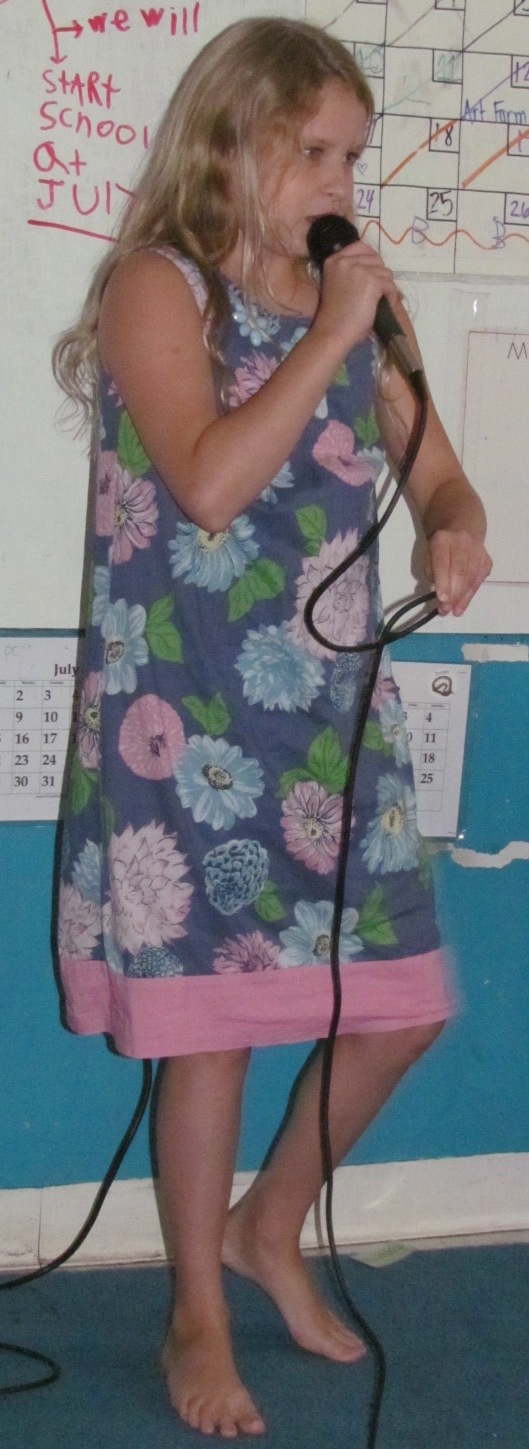
Emma loves music, dancing, being on stage in front of an audience.  Give Em a microphone and she will sing and dance.  She loves “talent shows.”  She loves any game involving running, swimming, holding her breath under water, laughing and being silly.  She loves playing versions of “Duck, duck, goose” or as Emma would say, “Raincoat, raincoat, umbrella!”  Musical chairs is another favorite, dance parties, hide and seek, dressing up, bouncing, swinging and going to any playground.  Emma is very athletic and very girly.  She likes cooking and while she won’t eat most of what she cooks, unless they’re pancakes, she will enjoy the opportunity to cook.

Does NOT like:

Emma gets upset if she is told not to do something she has just done.  Example:  “You cannot shout!” after she has just shouted is difficult for her.  Obviously she CAN shout, she just did, with you right there watching.  Telling her she “can’t” is not true and it’s confusing.  Instead say, “You mustn’t shout.” Then in a voice that models what you’d like you can say, “Here is how you can speak instead.”  By doing that, you are helping to give her other choices.  If she is not allowed to do something, be sure to tell her what she can do as an alternative.

Academics:

Emma is fairly new to all academics.  Within the past year she has learned to form the letters of the alphabet and is now reading, writing and typing at a 1st – 2nd grade level, likewise with math.   Emma loves the Hubble Imax movie and her favorite museum is the American Natural History Museum.  She is showing interest in learning about our world, the ocean, the moon, other planets and the universe.  She told me last night that she doesn’t want to be an astronaut though, she said she wanted to be a “singer on the stage!”

Needs extra help:

Emma resists academics.  They are hard for her and she becomes upset when she makes a mistake.  She doesn’t like getting anything wrong.  But if you help her succeed, she will flourish.  If she is reading and doesn’t know a word, give it 15 seconds or so to see if she can work it out on her own, (don’t say “sound it out” or “try again” because she didn’t learn to read phonetically and while she is able to sound some words out on her own, it won’t help her with all those exceptions like limb and thought.)   Emma has a strong desire to learn and an even stronger desire to do things independently.  With your help, she can and will succeed.

Frustration and Signs to watch for:

Emma gets a look of panic on her face.  She may begin breathing with short sharp intakes and she will often talk to herself in a high-pitched questioning voice laced with anxiety. When Emma is overwhelmed she may shut down and withdraw.  She may begin scripting, using set phrases she’s heard. Those scripts may be in context with what’s going on or their connection may not be clear to you, but that doesn’t mean there is no connection, it just means you don’t understand or know what it is.  Emma often has trouble processing her feelings and the feelings of others.  Sometimes she needs help identifying those feelings, just as we all do.  Sometimes she will start repeating things other teachers have said to her in the past in a scolding tone, such as, “No Emma!  You may not __________.  If you ____________ we will take ________________ away!”  When Emma is overwhelmed she has to rely on her scripts as all other words have left her. Try to listen even if the words seem meaningless, she is trying to communicate her feelings of distress to you.  Sometimes she might say, “You have to ask for help!”  This is what she says when she needs help, but sadly this can confuse those who do not know Emma well.  She might also say, “Do you want to go swimming?”  Which means she really, really wants to go swimming.  If you show her on the schedule when she’ll be able to go she will usually calm down.

It’s too late, the storm has hit!

This is not the time to engage in a power struggle.  Emma is not trying to manipulate you or upset anyone.  She is simply expressing her frustration in the only way she knows to.  Sometimes if she’s very upset she will bite herself or punch herself, usually on the hand or arm, sometimes if things are very bad, she will punch herself in the face.  Do not exacerbate this challenging time by raising your voice or telling her “You cannot hit!”  or “You cannot bite!”  or even “We don’t bite.”  (See Does not like paragraph above) Restraining her in an attempt to stop her will not prove helpful either.   Emma bites or hits herself because the feelings of frustration are overwhelming her.  The pain she causes herself by biting or hitting is within her control and is therefore preferable.  It things have escalated to the point where Emma is hurting herself, everyone must try to understand what has happened before things became this derailed and try to prevent them.  Sometimes it isn’t possible, but Emma is trying to cope as best she can.  When she is calmer you can work on helping her find alternate ways to cope.

What helps you when you feel overwhelmed?  What things do you do when you feel anxious, scared or upset and no longer feel you’re able to function?  Maybe the things that work for you will help Emma too.  Remember, be patient.  Showing Emma once or twice will not mean she’s learned, she will likely need to be shown numerous times.  Often there is a sensorial component to her upset.  She is overwhelmed with feelings or a sensation or too many sensations.  She may be tired or hungry, too hot, cold or thirsty.  Sometimes a sensory break will do wonders to restore her equilibrium.

Strategies that work well:

Make it into a game!  Music can be incorporated into just about any activity and can change anything.  High affect and silliness can make something that feels difficult seem fun!

Humor:

Emma loves anything silly and ridiculous.  Silly faces, silly dances, playful interactions, games!  She has specific jokes she likes to play with specific people.   Emma loves to laugh.  She loves to make up word games.  She enjoys taking a word like “uncle” and changing it to “Jungle.”  She will happily tell you that she has a “Jungle Andy and a Jungle Victor.”  Come up with silly word games and Emma will join in with glee.

Things that have a tendency to backfire?

If you say, “You have to do ________________.  If you don’t, I’m going to take __________________ away” will make her upset and anxious.  She will have a hard time concentrating because she will worry about having something she wants taken from her.  Instead say, “You can ______________, but first you need to __________________.”  That way Emma can concentrate on having/doing something she loves as opposed to taking something away.

Emma’s String:

 Emma has a string that she loves.  Please do not take away her string or use it as a form of punishment.  Her string helps her focus and it makes her feel safe.  If you take it away or threaten to she will become completely overwhelmed.  Sometimes, when she is writing or typing and needs both hands to do so, you can ask her to set her string near her or in her lap.  If you allow her to control where she puts her string she will feel safe enough to concentrate and do her work.  Also (a little secret) if you get some string or ribbon and copy her movements in a playful way, you might see and feel for yourself how wonderful it can be and Emma will be delighted that someone wanted to interact with her in a way that she loves.

Food:

Emma does not have any allergies or foods she cannot eat.  However she likes to eat the same food everyday.  Some food looks, tastes and smells strange to Emma.  Please do not make her eat anything she isn’t interested in eating.  Please do not tell her she must finish something in order to have something else.  If Emma shows interest in something someone else has or is eating and it’s appropriate, do allow her to smell, lick, taste or eat it if she wants to.  And please do tell me so that I can find whatever it is and offer it to her at home too.  We will pack Emma’s lunch everyday.

One last thing:

 Assume competence and respect Emma’s process.   Emma can and does learn.  She may take longer or less time than another child, but she will learn.  She is extremely independent.  Show her, help her, let her.   You are her role model.  Emma has dreams, just as we all do.  You can help her achieve those dreams by believing in her.

 I am available to talk, discuss and strategize.  I am here to help in any way that I can.  Nothing is more important to me than my daughter.  Please keep in touch with me.  Please let me help in any way that I can.  There is no detail about Emma’s day that is too small.  Do not hesitate in emailing me _____________ or calling  _____________. 

 Thank you so much,

Ariane

Emma performing at her old school


*The above “letter” was inspired by a form letter Ann sent me by Jene Aviram© http://www.nlconcepts.com