Tag Archives: autistic

Hope – Autism

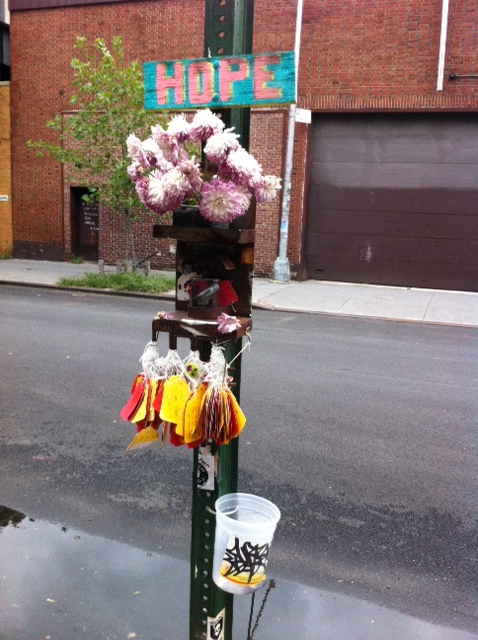
For those of you planning a trip to New York City, you must take in the High Line, New York City’s most creative and interesting park, built on the old elevated tracks on the west side of downtown Manhattan.  The High Line spans more than twenty blocks and eventually will end at 34th Street.  Last Sunday we came upon this art installation at the bottom of one of the High Line’s many entrances/exits.

On each of the little red and yellow tags people had written what they hoped for.  One said, “Cure Ann of her cancer” another said, “I hope I will love Miquel forever”, and still another read, “Please make Mom get better”.

Love and health were the most popular “hopes”.  I would have written one of my own had I’d thought to bring a pen with me – Let Emma live an independent, happy life, filled with loving relationships.  I guess the thing about hope is it keeps us moving forward.  Hope allows us to get through tough times.  I am reminded of the prayer of Saint Francis of Assisi:  “Where there is hatred, let me sow love; where there is injury, pardon; where there is doubt, faith, where there is despair, hope…”  Regardless of ones beliefs, these words have given solace to a great many, myself included.

For more on Emma and her journey through a childhood of autism, go to:  www.EmmasHopeBook.com

Do We Have An Obligation to People With Autism?

The scene in the airplane last week involving the man with autism, has stuck with me.  I keep wondering what the airlines would need to help them cope with situations such as the one we witnessed.  Of course I am approaching this question with the assumption that they are interested in mitigating the damage and distress such a scene may cause, not only for the man with autism, but for the other passengers seated nearby, as well as the flight crew.  At the very least – the airlines and all such companies who may come into contact with persons with autism should be educated enough to know how best to deal with most situations that might arise.  Given the current rise in autism, it seems scenarios such as the one I described last week will occur with increasing frequency.  At the very least, it does seem obvious that when a person with autism has requested a window seat they should be accommodated, just as someone who requires a wheelchair is given an aisle seat.

Why is it that neurological differences are treated any differently than physical?  The answer is –  for the most part neurological issues go unseen.  We cannot see inside the person’s brain and so we make assumptions.  Assumptions that the person has a psychological “problem” or are simply behaving badly because they are – poorly brought up or have emotional problems.  We have words for people like this, most of them cannot be written without using a lot of keyboard symbols.  We have little tolerance for those who seem to indulge their worst desires and allow themselves to act out on those selfish interests.  But what of the people who, like the man we encountered last week, have autism?  Do we not, as a society, have an obligation to these people?

For more on autism and my daughter, Emma’s journey through a childhood of it, go to:   www.EmmasHopeBook.com

The Hurricane – Autism

Explaining to Emma why all the museums and most stores were closed and subways and buses had stopped running as of noon this past Saturday because of the threat of Hurricane Irene was difficult.  Particularly as the weather was not cooperating with all the dire predictions.  There was a vast disconnect between the news coverage and what we were actually experiencing on our street in Chelsea.  Since we are not near either river, the winds were mild if even present and though it certainly rained, it was minor compared to what many others along the eastern coast experienced.

Emma gazed out the window and said things like, “It’s raining.”  And then she would add, wistfully, “Go to the carousel.”  Followed quickly with, “No not going to go on the carousel, it’s broken.”

Try as we might to explain that the city had shut down in anticipation of the impending hurricane, she seemed unable to make sense of it. It was all the more implausible when the hurricane never actually arrived.

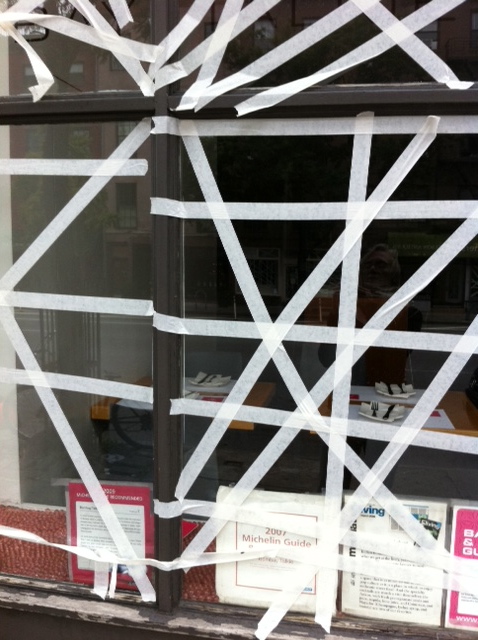
New York preparing for the worst?  May I just point out – this is masking tape.

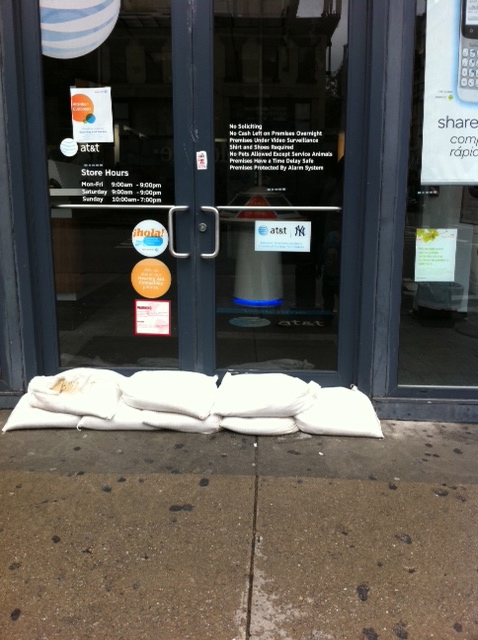
Sandbags in front of the AT&T store.

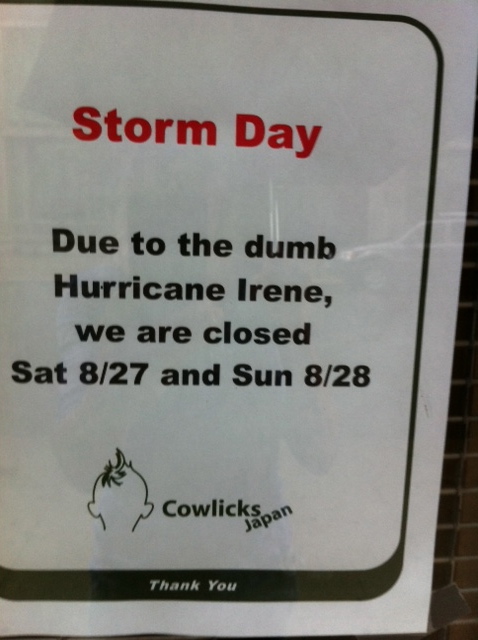
One of hundreds of signs – these guys had just been through the tsunami, so they get to make fun.

Sixth Avenue – Saturday, August 27th.

Looking toward New Jersey from a pier in Chelsea – Sunday AM.

Nic and Em feel the wind on Sunday AM.

The only sign of damage we found the next day.

Merlin looking majestic through it all.

For more on Emma’s journey through a childhood of autism, go to:  www.EmmasHopeBook.com

Autism and Traveling

Yesterday we flew back to New York city.  Emma is a terrific traveler, content to stare out the window, look at her books and sing songs.  As long as she is able to sit in a window seat, she is happy.

On the flight from Denver to New York, which was already delayed by about a half an hour, we noticed a man speaking in a loud voice to one of the flight personnel.  He was a large man, well over six feet tall, with close cropped greying hair.  I couldn’t hear what he was saying, but it was clear he was unhappy about something, not unusual given the rigors of traveling nowadays.  But as he went on, I noticed a cadence to his speech that was familiar to me.

“Mom, what’s wrong with that guy?” Nic asked me as I watched the scene unfold.

“Don’t know, Nic.”

“Is he autistic?”  Nic asked.

“Maybe.  I’m not sure.”

It was at this moment that we were called to board.  The man, visibly upset and walking with a cane, boarded first.  When we finally settled into our seats, I noticed that same man was seated directly in front of me – in an aisle seat.   The usual parade of harried travelers filed along, as exhausted flight attendants urged everyone into their seats so that we could take off without further delays.  By the time the plane was airborne, we all began to relax.  At a certain point the man in front of me yelled out, “I can’t see out the window!  I can’t see out the window!   Excuse me miss, I can’t see out the window!”

It wasn’t clear who he was speaking to, but it seemed that the woman seated near the window in the row in front of him had pulled the shade down.  Someone then said, “It’s her seat, she can do what she wants.”

To which the man shouted, “I can’t see out the window.  I hate these aisle seats.”

For another hour or so all seemed to calm down until about an hour from our landing when the pilot announced we were in a holding pattern over Pennsylvania and would be for an indefinite period of time.  The pilot then went on to assure us that we had enough fuel for several hours so everyone should relax and he would keep us updated.  But the gentleman in front of me began to get agitated, asking the flight attendant what was happening, what time would we actually land etc.  She explained that we were in a holding pattern and couldn’t predict what time we would actually land.

After she left the man began to shout, “I can’t see out the window.”  People were muttering and saying things under their breath, while the poor man became increasingly upset.  At this point I leaned forward to the woman in his row seated next to the window and asked her if she would mind changing her window seat for his aisle seat.  I explained to her that I thought he probably had autism and was becoming increasingly upset by all the delays and needed to be by the window.  I told her my daughter (happily gazing out the window directly behind her, also had autism and needed to sit in the window seat too.)  The young woman complied and I asked her if she minded if I intervened by telling the flight attendant.  She said that would be fine.  I went to find the flight attendant who was discussing the situation with another flight attendant in first class.  I explained that I thought the man had autism and that my guess was he would feel much calmer if he could sit in a window seat and that the woman to his right had agreed to change her seat with him.

The flight attendant then returned saying to the man, “This nice woman has agreed to change seats with you.”

“I hate these aisle seats.  I told them at the gate I hate these aisle seats.  I was suppose to have a window seat.  I told them I was suppose to have a window seat,” the man said, now standing in the aisle of the plane.

Once he had reseated himself by the window, all was quiet with no further mishaps despite our over an hour delay in landing.

What I find most upsetting about this, is how it all could have been avoided.  The airlines, like so many, do not have any understanding of autism.  How hard would it have been to give this man a window seat as he requested at the gate?  When I went to the flight attendant and suggested he might have autism, she said, “Oh, yes.  He does.”  So it’s clear the airline had been made aware of this and yet, chose to do nothing to help this man.

Sometimes I feel as though I am yelling from the top of a very large building.  WHAT IS IT GOING TO TAKE ?   The lack of understanding around a condition that affects hundreds of thousands of people is mind boggling.   The scene we witnessed could have been avoided had the airlines and it’s personnel had even a vague understanding of autism.

For more on autism and traveling with Emma, go to:  www.EmmasHopeBook.com

One Last Night

Sunrise

It’s hard not to feel the overwhelming beauty of life when seeing a sunrise over the mountains, like this one, as we did yesterday.

Emma has asked to go back to our little rustic one room cabin almost every night since we last spent the night there about a week ago.  Since we are leaving tomorrow, returning to New York, we decided last night was our final chance to spend in it.

“Hey Em, do you want to spend the night in the cabin?”

“YES!!!!” she shouted, jumping up and down.  Then she dashed upstairs, returning a little while later carrying her backpack.

Nic opted to stay with his Granma, so the three of us set out, Emma racing ahead of us up the little trail.  When we arrived and had settled in, Emma threw on her nightgown, despite the fact it was only 7:30PM and still light outside.

“Don’t y0u want to sit with us and watch the stars come up?”

“No, not going to sit outside.  Time for bed!”  Emma said snuggling under her sleeping bag.

Richard and I watched as the sun set, whereupon the bats came out.  Just as a bat whipped past us, less than two feet from where we were sitting, Emma appeared.

“Em, did you see the bat?”

“Bats come out.  Bats going to bite you!”  Emma exclaimed, looking up anxiously.

“No.  They eat bugs, Em.  They’re not going to bite you.”

“Okay, okay, sit with Mommy!”  Emma jumped onto my lap, pulling a blanket up around her shoulders.

When we got up this morning and began packing up to return to civilization, Emma said, “Spend tonight again in the cabin?”

“No Em.  We have to fly back to New York on Thursday.”

“Get on the airplane,” Emma said nodding her head up and down.

“Yes, we get on an airplane.”

For more on Emma’s journey through a childhood of autism, go to:  www.EmmasHopeBook.com
What Matters

We are leaving soon.  Back to New York City where our other life awaits us.  The children need to get ready for a new school year, medical forms need to be filled out, bus companies need to be contacted and confirmed, school supplies need to be bought.  Nic will be entering 6th grade and there’s a certain excitement in that.  Emma doesn’t enter a “grade”.  She will be placed in a class with other children on the spectrum, who are near to where she is academically.  I am always filled with trepidation at the start of a new year regarding Emma.  It is difficult not to give in to fears and worries.  Will she excel?  Will her new teacher and classroom be a good fit?

The truth is, Emma has progressed more in the past seven months than she has in five years.  We attribute this to the literacy program we began in January of this year.  We have now added a math program as well as a verbal program.  Emma is working each day for about three hours on these various programs.  It has been amazing to witness.  Progress.  This is the word every specialist we’ve ever spoken to has used.  Is she progressing?  And the answer to that question is a resounding – Yes.  We cannot predict what the future holds for Emma.  We cannot know how far she will go.  But as long as she continues to progress we know we are on the right track. I heard someone say once – Progress, not perfection.  It’s an apt thought for any of us.

Emma at dusk last night

For more on Emma’s journey through a childhood of autism, go to: www.EmmasHopeBook.com

Deficits and Assets – Autism

It is easy to see what’s wrong – with the world, with other people, with ourselves.  When Emma was diagnosed with autism we were told about all that was “wrong” with her.  Her deficits were listed with great care:  Her eye contact was weak.  She showed little interest in interaction with others, she didn’t point, she didn’t ask questions about others, she showed little awareness of others, she seemed oblivious to others pain or feelings.  Her verbal skills were delayed, her fine motor skills were delayed, her ability to play, to project, to engage in any sort of fantasy or pretend play was almost non-existent.  The list went on and on.

But what of her assets?  What about all the things she did that showed tremendous creativity and intelligence?  Where was the balance in her many and varied evaluations?

When Emma went to a Special Education Pre-School I met a little boy who couldn’t have been older than three.  He was pointing to all the signs in the building and reading them.  I exclaimed to one of the therapists standing nearby how incredible this seemed to me.  She then told me he was hyperlexic and that they discouraged him from reading as it wasn’t “normal”.

I have never forgotten that.  Here was a child with an unusual ability.  A talent that could be used to further his education and perhaps interests and yet it was being discouraged.  Is that what we want from our children – to be “normal”?  What do we sacrifice in our attempts to “fit in”, to adapt, to be like everyone else?

Emma has a beautiful voice and a love of performing.  If we have guests over she asks to “sing a song” for them as she did last night.  Sometimes she needs to be reminded that the song must eventually end as she can get into a loop, singing the same refrain over and over again.  She hasn’t mastered the whole concept of “losing ones audience”.  But we encourage her singing and desire to perform just as we encourage Nic to practice his Alto Sax and the piano.  Emma has a great many assets, things she loves doing over and over again.  With Nic we use the word “practicing”, with Emma we say she is “perseverating.”  Yet in her perseveration Emma is practicing as much as Nic is.  The difference is, Emma will do the same thing over and over again for hours, whereas Nic will practice for 20 or 30 minutes and move on to something else.

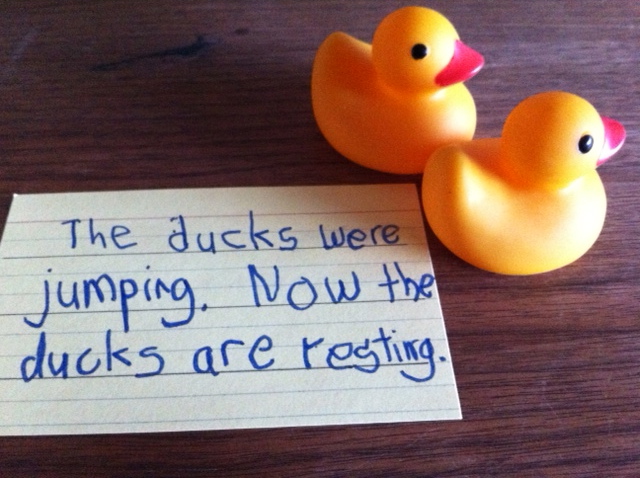
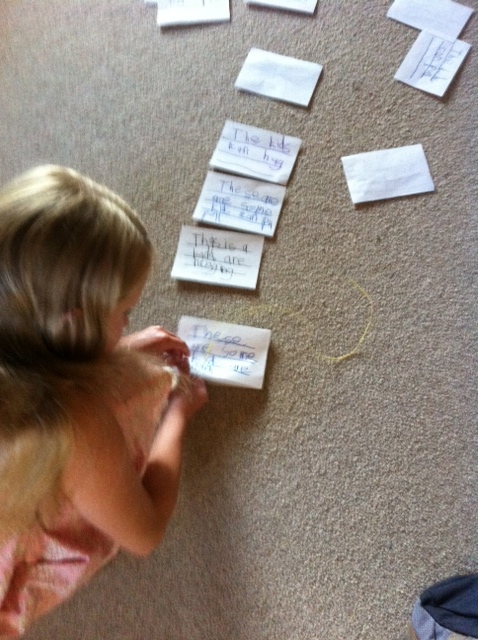
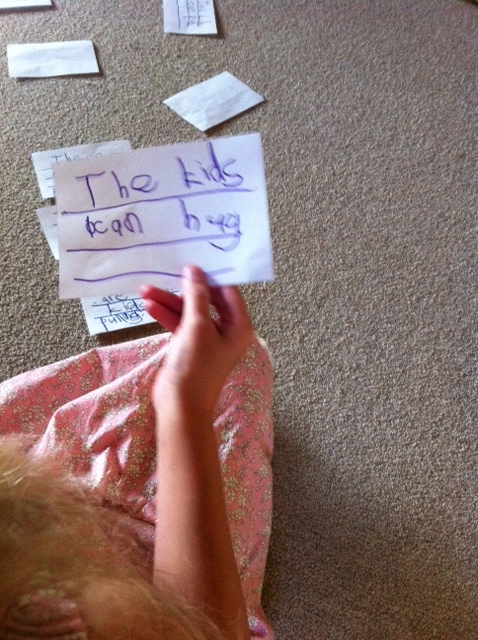
Last night as guests began to arrive, Emma was upstairs in her “study room”, sitting on the floor in her party dress writing.  When I went upstairs, this is what I saw.

She was talking to herself and picking up each piece of paper then reading it before placing it back down and moving to the next.

As we had run out of lined paper, she had made the lines herself, before writing the sentence – The kids can hug.

Now this scene isn’t exactly “normal”, on the other hand very little in our household is.

For more on Emma’s journey through a childhood of autism, go to:  www.EmmasHopeBook.com

Skateboarding – Autism

When Emma was a toddler, she taught herself how to swing by herself.  She thrust her legs out in front of her and then leaned her body forward as she tucked her legs under her.  It was an amazing and beautiful thing to witness.  I remember the first time it happened, we were in the Washington Square playground in New York City.  She pushed me away as she clambered up onto the swing.  I stood just to the side and behind her ready to push, but she shook her head no.  Then she reached down with her toes to the ground pushed off.  A small group of caregivers and parents gathered around as she sailed up higher and higher, so incredible was it that a child of just eighteen months could swing so high unassisted.

That’s how it is with Emma when it comes to physical things.  She has always insisted on doing things herself and while she can take direction, it is often very difficult for her to be taught by someone who relies on verbal explanation.  Emma feels and learns from watching and doing.  So when she put her arm around her brother, Nic the other morning at the skateboard park and said, “Nicky’s turn, then Emma’s turn,” we knew we were going to have to get creative if she was going to learn to skateboard.

We spoke to one of the instructors from Nic’s skateboard camp and arranged a lesson for Emma that afternoon.  When we finally went to meet him, we realized we hadn’t brought sneakers for her to wear and so bought a new pair at the skateboard shop.  They didn’t have any socks small enough for her, so she just wore the shoes without socks, despite my fleeting concern that she would get blisters.  With borrowed skateboard in hand, we headed to the skateboard park, Emma leading the way.

The instructor got her to put on elbow, knee and wrist pads and then together they slid into the bowl to practice foot positioning.  Emma wanted to skateboard though and didn’t want to practice standing on the board.  She wanted to go.

In this way Emma is fearless.

And then the blister on her heel became too painful and she tried to take her shoes off.  From there the lesson took a downward turn and after another ten minutes or so, Emma had had enough.  I am convinced that if we just let Emma experiment on a skateboard for awhile, she’d eventually figure it out on her own.  Just as she did so many years ago on the playground swing, and later with her scooter.  But for now, we will let her dictate how this goes.  If she shows interest in skateboarding again, we’ll try to borrow one for her to practice on.

For more on Emma’s journey through a childhood of autism, go to:  www.EmmasHopeBook.com
Bumps In The Road

Inevitably in life we have all experienced things that have forced us to slow down, perhaps take another route, do things differently than we would have liked.  I think of these things as bumps in the road.  I try to refrain from judging them as good or bad, but just as the way things are.  There are some moments I’m better at achieving this kind of calm perspective than others.  It’s easy for me to feel all that is happening at work is “horrible”, but the truth is, a series of events have been set into motion and I have had to make the decision to fight back, to defend myself or allow another person to harm me and in harming me, harm my family.

Emma experiences her own “bumps” along the way.  Things that happen, which force us to change well laid plans.  Plans she is excited about and is looking forward to.  But more and more, lately, Emma has taken these things in stride.  She is learning to adapt to a world that is often precarious, constantly changing and shifting.  It is a wonderful thing to witness.  We all must adapt to our ever changing circumstances.

Emma makes me happy –  Both my children do.  Try not to smile while looking at this next photograph.

I dare you.  No smiling.  Come on, it’s impossible not to feel a tiny degree of joy, right?  I love that.

Here’s another photograph that can’t help but bring a smile to my face.

This was done yesterday during Emma’s “study room”.  She is writing longer and more complex sentences.  Her reading is coming along beautifully.  Excuse me while I jump up and down with excitement!

So no matter how heinous things get at work, I have my family.  My beautiful, amazing family – and that’s all I need to bring things into the proper perspective.

For more on Emma’s journey through a childhood of autism, go to:  www.EmmasHopeBook.com
Work and Family

Things have been horrific at work.  Tremendous stress and upheaval, but despite it all, my children and family keep things in perspective.  I remember when I first heard the word “autism” and later read how those with this diagnosis tended toward anti-social behavior  I felt terribly sad.  Sad because I thought at the time it meant that Emma would miss out on the things that have made my life most meaningful.  My happiest moments have all been with my family, my favorite memories are all involving family and friends.  But so are Emma’s.  She still asks to go back to California to – “Uncle Andy’s wedding.”  When we’ve told her he won’t be getting married again or at least everyone hopes this to be the case, she says -“Go to California.  Andy’s wedding again?”

We’ve tried to explain that weddings are unusual celebrations, not the sort of thing one does every few years, at least for most of us.  But nothing we say fazes her.  She had such a wonderful time in Napa Valley at my brother Andy’s wedding, she wants to go back, be among my extended family.

My fondest childhood memories are of coming out to Aspen to visit my grandmother.  Her house was brimming with relatives, her brother, my Great Uncle Paul, a number of his children would come for tea every afternoon after skiing.  She had dinner parties, more relatives would descend and close friends were called, “Aunt” and “Uncle” even if they weren’t technically speaking.  The smells of cooking, burst forth from the kitchen, the upstairs always had the distinct smell of moth balls.  I loved going up to her attic and rummaging about through enormous steamer trunks filled with clothing and photographs from another time.

Emma is like me in this way.  She has a phenomenal memory and it is always about people and family that she refers to when she is recalling something she wants to do again from the past.  “Go back to Cape Cod” is one of her more recent requests.  Every summer Richard and I used to go to North Trurro.  We always had friends come and join us, a kind of revolving door of people – there was Kat and Randy, Christian and his girlfriend at the time, Anna.  Emma asks for these people by name, she hasn’t forgotten any of them.

So when things become difficult with work, problems arise, no matter how dire things can seem, it is my family who always bring things back into perspective.

For more on Emma’s journey through a childhood of autism, go to:  www.EmmasHopeBook.com
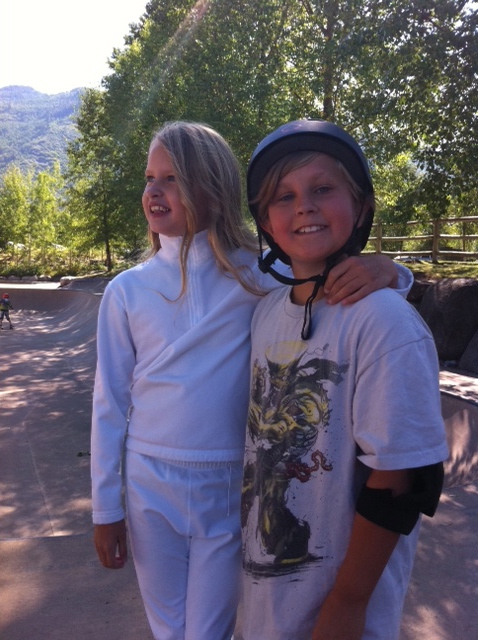
Sunday in Aspen with Emma

Yesterday I spent the entire day with my family.  This was a first since they arrived a week ago.  In the morning I took Emma on the 4-wheeler.  I couldn’t remember how to put the thing in reverse so I made sure we went places which only required forward movement.  The whole shifting gears thing was a bit tricky, so Emma learned quickly that she needed to hold on to me as we galumphed along – something she doesn’t usually do when riding with Richard.

After our ride we took the dogs for a walk.

And on the way we saw this…

Upon further investigation, it turns out it was the desiccated pelt of a coyote or perhaps a deer, hard to tell at this late stage.  My mother evidently found it lying on the path several months ago and hung it on this shrub so the dogs wouldn’t drag it around.  Emma was utterly uninterested and walked right by.

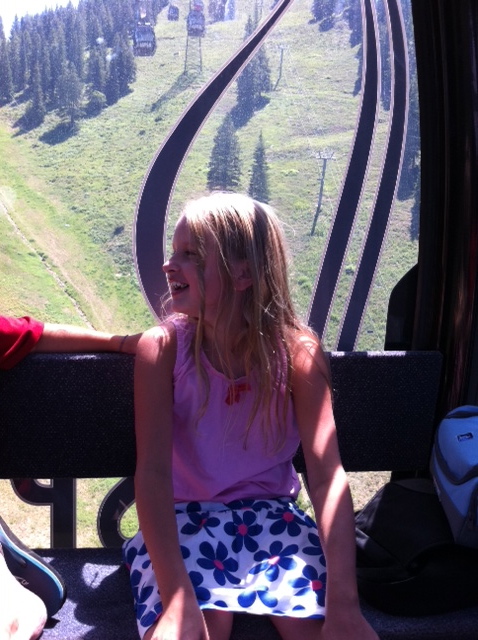
After our walk, we went up on the gondola to the top of Aspen Mountain where a blue grass band played.

On the ride up the mountain, Emma played a game where she went through a list of all our various relatives and added, “cousin” or “uncle” or some other title before their name.  Then she got a little creative and said, “Jungle Andy!”

“No Em!  Not jungle Andy, Uncle Andy,” we said, laughing.

“Uncle Andy,” she responded, then very quickly added, “Jungle Andy!” as we screamed “No!  Not jungle Andy!”  Emma thought this so hilarious that she kept it up for the entire 20 minute ride.  And in truth, it was pretty funny.

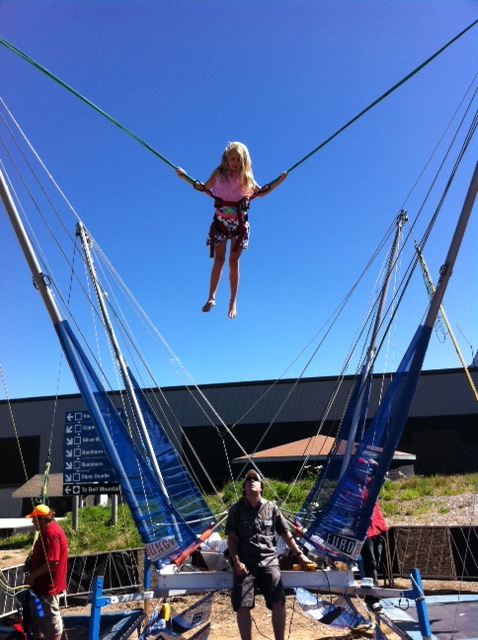
After our lunch on the top of the mountain, Emma stood in line to bungie jump.  The weekends are particularly crowded and so we ended up waiting…  and waiting…  and waiting.  For 45 minutes or more, I lost track of how long we waited.  But finally it was Emma’s turn.

After Emma finished bungie jumping we drove out to the Snowmass Recreation Center and swam in their outdoor saline water pool.  Finally we drove home, changed and went to Takah Sushi for dinner.

Emma was terrific.  Not a single meltdown.  She waited the interminably long wait to bungie jump, she went along with all the plans, even when they changed at the last minute due to things beyond our control.  And at the pool, she showered, washed her hair and then for the first time ever, brushed her own hair, completely, without any help from me.  When we went out for dinner that evening, we brought along her food, she ate with us, then played, making faces and being silly.  When it was time to leave, she ran ahead toward the car, never a protest.

Now that’s a great day!

For more on Emma’s journey through a childhood of autism, go to:  www.EmmasHopeBook.com
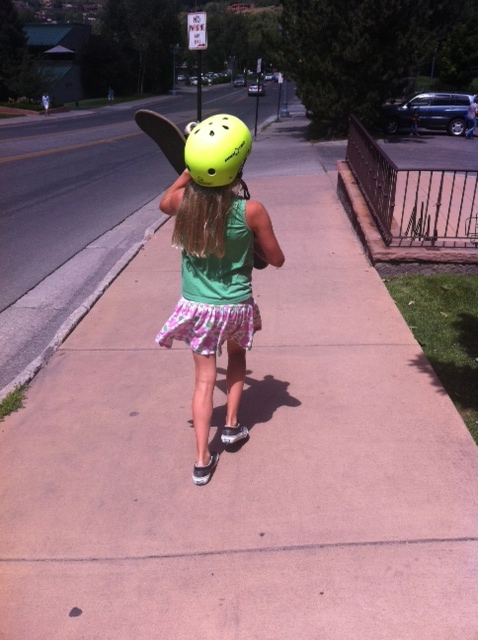
Bliss

I am sitting here writing this, with Emma to my left singing “Three Little Elephants” in Spanish.  Okay, so you might not know that was what she was singing even if you were a native spanish speaking person, but I know the song, because the tune is exact even if her pronunciation is not.  Richard and the children arrived in Aspen last night.  To say that I was pleased to see them, really doesn’t sum up my excitement and happiness.  I am blissfully happy!

Last night Emma was so excited to be here that she didn’t want to go to bed.  As my husband, now to be referred to as the man-of-the-decade (MOD – I tried “century” whose acronym then became MOC and have opted for “decade” simply because of the acronym and not because there’s a time limit on my admiration for him and all he does) was unpacking, I got Em into her nightie and brushed her teeth.  When she finally felt it was time for bed, at around 10:00PM (that’s midnight by New York time) she said, “Time for reading and bed!”

“Are you ready for bed, Em?” I asked.

“Yes.  Mommy come,” she replied.

I am reading a book written by a wonderfully talented friend of ours – Dan Elish – whose book is entitled “The School for the Insanely Gifted” and Emma is enjoying it immensely, as am I.  As I read to her, Emma snuggled up against me, putting her head on my shoulder as I read.  I use to do the exact same thing when my mother used to read to me and it filled me with joy.  When her little body succumbed to sleep I lay with her, not wanting to move, just relishing her head on my shoulder, her body pressed up next to mine.

This morning Nic and Emma woke at the rousing hour of 5:30AM – in part because the dogs began barking at a particularly tenacious coyote who has a habit of coming right up to the house and yelping.  The dogs, in a spectacular display of frenzied aggression twirl around barking and ramming their bodies against the door in an effort to get outside.  My mother’s voice shouting from her bedroom, “be quiet!” does nothing to calm them.  And in fact, may just rile them up further, though I’d never say this to her directly.  The whole thing has a comedic aspect to it – dogs making more noise than one would think possible, coyote howling, children bolt upright in bed, Mom shouting for quiet in a kind of exaggerated stage whisper and Richard covering his ears with a pillow.

Once downstairs Emma and I made chocolate pudding, while Nic proceeded to play his newest composition on the piano.  By the way – Piglet – if you’re reading this – any tips on how to keep the instant pudding from turning into soup after an hour or so in the frig?  I think it has something to do with the altitude, as this doesn’t happen to us in New York.  But I digress…  After making pudding, Nic proceeded to demonstrate his newly acquired skill of blowing bubbles and Emma went upstairs only to return wearing her bathing suit.  “Time to go to the indoor pool!” she cheerfully announced.

Nic proudly blowing a bubble

The aftermath of another bubble

“But Em, it’s not open yet.”

“We have to wait.  Then going to go to the indoor pool, jump off the diving board, go down the slide, go in the carousel.  Go with Mommy?”

“I can go later today or tomorrow Emmy,” I told her.

“Okay,” she said.  “Mommy has to work,” she added in a serious tone.

“How about getting dressed so you’re all ready to go?”

Emma returns wearing her swimsuit and clothing over her suit.


“Playing bells,” Emma explained as she pounded on the keys of the piano.

Everyone is together and I am in bliss.

For more on our crazy family and Emma’s journey through a childhood of autism, go to:  www.EmmasHopeBook.com
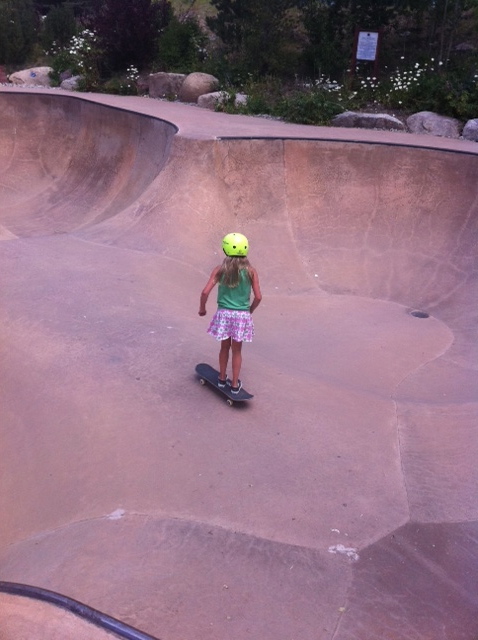
These Last Few Days

Every day for the past month, Emma has gone on the bus to summer camp with her brother, Nic and her therapist Joe, shadowing her.  Joe tells me this year has been terrific.  Emma has tried new things, been engaged and interacted with the other children more than the year before.  Today is their last day before coming out to join me in Aspen.  Because it’s their last day, Nic told me, they can do whatever they like.  Nic said he was probably going to play soccer, practice his archery, swim “a bunch of times” in the the lake and do gymnastics.

I am interested to hear what Emma will do.  When I called last night, she was with Joe in her “study room” so I couldn’t speak to her to ask.  Not that I would have gotten a clear answer.  The future and past are difficult concepts for Emma to express.  I never know when I speak with her if she’s referring to something she wants to do, did do, will do in the future or wished she could have done in the past. Despite my confusion in regards to what time frame is being referenced, Emma is usually without complaint.

Emma at camp – 2011

Every afternoon upon returning from camp, Joe and Emma go into her “study room” where she works on her literacy program.  I haven’t worked with her for the last ten days, so I am eager to see how she is coming along.  Emma’s literacy program, perhaps more than anything else, has caused a significant shift, in Emma, but also in me.  The progress she’s made since this January when she was just learning to form her letters, to now, where she is writing one and two sentences, is tremendous to see.  But I also feel she is gaining a certain degree of self confidence.  Working with her has been incredible as I know how hard it is for her, but she continues to do the work anyway.

Sleep, wake up, sleep, wake up, go on the airplane and see Mommy!

For more on Emma’s journey through a childhood of autism, go to:  www.EmmasHopeBook.com
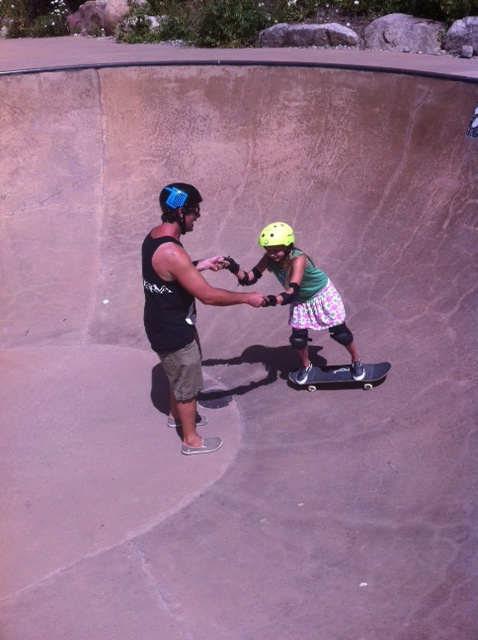
A Phone Conversation With Emma

Speaking on the phone with Emma has always been challenging.  She tends to forget that there is a person on the other end and often walks away, leaving the phone dangling there before someone either abruptly hangs the phone up, not realizing I’m still there or answers it in a harried sounding voice.  Sadly, since I’ve been out here in Aspen working, both my children and husband remain in New York City, so the only communication I have with any of them is by phone.  This morning I called before the children left for camp – which meant calling them at 5:45AM Rocky Mountain time.  The following was my conversation with Emma.

A rustling sound followed by, “Hi Joe!”

“No, Emmy.  It’s me, Mommy.”

“Oh!  Hi Mommy!”

“How are you Emma?”

“I’m fine.  Have so much fun at camp.  Last day.  Last day summer camp.”

“Two more days, Em.  You have two more days and then it’s Saturday and then you and Daddy and Nicky and Jackie fly out to Aspen!”

“No more summer camp.  Fly to Granma’s house!”

“That’s right Em.  I can’t wait to see you.  I miss you so much.”

Silence.

“I’ll be at the airport, Em, waiting for you guys.  I am so excited to see you.”

Silence.

“Emmy, have you enjoyed camp?  What are you doing there today?  Anything exciting?”

Silence.  Then humming.

“Emmy?”

More humming of a carousel song – whose name I cannot remember.

“Hey Em?”

More humming and the sound of her moving away from the phone until the humming was from far away.

“Em?”

“Oh hi honey.  She took off.  Nic wants to talk with you though.   He was going to call you this morning,”  Richard said.

I then spoke with Nic who informed me that he missed me and Emma did too.  He now knows how to blow bubbles from a single piece of gum, a proud accomplishment and something he had become convinced he would never be able to do.  He’s practicing his Alto Sax and loves it, is playing the piano and is working on a blues composition for it, while learning the guitar, so he is not as good at it, but is still enjoying it.  The sax he is shipping out to Aspen so he can practice while out here and his skateboard he intends to leave in New York.  He explained to me that he plans to buy another one for Aspen so he’ll have one here as well as in New York.  He requested that I find him a bail of hay so he can set up a bulls eye to practice his archery, which I’ve promised to look into.  As he told me all of this I could hear Emma in the background, talking, singing and laughing.  I could hear that Joe had arrived.  As I spoke to Nic, mining him for more information there was silence.

“Hey Nicky!”

Silence.

“Nic!”

Silence.

“Nic!  NIC!”

“Oh yeah, Mom?”

“Nicky, I was talking to you.”

Sorry.  Joe’s here, playing with Emma.  I got kind of distracted.”

Shrieks of laughter were then heard along with running and more laughing.  Talk about feeling out of the loop!  But also relieved everyone is having a good time and I will get to see them in another four days.  Just four more days…

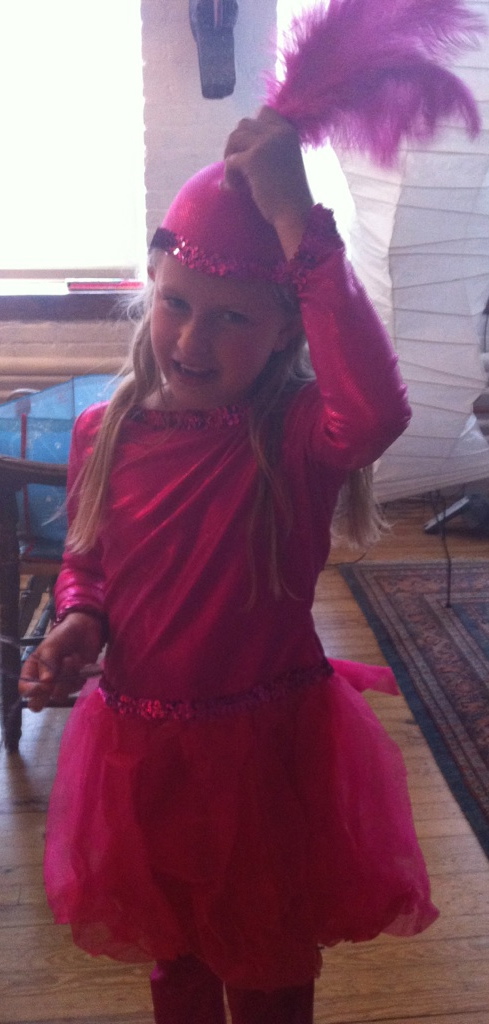
Emma in her Pink Flamingo costume

For more on Emma’s journey through a childhood of autism, go to:  www.EmmasHopeBook.com
Labels – Autism

Labels are easy, they’re shorthand for what we want to communicate and yet they often obscure what is really being said.  (These are the things I think about when I’m away from my family for an extended period of time, as I have been, since coming out to Aspen because of work. All of this reflection will end in another four days, because the children and Richard will be joining me out here this Sunday – Hurray!)

We say things like – “oh he’s schizophrenic,” “she’s bi-polar,” “she’s anorexic,” “he’s an alcoholic” and the meaning gets conveyed and yet, is it?  After all that’s not ALL the person is.  It’s something they have been diagnosed with, perhaps are struggling with,  it’s a medical term, but it does not encompass who and what that person is in their entirety.  When I hear someone describe another person as “autistic” I understand that person has been given a diagnosis of autism, but I don’t presume to know much more about that person.  For example, I won’t know if this particular person diagnosed with autism can speak, read or write, they may have other issues, physical issues, other diagnoses added on to further illuminate, but the labels begin to overwhelm the actual person.  I can’t know from the various labels whether the person has a sense of humor, if they have terrific eye contact or no eye contact, whether they cringe at physical contact or whether they seek it.  The word “autistic” does not give me any clues as to whether the person is gregarious or shy, enjoys reading about painting or knows everything there is to know about quantum physics.  The label does not tell me about the person’s passions, dreams, desires or talents.  If I knew nothing about autism, having someone described to me as such might cause me to presume a great many things.  Things I would be completely wrong in assuming.

In my daughter, Emma’s case, the labels are almost always unhelpful.  I use them, it is shorthand after all, but they reduce her to something that doesn’t help people know her or understand her.  For example, Emma has a terrific sense of humor, she loves playing jokes, being silly, making faces, repeating things in a way that will guarantee a laugh.  When I use the word autism, or say to someone – she has autism – it’s the best I can do in a short period of time.  It’s a little like when we say to one another – “How are you today?”  The answer we all know to give is:  “I’m fine, how are you.”  Even if we aren’t fine.  Can you imagine if you asked that seemingly innocuous question and the response was:  “You better take a seat, this may take some time.”

I avoid using the word “autistic” because it implies more to me, than saying “she has autism.”   It’s a subtle distinction, but to me, anyway, it’s there.  Emma is so much more than a diagnosis.  She is pure Emma. And Emma is complex, just like the rest of us.  She is funny, a talented singer with a beautiful voice, she has a personality and temperament that are unique to her.  She loves to run and swim and swing her arms and zip around on her scooter.  She enjoys being read to, sung to, and any game that involves running.  I dislike that her diagnosis takes up so much room in people’s minds.  I do not like that when people hear she’s “autistic” they make assumptions about her, almost always incorrect.

Can you imagine what the world would be like, if all of us took all these labels, our shorthand for communicating and tossed them out the window?  We would live in a world, which would make prejudice and judgements much more difficult to come by.  We would have to live in the discomfort of not knowing.  But what a great way to live!

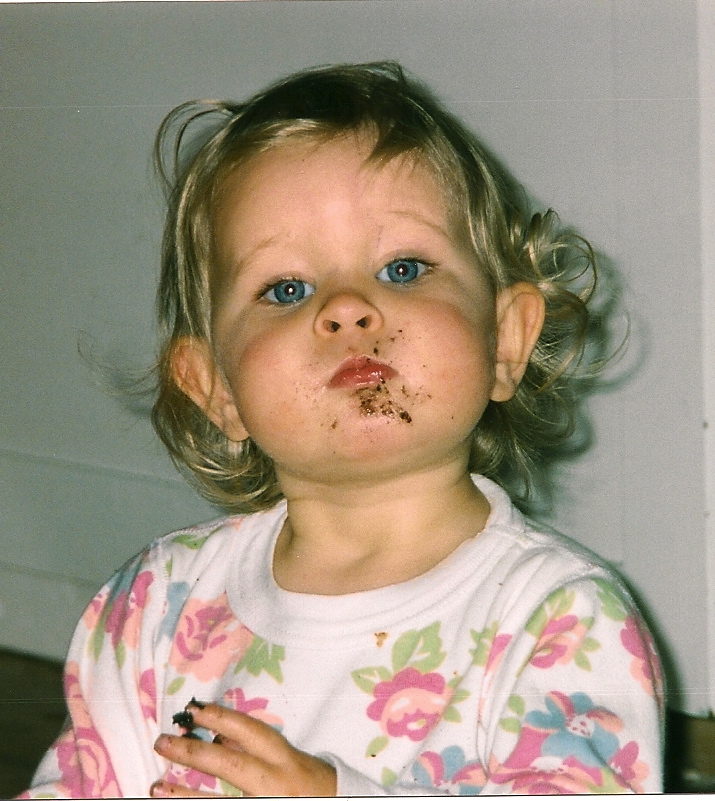
Emma – 13 months – eating a brownie.

For more on Emma’s journey through a childhood of autism, go to:  www.EmmasHopeBook.com