Tag Archives: Autism

Feelings

Emma’s friend, Charlie was upset yesterday.  No one knew what was wrong or why he was so sad.  However Emma went over to Charlie and comforted him.  These are the kinds of things parents are always pleased to hear.  As our children grow older, we come to expect such displays of empathy, even questioning our children when they do not respond this way.

In 1985 Simon Baron-Cohen developed a theory he called mindblindness, suggesting that children with autism have an impaired ability to make sense of others and their own feelings.  He has since amended mindblindness to E-S theory (empathizing-systemizing theory.)  Many people, when confronted with an autistic person’s inability to acknowledge or respond appropriately to their emotional state, assume that person does not care.

Before Emma was diagnosed, I learned of a friend’s death and was crying.  Nic ran over and immediately asked what was wrong and why was I crying, while Emma continued to look at a book.  At the time I thought she was more interested in her book or perhaps didn’t notice I was upset, but I remember feeling a certain uneasiness about, what I believed was, her lack of empathy.  As I have read more about autism and the problems in reading people’s emotions, I see her non-responsiveness as an inability to make sense of  my emotional state rather than indifference.  As Emma grows older, she has become increasingly curious about emotions of all kinds.

“Rip Good Night Moon, make Becky angry.  No you cannot rip Good Night Moon!”  Emma has said, referring to something that happened well over a year ago at her school.  One of Emma’s favorite books is “The Way I Feel.”   A book describing emotions with illustrations reflecting those feelings.  When Emma’s brother Nic is upset Emma, much to Nic’s annoyance, will attempt to make sense of Nic’s upset. “Nicky’s crying.  Nicky wants to go on the carousel,” Emma will say.  Or “Nicky’s angry.  Nicky doesn’t want to go to bed.”  Emma will apply her own reasons for being sad or angry with things that make her feel those things and becomes confused when we explain that Nic is upset or angry about something entirely different.  Still, she is doing her best to make sense of what she is seeing.  She will almost always try to comfort Nic, even if she has come to incorrect conclusions regarding the reasons for his feelings.

For more on Emma’s journey through a childhood of autism, go to:   Emma’s Hope Book

A Marathon

“It’s a marathon, not a sprint.”  This is a quote from Richard who said that to me one day many years ago.  At the time, we were leaving the office of one of the many doctors we had taken Emma to.  Those were the days when I still fully expected someone to produce the “secret thing” that would cure her.  Like some sort of closed, clandestine group, that if I just knew the secret password, Emma would be allowed to walk past the door labeled “autistic” and enter the one labeled “Neuro-typical” for better or worse.

I had a brief moment during my adolescence when I ran the mile, while my friends were running the 50 or 100 yard dash or sitting on the sidelines, munching on potato chips, I was doggedly doing laps around the quarter mile track at our local school.  I would set a pace for myself, not so fast that I was immediately out of breath, but not too slow that I was able to carry on a conversation.  And I’d stick to it.  Determinedly, often with my head down, listening to my breath, in, out, in, out.  Some days every step was a slog, as though I were wearing cement filled sneakers, my breath labored, every muscle ached, I would think about stopping before I’d hit the mile mark, but other days were bliss.  As a teenager I ran longer distances. I kept running for years just to experience those days when it all felt easy and right.

Just breathe.

For more on Emma’s journey through a childhood of autism, go to:   Emma’s Hope Book

A Moment of Levity

Yesterday, having successfully arrived in Denver and found our gate for the connecting flight to New York, an announcement told us of a short delay.  Emma, who was looking at her book – The Way I Feel – looked up and said, “Angry!  I am so angry!”  As she was on the page in the book describing anger, this was not surprising, however, the gentleman sitting next to her had no way of knowing the context for her words and so looked over at her and said, with an exasperated air, “Yeah, me too!”  Emma then scowled, to show off her angriest face, the man then scowled back before both of them began to laugh.  As I watched this interaction, I realized the man was with his wife and grown daughter, who were sitting directly across from us, both of whom were laughing so hard they had tears running down their cheeks.

Both our flights were, thankfully, uneventful.  We arrived in New York after 11:00PM where it was zero degrees with the wind chill, having left balmy Aspen, Colorado where it was in the upper forties.  Go figure.

For more on Emma’s journey through a childhood of autism, go to:   Emma’s Hope Book

Prepping Emma

We are flying back to New York City today.  As with most outings, we prepare her in advance.  Emma has become more aware of time in that she has been counting down the days until we fly home.  “Last day at the indoor pool,” she will say under her breath or “That’s it, no more skiing.  That was the last day of skiing.”

For the past week or so she has increasingly talked about going back to school, mentioning her friends and teacher and made references to things she wants to do in New York and the people she expects or would like to see.  Yesterday she helped clean up and gather her things to pack.  “Time to go back home,” she said at one point.  One year we were fortunate enough to be invited to fly in a friend’s private plane.  For the next few years Emma said, “Take just one plane,” with the hope that we would, once again, be able to fly straight from New York City to Aspen without stopping or going through the long lines of security and dealing with the large airports with their many delays and flight cancellations.

We walk her through the day by saying things like, “We leave on Tuesday, Em.  We’ll drive to the airport and say good bye to Granma.  Then we have to check our bags and go through security.  I will probably be pulled aside, so you’ll need to stay with Joe, Daddy and Nicky at the gate until I can join you.”  Often during this, Emma will join in, “We have to get on the airplane and fly up, up and then land at the other airport.”

We go through as much as we can with her, but there are inevitably issues which arise that we have no way of anticipating such as running into people we know, flights getting cancelled, luggage getting lost, alternative routes needing to be taken because of unforeseeable weather conditions, etc.  We do our best to make contingency plans, but fortunately Emma is a great traveler and most of these things she will take in stride.

I have seats all together today, so unless they change the aircraft on us, we should be able to sit altogether.

“We have to take a taxi,” Emma said, as I was going over our schedule this morning.  “Then we get to go through the tunnel and go home!” Emma said before running downstairs for one last morning of chocolate chip pancakes.

For more on Emma’s journey through a childhood of autism, go to:   Emma’s Hope Book.com

The New Year

I asked Nic this morning if he was looking forward to anything in particular in the new year.

“To sleep in,” he said with a grin.

“Really?”

He laughed, wryly (I might add) and nodded his head.

What I didn’t say, but thought, was – We’ve been on vacation since the 16th!  You could sleep in every morning if you wanted.  But Nic likes sleeping near his Granma and so has set up a little bed in her office for himself on her foldout couch with the promise that he make up his bed every morning, which he has.

“Hey Em.  What about you?  Are you looking forward to anything in the new year?”

Emma ignored me.

“Do you know what it means to look forward to something?” I tried again.  “It’s when we feel excited about something that hasn’t happened yet.”  I waited as Emma who had turned her back to me, continued to twirl her string that she has now “repaired” every morning since we’ve been out here.  The “string” resembles a snow board in the middle with long, thin tentacles coming out of the repaired part.  She holds onto the fat, taped part and twirls it in her hand very quickly.  “Hey Em,” I tried again.  “Are you looking forward to anything?”

“Yeah,” she said, staring out the window.

“What?  What are you looking forward to?”

“Uncle Victor and Aunt Susan took a train home,” Emma said, nodding her head, twirling her string and looking sad.

“Does that make you sad?”

Emma looked at me with such a sad expression and nodded her head.  “Yeah.”

I continued to ask her in various ways if there was anything she was looking forward to or wanted to have happen in the coming year, but Emma walked away or ignored me, until I finally stopped asking.

People have likened Emma to a two-year-old, but this is incorrect.  For one thing it vastly underestimates her and for another, it oversimplifies every aspect of her.  Emma’s mind is capable of some fascinating leaps, she will come out with incredibly creative ways to communicate – such as when her teacher, Lauren every Friday dresses up as “Laurenzo” and so Emma began calling herself Emmaenzo, which she (and everyone else) thought hilarious.  It is easier to think of a child like Emma as a “two-year-old” and leave it at that, but it does her a great disservice.  I continue to insist her mind is far more complex, holds all kinds of interesting thoughts and I insist on this thinking because I have seen too many nonverbal children with autism display staggering intelligence, but who are treated by many as though they are “two-year-olds” or worse.  I have read the poems and stories they have written.  These children and adults are profoundly intelligent, but their thinking and their difficulties in communicating are so vast most of us do not have the patience or interest in hearing from them.

What I wish for, what I look forward to in the new year is for all of us to increase our awareness of our possibilities.  We are capable of so much, whether it is an act of kindness toward another or withholding our judgements when we are annoyed, looking to our potential or assuming the best in one another instead of the worst.   If I could wish one thing for both my children, it would be that they realize their potential, and now come to think of it, I wish that for myself too.

Happy New Year!

For more on Emma’s journey through a childhood of autism, go to:   Emma’s Hope Book

Anniversary

Eleven years ago, Richard and I were married.  As usual we were a bit unconventional in the way we met, dated, had our first child, then lived together and finally were married.  We were married in a beautiful, old, though dilapidated, building in New York City, which also happens to be the oldest  synagogue in New York City.  (Neither of us are jewish, the building is no longer used for religious purposes, but instead is rented out for performances, parties, Spike Lee filmed a music video in it and other events.)  The day we were married, New York City was in a blizzard.  The black limo we’d ordered never arrived.  Meanwhile Richard had gone ahead with most of the other wedding party.  I was with Nic and my sister, on the phone, yelling at the car company, demanding they send a car, any car to take us downtown.  When the car finally arrived, they’d sent a white, stretch limo.   I remember I turned to my sister and said, “I feel like I’m going to a prom.”

“Let’s just go,” she pleaded with me.

We were over an hour late.  When we arrived Richard said, with his usual dry sense of humor, “I was wondering if you were going to show up.”  As my mother’s cousin, Peter led me down the aisle I kept my eyes on Richard, so handsome in his tuxedo and mouthed, I love you.  My entire family were there, Nic, then nine months old and wearing a little velvet tuxedo was in the first row.  Emma would be conceived in another few months.  We had no idea of the events that would unfold in the coming years.  We couldn’t know the feeling of unadulterated joy at the birth of our daughter, Emma, just two years later or our pride in watching our son, Nic play his Alto Saxophone in the winter concert at his school, just a few weeks ago.   All those moments, millions of moments when events played themselves out.

It was 15 below zero and the basement of the building where we had a quartet set up to play after the ceremonies, played with their down coats on and fingerless gloves.  You could literally see your breath it was so cold, still even in the freezing cold, it was beautiful.  Richard reminded me to stop every twenty minutes or so to just take it all in, because this night, this moment would all be gone, before we knew it.

Eleven years later, Richard still has to remind me to stop and breathe, enjoy the moment because it is all so fleeting.  But I do, we do.   We have a good life: two beautiful children, a wonderful extended family, dear friends, a good, strong marriage, our love for one another and this moment.

Our wedding – December 22, 2000

For a more detailed look at Emma’s journey through a childhood of autism, go to: Emma’s Hope Book


Dining Out

Dining out, as a family, is something we rarely do.  Which is all the more incredible since we live in New York City, a city known for it’s fabulous and wide range of restaurants serving food from every place in the world.  The few times we’ve eaten out, we would prepare and pack Emma’s meal and bring it with us.  We have taken Emma to only a few restaurants in her life because the whole process of trying to keep her occupied while we tried our best to enjoy “dining out” wasn’t easy and frankly, took the pleasure out of it.  But now, since Emma has become more willing to eat a few more foods, we told her we were thinking of going to a restaurant to eat.  We gave her the choice of coming too or staying home.

“Go together!” Emma said.

There was a certain degree of finality to her voice when she said that, so I said, “Okay.”  We decided to go to Boogies, the local diner and kid friendly restaurant here in Aspen.   Boogies is upstairs from a clothing store, so it’s brightly lit, has loud rock and roll music playing and lots of families with little kids running around.  I went over the outing with her, just so she understood we would not bring any food for her to eat, that she would have to find something from the menu.  Having a vague idea of what Boogie’s menu offers, I told her some of the foods she could have – hot dog, hamburger, chicken fingers, mac and cheese, grilled cheese sandwich.

When we arrived at the restaurant, we were able to get a large table in the back.  “Chicken nuggets and grilled cheese sandwich?” Emma said, in her questioning way that isn’t really a question, but just sounds like one, while nodding her head.

“You want both?” I asked.

“Yes!”

Joe, Richard and I looked at each other, shrugged and ordered her what she asked for.

“And apple juice?” Emma said.

Nic, meanwhile, ordered a hamburger and one of their famous chocolate milkshakes.  They always bring their milk shakes in a tall glass lathered with whipped cream and a cherry on top.   The metal container they make the milk shake in is brought too, holding the excess shake and a long handled spoon.  Emma saw the whipped cream and immediately tried to scoop it off Nic’s drink with her fingers.

“Em!  That’s Nic’s milk shake.  You can have one too, if you want.  But you can’t take his whipped cream,” I told her.

“It’s okay Mom.  She can have some of the whipped cream.” Nic offered his sister a spoonful, which she greedily grabbed from him.

“Do you want your own, Emma?”

Emma vigorously shook her head no and took a sip of apple juice.  Then she blew bubbles with her straw into the glass of apple juice, spraying herself before we could stop her.  When the food arrived, Emma dug into her melted cheese sandwich, ate most of it and tried a tiny bite of the fried chicken.  Each time she ate or drank anything Nic would look over at me with an expression of astonishment, while I nudged Richard, whispering, “Look!  Look at Emma!”

It was wonderful, all the more so, because my mother was with us too, making it a truly fabulous dining experience together, with the whole family.

For more on Emma’s journey through a childhood of autism, go to:   Emma’s Hope Book

“You

Emma Makes Breakfast

Yesterday morning Emma was up and in the kitchen by 6:30AM.  This was late for Em.  For the past two mornings she was up at 5:00AM and 4:00AM.  I was grateful for the extra few hours.

When I went downstairs I saw Emma.

She seemed to have everything under control, so I just followed her around taking photos as she worked.

There were a few minor spills, but nothing she wasn’t able to clean up on her own.

She was well organized.  All the ingredients she needed were laid out.

She even sang a little song as she worked.

“Mix, mix, mix the pancakes, mix, mix, mix the pancakes, mix, mix, mix, mix, mix!”

She tasted it, to be sure it was good.

I helped pour the batter onto the grill.

But she took it from there.

Pancakes!

It’s good to be home.

For more on Emma’ journey through a childhood of autism, go to:   Emma’s Hope Book

Flying to Colorado

We flew to Colorado for the holidays last Friday.  When I booked our reservations I tried to get all of our seats close together, but despite my most dogged attempts, getting five seats together just wasn’t possible.  Still I was fairly optimistic as I had managed to have Richard and Nic together in the row in front of Joe and Emma with me just needing to trade my window seat for an aisle seat in the same row but on the other side of the plane.  When the gentleman who had the aisle seat next to Joe and Emma, the seat I was hoping to trade him for, arrived, I explained that we were trying to sit together and would he mind terribly if I traded my lovely window seat just two seats over for his aisle seat.  No, he told me.  He was not willing to do that.  He then told me that he had a grandson with autism and felt for my predicament, but couldn’t trade seats as he didn’t like sitting near the window.  Not discouraged I asked the woman in the other aisle seat of that same row if she would mind terribly moving over just two seats to the window seat, thus letting the gentleman occupy her seat, while I occupied his.  (I know this is beginning to resemble a Shakespearean novel with a vast cast of characters.  I should have tried to download a seating map for this post.)  The woman, barely looked up, avoided any eye contact and said flatly, “No.” She then proceeded to read her book about the Palestinian/Israeli conflict.  By this point, all the passengers within three rows of us, were aware of what was going on.  Undeterred, I asked a few more people seated in an aisle seat if any would mind trading with me.  I was rebuffed each and every time.  At this point with my options becoming fewer, I decided to try and solicit the help of a flight attendant, though in the past this has never proven helpful.  Never-the-less off I went in search of a flight attendant while the gentleman took his seat next to Joe and Emma.  As I headed up the aisle another man, sitting several rows behind us, said he would trade his aisle seat for my window seat.  As the trade took place he leaned over to the first man and said, “You know, you could have helped her out.”

I thanked the man profusely and asked if we could buy his lunch.  He declined, said he flies at least once a week and it was no big deal.  I thanked him again and sat down.  Joe and I have been reading some material about speech and literacy, so we began to discuss how we might best apply what we were reading to our work with Emma.

About an hour into the flight, the man whose seat I was now occupying leaned over to me on his way back to his seat and said, “Forgive me.”

“Please,” I said, “don’t worry about it.”

“No.  I should have given you the seat.  It was wrong of me.  That man who volunteered, I’m proud of him.”

“Thank you for coming over,” I said.  And he sat back down.

A couple of things I keep coming back to, are not so much how people are not willing to move their seats, I understand it’s a pain.  Traveling has become hellish, everyone has just been through security lines, removal of shoes, waiting, standing in line and finally they get to their seat, the last thing anyone wants is to be asked to move.  I hadn’t realized the window/aisle conflict was such an issue.  I had thought as long as it wasn’t a middle seat it wouldn’t be hard to trade, but clearly this was incorrect.  But it made me think about the airlines themselves.  Is there not something the airlines could do for families traveling with children with disabilities?  I don’t know the answer to this question.  I don’t know how they could help, but it does seem that the airlines would do well to at least have an awareness that this is a growing problem.  We go through some sort of problem almost every time we travel.  I have gotten better at choosing seats that, while often not together, are at least seats people might be willing to trade.  But every now and again my best laid plans run amok.

The Rockies

For more on Emma’s journey through a childhood of autism, go to:   Emma’s Hope Book

The Dentist

“Go see new dentist,”  Emma said, when I told her she had an appointment.

I am always unsure what Emma intends when she makes statements like this.  Does this mean she doesn’t like her dentist?  She wants to go to a different dentist?  For some reason she is associating him as the “new dentist” even though she’s been seeing him for the past four years?  Or is she saying this for some other reason I have yet to figure out?

“You have an appointment with Dr. L.”  I waited to see if she would respond.  “Do you like Dr. L.?”  As I asked her this I thought about the question.  This is the guy who put a mask over her face and asked her to breathe in fumes until she was unconscious in the hospital to fill two cavities a few years ago.  His was the face she saw when she came to with a sore throat from having a tube put down it.  This was the man who was responsible for the two metal caps on her teeth, the metal caps that, upon waking, she tried to physically pry off with her fingernails.  Was that really a fair question?  Why would she like her dentist?  I’m not even sure I like him.  Okay, so that’s unfair.  I am grateful to him.  He’s a good dentist, he is kind and respectful of her.  He tells her what he’s going to do before he does it, even though he has a habit of asking her if she’s okay when he’s got both hands in her mouth and she clearly cannot speak in any recognizable way.  Or if she tries to nod her head yes, he then tells her to hold still.  I think they must teach this at dentistry school as a way of keeping the patients mind off of what’s actually happening.  I’ve never met a dentist who didn’t try to carry on a conversation while you sit there with a bunch of tools and hands in your mouth.  Doesn’t anyone ever tell them?   We cannot answer you.  Can’t you see our mouths are open and we are unable to speak?

But let’s get back to the appointment – Emma ran into the office, saw a stuffed beast of some unidentifiable species with a full set of teeth and plopped herself down in the chair while cradling the stuffed thing in her arms.

“What is that?”  I asked, trying to figure out if it was a horse, a giraffe or something else.  Frankly it was creepy whatever it was.  The full set of teeth looked frighteningly real, as though they’d been plucked from some poor unsuspecting person’s jaws.

“I don’t know,” the dental hygenist answered.

“Monkey,”  Emma stated matter-of-factly.

Case closed.

This from a child who does not typically show even a passing interest in toys of any kind, including all manner of stuffed animals.  But for whatever reason, this thing had captured her fancy.  Emma sat still holding the toothy “monkey”  while the dentist explained how her teeth are particularly porous and so food tends to adhere to her teeth, meaning it is essential she floss better than she already does.  In other words we need to help her more than we are.  She tolerated having her teeth scraped, her gums poked at and then her teeth cleaned with a bubblegum flavored toothpaste.  She let the dentist spray her mouth with water and allowed them to use the little hose that sucks all that water out again from her mouth.  For the first time the technicians were even able to take x-rays that resembled teeth and not a blurred image one might see in a Chelsea art gallery.  Emma brought the “monkey” in with her for the x-rays.

I was told some teeth (including that shark tooth) would have to be pulled, but we need to make an appointment with the orthodontist when we return from Colorado in January.  We will have to revisit the whole braces idea at that time too.   And throughout this whole process I kept thinking about how our insurance won’t cover any of this.  The good news is – she didn’t have a single cavity.

At the end of the appointment Emma put the monkey back on the shelf and said, “Bye, bye monkey.  It’s time to go home now.”  Then she skipped out, waving to everyone as she went.

For more on Emma’s journey through a childhood of autism, go to:  Emma’s Hope Book

Progress

A couple times a year we are called into Emma’s school to meet with her teachers to go over her progress.  There were a couple of things that stood out this morning during our conference.  The first was a video showing Emma playing with another child in her class.  She says his name and the two of them hug each other and laugh.  This goes on for quite some time, with Emma saying things like – “Hi Charlie!  Say hi.”  Then she waits and when Charlie, who is nonverbal, doesn’t respond, she prompts him by saying, “Say hi Emma.”  She takes his face and gently turns it so he’s looking at her.  Then he says, “Hi Emma!”  and they both start laughing .  It is one of the most uplifting videos I have ever seen.  In another video she negotiates with a different child something that she wants to do with the child and her therapist, but the other child at first does not want Emma to join them.  They go back and forth and eventually Emma says, “Please, please I want to go together.”  The other child relents and the video shows Emma, the other child and the therapist dancing down the stairs with Emma singing, “Together!  Together!”  It is adorable and shows tremendous progress.

For more on Emma’s journey through a childhood of autism, go to:   www.Emma’s Hope Book

An Epiphany

I was thinking about progress, Emma’s specifically.  Through the literacy program we embarked on just exactly a year ago now, Emma is reading and writing in full sentences, we are also working on comprehension.  Her language is beginning to change as a direct result of all of this work.  As I was thinking about this yesterday, I realized something that probably seems obvious.

Drum roll please.

If Emma continues to make the sort of progress she’s made in the past year, we have nothing to worry about.

(Richard is yawning right about now.  He has maintained this for years and continually reminds me of it, but when he says it, it seems hard to believe.  Okay, now he’s rolling his eyes and probably has walked away.)

I know this may seem like less an epiphany and more a random thought that anyone who’s been reading this blog will have come to, and probably quite a bit sooner than I have.  But here’s the thing.  Sometimes I am just too close to it all.  I’m in the trenches, working with her, everyday, observing and noting.  But pulling back, taking the longer view, seeing Emma from a distance, well, it’s just much harder for me to gain that perspective.  Whenever I am able to and do though, I can see how far she’s come.  I am filled with excitement with her progress.  And yes, it feels as though I’ve had an epiphany.

Unfortunately I have a short memory.  So it’s important I write this down.  Maybe I’ll even remember to reread this post some day when I have forgotten and am feeling discouraged again.

On April 9th, 2011 we began her first literacy session.  We began with the word “sit.”  Prior to that we had worked on letter formation and sequencing with colored tiles.  From that day in April, Emma is now writing sentences in answer to questions such as – “What is this?”  “What is she doing?”  “What does she want to do?”

This is a sample of Emma’s writing answering those questions from this morning’s “literacy session.”

For more on Emma’s journey through a childhood of autism, go to:   www.Emma’s Hope Book.com

There’s Always Hope

There’s hope and then there’s desperation.  Often I am not sure which one is pushing me more.  The feeling that with each year Emma grows older, the farther she is from her neuro-typical peers or the knowledge that others have progressed and come so far, therefore so shall she with various interventions.  At what point does hope turn into desperation?  At what point do you say, okay this is crazy, let’s stick with what we know works and stop pursuing the next treatment option.  How do you quell that irritating voice that is always urging you on?  Or am I being presumptuous?  Perhaps that voice is MY voice and not shared.  I always look to the couple of parents I know whose children have made massive leaps in progress.  The ones who have bypassed Emma, what did they do, that I haven’t?  And many times it seems to be a combination of things they did, often things we’ve tried, but that haven’t helped.  I even found myself saying this morning – I’ll keep this appointment with the thyroid doctor, but after this, no more!  That will be the last alternative thing we try.  But I’ve said this before.  I said that after the stem cell treatments.  I said that after the QiGong Master and again after the homeopathic doctor.  I’m pretty sure I said that after the Cranial Sacral/Shaman too, but I can’t remember for sure.  It’s my own version of Emma’s carousel.  Around and around we go, where will it stop, nobody knows.

This morning I stood in the shower with Emma, coaching her on washing her hair and body.  We’ve done this countless times before.  “Okay Em.  Grab the shampoo.”  Wait while she takes the bottle of shampoo, opens the top and pours some into her hand. Wait to see if she will lather the shampoo all over her head or just on the ends.  “Good, Em.  Now make sure you get the shampoo all over your head too.”  Wait.  “Go like this Em.  Do what I’m doing.”  Demonstrate how to get the shampoo lathered all over, including the hair just behind the ears.  Wait to see if she’ll do this on her own.  When she does not, help her.  “That’s great Em.  Now rinse the shampoo out of your hair.”  Wait to make sure she gets all the shampoo out.  “You have to rinse it all out, Em.  You have to make sure you get the shampoo out up here too.”  Point to her scalp.  Wait.  Try to ignore the urge to do it for her.  “There, now rinse.”  Wait.  Wait some more.  Wait to see if she will do it on her own.  Try not to help if it isn’t needed.  Try not to do things for her because it will be easier, faster or because I’m tired or just don’t want to watch her painstakingly try, only to still require help.

At what point will these instructions no longer be required?  And then the question that is a lesson in futility and despair, the question that always manages to creep into my thinking, even though I know better than to ask it because it’s a waste of time and only makes me feel the beginnings of panic – What if that point never comes?

Don’t go there – I tell myself the minute that question enters my mind.  Do not go there.

So I won’t.

A friend of mine’s husband was just diagnosed with Alzheimers.  “This story isn’t over yet,” she said to me the other night.

And neither is ours.  Not by a long shot.  Emma has her entire life ahead of her.  An entire life of one day at a time, one step at a time.  And that’s where there’s hope.

There is always hope.

For more on Emma’s journey through a childhood of autism, go to:   www.Emma’s Hope Book.com

The Diet

Emma has been on “the diet” for exactly seven weeks and two days now.  Because Emma did not test intolerant for gluten, last Wednesday we introduced gluten back into her diet, but stayed the course with all the other foods she tested an intolerance for.  Here is what we have seen:  nothing.  There has been no significant change since we began this, she has not expanded her choices of foods.  I’m starting to have an increasingly difficult time explaining to myself or to Richard why we are continuing.  Everything I’ve read, including her doctor tells me we should stick with it.  Give it at least another month.  One mother I spoke with told me I should give it at least six months!  So here’s my question – Why?  What could possibly happen in the next four weeks?  The idea that suddenly we are going to see some significant cognitive leap seems highly unlikely.  If one just looks at this practically, how is it possible that a child would show no signs of any improvement, but if we just kept on this diet, suddenly at some point in the foreseeable future the diet would kick in?  Kind of like an engine roaring to life despite having been jump started countless times.

The argument given as a reason to stay on the diet, goes something like this – these children have what’s called a porous intestinal wall also known as – leaky gut.  The leaky gut means foods, particularly foods with gluten and casein, are not properly metabolized or digested.  Some believe these foods become peptides or even opiates, which then leak into the bloodstream causing neurological problems.  So the thinking goes –  the leaky gut needs to heal and can only heal if the child does not continue to consume foods they cannot digest.  The only children I have personally heard about who have been helped by adhering to the GFCF diet, showed significant change very quickly, usually within the first few weeks, but more often within the first few days.  I have yet to hear from anyone who saw nothing, but stuck with it, then months later saw improvement.  If anyone reading this knows of anyone who’s child showed nothing, but much later improved as a result of the GFCF diet, please write me.

If this diet were easy to stay on, didn’t require a massive amount of time and energy, I would stay with it.  But that isn’t the case.  It has taken up hours and hours of time.  I have made batches and batches of gluten free baked goods only to have Emma refuse all of them.  We have thrown enough gluten-free, casein-free products away to feed a small village.  Emma’s diet, instead of expanding has become even more restrictive as a result.  She now seems to exist solely on applesauce, the occasional slice of ham and peeled Fuji apples.  She will eat one particular sheep’s milk cheese that I can only buy at the Farmer’s Market in Union Square on Saturday mornings, but shuns any other.  She will eat one specific brand of goat’s milk yogurt from Whole Foods, but will eat no other.  Because she cannot have many fruits and vegetables, only green, orange or yellow skinned are allowed on this diet, she now will only eat peeled Fuji apples, very occasionally I’ve been able to get her to eat a piece of honeydew.  She loved green grapes, but one week Whole Foods had a batch that tasted differently and now she refuses to eat them, even though they are like the ones she used to like.

When we put Emma on this diet the first time, when she was only two-years old, we saw the same thing happen.  Previously she was still eating scrambled eggs, hot dogs, pizza, grilled cheese sandwiches, pasta with pesto sauce, raisins, a wide variety of nuts, bananas, the list went on.  And while, at the time, I saw her diet as limited, it became much more so on the diet.  When we reintroduced foods after three plus months on it, she didn’t go back to many of those favored foods.  As the years continued, Emma has limited her foods to some half dozen.  She seems impervious to sensations of hunger or fullness.  If I find ten containers of the goat’s milk yogurt that she likes, she will eat all ten if allowed.  The next day, upon seeing there is no more goat’s milk yogurt left (or whatever it is that she’s eaten all of) she appears unconcerned.  She simply doesn’t eat.  There is a complete lack of drama one way or the other.  If it’s there she’ll eat it and if it’s not, she just doesn’t eat.

On a side note, a friend of mine asked, “What’s next?”  That will be the topic of tomorrow’s post.

I am taking Emma to the naturopath/physician this Friday and will report back.

For more on Emma’s journey through a childhood of autism, go to:   www.Emma’s Hope Book.com

Merlin

I rarely have the opportunity to post anything about Merlin, our beloved kitty, because Emma routinely ignores him and this blog is about Emma and autism.  Despite the fact we got Merlin because of increasing pleas from both children.  Nic was lobbying for a dog, while Emma kept saying things like – “Go to pet store, pet the kitty?”  and “go to animal shelter, bring kitty home?”  Richard, a self-professed “dog man” was adamant – No CATS!  As I too, much prefer dogs and felt his argument about the care required in having any animal was more than we should voluntarily take on, I agreed.  However a few months later, Richard said, “Do you think we should get the kids a cat?  Emma seems to really want one.”  I smiled and tried not to nod my head too enthusiastically.

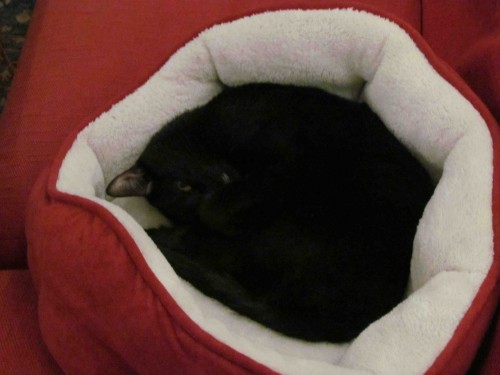
On the designated day, we went to the animal shelter together to choose a kitty.  Several hours later we returned home with the aptly named Merlin.   I went to the pet store to buy the essentials, including a soft cat bed (which he refused to sleep in.)  Merlin, being a cat who knows a thing or two about survival, immediately glommed onto Richard as though he were the anchor to his ship.  Wherever Richard went, Merlin was within a few feet.  By the second day Richard was extolling Merlin’s virtues, by the third day it was all over, Merlin and Richard were inseparable, it was love.  Ironically, the children, who after all were the ones vying for a cat to begin with, appear to have little more than a passing interest in Merlin.  Emma continues to say, as we pass a pet store, “Go in and pet the kitty?”  It seems she is only interested in petting other people’s cats, which we have found baffling.

Then this past weekend Emma found a stuffed cat I’d bought for the children after my cat Bertie of over twenty years, died.

“Oh Em!  You found the kitty!”

“Yeah.”  And for the rest of the morning Emma carried the kitty and her string with her wherever she went.

I keep hoping this affection for the stuffed kitty will translate to the real kitty, but so far it has not.  Still, I can now post this adorable picture of Merlin, who has finally decided he likes his cat bed after ignoring it for two years.   And who knows, maybe some day Emma will fall in love with Merlin just as the rest of us have.

For more on Emma’s journey through a childhood of autism, go to:   www.Emma’s Hope Book.com