Tag Archives: autism spectrum

A Comment

A follower of this blog wrote the following response to yesterday’s post.  I posted it here as it beautifully sums up exactly what my husband, Richard and I also feel and why we work as hard as we do with Emma.

“I think maybe this is what most parents or carers of children with autism aspire to.  Not to extinguish quirks and unique personality traits, rather to help our children function in this world, to cope, to survive, to find happiness. It is not as simple as just accepting someone as being unique when they can’t go out in public without dropping to the ground and self harming over some issue or they can’t even attend to their own most basic needs when they  become distressed, when there is an unavoidable change in routine, when they cannot even travel safely in a car or bus ( we’ve been there believe me), when they have no way to communicate their needs or to even tell a parent they are in pain or scared or hungry, when they want to reach out to a friend, but don’t know how and so are left friendless, when they struggle to eat because the food repulses them, struggle to even hold a fork or use a knife. That is not something I will accept for my children. I want more for them than that. As a mother I have had to watch my children cry in pain and be unable to hold them in my arms and give them this most basic of comfort, rather being forced to witness their anguish and left helpless. These are things that need to be changed and worked on. If that is a “cure” bring it on I say.”

I have never met the woman who wrote this comment, but we have been corresponding now for awhile.  She has two children on the spectrum, each utterly unique.  Her comments are always thoughtful and insightful.  Though we live on separate continents with several oceans between us, we have a great deal in common.  So, to you Liz – thank you for blazing a trail and sharing about it.  You have helped me more than you can know.

For more on autism and my daughter, Emma’s journey through it, go to:  www.EmmasHopeBook.com

On the Spectrum

I was asked recently why I am trying so desperately to overcome autism.  It’s a valid question and it made me think about the challenge of writing about one’s child in a way that honestly captures that child with all their complexities.  A week or so ago I wrote in my post entitled A Cure – “Emma cannot function in our world, she is not mainstreamed, she cannot take a shower, wash her hair and dry herself off without support.  We are not discussing nuances here.  We are talking about a child who is more than “quirky”.  My husband, Richard and I love quirky.  Quirky is GREAT!  We’ll take quirky.  But that’s not what Emma is.”

To me, that summed up why we continue to search, why we continue to try various things, but it does not adequately describe Emma.  Emma cannot function in our world without hands on support.  We cannot have a conversation with her or ask her questions.  I am still trying to capture Emma on video and post some clips on here, but haven’t had the time to do that yet.  The question I began this post with, made me realize that for someone reading this blog they cannot know her through my writing.  Perhaps one gets a sense of her, but there’s too much left out, too much I don’t think to mention, the cadence and inflections of her speech, the words, which I can understand, but which may not be understood by someone else.  I try to give an accurate portrait of her, but in the end, it is just that, an interpretation and not representative of the whole.

When we first received Emma’s diagnosis I was determined to find a “cure”.  I felt sure that I would find one too.  (Hubris?   Arrogance?  Ignorance?  Stupidity? Denial?  All of the above?)

After those first few years I realized I might not find a cure for what ailed Emma.  And after another few years and three trips to Central America for stem cell treatments under our belt, a “cure” seemed more and more elusive.  I have come to accept that.  Perhaps more importantly, I am less focused on the miracle of a cure and more focused on pushing Emma to expand her world.  There’s a balance we have tried to achieve with Emma.  We try to follow her lead whenever possible, but we also encourage her to stretch and do things beyond her comfort zone.  Our most recent attempts to expand her diet is a case in point, her literacy and math program are another.

Which isn’t to say that I don’t continue to research and do everything in my power to find treatments to help her.  I am convinced Emma’s digestive issues are exacerbated by her environment – the foods she ingests, the air she breathes, the water she drinks.  This Friday I am taking Emma to a doctor who has worked with hundreds of children on the spectrum.  He and I spoke on the phone yesterday for over an hour, going over her history, her GI issues (inflammations and ulcerations), chronic constipation, recurring strep throat, porous teeth, cracked heels and limited diet.  While a few years ago, I would have eagerly anticipated this appointment with the same degree of excitement the devoted view a visit from the Pope, I no longer do.  I have come to see all of these people, no matter what letters may follow their name, with tempered interest.

Last week Emma’s school bus matron told us Emma refused to buckle her seat belt and when the bus matron tried to help her, Emma kicked her hard in the chest.  We immediately went over with Emma the behavior we expected from her.  We rehearsed buckling her seat belt and made sure she had her ipod and ear buds with her so she could amuse herself once she was seated.  We went over the importance of not hurting another person.  We tried to consider what sort of support she might need to help her control herself.  We are lucky in that Emma seems to have understood and has not struck nor tried to get up from her seat while on the bus since.

As we waited for her bus this morning, I coached Emma, “Emma, it’s nice to say good morning to people.  She’s a nice lady and saying – Good Morning – will make her smile.

When Emma boarded the bus this morning she said, “Good morning, nice lady.”

The bus matron beamed.

There are many people with an autism diagnosis who are on the “mild” end of the spectrum or fall in the “gifted” category of Aspergers or are considered “high functioning”.  These children are often mainstreamed or learning at grade level or above.  And while they have tremendous hurdles, often requiring support into their adult lives, they occupy a different level of hurdles from those who, like Emma are moderately autistic.

I had a friend whose child was unable to walk or even lift his head.  He, too, was diagnosed with autism, though severely so.  That child faced developmental and physical problems far beyond anything Emma has had to deal with.  For me to compare the two would have been ludicrous.  At this point my goal is to get Emma to a higher level on the spectrum.

For more on Emma’s journey through a childhood of autism, go to:   www.EmmasHopeBook.com

Emma and Food

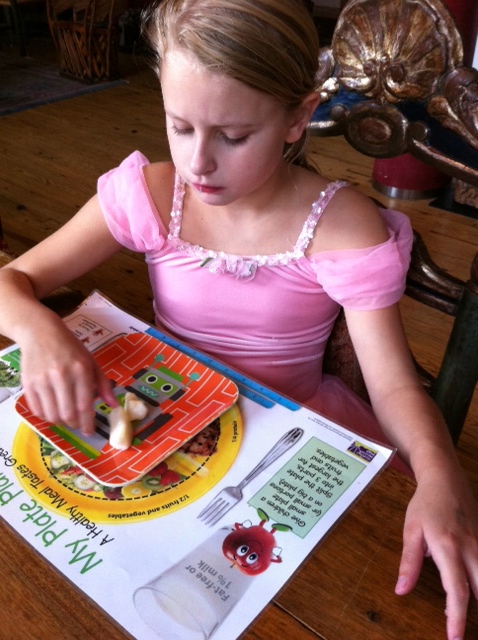
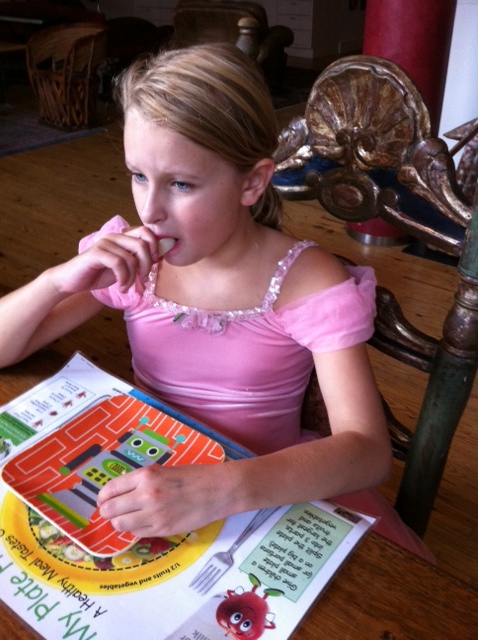
I have been keeping a chart of the new foods Emma has tried these past six days.  To date she has sampled:  pear, banana, apple, blueberry, raspberry, watermelon, honeydew melon, papaya, raisin, dried apricot, homemade granola, oatmeal with banana and raisins, chicken, (catfish, kale – totally pushing my luck last night with those two)  and the piece de resistance – vegetable frittata!  To date her favorites are watermelon, pear, banana, apple, raisin, chicken and the frittata.

I am also reading the Gut and Psychology Syndrome (GAPS) by Natasha Campbell-McBride.  It is a diet created by Dr.Campbell-McBride who “healed” her own son diagnosed with autism.  It is a daunting proposition, which requires one to forego almost all foods (saving a meat broth which one is suppose to consume every 30 minutes or so) for a few days to several weeks in order to allow the gut to heal before slowly introducing easily digested foods until eventually the child is able to eat a wide range of foods.   This diet is so draconian in the beginning, it makes going gluten and casein free look like a picnic.   Still I continue to do my research.  I guess you either have to laugh or cry.  I’m going with laughter at the moment.  Tears to follow, I’m sure.

Over the long weekend we took the children to the New York Botanical Gardens.  It was in the 80’s and gorgeous.

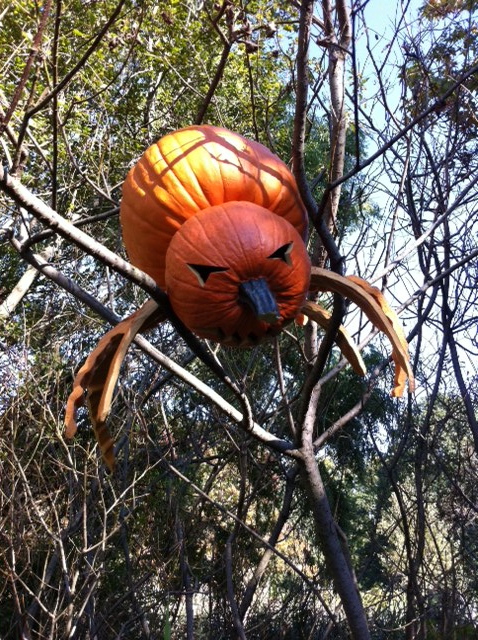
The Haunted Pumpkin Garden

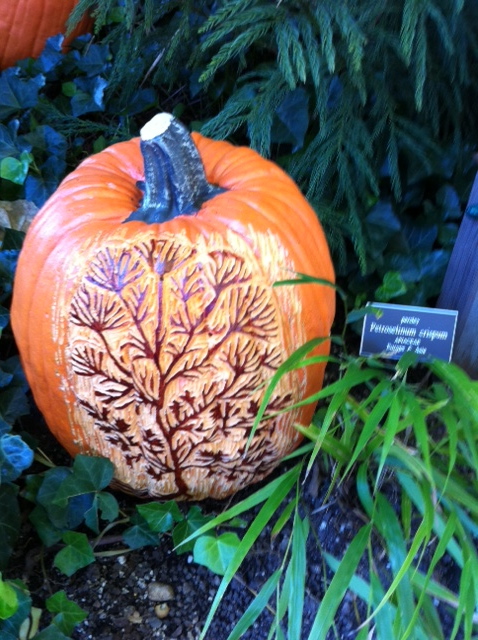
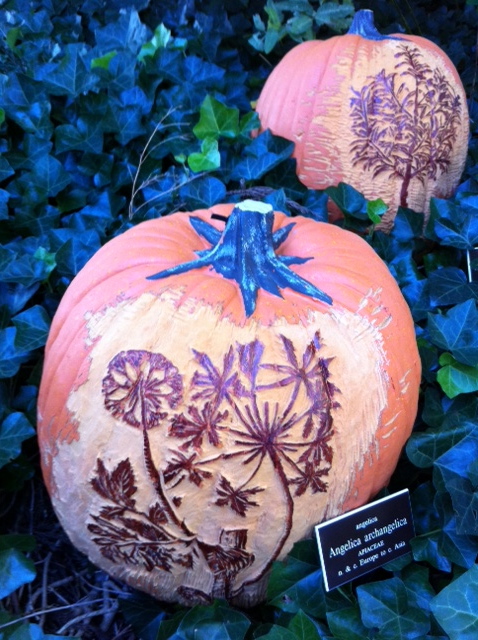
The “Herb” Garden

As delightful and creative as these pumpkins were, Emma was much more concerned with getting on the tram that runs through the grounds of the Botanical Gardens.

“She loves various modes of transportation,” Richard observed when we finally secured four seats on the tram.

Yup.  That’s our Emma.

For more on Emma’s journey through a childhood of autism, go to:   www.EmmasHopeBook.com
Em

Emma holds an uncanny resemblance to a fictitious children’s book character.

Okay, so we haven’t gotten the whole handstand-on-the-handlebars thing down yet, but I’m sure that’ll be next.

Merlin watches and waits.

He just cannot help himself.

Food update:  Emma ate a blueberry last night.  This morning – one blueberry, (not her favorite) a slice of apple, a slice of pear and a piece of banana!

After eating all of that she said, “No more medicine.”

I’ve got my work cut out for me.

For more on Emma’s journey through a childhood of autism and our attempts to help her, go to: www.EmmasHopeBook.com

Emma and Food

I’ve written about this before – Emma’s limited diet.  It’s self-imposed.   As her parent and someone who struggled with an eating disorder for 22 years, I have been reluctant to get too involved in her food other than to make a few half-hearted attempts to offer her other foods I thought she might like.  By the way, Nic, her older brother eats a wide range of foods, even eating a curried rice with cauliflower and chickpeas dish I made the other night, without complaint.  (He was being a good sport, I know.)

When we first received Emma’s diagnosis I immediately put her on a gluten free/casein free diet as so many families found it helped their child.  Some even found their child lost their diagnosis after going on it.   We had her on the diet for more than three months and saw her lose 10% of her body weight with no other noticeable change.  At the time we were working with a DAN (Defeat Autism Now) doctor, who specialized in allergies and nutrition.  During that time she became even pickier about what she’d eat and by the time we took her off of the diet, she was eating soy yogurt and scrambled eggs, shunning “good” foods she once ate, such as vegetables, chicken or fish.  Years later someone told me that soy is another food to be avoided and that may have been the reason we saw no change.  All these years later, I still wonder whether we did the diet wrong, if we’d removed all soy products, perhaps we would have seen some significant change.

A friend of mine suggested the GAPS diet, created by Dr. Natasha Campbell-McBride who “fully recovered” her own child with her diet.  The problem is, there isn’t a single thing allowed on this diet that Emma currently eats.  In addition it is a labor intensive diet, requiring one to make homemade condiments – such as mayonnaise, ketchup, etc as well as yogurt.  BUT – I am still willing to look into it and have purchased the book describing the diet as well as the cookbook with various recipes.  (Richard is groaning as he reads this as he no doubt is remembering the fanaticism with which I tackled the GFCF diet.)

Before I even contemplate starting the GAPS diet, I will take her to a new pediatrician who is said to be versed in autism and am trying to encourage her to try some new foods.  I intend to document our progress and (hopefully) hers on this blog.

Last night I introduced Emma to a piece of Comice pear, peeled.

She was tentative, but eventually after smelling it, licking it and touching it, she finally ate it!

This morning I gave her a small bite of a Fuji apple, which she immediately picked up and ate without hesitation.  Tonight I will go out on a limb and try a raspberry.

Emma on her way to the school bus this morning.

If anyone reading this has had success with any sort of diet, please contact me with what you tried and any progress you saw in your child.

For more on Emma’s journey through a childhood of autism, go to:   www.Emma’sHopeBook.com

Waking Nic – Autism

Last night Emma woke Nic up – again.

“No Mom, it was really bad.  She woke me up like five times. I swear Mom, FIVE times,” he held up one hand and wiggled all five fingers at me.

“What did you say to her?” I asked, stroking his somewhat greasy hair, while wondering if I should insist he wash it before school, then deciding he would be late for his bus and anyway it wasn’t all that bad.

“I told her she had to leave.”  He leaned against me, and said, “I told her – Emma!  You have to go back to your own room.”

“What did she do?” I asked.

“She went back to her room.  But then she came back. Like at three, then five, then six.”  He looked at me and pretended to fall asleep, collapsing in a heap on my lap.

“Hey Emma!” I called.  “You cannot wake up Nic.  It’s not okay to wake up Nic.”  But if I’m telling the truth, I was just a tiny bit relieved that she woke up Nic and not me.  I rationalized this “bad mother” thought with – He’s young and can handle sleep deprivation much better than I can.   Meanwhile Nic continued to mime sudden unconsciousness by falling on the ground, back on his bed, then into my arms, like some sort of narcoleptic preteen.

“You cannot wake up Nicky!”  Emma parroted, using her stern voice.

“Yeah, Em.  That’s just not cool,” Nic said.

I told Emma that since she woke up her brother, she couldn’t bring her  beloved “string” (a piece of packing tape) out of her bedroom.  She was very upset by this and said, “You cannot wake Nicky.  But listen, if you wake Nicky no string.”  Then she began to cry.

By the time it was time to go down to wait for her school bus, Emma was calm and said, “It’s okay.  Next time you cannot wake Nicky.  Then string can come out of the bedroom.”

I gave her a hug.  “That’s right Em.  It’ll be okay.”

Emma waiting for her bus this morning wearing a “pretty dress”.

“I Am In Here” – Autism

There’s a terrific new book entitled:  I am in here:  The Journey of a Child with Autism Who Cannot Speak But Finds Her Voice by Elizabeth M. Bonker and Virginia G. Breen.  The title is a line from the poem  Me written by Elizabeth when she was 9.   The story is yet another example of a nonverbal child with autism who was helped by Soma Mukhopadhyay’s Rapid Prompting Method.  Elizabeth’s mother, Virginia has tried any number of therapies with the hope that something, anything will help her daughter.  It is not a story about a cure, but rather a message of hope in the face of continual struggle and perseverance.

Virginia writes about using a three pronged approach in her battle with autism – Mind (academics), body (biomedical interventions and diets) and Spirit (the more difficult concept of something greater than ourselves, which Elizabeth seems to have a solid grasp of.)  The mind, body & spirit concept particularly resonated with me as it was this very idea which captured my grandfather, Walter Paepcke’s imagination when he envisioned a place of contemplation and learning in his creation of what came to be known as the “Aspen Idea” more than 60 years ago in Aspen, Colorado.

I can claim full allegiance to the mind and body portion of this, however I must admit the spiritual piece continues to allude me.  Though a close friend of mine said to me recently that for a person who professes not to believe, I certainly spend a great deal of time thinking, reading and discussing the subject.  She then said, “It’s kind of like the wife who’s husband everyone knows is having an affair.  She’s the last to know.”  When I answered her with a perplexed look, she said somewhat exasperated, “Come on, Ariane.  You’re the most spiritual non-spiritual person I’ve ever met.”

I’m pretty sure she meant that as a compliment.

For more on our journey with Emma through her childhood marked by autism, go to:   Emma’s Hope Book

A Written Conversation – Autism

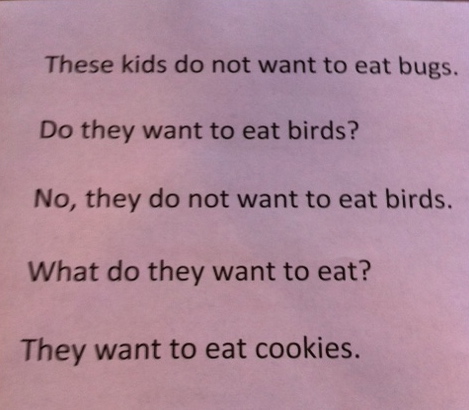
Yesterday afternoon, Emma said, “These kids do not want to eat bugs.”  Then she squinted her eyes and laughed, making her shoulders shake up and down.  It was a creative version of some of the work we’ve been doing during her literacy program.  We’ve been working on sentences such as – These are kids, they want to rest.  They are resting.  Or  This is a plane.  It can fly, but someone has to make it fly.

“That’s funny, Em.  Let’s type that.”  I pulled the computer forward and gestured toward it.

Em sat down and muttered, “Shift,” as she pressed the shift key with her right index finger while simultaneously pressing the “t” on the keyboard.  She then went on to type the sentence, only needing help with remembering to include the word “do”.  I then typed back a nonsense question – “Do they want to eat birds?”

Emma giggled and shook her head no.

I pushed the computer toward her.  “Type,” I said.

“No, they do not want to eat birds,” she wrote, being sure she made an upper case “n” for the start of the sentence.

“What do they want to eat?”  I typed.

Emma looked at me.  I shook my head, putting a finger to my lips and pushed the keyboard toward her.

Very slowly she typed, “They want to eat co”.  She smiled at me.  “Cookies,” she whispered.  “I need help.  Mommy hold hand.”

Cookies is not a word we’ve covered yet, so I held her hand and helped her type – cookies.

My typed conversation with Emma

For more on Emma’s journey through a childhood of autism, go to:  Emma’s Hope Book.com

Em’s Airplane

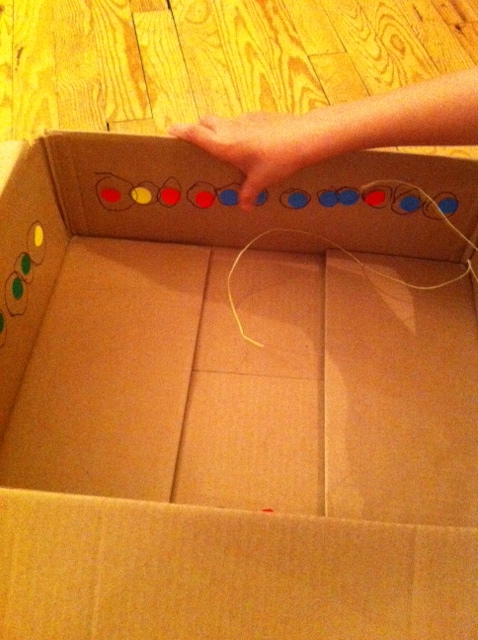
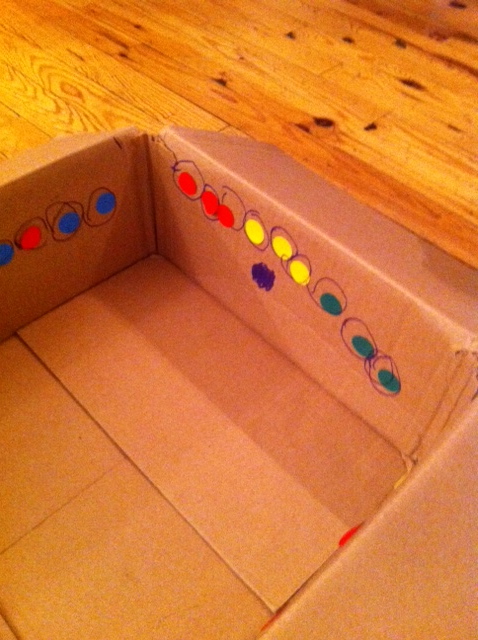
Yesterday Eddie (UPS man) delivered a package.  Emma took the box and began decorating the inside with stickers.  She then drew circles around each sticker.

With a different colored marker she drew a larger circle in the middle of one end, just underneath the circled stickers.

When I got home last night Richard said, “Did you see what Emma did?”

“Yes,” I said, walking past the box without really looking at it.

“Do you know what it is?”  he asked.

I bent down to view the box more carefully.  “She’s made a pattern with the different colored stickers?”

“It’s her airplane.”

“Really?”  My mind began to tick off the greater implications – imaginative play, creative thinking, fine motor dexterity, perhaps an attempt at patterning…

“The stickers are the windows,” Richard told me.  “You should have seen her.  She got inside of it, put on her seat belt and flew.”

“Wow!  How great is that?” I said.

This morning when I went out to help Emma make her breakfast, I pointed to the box.  “Hey Em.  What’s that?”

“Emma’s airplane.”

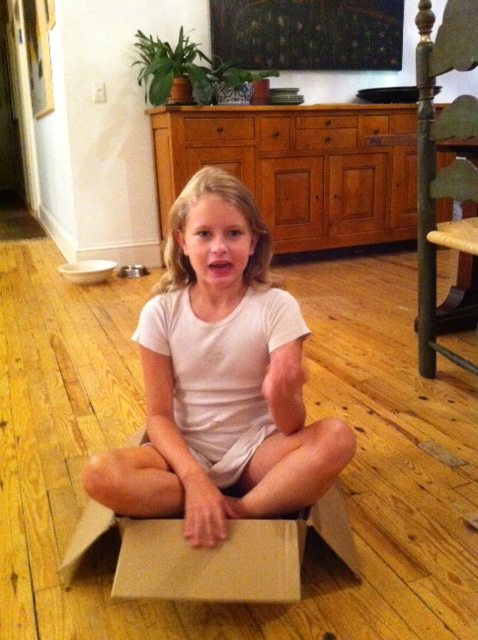
Then she proceeded to sit inside of it, buckled her seat belt and pushed the purple colored “button” which evidently “starts” her airplane and began to fly.  “Push the button.  Go up, up, up and fly!”  Emma said.  She held onto the box and began shaking it.  “Uh-uh-uh!  It’s bumpy.  You have to be careful.  You have to hold on!”

“Where are you going?” I asked.

“Up in the sky,” she said, with a tone that seemed to hold a hint of sarcasm, as in – Duh, where do you think? or maybe she was just tired of having to state the obvious.

“Yes, but where will you land?”  I pressed.

“No.  Up in the sky,” she said.

Because clearly I was missing the point.  The destination wasn’t the goal.

For more on Emma’s journey through a childhood of autism, go to:   www.Emma’s Hope Book.com

Yes, but… – Autism

A blog follower recently contacted me saying how exciting it is to see how much Emma is progressing.   Whenever someone says this to me, my first reaction is surprise, followed by a shot of hopefulness and finally curiosity.  What exactly do they see?  How is she progressing in their opinion?  So I almost always ask, “In what ways do you see her progressing?”

I then listen intently, making a mental note of the various things.  And then, and I’ve noticed this happens almost every time, I think – Yes, but _________ .  Here is the current list of my “Yes, buts…”

Yes, but she still sucks her thumb and as a result the shape of her mouth has changed, resulting in her front top and bottom teeth no longer meeting because of her massive over bite.  (This thought usually leads to a whole laundry list of anticipated horrors about dentistry, orthodontistry, the worry of how we will have to have her hospitalized to have braces put on – this is what we had to do when she had a cavity) and the exorbitant cost of  all of this.  I become acutely aware of how fast my heart seems to be beating.  Suddenly I am nauseous, can’t eat and wander around feeling ill.  Which leads me to my next – Yes, but:

Yes, but she only eats a half dozen things, all of which are either dairy or wheat and though we put her on a wheat free/ dairy free diet when she was first diagnosed to zero effect, maybe we did it wrong.  A vegetable has not touched her lips in more than six years.  Maybe we missed something.  Maybe there’s something else here that we should be doing.  I then am led to Google and several hours later I emerge from the black hole that only Google can provide, having learned about the dozens of diets all with the ominous warning that early intervention is key.  Which, to my mind, means we’ve missed the boat as she is now at the ripe old age of nine and a half.  If I’m feeling really panicked – almost ten!

Last night I mentioned to Richard my current litany of – yes, buts.

“You’re spiraling off again,” he observed, after I’d finished.  Then he looked at me with an expression of concern.  He sighed and said, “I know, honey.”

I understand that my thoughts, shooting off to the next catastrophe, are my convoluted way of protecting myself.  However that “protection”, all those, “Yes, buts” are what block me from fully enjoying Emma’s amazing accomplishments.

Yes, but…

For more on Emma’s journey through a childhood of autism, go to:  www.Emma’s Hope Book.com

Biting and Other Self Injurious Behaviors – Autism

Yesterday Emma came home from school with her forearm covered in bite marks.  I sat down next to Emma on her bed and gently touched her arm.

“You bit!”  She said sadly.

“I can see that,” I said, stroking her arm.

“I want to unlock it,” she said, twirling a scrap of what was once her blanket around and around her index finger.  “I want cokie,” she added.

I continued to stroke her arm.

“You cannot bite!  Emma!  No biting!”  She shouted.

When Emma is very upset, she begins to script.  In other words she mimics things others have said to her using the same tone of voice and if they have an accent, she’ll say the words with the same accent.  It’s a bizarre experience to listen to your upset child alternate between using someone else’s words, tone and inflections and her own voice, as though she were auditioning for all the roles in a play with an ensemble cast.  Sometimes she’ll throw me into the mix – “Oh sweetheart!”  and then severe and scolding – “You cannot bite!  That is not okay,” with her own pleading, “I want cokie, I don’t want to lock it up,” then the logical, calm tone of a teacher or therapist, “You can have cokie later.  First go to the roof, then you can have cokie.”  Her face crumples up while she fights back the tears, often losing the battle and collapsing into an anguished heap of heaving sobs and cries.

At a certain point, when her frustration, anger and upset become more than she can bear she turns it inward and becomes violent toward herself.  The emotions too great for her to contain, she bites herself, leaving the imprint of a full set of teeth upon her arm or finger or hand.  Once, when I held her arm to prevent her from hurting herself she jerked her other arm away and punched herself hard in the face.  The force with which she did this, took my breath away.

I mentioned on this blog, once before, when I was younger I struggled with bulimia.  A more accurate description would be less a struggle and more a complete and utter surrender to the eating disorder.  A therapist I was seeing at the time talked of the act of vomiting as self inflicted violence and I remember being furious with this description.  I wasn’t being violent toward myself, I was simply pursuing a thinner physique.  But after years and years of therapy and then recovery I came to recognize the violence in what I had done to myself for all those years.  When I see my own daughter hurting herself it is impossible for me not to reflect on those years of frustration and rage.

Emma’s acts of self injurious behavior are expressions of her rage, frustration and there is an added piece to this, I am convinced – the desire to control the pain, coupled with her many and varied sensory issues.  I think the combination is deadly.  But how to help her?

That is the question I have no solid answer to.  For now we are trying to explore other ways for her to get her sensory needs met without hurting herself.  However I know from having engaged in destructive behavior for more than two decades how entrenched and addictive that behavior can become.  There are no easy solutions, but then autism itself is like that.

For more on Emma’s journey through a childhood of autism, go to:   www.EmmasHopeBook.com
Autism – Daughters (continued)

I so wanted a little girl, I so looked forward to having a little girl who would feel safe enough to confide in me, the way I have always felt able to confide in my own mother.  (I feel a great deal of gratitude for that.)  I know how fortunate I am to have an amazing mom.  I have conversations with friends who audibly groan when the subject of their own mothers come up.

“If it’s not one thing, it’s your mother,” is something I’ve heard on more than a few occasions, uttered by exasperated adult children.  The famously “bad mothers” occupy several shelves of literature, poetry, plays and movies.  We all know them by name and every few years a few more get tossed onto the pile.  Beyond enjoying the guilty deer-stuck-in-the-headlights-horror of those stories, I cannot relate to them, thankfully.

My mother taught me how to sew and macrame, (this was the 60’s & 70’s) embroider, quilt and knit.  She showed me how to bake bread, make baclava, beef wellington and a fifty layer Daubache Torte.  I think I can justifiably credit my mother for my love of design and current career.  She read stories to me at bedtime and sang songs.  I remember sitting on the vanity in her bathroom as she got dressed to go out to a party.  I thought she was the most beautiful woman I’d ever seen.  I watched her as her hair turned grey and her fingers became deformed by arthritis.  I spoke with her about the aches and pains that come with growing old.  I looked to her the way one consults a Michelin Guide in a foreign country, she has always shown me the way.

Perhaps it is the same for Emma, I cannot know.  I know she feels connected to me as I do her.  I know when she wants something and I can often understand what she’s trying to say, even when the words come out wrong.  Lately she has even run to me when she’s hurt, though more often than not, I will have to prompt her, much the way I still must remind her to – “wrap your arms around and squeeze” when she hugs.

“You have to go see the nurse!”  Emma will shout when she hurts herself.  Then she’ll hightail it into our bathroom where she knows we keep a large supply of bandaids.

“Hey, Em!  How about coming to see nurse mommy?” I’ll ask blocking her way.

“Ouch!  Emma has a boo-boo!”  Emma will tell me, wiping the tears from her eyes, but keeping her distance.  Unlike neuro-typical children who instinctively seek out the comfort of a parent when hurt, Emma will instead cry out for the school nurse or say nothing and just take care of things on her own.  Often this means returning with a half dozen bandaids applied to various parts of her body, making it difficult to know exactly which part was hurt.

I think the thing about all of this that’s perhaps most important, is, while I don’t have the relationship with Emma that I envisioned when I was pregnant with her, we do have a relationship.  It’s a different relationship than I have with my mother.  But it is a relationship and it continues to evolve.

For more on Emma’s journey through a childhood of autism, go to:  www.EmmasHopeBook.com
Having a Daughter with Autism

Someone asked me the other day – What’s it like having a daughter with autism?

The flippant response would be – I don’t know what it’s like to have a daughter without autism.  But the more thoughtful answer is a bit longer and more complicated.  My own experience of being a daughter to a mother with whom I feel deeply connected to, a connection that many, I have learned over the years, do not have certainly plays a role in my answer.  I have always felt my mother and I share something that goes beyond the usual feelings of responsibility and gratitude toward someone who gave so much in order that I might have a good life.  It is as though we share something much more than the history and past of living under the same roof for the first 17 years of my life, something I cannot adequately put into words.  We have a closeness, a bond and yes, a friendship that only a few of my female friends can relate to regarding their own mothers.  I have often said that if my mother were not my mother, I would wish she were.  I don’t actually know many people who can truthfully say that about their mothers.  I am lucky.  I get that.

So when I was pregnant with Emma, I fully expected to have a similar experience.  I knew right away she was a girl.  Don’t ask me how, I just knew it.  For one thing I began to wear pink, a color I never liked until Emma entered my being and for another I craved spinach and blue cheese during my first trimester, as opposed to steak and all things meat when pregnant with Nic.  Okay so I’m not being completely serious – though all of this is true – the pregnancy was different with Em, it just was.  Without meaning to or even consciously trying to, I visualized my soon to be daughter.  I knew she would have blonde hair, blue eyes and broad shoulders, as both Richard and I share these things, but beyond that I couldn’t know. I sang to her, just as I did when I was pregnant with Nic, I talked to her, read to her and dreamed about her.

While pregnant with Emma, I was walking on Fifth Avenue one afternoon, when I passed The American Girl store.  It reminded me of my first and favorite doll, Maribelle, a gift from my mother to me when I was little.  Maribelle came in a blue and grey striped trunk complete with shoes, gowns, dresses, she even had a fur coat!  (I still have Maribelle – she and her trunk reside upstairs in my mother’s house.) I saved her, intending to give her to my own daughter, were I fortunate enough to have one. Looking through the large windows of the store I fantasized of the day I would bring my daughter there and how she would choose a special doll.  A doll that would be like Maribelle was to me – a companion, a doll she would whisper secrets to and spend hours upon hours playing with.

Richard and I were not the kind of parents intent on placing our yet-to-be-born children on waiting lists of the most coveted New York City preschools, looking to the day we could sit listening to our child’s speech having graduated  from Harvard Summa Cum Laude.  Ours was a more unconventional approach – at one point we fantasized about putting all of our belongings in storage and traveling the world for a few years.  We spent many an evening discussing the places we wanted to travel to, which included Tanzania, Lebanon, Egypt, Brazil, Morocco and Laos.  We poured over guide books and vowed that once both children were out of diapers we would make our fantasies reality.  We had no way of knowing that Emma wouldn’t be out of diapers until she was eight and a half years old.  We couldn’t know that once she was out of diapers we would be scrambling to cover the staggering cost of her care, making any dreams of extensive travel abroad impossible to seriously contemplate, not to mention the sheer logistics of traveling to a foreign country with a child with special needs.

(To be continued.)

For more on Emma’s journey through a childhood of autism, go to:   www.EmmasHopeBook.com

Autism’s Murky Future

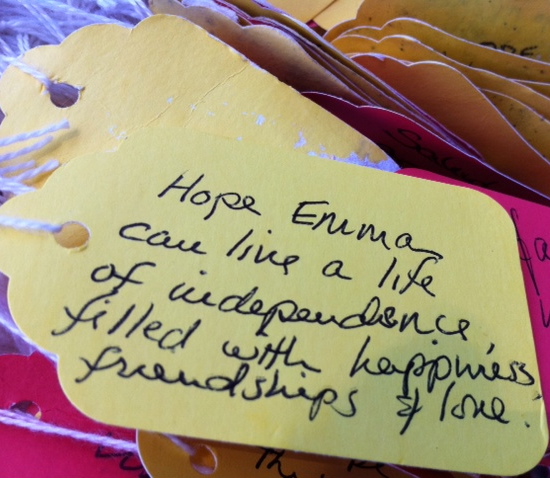
Yesterday the New York Times ran a front page piece entitled – Autistic and Seeking a Place in an Adult World.  I am always so grateful when I see anything on autism, even when I am not told anything I don’t already know.  I am particularly grateful when I see something on autism on the front page of the New York Times.  For those of us who are parents of a child with autism, the looming question of what will happen when our child becomes an adult is something we do not have the luxury to ignore.  Yet, the answer is not readily available to us, either.  There is no road map by which we can look to.  The future of our children is very much up in the air.  It is a tricky balance keeping the fear at bay, while also being practical and realistic about ones child’s future and how we might ensure she is taken care of should she not be able to hold down a job and live independently.

My message of hope on The Hope Installation at the entrance to the High Line

The truth is we cannot know what Emma will be like in another eight years, all we can do is continue to work as intensely and extensively with her as we currently are.

So this evening when I come home from work, I will work on the word – does.  After we spend an hour or so going over the word, both using it in hand written sentences and as well as typing sentences with it, we will also use the word verbally as when I lay out a frog, a boy, a bus and a dog and say, “Hand me the one who does not eat.”  After we have done all of that we will play some games using the word “does” and finally we will go over a list of words she has already learned and review them.  Somewhere during all of this – dinner will be prepared, Nic’s homework will get done, stories will be read and everyone will eventually go to bed.

For more on Emma’s journey through a childhood of autism, go to:  www.EmmasHopeBook.com

Gymnastics – Autism

Because Emma has a wide variety of sensory issues and because she is so active, we are always trying to find things she can do that might give her some of the sensory input she so craves as well as help her focus while doing something she enjoys – moving.  Finding someone willing and able to teach her is often challenging.  It requires a special person who can keep her focused without using a great deal of language, who also has the patience and desire to continue to work with her for more than one of two times.

When we finally found Brett, a gymnastics instructor, we leapt at the chance to make this into a weekly affair.  So on Sundays Emma and Nic have an hour of gymnastics – or they did until Brett hurt his ankle.  But now Brett is back and off they went last Sunday to their first gymnastics class in almost four months.  Emma was very excited and kept saying, “Oh, Brett’s ankle is broken.”  “Brett hurt his ankle.”  “Ankle all better now.”

To which we would answer, “Yes, Brett hurt his ankle, but now it’s much better!”

When we arrived and Brett came out to get Nic and Emma, Emma bent down and gently patted his ankle.  “You hurt your ankle,” she said, sadly.

“Yeah, but it’s better.  Thanks Emma.”

“Ouch!  Have to get a bandaid,”  Emma said.  Because to Emma, anything that hurts requires a bandaid and will feel better if a bandaid is applied.

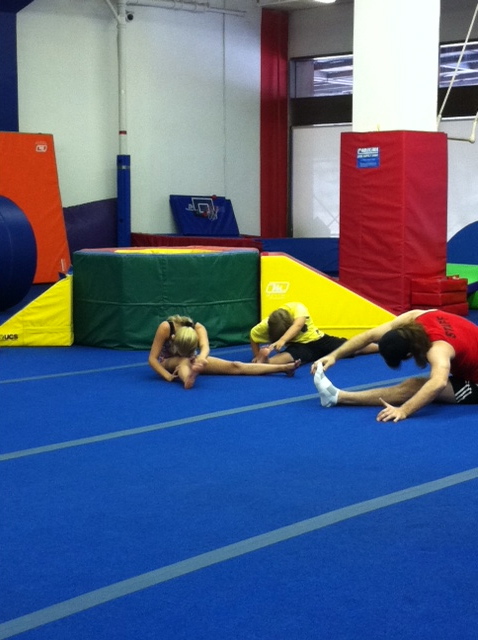
Emma and Nic stretching with Brett

Since it’s been awhile since Emma had gymnastics, I was curious to see what if anything was different.  Would she be able to stay more focused?  Would she attend more?  Would she be able to follow instruction better?

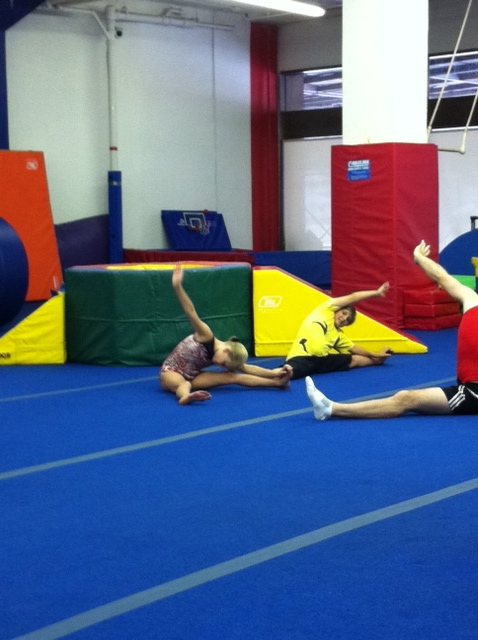
During their stretching period, Emma managed to keep up.

And while her form wasn’t great, she did do all the various stretches as best she could.

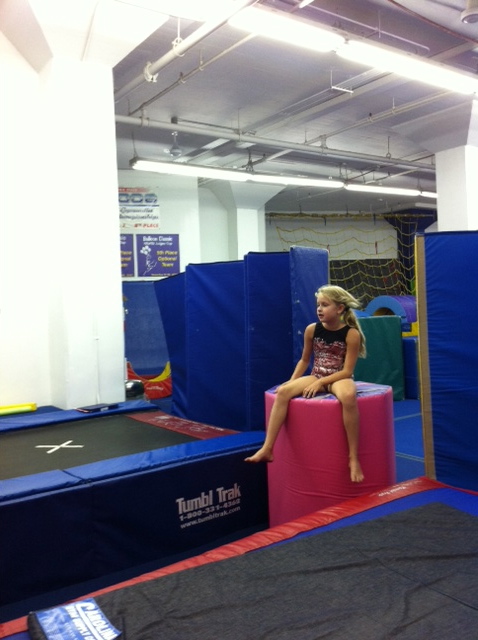
Later she was able to do straddle jumps on the trampoline and forward and back rolls on the mat.  She became a bit distracted when a birthday party took place in another part of the gym, but for the most part she attended and tried to listen.

Waiting for her turn on the trampoline.

All in all she showed progress, slow but steady progress.

For more on Emma’s journey through a childhood of autism, go to:  www.EmmasHopeBook.com