Tag Archives: autism spectrum

Autism, AutCom, Huffington Post, Podcasts, Sprinkler Parks and Tea Parties

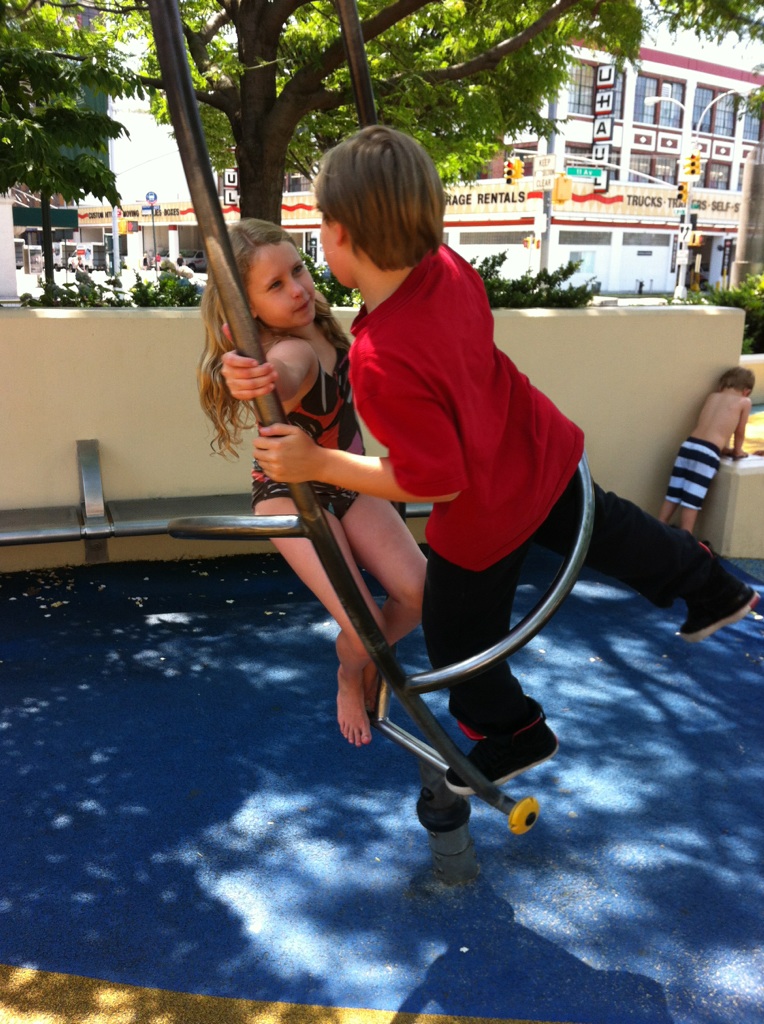
It was a jam-packed weekend.  Sunday Nic and Emma played together in one of the many sprinkler parks dotting this amazing city we are fortunate enough to call home.  (Not the sprinkler park.  Home, as in New York city… okay, you know what?  Never mind.  Just look at the adorable photograph.)

Yesterday, Richard and I spent the entire day at the Upublish BEA conference, which was pretty amazing.  Richard’s any-day-now-soon-to-be-listed-on-Amazon-five-star-Clarion-reviewed-amazing-genre-straddling-thriller, The Book Of Paul, will be available for public consumption soon and so this was a particularly relevant conference for him, and me as I am working on my book about Autism, our family and Emma.  I know – do we really need another book about autism?  I’m thinking we do, particularly after reading some of the comments on my most recent piece on Huffington Post, The Depiction of Autism and Why it Matters.
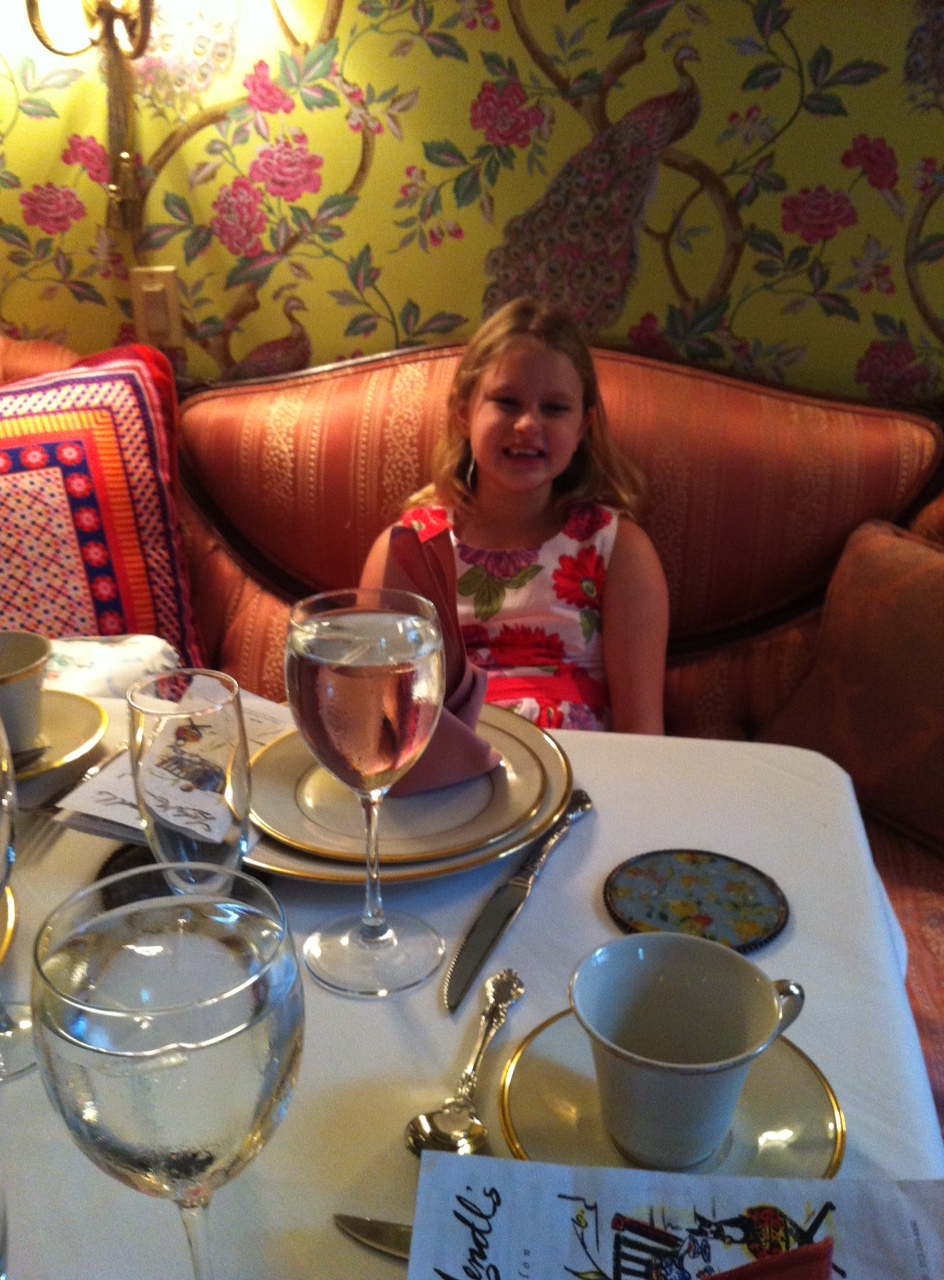
Meanwhile the wonderfully fun and up-for -anything Jackie, adored by both our children, took the kids to various parks and swimming.  She then invited Emma to a tea party celebrating her arrival to New York five years ago.  (This is the kind of thing we New Yorkers do, throw parties to celebrate our moving to this wonderful city of ours.)
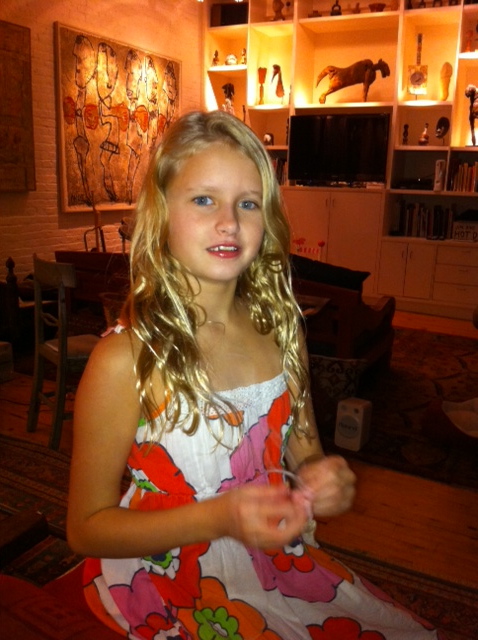
Emma, thrilled with any event that affords her the opportunity to wear one of her pretty dresses, was extremely pleased.
Meanwhile halfway through the Upublish conference, I received an email inviting me to speak at the upcoming AutCom conference this October, which will be held in Maryland this year.  I am honored and look forward to it!
Friday afternoon my piece The Depiction of Autism and Why it Matters was published on the Huffington Post.  By Sunday it was getting some attention on Facebook and so they bumped it up on HuffPo, giving it a more prominent place on their Health News home page.  A large number of Autists commented, for which I am grateful, both for their perspective and support, but also because, as one of my favorite people, Ibby said, “You’ve found your daughter’s people.”
Finally, the interview I gave on Friday (my first podcast!) with Bryn Johnson of WebTalkRadio – Business Cafe – When a Passion Leads to a Business with guest Ariane Zurcher  is now available for your listening pleasure.  The first half is about business and being an entrepreneur and the second is almost exclusively about this blog and autism.

Literacy, Diets, Progress

Dr. Marion Blank has written a terrific piece for the Huffington Post regarding the 60 minutes segment on APPs for autism and the current ways in which language is taught.  For anyone with even a passing interest in language or autism, I encourage the reading of it.

An update on Emma, her diet, her progress:

Emma ate about three tablespoons of chicken and brown rice two nights ago and tasted the pumpkin mousse I made.  I will attempt to make coconut milk whipped cream this evening in preparation for our Thanksgiving feast.  I want to have several things Emma might like, so I am planning to prepare Maple Syrup glazed Turkey, roasted carrots and sweet potatoes and some kind of desert she might enjoy (she didn’t love the pumpkin mousse or pumpkin scones, so I’ll try some other recipes) as well as things the rest of us will enjoy – we are having between 12 – 15 people, many of whom are bringing things!  I am thinking of writing a cookbook entitled All The Delicious Things I’ve Made That Emma Won’t Eat.

I worried the other day (someone pointed out that I am always worrying about something – I blame my mother for this – she is a known worrier, plus I’m a New Yorker so there’s no hope for me) that Emma is just as rigid now as she was before the diet.  Instead of only eating six things, all of which were dairy or wheat, she now eats six other things, but as Richard pointed out, at least they aren’t dairy and wheat.  I think my expectations were high (they tend to be) when we began the diet; I had read in many cases the child, once off dairy and wheat, expanded their diet dramatically.  Don’t get me wrong, it is wonderful to see Emma eating brown rice and roasted chicken.  In fact it’s a huge achievement on her part.  I’m taking a deep breath now and will bask in the glow of brown rice and chicken.

Okay.  Now that I am filled with gratitude, to continue –

To date we have seen no identifiable cognitive or behavioral progress as a result of this diet.  We see her doctor in another three weeks.  I am still hopeful we might see something by then.

We received a report from her school that Emma threw a chair across the room on at least two occasions and pulled one of the TAs hair.  Obviously this is not good news.

Another deep breath, focusing on the joys of brown rice and roasted chicken.

For more on Emma’s journey through a childhood of autism, go to:   www.Emma’s Hope Book.com

A Little Gratitude

There is a lot of great news out there regarding autism.  Many families have tried biomedical and therapeutic interventions with terrific results.  The website, autism.com has great information about treatments that have worked for many children on the spectrum.  No one can predict whether any of these will help your child.

When I was in my early thirties I sought help from the medical community for my bulimia.  I was depressed, could not stop the destructive cycle of binging and throwing up.  There seemed little to live for.  I phoned several rehabs and after speaking with several doctors and eating disorder specialists, I was told the longer a person had an eating disorder, the more intractable and harder to treat it became.  When I mentioned I had been bulimic for going on two decades there was silence.  I remember hanging up the phone and feeling utter despair.  I felt a similar despair when Emma was diagnosed.  But then, as I had when I was still bulimic, I became determined.  That determination served me well during those difficult years.  I never gave up and eventually found enough people who were able to help me, hold my hand and advise me.  I learned I couldn’t recover on my own.  I learned how to ask for help.  I learned to lean on others.  And I learned that in my darkest moments, if I remembered to reach out to someone else in need, to offer to help them, my own problems diminished.  I have tried to live my life in this way ever since.

Sometimes when I read about other people’s successes with their children, while happy for them, I feel sad for Emma.  I believe it’s natural to feel this.  I will never give up on Emma.  I will continue to do all I can to help her and while I do, I continue to work on my impatience while remembering to be grateful for each moment with her.

A little gratitude goes a long way.

For more on Emma’s journey through a childhood of autism, go to:   www.Emma’s Hope Book .com

Bruno Bettelheim

Most of us have heard, and many may have even read, some of Bruno Bettelheim’s ideas and work.  For those of you unfamiliar – Bruno Bettelheim, born in Austria, came to some prominence when he became director of the Orthogenic School, in connection with the University of Chicago for children with a variety of emotional and neurological issues.  His book, The Empty Fortress was published in 1967; read by many and touted as the final word on autism and its cause – the aloof and emotionally withholding mother.  At the time, his views on the subject became widely known and the treatment for autism was to put the mother in psychoanalysis.  The belief that the mother, in her lack of love for her child, caused the child to withdraw from the world was adopted by many.  Bettelheim claimed a high success rate of children with autism in his school.  It was only until after his suicide that many of his former students came forward with harrowing tales of abuse.  Much of Bruno Bettelheim’s work and ideas have since fallen into question.  The concept of the “refrigerator mom,” something he was an advocate of, has proven to have no validity.

Last week I had a piece published in the Huffington Post – http://www.huffingtonpost.com/ariane-zurcher/children-with-autism_b_1080076.html – a woman, now in her nineties wrote to me about her experience of being the mother of a child with autism, diagnosed in 1961.  Rather than examine her child when she sought help, she was put into analysis and blamed for her child’s neurological issues.  She wrote a book, A Few Impertinent Questions, http://301­45.myautho­rsite.com/, that tells of her painful journey.  It is a powerful story.

As I read her book, I reflected on what we think we know now about autism and what will come to light in the future.  Fifty years from now how will we view what we think we know?  What ideas will seem almost comical because we will have learned so much more.  What therapies will have fallen out of favor?  What new therapies will have taken their place?  What will be proven and seem obvious in fifty or sixty years from now, but are not obvious to us now?  I, most likely, will not be around in another fifty years to know the answers to these questions, but I am sure much will be revealed.

For more on Emma’s journey through a childhood of autism, go to:   www.Emma’s Hope Book.com

The Diet

It’s been a month.  Last Monday I wrote that it had been four weeks and two days, I was wrong.  It just felt like it had been a month.

One month ago, on October 16th we began Emma on a GF/(modified) CF/ soy free and a great many other free diet.  This is our second go around with this diet.  The GFCF diet was the first thing I did when Emma was still two years old, to no noticeable change.  However, that first time she began eating a great deal of soy – soy yogurt being her favorite.  I was working with a DAN doctor at the time who tested her for hundreds of foods but never said anything about all the soy she was eating.  So after three months we took her off the diet and again saw no change.  This time I’m working with a naturepath/physician who also tested her for hundreds of foods.  This time, the list of foods to avoid was much longer than the first: cocoa, corn, potatoes, chicken egg whites, all red skinned fruits and vegetables, bananas, peanuts, onions and garlic.   Emma did not test negatively for wheat, but he advised we take her off it anyway, just to be safe.  Oddly, she also didn’t test negatively for sheep and goat’s milk, so we’ve allowed her to have sheep’s milk cheese, sheep’s milk yogurt and duck eggs.

Still we have witnessed very little change in Emma.  We’ve grown used to this.

I keep thinking I’m going to find something, something that other families have tried with significant results, but so far, other than Emma’s literacy program, we have not.  It’s frustrating to try various things and see little, if any, change.  As I’ve written before, we think we are seeing an increase in physical affection, but it’s hard to say this with certainty.  We have definitely not seen a profound change of any kind causing us to feel without a doubt that this diet has done anything.  Still I will give it more time.

Why some of these interventions work for some children and not others is something that’s been debated for awhile.  Why is it some children are mainstreamed after a few years of intensive 40 hour a week ABA, yet for children like Emma, they were not helped?  How is it that some children go on a GFCF diet and within days are transformed from a screaming, frustrated, incoherent child to one who is speaking in full sentences, playing with toys in an “appropriate” manner and displaying a never before seen curiosity of those around them?

It is easy to blame oneself, but I don’t believe that is the answer.  I know of too many cases where the parent has tried a great many things only to find their child did not respond.  I wonder whether it is the children who do respond, who are the exception.  While this thought depresses me, I have to wonder whether it isn’t more accurate.

For more on Emma’s journey through a childhood of autism, go to – www.Emma’s Hope Book.com

What is

A Zen buddhist teacher told me once – anything that happens in life is an opportunity to practice.  I remember my feeling of irritation when she first said that to me.  As the years pass I think of her and her statement often.  Whatever it is that is happening – if I can suspend my judgement and not label it as good or bad, but just as what is, I have taken away one more obstacle.

I think of Emma, beautiful, amazing Emma, who is unique and like no other child.  Her autism is neither good nor bad, but what is.   Even as I write this I can feel the tug in my chest, the little voice whispering to me, no – it is bad.  As though by accepting I will have given up.  As if my judgement will somehow make it go away.  As though the label will somehow change it.  I am not in the we-must-accept-and-do-nothing group.  I am in the – my labeling her autism or anything else for that matter as bad does not take it away – camp.  It just adds one more thing that I am fighting.

My practice is to continue the fine art of balancing what is with what I wish to be. What I wish for, what I hope for, what I work so hard for is to help Emma become more independent.  To celebrate her strengths, to encourage her to sing, to join her in her joy of music, to push her to work on her spelling, reading, writing, typing, math and language.  To gently lead her away from her rigidity, to embrace her silliness, to urge her to explore and be curious.  While I am doing that, I continually remind myself that each moment is a moment that simply is.

Emma is and for that I am eternally grateful.

For more on Emma’s journey through a childhood of autism, go to:   www.Emma’s Hope Book.com

New York City Empire State Building taken from the High Line last night.

Preventative Measures

The New York Times published a piece in August of this year about the role the environment plays in the rise of autism.  It begins with the question asked by many people who are hoping to become parents  – What can we do to decrease the risk?

I have often thought about what I would have done differently, knowing what I now know.  There are a number of things, things I didn’t know to do or not do when I was pregnant with Emma.  There are a few things that appear to have some scientific basis to them, such as taking prenatal vitamins at least three months before getting pregnant and continuing to take them for the duration of the pregnancy.  I began taking them when I learned I was pregnant with Nic, though interestingly, with Emma I was taking them before I became pregnant with her and continued throughout the duration of my pregnancy.  I would not have eaten any fish of any kind during any part of my pregnancy.  I ate grilled swordfish a couple of times in my second trimester with Emma.  I also used fingernail polish remover a couple of times and had my hair highlighted once during my third trimester.   I would have stopped using all artificial sweeteners and I would have been more careful after the 9/11 attacks by not going downtown to Richard’s office in Soho to work.  Beyond those incidences, I did not take any drugs of any kind, not even aspirin, I didn’t consume caffeine or alcohol, I did not have an amniocentesis, avoided all and any invasive procedures, had two sonograms and gave birth naturally in a birthing center.  It seems unlikely that anything I did while pregnant contributed to her autism, but who knows?

After giving birth I would have done a number of things differently.  From the moment she took her first breath I would have eliminated all onion, garlic, dairy and wheat from my diet while I was breast feeding.  During those first few months when she was so uncomfortable and “colicky” I would have kept a food journal to see if there were other foods I was consuming that upset her and then eliminated those.  Since Emma seemed so uncomfortable when I breast fed and much preferred drinking breast milk from the bottle, I would have tried different techniques in swaddling her or having some sort of soft cloth between us so our skin to skin contact wasn’t so uncomfortable for her.  I would have started brushing therapy (click link for more detailed information on brushing) with joint compressions (see link for a detailed description of joint compression exercises) during this period as well.

Then there are the things I wish I had done much sooner such as  Dr. Marion Blank‘s literacy program instead of all those hours spent doing ABA.  I wish I had discouraged Emma from sucking her thumb.  I would not have introduced corn, soy, wheat, dairy or any foods that are thought to be problematic for some children.  I would have obtained an evaluation much sooner as well as taken her to a neurologist and had an MRI done before she was 18 months old.

Had I done all of those things, would any of it made a difference?  Except for introducing Dr. Blank’s program right away, which I am convinced would have made an enormous difference, who knows?  How much of a role does the environment play?  How much is due to genetics?  I have questions, lots of questions.  None of which will likely be answered any time soon.

For more on Emma’s journey through a childhood of autism, go to:   www.Emma’s Hope Book.com

Emma’s Story

This is the story Emma made up and wrote this morning before she went to school.

I had to give her support a couple of times when she would say a word, such as “the” or “to” but then would forget to actually write it and wrote the next word (always a noun or verb) instead.  According to Dr. Marion Blank, the woman who created the literacy program we have been using with Emma for the past nine months, children on the spectrum dislike non-content words.

Emma then took her story over to her dad and read it to him!

We first met Dr. Blank almost a year ago now.  Before that first meeting we both read her book “The Reading Remedy” and were impressed by it.  In January of 2011 we began implementing her program with Emma.  During those first few months we worked on the beginning of letter formations and sequencing.  In April Emma was able to form all the letters of the alphabet and we began the first level of the literacy program.  Over the last seven months Dr. Blank has added other elements to the program, specifically designed for Emma so that we now are working on a spoken language program in conjunction with the literacy piece as well as the Phonics Plus Five and Reading Kingdom programs.

For more on Emma’s journey through a childhood of autism, go to:   www.Emma’s Hope Book.com

Three Weeks and Two Days

Today marks exactly three weeks and two days since Emma began the modified gluten free/casein free/soy free/potato free/corn free/peanut free/banana free/chocolate free/cocoa free/red, blue, purple skinned fruit & vegetable free diet.  (Breathe.  I think I may have left some things out, but I can’t remember now.)

Last night she ate a tiny piece of catfish and coconut rice.  I soaked the catfish fillets in beaten quail eggs and almond milk, then drenched them in a mixture of coconut flour, quinoa flour & oat flour with some salt, before sauteing in ghee.  The coconut rice has become my new favorite dish.  Instead of cooking the rice in water I use coconut milk, making it creamy with a slightly nutty flavor.  However Emma is not quite as enthusiastic by my culinary inventiveness as the rest of the family.  Still, she did eat some and then was allowed to eat her new mainstay – green grapes and honeydew melon.  Except that when I offered her a few pieces of honeydew melon this morning she began to scream as though I’d amputated a limb.  As I’ve said before, she’s one tough customer.

In addition to all of this, ideally she should be on a rotation diet, meaning no food is to be repeated for at least four days.  (Laugh hysterically.  Then try to calm down and remember to breathe.)  Um.  Right.

“So how’s the rotation diet part going?”

“Not so much.”

That short dialogue sums it up.

As far as any changes we’ve witnessed – we think we may see an uptick in her desire for physical affection.  It’s hard to say this definitively, but we have all been getting more spontaneous hugs and kisses it seems.  I think her eye contact is better, again, it’s a subtle shift, if at all.  She has become more perseverative, so on the advice of her doctor we’ve reduced the Malvin, Piperine and one other, whose name eludes me at the moment, drops back to two daily instead of three.  I cannot tell if her chronic constipation is better as I have no way of knowing what she does, if anything, at school.  She does not seem particularly uncomfortable, but then she rarely does.  Emma also takes a magnesium supplement, Taurine, one drop of dopamine, several multi-vitamins as well as cod liver oil, which bizarrely, she actually seems to like.

And, because of this diet I now have become versed in such unlikely ingredients as – Guar Gum, (used as a thickener in place of cornstarch, it comes from the Guar or cluster plant grown in northern India and Pakistan.  The seeds are hulled and ground into flour)  Xanthum Gum, (also used in many gluten free recipes as a thickener and to add volume to baked goods.  It is derived from corn.  However, because it is derived from corn sugars and during the process, all corn sugars are removed, it should be okay for Emma.  This is according to her doctor.  I did find a corn free xanthum gum from Namastefoods.com, just to be safe.)  Arrowroot, (used as a thickener, found in South America, got it’s name from being used to treat wounds from a poisoned arrow.)  How’s that for a bit of trivia?

For more on Emma’s journey through a childhood of autism, go to:   www.Emma’s Hope Book.com

What They Don’t Tell You

Here are some things you will not find in your research on autism:

You will not learn how this diagnosis will affect your marriage or other members of your family.  You will not be told how it may fundamentally alter your perceptions of what is “normal”, how it may change your view of human beings, how it can force you to question small talk and why we behave the way we do, how it will transform your outlook on life, how it will change you, how your life and everything you assumed to be true, is no longer what you thought.

Having a child with autism may cause you to feel things you never dreamed possible.  You may know moments of joy and moments of despair you could not have imagined.  You may find yourself going to untold lengths in the hope of helping your child.  You may feel distracted, unable to concentrate.  Your work and career may suffer.  You may learn what it is to be sleep deprived.  You will come to know what it means to feel desperation.  You will know sorrow in a way no one can prepare you for.  You will know happiness in a way no one can prepare you for.  Sometimes you may feel both sorrow and happiness within the same day, within the same hour, within the same minute.

You may spend money you do not have on yet another treatment, yet another doctor, yet another specialist, yet another therapy, yet another intervention, all the while rationalizing that if it helps, it will all be worth it.  You may contemplate doing things you would have scoffed at before your child was diagnosed.  You may find yourself doing things that defy logic and have no medical basis.  You may listen to implausible, anecdotal stories and think – we will try that next.  You may dream your child is speaking to you in complex, beautifully self aware and revealing sentences.  You may wake from those dreams believing for a few seconds they were real and not a dream.  You will pray that you might dream again.  You will welcome sleep, as you never believed possible.  You may ache with sadness because your child is crying and in pain and your presence brings them no solace.  You may question every maternal instinct you have.

You may feel ecstasy from being hugged, unprompted.  You may feel the exquisite joy from having your child reach for you, ask for you, call for you.  You may know the joy that comes with seeing your child work so hard at something that does not come easily to them.  You may celebrate when they use the correct pronoun, even though they are no longer a toddler, when they learn to get dressed on their own, drink from a cup, say hello to you without being asked or simply acknowledge your presence.  You may feel a gratitude you would not have believed possible.  You may cry from happiness when they say a word, any word, even if you are the only person who can understand what the word is.  You will know what it is to appreciate commonplace things – eye contact, the correct use of the words “me”, “you” and “I”, physical contact initiated by your child, a word, any word spoken.

You will feel a fierce love for your child that seems to come from a place that is not of this world.  You will know what it is to love unconditionally and you will understand what that really means.

For more on Emma’s journey through a childhood of autism, go to:   www.Emma’sHopeBook.com

An Overview

On autism.com‘s web site, they write:

“What is the Outlook? Age at intervention has a direct impact on outcome–typically, the earlier a child is treated, the better the prognosis will be. In recent years there has been a marked increase in the percentage of children who can attend school in a typical classroom and live semi-independently in community settings. However, the majority of autistic persons remain impaired in their ability to communicate and socialize.”

After receiving an autism diagnosis for one’s child, most people go to the internet to learn more.  Quotes like this one abound.  What these sites do not say, cannot say, is what will specifically help your child –  What interventions, if any, will make a difference, what biomedical, dietary & behavioral approaches will work?

This quote is also from autism.com’s website:

Conclusion Autism is a very complex disorder; and the needs of these individuals vary greatly. After 50 years of research, traditional and contemporary approaches are enabling us to understand and treat these individuals. It is also important to mention that parents and professionals are beginning to realize that the symptoms of autism are treatable–there are many interventions that can make a significant difference.

The logo for the national parent support group, the Autism Society of America, is a picture of a child embedded in a puzzle. Most of the pieces of the puzzle are on the table, but we are still trying to figure out how they fit together. We must also keep in mind that these pieces may fit several different puzzles.”

A parent of a child with autism quickly finds they will need to read enormous amounts, speak with a great many “specialists”, sift through the endless opinions (often stated as fact), and try to make sense of all the various articles, papers, news items and books currently in print on autism.  In addition they may watch the numerous documentaries, interviews, YouTube clips and all the other visual forms that exist relating to autism.  Having done all of that a parent must make decisions as to what they can and cannot do, what they can and cannot afford to do in their attempts to help their child.  While they are making these decisions, they must cope with their own emotions, trying hard to keep depression, worry, panic, fear, sadness and guilt at bay.  They must learn to manage these feelings while continuing to research and do what they are able to with the hope something they try might just help their child.

But most important perhaps, we must never give up.  We must try in our darkest hour to see the light.  We must treasure our child’s differences, celebrate our child’s uniqueness, rejoice in our child’s strengths.

Years ago Richard and I went to a couple’s therapist.  He listened to us both individually and then asked us to meet with him together.  As we sat side by side on his couch he told us he didn’t want to hear about our latest disagreement, he was much more interested in hearing from each of us what the other had done right in the last 24 hours.  We were told to go home and keep a journal, recording all the things the other had done that was kind, thoughtful and helpful.  He encouraged us to examine each act, to consider things we perhaps took for granted.  It was the single most helpful advice anyone ever gave us.

This blog is a version of that exercise.  While I do my best to accurately document Emma’s progress or lack of, while continuing to try different interventions, I also try my best to celebrate her.  Let me concentrate on her strengths while I continue to do everything in my power to help her build on those same strengths and perhaps she’ll discover new ones.

For more on Emma’s journey through a childhood of autism, go to:   www.Emma’sHopeBook.com

Week Three

I spoke to a woman this morning who put her child with autism on a gluten free/ casein free/ phenol free rotation diet over a year ago.  About two minutes into the conversation she asked, “Have you seen any changes?”

“Maybe an increase in eye contact, but I’m not sure.”  I paused.  “She seems a bit more affectionate.  Not sure if that’s wishful thinking, but it seems like it’s true.”

“You have to give it at least three months,”  she said.

“Three months?  Please tell me you’re joking!”

She laughed.  “I know.  It’s so hard.”

Then she gave me a couple of tips, like making meatballs, then steaming vegetables and pureeing them to hide in the meatballs and serving them with hummus.  I’ll give it a try, though the idea that Emma would even taste such a concoction seems far-fetched.  Then she told me about some rice tortillas from Trader Joe’s that I can make a quesadilla with, again, I’ll try it.  Who knows?  Maybe Emma will like them.

At a certain point in our conversation, she was asking whether Emma liked any number of things to which I was answering no, no, no, she started to laugh.  “You have to laugh, it’s so awful.”  And we did.  We both just began laughing, because what else can you do?  When I told her Emma won’t drink anything other than apple juice, which she can no longer have because they don’t skin the apples before they juice them and she cannot have any red skinned fruits or vegetables, she asked about water.

“Emma will only drink water that comes from a water fountain,” I told her.  “I guess I’ll have to install a water fountain in our home.”

“Maybe you could hook up a hose or something,” she suggested.  And then we both began laughing again.  For some reason the image of me attaching a hose to our sink faucet and having Emma drink from it, struck both of us as hilarious. All the more so because we aren’t talking about a house in the suburbs, but an apartment in New York City.  Hoses and apartments are not things that go together.  I was grateful for the laughter.

Then my sister called to discuss menopause and how and when that might occur – she’s older and I look to her to advise me on such things, but that’s a whole other conversation.

Last night I had Emma help me make a rice milk/almond butter smoothie.  She loved making it, helped me pour the rice milk in, added ice cubes and then when it was all blended and frothy I said, “Here Em!  Look how yummy it looks!”

Em took one look at it and said, “No thank you!”   She sped away on her scooter, before I could get her to try it.

“Wait Em!  Come back!  Just taste it.”

“No thank you, Mommy.  I don’t like that.”

I put the smoothie down on the dining room table.  “Em just take a sip.”

She came over, peered into the glass, smelled it, then delicately dipped an index finger into it and licked her finger.  “That’s it, now it’s all done.  Mommy have it.”

“You don’t like it?”

“No thank you.  I don’t like that,” she said handing me the glass.

At least she’s polite.

For more on Emma’s journey through a childhood of autism, go to:   www.EmmasHopeBook.com

Day 10

Riding the wave of my previous day’s success, I fully expected to come home last night to find Emma agreeable to whatever was placed on her plate.  With visions of cheerful family dinners in my mind I set about making Hollandaise Sauce (with those duck eggs and Ghee).  Making hollandaise is a meditative endeavor, I’ve learned.  I cannot carry on a conversation with someone else while preparing it.  I must be focused, attentive with a certain amount of serenity or the whole thing curdles or separates.  I didn’t have any lemons, so I used a lime instead and all went fairly well, though it wasn’t as thick as the hollandaise I usually am able to whip up.  I steamed the asparagus, cooked the salmon steaks, drizzled everything with hollandaise and called everyone to the table where upon Emma took one look at her miniscule serving and said, “No!  I don’t want to taste it.  It’s okay.  It’s okay.  Just lick it.  You have to put your finger in it to taste.  Just one bite.  Taste it.  I don’t want to taste it!  I don’t like this.”  And then she began to whimper.

It was one of those Sybil moments, with Emma scripting using her “stern” voice, then mimicking a TA at her school to take one bite, just one bite, then Emma’s own sad voice pleading and on it went.  Finally I said, “Em you have to taste it, then you can have some grapes and apple (skinned).

“Okay, okay, okay,” she said, dipping her finger into the hollandaise.  “Taste it!”  She smelled the hollandaise, then tentatively licked her finger before looking at me with an expression of pure misery.  “I don’t like it, Mommy.  I don’t like this.”

My family dinner a la Norman Rockwell fantasy fizzled and I felt an overwhelming desire for someone to come and feed her for a month or two – get her eating a whole variety of lovely, nutritional foods before disappearing again.

Later Nic came over to me and put his arms around me.  “Hey Mom?”

“Yeah Nic?”

“I don’t mind this diet so much.  I still get to eat all my favorite things.”  He smiled at me.

“Oh, Nic.  That’s so nice of you.  You’ve been such a trooper with all of this.”  I gave him a hug.  “Thanks for being such a good sport.  It means a lot to me.”

“It’s no problem, Mom.”

This morning as I made my way to my studio I thought about when we tackled Emma’s bedwetting.  We did our homework, found an alarm to alert us to when she’d peed, whereupon we rushed her to the bathroom and eventually she was out of diapers, sleeping through the night with no accidents.  All of that seems like ages ago, but in fact it was just over a year now.  It took three solid months before she learned to use the toilet without incident during the night.  I expect it will take that much time or longer for her to become accustomed to eating new and different foods.

For more on Emma’s journey through a childhood of autism, go to:   www.EmmasHopeBook.com

Day 6

Call me crazy… BUT I think we’re seeing some changes.  Okay, I know, I said this after each of the three stem cell treatments.  Though there really did seem to be a slight shift – a change in her speech, better eye contact, longer more complex sentences, a more grounded presence in the world and I don’t think we were wrong about any of that.  I’m pretty sure Emma really did make some progress.  However, here’s my latest theory  (Richard, please refrain from rolling your eyes) – what if the stem cell treatments were helped by the fact that she also wasn’t eating all the dairy she normally ate.  What if in addition to giving her a little boost, the fact that she ate very little and therefore almost no dairy and hardly any wheat contributed to the progress we saw?   What if these food intolerances really are making it difficult for her to concentrate, focus, stay on task, carry on a conversation, maintain eye contact?

Today is the 6th day on Emma’s modified gluten free/casein free diet.  I use the word modified because, according to Dr. D she can tolerate dairy products from sheep and goats.  However she is not allowed to eat anything containing soy, corn or potato.  Which pretty much eliminates all pre-made foods, no matter how organic and gluten free they are, they all, every single one of them, contain either soy, corn or potato and often all three.  In addition she cannot eat anything with chicken eggs as she cannot have the whites, yolks are okay, but not the whites.

I’ve been doing a great deal of baking.  Which is a bit ironic considering how little Emma is actually consuming, but I keep trying to find things she might like.  I also love a challenge.  My mother told me about one of those cooking shows she likes called Chopped or a name like that. I’ve never watched it, but she described how the chefs are given bizarre items such as (I can’t remember what the actual ingredients were on the episode she told me about, so I’m making this up) – sweetbreads, licorice and coca-cola – and told to create something edible.  The chef then whips up some amazing concoction using those ingredients as their base, which looks delicious and the judges proclaim it a work of art.

The list of Emma’s “CANNOT EAT” foods sits on our kitchen counter, where I refer to it, reminding myself that if someone can prepare a fabulous dish with lifesavers and sweetbreads (or whatever it was they were given) then surely I can create something Emma will eat with all the foods she CAN have.  Still it does seem daunting.  And I’ll bet Emma wouldn’t touch any of those dishes prepared by those fabulous chefs, no matter how talented they may be.  Emma is one discerning customer.  Or as my son Nic said in answer to my question as to why he didn’t like the girl who keeps texting him at all hours of the day and night, “I’ve got very high standards, Mom.”  He then went back to playing his video game, involving lots of blood, various weapons no one has ever heard of and screams of agony.

When I first told Richard about taking Emma to Dr. D, he asked, “So what’s the science behind this?”

And the truth is I cannot answer that.  Though the following non-biased paragraph from the website, about.com is a pretty good description of the theory behind foods, intolerances, GI issues and autism:

“Why Does GFCF Seem to Work?

GFCF diets are difficult and expensive to administer. They require a lot of dedication and knowlege, and most professionals suggest that the diet be implemented over at least three months. Given all of this, it’s possible that parents who desperately want to see improvement could report improvement that may or may not actually be present. In addition, many children do gain new skills over the course of three months, with or without special diets.But there’s more to the story than just wishful thinking. Allergies to gluten and cassein are not uncommon, and those allergies often manifest themselves in diarrhea, constipation, bloating and other symptoms. About 19 to 20 percent of autistic children seem to have significant gastrointestinal issues.

If these issues are caused by gluten and/or cassein, then they would certainly be significantly improved by the diet. By removing a source of constant discomfort and anxiety, parents may well be opening the door to improved behaviors, better focus, and even lowered anxiety.”

It may be that I am trying to find improvements that have nothing to do with the change in her diet.  It may be wishful thinking on my part.  It may be that what I’m seeing may have happened had we not started her on this radical new diet. But I began this blog as an honest documentation of Emma, the progress, the lack of progress and everything in between.  Since we began the diet I have seen the following:

Greater sustained eye contact.  Less spaciness and a more solid grounded presence.  An interest in her Dad and a desire to include him beyond what she normally displays.  This morning, when I told her we didn’t have time to finish her study room and that we’d finish it tonight, she said, “Study room later.  We get to show Daddy.”  Now this may seem insignificant to most, but I can tell you, to Richard this sort of acknowledgement is a long time coming.

Emma – last night – October 20th, 2011

For more on Emma’s journey through a childhood of autism, go to:   www.EmmasHopeBook.com

Day 2

Last Friday, I took Emma to see a doctor who has seen over a thousand children with autism and is also a Natureopath.

“What the hell is a natureopath?” My husband, Richard, asked when I told him.

“I’m hoping he can help me with getting Emma to eat different things.  It’s more of a holistic approach, he uses homeopathy and things like that.”

“Circle gets the square,” Richard muttered.

“What?”

“You have no idea what you’re talking about, do you?”

“Yeah, okay.  I don’t know exactly what a natureopath is, but he’s worked with a number of children on the spectrum and I need help getting her to eat more than just a miniscule amount of something.  Also, I don’t know that what I’m giving her is any better than what she was eating before.”

Later, I looked up Natureopath and this doctor in particular and came across this quote from his web site:  “…practice focuses on autistic spectral disorders with special emphasis on chronic immune dysfunction, including allergies, asthma, recurrent or persistent infections and other genetic or acquired immune problems.  He uses diet, nutrients, herbs, homeopathy and immunotherapy to help his children achieve better health.”

On Friday afternoon we went to see the doctor.  Upon our arrival I went over Emma’s history and discussed all the other doctors and various therapies we’ve tried.  We were there for a very long time.

As I spoke, Emma leapt about the room, racing from one chair to the next.  At one point she ran over to the doctor and ran her fingers through his hair.

“Hair!” Emma intoned as though discovering the contents of King Tut’s tomb.

I glanced at the doctor with an apologetic smile.  He seemed at ease and continued making notes.

“You like my hair?”  He asked, while I said a silent prayer that she would say yes and not any number of inappropriate remarks she was just as likely to utter.

“Yeah!”  She said before jumping into yet another chair.

Eventually he had Emma sit opposite him and handed her a copper bar which she grasped in her right hand while he ran another device along the inside of a finger on her left hand.  In this way he tested Emma for over 200 different foods.  Every single food she currently eats was a food that showed up on the “Avoid” list.  But since she only eats about six things, the list was actually not that long.  Each time the machine made a weird beep, signifying a food she couldn’t eat, I groaned.

“Corn,” he said.

“Not a problem.  She doesn’t eat corn.”

To which he replied, “That means anything that has any form of corn – corn syrup, corn starch, corn’s in almost every processed food.”

By the time the testing was finished I was left with a list of “Must avoid” foods ranging from egg whites (from a chicken), corn (and any food with anything derived from corn), potatoes (and all foods containing anything derived from potatoes), all night shade vegetables, any dairy coming from a cow, all soy products, all red skinned fruits and vegetables and of course, wheat.  The only thing NOT on the list that Emma enjoys is maple syrup, raw cane sugar and honey.  I was told we could expect to see some “significant change” within a month.

I’m up for pretty much any challenge given to me, but I must admit to feeling a certain degree of anxiety as I left his office and began thinking about how I was going to implement this list.

“Cold turkey,” he advised.  “Otherwise it’s like ripping off a bandaid very, very slowly.

When he said that, I thought immediately of Nic who much prefers the slow peeling off of a bandaid than the – here-let-me-rip-it-off-for-you approach.

I spent most of Saturday scouring New York City for foods she can eat.  Specifically flours to make a non gluten bread and duck eggs, since Emma can’t eat the whites of chicken eggs.  Duck eggs are a great deal harder to find than one might think.  I finally gave up and have ordered a dozen from a woman in Michigan, who told me all about her ducks, how the older ones aren’t laying much any longer, the eggs she’s sending me are from one year olds and so the eggs might be missing yolks, etc.  She also told me she will send them to me with the dirt “brushed” off, but not clean the way one expects to see eggs in the grocery store.  Having grown up with a brother who had (for a number of years) about 24 hens and a single fierce rooster, he named Digby, I’m not particular about the dirt on my eggs.

“It’s okay, she won’t be eating the shells,” I reassured her.

The woman laughed.  “I’m just warning you.  Duck eggs are much dirtier than other eggs.”

Who knew?  I’m glad for the warning.

Yesterday, Sunday was Day 1.  It was tough.  Emma was not pleased and though I tried to explain to her that she was going to feel much better when she began eating foods that were better for her, she remained unconvinced.  However, she did end up eating a slice of ham, a tiny, imperceptible “taste” of lamb burger as well as a tiny bite of carrot, which she promptly spit out accompanied by “yeach!”  The granola I made, remained untouched, though everyone else in the family thought it amazing.  Nic had a friend over Friday afternoon who brought his 5 year old sister.  All of them sat at the dining room table happily munching on the granola and even asked for seconds, while Emma stared morosely at her serving and refused to eat more than a tiny piece of a dried apricot.

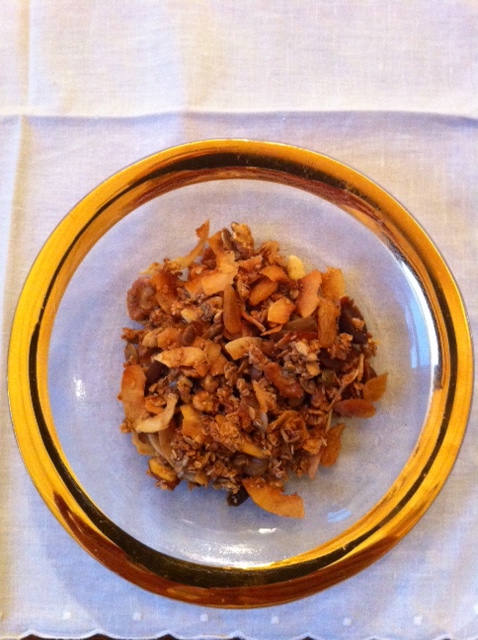
Ariane’s Granola
Preheat Oven to 325°

1 Cup Organic Oats, ½ C. unsweetened shredded coconut, ½ C. unsweetened coconut flakes or chips, ½ C. pumpkin seeds, ½ C. sunflower seeds, ½ C. chopped walnuts, ½ C. pecans (or sliced almonds)

Heat together and then pour ½ C. maple syrup, ¼ C. honey & 1 teaspoon Vanilla extract onto dry mixture.  Mix with wooden spoon until everything is coated.  May need to add a little more honey or maple syrup.

Line a cookie sheet with parchment paper, spread granola in a layer.  Bake in oven for 30 minutes, stirring every 10 minutes to make sure it is uniformly brown.

Add 1 Cup chopped dried fruit.  I used dried apricots and yellow raisins, but any dried fruit would work.  Mix into granola after it’s cooled for 10 minutes or so.

For more on Emma’s journey through a childhood of autism, go to:   www.Emma’s Hope Book.com