Tag Archives: autism children

Merlin & Emma

Our male black kitty, Merlin doesn’t get a lot of play on this blog.  Mainly because Emma completely ignores him and so, try as I might, I rarely can figure out how to work him in to any posts since Emma’s the star of this blog.  Every now and then I am able to squeeze in some random mention of him, such as these few posts: Do You Think She’s Okay? and Emma’s Photographs, but it’s really a cameo role he’s been relegated to, nothing close to what he deserves.

“Emma, Merlin’s sleeping in the rocking chair, don’t push him off,” Nic cried out last week as Emma tipped the rocking chair on end so he toppled to the ground.  Where upon she happily occupied the rocking chair smiling to herself.

There’s a certain ruthlessness to Emma’s interactions with Merlin.  And while she seems interested in our neighbor’s cat, Lester, asks to visit him and always requests visiting the cats and kittens in the pet store, she appears completely disinterested in Merlin.

“Go see Lester kitty?” Emma asked a couple of weeks ago.

“But what about our kitty?” Richard asked.

“Yeah, Em.  What about Merlin kitty?” Nic chimed in.

“Go see Lester,” Emma said going to the front door as though this was just as good a time as any to pay him a visit.

“Em, we have to call Bob and Cynthia before we go visit.  We can’t just go over there now,” I explained.

“Go see Lester kitty later,” Emma said.

“Yes.  But we can play with Merlin now.  Want to play with Merlin?” I asked.

“No,” Emma said matter-of-factly and walked away.

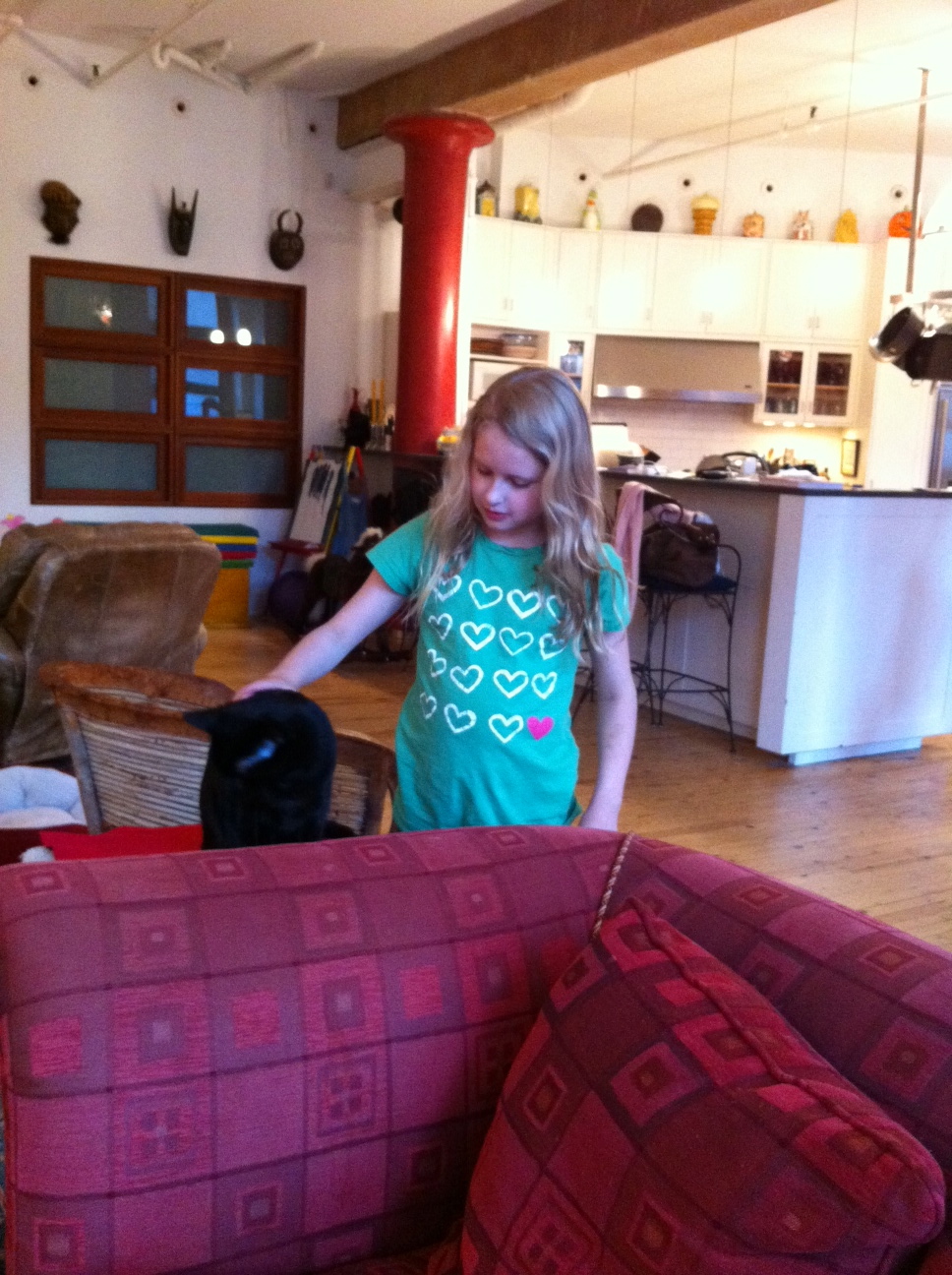
So when Emma and I were home the other day and Merlin jumped up onto his scratch post, I said, “Oh look, Emma!  Merlie’s come to say hi!”  When she turned to look at him I said, “I bet he’d love it if you pet him.  He loves being pet.”

To my amazement she stroked his back while saying, “Merlie.  Petting Merlie,” as I rushed for the camera.  These are a little out of focus, okay, a lot out of focus because I was hurrying to capture the moment before Emma lost interest.

Merlin gets Emma’s attention

Finally, having waited so long…

Months…

Years…

Merlin was purring, he was so happy…

A final moment of affection between Merlin and Em
And then it was over.  Who knows if she will revert back to ignoring him or callously pushing him off whatever surface he’s asleep on because she wants to sit there.  Everything changes.

For more on Emma’s journey through a childhood of autism and Merlin’s cameo appearances, go to: www.EmmasHopeBook.com


Bonding

I gave birth to Emma in a birthing center here in Manhattan.  It was a relatively “short” labor being just shy of 20 hours, compared to Nic who took more than 38 hours to appear.  Okay, it wasn’t remotely “short”, but that was the word everyone kept using when predicting how long it would take, and compared to Nic, it was certainly short-er, but that’s really the only way you can use any version of the word “short” in describing my labor with either of my children.  Richard caught Nic, as he likes to say, as if he were a football being hiked during a long, boring and tedious game.  The first hands Nic felt were Richard’s.  The first face he became aware of was Richard’s and they bonded immediately.  Not so with little Em.

First of all the labor was more painful or maybe it was just that I wasn’t as exhausted and so I can remember it better.  Richard was comforting me and holding my shoulders when I began to push.  When Emma appeared the midwife was the one pulling her from me before placing her onto my chest.  Richard missed that “father/daughter” moment of connection those first few seconds of her life.  Later, when he didn’t feel the same kind of innate bonding he’d had with Nic, we assumed it was because he wasn’t there to catch her.  For years I felt badly that I’d asked him to hold me and as a result he wasn’t able to be there to hold her.  But as with so many things in life – it’s easy to look back and see things differently when you know the outcome.

When Emma was diagnosed it kind of closed the book on the whole – I should have let Richard catch her during her birth – it was the one bit of guilt the diagnosis freed me of.  As time went on we saw how Emma seemed aloof around friends and other family members.  We came up with ways to rationalize her seeming indifference.  She was independent, she liked doing things on her own, she was her own person, she knew what she wanted, had a mind of her own, etc.  These were all things we said to ourselves and each other as we tried to make sense of Emma during those early years.

Yesterday Emma said to me, “Go swimming at the Y with just Mommy?”

“Yeah.  Okay.  Just the two of us,” I agreed.

Later when we returned home I said to Richard, “I’m not sure why Em wanted just me to go with her.  She pretty much ignored me every time I tried to engage her at the Y today.”

“You’re the only one she’s ever really physically bonded with, Ariane.  You’re the only one whose lap she likes to sit in.  You’re the only one she really likes to be held by.  It’s always been that way,” Richard said.

This morning as I was getting ready to take Nic down to his bus, I heard Emma giggling and Richard laughing, “Emma!  What are you doing?”

I turned around to see Emma climbing from the window sill onto her dad’s shoulders, unprompted, of her own volition and utterly happy.

Everything changes.

For more on Emma’s journey through a childhood of autism and our attempts to keep up, go to:  www.EmmasHopeBook.com

Emma and The Peach Gum

Last night Emma arrived home in tears.  It turns out she had swallowed a piece of peach flavored gum and her therapist, Joe, who had warned her that if she swallowed the gum he would not give her another piece, wouldn’t allow her to have another.  He offered her two other flavors to no avail.

“No!  Peach gum!” Emma cried when I went into her bedroom to sit with her.

“But Em, you swallowed it and Joe told you, you couldn’t have another piece if you swallowed it,” I said, stroking her hair.

“No!” Emma shouted, tears streaming down her face.  “NO!  Peach gum!”

“How about a different flavor?  But you can’t swallow it or you won’t be able to have another piece of any kind,” I offered.

“No, no, no, no.  Peach,” Emma insisted.

I often wonder, when Emma is derailed by something, seemingly rather insignificant, if there isn’t a whole series of events – perhaps unrelated – that have lead up to this kind of monumental upset.  It reminds me of days I’ve had, when everything that could go wrong does.  I get to work and my printer won’t scan, the cartridge is out of ink and I don’t have a back up, I can’t remember my password to upload images that have been requested to my FTP site, my merchant account isn’t showing my latest sales transaction, my gem setter calls to tell me he’s chipped a stone, I forgot to bring some documents I need from home, etc.  and then after all that I go home, having put in nine or ten hours of work, tired and grumpy and find a light bulb has blown in the living room. It just seems too much.  Meanwhile my husband wanders in, sees me and says innocently, “Hey, what’s going on?”

Those words are what flip the switch and suddenly I feel nothing but rage.

Is that what it’s like for Emma sometimes?  Only she can’t take a deep breath and explain that her day has been a nightmare of frustrations and mishaps, while the other person nods their head and says things like, “God that sounds awful.  Here why don’t you put your things down and let’s talk about it.”  Or “I know just what you mean.  It’s been a hell of a day.”  Poor Emma can’t say any of those things.  She doesn’t have the words to tell me how she’s feeling she can’t keep it together for one more second, so she just screams and cries and if things are really bad, bites or hits herself.

This morning one of her therapists emailed me, telling me about some of her frustrations at school yesterday.  I thought about how upset she was when she came home and it all began to make sense.  She had a bad day.  I can relate to that.  I have bad days from time to time too.  But I can pick up the phone and rant about it to one of my girlfriends or I can call my husband and tell him or I can sit and try to be quiet for a few minutes, “sit with the discomfort of it all”, as a meditation teacher I knew referred to those moments when it all feels unbearable.  The point is I don’t have to be alone with those feelings of frustration.  I can reach out and by reaching out I mitigate the feelings.

“You were frustrated, you scream, you bite,”  Emma told her therapist yesterday.  Emma was doing what we all do when we’re upset, trying to communicate her feelings with another human being.

Emma on a good day when she was seven.

For more on Emma’s journey through a childhood of autism and how that effects her older brother, go to: www.EmmasHopeBook.com

Emma and Art – Part 2

As promised, I arrived home yesterday evening and found the art bin in Emma’s room.  After brushing off the dust I pulled it out into the living room.  “Hey Em.  Look!  Let’s make something together!” I gestured at the pop beads, the wooden beads, the string, the glitter, paint and brushes.

“No, no, no, no, no!”  Emma said, casting an eye at the art supplies before returning to the vigorous twirling of her velcro strip.

“Oh come on!  Look at these things.  These look great.  Let’s make something with these,” I said, digging into the bin and producing a bag filled with brightly colored wooden beads.

“No, no, no, no, no!  Mommy go away!  Go away!”  she said, whipping her plastic strip around so that it made crackling noises.

I sat there looking at the bin and then at her.  “Are you sure?” I asked.

“Mommy no!  Go away!   Go away!   Go away!”  she said very quickly so the words all slurred into each other.

“Go away!” is new for Emma.  She says this either when she is going into the bathroom, a very good sign in my opinion, or when she is doing something she thinks we might object to.  That she was now using these same words to indicate displeasure with a suggestion seemed like an advancement as well.  This is a child who just months ago might have bitten her arm or hand or punched herself in the face to express her dislike of an idea.  I was relieved to hear her say – Go away!   And while it might not be considered the most polite response to someone who is trying to engage in an activity with her, it’s certainly a step up from self injurious behavior.  We parents of autistic children take what we can get.

An old familiar feeling of determination crept into my thinking, as I sat on the floor with the art bin before me.  Right, I thought, we need better art supplies.  Wooden beads and pop beads just weren’t going to do it.  As I considered what sorts of things to look for, it occurred to me that I have a great many things at my studio which I will never use.  Drilled gemstones I bought years ago when I first began designing jewelry, glass beads, cooper and brass wire, as well as lots of silk thread in dozens of beautiful colors.   I have a wide assortment of origami paper, leftover from the year I became obsessed with paper folding while pregnant with my son, Nic.  We have glitter, paint, construction paper, tissue paper, scraps of hand pressed paper, pipe cleaners, all the things one might need to make a wide variety of art projects.

“Okay, Em.  Don’t worry.  We can make something together another time,” I said, dragging the bin back into her room.

Emma followed me.  She bent her head down so that it was about an inch away from mine and said, “Play – Don’t say Mommy?”

“Don’t say Mommy” is a chase game where Emma and sometimes her brother Nic will come very close and say, “Don’t (two second pause)  say  (two second pause)  Mommy! (shouted)” and then they run screaming through the house while I chase them.  This game usually involves lots of doors being slammed and beds being torn apart as they burrow under sheets and blankets.  A variation on this game is – don’t say Daddy!  When we catch up to them, we walk very, very slowly giving them plenty of time to hide and ruin whatever bedroom they’ve sought refuge in, we tear the blankets off them while saying in a loud voice, “AHHHHHHH!  There you are!  I found you!” followed by villinous sounding laughter and tickling until they cry for mercy.  This game can go on for a very long time, so we have found, for the sake of ourselves and our neighbors, it’s important to put limits on it.

“Okay, but just two games and then we have to get into PJ’s and brush teeth.”

Emma stared at me intently with a little grin on her face and a wild look in her eyes, “Okay, okay.  Don’t… say… Mommy!” and off she went like a shot, her feet thumping against the floor as she disappeared into our bedroom.

Art will have to wait one more day.

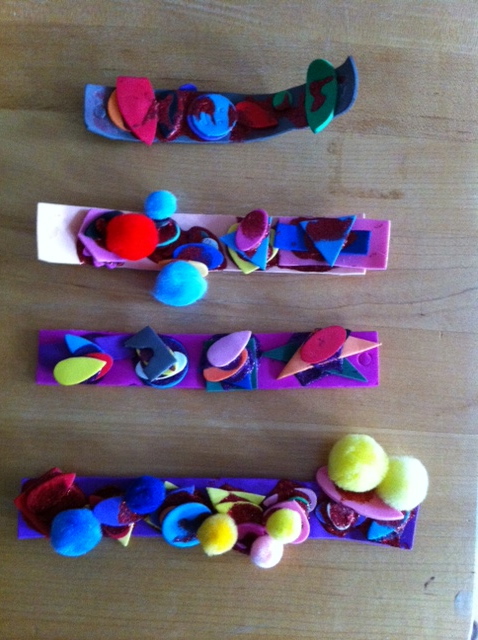
Emma’s art project brought home from school.

What makes these significant is the detail, the number of “bracelets” she made and the fine motor skills required to make them.  For any neuro-typical preschooler, these would be commonplace, but for Emma these bracelets show a marked improvement in her finger dexterity, concentration and focus, not to mention the sheer artistry. (Okay I’m totally biased, but they are pretty fabulous!)

For more on Emma’s continuing journey through a childhood of autism go to:  www.EmmasHopeBook.com

Emma and Art

This morning we had our parent/teacher conference with Emma’s team of teachers and therapists.  I am rarely told anything that completely catches me off guard at these meetings.  But this morning when her teachers related to us how Emma loves doing craft projects, I must admit I was astonished.

“Did you see the bracelets she made?  We sent them home in her backpack,” one of her teachers asked.

“Yes,” I said.  “But I assumed someone helped her with them.”

“No, no!  She did those all by herself,” I was told.

To say I was ecstatic is an understatement.  When I was pregnant with Emma I dreamed of the day when she would be old enough for me to teach her to knit, sew, embroider, do art projects, just as my mother had done with me.  Some of my favorite childhood memories are of my mother and I knitting, sewing, embroidering the figures for the nativity scene we made together one christmas that we still display on the mantle above my mother’s fireplace each December.  But up until now, Emma showed little if any interest in art projects, her fine motor skills are one of her biggest challenges, so my hopes of one day doing these things with her were pushed aside for the more pressing issues of helping her learn to read and write.

I am always looking for things Emma and I can do together.  Things that do not include her favorite outings – which can be very rigid and exacting – the Central Park Zoo, the American History Museum and the Central Park Carousel.  These are regulated outings with specific things that must be done in a particular order, “go see snake bite boy” in the museum, “go see bats” at the zoo.  One day, frustrated with Emma’s desire to ride the carousel over and over again I decided to just continue riding it to see how long she would do so before she asked to leave.  It took almost an hour and more than a dozen rides before she said, “All done.”  I was so dizzy I thought I was going to throw up and the next day she wanted to go back and do it all over again.

Emma has always shown an incredible memory for music, will hear a song once and then months later will hum or sing the entire song without missing a note.  I assumed, until now, that Emma’s artistic leanings were contained in her musical abilities. But every now and again I have wondered whether Emma might find some other medium with which to express herself since both her parents are artistic as is her Granma (she’ll deny this, but she is a terrific artist who did pencil sketches of us when we went on trips together that were amazing) and her great-grandmother was extremely artistic as well.  It definitely runs in the family, so to hear that Emma is deriving pleasure from her art projects at school is terrific.

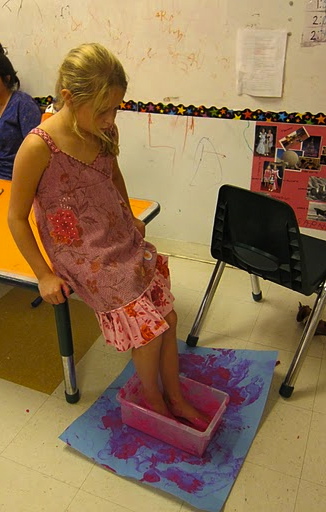
Emma at school using her feet to paint.

We have a bin filled with art supplies buried somewhere in Emma’s closet at home.  When I get home this evening I will pull it out.

For more on Emma’s artistic leanings and her journey through a childhood of autism go to:  www.EmmasHopeBook.com

Autism & Emma’s Loose Tooth

I forgot to mention in yesterday’s post, Emma yanked her tooth out at some point in the movie theatre as we watched Hoodwinked Too this past Sunday.  I don’t know when, all I know is that when we proceeded out of the theatre into the light of early evening, I looked over at her and saw the gaping bloody hole in her gum once occupied by a tooth, her lower left incisor, to be exact.

“Oh my gosh, Em.  What happened to your tooth?”  I asked.

“Pulled out your tooth!” She said happily, bouncing up and down.

“I can see that.  But where is it?  Where did you put your tooth?”

“You threw it.  In the movie theatre, yeah,” Emma said, nodding her head up and down.

“God, Emma.  I can’t believe you just chucked it,” Nic said, no doubt thinking of the money she had essentially just tossed away, being well versed in the ways of the “tooth fairy.”

As a quick aside here, Nic caught on to the whole tooth fairy thing years ago.  “Mom, you can stop telling me about the tooth fairy.  I’m not stupid,” he said to me several years ago.

“I don’t know what you’re talking about, Nic,” I said, feigning shock.

“I know you and dad sneak into my room at night,” he pantomimed tiptoeing like a cat burglar with an evil expression on his face as he said this,  “and leave money.”  He looked at me, but I kept my face blank.  Exasperated he said triumphantly, “You guys are the tooth fairy!”  He said this with the kind of flourish one might expect from Hercule Poirot or Columbo as they sum up a particularly tricky mystery.  Okay, I’m dating myself, but you get the picture.

“You threw it!”  Emma said, evidently pleased with herself.

I looked over at Richard who shrugged and kept walking.

“I think we have three of her teeth.  All the others are on the floor of various school buses and now the floor of the movie theatre,” I said.

“I think there’s one somewhere in the vicinity of the Central Park carousel,” Richard added, thoughtfully.

“She’s never really taken to the whole tooth fairy concept,” I said.

“Yeah, right,” Nic laughed and rolled his eyes.

In fairness to Emma, it is an odd concept, one we tried to explain to her when her first baby tooth looked as though it might come out soon.

“So Em, when your tooth comes out you have to save it, okay?” I said, kneeling down so I was eye level to her.

She ignored me.

“And you give it to Mommy, okay?  We’ll put it under your pillow and the tooth fairy will come and take it and leave you money,” I said, realizing how bizarre this sounded to someone who takes things literally and has no concept of money, before I’d even finished.  “Okay, Em?”  I asked as she squirmed away from me.

Later that day the tooth was gone, where she put it we have no idea.  As with all of Emma’s teeth, there is a ruthless quality to her handling of her baby teeth.  They become loose and she will often say, “Pull it out!”  I’m never sure if that’s a direct request, though she did ask Joe once, about a year ago, but he refused.  The next time  I notice the tooth, it is inevitably gone.  How she manages to yank it out, without us knowing, without a sound or cry of pain, is one of the many mysteries of all things Emma.  The way she experiences pain is exemplified in all those missing teeth.  I can still remember the agony of loosing my baby teeth, the days of pain I would endure.  Emma, apparently feels none of this.

“Tooth missing!” she exclaimed  when she returned home from school yesterday.  She opened her mouth and pointed at the place her tooth once inhabited.  “You threw it!”  Then she laughed and jumped up and down.  “You threw it in the movie theatre!”  She laughed, whipping her plastic velcro strip around her head like a lasso.

Emma wielding her plastic strip

For more on Emma’s tolerance for pain and her continuing journey through a childhood of autism go to:  www.EmmasHopeBook.com

Our Family & Autism

Yesterday I slept in.  It was lovely.  When I woke Emma and Nic greeted me with a Happy Mother’s Day song (complete with pompoms and a loosely choreographed dance) that was so wonderful I wished I’d recorded it.  My thoughtful and doting husband made me a fabulous breakfast and then Emma and I went to her study room.  We are working on the concept of two or more as in – “Some frogs”, “What are these?”  “These are trucks.” etc.  After the study room we went swimming at the Y, something Emma has been requesting we do for weeks now.  It was completely empty and for the first half hour we had the entire pool to ourselves.  This is unheard of in New York City!  We then went to see Hoodwinked Too – a movie Nic has wanted to see since it came out, followed by dinner at a restaurant.  A little something for everyone.

For those of you who do not have an autistic family member this must seem like a perfectly normal way to spend a day.  But for those of you who are like us, you already know without me saying another word, how incredibly, gutsy and insane it is to even attempt the things I’ve just casually listed.  Let me explain.

Because of the issue of transitions, never easy for Emma, her very specific sensory issues coupled with her need for routine and sameness, a day as I’ve described can be a veritable minefield of upsets and cause untold anxiety for Emma. With this in mind we prepared Emma for the day by going over the key points with her – study room, lunch, swimming, movie in the movie theatre, dinner, cupcakes at home – and repeated this list throughout the day, often with Emma interjecting for clarification, “not movie at home, movie in movie theatre!”

The swimming was easy, it is something Emma absolutely loves to do and we try to arrange at least one day a week when she can go, though this isn’t always as simple in New York City as it may sound.  Needless to say we do not live in one of those coveted buildings in New York City with an indoor pool.  However, there are a number of excellent pools throughout Manhattan and so it is not impossible to arrange.  After we swam, (Emma was ecstatic and we all had a great time) we made our way to the movies.  This transition can be tough for Emma ending with protests, tears or worse.  Movies are not something she particularly enjoys and even though this was a kid friendly animated movie, Emma was just as likely to find it intolerable.  It is difficult for her to sit still through the trailers, she doesn’t like the 3-D glasses (I don’t either) and unless it has lots of music, the movie usually does not hold her interest for long.  Emma then will begin standing up in her chair, looking at the people sitting in back of us and saying in a very loud voice, “NO!  You have to be quiet!”  which they find utterly confusing as none of them have spoken.   Emma is just as likely to put her index finger to her lips and make a loud “SHHHHHHHH!” noise, followed by “You have to be quiet!”  Other movie goers find this equally baffling, as we do our best to quiet her.  We always come prepared knowing one of us may have to leave with her, taking her to a nearby playground until the movie is over.  But yesterday she sat through the entire movie, with very little squirming and no audible protest.

After the movie we walked to a restaurant, a little trendy upscale diner with loud rock and roll music (a plus for Emma & Nic who knew all the songs) and with fast service.  Even so, going out to eat is not something we do often as a family as it can end with drinks knocked over, loud utterances of “Time to go now!” from Emma or she will simply get up and leave with one of us racing after her.  This restaurant was one of those places that doesn’t really get crowded until after 8:00PM so we had no trouble securing one of their much sought after booths at 6:30PM.  Emma has such a limited number of foods she’ll eat, we came prepared with her favorites, which she happily ate when our food was served and then patiently waited for us to finish.

Nic and Emma sitting in a booth at the restaurant.

Richard, ever the thoughtful boy scout had bought cupcakes from Magnolia Bakery the day before, thinking Emma was more likely to get into the celebratory spirit if there were cupcakes for dessert waiting for us at home.  So after we ate our dinner we made a pit stop at a playground across the street before going home to eat cupcakes.

Except when we returned home and brought out the cupcakes Emma said, “No thank you,” and wandered off to her bedroom.

“Wow, that’s new!  She doesn’t want one?” I looked at Richard incredulous.

“Hey, everything changes,” Richard said with a shrug.

By 8:00PM both children were in their pj’s, teeth brushed and flossed and in bed.

It was a perfect Mother’s Day.

For more on Emma’s journey through a childhood of autism go to:  www.EmmasHopeBook

Compulsions

I’ve been thinking a great deal about “stimming” which was the topic of yesterday’s post.  Stimming or self-stimulation is the word used for what many children and adults do who have been diagnosed with autism.  It is the repetitive behavior, often as varied as the personalities of the person engaged in it, used to self-regulate or calm oneself.  Many people with autism suffer from a wide range of sensory issues.  Emma may well experience light and sound differently than I do, for example.  I know she experiences physical pain differently.  A small, seemingly incidental scratch causes her to howl in pain, clutching the injured body part, scratching at it or rubbing it vigorously.  Yet a fall, that looks extremely painful, will be ignored.  Days later a large bruise might appear or swelling, which only makes one that much more aware of how it must have hurt and yet she didn’t seem to notice.

Sometimes Emma will plug her ears with her fingers when someone is speaking, often it is when one of us join her in singing a song.  I’ve noticed she does this when her air conditioner is on as well.  The low hum it makes is something she is unable to tolerate.  All of these examples are specific to Emma.  And it makes me wonder whether there are many other things I cannot know about;  does she see certain colors in a way that is painful?  Are some colors brighter to her, even garish and therefore hurt her eyes to look at?  I know certain sounds hurt her ears, sounds like that hum of her air conditioner, does it merely bother her or is it actually painful?  I can’t know.  What I do know is that if  one was bombarded with images, noise, sensations that I could not verbalize, would I not seek refuge in something I could control?  I don’t know, but I think I would.  Is Emma, when she twirls the plastic backing to the velcro strip around and around, soothing herself from an overload of external senses?  It seems likely.

Yet how is this so different from addictive behavior?  Is it not somewhat similar or in the same general ball park?  If someone engages in hours of video game playing or round after round of Solitaire on their computer or Spider (my particular favorite), how is this not also a kind of stimming?  At the very least it is certainly perseverative behavior.   If the game was just played once or for a few minutes that would be one thing, but what of the person(s) who plays endless games, one after the other?  A friend of mine said to me a few months ago, “Sometimes I ask myself – how many times do I have to win before I’ll stop and say that’s enough?  Because when I win there’s no real satisfaction or feeling that – okay now I’m won, it’s time to stop.  I mean how many hours have I wasted playing a really stupid game on the computer over and over again?”  I’m guessing many people can relate to this.  Even if they aren’t into computer generated games, there are other things many of us engage in, mindless “games” or habits we do that we wish we didn’t.  Consider all the games, video games, obsessive exercising, compulsive eating, compulsive dieting, any and all obsessions, compulsions or habits that get in the way of our lives or health, all the things we do while knowing they aren’t good for us and yet we can’t help ourselves from doing them anyway?

When I watch Emma twirling her strip of plastic, while jumping up and down and singing I am reminded of my own perseverative behaviors, the hours I’ve spent doing mindless activities, all to what end?  Am I too, calming myself?  Is this my own brand of self soothing?  I have harsher judgements about my activities, particularly computer games, than I do of Emma’s activities.  I have even, periodically deleted all games from my computer or mechanical device, only to reinstall at a later date.  Certainly there is a compulsiveness to my behavior and I would even go so far as to say an obsessiveness.  I do not mean to suggest my OCD tendencies are remotely the same as what Emma must go through on a daily basis, that would be insensitive and dismissive of her very serious sensory and neurological issues, but I throw this out as something I’ve noticed and can relate to in a very superficial way.  Of course I could be completely wrong about all of this and anyway I have to hurry so that I can finish today’s crossword before starting my day.

For more on Emma’s journey through a childhood of autism and obsessive behavior go to:  www.Emmashopebook.com

The Velcro Strip

Emma’s balloon string has been officially replaced.  She now carries a long plastic strip, the kind you peel off a self adhesive velcro strip.  How such a bizarre and unlikely item came into her possession is anyone’s guess.

Emma with her plastic velcro strip this morning before going to school.

Over the past year or more Emma has become attached to an assortment of long, thin objects.  The first was a stick she picked up on a playground near the Bronx Zoo.  One can never know when an object will become a coveted one.  But I remember that stick because she wouldn’t let go of it, even when she swung on the monkey bars at the playground.  It was an odd thing to watch her movements so clearly hindered by her refusal to let go of that long stick.  When we made our way to the subway for the long ride home, we told her she could not bring the stick with her.  She didn’t put up a fight and I thought nothing more of it until I saw her, upon our return home, reach down to pick up another stick from the planter outside our building’s front door.

” No Em.  The stick stays outside,” I told her and she complied.

But it became a habit, each and every time we left the house she would find a stick and carry it with her.  A few months later she found a long plastic strip used to bind packages and began carrying, twirling and waving that around while inside our home.

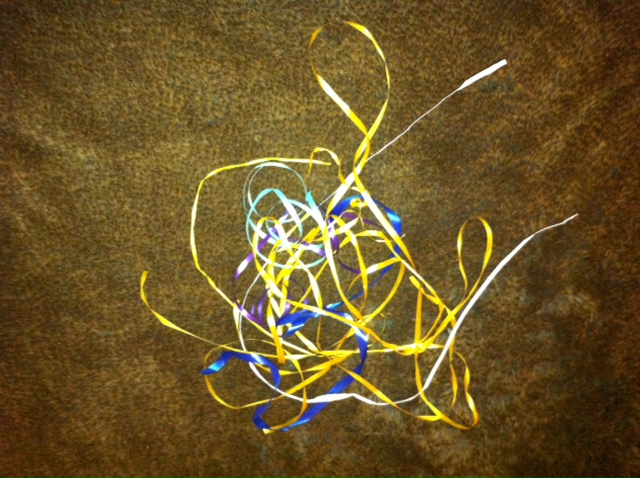
Emma’s assortment of “strings”.

There are a few thoughts on this sort of behavior with autistic children.  Some believe the items should be removed.  The idea being the child should not be allowed to have them as they increase “stimming”.  Stimming – shorthand for self-stimulation is a word, which is much used when speaking of autism.  It is the repetitive behavior the child/person uses to soothe, calm or regulate themselves.  The objects are varied and can be anything from spoons to things like running water.  But some children do not engage an object at all.  These children do things like  hand flapping, twirling, spinning, rocking and even head banging, while others stare at their own fingers that they wave in front of their eyes, others tap their fingers rapidly, hum or grunt, bite or twirl their hair, lick surfaces or smell things.  What marks their behavior from so called neuro-typical behavior such as pacing, doodling and thumb twirling is the child who is autistic may engage in these behavior for hours at a time, often getting in the way of daily living and learning.

Others believe the child should be allowed to stim and feel it is better to allow the child to self regulate.  They believe it is, in fact, cruel to remove the source of comfort for these children/adults who are autistic.  Many people believe learning can take place despite the stimming.

I don’t fall squarely into either camp.  Richard and I have done our best to give her the freedom to have some objects – balloon strings, velcro strips etc. while telling her she cannot bring sharp, pointed or objects we think might accidentally hurt her into the house.  We do not allow her to have her “Coqui” aka scraps of blanket outside her bedroom because she can sit for hours at a time sucking her thumb, which is doing untold damage to her teeth.  When I am working with Emma she may not have anything in her hands as I need her hands free to type, write etc.  But when she has gotten dressed, brushed her teeth, straightened her room, she can race around the house on her scooter, carrying whatever long piece of string/plastic/packaging tape she likes.  It’s difficult to know whether we are doing the right thing, but for the moment this middle ground seems to work or, at the very least, not cause too much damage.

Earlier this morning when I was trying to take a picture of Emma with her velcro strip, she wouldn’t look at the camera.

“Hey Em.  Can you look at the camera?” I asked.

“Say cheeeeese!”  Emma said scrunching her face up into a hapless and obviously forced “smile”.

“No not like that.  Think of something happy.  What makes you happy?” I asked, pointing the camera at her.

“Mommy makes me happy,” she whispered.

And that makes me happier than she can ever know.

For more on Emma’s journey through a childhood of autism and arbitrary items that hold her interest go to:  www.EmmasHopeBook.com

Sliver Abilities in Autism

The other day while waiting for Emma’s bus we sat together.  Emma recounted, as she often does, what she planned to do that day and what she looked forward to in the days ahead.  “Get on school bus, Becky’s class, Joe, see Mommy, sleep, wake up, sleep, wake up, sleep wake up, sleep, wake up, Throwback Sports, sleep, wake up, make pancakes!”

Our neighbor took this photograph of me and Em waiting for her school bus.

I’m always astonished that Emma almost always gets the right number of “sleep, wake ups” before she can have pancakes on the weekend.  I have even seen her count on her fingers, making me wonder whether we shouldn’t start implementing a math program – if I can find one – as it’s clear she is counting and figuring out how many times she’ll sleep and then wake up before Saturday morning.

Much has been said about autism and “sliver” abilities, the sorts of things autistic children seem to be able to do at age level or above while most other things lag far behind.  I am not referring to the much publicized, but rare, savants.  I’m talking about the abilities many autistic children have that surprise us, their parents.  In Emma’s case it is her unbelievably accurate memory for people, places and things.  She will talk about a preschool teacher she had when she was three and she has an uncanny ability to know when a favored object or photograph is missing.  She seems to know immediately that not only a photograph is missing, but she knows which one with a glance at the pile of over 200 photographs.  I have no idea how this is even possible.

“Carousel photo?”  Emma will cry.

“But Em, here’s the photo.  Look!  There’s you and…”

“No!  Other one!” She’ll cry in frustration.

We no longer doubt her.  I cannot remember Emma ever being wrong about a missing photograph from her box of photos.  She keeps them in a box the size of a shoe box and there are over two hundred photographs.

I am constantly amazed with Emma’s mind.  It can retain massive amounts of information and yet I still must remind her that she needs to dry her body off when she gets out of the shower.
“Okay, Em.  Now get a towel.  You have to dry your arms and legs.  Now dry your stomach and back,” I will say.

What has become clear to me is that Emma’s mind is not something I can predict.  I cannot assume she will know how to do something – rinse her hair after she puts shampoo in it – while at the same time I cannot not assume anything either.

“Mona Lisa!”  Emma said, pointing to a book with the portrait of the Mona Lisa on the cover.

“Yeah, Em.  That’s right.  Who painted it?”

“Leonardo,” Emma answered happily.

“What’s his last name?” I asked.

“Vincy” She said.

“That’s right Em.  His name was Leonardo Da Vinci.”

When we were at MOMA a few years ago, Emma astonished all of us when she pointed to a painting and said, “Picasso!  Man with Guitar.”

Just around the time Emma was diagnosed I showed Emma a book on famous painters and their paintings.  Over six years later she still could remember them.

For more on Emma’s “splinter abilities” and her journey through a childhood of autism go to:  www.EmmasHopeBook.com

How We Communicate

Recently someone commented on the “I Believe” post.  She wrote:  “She is communicationg to you, she communicates to you ever day. With her body language, with her expression, with her unusual use of language.”

I loved receiving this comment (I love receiving all the comments people have sent over the past year, they are always informative, interesting and often provocative), which adds to the earlier discussion in the post “Embrace-ness-ness” regarding how we view intelligence in non-verbal people and what that means.

As I have mentioned before, my father spent the last 15 years of his life in a wheelchair and though he was cognitively unimpaired, he was treated differently, almost as though people thought his brain had somehow been damaged too.  His accident and disability profoundly altered my view of the world.  I came to see first hand the pain and suffering caused by people’s responses and misunderstandings of his disability.

When we are out in public with Emma, she is a free spirit.  I have never seen her look in judgement at another human being, no matter how deranged they may appear.  Emma will sit next to a homeless person on the subway without a second thought.  If someone smiles at her, she will smile back.  Emma is without malice.  She is utterly void of judgement.  And yet, I see the looks of fear and confusion on the faces of those who see her and do not understand what they are seeing.  I see how their eyes watch her and then move to us, trying to find a clue as to why this child is behaving so oddly.  Many times people assume she is behaving as she is because of our parenting or lack of parenting.  We have been given well meaning advice from countless strangers over the years, people who feel they are, no doubt, helping us.  Yet, if we tell them she is autistic, this explanation is rarely met with understanding.

Autism is an almost meaningless word, at this point.  It covers such a vast array of behaviors and issues, it is no wonder people feel confused.  Many people know someone who is autistic and assume all autistic people must share the characteristics of that person.  This could not be farther from the truth however.  There are people who are verbal, non-verbal, semi verbal, highly verbal, but echolaic, verbal with perseverative tendencies, etc.  Some people who have received the autism diagnosis are highly functional, go on to have successful careers, excel in their chosen fields, others maintain jobs, never missing a day of work, while others cannot hold a job and will need assistance for the rest of their lives.  Meeting one person with autism is like meeting one person anywhere.  If that person is not able to communicate in a language we know, it doesn’t mean they can’t communicate or do not want to.

We all want to communicate.  Perhaps the single most destructive belief about autism is that those who are diagnosed with it have little desire for human interaction.  Just because they may not be able to communicate their desires in ways we are used to, does not mean the desire doesn’t exist.  If I want to communicate with Emma I just have to spend time with her.  She communicates with me in a wide variety of ways constantly.

Emma with her beloved balloon string – recovered from the laundry hamper.

For more on Emma’s balloon string and her journey through a childhood of autism go to:  www.EmmasHopeBook.com

Emma’s Handwriting

As those of you who follow this blog know, Joe (click on “Joe” to read an entire post devoted to him regarding his tireless efforts and hard work with our daughter, Emma) and I have been working diligently with Emma on her reading and writing skills and comprehension.  So when she requested Sunday morning to “go to the study room”, I wasn’t particularly surprised.  Just as she inquired however, Nic and his friend Max, who had spent the night, wandered into the kitchen asking for french toast.

“Hang on, Em.  Let me make the boys breakfast and then we’ll do study room,” I said.

“Study room now?”  Emma replied.

“Would you like to write something?” I asked pulling a pad of writing paper out.

“Yes.” Emma said, much to my surprise as handwriting is by far the most challenging aspect of the literacy program we’ve implemented for Emma.

“Okay.  Here.  Go ahead while I make breakfast.”  As I began the preparations for french toast I could see Emma at the dining room table writing.  I quelled the urge to go over and look.

After a few minutes Emma said, “Good job drawing hand!”

I went over to see and saw that above the drawing of her left hand she had written, “This a kid”.

What was remarkable about this was that she came up with this sentence on her own, did not copy it from anywhere, initiated the whole thing, used an upper case “T” to begin the sentence and other than the absence of the “is” and a period at the end, wrote a complete, grammatically correct sentence.  This is not a child who is learning their alphabet, this is a child who is reading and writing.  It was breathtakingly exciting.

“Good drawing hand!” Emma said when she saw me staring down at her work.

“Em!  You wrote – This a kid – that’s fantastic!” I answered.  “Look, you just forgot the is,” I said pointing to the space between this and a.  It’s fantastic!  And this has is in it, so it’s easy to forget.”

“Yeah!” Emma said, smiling broadly.

“I love how you wrote that, Em.  It’s so great!” I said staring at her handwriting and feeling tremendous pride.

“You writing,” Emma said.

“You have to say – I’m writing,” I told her.

“I’m writing,” she said.

“Hey, let’s write – This is a hand,” I said while writing the words to the right of her hand drawing.  “Now you write – hand,” I instructed.

Emma carefully took the marker and wrote – hand – underneath mine.

“That’s great.  And look, let’s write – Emma’s hand – here,” I said.

“Yeah.  That’s Emma’s hand!” she said, pointing.

“Wow, Em.  This is terrific,” I told her.

“Study room now?” Emma asked.

“Yes!  Let’s do your study room now,” I said.  “But first let’s write – This is a kid – again.”

Very methodically Emma took a separate piece of paper and wrote – This is a kid.  Then she reached over and made the toy kid sit on the edge of the page.

“Em, I’m so proud of you,” I told her.

“Emma’s writing!” Emma said, happily.

“I’m writing.  You say – I’m writing,” I said.

“I’m writing!”  Emma repeated.

Yes, she is.

For more on Emma’s journey through a childhood of autism go to:  EmmasHopeBook.com

Clothing Autism

This morning I asked Emma, “Do you want to wear pants or a dress to school today?”

“Pretty dress,” Emma said without hesitation.

“Okay.  Which one?” I pulled two dresses out for her to choose from.

“Other one?”  Emma said-asked.  “This one?”   She pulled at her red and white print skirt she’d worn just the day before.

“No.  How about picking a different one.  You just wore that one,” I said, wondering if I should let her wear it again.  After all I wear a uniform of sorts to my studio most days – a pair of jeans and t-shirt of some kind.  Her skirt had been washed and ironed, there was no reason why she couldn’t wear it twice in one week.  Nic wears a school uniform to school everyday and I must admit it makes life easy.

When Emma was first diagnosed I became aware of how I was dressing her with painstaking care each morning.  It was as though I were trying to cloak her autism in pretty dresses, making sure her hair was neatly braided with different colored ribbons.  As she grew older I became less fastidious about her clothing, but I am still aware of my complicated feelings when I see her wearing some bizarre outfit of her own choosing.  Often when a caregiver has let her choose what she wants with no editing.  Socks worn with crocs, leggings that are too small, now resembling capris, the two inch gap of skin between pant and sock, the t-shirt in some color, ill-matched with the rest of the outfit.  I inwardly cringe and I admonish myself for being so shallow.  I just want her to fit in and when she’s dressed in such a way that only seems to advertise loudly how different she is, it breaks my heart.  Still I do my best to temper those feelings.

“You rarely get the chance to be frivolous,” a friend of mine said the other day.

“But it’s ridiculous.  I know,” I answered.

Once when I brought the subject up to my husband, Richard, he replied, “But people do respond differently to her when she’s wearing a pretty dress.”

And he’s right they do.  They tell her how pretty she looks and she smiles and twirls around.  I know it really is absurd, but I want people to be kind to her.  I want people to smile at her and they do when she’s dressed nicely.  I know how silly all of this sounds.  I know this isn’t going to help her autism.  I know I’m talking about something as idiotic as how she appears and has nothing to do with substance, but I also know that people react to her in a more complimentary way.

“Please don’t ever let her wear a velour track suit,” I begged Richard before leaving on a trip a few months ago.

“I love velour!”  Richard said.

“Well of course you do, just don’t let her wear one, okay?”

“She doesn’t own a velour track suit,” he answered, seriously.

“Yeah, but you might feel compelled to buy one while I’m gone,” I said.

“It’s going to be okay, honey.  I think I can handle this,” he said.

And of course he did handle it all beautifully while I was away, just as he always does.

“Okay.  This one,” Emma said, patting at a pretty white, turquoise and orange skirt.

“Oh that’s perfect!” I said, pulling it out of the closet.

“It’s perfect!” Emma repeated, bouncing up and down on the bed.

For more on Emma’s journey through a childhood of autism go to:  www.EmmasHopeBook.com

I Believe…

Every year we have a meeting with the Board of Education aka BOE.  Yesterday morning was our scheduled meeting time, but because Richard has been ill, I went alone.  I do not look forward to these yearly meetings.  And as yesterday morning got off to a bumpy start I was doing my best to bolster myself for what I knew was going to be an emotionally  difficult time.  They always are.  It is at these yearly meetings when we go over Emma’s IEP (Individualized Education Program).  Each year the BOE sends someone from their department into Emma’s classroom to observe her for a half an hour.  From that observation, a report is written, almost always a report we read with dread.  It’s not that they are unreasonable or unfair, though sometimes Emma is unrecognizable, it’s that they are stripped down to the basics.

A sample from one of these reports:  “Emma came down from the cabinet and lay down on a rug.  At 9:07, she remained lying on the rug.  At 9:08, she went out of the classroom and came back barefooted with a plastic box.  A teacher assistant showed her two bottles of paint.  She said, “no” loudly…”  The report goes on to depict a low functioning autistic child (Emma) who is somewhat responsive to the teacher’s assistant, at times non-compliant and with almost no verbal language.

This year Emma was also assessed by a psychologist sent from the BOE.  This report was even more troubling: “Emma is minimally verbal, spoke in single word utterances, or short, attenuated sentences for the most part, was able to repeat simple phrases heard, and was echolalic.”  The report goes on:  “Emma was able to hold a pencil somewhat awkwardly and make a scribble, or simple circular motion.  She was unable to copy simple vertical and horizontal lines, or any simple recognizable geometrical designs.”

As her mother it is difficult to read these reports.  I look at my daughter, my beautiful, funny, athletic Emma and I see her potential.  I choose to believe she is capable of so much.  I choose to believe she understands so much more than she appears to.  I choose to believe she will one day read and write.  I choose to believe one day she will communicate with us.  She will tell us what it’s like for her.   I choose to believe these things because to do otherwise is not a life I want to live.  But when I am confronted with reports such as the ones I’ve quoted from, it makes me question, even if for only a moment these choices, these so called beliefs of mine.  What if I’m wrong?  A question I always follow with – what does it matter if I’m wrong?  Because if I’m wrong, I won’t find out until I’m very old or will never know because I’ll be dead. I will always choose to believe I’m right about Emma.  I have to.  All the work we do with her every single day is because I believe in her abilities.  I believe she can do more.  I believe she is capable of so much.  When I tell her we have to do yet another reading exercise or writing exercise I am doing so because I believe she can.  When I read to her about Harriet Tubman or Helen Keller or Balto or the discovery of King Tut’s tomb,  I believe she is taking it all in.  When I ask her if I should keep reading and her answer is always – yes – I take that as confirmation of my beliefs.  I know I am making a choice.  I know my decision to believe these things are based on very little, but never-the-less I believe.

I believe in Emma.

For more on Emma’s journey through a childhood of autism and my journey in parenting an autistic child, go to:  EmmasHopeBook.com

Emma waiting for her school bus this morning

Some Mornings

Some mornings are just not meant to be woken to.  This has been such a morning.  Emma lost her balloon string.  A yellow piece of string that was once attached to a balloon.  Emma doesn’t care that the balloon is no longer attached, in fact, she isn’t even remotely interested in the balloon.  It’s the string she cares about and this morning it went missing.  No amount of reassurance, no amount of talking to her about it, no substitutions would quell the storm that emanates from Emma when she is upset.  Emma was beyond upset.  Emma was heart broken, in a panic, utterly stressed out, screaming, snot pouring from her nose, shrieking “I need help!   Mommy!  Mommy!  I need help!” over and over and over again until the words become some sort of hysterical mantra.  It is at this point that she begins to script.  “I know baby.  You threw it!  You cannot throw it.  I need help.  Mommy!  I need help.  Baby, baby you can’t throw it!”  And on it goes, repeatedly, between tears and screams and stomping of feet and then when it all becomes too much she bites herself or hits herself in the face or punches herself in the leg or arm.  And we run around trying to find the damn balloon string or mutter under our breath that we should have thrown the stupid string away days ago, because this isn’t the first time she’s lost it and no substitution will do.

Last weekend when Richard offered her an identical balloon string she said, “Other one.”  And walked away.

No there will be no substitution and all that can be done is to barricade oneself mentally from the screams, try to keep ones patience and get her ready for the school bus because if we miss that, we have a whole new set of problems.  Once we were downstairs the tears and scripting continued.  But eventually, eventually she calmed down enough to play “bat” with me.  We talked about the bus and school and later Joe and study room and how it was going to be a good day.  It got off to a rocky start, but it would be okay.  And somehow, at some point Emma seemed convinced that this just might be true.

For more on Emma’s journey through a childhood of autism go to:  EmmasHopeBook.com