Pretty

Emma loves to wear “party dresses”.  A party dress can be any dress if it’s fancy enough, but the kind she seems to like best are the fairy princess variety you find in toy stores or costume shops -–frilly, bright, colorful, shiny, sequined. When she gets one for a present her typical reaction is to squeal with glee, “OH! It’s so PRETTY!”

Every dinner party we have is an occasion for her to dress up in one of her favorite dresses that she will pick out herself without any suggestions from us. When guests arrive she will prance and skip and whirl around, making sure everyone notices her glamorous attire. If she doesn’t get the “oohs and awws” she’s looking for, she isn’t above fishing for compliments, walking right up to the insufficiently impressed person and shouting, “PRETTY DRESS!” while displaying her ball gown to its best advantage.  All the preening will usually be accompanied by an impromptu concert performance, with Emma belting out a medley of her favorite Sesame Street songs.

Emma definitely has her tomboy side, but she is very much a girly girl too. When I see how happy and excited she gets dressing up and admiring herself in the mirror, I always think of Maria in West Side Story, singing “I feel pretty!” And she is, of course — a chip off Ariane’s block.

Ariane has often talked about the sadness she has felt in not having had the kind of mom/daughter relationship she had dreamed about with Emma – going shopping together or having a manicure side by side. But that is starting to change a little bit at a time. Emma loves it when Ariane paints her toenails now. Next thing you know – Canyon Ranch.

This Morning’s “Conversation”

(Showing Emma this photograph)

Emma splashing

A:  Hey Emma!  What do you see?

Em:  He putting on the sprinkler.

A:  Who’s “he”?

Em:  He putting on his feet in the sprinkler.

A:  Who is that?

Em:  Emma.  Emma putting he feet in the sprinkler.

A:  Her.  Her feet in the sprinkler.

Em:  Her.

A:  You’re putting your feet in the sprinkler.

Em:  Yeah.

A:  Was that fun?

Em:  Yeah.

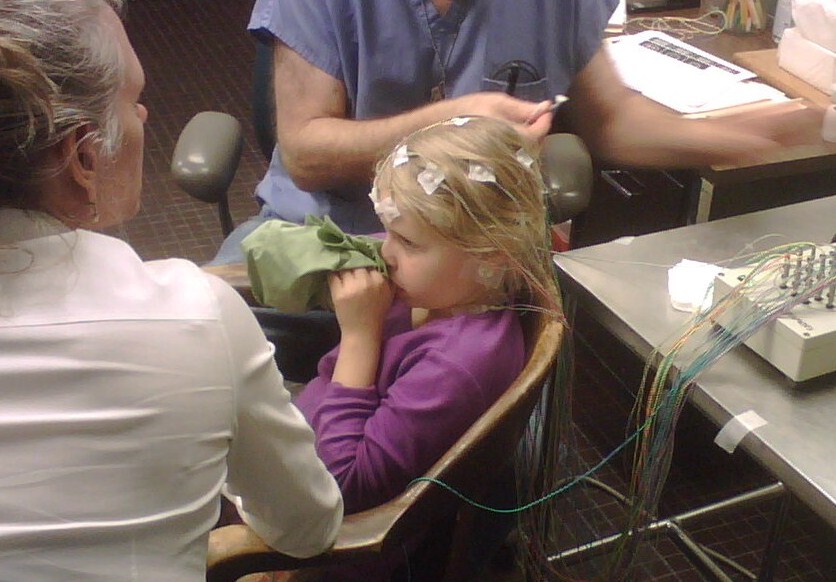
(I show her this photograph)

Me:  What about this?  What’s going on in this photograph?

Em:  Dr. Halper.

Me:  What’s he doing?

Em:  Just Toni Karlsrud.

Me:  Is that Dr. Karlsrud?

Em:  Nooooo!  (Laughing) Dr. Halper.

A:  What’s happenig to you?

Em:  (Touching photograph.)  Goes beep, beep, beep, beep.

A:  You’re having a QEEG done.  It measures your brain waves.

(Emma gets up and walks away.)

A:  Emmy!  Come back!

Em:  Where are you going?

A:  Emmy!  Come back!

(I follow her into the other room where Richard is.)

A:  Hey Em, do you know why you’re having a QEEG done?

Em:  Now goes beep, beep, beep…  (while she says this she is touching various points on her head where the electrodes are placed.)  beep, beep, beep, beep… (she touches her arm) beep.

A:  They don’t put one on your arm!

Em:  (Laughs) Beep!

A:  Do you know why this is being done to you?

Em:  Beep, beep, beep, beep.

A:  It’s looking at your brain.  It measures your brain waves.

Em:  Beep, beep.

A:  Do you like going to see Dr. Halper and having a QEEG?

Em:  Yeah!

A:  Should we go pick out what you’re going to wear today?

Em:  Yeah, sit for one more minute.

A:  Okay.

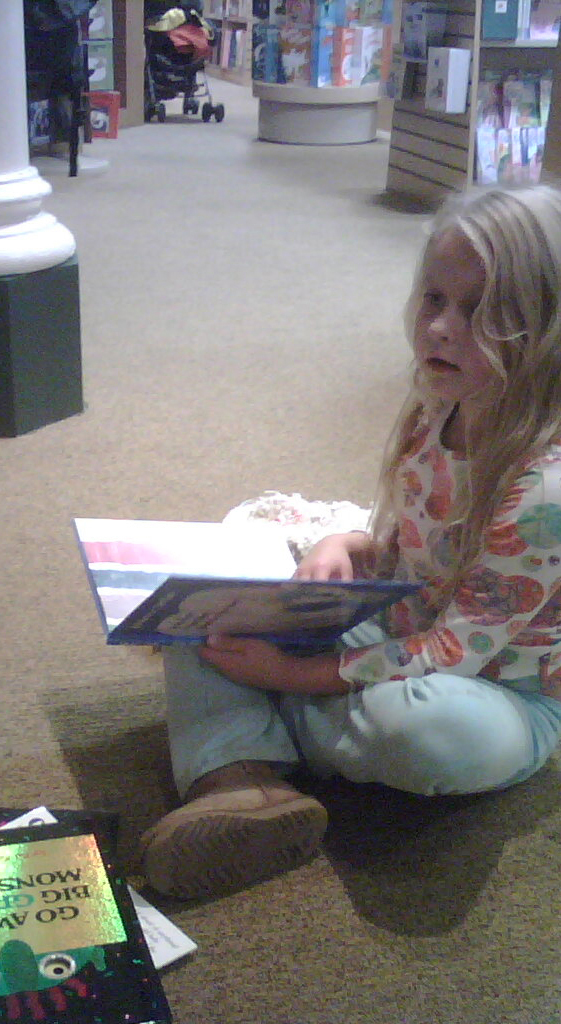
Go Away, Big Green Monster!

This photo was taken a few years ago at the local bookstore near where we live.   Emma has never shown much interest in books.  When she was a baby she would squirm and wimper when I tried to read to her.  As she grew older, she allowed me to read to her as long as she was able to hold the book and turn the pages.  Often she didn’t wait for me to finish reading before turning the page.  Much the way she flips through photographs, so quickly it’s hard to believe she is really able to see what and who are in the photo, she does the same with books.  I often wonder if Emma sees in patterns.  In other words, her brain picks up the entire scene and creates an instant pattern, allowing her to “see” the image instantly, any variation is immediately recognized.  I don’t know that she sees in this way, but I wonder.

Years before this photo was taken, I took Emma to the bookstore.  She couldn’t have been older than three.  She wriggled out of the stroller and ran to the back of the store.  We hadn’t been inside this particular bookstore for at least six months.  I followed Emma, calling out to her, “Emmy, where are you going?”  As was typical, she ignored me and kept running.  To her left was a floor to ceiling bookcase, filled with large picture books.  Emma attempted to scale the bookcase.

“No! No!  Emma!”  I cried.  “You can’t climb that.  What do you want?”

Emma jumped up and down, making noises.

“Is there a book you want to see?” I asked, looking at the shelves for a familiar book, which she might like.  Emma doesn’t like new books.  Whenever we are in a bookstore and I offer a new book, one that she hasn’t seen before, she shakes her head no.  Then goes over to a book she knows and pulls it from the shelf and hands it to me.  A few of her favorites:  “Chicka, Chicka Boom Boom”,  “Gossie”, “Gossie and Gertie”, “Brown Bear, Brown Bear” etc.  On this particular day she wasn’t interested in any of those books.  She was determined to climb the book shelf.  I picked her up, bringing her close to the books so they were in her reach.  “Do you want any of these?”  I asked.  Emma reached above my head, so I lifted her higher.

On the second to highest shelf, at about seven feet tall, Emma pulled a single book by it’s spine down from the shelf.  “Is that what you wanted?” I asked.  I set Emma down on the floor with her new book.  The book was “Go Away, Big Green Monster!”  I had never seen the book before.  As I stood watching Emma flip through the pages, reciting each and every word, I felt a chill.  It was eerie.  Where had she seen this book?  Who had read it to her?  She knew every word of that book by heart and spent the next hour “reading” it over and over again.

When we returned home (with the book) I related to Richard what had happened.  “It was bizarre, ” I said.  “I mean have you ever seen this book?”

“No, really weird,” he said.  “Maybe one of her therapists has it.”

“But she never lets them read to her.  And how did she know where it was in the bookstore?  She ran straight to it.  The therapists don’t take her outside.”

“I don’t know.  It’s really strange,” Richard said, looking at me.

“It was the only copy, Richard.  She knew it from it’s spine.  It wasn’t like it was out on display.  And I haven’t taken her to that bookstore in months.  She immediately knew where to find it.”

During the following weeks I asked everyone who came in contact with Emma, but no one had read her or lent her the book.

After a few months I stopped trying to figure it out.  To this day, I have no idea how she found that book, or even knew of it’s existence.  It remains one of the many unsolved mysteries of Emma’s mind.

The Search

One of the things I realized early on in my search to help our daughter was, there are a number of people who believe they know what causes autism and many more who believe they can cure it.  There is also a tremendous amount of money to be made from desperate parents, like myself.   I cannot tell you how often I took Emma to an alternative “healer” who claimed, if I just kept going and paying them their enormous fee, Emma would be cured.  I do not believe these people meant to deceive, I think they really have convinced themselves their method will cure a child and if it does not, it is because we didn’t give it enough time.

In many ways Bruno Bettelheim’s refrigerator mom is alive and well even if it has taken on a new twist in today’s world.  While no one came right out and said – You are to blame for her autism (and to blame if whatever method they were pushing didn’t cure her) – it was inferred by the questions they asked.  What follows is a sampling of a few of the questions I have been asked over the years.

Did you drink caffeine during your pregnancy?

No.

Did you or do you drink alcohol?

No.

Did you take any sort of medication during your pregnancy or labor?

No.

None?

No.

What about aspirin?

No.

Did you sun bathe?

No.

Did you have an epidural during labor?

No.  No drugs, natural childbirth.

How long did you breast feed?

9 months.

Just nine months?

Yes.  Emma didn’t want to breast feed, she weaned herself.  I wasn’t going to force her to breast feed when it clearly distressed her.

Ahhh…  Did you eat fish?

A couple of times.

What kind?

Grilled swordfish.  I didn’t know about the mercury levels in fish when I was pregnant with Emma.  It was only a few times when we were in Cape Cod.

Uh-huh…

There it was, finally, the answer they were waiting for.  Depending on the practitioner, the questions changed and as a result, my answers, but there always came a point when I gave the “wrong” answer. It always ended the same way with the same look – eyes downcast, a slight sad shake of the head.  I came away from these ‘interviews’ feeling angry, but I also wondered if there was any truth to it.   Maybe the two times I ate grilled swordfish while we were in Cape Cod, really was enough to cause her autism…  I think as a mother, it is second nature to wonder if something one did during pregnancy horribly effected the baby.  To this day I feel tremendous guilt for having unwittingly eaten swordfish during my pregnancy with Emma.  I honestly did not know how toxic our oceans had become.

I have become particularly wary of those who are adamant autism is caused by any one thing.  My guess is, it’s multi-causal, but who knows?  I am also wary of those who speak with absolute assurance they know how to “cure” autism with diets, behavioral therapies and alternative remedies.  Autism is a neurological disorder and while all of these things may play prominent roles in children getting better, I have yet to meet a child who has been cured, in fact, I have yet to meet anyone who has met a child who has been cured.

Mother’s Day

Every year when Mother’s Day rolls around I think about buying a trophy for Ariane. But if you’ve ever seen the kind of “World’s Best Mom” statuettes they sell in gift shops, you’ll understand how easy it becomes to resist that impulse. To do full justice in honoring her ceaseless sacrifices, her boundless commitment, and her indomitable courage in the face of repeated heartbreak, I’d have to commission a giant gold statue of her in full Viking Goddess mode, hair blowing in the wind, fist outstretched in an upward and onward call to arms as she stands atop a mountain of diapers, empty vanilla milk cartons and pancake batter, Emma perched on her shoulder with her thumb in her mouth, her other hand clutching her blanket Cokie as it flutters behind them like a triumphant flag.

Maybe next year. God knows she deserves it.

It’s hard being a mom. It’s hard being a mom for a normally developing child. Harder still raising two normally developing children, which is what we both thought we were doing in Emma’s first year of life. She logged in countless hours in countless playgrounds, bookstores, zoos and museums – with more than a gazillion trips to the Museum of Natural History alone — which Emma still calls the Snakebite Museum because she obsessively goes up to the third floor on each visit to see the diorama of a boy laying on the ground that’s been bitten by a snake.

And it’s hard…really, really hard…to be the mom of an autistic child. It’s hard being the dad of an autistic child too, but not as hard as it is for Ariane. For one thing, Emma can only bond physically with one person in the world, and that’s mommy. She might sit next to me, or lay in bed next to me, but we can’t cuddle. She likes to stroke my arm and she really likes to slap it. But I cannot hug her for more than a few seconds, I cannot hold her in my arms, I cannot sit with her in my lap in the rocking chair, not for long anyway.

She is not daddy’s little girl. She is mommy’s little girl. And along with the joys of that affection comes a world of responsibilities that are extremely difficult to bear when they rest on one person’s shoulders. Only mommy can comfort Emma when she stubs her toe, or gets a cut. Only mommy can hold her and say, “It’s okay.” I cannot count how many times I’ve run to Emma’s assistance when I’ve heard her screaming, only to have her run right past me and into mommy’s arms. And when Ariane is out of the house and she injures herself, there isn’t much I can do but try and calm her while I get a bandaid.

This next part is difficult to talk about, but I think it needs to be said in order to fully appreciate what this has been like for Ariane. Emma has only been able to poop in the toilet by herself for the last year. She has had chronic constipation we have tried everything to relieve for as long as I can remember. Ariane, being the only one who could really hold her, had to hold her on the potty while Emma screamed in agony, trying to relieve herself. This could go on for more than an hour. Every day. For years. Think about it. Now add to this the fact that Emma screams louder than a jet plane on takeoff. Nuff said.

Mothers of autistic children have to cope with another burden that never seems to fully go away, not that I’ve seen anyway. Guilt. Ariane is not alone in this respect, every mother of an autistic child that I’ve ever spoken to about this has said pretty much the same things: “I shouldn’t have eaten so much fish when I was pregnant. Or exercised. Or done those leg lifts the midwife told me to do because they said she was breached – and she wasn’t. I shouldn’t have gone down to the World Trade Center after they blew it up and all that smoke was in the air. I was too old to have another child. That’s what did it. That’s what made her this way.”

I’ve never heard the father of an autistic child wring his hands over his role in ‘causing’ their child’s autism, even though some studies have said that one possible factor in the disease is the age of the father, not the mother. But the mother bears the child and that seems to lead to countless recriminations and self-blame that doesn’t even end after the child is born. “I shouldn’t have given her that MMR vaccine. I shouldn’t have given her any vaccines.” And so on.

I once said to Ariane, “If you were talking to another mom with an autistic child, would you blame her? Would you tell her it was all her fault?”

Of course not. But I wonder how much these thoughts have faded even after all this time.

As soon as we got the diagnosis, Ariane must have read every book on the subject. While I consider myself to be a pretty good dad, equally concerned and committed to healing our daughter, I have still never read a single book on the topic, not cover to cover. Maybe I’m just being a guy, but my initial response was to Google everything I could discover about possible causes and treatments in the most concise descriptions possible. I couldn’t take the pain of all those details, of all those suffering voices. “Bottom line it for me.”

Ariane tried every possible treatment she had heard about on the internet – from other mothers, of course. She has documented many of these efforts on these pages. For example, she mentioned here that she once baked a casein-free/gluten-free cake for Emma’s birthday that took her hours and hours to make. No flour, no yeast, no dairy, no sugar. I couldn’t believe how good it tasted. “What’s in here, fairy dust?” I asked, reaching for a second slice.

Emma never took a single bite of it. That trophy I was talking about should have been awarded for this feat alone. I might have to commission one after all.

Happy Mother’s Day Ariane. I love you. Nic loves you. Emma loves you.

You are amazing.

Tests

We took Emma and Nic to a center specializing in hearing tests.  The tests for Emma came back negative for hearing loss, though the center did recommend hearing therapy for Nic.  Nic was sensitive to loud high pitched noises, like the fire truck’s sirens from the fire house across the street from where we lived.   He would run away from the sound covering his ears and crying.  Emma didn’t seem bothered by noise, in fact, Emma seemed to enjoy noisy situations, loved parties, the more, the merrier, it seemed.  Up until we received the results from the hearing tests I convinced myself this was the crux of the problem.  I remember telling my mother about a book I’d read regarding hearing loss and how it can lead to a variety of behavioral problems.  Surely this was what ailed Emma.

When the hearing tests came back negative, I had to modify my thinking.  Okay so her hearing was fine, this was good news, right?    It didn’t feel like good news.

We set up an evaluation through Visiting Nurse Service of New York.  VSNY is a not-for-profit organization providing health care in New York City.   There were pages of paperwork to be filled out prior to the evaluation.

Some of the questions were:

Does your child look at or turn to sounds?

YES!

Does your child respond to favorite people, making happy sounds or smiling?

YES!  She’s very happy with a jubilant, infectious laugh.

Does your child imitate you when playing a game, such as peek-a-boo?

YES! Another bull’s eye.  Maybe things were going to be fine after all.

Does your child engage in “make-believe”, such as playing with a doll or truck or playing house?

Okay, no, but she’s not interested in dolls, she’s more of a tom-boy.  She likes to run around and be outside.

Does your child indicate when she wants something?

Well no, but Emma never seems to want anything – so it’s not applicable – right?

Does your child interact with peers?

No.

Does your child use one or more words to ask for what he/she wants?

She did… sometimes, okay, not often.  She said “chase me” when she was about 16 months old, but as her language regressed, “chase me” went the way of all the other phrases – into the great abyss.

Does your child look up when you call to him/her?

Well, no.

And so it went.  Each question – like a nail being pounded into a plank – shutting out the possibility she was going through some sort of freakish delay which would right itself if left alone and not questioned.

For more information on Visiting Nurse Service go to:  www.vnsny.org

For more information on Emma’s evaluation see earlier posts:  The Beginning  and Hug Witness.

Emma At Ten Months Old

I sat in the pediatrician’s office with Emma squirming on my lap.  “She’s not really talking.  I mean she says words grouped together, but not single words.”

“Like what?” the pediatrician asked.

“Ba-bye, Da-da, Ah-done… things like that.”

“Smart kid,” the pediatrician said, checking Emma’s reflexes.

“So there’s nothing to worry about?” I asked.

“She looks great,” the pediatrician laughed, as Emma scooted across the room one leg jutted out in a crab-like crawl.

Thirteen Months

“So I shouldn’t worry, right?” I asked the young master’s degree student, studying speech therapy, who was Nic’s ‘teacher’ at his pre-school.

She nodded, “Some kids, especially the ones who are more athletic often have delayed speech.”  She looked at me with a smile.  “And her brother is pretty precocious, sometimes their younger siblings are slow to speak.  I’m sure it’ll come in time.”

I was turning into one of those neurotic New York moms.  It was classic.  I needed to stop worrying, Emma was fine, I told myself as Nic and I walked home from his pre-school.

Twenty-two Months

“Do you think she might have a hearing problem?” I asked my girl friend.

“But she looked up when that siren went by,” she reasoned.

“Yeah, I know,” I said, watching Emma push an empty swing.  “Watch this.  Hey Emma!” I called out.

No response.

Louder, “Hey Emma!”

Nothing.

Now shouting, “Emma!  Emma!  Look at Mommy!”

But Emma continued to play with the empty swing.

“Okay, but half the time my kids don’t look at me when I call them either.  Kids do that,” my friend said.  “Don’t they?”  She looked at me with half a smile.   “Anyway who wouldn’t be mesmerized by that swing?” she added, putting her arm around me and giving me a squeeze.

Thrity-One Months

“When was the last time you heard Emma say, Chase me?” Richard asked.

I thought for a few seconds.  “When was the last time you heard Emma say anything?” I asked in answer.

This was the conversation that poked the final hole in my bubble of denial.   It was August and we had rented a house in Cape Cod.   I remember standing in the living room, looking outside, watching the children.  Nic and Emma were on the porch in their ‘swimming pool’ a make-shift plastic tub we’d filled with water.

The mask I had so meticulously constructed for myself and my family fell away revealing something I couldn’t identify and could not understand.  I remember telling myself to breathe through the rising panic that threatened to consume me.   And then I remember feeling the feeling that I would feel many times in the ensuing years.  Failure.  Something was terribly wrong with my child and I had failed to see it, failed to do something about it.

As often happens when I feel overwhelmed, I began to make a mental list of actions I would take the instant we returned to New York.    The first two items on my list were:  get a hearing test done and get an evaluation.

Mommy & Me Class

One of my girlfriend’s and I decided to enroll our daughters in a Mommy & Me class at the Children’s museum.  Emma was walking, so it must have been when she was about eighteen months old or so.  Our daughters were born four weeks apart and it was a way for us to see each other in a city where one routinely must make appointments months ahead to see even close friends.

During the first class Emma became fixated with the guitar, which the young woman who was leading the class played periodically through out the hour and fifteen minutes.  When Emma wasn’t trying to grab the guitar out of her hands, she was dashing up the wooden ladder, crawling through a series of tunnels and sliding down the inflated slide, over and over and over again.  Meanwhile my friend’s daughter was listening to the stories, happily creating all sorts of “art”, interacting with the other children and seemed content to go along with what was being offered.  I laughed it off at the time, but I remember on the subway ride home feeling ashamed and lonely.  They weren’t feelings I could logically explain.  I mentioned to Richard when he returned home from work in the  evening that Emma didn’t seem to like the mommy and me classes.  Beyond that I was unable to put the feelings into words.  I just felt an inexplicable heaviness.

As was typical, I persevered, hoping she would grow out of it, whatever “it” was and kept showing up for the weekly classes that spanned three months.  While other children seemed to develop relationships with one another, albeit rudimentary ones, Emma continued to show no interest in any of the children or adults, for that matter.  I remember clinging to the idea that she was independent.  Looking back to that time, even now, is painful.  I realize we were in limbo, a sort of odd “in between” place which I was unable to recognize, much less express.

A Tribute To Stanley Greenspan

We first heard of Dr. Stanley Greenspan and his work through another parent who had seen some success using his DIR/floortime methodology with their autistic child.  I read his book:  The Child With Special Needs, which led to our appointment for a floortime training session with Emma.  We drove to Bethesda, checked into the hotel, took Emma swimming and hoped we might all get a good night’s sleep for what we guessed would be an exhausting day.  In preparation for the meeting, Richard and I watched some of Stanley’s training videos.  We felt we had a vague idea of what was expected of us.  Whether we would be able to engage and interact with Emma in the DIR way or not, we were not so sure.

So it was with some trepidation that we were ushered into Stanley’s office – a small dingy room with some toys, a few broken, Stanley’s desk and piles of papers and books.  Stanley asked us a number of questions, all the while watching Emma intently.  “Okay.  Mom, why don’t we start with you?” He said, still watching Emma.

“Hey Emma!” I said, huge smile, high affect.  “What should we play with?!”

Emma ignored me and wandered over to the couch where Richard was sitting.  I ran over to her, tried again to engage her, “What do you want to do?  Do you want to play with this,” I asked, thrusting an armless doll at her.

The office was hot. I could feel perspiration beading on my upper lip.  After about twenty minutes Stanley said, “Okay Mom.  That’s fine.  Now I need you to take that energy and up it by about 100%.

“You’ve got to be kidding!” I exclaimed.

Stanley smiled at me,  “You have a nice connection with her. “

As he spoke, Emma was busy trying to open the door to leave the office.  I tried to pull her away.  “No, no Emmy, we can’t leave yet, “ I said.

Emma resisted me and continued to turn the door’s handle.

“Em, it’s not time to go yet.  We have to stay here,” I said, pulling on her arm to come with me.

“Block her!  What will she do if you put yourself in the way?” Stanley asked.

I wedged my body between the door and Emma.

Emma tried to reach around me.

“What do you want me to do?” I asked.

Emma tried to push me out of her way.

“Oh!  You want me to move?”

“Don’t make it so easy for her.  Make her tell you what she wants!” Stanley coached.

“Emma, what do you want?” I asked, sure that this was leading to a melt down.

“Open it!” Emma said.

Richard and I gasped.  WOW!  We hadn’t heard Emma say that since she was 13 months old.

Stanley was brilliant.  Keenly observant, unfailing in his critique, he encouraged us to follow Emma into her world.  To interact with her, “playfully obstruct”, “entice her”, were a few of the things he encouraged us to do.  “The worst thing you can do is nothing at all,” he said, as our session came to a close.

When we returned home his insight and words stayed with us. We enrolled Emma in the Rebecca School in New York, which uses the Greenspan DIR approach. It is the only school in New York City using this model.  Richard and I undertook additional floortime training sessions at the Rebecca school and hired their DIR training specialist to work with us at home.  Alex trained Emma’s therapist, Joe as well.  Hence the “Zen Master of DIR” label in the last post.

Dr. Greenspan had a consulting relationship with the Rebecca School and we were privileged to have two sessions with him over the last three years. The entire school faculty was in attendance and Stanley was conferenced in by telephone. Richard and I began each session by updating everyone on Emma’s home life, her progress and problems and our questions on what we could do to help her.  This was followed by her teachers’ review of how Emma was doing at school. Whenever they addressed an area of difficulty, such as Emma’s self-injurious behaviors like biting herself, instead of giving his recommendations immediately, he asked the faculty for their ideas. He listened patiently and then offered his own suggestions, which were always so intelligent and insightful that Richard and I would look at each other with an expression of awe – and gratitude.

Dr. Stanley Greenspan’s ideas and methodology changed everything for us.  His belief in the intelligence and abilities of each and every child were a profound change from the kind of rote “training” we had heard and received in the past. To say that his presence and guidance in our lives will be missed is a vast understatement. It is a great loss for us and for all the parents and children who will never have the opportunity to experience his keen analysis and problem solving ability on an individual basis.  Yet his legacy will live on through his books and videotapes, his DIR Support Services under the brilliant stewardship of his son Jake, a floortime genius in his own right – and with schools like Rebecca School, which have adopted his teachings as their principle therapeutic model, helping countless autistic children and their families like ours move forward one day at a time.

For more information on Stanley Greenspan and his work with Autism read:  Engaging Autism & The Child With Special Needs and go to his web site:  www.stanleygreenspan.com

From Joe (Emma’s Therapist for the Past Five Years)

Joe, Emma’s therapist, who came to us five months after we received her diagnosis, was initially trained in ABA (Applied Behavioral Analysis).  As Emma regressed using ABA, Joe was the first to agree with us that we should find another methodology which might work better.  When we found Stanley Greenspan (who died April 27th, 2010 – next post will be a tribute to him) Joe was an eager participant in learning how to do Stanley Greenspan’s DIR (developmental, individual-difference, relationship-based) therapy with Emma.  Joe has since become the “Zen Master” of DIR.  He is brilliant at it and watching him work with Emma is a profound experience.  The following is a post by Joe.

“I was watching ABC’s Nightline last night, which aired a story about a pro-surfer who has autism. Watching his intensified focus on the waves certainly reminded me of Emma’s physical grace and all of her athletic talents – skiing in particular. They described the teenaged surfer as someone who’s “mastered the seas but still struggles on land.” On the water he feels relaxed, but on land he must face the pressure and anxiety of social interactions. Like Emma, the surfer has no physical indication of any disorder so his inability to respond appropriately to social interactions (or simply say hello) is often interpreted as rudeness. This is one of the dozens of catch 22’s of autism – wanting her to be seen and treated just like anyone else but also expecting others to be understanding/non-discriminatory once they find out she’s autistic.

The surfer’s story ended by crediting his autism for opening this door for his talents to shine: a door which may have otherwise remained shut.  While Emma’s autism has come with its vast array of difficulties and challenges, it has also opened similar doors for her talents to shine. While I feel many of Emma’s abilities are innate, I believe a stage needed to be set in order for them to be unveiled. So I end this story by crediting Emma’s parents, Ariane and Richard, for all of their endless efforts to open every door and set every stage possible for her. As for her athletic talents, giving her the opportunity to swing herself at 18 months, getting her into gymnastics at 2 years old, and strapping her into skis at 3 years old is just a fraction of all of the sensory input she was constantly provided with at such an early age. While Emma continues to shine in the spotlight, I credit her director and choreographer, Ariane and Richard, for making it happen.”

The Kiss

Last night, after Richard and I realized Lost was NOT airing a new episode, we decided to watch the amazing documentary “A Mother’s Courage”, which a number of people saw and contacted me about.  Emma was sitting in bed next to me, (she does not go to sleep much before 9:00PM, despite waking at around 6:00AM).  I was propped up on some pillows with my knees bent.  Emma ran her index finger up and down my arm, saying, “You may NOT hit Mommy.  You have to be gentle.”

Emma wants to hit the people she is most fond of.  All of us tell her when she does this, “You may NOT hit, Emma.  You have to be gentle.”

Sometimes I’ll add, “Look, Emma.  Like this,” and then I’ll stroke her arm or face.  So last night Emma was parroting this and, it seems to me, practicing.

I laughed when she ran her finger up my arm.  “That tickles,” I said.

Emma laughed, “Be gentle.”

I nodded my head, watching the television as the documentary began.

And then Emma leaned over, with a enormous grin on her face and kissed my left knee.  Emma has never initiated a kiss like this.  She kisses me good-bye or when I get home from work.  She’ll kiss me back when I kiss her or when I ask her to.  To kiss me as she did last night, for no apparent reason other than because she wanted to – it was one of those moments – a indescribably beautiful, touching, magical, moment.  I looked over at Richard.  “Did you see that?  Did you see that!?  She kissed me!”

I looked back at Emma, “Thank you Emmy.  I love that!”

She beamed at me and said, “Kiss Mama.”

And then I held her and I wept.

The Playground

I use to take the children to a number of playgrounds in the city when they were young.  We went to Union Square Park (before the renovation), Washington Square Park, Seal Park which is way over on 10th Avenue between 22nd & 21st Streets, Madison Square Park and Triangle park (a little playground nestled in the triangle created by Hudson becoming 8th Avenue.  There were others, but these were the ones we went to more often than not.  Washington Square was a particular favorite because of the large sand box and there was a smaller playground close by for younger children, where we would stop, on our way home.  In addition there was the huge water fountain in the center of the square and when the weather was very hot, the children loved to splash around in it.

One summer day while at the playground in Washington Square, Nic was playing in the sand box with his trucks and Emma wanted to swing.  Typically there were lengthy lines for the swings, particularly in the mid morning and mid afternoon.  I learned to repeatedly remind Emma she would have to wait for the swing, something she seemed increasingly unable to do.  More and more frequently I would have to pull her from the ground where she had crumpled in a sobbing heap and strap her into her stroller kicking and screaming to leave the playground with Nic, reduced to tears, in tow because she refused to wait in the line.  Anyone who has spent time with small children in a playground knows cutting in line for the swings is tantamount to declaring war on the other parents and children.

On this particular day we were waiting I counted each time a child vacated a swing.  “Okay, Emma, five more children ahead of us.  Remember we have to wait.  Let’s count. “  And then I would count while Emma stared fixedly ahead.  Eventually when it was Emma’s turn she leaped onto the swing and waved me away so that I couldn’t push her.  I stepped back, wondering what she would do.  Then with her feet scuffing the ground she pushed off and began to pump her legs.  It was amazing to watch such a little girl able to swing herself.  A small crowd of moms and caregivers gathered around, watching.  One of them asked, “How old is she?”

“Eighteen months,” I replied, as Emma soared high in the air and back down again.

Much later I learned many autistic children have what are termed splinter talents.  Things they are good at, though they remain delayed in most other things.  Emma has always been coordinated even though she began walking late – at fourteen months – and needs more time than a normally developing child to learn things.

But on that warm summer day, Emma found something she was able to do, and do really well.

Misconceptions Regarding Autism

Denis Leary made a stir in 2008 when he made public his belief that autism was caused by “inattentive moms and competitive dads”.  His comments echoed Bruno Bettelheim, who in the 1950’s posited autism was caused by emotionally distant mothers whom he referred to as “refrigerator moms”.   While Bettelheim’s theories were largely rejected in the 1960’s, there remains confusion by many people when confronted with an autistic child.   My guess is many people believe autism is a psychological problem as opposed to neurological.  As my mother so beautifully wrote in her post From Emma’s Granma autism is largely invisible.  Because of this, people often assume the child is behaving badly because they are spoiled and the parents are unaware or worse, condone the bad behavior.

Several years ago, Joe, Emma’s therapist, was with Emma in the park when she fell to the ground screaming she wanted to ride the carousel one more time.  Joe, knowing Emma needed to be back home, told her it was time to go.  Emma refused and sat in the mud in her pretty dress crying and screaming.  A group of women stood nearby, watching with looks of shock and concern.

Emma continued in full melt down mode repeating over and over again, “I want to ride on the carousel!”

One of the women asked Emma if she was okay.  When Emma didn’t respond, Joe tried to physically pick her up, thinking she might calm down once he was holding her.

Another woman in the group yelled at Joe, “Don’t touch her!”

“You have no idea what’s going on here,” Joe said, trying desperately to get Emma to cooperate.

“I’m calling the police,” the woman said, pulling out her phone.

Figuring there was nothing he could say or do to make the women understand, he finally was able to pick Emma up and carry her out of the park.

The group of women followed Joe for the next ten to fifteen minutes.  At which point Emma was calmer and Joe was able to get her into the subway and home.

When Joe arrived back at the house, he was visibly shaken.

All of us who have spent time with Emma over the years have experienced versions of Joe’s experience.  I remember being in a playground in Central Park with Emma one weekend.  It was crowded and Emma was having a tough time waiting for her turn on the swing.  Each time one became empty she rushed forward, trying to grab it.  I ran after her, explaining that it wasn’t her turn yet.  Finally one of the father’s of another child turned to me and said, “Hey!  Can’t you control your kid?”

“She’s autistic”, I said.

Before I could explain further he interrupted me and said, “Yeah?  Well my kid likes to paint too.  Who cares?!”

Confused, I said nothing, but as I led Emma back to her place in line I realized he had misunderstood me and thought I’d said, “artistic”.

It became a running joke at our house whenever any of us didn’t want to do something we’d say, “Hey, I’m artistic.”

Food

As Emma began to regress, starting at around 13 months old, it was not just what I believed to be typically “autistic” behaviors – lack of eye contact, delayed speech, obsessive-compulsive behavior, rigidity – that regressed, but things I didn’t expect, such as the restriction of  foods.  Slowly, just as her speech began to disappear, so did her ability to try new foods and after a few years, a paring down of foods that were a staple to her diet fell away as well.

The following is a list of the foods Emma will eat.  Anything else she refuses.

Cheerios

Mango Fruit Leathers

Red Grapes

Bananas

Apples

Wheat toast with Organic Raspberry Jam (must be the red labeled wheat toast from Whole Foods & The Organic Raspberry Jam from Whole Foods)

Horizon Vanilla Milk – occasionally she will drink the Horizon Chocolate Milk

Stonyfield Chocolate Yogurt (She use to eat the caramel yogurt as well, but they discontinued it.)

Motts Apple Juice (this was an issue in Costa Rica as they had a different brand and she refused to drink it, though eventually did, cut with water)

Pirate Booty

Baby Bel Cheese

Grated Cheddar Cheese – must be orange

Pancakes

Maple Syrup

Chips Ahoy (she will not eat any other kind of cookie)

As a baby Emma was a healthy eater and tried just about anything I put in front of her.  At 9 months she ate a mushroom-barley soup I made.  I recorded this milestone in her baby book.

Many people believe that autistic children are unable to process gluten and dairy, others believe that their child has food intolerances which adversely effect their behavior and some believe that a gluten free/casein free diet has cured their child of autism.  While I have never met a cured autistic child or personally know anyone who has, I do know of one child who clearly functions better without dairy in their diet and a number of autistic children who are allergic to a variety of foods.

In October of 2004, we began working with a DAN (acronym for Defeat Autism Now) doctor who was also a pediatric nutritionist/allergist.  We removed all dairy and wheat from Emma’s diet.  At that point she was eating a limited, but varied amount of foods such as scrambled eggs with cheese, a wide variety of fruits, all flavors of yogurt, ham, turkey, chicken, dried fruits, carrots, etc.  In retrospect her diet seemed limitless in comparison to what she whittled it down to.

Once on the gluten free/casein free diet she refused to eat any new foods to substitute for the old.  I stayed up, often until after midnight, baking wheat-free breads made from rice flour, almond flour, and almond butter.  I found web sites that specialized in casein free/gluten free products and recipes.  I developed a way to make my own organic pureed fruit leathers, which I spread onto baking sheets and dried in a low heated oven for 10 hours or over night.  To celebrate her third birthday I made an entire menu of gluten free/casein free foods.  Emma would not touch any of it.  Even refusing the birthday cake I made, which everyone else seemed to like, including Nic.  Though he confided in me later that he didn’t like it as much as a ‘normal’ cake, but didn’t want to hurt my feelings.

After three and a half months and no change in her behavior, other than a 10% loss of body weight, we took her off the diet and slowly introduced her old foods that she once loved.  Only now she refused to eat most of the old “fail-proof” foods too.  It was as though she never liked them to begin with.  The DAN doctor advised us to introduce one food we knew she liked – we chose cheddar cheese – and to give her a great deal of it and then wait to see if we saw a discernable change.  I gave her several ounces of cheese, which she ate and then waited to see what would happen.  After several days and no change, the nutritionist advised us to introduce yet another food.  We repeated this exercise over and over again.

Occasionally now Emma will take a ‘bite’ of some other food – say grilled chicken – with great reluctance and protest.  I remember a friend telling me about her sister who refused to eat any foods that were not “white”.  I was horrified by the story and remember thinking I would never have a child like that, as I prided myself in being an excellent cook and would never tolerate that sort of “behavior.”  I have since come around to the pick-your-battles way of thinking.  The food battle is one I am just not willing to engage in any longer.

Late at night when I am caught in a cycle of worries, I console myself with the idea that there are certain indigenous populations that survive quite well on extremely limited foods, such as a group of Eskimos who survive on whale blubber and little else.  For now that consolation will have to do.

The Carousel

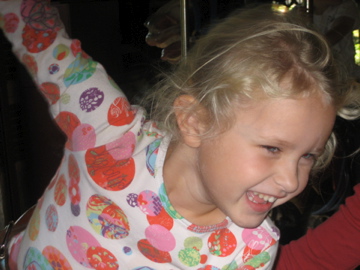
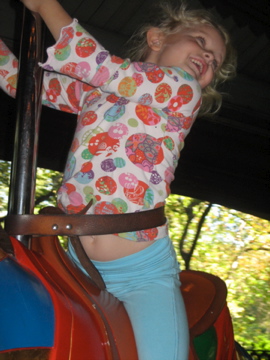
Emma loves movement, she always has.  This is Emma riding the carousel in Central Park.


In occupational therapy they call it – craving vestibular movement,  and she does.


She is happiest when she is moving!  And every now and then, I get nervous.


Needlessly… because she’s fine.