Category Archives: special needs

The New Year

I asked Nic this morning if he was looking forward to anything in particular in the new year.

“To sleep in,” he said with a grin.

“Really?”

He laughed, wryly (I might add) and nodded his head.

What I didn’t say, but thought, was – We’ve been on vacation since the 16th!  You could sleep in every morning if you wanted.  But Nic likes sleeping near his Granma and so has set up a little bed in her office for himself on her foldout couch with the promise that he make up his bed every morning, which he has.

“Hey Em.  What about you?  Are you looking forward to anything in the new year?”

Emma ignored me.

“Do you know what it means to look forward to something?” I tried again.  “It’s when we feel excited about something that hasn’t happened yet.”  I waited as Emma who had turned her back to me, continued to twirl her string that she has now “repaired” every morning since we’ve been out here.  The “string” resembles a snow board in the middle with long, thin tentacles coming out of the repaired part.  She holds onto the fat, taped part and twirls it in her hand very quickly.  “Hey Em,” I tried again.  “Are you looking forward to anything?”

“Yeah,” she said, staring out the window.

“What?  What are you looking forward to?”

“Uncle Victor and Aunt Susan took a train home,” Emma said, nodding her head, twirling her string and looking sad.

“Does that make you sad?”

Emma looked at me with such a sad expression and nodded her head.  “Yeah.”

I continued to ask her in various ways if there was anything she was looking forward to or wanted to have happen in the coming year, but Emma walked away or ignored me, until I finally stopped asking.

People have likened Emma to a two-year-old, but this is incorrect.  For one thing it vastly underestimates her and for another, it oversimplifies every aspect of her.  Emma’s mind is capable of some fascinating leaps, she will come out with incredibly creative ways to communicate – such as when her teacher, Lauren every Friday dresses up as “Laurenzo” and so Emma began calling herself Emmaenzo, which she (and everyone else) thought hilarious.  It is easier to think of a child like Emma as a “two-year-old” and leave it at that, but it does her a great disservice.  I continue to insist her mind is far more complex, holds all kinds of interesting thoughts and I insist on this thinking because I have seen too many nonverbal children with autism display staggering intelligence, but who are treated by many as though they are “two-year-olds” or worse.  I have read the poems and stories they have written.  These children and adults are profoundly intelligent, but their thinking and their difficulties in communicating are so vast most of us do not have the patience or interest in hearing from them.

What I wish for, what I look forward to in the new year is for all of us to increase our awareness of our possibilities.  We are capable of so much, whether it is an act of kindness toward another or withholding our judgements when we are annoyed, looking to our potential or assuming the best in one another instead of the worst.   If I could wish one thing for both my children, it would be that they realize their potential, and now come to think of it, I wish that for myself too.

Happy New Year!

For more on Emma’s journey through a childhood of autism, go to:   Emma’s Hope Book
The Dentist

“Go see new dentist,”  Emma said, when I told her she had an appointment.

I am always unsure what Emma intends when she makes statements like this.  Does this mean she doesn’t like her dentist?  She wants to go to a different dentist?  For some reason she is associating him as the “new dentist” even though she’s been seeing him for the past four years?  Or is she saying this for some other reason I have yet to figure out?

“You have an appointment with Dr. L.”  I waited to see if she would respond.  “Do you like Dr. L.?”  As I asked her this I thought about the question.  This is the guy who put a mask over her face and asked her to breathe in fumes until she was unconscious in the hospital to fill two cavities a few years ago.  His was the face she saw when she came to with a sore throat from having a tube put down it.  This was the man who was responsible for the two metal caps on her teeth, the metal caps that, upon waking, she tried to physically pry off with her fingernails.  Was that really a fair question?  Why would she like her dentist?  I’m not even sure I like him.  Okay, so that’s unfair.  I am grateful to him.  He’s a good dentist, he is kind and respectful of her.  He tells her what he’s going to do before he does it, even though he has a habit of asking her if she’s okay when he’s got both hands in her mouth and she clearly cannot speak in any recognizable way.  Or if she tries to nod her head yes, he then tells her to hold still.  I think they must teach this at dentistry school as a way of keeping the patients mind off of what’s actually happening.  I’ve never met a dentist who didn’t try to carry on a conversation while you sit there with a bunch of tools and hands in your mouth.  Doesn’t anyone ever tell them?   We cannot answer you.  Can’t you see our mouths are open and we are unable to speak?

But let’s get back to the appointment – Emma ran into the office, saw a stuffed beast of some unidentifiable species with a full set of teeth and plopped herself down in the chair while cradling the stuffed thing in her arms.

“What is that?”  I asked, trying to figure out if it was a horse, a giraffe or something else.  Frankly it was creepy whatever it was.  The full set of teeth looked frighteningly real, as though they’d been plucked from some poor unsuspecting person’s jaws.

“I don’t know,” the dental hygenist answered.

“Monkey,”  Emma stated matter-of-factly.

Case closed.

This from a child who does not typically show even a passing interest in toys of any kind, including all manner of stuffed animals.  But for whatever reason, this thing had captured her fancy.  Emma sat still holding the toothy “monkey”  while the dentist explained how her teeth are particularly porous and so food tends to adhere to her teeth, meaning it is essential she floss better than she already does.  In other words we need to help her more than we are.  She tolerated having her teeth scraped, her gums poked at and then her teeth cleaned with a bubblegum flavored toothpaste.  She let the dentist spray her mouth with water and allowed them to use the little hose that sucks all that water out again from her mouth.  For the first time the technicians were even able to take x-rays that resembled teeth and not a blurred image one might see in a Chelsea art gallery.  Emma brought the “monkey” in with her for the x-rays.

I was told some teeth (including that shark tooth) would have to be pulled, but we need to make an appointment with the orthodontist when we return from Colorado in January.  We will have to revisit the whole braces idea at that time too.   And throughout this whole process I kept thinking about how our insurance won’t cover any of this.  The good news is – she didn’t have a single cavity.

At the end of the appointment Emma put the monkey back on the shelf and said, “Bye, bye monkey.  It’s time to go home now.”  Then she skipped out, waving to everyone as she went.

For more on Emma’s journey through a childhood of autism, go to:  Emma’s Hope Book
Another Mom’s Comment

This comment from the “On Engagement” post was so beautiful I wanted to share it.  Her daughter is also named Emma.

“I love your Utopian world. I wish it existed. I avoid going to events sometimes because I just don’t want to have to have Emma deal with the looks, or me at times. Her tantrums are nothing like that of a two year old either. She is eight, and carrying an eight year old out of a store spitting and biting and screaming in a piercing , gut wrenching manner gets many looks. One time Emma lost it in a fabric store. I should have known better because it is overstimulating. She loves textures, but does horrible in overstimulating environments. Anyway, it ended abruptly when I had to take her screaming and kicking out of the store. I held onto her for dear life, wishing I had parked closer, hoping no one would see me. I almost accomplished this endeavor when a woman started approaching me as I was desperately getting Emma to buckle her seat belt. I was sure she was coming over to tell me what a horrible mom I was, how social services should be called on me because it felt so violent as I held onto Emma and I imagined it looked violent as well. But instead, she came over and asked if she could hug me. She told me her son was autistic and has been a participant in much worse tantrums and just wanted me to know I was loved. I felt an angel had been sent to me. What a world of difference it would make if people were less worried about judging others and more concerned about helping others. A smile to a parent that is in need can make such a difference. We are all mothers, or daughters, or fathers, or sons. That is something that binds us all. Why not honor that in our daily encounters and help a struggling parent, not shun her, and refrain from assuming.”

Happy Thanksgiving!

For more on autism and Emma’s journey through a childhood of it, go to:   www.Emma’s Hope Book.com

A Comment

A follower of this blog wrote the following response to yesterday’s post.  I posted it here as it beautifully sums up exactly what my husband, Richard and I also feel and why we work as hard as we do with Emma.

“I think maybe this is what most parents or carers of children with autism aspire to.  Not to extinguish quirks and unique personality traits, rather to help our children function in this world, to cope, to survive, to find happiness. It is not as simple as just accepting someone as being unique when they can’t go out in public without dropping to the ground and self harming over some issue or they can’t even attend to their own most basic needs when they  become distressed, when there is an unavoidable change in routine, when they cannot even travel safely in a car or bus ( we’ve been there believe me), when they have no way to communicate their needs or to even tell a parent they are in pain or scared or hungry, when they want to reach out to a friend, but don’t know how and so are left friendless, when they struggle to eat because the food repulses them, struggle to even hold a fork or use a knife. That is not something I will accept for my children. I want more for them than that. As a mother I have had to watch my children cry in pain and be unable to hold them in my arms and give them this most basic of comfort, rather being forced to witness their anguish and left helpless. These are things that need to be changed and worked on. If that is a “cure” bring it on I say.”

I have never met the woman who wrote this comment, but we have been corresponding now for awhile.  She has two children on the spectrum, each utterly unique.  Her comments are always thoughtful and insightful.  Though we live on separate continents with several oceans between us, we have a great deal in common.  So, to you Liz – thank you for blazing a trail and sharing about it.  You have helped me more than you can know.

For more on autism and my daughter, Emma’s journey through it, go to:  www.EmmasHopeBook.com

Gymnastics – Autism

Because Emma has a wide variety of sensory issues and because she is so active, we are always trying to find things she can do that might give her some of the sensory input she so craves as well as help her focus while doing something she enjoys – moving.  Finding someone willing and able to teach her is often challenging.  It requires a special person who can keep her focused without using a great deal of language, who also has the patience and desire to continue to work with her for more than one of two times.

When we finally found Brett, a gymnastics instructor, we leapt at the chance to make this into a weekly affair.  So on Sundays Emma and Nic have an hour of gymnastics – or they did until Brett hurt his ankle.  But now Brett is back and off they went last Sunday to their first gymnastics class in almost four months.  Emma was very excited and kept saying, “Oh, Brett’s ankle is broken.”  “Brett hurt his ankle.”  “Ankle all better now.”

To which we would answer, “Yes, Brett hurt his ankle, but now it’s much better!”

When we arrived and Brett came out to get Nic and Emma, Emma bent down and gently patted his ankle.  “You hurt your ankle,” she said, sadly.

“Yeah, but it’s better.  Thanks Emma.”

“Ouch!  Have to get a bandaid,”  Emma said.  Because to Emma, anything that hurts requires a bandaid and will feel better if a bandaid is applied.

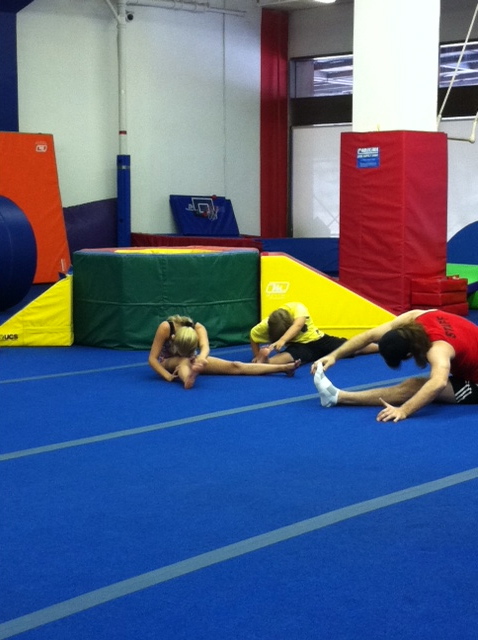
Emma and Nic stretching with Brett

Since it’s been awhile since Emma had gymnastics, I was curious to see what if anything was different.  Would she be able to stay more focused?  Would she attend more?  Would she be able to follow instruction better?

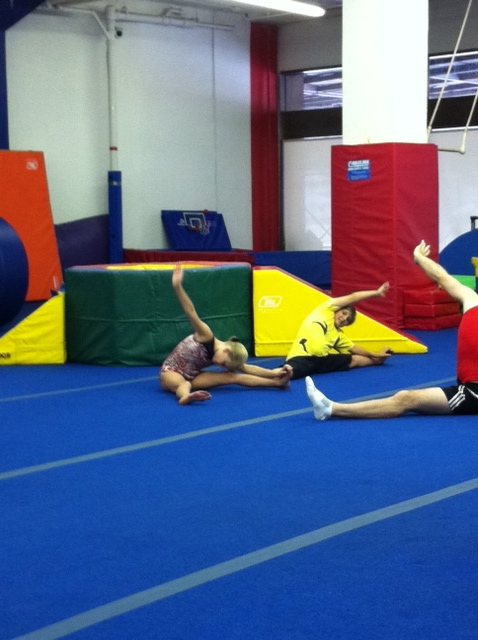
During their stretching period, Emma managed to keep up.

And while her form wasn’t great, she did do all the various stretches as best she could.

Later she was able to do straddle jumps on the trampoline and forward and back rolls on the mat.  She became a bit distracted when a birthday party took place in another part of the gym, but for the most part she attended and tried to listen.

Waiting for her turn on the trampoline.

All in all she showed progress, slow but steady progress.

For more on Emma’s journey through a childhood of autism, go to:  www.EmmasHopeBook.com

Tolerance, Despair and Hope – Autism

A follower of this blog emailed me this morning about a new app for the ipad called, Pop It.  It’s a “book” that when one shakes the ipad, the perspective of the story changes.  The creator, an artist named Raghava, gave a talk on Ted.com, which is terrific – about perspective and tolerance of others and the role of art and creativity.  Listening to Raghava made me think of a book I am currently reading by the extremely talented and insightful theologian, James H. Cone.  His book – The Cross and the Lynching Tree is a deeply touching and powerful investigation of suffering and hope.  James Cone writes at length about the nature of faith, how God “could make a way out of no way”, how “hope could remain alive in the world of Jim Crow segregation.”

I do not claim to know of the existence, nor can I claim to know of the non-existence of a god.  I cannot even define that word.  It is not a word that holds any meaning for me.  But I do know what it is to struggle with hope.  Hope for Emma, hope for all our children who will grow up to become adults, who many will fear, ignore or just wish would go away.  Our children with autism are often misunderstood, in their inability to fall into line with societal norms they are in turn rejected by society.  The continued negligence and worse, abuse, of people with disabilities is rampant.  Their abuse is done by people who have deemed them incompetent, imbeciles and without value.  This is the common thread that exists in the abuse of all groups of people throughout history.  It is our intolerance of those we believe to be “less than” that makes us believe we have the “right” to punish, shun, ignore, hurt, torture and kill.

James Cone writes:  “The cross is a paradoxical religious symbol because it inverts the world’s value system with the news that hope comes by way of defeat, that suffering and death do not have the last word, that the last shall be first and the first last.”

When I was in my late teens I began using food as a way to quell anxiety and emotions I felt incapable of dealing with.  My overeating turned to full blown bulimia and the bulimia became a way of life – for 22 years.  I remember when I finally stopped, the idea of “surrender” seemed antithetical to all I had, up to that point, believed.  I thought that if I just had more will power I would be able to stop the destructive behavior.  I believed that the bulimia was something I could control.  I believed that my lack of control simply proved how despicable I was, which only served to fuel more of the same behavior.  It wasn’t until I took a leap of faith – really took in that I was, in fact, out of control, that I received a respite from the behavior.  Early in my “recovery” from bulimia someone said to me, “don’t you think that if you could have controlled the bulimia, you would have by now?  Isn’t it true that in fact you have tried to control it all these years and this is where that control has gotten you?”  With a great deal of support from others who had eating disorders and had come out the other side, was I finally able to find a way out from under it.  In surrendering to the fact that I was unable to control it, was I finally able to find freedom from it.

I’m all over the map with this post, but perhaps some of these thoughts will prove helpful to someone else or if not at least encourage thought and conversation.

For more on Emma and our journey through her childhood of autism, go to:   www.EmmasHopeBook.com