Category Archives: Parenting

Entries about what it means to be the parents of an autistic child.

There’s Always Hope

There’s hope and then there’s desperation.  Often I am not sure which one is pushing me more.  The feeling that with each year Emma grows older, the farther she is from her neuro-typical peers or the knowledge that others have progressed and come so far, therefore so shall she with various interventions.  At what point does hope turn into desperation?  At what point do you say, okay this is crazy, let’s stick with what we know works and stop pursuing the next treatment option.  How do you quell that irritating voice that is always urging you on?  Or am I being presumptuous?  Perhaps that voice is MY voice and not shared.  I always look to the couple of parents I know whose children have made massive leaps in progress.  The ones who have bypassed Emma, what did they do, that I haven’t?  And many times it seems to be a combination of things they did, often things we’ve tried, but that haven’t helped.  I even found myself saying this morning – I’ll keep this appointment with the thyroid doctor, but after this, no more!  That will be the last alternative thing we try.  But I’ve said this before.  I said that after the stem cell treatments.  I said that after the QiGong Master and again after the homeopathic doctor.  I’m pretty sure I said that after the Cranial Sacral/Shaman too, but I can’t remember for sure.  It’s my own version of Emma’s carousel.  Around and around we go, where will it stop, nobody knows.

This morning I stood in the shower with Emma, coaching her on washing her hair and body.  We’ve done this countless times before.  “Okay Em.  Grab the shampoo.”  Wait while she takes the bottle of shampoo, opens the top and pours some into her hand. Wait to see if she will lather the shampoo all over her head or just on the ends.  “Good, Em.  Now make sure you get the shampoo all over your head too.”  Wait.  “Go like this Em.  Do what I’m doing.”  Demonstrate how to get the shampoo lathered all over, including the hair just behind the ears.  Wait to see if she’ll do this on her own.  When she does not, help her.  “That’s great Em.  Now rinse the shampoo out of your hair.”  Wait to make sure she gets all the shampoo out.  “You have to rinse it all out, Em.  You have to make sure you get the shampoo out up here too.”  Point to her scalp.  Wait.  Try to ignore the urge to do it for her.  “There, now rinse.”  Wait.  Wait some more.  Wait to see if she will do it on her own.  Try not to help if it isn’t needed.  Try not to do things for her because it will be easier, faster or because I’m tired or just don’t want to watch her painstakingly try, only to still require help.

At what point will these instructions no longer be required?  And then the question that is a lesson in futility and despair, the question that always manages to creep into my thinking, even though I know better than to ask it because it’s a waste of time and only makes me feel the beginnings of panic – What if that point never comes?

Don’t go there – I tell myself the minute that question enters my mind.  Do not go there.

So I won’t.

A friend of mine’s husband was just diagnosed with Alzheimers.  “This story isn’t over yet,” she said to me the other night.

And neither is ours.  Not by a long shot.  Emma has her entire life ahead of her.  An entire life of one day at a time, one step at a time.  And that’s where there’s hope.

There is always hope.

For more on Emma’s journey through a childhood of autism, go to:   www.Emma’s Hope Book.com

Merlin

I rarely have the opportunity to post anything about Merlin, our beloved kitty, because Emma routinely ignores him and this blog is about Emma and autism.  Despite the fact we got Merlin because of increasing pleas from both children.  Nic was lobbying for a dog, while Emma kept saying things like – “Go to pet store, pet the kitty?”  and “go to animal shelter, bring kitty home?”  Richard, a self-professed “dog man” was adamant – No CATS!  As I too, much prefer dogs and felt his argument about the care required in having any animal was more than we should voluntarily take on, I agreed.  However a few months later, Richard said, “Do you think we should get the kids a cat?  Emma seems to really want one.”  I smiled and tried not to nod my head too enthusiastically.

On the designated day, we went to the animal shelter together to choose a kitty.  Several hours later we returned home with the aptly named Merlin.   I went to the pet store to buy the essentials, including a soft cat bed (which he refused to sleep in.)  Merlin, being a cat who knows a thing or two about survival, immediately glommed onto Richard as though he were the anchor to his ship.  Wherever Richard went, Merlin was within a few feet.  By the second day Richard was extolling Merlin’s virtues, by the third day it was all over, Merlin and Richard were inseparable, it was love.  Ironically, the children, who after all were the ones vying for a cat to begin with, appear to have little more than a passing interest in Merlin.  Emma continues to say, as we pass a pet store, “Go in and pet the kitty?”  It seems she is only interested in petting other people’s cats, which we have found baffling.

Then this past weekend Emma found a stuffed cat I’d bought for the children after my cat Bertie of over twenty years, died.

“Oh Em!  You found the kitty!”

“Yeah.”  And for the rest of the morning Emma carried the kitty and her string with her wherever she went.

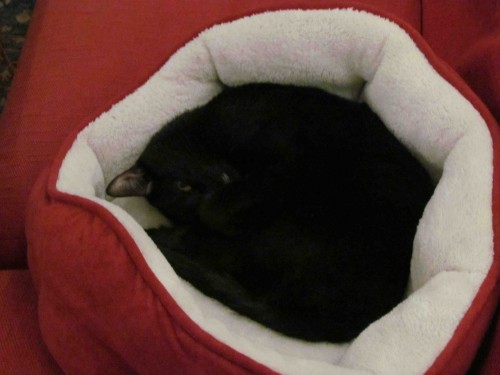
I keep hoping this affection for the stuffed kitty will translate to the real kitty, but so far it has not.  Still, I can now post this adorable picture of Merlin, who has finally decided he likes his cat bed after ignoring it for two years.   And who knows, maybe some day Emma will fall in love with Merlin just as the rest of us have.

For more on Emma’s journey through a childhood of autism, go to:   www.Emma’s Hope Book.com
Nic & Emma

This morning I told Emma she had to take a shower and wash her hair.

“Just Emma.  Bye-bye Mommy,” Emma said as she ran into the bathroom, closing the door firmly behind her.

“No wait, Em.  I’m just going to supervise.  You need to rinse all the shampoo out of your hair, otherwise we have to wash it all over again.”

From behind the closed bathroom door I could hear her say, “No Mommy!  Emma do it!  Emma do it!”

This is great, I thought.  She’s at an age where she needs privacy, all developmentally appropriate.

Later Emma joined me in the kitchen where Nic had just appeared, hair wet and sticking straight up in the air, as he too had just washed his hair.

“Nice,” I said.

“What?”

“Your hair.  You might want to run a brush through it, Nic.”

Nic rolled his eyes and sat at the dining room table listening to who knows what on his ipod.

“Here Em.  You have to brush your hair.”  I handed her the hair brush.   “And you’re next Nic.”

Nic either didn’t hear me or pretended not to hear me.  Either way there was no response.

“Hey Nic!” I said again in a louder voice.

“Huh?”

“Nic.  Your hair is sticking up.  You need to brush it.”

Nicky!  You need to brush it!” Emma parroted.

Nic ignored both of us.

“Nicky!”  Emma said loudly.

“Emma!  Be quiet!”  Nic shouted with irritation.

“YOU HAVE TO BE QUIET!”  Emma echoed.

“EMMA!”  Nic shouted back.

“Nicky!  Stop talking!”  Emma yelled.

Nic caught me trying not to smile and said, “What?”

“Nothing.”

“Why are you smiling?”  he demanded.

“Nope.  No smiling.”

“Mom!  You’re totally smiling.  Why are you smiling?”  Nic punched me.

“Ow!  Nic!   You just punched your mother!”

“Nicky!”  Emma shot over on her scooter and thrust the hair brush at him.

“Mom she’s torturing me!”

“Torturing?  Seriously?”

Emma then began to try and brush Nic’s hair.

“Oh my god Mom!  She’s torturing me.  Make her stop!”  he said, as Emma attempted to brush Nic’s snarled hair.  “Ouch!  She’s hurting me!”  Nic said with feigned pain.  He held his head between his hands and pretended he was in agony.

“Okay Em.  Give Nic the brush.  He’ll brush his own hair,” I told her.

“Emma do it,” she insisted.

“No Emma.  Seriously.  I’ll do it,” Nic said, grabbing the brush from her.

Emma began laughing.  “I want to brush Nicky’s hair.”

“No Em.  You brush your own hair,” I said.

“Already did brush hair,”  Emma said indignantly.  “Now it’s Nicky’s turn,” she said before racing off on her scooter.

The diet update –  I spoke with Emma’s physician about the diet yesterday.  Since Emma did not test intolerant for gluten and because we’ve seen no significant change in over six weeks, we are putting gluten back into her diet.  This morning Emma ate Cheerios with rice milk.

“Well that should decrease the anxiety,” Richard commented when he saw the box of cheerios on the counter.

“Do you think she felt a lot of anxiety?”

“I meant yours,” he said.

“Oh.”

For more on Emma’s journey through a childhood of autism, go to:    www.Emma’s Hope Book.com

Emma’s Literacy

Today Emma wrote the following sentences:

It is a good visual reminder of how nicely she is progressing.  After she wrote these sentences she became frustrated with two longer sentences she was suppose to remember and write.  I finally had to break them down into smaller pieces.  We then worked on reading comprehension.  The idea being – it won’t matter how well she reads if she cannot understand what it is she’s just read.  Like many children on the spectrum, Emma has a tough time saying what a story is about.  So we are slowly trying to build a foundation for her to be able to do so with increasing ease.  At the moment it remains very difficult for her.

Yesterday and this morning have been hard for Emma.  Her routine was interrupted, I spent a good part of yesterday cooking, we had guests for Thanksgiving and though Emma loved having family and friends over and sitting with us at the dinner table, I think the disruption proved tough.  She’s been out of sorts, a little crankier than usual.  This morning she kept insisting she go to the Central Park zoo and the big carousel; all things Richard did with her yesterday.

I never know what the reason is for her steps backwards, particularly when we can also see her many steps forward.  I keep hoping things will just move forward with no steps back, but this is unrealistic.  I know.  I have to keep my eye on the bigger picture and not get weighed down with the little daily upsets.  As we worked together this morning we had to stop several times as she became too upset to continue.  Her frustration is in glaring evidence during these moments.  She clenches her fist, hits her legs or pinches herself, so we had to stop each time and wait.  I understand how frustrating it must be to not be able to make the words come out right, to not be able to retain a seven or eight word sentence, to want to give up.

“We have to keep trying, Em.  I know it’s hard, but you can’t give up.”

“I know,” she said, nodding her head and looking sad.  “I know.  We have to do it again.”

“That’s right, Em.  You’re doing great.”

“Last time.”

“We’ll do it until you get it.”

“Okay.  Last time.”

And then she did it perfectly.

For more on Emma’s journey through a childhood of autism, go to:   www.Emma’s Hope Book.com

Another Mom’s Comment

This comment from the “On Engagement” post was so beautiful I wanted to share it.  Her daughter is also named Emma.

“I love your Utopian world. I wish it existed. I avoid going to events sometimes because I just don’t want to have to have Emma deal with the looks, or me at times. Her tantrums are nothing like that of a two year old either. She is eight, and carrying an eight year old out of a store spitting and biting and screaming in a piercing , gut wrenching manner gets many looks. One time Emma lost it in a fabric store. I should have known better because it is overstimulating. She loves textures, but does horrible in overstimulating environments. Anyway, it ended abruptly when I had to take her screaming and kicking out of the store. I held onto her for dear life, wishing I had parked closer, hoping no one would see me. I almost accomplished this endeavor when a woman started approaching me as I was desperately getting Emma to buckle her seat belt. I was sure she was coming over to tell me what a horrible mom I was, how social services should be called on me because it felt so violent as I held onto Emma and I imagined it looked violent as well. But instead, she came over and asked if she could hug me. She told me her son was autistic and has been a participant in much worse tantrums and just wanted me to know I was loved. I felt an angel had been sent to me. What a world of difference it would make if people were less worried about judging others and more concerned about helping others. A smile to a parent that is in need can make such a difference. We are all mothers, or daughters, or fathers, or sons. That is something that binds us all. Why not honor that in our daily encounters and help a struggling parent, not shun her, and refrain from assuming.”

Happy Thanksgiving!

For more on autism and Emma’s journey through a childhood of it, go to:   www.Emma’s Hope Book.com

On Engagement

Last Sunday I was interviewed by an NYU graduate student in the award winning actress and performer Anna Deavere Smith’s class, On Engagement.  The class covers the various forms in which we engage with one another.

One of the students asked me how I would like to see others engage with me when I am with Emma and also how to engage with Emma.

“Without judgement, for starters,” I answered.

Other people, but especially other parents can be extremely critical when confronted with a nine-year old who has fallen to the ground, screaming as though they were a two-year old having a “meltdown.”  Trust me, we aren’t talking about your typical meltdown.  I’ve been the mother of a toddler having a meltdown.  There is a vast difference between Emma’s upset and a two-year old who has been told they cannot stay at the park for another hour.  For one thing Emma is no longer two years old, for another, even a two-year old is not apt to punch themselves in the face or bite themselves so hard you can see a perfect imprint of their teeth on their arm.  Many people witnessing such a scene make the assumption the parent has done something horrendous to cause such a display.  So there’s blame, added to the guilt the parent may already feel.  There’s also something else people do not often speak of and that is contempt.  Contempt for the parent and the child.  People use nicer words such as impatience or irritation, but both Richard and I have been on the receiving end of those stares, those under-the-breath mutterings or outright shouting at us – “Can’t you keep your kid quiet?”  or “Why can’t you control her?”  (These are the more polite versions of some of the things people have said to us.)  Those comments are full of contempt.

As far as engaging Emma – my wish would be for people to treat her with respect and assume she can understand them.  This is tricky because it is easy to think she doesn’t understand, to talk about her as though she weren’t there, to ignore her.  I have spoken to others about Emma while she was in the room and now regret it.  My oldest brother is amazing when it comes to engaging Emma.  He talks to her, asks her questions and even though she will often ignore him, he continues.  He doesn’t allow her nonverbal response to deter him.  And she adores him.  Absolutely adores him.  Emma talks about him, asks about him and excitedly anticipates seeing him again.

The last question asked was if I could make up a Utopian world, what would it be.  I loved that question.

It would be a world where we greeted one another as we would a favorite family member.  A world where we approached each other with love and not preconceived notions of who and what that person was because of the way they looked, sounded, their nationality, race or political views.  A place where we embraced our commonalities and not our differences.  I know, it all sounds annoyingly pollyannaish and simplistic, even corny, but what if each of us tried, just for one day to do this?  What if we tried to put our judgements aside?

For more on Emma’s journey through a childhood of autism, go to:   www.Emma’s Hope Book.com

A Little Gratitude

There is a lot of great news out there regarding autism.  Many families have tried biomedical and therapeutic interventions with terrific results.  The website, autism.com has great information about treatments that have worked for many children on the spectrum.  No one can predict whether any of these will help your child.

When I was in my early thirties I sought help from the medical community for my bulimia.  I was depressed, could not stop the destructive cycle of binging and throwing up.  There seemed little to live for.  I phoned several rehabs and after speaking with several doctors and eating disorder specialists, I was told the longer a person had an eating disorder, the more intractable and harder to treat it became.  When I mentioned I had been bulimic for going on two decades there was silence.  I remember hanging up the phone and feeling utter despair.  I felt a similar despair when Emma was diagnosed.  But then, as I had when I was still bulimic, I became determined.  That determination served me well during those difficult years.  I never gave up and eventually found enough people who were able to help me, hold my hand and advise me.  I learned I couldn’t recover on my own.  I learned how to ask for help.  I learned to lean on others.  And I learned that in my darkest moments, if I remembered to reach out to someone else in need, to offer to help them, my own problems diminished.  I have tried to live my life in this way ever since.

Sometimes when I read about other people’s successes with their children, while happy for them, I feel sad for Emma.  I believe it’s natural to feel this.  I will never give up on Emma.  I will continue to do all I can to help her and while I do, I continue to work on my impatience while remembering to be grateful for each moment with her.

A little gratitude goes a long way.

For more on Emma’s journey through a childhood of autism, go to:   www.Emma’s Hope Book .com

Bruno Bettelheim

Most of us have heard, and many may have even read, some of Bruno Bettelheim’s ideas and work.  For those of you unfamiliar – Bruno Bettelheim, born in Austria, came to some prominence when he became director of the Orthogenic School, in connection with the University of Chicago for children with a variety of emotional and neurological issues.  His book, The Empty Fortress was published in 1967; read by many and touted as the final word on autism and its cause – the aloof and emotionally withholding mother.  At the time, his views on the subject became widely known and the treatment for autism was to put the mother in psychoanalysis.  The belief that the mother, in her lack of love for her child, caused the child to withdraw from the world was adopted by many.  Bettelheim claimed a high success rate of children with autism in his school.  It was only until after his suicide that many of his former students came forward with harrowing tales of abuse.  Much of Bruno Bettelheim’s work and ideas have since fallen into question.  The concept of the “refrigerator mom,” something he was an advocate of, has proven to have no validity.

Last week I had a piece published in the Huffington Post – http://www.huffingtonpost.com/ariane-zurcher/children-with-autism_b_1080076.html – a woman, now in her nineties wrote to me about her experience of being the mother of a child with autism, diagnosed in 1961.  Rather than examine her child when she sought help, she was put into analysis and blamed for her child’s neurological issues.  She wrote a book, A Few Impertinent Questions, http://301­45.myautho­rsite.com/, that tells of her painful journey.  It is a powerful story.

As I read her book, I reflected on what we think we know now about autism and what will come to light in the future.  Fifty years from now how will we view what we think we know?  What ideas will seem almost comical because we will have learned so much more.  What therapies will have fallen out of favor?  What new therapies will have taken their place?  What will be proven and seem obvious in fifty or sixty years from now, but are not obvious to us now?  I, most likely, will not be around in another fifty years to know the answers to these questions, but I am sure much will be revealed.

For more on Emma’s journey through a childhood of autism, go to:   www.Emma’s Hope Book.com

The Diet

It’s been a month.  Last Monday I wrote that it had been four weeks and two days, I was wrong.  It just felt like it had been a month.

One month ago, on October 16th we began Emma on a GF/(modified) CF/ soy free and a great many other free diet.  This is our second go around with this diet.  The GFCF diet was the first thing I did when Emma was still two years old, to no noticeable change.  However, that first time she began eating a great deal of soy – soy yogurt being her favorite.  I was working with a DAN doctor at the time who tested her for hundreds of foods but never said anything about all the soy she was eating.  So after three months we took her off the diet and again saw no change.  This time I’m working with a naturepath/physician who also tested her for hundreds of foods.  This time, the list of foods to avoid was much longer than the first: cocoa, corn, potatoes, chicken egg whites, all red skinned fruits and vegetables, bananas, peanuts, onions and garlic.   Emma did not test negatively for wheat, but he advised we take her off it anyway, just to be safe.  Oddly, she also didn’t test negatively for sheep and goat’s milk, so we’ve allowed her to have sheep’s milk cheese, sheep’s milk yogurt and duck eggs.

Still we have witnessed very little change in Emma.  We’ve grown used to this.

I keep thinking I’m going to find something, something that other families have tried with significant results, but so far, other than Emma’s literacy program, we have not.  It’s frustrating to try various things and see little, if any, change.  As I’ve written before, we think we are seeing an increase in physical affection, but it’s hard to say this with certainty.  We have definitely not seen a profound change of any kind causing us to feel without a doubt that this diet has done anything.  Still I will give it more time.

Why some of these interventions work for some children and not others is something that’s been debated for awhile.  Why is it some children are mainstreamed after a few years of intensive 40 hour a week ABA, yet for children like Emma, they were not helped?  How is it that some children go on a GFCF diet and within days are transformed from a screaming, frustrated, incoherent child to one who is speaking in full sentences, playing with toys in an “appropriate” manner and displaying a never before seen curiosity of those around them?

It is easy to blame oneself, but I don’t believe that is the answer.  I know of too many cases where the parent has tried a great many things only to find their child did not respond.  I wonder whether it is the children who do respond, who are the exception.  While this thought depresses me, I have to wonder whether it isn’t more accurate.

For more on Emma’s journey through a childhood of autism, go to – www.Emma’s Hope Book.com

What is

A Zen buddhist teacher told me once – anything that happens in life is an opportunity to practice.  I remember my feeling of irritation when she first said that to me.  As the years pass I think of her and her statement often.  Whatever it is that is happening – if I can suspend my judgement and not label it as good or bad, but just as what is, I have taken away one more obstacle.

I think of Emma, beautiful, amazing Emma, who is unique and like no other child.  Her autism is neither good nor bad, but what is.   Even as I write this I can feel the tug in my chest, the little voice whispering to me, no – it is bad.  As though by accepting I will have given up.  As if my judgement will somehow make it go away.  As though the label will somehow change it.  I am not in the we-must-accept-and-do-nothing group.  I am in the – my labeling her autism or anything else for that matter as bad does not take it away – camp.  It just adds one more thing that I am fighting.

My practice is to continue the fine art of balancing what is with what I wish to be. What I wish for, what I hope for, what I work so hard for is to help Emma become more independent.  To celebrate her strengths, to encourage her to sing, to join her in her joy of music, to push her to work on her spelling, reading, writing, typing, math and language.  To gently lead her away from her rigidity, to embrace her silliness, to urge her to explore and be curious.  While I am doing that, I continually remind myself that each moment is a moment that simply is.

Emma is and for that I am eternally grateful.

For more on Emma’s journey through a childhood of autism, go to:   www.Emma’s Hope Book.com

New York City Empire State Building taken from the High Line last night.

Preventative Measures

The New York Times published a piece in August of this year about the role the environment plays in the rise of autism.  It begins with the question asked by many people who are hoping to become parents  – What can we do to decrease the risk?

I have often thought about what I would have done differently, knowing what I now know.  There are a number of things, things I didn’t know to do or not do when I was pregnant with Emma.  There are a few things that appear to have some scientific basis to them, such as taking prenatal vitamins at least three months before getting pregnant and continuing to take them for the duration of the pregnancy.  I began taking them when I learned I was pregnant with Nic, though interestingly, with Emma I was taking them before I became pregnant with her and continued throughout the duration of my pregnancy.  I would not have eaten any fish of any kind during any part of my pregnancy.  I ate grilled swordfish a couple of times in my second trimester with Emma.  I also used fingernail polish remover a couple of times and had my hair highlighted once during my third trimester.   I would have stopped using all artificial sweeteners and I would have been more careful after the 9/11 attacks by not going downtown to Richard’s office in Soho to work.  Beyond those incidences, I did not take any drugs of any kind, not even aspirin, I didn’t consume caffeine or alcohol, I did not have an amniocentesis, avoided all and any invasive procedures, had two sonograms and gave birth naturally in a birthing center.  It seems unlikely that anything I did while pregnant contributed to her autism, but who knows?

After giving birth I would have done a number of things differently.  From the moment she took her first breath I would have eliminated all onion, garlic, dairy and wheat from my diet while I was breast feeding.  During those first few months when she was so uncomfortable and “colicky” I would have kept a food journal to see if there were other foods I was consuming that upset her and then eliminated those.  Since Emma seemed so uncomfortable when I breast fed and much preferred drinking breast milk from the bottle, I would have tried different techniques in swaddling her or having some sort of soft cloth between us so our skin to skin contact wasn’t so uncomfortable for her.  I would have started brushing therapy (click link for more detailed information on brushing) with joint compressions (see link for a detailed description of joint compression exercises) during this period as well.

Then there are the things I wish I had done much sooner such as  Dr. Marion Blank‘s literacy program instead of all those hours spent doing ABA.  I wish I had discouraged Emma from sucking her thumb.  I would not have introduced corn, soy, wheat, dairy or any foods that are thought to be problematic for some children.  I would have obtained an evaluation much sooner as well as taken her to a neurologist and had an MRI done before she was 18 months old.

Had I done all of those things, would any of it made a difference?  Except for introducing Dr. Blank’s program right away, which I am convinced would have made an enormous difference, who knows?  How much of a role does the environment play?  How much is due to genetics?  I have questions, lots of questions.  None of which will likely be answered any time soon.

For more on Emma’s journey through a childhood of autism, go to:   www.Emma’s Hope Book.com

What They Don’t Tell You

Here are some things you will not find in your research on autism:

You will not learn how this diagnosis will affect your marriage or other members of your family.  You will not be told how it may fundamentally alter your perceptions of what is “normal”, how it may change your view of human beings, how it can force you to question small talk and why we behave the way we do, how it will transform your outlook on life, how it will change you, how your life and everything you assumed to be true, is no longer what you thought.

Having a child with autism may cause you to feel things you never dreamed possible.  You may know moments of joy and moments of despair you could not have imagined.  You may find yourself going to untold lengths in the hope of helping your child.  You may feel distracted, unable to concentrate.  Your work and career may suffer.  You may learn what it is to be sleep deprived.  You will come to know what it means to feel desperation.  You will know sorrow in a way no one can prepare you for.  You will know happiness in a way no one can prepare you for.  Sometimes you may feel both sorrow and happiness within the same day, within the same hour, within the same minute.

You may spend money you do not have on yet another treatment, yet another doctor, yet another specialist, yet another therapy, yet another intervention, all the while rationalizing that if it helps, it will all be worth it.  You may contemplate doing things you would have scoffed at before your child was diagnosed.  You may find yourself doing things that defy logic and have no medical basis.  You may listen to implausible, anecdotal stories and think – we will try that next.  You may dream your child is speaking to you in complex, beautifully self aware and revealing sentences.  You may wake from those dreams believing for a few seconds they were real and not a dream.  You will pray that you might dream again.  You will welcome sleep, as you never believed possible.  You may ache with sadness because your child is crying and in pain and your presence brings them no solace.  You may question every maternal instinct you have.

You may feel ecstasy from being hugged, unprompted.  You may feel the exquisite joy from having your child reach for you, ask for you, call for you.  You may know the joy that comes with seeing your child work so hard at something that does not come easily to them.  You may celebrate when they use the correct pronoun, even though they are no longer a toddler, when they learn to get dressed on their own, drink from a cup, say hello to you without being asked or simply acknowledge your presence.  You may feel a gratitude you would not have believed possible.  You may cry from happiness when they say a word, any word, even if you are the only person who can understand what the word is.  You will know what it is to appreciate commonplace things – eye contact, the correct use of the words “me”, “you” and “I”, physical contact initiated by your child, a word, any word spoken.

You will feel a fierce love for your child that seems to come from a place that is not of this world.  You will know what it is to love unconditionally and you will understand what that really means.

For more on Emma’s journey through a childhood of autism, go to:   www.Emma’sHopeBook.com

An Overview

On autism.com‘s web site, they write:

“What is the Outlook? Age at intervention has a direct impact on outcome–typically, the earlier a child is treated, the better the prognosis will be. In recent years there has been a marked increase in the percentage of children who can attend school in a typical classroom and live semi-independently in community settings. However, the majority of autistic persons remain impaired in their ability to communicate and socialize.”

After receiving an autism diagnosis for one’s child, most people go to the internet to learn more.  Quotes like this one abound.  What these sites do not say, cannot say, is what will specifically help your child –  What interventions, if any, will make a difference, what biomedical, dietary & behavioral approaches will work?

This quote is also from autism.com’s website:

Conclusion Autism is a very complex disorder; and the needs of these individuals vary greatly. After 50 years of research, traditional and contemporary approaches are enabling us to understand and treat these individuals. It is also important to mention that parents and professionals are beginning to realize that the symptoms of autism are treatable–there are many interventions that can make a significant difference.

The logo for the national parent support group, the Autism Society of America, is a picture of a child embedded in a puzzle. Most of the pieces of the puzzle are on the table, but we are still trying to figure out how they fit together. We must also keep in mind that these pieces may fit several different puzzles.”

A parent of a child with autism quickly finds they will need to read enormous amounts, speak with a great many “specialists”, sift through the endless opinions (often stated as fact), and try to make sense of all the various articles, papers, news items and books currently in print on autism.  In addition they may watch the numerous documentaries, interviews, YouTube clips and all the other visual forms that exist relating to autism.  Having done all of that a parent must make decisions as to what they can and cannot do, what they can and cannot afford to do in their attempts to help their child.  While they are making these decisions, they must cope with their own emotions, trying hard to keep depression, worry, panic, fear, sadness and guilt at bay.  They must learn to manage these feelings while continuing to research and do what they are able to with the hope something they try might just help their child.

But most important perhaps, we must never give up.  We must try in our darkest hour to see the light.  We must treasure our child’s differences, celebrate our child’s uniqueness, rejoice in our child’s strengths.

Years ago Richard and I went to a couple’s therapist.  He listened to us both individually and then asked us to meet with him together.  As we sat side by side on his couch he told us he didn’t want to hear about our latest disagreement, he was much more interested in hearing from each of us what the other had done right in the last 24 hours.  We were told to go home and keep a journal, recording all the things the other had done that was kind, thoughtful and helpful.  He encouraged us to examine each act, to consider things we perhaps took for granted.  It was the single most helpful advice anyone ever gave us.

This blog is a version of that exercise.  While I do my best to accurately document Emma’s progress or lack of, while continuing to try different interventions, I also try my best to celebrate her.  Let me concentrate on her strengths while I continue to do everything in my power to help her build on those same strengths and perhaps she’ll discover new ones.

For more on Emma’s journey through a childhood of autism, go to:   www.Emma’sHopeBook.com

Day 13

Today is the thirteenth day of putting Emma on the modified gluten free/casein free diet.  She has found a few things she likes to eat, is slowly expanding her choices, but there are only a couple of things she seems happy to eat and many more that she eats begrudgingly.  Most of the things I offer, she’ll taste, but will then say, “Now it’s all done.  Please Mommy I don’t like that.”

Meanwhile we continue with her studies.  I have not seen any noticeable change there.

Parenting a child with autism is like going on a trek in the Himalayas.  There are moments when you feel you’re not going to make it, your pack is too heavy, your muscles are tired and sore.  You wonder how you’ll take another step, the terrain is too steep and unforgiving.  But there are other moments of untold beauty.  Moments when you look around and see the mountains stretched out before you, the view so majestic it takes your breath away.

For more on Emma’s journey through a childhood of autism, go to:   www.EmmasHopeBook.com

Day 12

I’m feeling discouraged.  I know.  It hasn’t even been two weeks.  I know.

If a friend of mine told me they were discouraged after less than two weeks, I would say – No!  Are you kidding?  You have to be patient!  You can’t expect her to neurologically change because of her diet in two weeks!  And anyway this is about other things too.  Helping her chronic constipation, improving her focus and ability to attend to her studies, expanding her food choices, making it possible to one day go out as a family to a restaurant or travel places without bringing an extra suitcase of “Emma’s Foods” or worrying about where we’ll find Stonyfield chocolate yogurt or Wheat Bread, the one with the red label from Whole Foods because she won’t eat any other brand or flavor.  This is about not panicking when Whole Foods is out of one of the six things she’ll eat.

This diet requires a tremendous amount of work.  And I’m up for the task.  But every now and again I just want to complain and maybe cry.

A friend of mine sent me the following story:

An old donkey fell into an abandoned well.  The owner of the donkey, ambivalent about how hard he would have to work to try and get his old, and now useless donkey out of the well, decided to fill in the well, a danger to the community and now with the donkey having fallen into it, a way of doing away with the donkey too.  So he called his neighbors to help him shovel dirt into the well and as the dirt fell on top of the donkey, the donkey began to bray.  Horrible sounds, which did nothing to slow the falling dirt.   After a few minutes the donkey decided to shake off each shovelful of dirt and stomped on it with his hooves, while rising to a new level.  Soon the donkey was at the top of the well and able to walk out, much to everyone’s astonishment.

I feel much better now and if you’re having a tough morning, perhaps you are too.

The end of the story is that the donkey then trotted over to the farmer and kicked him as hard as he could.

For more on Emma’s journey through a childhood of autism, go to:   www.EmmasHopeBook.com