Category Archives: language

“Thriller”

For Emma’s birthday, Joe gave her a video montage with Michael Jackson’s incomprehensible song – Wanna Be Startin Somethin – playing in the background.  Emma loves playing the DVD and calls it – “Thriller.”  Despite our corrections, she is resolute.  Saturday night she put the DVD into the player and then said, “Halloween!” and ran to the costume chest.  “Want to put on halloween costume?”

“But, Emma it’s not halloween,” Richard told her.

“I think she wants to put on a costume like she does on halloween,” I said.

After a good bit of rummaging around, Emma pulled out a costume, ran to her room and several minutes later burst forth wearing this…

“Watch Thriller,” she announced before settling down on the couch to watch the video montage Joe had put together for her.

*Just in case anyone is curious, we correct Emma when she makes these types of grammatical errors.  For example in the above comment, I said, “You want to watch your video?”  To which she responded, “Yes, I want to watch my video.”  With repetition we have seen an enormous uptick in Emma’s spontaneous language as well as an increase in her ability to say grammatically correct sentences without our intervening.  The pronoun confusion, while still present, has gotten much better as well.

Richard and I have a running joke regarding MJ’s lyrics, something neither of us can understand without printing out the actual lyrics, still, as a nod to our advancing years, we use phrases like “new fangled” and “these kids” while shaking our heads.  Thankfully Richard finds all of this as humorous as I do and we have each come up with obviously ridiculous lyrics, which we then suggest are the actual lyrics.  “Do you think he just sang, go to the post office?”  “Yeah, post a letter, I’m pretty sure he just sang that.”  So I wasn’t surprised when Richard said at one point, “He just said, “You’re a vegetable.”

“I am not!” I responded with feigned indignation.

“No.  Seriously, I think he just sang, You’re a vegetable.”

“Uh-huh.  Yup.  I think you’re right,” I said, nodding my head and grinning at him.

“I’m being serious.  Do you think that could be part of the song?”

“Oh yeah,” I said with an exaggerated tone, “You’re a vegetable.  I think that has to be right.”

“I’m going to google it,” Richard announced.

A few minutes later Richard returned, “Look!” he thrust a sheet with the lyrics printed on them and there it was in black and white – “You’re a vegetable, You’re just a buffet, You’re a vegetable,  They eat off of you, You’re a vegetable.”

Richard looked at me.

Meanwhile, Emma continued to bop her head up and down as she watched the slideshow of photographs from the past year of herself, that all of us have taken, wearing her witch costume.

For more on Emma’s journey through a childhood of autism, go to:  Emma’s Hope Book

Conversing With Emma

“Mommy, I want to make pancakes please!”  Emma said sweetly the other morning.  A simple sentence, no big deal, right?  Except to us it was an enormous deal.  Pronouns all in their proper place and used appropriately, a polite “please” added at the end to ensure a positive response to her request, how could we say no?  And since it was the weekend, we didn’t.  Though we did tell her, she would need to wait a little while, which she did.

Someone, years ago, asked me what I hoped for when it came to Emma’s progress and I responded with something about giving my right arm if she would only ask me for something.  At the time, it was a worthy objective.  Please, just let her ask me for anything and I’ll be happy.  Thankfully I did not have to relinquish a limb for her to get to that point and now those requests have become commonplace.  “Mommy!  I want to go to the Vanderbuilt Y please,”  “Daddy, I want to go to the New York Botanical Gardens with just Daddy!” or “I don’t want to eat the pear.  Please Mommy, no more pear!”

Now that we have the “I want,” “I don’t want” sentences, we are moving on to the lofty goal of commenting on surroundings.  “Oh look, Em!  Look at the bird outside the window!  Do you see it?”  And then we wait.  “Yes, I see the bird.  There’s a bird flying outside,” Emma might respond or she might then comment on something else.  “It’s raining outside.  We cannot go to the park.”  The idea of using language as a way to connect, a bonding experience or as a way to share an experience with another person remains somewhat elusive, though she is making strides in that direction.  We are not able to carry on a conversation with Emma yet.  But we hope to get there eventually.

For more on Emma’s journey through a childhood of autism, go to:   Emma’s Hope Book
Emma’s Sense of Humor – Autism

Emma’s sense of humor, much like everything else about her, is… quirky.  As a baby, Emma squealed with excitement when we popped out from behind things and yelled, “Boo!”  As Emma grew older she continued to delight in anything resembling silliness.  We were filled with hope when, during one of Emma’s many early intervention therapy sessions, she offered some play-doh to the therapist, only to pull it away just as the therapist reached for it.  Emma howled with laughter as the confused therapist realized Emma was playing a joke with her.

Afterward the therapist made a point of telling us how Emma’s sense of humor suggested tremendous potential, how she was expressing a desire to interact, how unusual this was for a child with autism to want to initiate in such a creative way.  Emma continues to display her silliness and creativity in surprising ways.

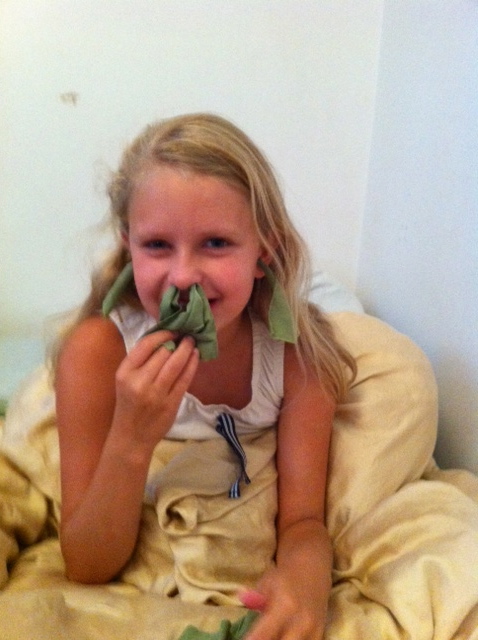
Emma with what’s left of her cokie  (this use to be a crib blanket filled with down).

When I came into her bedroom and saw her I said, “Em!  What are you doing with cokie?!”

To which she laughed, “Stick cokie up your nose.”

“That’s so gross, Em!”

“No not going to stick cokie up your nose, stick cokie in your ears,” she replied, still laughing.

“Ew!”

“That’s funny,” she then said.

It reminded me of when we took Nic out to eat at a Japanese restaurant.   “Look Mommy!”  He said as he unwrapped his chopsticks and stuck each into a corner of his mouth.    “I’m a walrus,” he managed to say.

My grandmother was known for, after a few drinks, rolling a napkin up, and placing it above her upper lip pretended it was a mustache – so maybe it’s genetic and not a display of extreme intelligence after all.  Not that she wasn’t extremely intelligent, she was…

For more on Emma’s journey through a childhood of autism, go to:   www.EmmasHopeBook.com

Asking – Autism

I remember the first time Emma’s older brother, Nic asked permission to do something.  He was about 14 months old and he asked if it was okay to take a particular toy with him to the playground.  It was noteworthy for a number of reasons, but as his mom, I remember thinking how incredible it was that this tiny child understood that if you asked, rather than just did something, chances were you would be able to do whatever it was.  The whole “polite” thing wasn’t part of the equation yet, but it soon came to be, shortly thereafter.

With Emma it was different right from the beginning.  For one thing, she didn’t ask questions as much as demand that her basic needs were met.  Because her language was severely delayed, she would often drag one of us to the refrigerator and indicate what she wanted.  As she didn’t “want” our attention, toys or many of the things other neuro-typical children do, there was less motivation to ask for things.

As Nic grew older his questions became more complicated and interesting.  Suddenly we were discussing such topics as religion, questioning the existence of God and if there was a God, who made him.  Could there be a heaven without a “God”, why did people die, was there life beyond our planet earth, how did we come to be and what was our purpose, where did the earth come from, how is it possible that the universe is infinite and what does that mean, exactly.  Nic also became curious about Richard and my experiences.  He wanted to know if I’d ever felt scared (yes!), whether I was nervous when in front of new people (often), when did I know what I wanted to be when I grew up (that concept continues to evolve), when did Richard and I meet, and the questions have never stopped.

Emma does not ask questions about life and the world.  She has never asked me a personal question.  But she has learned to ask for things that she needs or wants.  Often the question is a demand with an upward lilt added, making the demand more palatable, as in  – “Go to the zoo?”  “See the snake bite boy?” “Apple juice?”  However lately her questions have changed slightly.  It’s a subtle difference, but I have noticed it a number of times in the last few days.  This morning she came into the study (this in and of itself is startlingly new as in the past she would simply ask from where ever she was and then when no one responded because no one heard her, she would begin to scream until someone appeared) but today she found me and said, “Mommy?”  Then she waited for me to respond.  When I looked up, she said, “Can I have a caramel yogurt?”  Again she waited for my response.  This too is different.  In the past she might have asked if I was standing nearby and then after uttering the words she would have raced off, not waiting for a response.  The question was rhetorical.

“Sure Em.  Go have a caramel yogurt,” I said.

To which she ran off, only to reappear a few minutes later saying, “Okay.  Last one caramel yogurt?  Eat one more and then it’s all done.”

“Yeah.  Okay, Em.  That sounds good.  Go have another one.”

“Okay!”  She yelled as she went back into the kitchen.

Last night she found me in the bathroom, where I was brushing my teeth.  “Mommy?”  She waited.

“Yes, Em?”

“Can I watch Winnie-the-Pooh?”  Again she stood looking at me expectantly, waiting for my answer.

“Sure Em.  But first put on your nightie and brush your teeth.  Okay?”

“Okay!”  she said tearing off to change.

I cannot describe my surprise at her actually waiting for me to respond.  This is new and a welcome change.

For more on Emma’s journey through a childhood of autism, go to:  www.EmmasHopeBook.com

Skateboarding – Autism

When Emma was a toddler, she taught herself how to swing by herself.  She thrust her legs out in front of her and then leaned her body forward as she tucked her legs under her.  It was an amazing and beautiful thing to witness.  I remember the first time it happened, we were in the Washington Square playground in New York City.  She pushed me away as she clambered up onto the swing.  I stood just to the side and behind her ready to push, but she shook her head no.  Then she reached down with her toes to the ground pushed off.  A small group of caregivers and parents gathered around as she sailed up higher and higher, so incredible was it that a child of just eighteen months could swing so high unassisted.

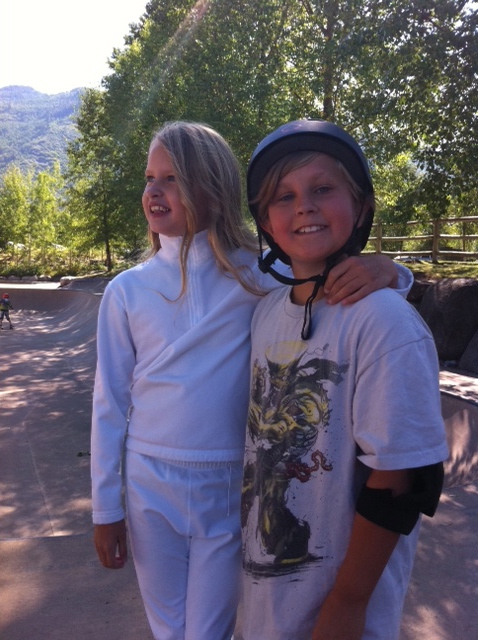
That’s how it is with Emma when it comes to physical things.  She has always insisted on doing things herself and while she can take direction, it is often very difficult for her to be taught by someone who relies on verbal explanation.  Emma feels and learns from watching and doing.  So when she put her arm around her brother, Nic the other morning at the skateboard park and said, “Nicky’s turn, then Emma’s turn,” we knew we were going to have to get creative if she was going to learn to skateboard.

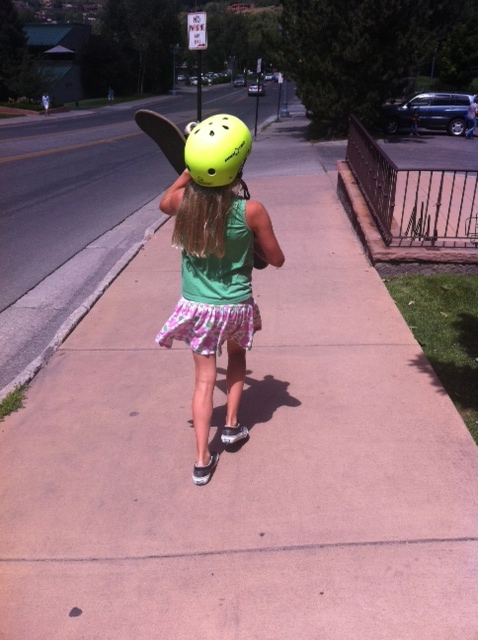
We spoke to one of the instructors from Nic’s skateboard camp and arranged a lesson for Emma that afternoon.  When we finally went to meet him, we realized we hadn’t brought sneakers for her to wear and so bought a new pair at the skateboard shop.  They didn’t have any socks small enough for her, so she just wore the shoes without socks, despite my fleeting concern that she would get blisters.  With borrowed skateboard in hand, we headed to the skateboard park, Emma leading the way.

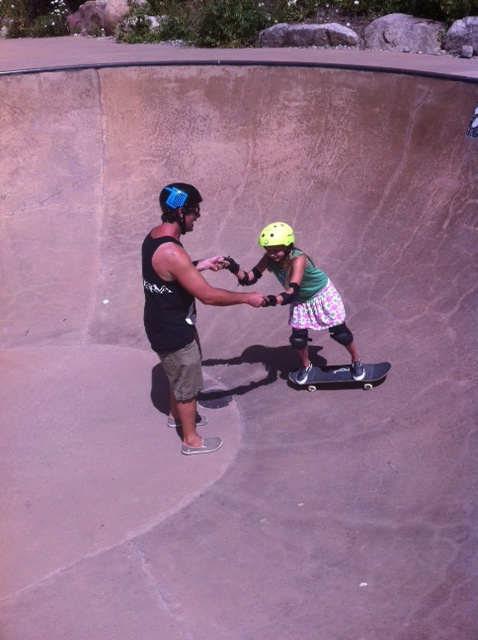
The instructor got her to put on elbow, knee and wrist pads and then together they slid into the bowl to practice foot positioning.  Emma wanted to skateboard though and didn’t want to practice standing on the board.  She wanted to go.

In this way Emma is fearless.

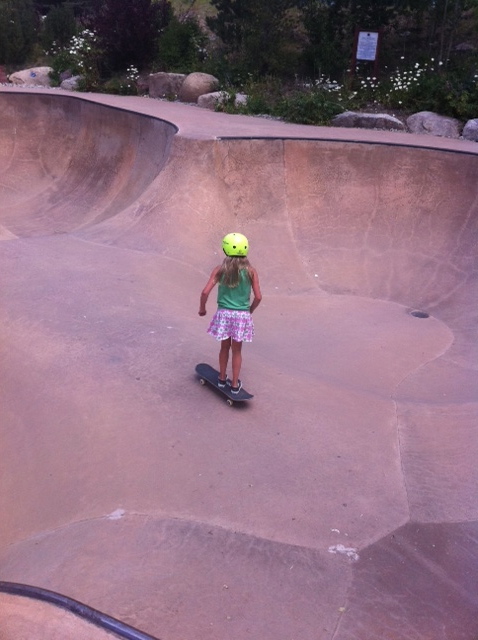
And then the blister on her heel became too painful and she tried to take her shoes off.  From there the lesson took a downward turn and after another ten minutes or so, Emma had had enough.  I am convinced that if we just let Emma experiment on a skateboard for awhile, she’d eventually figure it out on her own.  Just as she did so many years ago on the playground swing, and later with her scooter.  But for now, we will let her dictate how this goes.  If she shows interest in skateboarding again, we’ll try to borrow one for her to practice on.

For more on Emma’s journey through a childhood of autism, go to:  www.EmmasHopeBook.com

Emma’s Struggle with Pronouns

I have written about this before – Emma’s continuing struggle with using the correct pronouns.  It is something one sees in children on the spectrum.  Pronoun confusion, lack of pointing at an early age, a lack of engagement or initiating play, these are all warning signs in small children and almost all children diagnosed with autism share at least a couple of these.

Emma uses the word “you” when speaking about herself, but also when speaking about someone else.  It’s a word she uses for anyone, herself included.  As in “You want to go on the 4-wheeler?”  Someone who doesn’t know Emma would assume she’s inviting them to go with her and the response is often an enthusiastic, “Yes, I do want to go on the 4-wheeler!”

Emma, then happily runs outside, turns the engine on and waits for the unsuspecting person to join her.  This scenario actually happened with our cousin Max, whom neither of the kids had ever met until last summer.  But when Emma says things like, “Bye Emma!” to the person she has just been introduced to, things get a bit more confusing.

So last night when Richard and Emma picked me up from my store in town, she said, “No not going to see July fireworks.  They’re too scary.  Mommy has to pick you up.”  Then she paused and said, “No, Mommy has to pick me up!”  We were surprised and pleased.

“That’s right Em!”  And then as an aside to Richard, “Wow!  That was pretty great.  She corrected herself!”

Emma then repeated herself several times, “Fireworks too scary.  Mommy will pick me up.”  She looked from Richard to me proudly.  “Good talking!” she said, before leaping into the car.

During the ride back to the ranch she tried various variations on this theme.  Each time using “me” correctly.

It was a proud moment for all of us.

For more on Emma’s journey through a childhood of autism, go to:  www.EmmasHopeBook.com

“Go Back” – Autism

Last week Emma began crying and said, “Go back to hotel.”  Richard felt she was missing me, as I had to leave my family to return to Colorado for work when we left California instead of returning with them to New York City.  We also felt she was wishing we could have stayed longer and spent more time with my extended family, all of whom she loves being with.  She had such a wonderful time with so many family present at the Bed & Breakfast in Napa, California where we stayed for my brother’s wedding.

There’s a mistaken thought by many people that because a great number of children and adults with autism cannot express themselves well and often do not show tremendous emotional attachment to those they love, that they do not love.  Some people believe they do not feel the same intensity of emotion that we neuro-typicals do.  I disagree with this thinking.  I believe Emma loves and misses people as much as any neuro-typical child.  I believe she misses them with the same aching as any of us do.  The difference is, Emma doesn’t have the same neuro circuitry or the ability to put into words her feelings.  She lives in a world that must be incredibly confusing so much of the time.

I wonder, when I get on the phone with her, how much does she understand?  Does she understand that I am in Colorado and not in New York with her, Nic and Richard because I have to work?  Because time is a difficult concept for her, does she really understand when I will be returning?  When she wakes up in the morning does she wonder if I might be there only to find I’m not?   Our phone conversations are limited.  When speaking with Nic, I can reassure him that I will be home in another couple of weeks.  We can discuss what he did, he can describe the breakfast he fixed for his dad yesterday for Father’s Day.  We can talk about things.  With Emma, who does not and cannot ask questions, I ask – How are you?  She tells me she’s fine, even if she isn’t, because it’s the conversation we always have on the phone.  She may add some random thing such as – “Seal park, Chelsea piers carousel” and I can deduce that Richard took the children there yesterday.  I always ask her – What did you do today?  To which I can receive an accurate list of what she did, but just as easily I can receive a somewhat confusing version of events that may or may not have taken place.  I then will verify with Richard to get a clearer idea.

Yesterday was Father’s Day and Richard spent it with the children.  There was no sleeping in for Richard as I’m not there to give him a break.  Nic made him a special breakfast and then Richard took the children to various parks.  I know it wasn’t the day Richard would have liked.  I know how hard it is being the sole parent taking care of everything, especially for such an extended period of time.  And particularly tough when it’s a day designated to celebrate fatherhood.  When I spoke to Emma yesterday I said, “Be sure to tell Daddy – Happy Father’s Day and give him a hug, Em.”

“Happy Father’s Day,” Emma said into the phone.  I have no idea where Richard was or if he overheard her.  I can only hope he did.  I know Emma loves her dad.  She isn’t able to express it in the typical ways we are used to, but she does.

For more on Emma’s journey through a childhood of autism, go to:  www.EmmasHopeBook.com

The Early Signs of Autism

I have been thinking a great deal about those first clues, the things Emma did that we now know were the first warning signs of what ended in a diagnosis of autism.  The CDC has a website with a checklist – “Learn the Signs” .

According to their checklist, at 3 months, Emma was developing as any neuro-typical child, by seven months there were only one or two things on the checklist that she didn’t do.  Both fall under the “Language” category.

“Responds to own name” is the first and at 7 months Emma did respond to her own name, but not all the time.  I remember a friend reassuring me that her kids, who were older than Emma, didn’t respond every time she called to them either.  Still, it was the first red flag.

“Can tell emotions by tone of voice” – this is difficult.  I made some notes in her baby journal that she seemed preoccupied, but I can see how I and others would have dismissed this as being overly worried.

Everything else on the checklist were things Emma was doing – Ability to track moving objects, transfers object from hand to hand, sits with, and then without, support on hands, rolls both ways, (front to back, back to front.)

The 1 year checklist has more things that Emma was clearly not doing, but again, they were not black and white, such as:  “Shy and anxious with strangers.”

Emma wasn’t shy or anxious around anyone.  In fact, I remember thinking, with a certain degree of pride that this was an expression of her self confidence and independence.

“Cries when mother or father leaves.”  Again, a sign of her independence, I thought and sometimes she would cry when I left, just not often.

“Shows specific preferences for certain people and toys.”  She did, but not to the degree Nic had.  She seemed indifferent to people and rarely asked for toys, something I attributed to her solid sense of self.

“Maybe fearful in some situations.”  Emma showed no fear toward anyone or anything.  We had no idea this was not a good thing.

“Does not search for objects that are hidden while he or she watches.”  I remember Nic loved a picture book by Richard Scarry.  It had a little animal (I can’t remember what kind) that was somewhere on every page, but often difficult to find.  He loved scanning the picture and pointing to the mouse.  When Emma was his age, she had no interest in the book, let alone locating the tiny hidden creature.  It was the same with the mouse in “Good Night Moon”.  Nic loved pointing out the mouse that is always somewhere on each and every page.  Emma would push my hand away when I said, “Emma!  Where’s the mouse?”

I told myself it was because the book didn’t interest her and not because it was indicative of a larger problem.  I remember being baffled by her degree of disinterest.  But I also remember telling myself that children are different and she just wasn’t as interested in books the way Nic had been.  Finding the hidden animal, something Nic and I spent hours doing, was not enjoyable for Emma and while it made me sad that I couldn’t share this with her, I shrugged it off as yet another example of her temperament.

When I look at these checklists I am still struck by how many more things Emma did do than didn’t.  Even on the 2 year checklist, the majority of bullet points were things she did.

Which is why diagnosing autism is so tricky.  Many believe “autism” is a misnomer.  They believe it is actually a word being used to house a wide variety of different issues.  If they are right it would explain the intractable nature of “autism” and why it continues to confound.

For more on Emma’s journey through a childhood of autism and a trip down memory lane, go to:  www.EmmasHopeBook.com

Building Blocks & Autism

Sadly, I have no new photographs of Emma petting Merlin.  After that one brief encounter she has returned to ignoring him.  He seems to take it all in stride, poor kitty.  But it leads me to another topic I keep meaning to write about – building blocks.  Not the literal kind, but the developmental kind.  Children typically go through a series of advancements in their speech, physical abilities, etc.  There are specific physical milestones –  lifting their head, turning over, crawling, standing walking, and on it goes.  A foundation is being laid down which further progress is built upon.

What I have seen with Emma is less a foundation and more a series of seemingly unrelated events.  We see her do or say things never to be repeated or if they are, not for many months or even years.  I’m not sure I would have noticed this, except that I’ve made a habit of noting everything she does and then writing about it.  She pets Merlin and then instead of tentatively reaching out to him again the following day, it’s as though she never spent those few minutes petting him.

It reminds me of when she was just over a year old.  She would learn to say something – “play catch” and we assumed that these two words would now be added to the other words she had, such as ba-bye, dada, ah da (all done), hi, okay and no.  We expected to hear them uttered again.  At the time, knowing absolutely nothing about autism, we weren’t looking for signs of anything being wrong.  When she didn’t repeat – play catch – we assumed it was because she didn’t want to play, not that it was a one time event, never to be spoken again.

When I look at her baby journals, (which I discontinued after she was diagnosed – more about that some other time) the first two and a half years of her life, I am struck by the words she knew by the time she was thirteen months old.  Including the ones I’ve listed above she said, Bertie (the name of our elderly cat), Ma-ma, Nic, and Ra-ra (our caregiver).  I was concerned with her lack of language, but it wasn’t as though she wasn’t speaking at all and then she’d come out with something like “play catch” and I would sigh a huge sigh of relief and push my concerns aside.  Except that she never said play catch again.  The full list of words she spoke as a thirteen month old were either salutations or proper nouns of the main people in her life.  Other than the one time she said, “play catch” she did not use any  verbs or nouns.  It was at around this time, between thirteen and fifteen months of age that she would seem to learn a new word or phrase – “play catch”, but also, “chase me” and “go out”.  Some of them, like “chase me!” she would say many times but at around eighteen months she suddenly stopped.  We never heard her say those two words again.  It was as though there were some sort of black hole sucking all those words and phrases away.

Still we fully expected to hear her say those words again, that she did not was something we didn’t realize until much later.  At the time we were sure it was because she chose not to, as opposed to something neurologically wrong.  Why would one assume something was terribly wrong when she would come out with a new phrase or word the next week?  It wasn’t until we were told she was autistic, and only after much research did I begin to look back on all those hopeful notes from her baby journals and see a pattern.  There was not the steady building of a foundation of words, ever added upon to become an extensive and diverse vocabulary.  Instead there were a few scattered words and phrases some repeated, some never heard again.  Arbitrary words, perhaps she heard us say and repeated, but the milestones were not being reached in the time frame one normally would expect.

What I see now is that Emma is slowly, slowly building a vocabulary, but it is at a snail’s pace and it does not follow a neuro-typical trajectory.  Still she is advancing in her own haphazard way.  Who knows, she may even pet Merlin again.

For more on Emma’s criss-crossing journey through a childhood of autism and my ongoing attempts to make sense of it all, go to:  www.EmmasHopeBook.com

Emma and The Peach Gum

Last night Emma arrived home in tears.  It turns out she had swallowed a piece of peach flavored gum and her therapist, Joe, who had warned her that if she swallowed the gum he would not give her another piece, wouldn’t allow her to have another.  He offered her two other flavors to no avail.

“No!  Peach gum!” Emma cried when I went into her bedroom to sit with her.

“But Em, you swallowed it and Joe told you, you couldn’t have another piece if you swallowed it,” I said, stroking her hair.

“No!” Emma shouted, tears streaming down her face.  “NO!  Peach gum!”

“How about a different flavor?  But you can’t swallow it or you won’t be able to have another piece of any kind,” I offered.

“No, no, no, no.  Peach,” Emma insisted.

I often wonder, when Emma is derailed by something, seemingly rather insignificant, if there isn’t a whole series of events – perhaps unrelated – that have lead up to this kind of monumental upset.  It reminds me of days I’ve had, when everything that could go wrong does.  I get to work and my printer won’t scan, the cartridge is out of ink and I don’t have a back up, I can’t remember my password to upload images that have been requested to my FTP site, my merchant account isn’t showing my latest sales transaction, my gem setter calls to tell me he’s chipped a stone, I forgot to bring some documents I need from home, etc.  and then after all that I go home, having put in nine or ten hours of work, tired and grumpy and find a light bulb has blown in the living room. It just seems too much.  Meanwhile my husband wanders in, sees me and says innocently, “Hey, what’s going on?”

Those words are what flip the switch and suddenly I feel nothing but rage.

Is that what it’s like for Emma sometimes?  Only she can’t take a deep breath and explain that her day has been a nightmare of frustrations and mishaps, while the other person nods their head and says things like, “God that sounds awful.  Here why don’t you put your things down and let’s talk about it.”  Or “I know just what you mean.  It’s been a hell of a day.”  Poor Emma can’t say any of those things.  She doesn’t have the words to tell me how she’s feeling she can’t keep it together for one more second, so she just screams and cries and if things are really bad, bites or hits herself.

This morning one of her therapists emailed me, telling me about some of her frustrations at school yesterday.  I thought about how upset she was when she came home and it all began to make sense.  She had a bad day.  I can relate to that.  I have bad days from time to time too.  But I can pick up the phone and rant about it to one of my girlfriends or I can call my husband and tell him or I can sit and try to be quiet for a few minutes, “sit with the discomfort of it all”, as a meditation teacher I knew referred to those moments when it all feels unbearable.  The point is I don’t have to be alone with those feelings of frustration.  I can reach out and by reaching out I mitigate the feelings.

“You were frustrated, you scream, you bite,”  Emma told her therapist yesterday.  Emma was doing what we all do when we’re upset, trying to communicate her feelings with another human being.

Emma on a good day when she was seven.

For more on Emma’s journey through a childhood of autism and how that effects her older brother, go to: www.EmmasHopeBook.com

How We Communicate

Recently someone commented on the “I Believe” post.  She wrote:  “She is communicationg to you, she communicates to you ever day. With her body language, with her expression, with her unusual use of language.”

I loved receiving this comment (I love receiving all the comments people have sent over the past year, they are always informative, interesting and often provocative), which adds to the earlier discussion in the post “Embrace-ness-ness” regarding how we view intelligence in non-verbal people and what that means.

As I have mentioned before, my father spent the last 15 years of his life in a wheelchair and though he was cognitively unimpaired, he was treated differently, almost as though people thought his brain had somehow been damaged too.  His accident and disability profoundly altered my view of the world.  I came to see first hand the pain and suffering caused by people’s responses and misunderstandings of his disability.

When we are out in public with Emma, she is a free spirit.  I have never seen her look in judgement at another human being, no matter how deranged they may appear.  Emma will sit next to a homeless person on the subway without a second thought.  If someone smiles at her, she will smile back.  Emma is without malice.  She is utterly void of judgement.  And yet, I see the looks of fear and confusion on the faces of those who see her and do not understand what they are seeing.  I see how their eyes watch her and then move to us, trying to find a clue as to why this child is behaving so oddly.  Many times people assume she is behaving as she is because of our parenting or lack of parenting.  We have been given well meaning advice from countless strangers over the years, people who feel they are, no doubt, helping us.  Yet, if we tell them she is autistic, this explanation is rarely met with understanding.

Autism is an almost meaningless word, at this point.  It covers such a vast array of behaviors and issues, it is no wonder people feel confused.  Many people know someone who is autistic and assume all autistic people must share the characteristics of that person.  This could not be farther from the truth however.  There are people who are verbal, non-verbal, semi verbal, highly verbal, but echolaic, verbal with perseverative tendencies, etc.  Some people who have received the autism diagnosis are highly functional, go on to have successful careers, excel in their chosen fields, others maintain jobs, never missing a day of work, while others cannot hold a job and will need assistance for the rest of their lives.  Meeting one person with autism is like meeting one person anywhere.  If that person is not able to communicate in a language we know, it doesn’t mean they can’t communicate or do not want to.

We all want to communicate.  Perhaps the single most destructive belief about autism is that those who are diagnosed with it have little desire for human interaction.  Just because they may not be able to communicate their desires in ways we are used to, does not mean the desire doesn’t exist.  If I want to communicate with Emma I just have to spend time with her.  She communicates with me in a wide variety of ways constantly.

Emma with her beloved balloon string – recovered from the laundry hamper.

For more on Emma’s balloon string and her journey through a childhood of autism go to:  www.EmmasHopeBook.com

I Believe…

Every year we have a meeting with the Board of Education aka BOE.  Yesterday morning was our scheduled meeting time, but because Richard has been ill, I went alone.  I do not look forward to these yearly meetings.  And as yesterday morning got off to a bumpy start I was doing my best to bolster myself for what I knew was going to be an emotionally  difficult time.  They always are.  It is at these yearly meetings when we go over Emma’s IEP (Individualized Education Program).  Each year the BOE sends someone from their department into Emma’s classroom to observe her for a half an hour.  From that observation, a report is written, almost always a report we read with dread.  It’s not that they are unreasonable or unfair, though sometimes Emma is unrecognizable, it’s that they are stripped down to the basics.

A sample from one of these reports:  “Emma came down from the cabinet and lay down on a rug.  At 9:07, she remained lying on the rug.  At 9:08, she went out of the classroom and came back barefooted with a plastic box.  A teacher assistant showed her two bottles of paint.  She said, “no” loudly…”  The report goes on to depict a low functioning autistic child (Emma) who is somewhat responsive to the teacher’s assistant, at times non-compliant and with almost no verbal language.

This year Emma was also assessed by a psychologist sent from the BOE.  This report was even more troubling: “Emma is minimally verbal, spoke in single word utterances, or short, attenuated sentences for the most part, was able to repeat simple phrases heard, and was echolalic.”  The report goes on:  “Emma was able to hold a pencil somewhat awkwardly and make a scribble, or simple circular motion.  She was unable to copy simple vertical and horizontal lines, or any simple recognizable geometrical designs.”

As her mother it is difficult to read these reports.  I look at my daughter, my beautiful, funny, athletic Emma and I see her potential.  I choose to believe she is capable of so much.  I choose to believe she understands so much more than she appears to.  I choose to believe she will one day read and write.  I choose to believe one day she will communicate with us.  She will tell us what it’s like for her.   I choose to believe these things because to do otherwise is not a life I want to live.  But when I am confronted with reports such as the ones I’ve quoted from, it makes me question, even if for only a moment these choices, these so called beliefs of mine.  What if I’m wrong?  A question I always follow with – what does it matter if I’m wrong?  Because if I’m wrong, I won’t find out until I’m very old or will never know because I’ll be dead. I will always choose to believe I’m right about Emma.  I have to.  All the work we do with her every single day is because I believe in her abilities.  I believe she can do more.  I believe she is capable of so much.  When I tell her we have to do yet another reading exercise or writing exercise I am doing so because I believe she can.  When I read to her about Harriet Tubman or Helen Keller or Balto or the discovery of King Tut’s tomb,  I believe she is taking it all in.  When I ask her if I should keep reading and her answer is always – yes – I take that as confirmation of my beliefs.  I know I am making a choice.  I know my decision to believe these things are based on very little, but never-the-less I believe.

I believe in Emma.

For more on Emma’s journey through a childhood of autism and my journey in parenting an autistic child, go to:  EmmasHopeBook.com

Emma waiting for her school bus this morning

An Easter Birthday Party

To Emma a party is a birthday party, no matter what we say to explain that this is not the case in every circumstance.  Yesterday was no different.  When Emma saw me pulling out the linen table cloth and setting the table for our Easter (or as we like to refer to it – Welcome to Spring) party she said, “It’s a birthday party!”

“No Em, it’s an easter party,” Richard said.

“Birthday party,” Emma insisted.

“Today is Easter.  We’re having a dinner party for Easter,” Richard explained.

“Easter birthday party!” Emma said, jumping up and down.

“Not a birthday party, just Easter,” Richard patiently corrected her.

Not easily swayed, Emma cheerfully said again, “Easter birthday party!”

“Whatever Dad,” Nic said, accompanied by the one-two punch that apparently afflicts all tweens – shrugging his shoulders and rolling his eyes.

“Hey Em, sometimes we have a party and it’s not for anyone’s birthday…” I began.

“Christmas,” Richard interjected.

“Thanksgiving,” I added.

“Valentines Day, no wait that’s Daddy’s birthday,” I said, catching myself and realizing this was only going to confuse the situation.

“Birthday party,” Emma chimed in.

“Except no one is having a birthday tonight.  We’re having people over just because it’s fun.”

At this point Emma wandered off, probably feeling we’d exhausted the subject.  A little later she returned to survey the cooking and, since I’d made cupcakes for her and Nic and his friend, knowing they probably wouldn’t eat the meringue & apricot extravaganza I’d made for the rest of us, to lick the icing.

As though to prove her point she said, pointing to the purple, blue and green frosting, “Yum!  Birthday cake,” Emma said.

“Easter cupcakes,” I said.

“For Easter,” Emma said, nodding her head.

“Yes!  That’s right.  For Easter.”

“Easter!” Emma said.  And then as she was walking away she said very quickly and under her breath, “Easter birthday party!”

For more on Emma’s journey through a childhood of autism and an actual birthday party go to:  EmmasHopeBook

Unlocking Emma’s Mind

This morning Emma said, “Play musical chairs!”  Then proceeded to position several dining room chairs in the middle of the room so they had their backs to one another, fanning out in a kind of lopsided circle.  She turned on some music from her iPod and danced for a minute or two, then hit the pause button and yelled, “Freeze!”  She ran to the nearest chair and sat down, staying very still for a few seconds before leaping up and turning the music back on.

When I joined in she said, “Mommy dancing!”  Then she began to laugh uncontrollably.

After about twenty minutes I sat down and watched her continue to play by herself.  She looked up at me and smiled, then covered her eyes with one hand.  “Hi Mommy!”  she said, peeking out between two fingers.

“Hi Em.”

“Playing Freeze with Mommy.”

“Yeah do you want me to keep playing?”

“No.  Nicky hurt his toe in Aspen.”

This is typical of Emma to make a sudden leap in thinking or maybe we all do this, but she just verbalizes her train of thought.  Maybe he hurt his toe while they were listening to music, I can’t remember any more.  Maybe it was simply an errant thought.

A specialist said, while being interviewed about autism, that they thought autism was the disregulation of neural pathways.  They went on to speak of the idea that people with autism have trouble communicating and putting into words their thinking.  But that it was the communicating that is troublesome, not the thinking.  I have no way of knowing what Emma is thinking, obviously, unless she tells me and even then it can be difficult figuring out exactly what she is trying to tell me, but I know her mind is very busy.  I can see her processing information, I can watch her and see that she is thinking, I just don’t know about what.

When I work with her on her reading and writing I can see how she is very clearly understanding the words she sees.  She is learning to read.  Yet if I ask her to read the sentence – Here is a truck – it causes her tremendous difficulty.  I know she can read it because she knows each word when shown by itself.  Yet put it into a sentence and it confuses her.  It’s similar to when she works at the computer.  She seems to have an easier time typing words and identifying words when she’s on the computer than if she’s asked to write those same words by hand.

When I read about autistic children who suddenly begin to type out full comprehensive sentences, it seems like magic.  Usually these same children have displayed nothing to indicate to their caregivers that they can read, let alone spell.  Yet there are numerous cases of children communicating through typing who have never been able to communicate before.

The other night I dreamt about Emma.  In my dream she was talking to me, just as any neuro-typical nine-year old child would.  She was telling me “secrets” and in the dream I thought how profound this information was.  She was telling me about what it was like for her and answering all my questions.  When I woke up the next morning I tried to remember what she’d told me, but I couldn’t.  I kept thinking if I just relaxed I would remember, as though she really had told me, as though it hadn’t been a dream, as though for a brief moment I had the answers, the key to unlocking her mind.

Every time I work with her on the computer I have a tiny hope that she’ll suddenly write something on her own, something that we aren’t working on.  Like magic, she’ll write a sentence that let’s me in on her thinking and her mind.  And each session when she doesn’t do that, I think – it’s okay, maybe next time.

For now, I have a game of musical chairs waiting for me.

For more on Emma’s journey through a childhood of autism and to hear her sing go to:  EmmasHopeBook

“Mommy Cut Hair”

The other day as I was helping Emma brush her teeth, she said, “Mommy cut hair?”

Which could mean she wanted me to cut her hair or she felt my hair was in need of a trim or she was remembering when I cut her hair a few months ago, it’s hard to say what she actually meant without more information.  “Do you want me to cut your hair Em?” I asked for clarification.

“No?” she said as though it were a question.  “Mommy cut hair?” she said again with the same upward, questioning  tone.

“You want me to get my hair cut?”

“Yes?” she said it as though she wasn’t sure or maybe she was asking me if I agreed with her assessment of my hair needing a trim.

“Really?   Do you think I’m due for a trim?” I asked, looking at our reflections in the bathroom mirror.

“Yes!”

“Really?”  I asked again, not at all sure I was interested in getting my hair cut.

“Yes!  Mommy cut hair like this,” Emma said, reaching over and pulling my hair up so that it barely grazed my shoulders.

“Wow Em!  That’s really short!”  I laughed.  “Are you sure?”

“Yes!”  Emma said and then she ran out of the bathroom.

“Wait Em!  We aren’t finished with your teeth!”  I called.  When there was no reply I left the bathroom and found Emma in the kitchen wielding a pair of scissors.  “Cut Mommy’s hair!” Emma laughed when she saw me.

“Whoa!  Em, no way!  We are NOT cutting my hair right now.  You have to put those away!”

Emma laughed and said, “Mommy cut hair now.”

“No.  Not now,” I said.  “Maybe I’ll get my hair cut later.”

Richard and Nic, who were now both in the kitchen witnessing all of this were laughing.

“Not funny,” I said to all of them.

“Very funny,” Nic said still laughing.

“But that was great,” Richard said to me later.

And it was, because for Emma to express awareness and interest in another person is a huge step.  In fact the entire dialogue was incredible as it did not center around her personal needs.  She was engaged in a playful interaction with another person, about something that had nothing to do with her.  This was a big leap forward.

This morning as Emma was getting dressed, I knelt down to straighten her dress.  She put her hands around my hair and said, “Mommy cut hair like this.”  Then she pushed her face up into mine and began giggling.

“That’s really short, Em.  How about I just get it trimmed. Maybe this much,” I showed her with my hands, cutting off about four inches.

“Okay,”  Emma said.

This afternoon I will go in to get my hair trimmed.  We shall see if Emma approves.

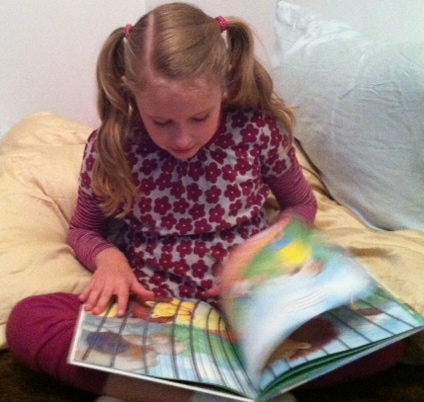
Emma looking at a book before going off to school this morning