Category Archives: Education

The Practice of Life

Yesterday while working with Em (we are learning about American Indians) I had a moment of panic.  I thought, I have no idea what I’m doing here.  I don’t know how to teach this material.  I don’t know that she understands any of this.  

The more panicked I became, the more impatient I felt.  The more impatient I felt the more in touch with my anger I was.  When she randomly pointed to the wrong answer I said in a stern voice, “No!”  Emma doesn’t respond well to “No!”  I know this. But in that moment yesterday, I needed to take a break.  In that moment, neither of us were going to be well served by pushing ahead with the material.  It didn’t matter that I’d printed out more than a dozen photographs of various American Indians and the living structures different tribes used.  It didn’t matter that I’d prepared material to discuss how some planted and became farmers, while others fished and still others hunted buffalo.  None of it mattered because I was having feelings about how she should be able to learn it in the way I was teaching it, despite the fact that the way I was presenting the material was not the way I’ve been taught.

I was not, in that moment, able to practice patience and good teaching.  In addition to this, my thinking was my own worst enemy.  Whenever I begin to think in terms of fearful, projected thinking, and then ask questions such as, “what if she doesn’t understand this?”  or “why didn’t she know the answer to that question?”  I begin to feel impatient and then angry.  In that moment I was not able to see that I was asking the wrong questions.  In that moment I was not presuming competence in her ability to learn.  I know she can learn the material.  I have seen her learn all kinds of material.  This is an example of expectations, coupled with impatience and not teaching the material in the best possible way.

It is during moments like this that I need to take a break.  I know this.  It seems that this would be a fairly easy thing to recognize and then implement by saying something like.  “Oh, hey.  I need to take a break.  Let’s come back to this later.”  Or some other equally non-judgmental comment, but this isn’t easy for me nor does it come naturally.  I slide quickly into either self recrimination or fear and annoyance that she isn’t attending to the material (and me) in the way I would like.  *Breathe*  It’s okay.  You’re okay.  Just take a deep breath.  It’s all fine.  In moments such as this, it is vitally important that I take good care of myself so that I don’t do harm to those around me.  I’ve learned this.  I know this.  This is fact.

So I am writing all of this out here, not as a public flogging or because I’m seeking absolution, but as a gentle reminder to myself that the way I treat myself is the way I treat others.  It’s all practice.  My specific practice includes patience, remaining calm in the face of fear and annoyance.  Recognizing, without judgement, that I do not always behave the way I would ideally like.  Admitting and accepting that I am flawed.  And doing everything in my power to be the very best parent (and person) I can be.  I can’t rewind the tape of yesterday’s session, but I can acknowledge what happened and that I do have the tools to present the material differently this afternoon.

This lesson of patience and calm when my emotions are running in the red is one I have not yet mastered, but am working toward one day at a time.

contemplation

Why Teach Age Appropriate Topics?

Someone asked me why would I teach my child age appropriate topics such as the American Indians, the arrival of Europeans to America, the Roman Empire and the difference between amphibians and reptiles, when tying her shoes, answering (whether verbally or by typing) a why question and riding a two-wheel bike has yet to be accomplished.

The short answer is – they are not mutually exclusive.  It is not that one thing gets taught and the other is left to languish.  I believe all these things are important for any child to learn; why shouldn’t my child have the opportunity to learn these things too?  But just to play devils advocate, let’s say that the questioner still asks, but why?  To them I say, because knowledge is freedom.   Knowledge gives us context, history provides us with choices, knowing how our government works gives us important information about leadership, honesty and conversely dishonesty.  Learning about geography gives us information about the physical world we inhabit.  Reading Wordsworth or Shakespeare or Susan Sontag, studying a painting by Rubens or Renoir or Basquiat, listening to music by Rachmaninov or  Ray Charles or, my daughter’s personal favorite, Gwen Stefani transports us, encourages us to think both analytically and creatively and enhances our lives.

Ralph Saverese, author of  Reasonable People: A Memoir of Autism and Adoption wrote a wonderful piece about a year ago, The Silver Trumpet of Freedom about his non-speaking, Autistic, son DJ who had just been accepted into Oberlin.  It’s a terrific piece and I encourage all of you to take a few minutes to read it.  I’ll wait.

Right here.

Seriously.

Go.

Read it.  

What many believe to be true about Autism is proving again and again to be incorrect.  What many believe to be true about those who are Autistic AND non-speaking is proving to be incorrect.  Our ideas about someone who has physical challenges AND is Autistic AND does not speak are proving to be incorrect.  Our incorrect beliefs are limiting how that segment of the population is taught and what information they are given access to.

This must change.

To My Daughter…

You are capable.  I am sorry it has taken me so long to fully understand this.  You are smart and able to learn and know so much more than I ever knew.  You understand that sea turtles lay their eggs beneath the sand and then, once hatched, the baby turtles must make the treacherous trek toward the ocean.  An ocean many will never reach.  You understand this.  You understand that turtles live in and out of water.  We did not categorize them yet as reptiles, but we will get to that, possibly tomorrow.

You know Christopher Columbus is said to have reached America in 1492 and that there were people already living here.  You pointed to an illustration of an American Indian and typed that this person was called a Native American.  You showed me where we live on a globe and then suggested we take a boat to England over the Atlantic Ocean so that you might visit an old therapist you still remember and speak of with great fondness.  You became particularly excited by the thought that we would have to stay in a hotel and inquired whether that hotel would have a swimming pool.  I know.  A hotel is not a good hotel without a pool.

You told me an insect has six legs and that a spider has eight legs and even though it kind of seems like a spider should be called an insect, it is not and in fact eats insects which is why all those insects in the Miss Spider book you love so much are scared of Miss Spider and that makes her cry.  You demonstrated your innate acting talents by pretending to cry about Miss Spider’s predicament.  It turns out Miss Spider is a vegetarian and happily eats the flowers offered to her much to the relief of all the fearful insects.  That made you laugh.  Then you remembered how “Bertie kitty” was admonished for getting on the dining room table and eating the flowers and said so, again in a very convincing and stern voice.  You are so talented.  I believed both your pretend tears and your pretend/scolding voice. Thank you for telling me you were pretending because you were very convincing.

You are so, so capable and for so many years I’ve been blind to just how capable you really are.  But maybe, just maybe now I have the tools I need to hear you.  Those tools I thought I was learning to use for you, it turns out are tools I needed for me.  I need them so that I can hear all the things you’ve tried to tell me for so long.

I promise.  I promise to keep listening.

Goals and IEP Meetings

My goals for my daughter have completely changed since she was first diagnosed with Autism more than nine years ago.  I have been thinking about goals a great deal because her IEP (Individualized Education Plan) meeting is coming up and for those of you familiar with IEP meetings, it’s all about goals, both long-term and short-term.  The parent’s goals, the teacher’s and therapist’s goals, everyone’s goals are discussed and written down.  Except for Emma’s.  What are Emma’s goals for herself?  For those who have children with either spoken or typed language this is an easy enough question to ask.  For those of us whose children do not it gets a bit more complicated.  Still, I plan to ask, even if I do not get an answer, whether verbally or typed, I will ask and I plan to talk to her about her IEP and what that means as well.  I may even type out some of the goals we are thinking about and ask her if she agrees with them.

I have to admit that sometimes when I speak to Emma about things, whether it’s about privacy, our bodies and bodily functions, the power of saying no, the importance of self and self-determination, or something like explaining what is going to happen over the weekend or asking her what her goals are at an IEP meeting, I catch myself wondering if she really understands.  What I have learned, what I continually remind myself is that it’s okay to wonder, it’s okay to feel all those feelings, but it’s not okay to act or behave as though she does not understand.  I have to speak to her as though she does understand, even when I don’t know that she does.  In the end I have to do this, because to believe that she can’t/ won’t/ doesn’t understand and to be wrong is a risk I cannot take.


An Interview With an Autistic Teacher Who Teaches Autistic Students

What follows is my interview with a teacher.  A teacher who teaches Autistic students.  A teacher who is Autistic.  

When were you diagnosed with Autism?

 I self-diagnosed as having NLD (Nonverbal Learning Disability) (which I mistakenly thought was mutually exclusive to Autism – a good reason to get a professional diagnosis, not a web diagnosis) in college, which brought me a lot of peace of mind and self-understanding. (And helped me make peace with a lot of my past.)  I was in my 30s when I finally made the decision to get the formal diagnosis. (I was both right and wrong: I do have NLD, but I’m also on the Autism Spectrum.)

I got the diagnosis because I was having a lot of trouble communicating effectively at work, and I was getting written up for it.  My supervisors were trying to work with me, but I was afraid I was going to lose my job.  It wasn’t the first job I’ve had that happen at.  The problems my coworkers were going to administration about were hauntingly familiar: my voice tone, my inability to read others voice tone, my quick answers that don’t make sense and sound frustrated.  It was a pattern I’d seen before and had never had any success stopping or changing.  I knew I needed help if I wanted to save this job.

Why do you prefer remaining anonymous?

 For now, at least, I want to maintain control over disclosure.  Also, privacy.  The web is public and it stays there forever.  I’m not comfortable with anything about me, disability related or not, being out there like that.  I don’t have anything meaningful out on the web under my real name, and I’ll keep it that way, thanks.

How did you get into teaching?

 I think it’s in my blood.  My dad is a teacher.  I remember being in first grade, when everyone wants to be police officers and firemen: I wanted to be a special education teacher.  I got a BA in Psychology and spent 5 years doing direct care before moving to work in the schools.  I worked as a paraprofessional while I got my M.Ed.  I’m certified in intensive special needs and deaf/blind education.

Would you talk about your childhood and how autism affected it?

 I did the stereotypical “little professor” thing.  My mom says my favorite word as a kid was “actually.” I had friends growing up, and if my parents thought my relationships with them were a little off, I never noticed.  I had no other standard of relations, and I was happy with what I had.  My mom tried vainly to model more appropriate social interactions (my poor mother) but it all went right over my head (I do not learn from environmental cues or social models.)

Middle and high school were rough.  I was the victim of significant bullying. Kids are mean.  I considered changing schools (I went to public school) but decided against it.  Instead, I dove into my interests: computers, foreign languages, band, technical theater. Bullying happens during the unstructured times of the school day.  I was never unstructured, participating in more classes and extracurriculars than there were hours in the day. (I seriously could have used Hermione’s time turner back then….) Not only did it give me structure and purpose, but it successfully buffered me from my would-be tormentors.

Are you concerned that if the school where you work knew you were Autistic your job would be in jeopardy?

 I’d be worried about an employer learning that I was Autistic before I had a chance to prove myself as a teacher, yes.  The concerns about my communication problems at this job came in the context of “we love your passion, but…” I had already proven myself, multiple times over, as a good teacher getting excellent results with students who are considered difficult.  Afterward, I could see I had to re-prove myself because the words of my NT (neurotypical) paraprofessionals (sometimes not just in the area of classroom communication) carried more weight than mine did.  I have reason to believe we’ve gotten past that now, but it lingers in the back of my mind.  I know I have to work harder and sometimes that makes me mad.  Luckily, I have an administration and paraprofessionals who support me in the work I do and who respect that I am approaching it from an Autistic perspective (even if they don’t always understand that perspective.)  I haven’t always been that lucky, and I am continuously grateful for it.

You say, “with the right accommodations..” can you give an example of a couple that are helpful?

 Using written communication when possible.  This frees me up to only address questions that need to be addressed, which is means I am more likely to be clearer because I can devote the needed resources to perspective taking and processing time.  Regular meetings.  I don’t pick up on things incidentally unless I’m working hard to pay attention to everything that is going on.  That’s impossible when your class is spread between multiple locations.  Regular meetings give me a chance to make sure we’re all on the same page at the end of every day and put out any fires before they get out of hand.  However, the effectiveness of these meetings is predicated on….

Direct communication from staff. This is quite possibly the hardest accommodation to get and the most important.  I ask everyone I work with to be direct with me and everyone says they will. But saying and doing are not the same thing.  Most NTs find being as direct as I need them to be as impossible as I find reading their non-verbal language.  It’s a real communication gap.  I’m incredibly fortunate that I have a para that can bridge the gap.  Some of my new paras are starting to learn as well, and I’m starting to learn to read their individual cues.  Translation is never as good as reading the original, but we get by.

Having communication support people I can turn to.  I have 2 coworkers I can trust to run things by when I’m concerned about how I’m coming across or not sure if I missed a cue from someone else.  This doesn’t help, of course, when I’m oblivious to the fact that there was something I should be concerned about in the first place, but it reduces the pool of potential landmines, at least.  Also, these are people who can listen for what I’m not hearing on the rumour mill (because I’ll never hear it) and potentially warn me of landmines I’m not aware of.  They’ve definitely saved me from several potential disasters already this year.

What are the most common misperceptions you face in trying to teach this population?

Top five misconceptions held by administrators, paraprofessionals, parents, and community members that make my job harder:

  1. That my students cannot possibly be capable of having control over (or a meaningful say in) what will happen with their lives.
  2. That the fact that most of my students may never be fully independent (living alone, working full-time) means that we should not bother teaching them community living and vocational skills.
  3. That my students are unpredictable or dangerous.
  4. That a student who may exhibit challenging behavior in the school environment shouldn’t be allowed in the community because he might exhibit the same challenging behavior.  (This one really makes me angry, because it doesn’t teach the kid anything useful. Give me appropriate staffing to handle the behavior; don’t penalize the kid.)
  5. That my students should be pitied.

Have you been surprised by any child’s ability?

 Have I have taught a student who had more skills than their assessments claimed? Absolutely.  Have I ever had a student make more progress in a year than I anticipated and had to amend the IEP part way through? I love it when that happens!  Have I ever taught a student who may not have a lot of skills that can be formally assessed, but who enriched my classroom in so many other ways?  All the time.  I don’t like the word “surprised” – it’s an autism thing, I guess.

How do you deal with self-injurious behavior?

 Behavior does not occur in a vacuum and all behavior is communication.  SIB (self-injurious behavior) usually has a sensory component, but a FBA (functional behavior assessment) will give clearer answers.  We need to look at the environment, the student’s communication strategies, and antecedents and consequences.  What is the cause of the stress?  How can we teach the student to deal with it more effectively?  Generally, positive behavior supports are most effective, but they have to be individualized in order to be effective.  What is reinforcing to one student may be aversive to another.  Behavior does not occur in a vacuum, and we cannot try to treat it in one.

Can you describe some of your own sensory issues and how they impact your life and work?

 I only recently really mastered reliable daily living skill routines.  Showering was a difficult sensory experience for me for years.  I still have trouble with toothbrushing and flossing, but I’m working on it.  I eat pretty bland foods (though, due to food allergies, my diet is both more varied and more monotonous than average) because I don’t care much for significant smells or tastes.  I’ve gotten more tolerant of different clothing textures than I was when I was younger.  I still freak out at certain textures, but my repertoire has expanded significantly from the “cotton/poly blend only” I wore when I was younger.

At work, I’m in control over the visual environment, since I’m the classroom teacher.  So I keep it pretty visually quiet, both for my own sake and that of my students.  Any conversations go out of the room, which really helps all of us focus.  My para knows to ignore when I’m self-talking, which is my primary self-calming strategy (I try to take that out of the room too, when I can.)  I stim when I need to.  So do my students. I don’t see that (the stimming) as particularly impacting our work.  I bring figits or sit on the floor during meetings (I sit in the back so it’s not disruptive.)

In previous years, when I was trying to pass and having more communication problems, I needed more sensory breaks and did a lot more self-talk (which in turn cased more communication problems.)  Now that I’m not trying to pass, I’m more comfortable and less stressed, which means I’m generally more sensory regulated – and if I’m not, dealing with it is no big deal.

Are there specific things you suggest schools can do to help their students?

 I think a lot of schools do the first half of this puzzle really well.  They have proactive sensory programs: do this activity after this interval for this amount of time.  And they have reactive programs: if you see this behavior, offer these choices for this amount of time.  The good ones have a mixture of the two.  Where the programs tend to miss the mark is in taking it to the next level: teaching the student to recognize when their sensory system is starting to become disregulated and what to do about it.  There are some good programs out there for teaching this skill: The Alert Program(TM) is probably the most popular.  I’m a fan, personally, of the Incredible 5-Point Scale, because the students can apply it to more than just their sensory system and because it has a more flexible metaphor (colors, numbers, can use pictures) and it ties into emotional regulation and understanding.

What is your opinion regarding stimming?

 I stim. My students stim. I won’t stop a student from stimming. My para (the only NT  in the room, poor guy) frequently points out that everyone stims, it’s just that society has declared NT stims socially acceptable and autistic stims unacceptable.  That said, there are also students who demonstrate self-stimulatory behaviors that are not self-calming but rather a precursor to or the beginnings of further stressed or out of control behavior. It is extremely important to know your student and to know the difference between these two types of behaviors. In one situation, the student is using their own coping strategies to de-stress, and in the other the student is indicating the beginning of losing control, and the environment or stressors needs to be addressed to prevent further escalation.

Have you ever witnessed treatment of a student that you objected?

 I’d love to say “no,” but yes, I have. Most of the time it’s things like not giving enough wait time and over-prompting. I get incredibly frustrated by the way that students who are not socially engaging, especially if they have challenging behaviors, tend to get left out in favor of the “easier” kids. But also, yes, I’ve seen what you’re really asking about. I’ve seen students physically moved or restrained when they shouldn’t have been.  I’m trained in the use of physical restraint, and yes, I’ve had to use it. Do I like it? No. Is it ever my preference to use it? No. Will I use it as a last resort to keep students safe? Absolutely. And I would 100x prefer to be called in and asked to do so then to have people who are untrained and don’t know what they are doing try to make do.  That way only leads to injury, trauma, and possibly death.  And I’m not afraid to call it like I see it.  I’ve reported coworkers to administration and when needed I’ve filed 51a reports (reports of abuse or neglect.) There are certain benefits to having an overarching sense of right and fair and not feeling bound by social conventions, at least where the students rights and safety are concerned.

Is there any methodology that you prefer and why is that?

The short answer to this question is no.  I am very wary of any program that says that a particular methodology is right for all students with diagnosis x.  I don’t believe that to be true.  The role of the teacher is to be familiar with the breadth of instructional tools that are out there and to find (or adapt) the right tool for the individual student to learn the specific skill.  For one student, that might be Discrete Trial Training to learn to attend to directions given in ASL.  For another student, that may be a phonics curriculum to learn to read.  A third student might be learning vocabulary in the natural context of a community work placement.  The one thing that all of these methods have in common is data.  I need reliable data taken daily on student achievement to know if the methodology is effective and the student is making progress, or if the instructional method needs to be changed.  There is no right or wrong method; I don’t even believe there is a best method. The question is whether the method being used is effectively teaching the student the desired skill, and there is only one way to answer that question: data.

Are there any methodologies that you believe are harmful?

Aversives, repeated use of any form of punishment (including time outs,) restraint used as a programming tool as opposed to an emergency procedure. If you’re doing it on a regular basis, something is wrong.

How do you work with a curriculum given your student’s disparate needs?

 The short answer is good staffing ratios and competent paras.  Also, using the principles of Universal Design for Learning.  By differentiating how I engage each student, and with paraprofessional support for behavior and data-taking, I can have three students engaged in a group setting.  I can have a fourth student, with additional paraprofessional support, engaging in the same material with us and connecting to the group as able. If you’re counting, that’s 3 staff and 4 students.  I’ve just described to you what my classroom looks like most days.

In an ideal world where Autism carried no stigma and you were able to be open about being Autistic, are there specific things that would allow you to do your job better?

 I would like to be able to work with my students on understanding Autistic culture and the Autism community.  My school does very well teaching our Deaf students about Deaf Culture and their Deaf identity.  I believe we could do the same for the Autistic students.  I would like to make that happen, and I know that no one else will lead it, but it would require being open about being Autistic and I’m not ready for that yet.  I trust my administration and those I’ve told, but I am not comfortable working with the rest of my co-workers as an Autistic person, which I’d need to do in order to make that happen for these students.  It’s something I want to do, but not yet.  One day, I hope.

What do you advise people who are thinking about entering the field of special education?  Is there anything you wish you’d known when you were just starting out?

 Work with kids with disabilities before you go into the schools.  Work at multiple schools (or with kids from multiple programs) before you start teaching.  One of the downsides to being in the schools, especially since most teachers work as paraprofessionals while they get their degree, is that you work with one student, or one group of students, for years.  There is frequently only one or two special education classrooms in the building, so there aren’t a lot of models to observe.  I have had too many experiences of people singing the praises of teachers I know to be mediocre at best, because they have no standard to compare them to.  See as many different students and teachers as you can before you settle on a specific subset of the population, a school, and a classroom where you want to work.  Most importantly, spend time working with typically developing children.  You’ll need that reference to fall back on so you can recognize what’s typical age-appropriate nonsense and what is actually behavior that needs to be addressed.  We tend to acquire tunnel vision in special education; make sure you don’t put the blinders on until you have to.

What do you advise parents look for of non-speaking children seeking a good school?

 Without knowing the specific student or her goals, it is impossible for me to say what program is best.  I can tell you what I look for in a school where I would consider working.  The one thing that sends up red flags and makes me stay far away is a school that believes there is one right method to teach all students.  Simply put, there isn’t.  Beyond that, I look for evidence that the people there know how to use picture supports and both high and low tech communication supports, not just for schedules but integrated into everyday activity: academics, leisure/social time, specials, lunch, etc.  For an older student, I look for evidence of functional skills and community based learning, not just using pictures to represent and role-play functional community activities, but actually getting out into the school and local community and learning the skills in the real environment.

If you could create a “dream school” what would it be like?

My dream school would have the physical environment, educational methodologies, peers, and teachers and paras with appropriate training and ratios to give each student access to both the general educational curriculum and any related services she needs to be successful as an adult: whatever that looks like for each individual student.  My dream school is not one school, but a range of options for every student so that the right option is always available.  That option would naturally change over time as the child grows and her needs change, and no one would question the need for that change.

Have you had parents or other staff question the competence of a child in your class?

 I had a former administrator tell me a student didn’t matter because his family would take care of him after graduation and to focus all my attention and resources on another student who, she said, actually had a chance of being fully independent. I basically ignored her. They are now both working in the community with support.

 Have you had a parent question their child’s competence?

 Not directly, but I certainly have known parents who have underestimated their child’s academic or independence skills.

 How have you dealt with that?

 I don’t judge, because I can’t.  I don’t walk in their shoes.  I only see their child at school.  I only know what their child does in one environment and I understand well that students will present differently in different environments. I will encourage bridging to home; I will provide support; I will provide information and data. But I will not judge, because I do not, I cannot, really know.

“I Want to be a Singer on the Stage!”

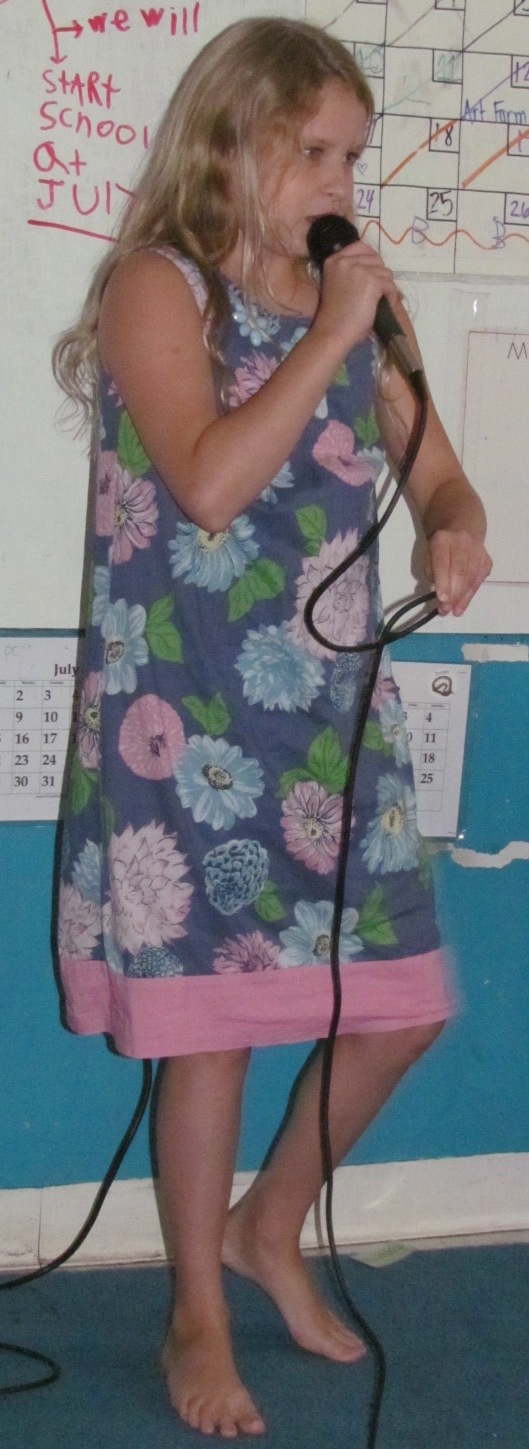
Emma told us she wants to be a “singer on the stage!”  She said this a few weeks ago and repeated this desire last night.  Richard and I are doing and will continue to do all we can to support and encourage her desire.

Emma’s love of costumes and theatrics, coupled with her love of music, performing and singing in front of an adoring audience will go a long way in helping her achieve this lofty goal.  It is the perfect window by which we can enter to help her acquire language, encourage her reading, writing and typing.  I am starting to print out the lyrics to her favorite songs (reading) and find other ways to encourage writing (lyrics? poetry?) or anything else she might find motivating.

Emma dressed as a knight

Emma in her flamingo costume with her favorite Alien doll

Related articles

A Letter To My Daughter’s Teacher

*I’ve never removed a post before.  But I couldn’t get away from the creepy feeling the original post was giving me.  I have kept much of the original content, but rephrased it so that I’m not speaking as though I were my daughter, which I have no right to do, and am instead speaking as her mother, which I am.

My daughter, Emma will be in your class this year.  A few days ago, Emma told me she was “scared to go to new school.”  Emma loved her teachers and friends from her old school.  So I want to introduce you to her.  I cannot speak for Emma, I cannot know if everything I write here is completely accurate, but these are things that I have learned over the years, things that are specific to Emma and that may be helpful, at least that is my hope.

Sometimes Emma does not look at you when you are speaking to her, but that doesn’t mean she doesn’t hear you.  Her hearing is excellent.  She may not know how to process what you’ve said or she may not know what is expected of her.  Often if you ask Emma a question, especially if it’s a question she knows the answer to she either won’t answer or will say something nonsensical because she isn’t sure what’s expected of her or why the question has been asked.  Sometimes people get nervous and don’t know what to say, so they’ll ask, “Oh Emma, that’s a pretty dress.  What are you wearing?”  or  “What color is that?”  These are questions that aren’t being asked for any real purpose or they are testing questions.  Typically these are the kinds of questions Emma will not answer.

Change is difficult for all of us and Emma is no exception.  Having a written or picture schedule for the day and week will reduce her anxiety.  Like everyone, Emma really appreciates having a say in what happens throughout the day.  Whenever appropriate allowing her to set a timer for a one, two or five-minute warning before a change in activity will go a long way in helping her do what she needs to prepare herself.   Usually Emma will go along with any change if she’s given sufficient warning.

General Disposition:

Emma loves people.  She is gregarious.  Her fall back position is one of happiness.  She is also very sensitive.  She can tell if someone is upset, stressed or angry and can become easily overwhelmed by those feelings.

 Particularly good at:

Emma is terrific at leading others.  She can be extremely persuasive and is a great negotiator.    Her negotiating skills are wonderful for math and science and her leadership skills are wonderful motivators.

 LOVES:

Emma loves music, dancing, being on stage in front of an audience.  Give Em a microphone and she will sing and dance.  She loves “talent shows.”  She loves any game involving running, swimming, holding her breath under water, laughing and being silly.  She loves playing versions of “Duck, duck, goose” or as Emma would say, “Raincoat, raincoat, umbrella!”  Musical chairs is another favorite, dance parties, hide and seek, dressing up, bouncing, swinging and going to any playground.  Emma is very athletic and very girly.  She likes cooking and while she won’t eat most of what she cooks, unless they’re pancakes, she will enjoy the opportunity to cook.

Does NOT like:

Emma gets upset if she is told not to do something she has just done.  Example:  “You cannot shout!” after she has just shouted is difficult for her.  Obviously she CAN shout, she just did, with you right there watching.  Telling her she “can’t” is not true and it’s confusing.  Instead say, “You mustn’t shout.” Then in a voice that models what you’d like you can say, “Here is how you can speak instead.”  By doing that, you are helping to give her other choices.  If she is not allowed to do something, be sure to tell her what she can do as an alternative.

Academics:

Emma is fairly new to all academics.  Within the past year she has learned to form the letters of the alphabet and is now reading, writing and typing at a 1st – 2nd grade level, likewise with math.   Emma loves the Hubble Imax movie and her favorite museum is the American Natural History Museum.  She is showing interest in learning about our world, the ocean, the moon, other planets and the universe.  She told me last night that she doesn’t want to be an astronaut though, she said she wanted to be a “singer on the stage!”

Needs extra help:

Emma resists academics.  They are hard for her and she becomes upset when she makes a mistake.  She doesn’t like getting anything wrong.  But if you help her succeed, she will flourish.  If she is reading and doesn’t know a word, give it 15 seconds or so to see if she can work it out on her own, (don’t say “sound it out” or “try again” because she didn’t learn to read phonetically and while she is able to sound some words out on her own, it won’t help her with all those exceptions like limb and thought.)   Emma has a strong desire to learn and an even stronger desire to do things independently.  With your help, she can and will succeed.

Frustration and Signs to watch for:

Emma gets a look of panic on her face.  She may begin breathing with short sharp intakes and she will often talk to herself in a high-pitched questioning voice laced with anxiety. When Emma is overwhelmed she may shut down and withdraw.  She may begin scripting, using set phrases she’s heard. Those scripts may be in context with what’s going on or their connection may not be clear to you, but that doesn’t mean there is no connection, it just means you don’t understand or know what it is.  Emma often has trouble processing her feelings and the feelings of others.  Sometimes she needs help identifying those feelings, just as we all do.  Sometimes she will start repeating things other teachers have said to her in the past in a scolding tone, such as, “No Emma!  You may not __________.  If you ____________ we will take ________________ away!”  When Emma is overwhelmed she has to rely on her scripts as all other words have left her. Try to listen even if the words seem meaningless, she is trying to communicate her feelings of distress to you.  Sometimes she might say, “You have to ask for help!”  This is what she says when she needs help, but sadly this can confuse those who do not know Emma well.  She might also say, “Do you want to go swimming?”  Which means she really, really wants to go swimming.  If you show her on the schedule when she’ll be able to go she will usually calm down.

It’s too late, the storm has hit!

This is not the time to engage in a power struggle.  Emma is not trying to manipulate you or upset anyone.  She is simply expressing her frustration in the only way she knows to.  Sometimes if she’s very upset she will bite herself or punch herself, usually on the hand or arm, sometimes if things are very bad, she will punch herself in the face.  Do not exacerbate this challenging time by raising your voice or telling her “You cannot hit!”  or “You cannot bite!”  or even “We don’t bite.”  (See Does not like paragraph above) Restraining her in an attempt to stop her will not prove helpful either.   Emma bites or hits herself because the feelings of frustration are overwhelming her.  The pain she causes herself by biting or hitting is within her control and is therefore preferable.  It things have escalated to the point where Emma is hurting herself, everyone must try to understand what has happened before things became this derailed and try to prevent them.  Sometimes it isn’t possible, but Emma is trying to cope as best she can.  When she is calmer you can work on helping her find alternate ways to cope.

What helps you when you feel overwhelmed?  What things do you do when you feel anxious, scared or upset and no longer feel you’re able to function?  Maybe the things that work for you will help Emma too.  Remember, be patient.  Showing Emma once or twice will not mean she’s learned, she will likely need to be shown numerous times.  Often there is a sensorial component to her upset.  She is overwhelmed with feelings or a sensation or too many sensations.  She may be tired or hungry, too hot, cold or thirsty.  Sometimes a sensory break will do wonders to restore her equilibrium.

Strategies that work well:

Make it into a game!  Music can be incorporated into just about any activity and can change anything.  High affect and silliness can make something that feels difficult seem fun!

Humor:

Emma loves anything silly and ridiculous.  Silly faces, silly dances, playful interactions, games!  She has specific jokes she likes to play with specific people.   Emma loves to laugh.  She loves to make up word games.  She enjoys taking a word like “uncle” and changing it to “Jungle.”  She will happily tell you that she has a “Jungle Andy and a Jungle Victor.”  Come up with silly word games and Emma will join in with glee.

Things that have a tendency to backfire?

If you say, “You have to do ________________.  If you don’t, I’m going to take __________________ away” will make her upset and anxious.  She will have a hard time concentrating because she will worry about having something she wants taken from her.  Instead say, “You can ______________, but first you need to __________________.”  That way Emma can concentrate on having/doing something she loves as opposed to taking something away.

Emma’s String:

 Emma has a string that she loves.  Please do not take away her string or use it as a form of punishment.  Her string helps her focus and it makes her feel safe.  If you take it away or threaten to she will become completely overwhelmed.  Sometimes, when she is writing or typing and needs both hands to do so, you can ask her to set her string near her or in her lap.  If you allow her to control where she puts her string she will feel safe enough to concentrate and do her work.  Also (a little secret) if you get some string or ribbon and copy her movements in a playful way, you might see and feel for yourself how wonderful it can be and Emma will be delighted that someone wanted to interact with her in a way that she loves.

Food:

Emma does not have any allergies or foods she cannot eat.  However she likes to eat the same food everyday.  Some food looks, tastes and smells strange to Emma.  Please do not make her eat anything she isn’t interested in eating.  Please do not tell her she must finish something in order to have something else.  If Emma shows interest in something someone else has or is eating and it’s appropriate, do allow her to smell, lick, taste or eat it if she wants to.  And please do tell me so that I can find whatever it is and offer it to her at home too.  We will pack Emma’s lunch everyday.

One last thing:

 Assume competence and respect Emma’s process.   Emma can and does learn.  She may take longer or less time than another child, but she will learn.  She is extremely independent.  Show her, help her, let her.   You are her role model.  Emma has dreams, just as we all do.  You can help her achieve those dreams by believing in her.

 I am available to talk, discuss and strategize.  I am here to help in any way that I can.  Nothing is more important to me than my daughter.  Please keep in touch with me.  Please let me help in any way that I can.  There is no detail about Emma’s day that is too small.  Do not hesitate in emailing me _____________ or calling  _____________. 

 Thank you so much,

Ariane

Emma performing at her old school


*The above “letter” was inspired by a form letter Ann sent me by Jene Aviram© http://www.nlconcepts.com

Autism = A Human Rights Issue

Sometimes I read something and I am completely overwhelmed by the weight and content of the words.  Yesterday I read this – written by Kate.  It’s entitled Scarred.   It was posted on The Thinking Person’s Guide to Autism.  I am including just the first few sentences.  Please click on the link to read it in it’s entirety.  This piece needs to be read – by every parent, every school, every “specialist,” every researcher, everyone and anyone who every comes into contact with anyone, ever, on the spectrum.

“Scarred

Kate

We are scarred, we adults on the spectrum.

We are scarred, both inside and out.

Our lives are twisted paths littered with diagnoses. We have fought for years to get to where we are now, and still it isn’t good enough. 

We are scarred.” 

Autism is a human rights issue.  We must begin thinking of it this way.  We are condemning a group of people, treating them worse than we treat convicted felons, murderers, rapists, psychopaths.  We must stop.  We must stop the way we think about Autism.  We must stop the way we think of Autistics.  We must stop oversimplifying, we must stop applying our Neurotypical thought processes to Autistic people.  We must stop with our assumptions.  And the only way we are going to stop is by LISTENING!  We must, every single one of us, listen to those on the spectrum who are communicating and we must put aside our “but my child can’t talk, therefore this person isn’t like my child” or “this person must be high functioning and therefore doesn’t know what it’s like for me and my child” or “my child is in diapers and is nonverbal and therefore this other Autistic person has nothing of any importance to say to me”  or “I can’t hear this person, they’re too angry.”

We must stop speaking for Autistics.  We must stop arguing about semantics.  We must stop and hear the pain our misinformation and misperceptions are causing.  We must stop and listen.  Listen to what we, as a society, are doing.  Listen to what Kate and so many others are saying.  A group of people are being abused, shamed, yelled at, blamed, talked about, treated with contempt by schools, specialists, doctors, teachers, organizations carrying the word “autism” in it’s name, parents, siblings, cousins, society, the world.  We are arguing over wording.  We are bristling at the word Neurodiversity, we are shouting at one another, but shouldn’t we start listening to those who we are all supposedly wanting to help?  Isn’t it condescending of us to pretend to care about autism and yet make excuses as to why what so many of them are saying shouldn’t be listened to?  I hear people say, well that person is too angry, therefore, what?  Therefore their voice is invalid?  Really? Do we really believe that when  someone is saying something we agree with and want to hear?  Isn’t it that we don’t like it when someone is saying something that goes against what we think or believe?

Can we all try harder to look at what we’re doing when we try to silence those who are speaking out.  Do you think so many would be so angry if they felt they were being heard, that what they had to say was having an impact?  Hasn’t every movement had voices of anger as well as those who tried to be civil?   Don’t we need both?  Do you think they would be shouting if they didn’t feel ignored, condemned, brutalized?  Many Autistics are angry?  Yes.  Why wouldn’t they be?

Autism is a human rights issue that has been sadly overlooked.  That has to change.

It must.

I know, I know.  I just went on a rant.  I’m taking a deep breath…  

Autism can look like this… (2002)

and like this… (2003)

and this… (2004)

and this, too… (2012)

Related articles

Joe Scarborough’s Ignorance And What It Means To The American Public

I wanted to write about how Richard came home yesterday (Yay!) and how we took Emma to the Chelsea Market and how she insisted on wearing a pair of black patent leather shoes, turquoise tank top and pink terry cloth shorts with white hearts.  I wanted to post a couple of photos of her so you could see for yourself how great she looks, but when I sat down to write I knew I had to write about something else.

I don’t want to talk about Joe Scarborough any more.  Yet his unfortunate, ridiculous, careless and ignorant remarks, make it impossible not to mention him, because he has a huge following, because people imagine he knows something about Autism.  Joe Scarborough’s remarks are indicative of a larger issue – ignorance and misinformation, which leads to opinions and a general consensus about Autism that is incorrect.  One such commenter on an article about Joe Scarborough’s remarks, said he believed Joe Scarborough knew more about autism than he did because he has a son who is Autistic.  And that is exactly why this is about more than just some asshole with a radio show.  There are countless people spewing all kinds of venom on the radio and everywhere else.  Much of it is dismissed.  But when someone, whether it’s a pseudo celebrity or a talk show host with a large following says they have a child on the spectrum ears perk up.  Forget that AUTISTICS are talking about what it’s like to be autistic ALL THE TIME and their words are almost never in accordance with what that parent with an Autistic child is saying.

So just to reiterate:

Autism is NOT a “mental health” issue.  It is neurological, neither good nor bad, just DIFFERENT.

Joe Scarborough, (I know, there’s his name again) said in a statement he made yesterday, which was neither apologetic nor a retraction from his original inflammatory comments, “I look forward to continuing my work with wonderful organizations like Autism Speaks to provide badly needed support to millions of Americans who struggle with Autism every day.”

Autism Speaks does NOT provide badly needed support to Autistics.  In fact Autism Speaks is uniformly HATED by a massive number of Autistics who speak to that fact on a daily basis.  If you google “Autistics who hate Autism Speaks” you will see more than a dozen pages of links addressing why this is so.  (Really, I just googled it.)

While I’m at it, let’s dispel a couple more myths, something Autistics are doing ALL the time on their blogs.

Autistic people are not inherently violent.

Autistic people do not LACK empathy.

Autistic people are not all loners sitting in a corner banging their heads against the wall  (That would better describe me right about now)  until they can no longer take it and go on a murderous rampage.

Autistic people are not all depressed and friendless.

I’m depressed right now.  But this isn’t about me, or how I feel, or anything else that contains the word, me or I.  This is about prejudices and prejudices are always negative, reinforced by ignorance, ingested by those who believe they are being told the truth by someone who is more knowledgable than they are about something they know nothing about.  This is how it works.  This is how it has always worked throughout history, the demonization of a group of people whose voices are drowned out by the larger roar of ignorance and stupidity.

I refuse to end on this note, however.  So here.  Here are a couple of photos of Emma in the outfit she threw on to go to Chelsea Market yesterday evening.  Because Em is one more example of what Autism looks like.  Emma is inherently HAPPY.  Emma is inherently SOCIAL.  Emma is inherently KIND.  Emma is inherently EMPATHIC.  I’m trying really hard to follow her lead.

This is Autism.  This is Emma.

Loved that as I took this photo a woman wearing black patent leather pumps and turquoise dress walked toward her!

“I can’t reach!”

Related articles

What the BOE and Preppers Have in Common

Today is our IEP meeting with the BOE.  Perhaps the only organization using more acronyms than the BOE (Board Of Education) are Survivalists.  How and why do I even know about such a group, you might ask?  Because my husband, in his thorough research for his almost finished YA novel (it is so good, so wonderfully written, so exciting, it will turn YA literature on its head) has told me all about them.  Survivalists or Preppers as they are also known, are preparing for the worst.  Don’t ask me anything more because that is the extent of my knowledge regarding Survivalists.  However I am a bit chagrined that the name “Survivalist” has been taken by this group as it seems an appropriate name for our children on the spectrum, though if they rejected it, I suggest we parents adopt it.

But I digress… this afternoon we have to go to the BOE and meet with three or four members of their staff to go over Emma’s IEP (individualized education program) mandated by the IDEA (Individuals with Disabilities Education Act).  The point of the IEP is to help teachers and related service providers understand the specific issues, challenges and strengths of each specific child, with specific written goals for each and every child with a disability.

This is how the NYC DOE (Department Of Education) describes the IEP: “An Individualized Educational Program (IEP) describes the special education and related services specifically designed to meet the unique educational needs of a student with a disability. An IEP is the guiding document for a student’s educational program. It includes all of the goals, objectives, present levels of performance and related services that are recommended for the student.”

The first time I went to such a meeting, I was very excited, assumed the BOE cared about my daughter and her educational needs, wanted what was best for her, would urge for the best possible services, would work with me to get those services, suggest the most appropriate placements, write up a detailed and suitable IEP for her, etc.  To say that I was disappointed does not in any way express what actually transpired.  I left that first meeting surprised by my naivety, realized that of course this was a huge bureaucracy, bound by law to write an IEP, underfunded, understaffed doing the best they could with limited resources in a very imperfect world.  In addition to all of that, one sits at an oval table with complete strangers most of whom have never met Emma.  One person at the meeting will have done an assessment of Emma for 30 minutes, several months earlier.  Emma will have been one of hundreds of children they saw.  From that 30 minute “assessment” a report will have been written and all parties from the BOE will have that report in front of them, which they will refer to during our meeting.  This is a sample from last year’s report:  “Emma is minimally verbal, spoke in single word utterances, or short, attenuated sentences for the most part, was able to repeat simple phrases heard, and was echolalic.”

When I read that report last year, not only did I not recognize Emma, but I wept for this child that I did not know.

During the IEP meeting the staff from the BOE will not use the words “sensory issues” in fact, the word “sensory” will not be uttered in any context.  Nothing will be mentioned about the necessity of having a sensory diet, that in order to focus and attend to academic work Emma will need certain sensory supports.  Richard and I will mention these things.  We will insist that they be included in her IEP.  We will go on at length regarding her need to be allowed a break so that she can move between tasks, we will insist that a compression vest, a slanted writing board and various other sensory aids be added to the report.  To be blunt – we will be a pain in the BOE’s ass.  They will be relieved to see us leave.  This is not our intention.  Our intention, our sole purpose during this meeting is to ensure an accurate and appropriate set of goals are written for our daughter.  Even if no one from the BOE ever reads them again until our next meeting next year, we will leave knowing that we did our best for our daughter.

For more on Emma’s journey through a childhood of autism, go to:   Emma’s Hope Book