Monthly Archives: March 2014

“Talking is Easy, But Saying What I Mean is Hard”

Most of us, who have spent our lives using spoken language as a way to socialize and convey what we are thinking, do not ponder what it would be like if we could not do so.  Most of us who are able to speak do not spend time imagining what it would be like if we could speak, but what came out of our mouths did not necessarily match what was in our minds, or wasn’t what we wanted to say, or was taken to mean something else.  For those of us who speak and have little difficulty having a conversation with another it is difficult to imagine what it might be like if we could not speak at all.  We easily tune out our environment allowing us to focus on what is being said by another person.  Asking questions comes naturally, and without thinking we ask for clarification about things we don’t understand or want to know more about.  When we cannot hear something or lose part of a sentence spoken by another, we ask to have the part we didn’t hear repeated, or request that it be said in a different way.  And even so people misunderstand each other all the time.

But what if we could speak only a little and those hard-earned words we finally managed to say were met with confusion, irritation, even anger and led to misunderstandings.  Or what if speaking words was so difficult it was easier to utter sentences constructed by others, sentences that held special meaning to us because it reminded us of a happy or sad or anxious or frightening time. Whenever one of those emotions surfaced, we would blurt out that sentence from the past, because it so beautifully captured what we were feeling now.  Maybe though, other people who did not understand or know the meaning they held for us, took them to mean something entirely different.

A blogger friend, E. of the fabulous blog The Third Glance wrote an amazing piece, Words, a couple of years ago about trying to participate in a conversation with a group of friends.  I’ve never forgotten that post, it was one of a number of posts that radically changed my thinking.  You can read it by clicking ‘here‘.  She describes wanting to keep up with a conversation that a group of people she knows is having in a busy place, while trying to filter out the noise that comes with being in a public place, the stress of trying to figure out when it would be appropriate to interject a comment, the pressure of knowing some sort of response is expected of her, and not being successful.

Yesterday Emma wrote, “Talking is easy, but saying what I mean is hard.”  I understand that when she wrote that, she meant it literally.  Emma “has language” yet cannot carry on a spoken conversation.  Emma cannot answer with spoken words questions like, “What did you do in school today?”  Or “What did you think of that movie?”  Or “Which student in your class do you like best?”  Or “What’s your favorite subject?”  Or even “What are the names of the other students in your class?” or “Where do we go to borrow books?”  As a result all those so-called reading comprehension questions are met with silence, or with words that seem to have nothing to do with the question asked.

The other person then draws the conclusion that Emma does not understand the question, or cannot read, or isn’t interested, or doesn’t care or is intellectually disabled, impaired, has a disorder, a disease, is afflicted, suffers from, is a puzzle piece, is locked in her own world or any other word or phrase used to convey what we believe to be true because of our understanding of her and those like her based upon what she can or cannot say with spoken words.  This is the same girl who wrote, ““I can’t talk the way I think.  Where is the label for that?”  The same person who eloquently answered questions about functioning labels, stimming and autism, ‘here‘, ‘here‘, and ‘here‘.

“Talking is easy, but saying what I mean is hard.”

Emma Playing the "My Mouth is Glued Shut" Game

Emma Playing the “My Mouth is Glued Shut” Game
Emma’s Story Written Entirely On A Qwerty Keyboard!

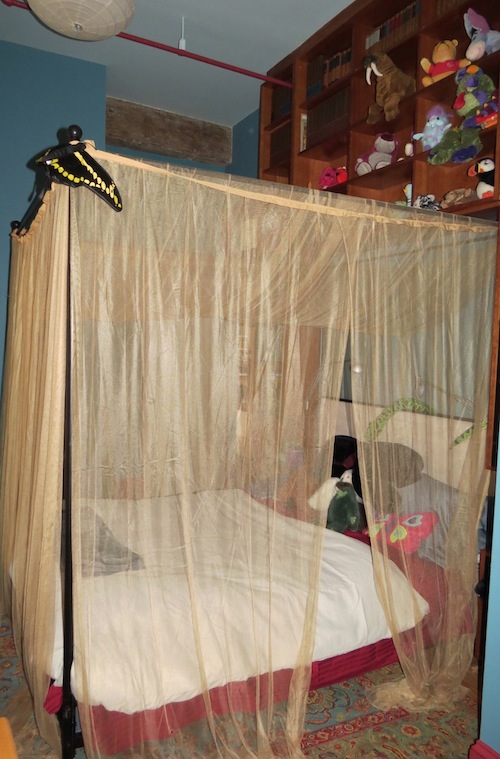
Recently we painted both the kid’s bedrooms.  They each found the colors they wanted.  Emma chose a beautiful sea greenish blue and a luxurious red for the baseboard, exposed pipes and doors.  She picked out a gold-colored mesh to cover her new four-poster bed.  Her new room is beautiful and I have found myself wandering into it, just so I can soak up the beauty of her newly painted walls, her princess bed with golden, cascading canopy and all her stuffed animals filling the floor to ceiling bookshelves.

Yesterday during Emma’s RPM (Rapid Prompting Method) session Emma wrote that she intended to write a story.  I’m including a link here to the post I wrote not long ago entitled “How We Got Here” for those of you new to this blog.  This is the story Emma wrote by typing on a qwerty keyboard attached to an iPad.  This is Emma’s first full story written entirely on a qwerty keyboard!  And as always, Emma approved this post and the accompanying photograph of her room.

                               The Girl Magician

From the bedroom of a house in Southern Georgia, there lived a girl named Judy.  Her room was dazzling.  Her time was spent by herself, and she liked it that way.

She had visiting hours for family to check out the best room in the house.  When visiting hours were over, Judy got to work on secret projects.  She noticed that when she changed the color of her scarf, many other things changed also.  When the blue scarf attached to her, she became very talkative.  The orange one made her laugh and the brown one made her cry.

Judy wore a yellow scarf during visiting hours one day.  Family was calling her name, but they did not see her.  She was invisible.  Judy was someone with magic powers.

The End

The Princess Bed with bookshelf filled with animal friends.  Notice the newly painted blue walls with red trim!

The Princess Bed with bookshelf filled with animal friends. Notice the newly painted blue walls with red trim!

Emma’s Question To You

Last week during Emma’s RPM session with B. they discussed interviews, the act of interviewing another person and the reasons one might interview another: for jobs, schools, etc.  They discussed where an interview might take place, one on one and in person, a group interview, by telephone, over email, etc.  I don’t have Emma’s permission to write about the interview she then conducted with an imaginary person, but as a result of all of this, I decided to continue with this idea of an interview in our session at home.  So I asked Emma whether she wanted to be the interviewer or the one being interviewed.

Emma wrote, “I want to know what you think about autism and am curious to understand why wasted time is spent being against a way of thinking.”  Later she added to that last part, “and being.”  So the sentence read, “I want to know what you think about autism and am curious to understand why wasted time is spent being against a way of thinking and being.”

Whew.  Talk about a great question!  I told her that I believed there was so much more we do not know than we know about all neurology.  I mentioned that with  Autistic neurology in particular, there is a tendency to state as fact a great deal that is not fact, but is really an opinion.   I told her that her writing has so completely changed my thinking about not just her, but autism in general.  I talked about how people fear what they do not understand, how they make up stories and confuse ideas and opinions as facts.  I discussed how assumptions are made because people like to believe they know things, even when they don’t and how people would rather believe something that isn’t true than sit with the discomfort that can come with not knowing.

And then I asked her if she wanted to know what other people thought about her question, or was this a question specifically for me?

Emma wrote that she would like to know what others think.

So I’m throwing it out to all of you… think of this as Emma’s first interview question to you.

“I want to know what you think about autism and am curious to understand why wasted time is spent being against a way of thinking and being.”

Emma's "Eyes and I" project

Emma’s “Eyes and I” project

“Picture Day Moments”

Yesterday was picture day at Emma’s school.  Over the weekend I went to the photographer’s website, paid for the photographs online, chose which packet we wanted and then filled out the little envelope that had been sent home and placed it in Emma’s back pack.  Emma and I discussed picture day and she carefully chose what she wanted to wear, a red velvet dress worn with black velvet leggings.  She’d washed and rinsed her hair the night before with particular care, and as she waited for the bus, she smiled at me and said, “Smile!”  I laughed and told her I couldn’t wait to see her photograph. The bus arrived and off she went, sprinting up the steps, with me waving good-bye.

That afternoon I had a meeting at her school with a few people from her team.  I was informed that there’d been some issues in the morning with Emma distressed.  Something about wanting to leave the room.  There was mention of her wanting to leave the room because of it being picture day, but that she had to stay in the room and was not allowed to leave.  I assumed that was because the other children were waiting their turns too and didn’t think to ask for more information.  The conversation veered off to other, seemingly more important, topics.

When I returned home with Emma I opened her back pack to find the envelope for picture day just where I’d left it.  No one had taken it.  Still, I didn’t put two and two together, didn’t think to ask Emma about it and besides, she’d already been asked to write with me that afternoon at school.  I emailed her teacher telling her the envelope was still in her back pack and received a reply that they hadn’t seen it and therefore assumed that I did not want Emma to have her photograph taken, but that she had been included in the class photo.  And I felt that awful feeling when your throat feels swollen and you can feel your heart beating and your chest constricts and your breathing becomes shallow and your vision blurs.

This morning I spoke with Emma about picture day, telling her there’d been a misunderstanding and how sorry I was.  I asked her to talk about it.  She told me how upset she was that she didn’t get to have her individual photograph taken as the other children had.  “I’m so sorry” I kept saying, but I can’t make what happened any different.  I know it’s just one incident, something relatively small and in the grand scheme of things not particularly important, but you see, this is just one example of what occurs regularly for our kids who do not speak, or, as is the case with my daughter, cannot say what she necessarily intends.

There are dozens and dozens of “picture day” moments.  Little things where she is misunderstood, cannot initiate a complaint, is not asked the right questions, cannot “speak up”, cannot protest with a reason why, instead she is thought to have “behaviors” when she tries to leave the room.  Assumptions are made, well meaning staff decide they understand her and know what is going on, and maybe they do, but maybe they don’t.  How many “picture day moments” happen from one day to the next.  Expectations and questions gone unanswered, thoughts and feelings unable to be formulated into words, or words at the ready if others were only capable and able to support enough that those things could be expressed.  How often?

Teachers are trained in a definition of autism, that is incorrect.  A definition that assumes intellectual disability which is connected to an inability to make oneself understood, low IQ, problematic behaviors, unable to read aloud and therefore cannot read, a whole series of assumptions are being made daily about Emma and kids just like Emma, but those assumptions are based on a false premise.  Teachers must give our children state required assessments and those scores are believed to represent capability when, in fact, they do nothing of the kind.  Our children must prove that they are not the sum of what others believe to be true.

There is so much that is wrong with the way we think about autism and Autistic people and it begins with our children and continues from there.  Our children who are then put into schools, most of them ill-equipped to help them flourish, spend their days in classrooms where they protest in little ways all the time.  The Board of Education is a massive machine and it is one that must change from the bottom up.  The premise they are working from – that what our children who have the ability to speak words are saying exactly what they mean, that their spoken language represents what they are capable of, that those who cannot speak, who protest by biting themselves, hit their heads against walls of brick and concrete are demonstrating “behaviors” as opposed to actively protesting a system that is not helping them, curriculum is dumbed down, life skills are taught, a high school diploma is not a given, college is not viewed as a realistic goal, all of this is wrong, so very, very wrong.

How many “picture day moments” does a child have in any given day?  How many?

Picture Day ~ 2008

Picture Day ~ 2008

Words of Truth

“Raw thoughts are like savory understandings of yummy foods.” ~ Emma 03/02/14

Sometimes when Emma and I are working she will write something that I simply cannot follow in real-time.  It is only after multiple readings and many hours of pondering have passed that I can begin to make sense of certain sentences.  As Emma constructs a sentence to reflect her thoughts by pointing to the letters she wants on the letter board, my mind is working on another level.  I am transcribing as she points, so I’m concentrating hard on remembering the letters and figuring out when I can pause to write those letters down.

Will the pause create a disconnect?   Will it break her concentration?   How much will I be able to remember before I have to stop her to write the letters she’s chosen down?  Sometimes she’ll point to “I” then “a” and then “y” and I’ll have to stop and show her the letters and say, do you need to change any of these letters?  Sometimes she will erase all the letters, insert a letter between two others, but other times she’ll erase just the last letter and continue.  Sometimes she will say aloud, “No, keep letters” and we will proceed.  Often she will then write something so astonishing I cannot contain the surge of emotions that rush forward.

During all of this, Emma may twirl her string, laugh, say unrelated words, or look at the timer and comment about how much time is left.  Sometimes writing one sentence might take 45 minutes.  Sometimes that one sentence will remain unfinished and when we come back to it, she will simply say, “no” and we will move on to something else.  Sometimes the words are so seemingly unrelated I have to resist the urge to ask for clarification mid sentence.  Sometimes she will write something I cannot understand, but the next day will re-read it and think –  my gosh, that’s brilliant!

“Raw thoughts are like savory understandings of yummy foods.”

Seemingly disparate senses woven together to create a canvas of rich and varied depth and colors has me in awe.  We talk about autism and autistic people as having sensory integration issues, but I look at a sentence like this one and I question whether the sensory integration issues are mine rather than hers.  Emma has a wonderful command of the English language, she is able to express her senses in complex, creative and layered ways.  I am compelled to read and reread her words.  I savor them, exactly as the sentence states so matter-of-factly.   Her words…  painstaking…  one letter at a time, convey truth.

Truth

Truth