Monthly Archives: October 2013

Internalizing What Others Believe

When I was growing up my sister was the “athletic one” and as a result for a very long time I believed I was not athletic.  It wasn’t until I started dating a man who had almost no athletic abilities at all that I began to suspect this version of myself was false.  It wasn’t that I wasn’t athletic, but more that in comparison to my sister, I wasn’t.  These kinds of internalized beliefs about ourselves begin young.  I have yet to meet anyone who did not take on some belief about themselves that had nothing to do with who they actually are, but instead was what others said or believed about them when they were young.

With autism there is a whole population of children who are growing up with assumptions about their neurology that will be very difficult for them to reject.  When a two-year old is diagnosed and overhears their family, doctors, therapists, and friends speak about them as neurologically inferior it will be difficult for them to not take that on as fact.  If they act out in frustration, because what they know and what they are able to say do not match, their frustration is labeled as “challenging behavior”, they are thought to be manipulative or difficult or misbehaving.  If they are then punished for these behaviors, the actions they take because their bodies do not do what their minds are telling them to do, or because they are bored out of their minds from being asked to do the same thing over and over, as they grow older and continue to have picture books given to them when they are intellectually capable of far more, I imagine it must only make this perceived belief about themselves all the more painful.

Society has adopted the medical model for autism.  It is a neurology seen as deficient when compared to non autistic neurology.  It is pathologized because to not do so would mean insurance companies would refuse to help pay for certain therapies that can be very helpful.  Things like OT and PT, and  in some cases, speech therapy etc would all be deemed unnecessary.  But I have to wonder whether there isn’t a better way.  After all the cost our children and the Autistic population is having to pay is pretty steep.  Their self-esteem is often battered, their internalized view of themselves is negatively affected, ask just about any Autistic adult about their childhood and what they believed about themselves as a direct result of what was said to/about them, even if not in their family of origin, but at school, by other kids, or the doctors they were taken to.

Many talk about how autistic children are trapped and imprisoned by their autism.  A few Autistic people have written about how they lived in their own world until they were given the support to communicate.  Some have even said they felt imprisoned and trapped by their autism.  The image of autism as a prison, is a strong visual image, one that a number of autism organizations have used with great success in drumming up donations and funding.  When I read things like that, written by Autistics, it is painful to read.  Understandable, but painful.  The internalized view of themselves as imprisoned by autism is what others and society has said.  But if autism was better understood, if all children were immediately given the help they need to communicate in ways the non autistic population could understand, much of these views would disappear.  For a long time I bought into these beliefs, too.  But I have come to understand that it is not autism that imprisons my daughter, but society’s beliefs and inability to accommodate her that does.

Em’s new guitar

Guitar copy

Patience

The strangest experience I’ve encountered with my daughter is seeing her work with someone like Soma Mukhopadhyay or Rosemary Crossley or Pascal Cheng or Harvey Lavoy.  I don’t know that one can ever really be prepared for the flurry of emotions that threaten to overwhelm as you sit and watch your non fluent speaking child write profoundly insightful things, show their vast intelligence and knowledge despite having had almost no formal education and what little they’ve had it was most definitely not anywhere near what they are capable of or even at age level.

To watch them so easily converse through writing, or what looks so easy as I sit witnessing…  it is like nothing else I’ve ever experienced.  The only thing I can liken it to was when I was eight years old and my older brother told me that the universe was infinite.  I remember saying that couldn’t be true, that it must end somewhere, and he looked at me and smiled.  Then he asked, “if it ends, then what’s on the other side of the “end”?  And I sat there mesmerized by this idea of infinity, trying over and over to imagine what that looked like, and my mind coming up against the impossibility of this concept, so conditioned, already at the age of eight to think of things as being limited.

So inevitably, after we return home from seeing these various people, or after they pack up their things and leave, I am filled with optimism.  After all what we’ve just witnessed  fills us with hope and the future, our child’s future is limitless.  Every time, without fail,  I am filled with astonishment that my daughter isn’t enthusiastically and cheerfully typing or writing her opinions and thoughts about things with me.  I’ve discussed this with my husband, I’ve spoken to close friends, I’ve talked to other parents and always it is variations on this story.  The incredulous parent with the child who does not seem overjoyed with the idea of continuing to do this all the time, or even any of the time.

At first I spoke of it as resistance, but that puts the onus on my child and I’ve learned to be very careful with words like that, they are far too close to the whole, “you just have to try harder” idea, which I know both for myself and for her is detrimental.  This isn’t about trying harder, this is about how difficult communication is for someone like my daughter.  Just because she can communicate through typing or pointing to words on a stencil board, does not mean it is easy or simple for her.  Just because I am filled with enthusiasm does not mean it isn’t hard work for her.  And so I have to acknowledge how hard this is.

I’ve thought of it as akin to the difficulty I have in learning a foreign language, but I’m not sure that’s really a great analogy.  To me, the idea that she can communicate in any form is just fantastic news and to my thinking why wouldn’t my child want to grab that and run with it?  And then I thought about meditation or exercise or eating foods I know are good for me and how I know my day will go better if I do these things and yet days will go by and I don’t.  Perhaps it is more like that.  Perhaps the importance I place is not the same or maybe importance isn’t even part of the equation for her.

What I’ve noticed is that I feel tremendous fear trying to replicate what I’ve witnessed.  I worry that I will do it wrong, that I will inadvertently hurt her or make a mistake that will cause her upset.  I worry that I will make what is already difficult even more so.  I am also aware of how I do not want to be disappointed.  I do not want to feel those feelings of hope and expectation dashed and the inevitable feelings that then follow, which are often doubt.  Was it all a dream?  Did it really happen?  Could it be it was just that one time?  A kind of burst of brilliance, never to be seen again?

I have had dozens of these moments over the last year.  Dozens of times when I have doubted what I just witnessed.  Dozens of times when I’ve thought – I won’t be able to do this.  I’m too invested, I’m putting too much pressure, I can’t do it, I won’t be able to, I’m not cut out for this kind of work, I don’t have the patience.  But what I see over and over is that I do and I can.  I have to go slowly, I cannot expect to get the results that people who’ve been working with non-speaking Autistic people for decades get.  I have to begin with simple options.  In supported typing they have a “ladder” of communication and new supporters must begin at the bottom rung, not because the person they are supporting isn’t capable, but be cause they are not, not yet.  With Soma’s method it is similar.  One begins with choices, and from there fill-ins and slowly, slowly as one becomes more confident, as trust is built, I will move to increasingly open-ended questions.

All of this requires patience.  Patience with myself, patience with the process, patience with my child.  Patience.  Showing up and being in this moment without expectation.  Patience with my limitations.  Patience with my inexperience.  Patience with my limited thinking that is slowly, slowly expanding to embrace the unknown.

Today Emma is sick and so is home from school.  I asked her what she wanted to discuss – poetry, a story, or Buddhism.  She wrote, “buddhism.”  The irony of her choice is not lost on me…

Buddha copy

“Look At Me”

When I was young, my father would call my siblings and me into his home based “office” when we had done something wrong.  We knew when we were summoned that we were in trouble.  I can still remember, now more than four decades later, the feeling of dread when my father would call my name.  I still remember standing before him, terrified, often angry and defiant, while he spoke to me, describing whatever it was that I’d done wrong.  And I can still remember those dreaded words, “Look at me when I’m speaking to you!”  The tone was not an invitation, but a demand, a demand for compliance, a demand for respect that I did not feel, a demand to do as I was being told.  And so I did.  I would pick a point near his eyes, without actually looking at him, sometimes it was at one of his large eyebrows, or maybe a single hair that grew from his ear, or the bridge of his nose, anywhere but into those steely blue, angry eyes.  Those eyes that when I looked into them expressed pain and anger and contempt beyond anything words could convey.  It was physically painful to look into his eyes.  It was deeply, soul-wrenchingly, painful.  It tugged at the core of my being and threatened to annihilate me.  I learned, early on, to do anything BUT look him in the eye.

For years I’d forgotten about those moments of horror when I would get called into his office.  And then I gave birth to a beautiful child.  A child who would be diagnosed with autism and suddenly those awful words would be repeated by a great many and I felt that same terror all over again.  But now people who knew about autism, professionals, people who devoted their lives to working with children on the spectrum were telling me of the importance of eye contact and oddly I found a way to compartmentalize my past, after all I am not Autistic, therefore my experience must not be relevant or similar to someone who is.  And anyway, I only had trouble making eye contact in this one specific instance, it was unrelated.

I was told autistic children must be taught to look at those who are speaking to them because it was important they learn to “fit in”, and that this was what people expect and that those who do not learn to make eye contact will be thought suspicious.  So I nodded my head and proceeded to demand that my child “look at me.”  And then I read a post from an autistic person who wrote of how physically and emotionally painful it was to be told they must do this thing that hurt them.  She said it was like looking into the depths of the other person’s soul and that often the pain she saw there was too overwhelming.  And I identified.  I understood what she meant.  I had felt that way with this one person, my father, and it was exactly as she described and it made me stop and think about what I was asking of my child.

You see, I had only had this experience with one person, it was not universal, but her description reminded me of that pain I’d felt so long ago and I began to wonder, what if that experience that I had with one person was how it felt with everyone whose gaze I met?  What would that be like?  I knew then that it would be horrible to have those words said, over and over by so many, and I vowed to stop demanding this of my child.  Whatever this might cost her in the long run, whatever others might conclude about her because she did not learn to “look” at others in their eyes, I decided it was worth it.  I did not and do not want her to ever feel that terrible feeling of sadness, of pain, of overwhelm or whatever it was that made her avert her gaze to begin with.

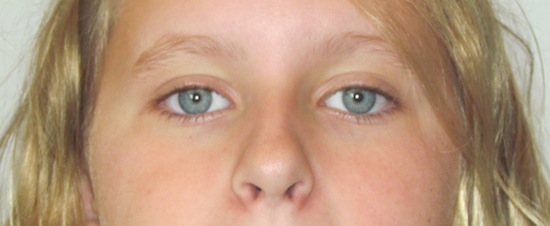
Interestingly, my daughter often makes eye contact, though I do not for a moment believe this has anything to do with me or anything I did or didn’t do one way or the other.  In fact my daughter wrote she likes looking at people’s eyes.  So much so that we have agreed to work on a project based on this together.  But for all who do not, who are overwhelmed, who feel physically ill or in pain, why would we demand this of them?

Eye Contact

“Both Sides of the Table”

I’m reading a really wonderful book right now.  Both Sides of the Table Autoethnographies of Educators Learning and Teaching With [Dis]ability Edited by Phil Smith.  My friend Ib wrote a chapter for this fabulous book.  Her chapter is called, Autistethnography.  In her chapter she writes about the mesmerizing beauty of a dodecahedron and provides the following link – http://beachpackagingdesign.typepad.com/photos/uncategorized/2008/04/30/dodecahedron.jpg .   Ibby writes, “…. if you memorize it well enough to be able to spin it around in your head while changing its colors, enable you to loiter for ages with the greatest of ease, astonishing onlookers with your ability to do what they mistakenly believe is nothing whatsoever.

Oh how I love that and if you’re like me, you will read that sentence many times, considering its implications and its layered meaning.  That sentence, if a sentence could be a dodecahedron, then it certainly is.  I have spent the last five minutes carefully spinning those words around in my head while staring out the window of my studio at the snarled traffic creeping along the 59th Street bridge.  What a wonderful sentence.  What a wonderful way to think about something.  And it is so perfectly Ibby-ish in all it’s spectacular-ness.  My daughter understood this instantly after meeting Ibby for the first time and began to refer to her cheerfully as, “Ibby from Ibbia!”  Do not mistake this as a demonstration of othering; it most certainly is not.  In fact, it is the opposite.  That she understood so instantly and on a whole other level is something I envy.

Both Sides of the Table isn’t an autism only book.  It’s a book about identity, relationships, society, politics, research and self-discovery.  It’s about the stories we create so we might learn about and from one another and how we affect each other through our experiences of the world.  Don’t be put off by the title.  Autoethnography is really another word for memoir, but the best kind of memoir.  Memoir as a tool for investigation and a search for larger meaning.  To me, anyway, those are always the very best memoirs, the ones where we not only identify, but where we learn something about the other person and in so doing, ourselves.

So I’ve been thinking a great deal about stories.  Stories as research, stories of lives that overlap and how we affect one another.  Deodatta Shenai Khatkhate left a great comment on yesterday’s post, he wrote, “There is a thought process that we ought to use our Words with caution, for they become our Actions; then our Actions become our Habits; and our Habits become our Character; and ultimately our Character becomes our Destiny. Thus the creator of one’s Words is always the master of one’s Destiny.”  He attributed this idea to Ghandi and Margaret Thatcher;  I’ve also read something similar from Lao Tse.  In any case, it is wonderful and reminded me of this idea of autoethnography.  The layering of experience, meaning, the overlap and the way we are intertwined with each other’s lives as they unfold, affecting change, shifting research, becoming research, becoming change.

Dodecahedrons

FCX0LIXGXDWPLQJ-1.LARGE


The Problem with “Use Your Words”

How many of us have uttered those three words to our kids?

Use your words!

And yet, if your child is like mine, they probably do use words.  Perhaps they “script”, words we dismiss because we recognize them from a movie, or perhaps we hear the tone and recognize it as echolalia and therefore  ignore.  Maybe we think of the words as a verbal stim or maybe we hear that those words come from a teacher, the bus driver, another kid, a friend, us…  and again we dismiss them as meaningless.  But what if we are wrong?  What if all those words our kids are nobly attempting to use ARE communicating something, but it is US who cannot make the connection?  What if our kids do not learn language as we think of language being learned, but they are learning it, in their own way, on their own timeline?  What if all those words they keep using, the ones we are told to ignore or not reinforce by acknowledging, are HOW they are learning to speak?

I am currently reading Marge Blanc’s book, Natural Language Acquisition on the Autism Spectrum: The Journey from Echolalia to Self-Generated Language
and these are but a few of the questions being answered.  One thing I have not yet seen or can find in this terrific book is any mention of Tourette’s.  I am curious to know the authors opinion on how Tourette’s factors into language acquisition or if it even does.  Marge, if you’re reading this, I’m hoping you’ll comment!

In those early, blurred years after Emma’s diagnosis I remember thinking that any language was good language.  And then my daughter began to say things, things I could not and did not understand and I was told, those are meaningless words, you must ignore them, you must not reinforce them.  But maybe, just maybe those words are the foundation for others that I and others will be able to understand at some point.  My friend Ibby, of the fabulous blog, Tiny Grace Notes, told me more than a year ago about the importance of not trying to do a word for word translation of the things my daughter said, but rather to lean into the words.  I couldn’t fully understand what she was telling me at the time, but slowly I have begun to.

Marge Blanc writes, “As we valiantly try to replace our kids’ echolalia, their natural language, we feel validated when they learn to say new things.  We teach our kids a dozen functional phrases and sentences and feel satisfied that we have taught “functional speech.”  The tragedy is that while IEP goals are met, children’s linguistic potential has been ignored – and undermined.  We have forgotten how to assess a child’s developmental language level and his capacity to develop generative language.  And we have also failed to consider that the functional phrases we’ve taught might actually interfere with his potential to develop language competence.  And in the process, the echolalia doesn’t go away.”

Now add to this idea the way we are taught to ignore those scripts, that we mustn’t give them any air to breathe as we will only encourage the proliferation of similar non “language.”  So we smile patiently and nod our heads and say…

Use your words.

But not those words.  Use these words.  The words I want to hear.  The words I am now going to repeat and have you say over and over with the hope that you will say these words, my words, in place of yours.  Isn’t that really what we mean when we say “use your words”?  Use words I want to hear.  Use words I give you, but don’t, please don’t use YOUR words.

Over a year ago I wrote about how Emma advocated for herself on the school bus.  You can read that post ‘here‘.  What I didn’t spend a great deal of time talking about was how she tried, repeatedly to “use her words” but was not listened to because they did not believe she understood what she was saying.  It was only after many attempts of using the only words she knew, “you’re going the wrong way!”  “Emma goes to a different school!”  and “you have to go this way!” that she began to scream and then bite herself and eventually punch herself in the face.  Even then, when she fell to the floor of the bus, refusing to get off, crying and hurting herself, even then they continued to not listen to the words she was saying and using and insisted she get off the bus.  It was only when one of the staff at her old school heard her and recognized her and thought to tell the driver that yes, she was correct and no longer went to this school, that she was on the wrong bus, it was only then that they dialed my number and told me my daughter was refusing to go to school, and as it turns out, rightfully so.  They had taken her to the wrong school.

When they brought her home she was devastated.  I will never forget the look on her face as she descended the steps of that bus.  Before her feet hit the ground I said, “You are so awesome Emma!  You told them this wasn’t your bus.   You told them they were going the wrong way!  I am so proud of you!”  Emma still talks about that morning, that morning over a year ago when she was “using her words” and no one listened.

Use your words.

Waiting for the school bus ~ October 2, 2013
*Em copy

Changing Our Thinking

I asked Emma for her permission to talk about language retrieval issues, and specifically to describe some of what occurred during her first session with Soma last week.  She said it was okay for me to do so.  I’m incredibly grateful to my daughter for being so generous with what is personal information.  She has given me her permission, but to leave it at that, would be wrong.  To not acknowledge what this means would be negligent at best.  She is unbelievably generous to allow me to share these things.  I do not know how many of us would be willing for another to share such personal things about ourselves, and the trust she has bestowed upon me, the trust that I will not betray her…  it is something I not only take very seriously, but need to acknowledge.  To say I am grateful does not come close to describing the feelings of appreciation and awe my daughter inspires.  If all human beings could take a page from Emma, both in her cheerful generosity in giving of herself so that others might benefit and her compassion and willingness to see the best in people, even when so many have said and done cruel things to her, this world would be a far better place for all of us.

I wrote about Emma’s first session with Soma ‘here‘.  What I didn’t write about was how after Emma pointed to a letter she was encouraged to say the name of the letter, just as her Proloquo2Go program does on her iPad.  She was able to do so without hesitation.  But when Soma put the stencil board down and asked Emma to say the next letter of the word she was writing, without pointing to it first, Emma would, more often than not, say a random letter.  Soma then picked up the stencil board and again without hesitation, Emma pointed to the correct letter and was able to identify it correctly out loud.  After Emma wrote a sentence she was invited to read the sentence aloud, but could not do so.  This is a sentence she’d just written, one letter at a time.  A sentence she’d created, yet was not able to read.  It is not then surprising that Emma is unable to read a random story out loud, even though she is perfectly capable of reading it silently to herself and fully comprehending it.  See related post about reading aloud, ‘here‘.

To see this broken down, to witness this at the level of single letter retrieval and not a whole word even, made it all even clearer to me.   Which isn’t to say that Emma will never be able to do this.  Perhaps at another point, perhaps once she is proficient in writing her thoughts and identifying a letter after pointing to it, one letter at a time, she will then be able to work slowly, patiently and without the anxiety of feeling expectations are being placed on her, perhaps then she will be able to come up with the next letter before she points to it and from there the next word and on it goes until verbal language can catch up to her written.  But for now, it is imperative that every single person who comes into contact with my daughter understand how detrimental it is for her to have these expectations placed on her and then to have the inevitable conclusions drawn about her comprehension and ability.

My daughter is nothing short of brilliant.  I am not saying this as a biased mother who is basing her thoughts on nothing more than some sort of convoluted tip of the hat to genetics, or a round about way of bolstering my own ego and intellect.  I am saying this because I have seen the evidence.  Since her diagnosis, Emma has been treated as though she were intellectually impaired when, in fact, she is intellectually gifted.  This is, I’m sorry to say, something I am hearing from others.  We have a growing population of children and people who are treated as though they are incapable, when in countless cases the opposite is true.  The onus is on us to change our current teaching methods and the therapies we are employing and to open our minds to the idea that we have gone about this all wrong.  This is what must change.

Soma & Em copy