Monthly Archives: January 2013

Confessions From a Literal Mind

My husband is funny.  Just had to say that.  He’s a funny guy and sometimes he’s funny without meaning to be, which throws him out of funny territory and plops him directly into the hilarious camp.  Some people are like that.  Thankfully, my two kids are also funny/hilarious so there’s a great deal of laughter in our home.  Until my husband or son tells a joke.  Me and Em don’t do the joke thing, mostly because Em is more into making faces and physical comedy and I don’t “get” most jokes (I’m told this is because I tend toward literal-mindedness) and even when I do, I usually do not think they’re funny, which makes others insist that I haven’t “gotten” the joke, because, the thinking goes, if I did, I’d laugh with everyone else.  I disagree and maintain that it’s a bad joke, but this argument never goes over well, particularly to the joke teller, who’s convinced the joke they’re telling is, by the very fact that they’re telling it, hilarious.  Even if it isn’t. And it isn’t.  Trust me.

Case in point, and this is one of Richard’s favorite jokes, whenever we travel.

Random person:  “How are you?”

Richard:  “We just flew in from New York…” Beat “and boy are my arms tired.”

Me:  expressionless face.  

Richard:  Looks over at me, sees expressionless face and says, “Ba-doom, boom!”

Random person:  Doubled over with laughter, “Oh boy I haven’t heard that one in a while.”

Me:  Look of confusion.  “Wait, what?”  Watches laughing husband and random person.  “What’s the punch line?”

Random person and husband:  As though choreographed, swivel their heads to face me, look at each other, then burst into peels of renewed laughter.

Me:  View of my back as I walk away…  Sometimes I’ll shake my head in an exaggerated display of my (feigned) contempt.

So I have a confession, because… well why not confess these things (?) I’ve nothing to hide…  I do “get” the joke, intellectually, I understand the play on words, I just don’t feel anything remotely like laughter surging through my body because of those words and truthfully, that joke, in my opinion, as well as most others like it are “made” funny with a straight man.  So I, being the thoughtful and generous soul that I am, feel obligated to provide this.

You’re welcome.  *Big grin*

Signed:  “Straight man” aka Ariane

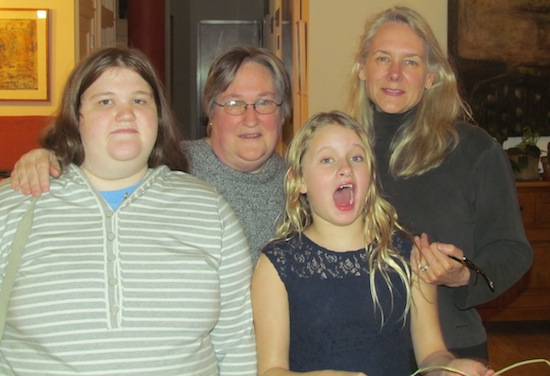
Laura B., Barb P., Emma (ever the performer) and Me (trying hard to keep a straight face)
2GroupShot

Living in the Grey

No, this post has nothing to do with porn, soft, hard or anything in between.  In fact, this post is not about sex at all.   There will not be any numbers or shades or subtle, implied meanings of anything remotely titillating.  For those who were hoping otherwise, best to move along…

However, I do have a confession to make.  I tend toward extreme thinking.  An example, if someone cuts me off while I’m waiting for the subway, grabbing the one remaining, unoccupied seat, forcing me to stand, I can get into some pretty abysmal thinking.  I am likely to assume the day is cursed, as I engage in heinous thinking about the person who “stole” MY seat, to apocalyptic views about the nature of human beings.  I know this about myself.  I know I have a difficult time living in the soft, greyness of life, while rejecting the glaring, yet far more exciting black and white tragedy or ecstasy of my circumstances.

For years I felt mildly victimized by Em’s diagnosis.  I felt no one really understood or could possibly understand and any who suggested otherwise offended me.  Then I found Autistic adults who were not living the tragedy I had assumed was my daughter’s inevitable future.  In fact, these adults were interesting, smart, some spoke, some did not, others spoke on occasion, some communicated through typing, others communicated through typing with a facilitator, some had careers, others didn’t, some were in relationships, others weren’t, some had children, others did not.  Some have become friends, one in particular has become a close friend, someone I seek out, think about, want to spend time with, look forward to talking to and miss when our schedules do not allow us to connect.  In knowing her I’ve been able to dispense with the “victimized” mindset.  She’s helped me enormously, not just in giving me a better, more tempered view of autism and breaking down some of the more harmful stereotypes and beliefs I once held about autism and Autistic people, but in what it means to be human.

I have gone from feeling a low-grade sense of sorrow for my circumstances to feeling fortunate and grateful for my life and family.  I don’t mean that everything is perfection and that we never encounter moments of sadness or unhappiness, I just mean that I no longer pin my dark moods and feelings on “autism”.  In fact, I feel ridiculously fortunate.  I have met more fascinating people in the past year than I ever imagined possible.  I no longer wonder what life would be like had I not had an autistic child.  I am grateful for the life I have.  I am grateful for both my children and I’m grateful for my friendships.  I find I am living more and more often in that comfortable grey area of non-extremes.  (Please feel free to remind me of this post when I write something less “evolved”.)

And that woman on the subway, who for the past four years has shot in front of me to grab the only remaining unoccupied seat on more mornings than I can count?  I wish her well.  I even gave up my seat, so she could sit this morning AND I didn’t feel smug or resentful; I just kept reading my email.  Who knows?  Tomorrow I may even muster up the courage to smile at her.  Because you know what?  Life is just too damn short.  Besides I’m growing fond of the grey.

Christmas Eve Dinner – 2012

“I might be you.”

I might be you. the terrific new book written by Barb Rentenbach and Lois Prislovsky, Ph.D awaited my arrival from our holiday travels.  I am only on page 51, but wow(!) what a book!  Barb is Autistic.  She also happens to be non-speaking and needs support doing almost everything including communicating.  Barb uses facilitated communication to type.  In her own words she explains, “The deal is, I still can’t talk, but I can type on a keyboard or letter board if someone supports my wobbly hand.  The process is called facilitated communication, or “assisted typing.” It is quite controversial, meaning lots of people think it is not really me doing the typing.  This infuriates me…”

For those who are dubious about facilitated communication, Barb now types independently requiring just a hand placed gently on her back.  In October of last year I went to a presentation given by Barb and Lois.  It was riveting, mind-blowing and made me rethink everything I thought I knew, but realized I did not.  Barb wears thick glasses and uses an oversized keyboard to type.  She has a terrific sense of humor, is incredible honest on all topics including extremely personal ones;  this book is a joy to read.  She discusses self-injurious behavior, feces smearing, violent outbursts, which her school viewed as baffling and without provocation and yet in the telling, one realizes this was not the case.

Barb eloquently describes the brutality of other human beings who do nothing to temper their contempt for any who appear different.  Barb writes, “Let me be brutally honest.  Most of the blisteringly painful assaults and provocations happened at school – this school, by children who grew up to be you.”  Breathe.  Read that again.   “… Most of the blisteringly painful assaults and provocations happened at school – this school, by children who grew up to be you.”  “You.” Take a breath and let that in.  “Children who grew up to be you.”  

Confession:  I am in second grade.  There is a little girl named Louise who wants to be my friend.  She has warts covering her hand, the hand that she has extended to me, the hand she wants me to hold, only I will not.  I am the new kid.  I am well aware of the unspoken rules of the playground.  You do not hold Louise’s hand.  You do not allow yourself to be seen with Louise.  You distance yourself.  You play alone if need be.  To be seen with Louise is to be like Louise.  Flawed, with warts for all to see.  Instead I tell everyone I moved from a foreign land and spoke another language, a language only I and the village I have moved from speak.  I lie about my family, I lie and say we lived in a field with a house made of straw.  I told these lies because I thought they made me seem exotic and fascinating.  I lied because, already at the age of seven I believed I was less than, not good enough, destined to be like Louise, with my hand outstretched to others, only to be rejected time and time again.

Barb writes about how she is unable to eat without making a mess, as hard as she tries, her hands do not do as her mind bids them.  At lunch a student reports her messy attempts to eat her sandwich and is told by a teacher that she will have to eat somewhere else, away from the others as she is, “making the other children sick.”  This book (and again I am only on page 51) made me stop and reflect on my own behavior.  Am I really as empathic, compassionate and wonderfully kind as I would have everyone believe?  Do I make assumptions?  Do I hold beliefs about others because of the way they appear?  What are my hidden prejudices?  Am I able to admit to them?   Who among us can say without hesitation that were our bodies not able to respond in the way our brain and intellect would have us, were we ridiculed and shunned as a result of that disconnect, that we would maintain our composure, would not act out in protest?

“Am I so different from any of you?” Barb asks.

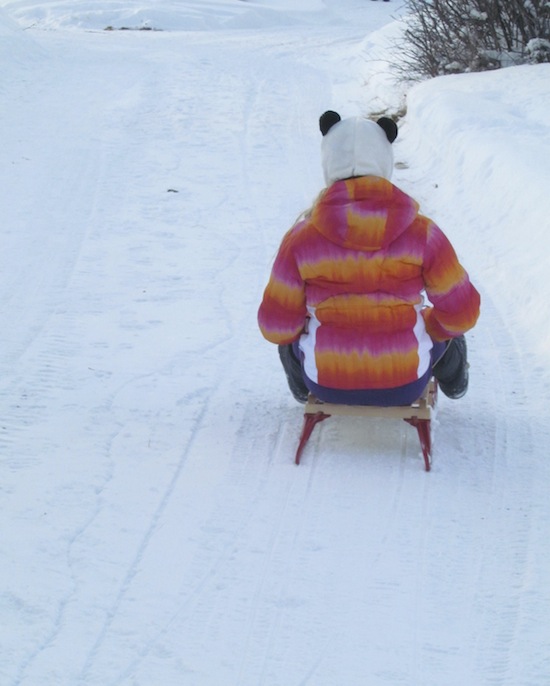
Em sledding

Impatience and Expectations

I’m impatient.  I know this about myself.  Impatience serves me to do a great many things.  It propels me to take action rather than not.  It makes me push harder, try harder.  My impatience, which usually begins with tremendous optimism can descend rapidly into disappointment and discouragement.  Fortunately I am also fiercely determined and dogged in my reluctance to give up which helps mitigate some of my impatience or maybe it just makes me confused. 😕

However, there are a great many things that are not helped by impatience, things like learning a language, learning to type or learning almost any new skill.  These are things that take time, practice and patience.  So I have to recognize this and continue despite my impatience.  This comes up over and over as I work with my daughter.  But in working with her, I’ve also come to recognize something else and that is my expectations.  Huge expectations, coupled with impatience can do harm.  I see that.  I’ve been very aware of how it affects me, but how does it affect Em?

I am learning how to support Em in her communication.  For example we will read a story together, such as a book Emma chose recently entitled, Who Pooped in the Park?  The story details a family outing where the two kids are upset when they don’t see a great many wild animals on their hike, but learn to identify what animals live in the area by the markings they leave.  During our session together I asked Em, “What were some of the animals the family identified?  One animal starts with the letter b.”  Emma then typed, “There was a bear and ciyoty and a deer.”   Other than misspelling coyote, this was a terrific answer and correct.  We went on to discuss another name for animal poop, which is scat and that all living things produce “waste” of some kind.  After our session was over, Richard asked, “So how did it go?”

“It was fine,” I answered.

“It sounded great!” Richard said with enthusiasm.

“Yeah, I guess,” I replied.  And then I had a tiny flicker of realization.  I was feeling disappointed in our session.  I was hoping for some brilliant, philosophical insight.  I was hoping that we would have a conversation that blew my mind and when I realized that, I also realized that my desire, my expectations, my impatience had caused me to not fully take in how terrific our session had been.  It also made me see how my response may have felt to Emma.  Here she was working hard, doing something that does not come easily and doing it really, really well, yet I had not responded with the kind of unbridled enthusiasm I would have hoped for had our roles been reversed.

During our next session we talked about her birthday, which she is very excited about, and the party and various events we’ve planned for her.  I tried hard to be aware of my response to what she was typing.  I became increasingly aware of my expectations as they arose and did my best to silently acknowledge them before responding with genuine enthusiasm and appreciation for Em’s work.  As a result our session was more fun for both of us.  Later when I spoke to a friend about all of this he pointed out that most communication is not wildly brilliant, philosophical or even necessarily enlightening.  And of course, he’s right.  The majority of our communication with one another is about pretty basic stuff.  Learning how to communicate basic things is relevant and important.  But my impatience and expectations make me forget that.

I have learned over the years that if I want to change a behavior I need to have awareness that I’m doing whatever it is, I then need to have some degree of acceptance that I’m doing it before I can begin to make little changes to it.  Those little changes repeated and added up can, over time, create bigger changes.  Admitting aloud I am doing whatever it is can be very helpful as well.  Without taking these steps however, I have no hope of changing the way I do something.

There’s a great deal of talk about autism and how our children and autistic adults need to work on a whole range of things, but there isn’t a great deal of conversation in the general population about our own neurological deficiencies.  It seems to me that if we are going to continue to have this ongoing discussion of deficits, it’s only fair that we begin to detail our own as well.  Now that’s a conversation I look forward to having.  And while we’re at it, let’s include the positive aspects of Autistic neurology as well, because a little balance is a good thing!

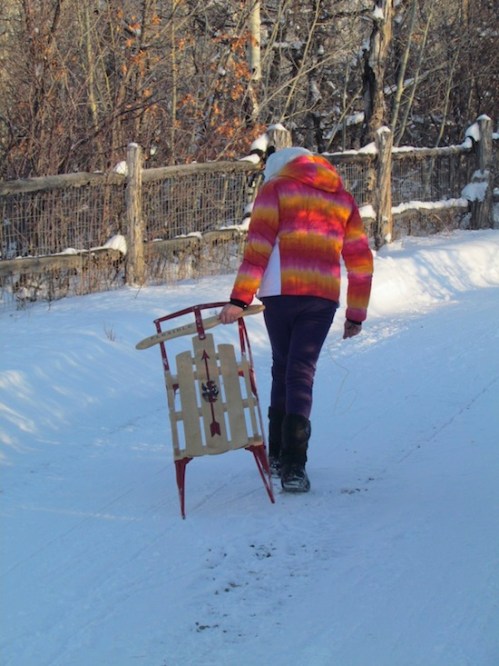
Sled