Tag Archives: Speech

Emma and her Singing

“Sing Zoo Zoo Zoo with your mouth closed?”  Emma said this morning as she was getting ready for school.

“Good idea!” I said.  And then began to sing one of her favorite songs with my mouth closed.

She waited patiently until I had finished the first refrain and then said, “Emma’s turn!”

I knew, before I began singing that she meant she wanted to sing the song with her mouth closed, but since repeatedly correcting her over the years hasn’t made a dent in her continued use of “you” in place of “I” or “me,” I have begun taking her words more literally and seeing how that works.  Other than mildly irritating her, I’m not sure it’s making much of a difference.  The elusive pronoun continues to trip her up.

In addition there are words which she finds impossible to articulate.  A few of them can be found in another of her favorite songs – “Fabulous”.  Emma says – Sandy lot – or something that sounds suspiciously like that, in place of Fabulous as well as humming the word “imported” which is used repeatedly in the song, instead of making an attempt to say some version of the word.

Yesterday I tried more than a few times to have her repeat my enunciation of “imported” first by singing the lyrics “towels imported from Turkey, Turkey imported from Maine…” but when that didn’t help I tried to have her say “imported” all by itself.  I could see how hard she was trying, she watched my mouth as I said the word, she tried her best to mimic me, all to no avail and eventually wandered off into our bedroom where I could hear her singing loudly her own special version of the song, the tune utterly recognizable even as the words were not.

Richard found the lyrics of the song online and printed out several copies so each of us could review and sing along with her when she launched into yet another rousing rendition of it, which happens more than a few times over the course of a day.  Emma articulates a few lines of the song beautifully – “I want MORE!” and”Excuse Me Thank You” then lapses into her “Emmalish” – impossible for anyone to decipher.  Sometimes Emma will allow all of us to join her in singing, but often, particularly when it is her brother, Nic who is singing along she will stop abruptly and yell, “Nicky L. stop singing!”  or “Nic!  Stop talking!”

To which we respond, “No Emma.  Nic can sing too if he wants.”

“Forget it, it’s no fun now,” Nic will say as we wait for him to continue.  “She ruined it.”

Or if Nic does have the fortitude to continue, Emma will stand silently for a moment before seeking refuge in her bedroom and shutting the door.  It seemed as though it was as much a gesture of contempt for the whole unruly scene as a desire to escape the singing.  Nic usually shrugs and returns to whatever it was he was doing before the whole thing began.

I cannot hold a tune.  This is a fact I came to terms with early on in junior high school when I was contently singing along to “Angie” by the Rolling Stones and was ridiculed for my off key trilling.  My ego bruised, I was careful to hum or sing quietly under my breath or in the privacy of my own room.  Something I have continued to do ever since.  Emma however, did not inherit my tin ear.  Hers is the voice of an angel or Broadway singer, (depending on the song) as she belts out songs in decibels I didn’t know were possible.

The other week when we gathered to sing Happy Birthday, the one song anyone can sing off key with abandon, with no fear of ridicule, Emma out sang all of us put together.

“She’s  got a set of pipes on her,” Richard said, proudly when the song had come to it’s end.

“Yup.  She sure does,” we agreed.
“No Braid!”

Combing through the tangled knot that was Emma’s hair this morning, she cried, “I don’t like hurt.  Ouch, use brush.”  She grabbed the brush next to her and began brushing her hair.  Only Emma’s “brushing” her own hair consists of placing the brush arbitrarily on some portion of her head and pulling down, which is fine if her hair isn’t tangled.  If her hair is tangled, as it was this morning, Emma’s attempts to brush it, only serves to make it more so.

“Okay, Em.  I’m sorry, I didn’t mean to hurt you,” I said, plying the brush from her.

“It doesn’t hurt,” Emma responded.  Which meant it did hurt.

“Here, I’ll use the brush, see?” I said, being careful to not pull on her hair.  How about I make a braid today?”

“NO!  No braid.  Ponytail!”  Emma cried grabbing the brush again.

“Okay.  How about I make pigtails?” I asked.

“Yes.  Pigtails!” Emma said.  She made her hand into a fist and put each fist on either side of her head, indicating where she wanted the pigtails.

“Perfect.  I’ll do that,” I promised.  After I put the pink frilly hair ties in place I said, “Let me see!”

Emma turned toward me and tossed her head from side to side making her hair whip around.  With a huge grin, she shouted,  “Pigtails!”

“Oh Emma you look great.  I love those pigtails.”

“You’re so pretty!” Emma said jumping up and down.

“Yes you are.  Now let’s go brush your teeth.”

When we went into the bathroom, Emma looked at her reflection in the mirror.  “Look at you!” she squealed, grinning at herself.  “You’re so cute!”

As we left to catch her school bus, Emma carefully put her hat on over her pigtails, only the pigtails were so high on her head it made her look as though she had little horns.  I smiled at her as we got into the elevator.

Emma jumped up and down and waved her arms while making a kind of whooping noise, something she does when she’s excited.

“Are you happy?” I asked, smiling at her.

“Are you happy?”  Emma repeated.   After a pause, Emma shouted, “YES!”

“Why?”

Answering “why” questions is usually quite difficult if not impossible for many autistic children.  Emma is no exception.  Usually a conversation, which starts with “Why?” ends as abruptly as it began.

“Hey Em, why do you want to do that?”  “Why do you want to go there?”  “Why are you screaming?” “Why are you sad?” “Why are you hitting yourself?” etc.

99.9% of the time when asked “why?” Emma will either – walk away, not answer or will answer by repeating the question.

“Why?” Emma will respond in a high-pitched voice edged with anxiety.  “Why you hitting,” or “Why want to?”

Repeating the question does not produce positive results.  Repeating the question in a louder voice also does not make a difference.  After all there is nothing wrong with Emma’s hearing.  She hears the question she just has a difficult time responding.  So it was noteworthy when Emma responded to a “why” question the other day.

Emma wanted to have a pair of scissors so as to cut the gym mat we had tied around a standing beam for Nic to use when practicing his karate punches and kicks.

“Emma why do you want to take it down?” Richard asked.

“Because I want to jump into the swimming pool,” came Emma’s surprising response.

Now many of you reading this may be confused by her words, but to us, who understood she meant she wanted to turn the multi-colored gym mat on it’s other side, which happens to be all blue, and pretend it’s a swimming pool, we were in shock that she answered a “why” question and answered it so beautifully with a clear, concise, complete sentence.

When Richard told me I couldn’t believe it.  “Really?” I said, barely able to contain my excitement.  “Really?  She said because?”

Richard nodded his head.

“But that’s amazing!”

“Yup,” Richard said.

So Richard cut the mat down, told her to put on her swimsuit and let her “dive” into the “swimming pool”.

Ah life at the Zurcher-Long’s… it just never gets boring around here.

Thanksgiving With Emma

Yesterday we hosted Thanksgiving at our place.  It makes it easier for us in many ways to be home, as I love to cook and Emma can race around on her scooter while the rest of us enjoy each other’s company and later sit down to a thanksgiving feast.  Whenever we have a large celebratory gathering at our house, I put out a place setting for Emma, even though we know she won’t sit and eat any of the food I’ve prepared.  As I set the table yesterday afternoon, I allowed myself to imagine for a minute what it would be like to have all of us gathered for a meal, something I looked forward to with almost frenzied excitement as a child.  Not so with Emma.  Unless birthday cake is being served and then only if it’s vanilla cake with vanilla frosting, Emma can be counted on to forgo the meal.  Since she also cannot communicate in any substantial way, there is absolutely no allure for her to sit with us and we’ve given up insisting that she try.

So it was yesterday as our guests began to arrive, Emma in her “pretty dress” which actually was a taffeta skirt with tulle and a black turtleneck.  Emma insisted on yanking the skirt down around her hips so the gap between where the turtleneck ended and the waistband of the skirt began was substantial, giving the whole ensemble a kind of weird, grungy chic.  She shot around the living room on her scooter, while Nic joined us for conversation and hors d’oeuvres.

“Edie bring Toni books?” Emma asked as I was pulling the turkey out of the oven, checking on the nearly burned roasted vegetables and wondering whether I had ruined the meal, while the mashed potatoes warmed in the oven and the brussel sprouts were being sauted on the stove.

“What?” I asked.

“Edie bring Toni books?” Emma repeated.

“Who’s Edie?” one of our guests inquired.

“He delivers UPS packages.”

“Edie come?” Emma asked.

“Yes, Em, let’s order some books tomorrow and Edie can deliver them.  But you have to tell me what books you want,” I said.

“Edie come?  Edie bring Toni books?”

It’s not clear why Emma has equated my sister or someone else with the name Toni, with getting books.  The last book Edie delivered for Emma was a book we couldn’t find at Barnes & Noble, so ordered online a few months ago.   Ever since, but recently with increasing excitement Emma has been requesting that Edie deliver books to her.  We have asked her numerous times to specify what book she is hoping to receive, with little success.

Eventually Emma gave up and contented herself with listening to music on her ipod only reappearing at the end of the meal.  “Dinner is all done,” Emma announced.

We had retired to the living room so no one was offended and thankfully she did not start bringing people their coats.  “Yes, Em.  That’s right.  Dinner is over now,” I said.

“Emma blow out the candles?”  Emma said as she leaned over the dining room table and blew a candle out.

“Yes, Em.  Go ahead.”  After which, Emma could be heard singing loudly to various music videos in her bedroom.

“Wow!  She really has a great sense of rhythm,” one of our guests noted.

This morning I went online with Emma and she chose several books, which I ordered and expect will be delivered in another week or so.  “Edie bring Emma books?”  Emma said when we finished the checkout process.

“Yes!” I said.  “You should get them in another week.”

“Next week,” Emma said, nodding her head.

“Yes.”

“Go to gymnastics?”  Emma said.

The School Bus

We received a call yesterday from Emma’s school saying the bus driver had yelled at Emma in front of the other children when she was getting off the bus. The driver claimed Emma had spit in her face. Richard and I were incredulous as neither of us have ever seen Emma spit nor did I think Emma was physically capable of projecting a pool of saliva from her mouth at a target, human or otherwise.
When we asked Emma what happened on the bus, she replied, “Emma so sad. You make Emma cry. Emma want to get off the bus.”
“Why did you want to get off the bus, Em?”
“Lady. You have to ask the lady. Lady, can I get off the bus?” Emma said while wrapping a strand of hair around and around her finger.
“What did the lady say?”
“NO! Emma sad.”
“But Em, what happened?”
“Emma go to gymnastics?” She looked at me and nodded her head.
“Yes, Sweetie. You’re going to gymnastics this afternoon,” I said.
By the time the bus arrived, Richard and I were no clearer on the actual events than before. As with many autistic children, their (in)ability to speak is much more than a language delay. The language they have is often garbled, confused and the thinking difficult, if impossible to follow. Emma’s reference to gymnastics in answer to my request for clarification as to the events on the bus suggested she feared she wouldn’t be able to go to gymnastics as a result. She had done something wrong, someone was angry, her beloved gymnastics would be taken away. Even after I reassured her she would be attending gymnastics, she continued to ask several more times.
Last night Emma woke me at 1:47AM screaming, “Mommy! Mommy! Mommy come!”
When I went into her room I told her if she continued to scream we would not let her go to gymnastics, something she’s been looking forward to for several days. It does make sense how she might conclude gymnastics was up for grabs, given the upset on the bus.
When the bus arrived we asked what happened.
The driver leaned forward and said, “She spit in my face. I told her that wasn’t okay.”
“She spit in your face?” I repeated.
“Yeah. In my face. She sits there spitting on the floor and then blames another kid, but it’s not him that’s doing it, it’s her. She’s the one who’s spitting,” the driver said.
“It’s hard for us to believe this, as we’ve never seen her spit at anyone,” Richard replied.
“Yeah, well I think she picked it up from the other kid, cause he use to spit, but now she does more than him and blames him.”
“Okay. Then what happened?”
“I told her – it’s not okay. You can’t do that,” the driver said. “She went like this,” the driver took her hand put it to her mouth and flicked out with her fingers. “She spit at me and I told her you can’t do that.”
“Okay, do you mind if I get on the bus to talk to her?” I asked.
The bus driver nodded her head.
“Em, you can’t spit. Do you know what that means?” I asked.
Emma stared at me and said, “You have to ask Mommy.”
“No Em. You just can’t spit. You have to keep your fingers out of your mouth. You have to keep your gum in your mouth. Okay?”
“Okay,” Emma answered.
“She doesn’t listen,” the bus matron said.
“It’s not that she doesn’t listen, it’s that she doesn’t understand what’s being said to her,” I began.
“Yeah, but she doesn’t listen,” the matron said, shaking her head and staring at Emma who was now seated directly behind the driver with her seat belt buckled.
“She doesn’t understand what’s being said to her, it’s different than not listening,” I said.
“No I know. I understand these kid’s situation. I’ve been driving kids like this for a long time,” the driver said. The matron stood by shaking her head. As all of this was going on one of the children kept getting up from her seat and standing in the aisle.
“Logan! Sit back down!” the driver said, loudly.
“Logan! Sit down!” Emma parroted.
“She doesn’t understand why you’re angry with her. She doesn’t understand what it means to spit at someone,” I said. “Yelling at her won’t make her understand any better.”
“Oh no. I don’t yell. I never yelled at her,” the driver said. “I just told her like this,” she then spoke in a kind voice, “You can’t do that, it’s not okay.”
Richard and I looked at one another. “Okay, well please tell us if anything like this happens again.”
“She’ll have a new driver after the holiday,” the driver informed us. “But I know her, she’s a friend of mine, I’ll tell her what’s going on.”
By the time the bus left with Emma inside it, Richard and I stood together and watched it go. I felt a familiar constriction in my chest. How can we know what really happened? Our daughter is incapable of telling us her version of what occurred, the school wasn’t on the bus until after the “incident” happened, though they did witness the driver shouting at Emma. The accounts from the driver and the bus matron, who appear to have little if any knowledge of autism and certainly no training in autism, are all we have.

Milestones and Miracles

As we sat at the dinner table last night celebrating our dear friend Claudie’s birthday, I saw Emma ride up to Nic on her scooter and stand in front of him as he sat on the couch listening to music on his iPod.

“Hey Nic!” she said.

It was very unusual for Emma to go up to Nic and speak to him so directly so I nudged Ariane who was sitting next to me, and pointed in their direction.

“Hey Nic!” Emma repeated. “Will you come to mommy’s room with me and watch Elmo?”

We were absolutely floored. Ecstatic. Choking up with emotion. Not only was this one of the longest and most articulate sentences Emma has ever spoken, it was also directed at Nic, asking him to do something together with her.

For any parent of two normal children, this would be something you take totally for granted — something you would have witnessed twenty million times by the time your children were 10 and 8 years old. For us it was first, a true milestone, as significant as when Nic and Emma took their first steps or spoke their first words. More than that, it was something we had hoped and prayed would happen for such a very long time. Something we feared might never happen.

It was a miracle.

We looked at our guests with our mouths hanging open in shock and wonder, then began hugging and kissing each other in joy and gratitude. It was such a special moment, made even more special by the great good fortune of being able to share that wondrous milestone with such special friends. Claudie said it was the best birthday present she ever had. Elaine knew exactly what we were feeling and how significant it was, having experienced parental challenges so much more arduous and painful than anything we have weathered.

I went with Emma and Nic into our bedroom and helped her put the Elmo DVD on, then spied on them from around the corner, my ears perked up for any more dialog that might be forthcoming. They just sat together silently, watching Elmo, Nic barely able to tolerate it, but being such a great sport, Emma looking so happy in his company.

Eyes were teary as we put the candles on Claudie’s cake, then called for Nic and Emma to join us. Emma came running in like a freight train, since two of her favorite activities in the world are singing Happy Birthday and blowing out candles. True to form, Emma led the chorus, singing as loudly and cheerfully as always. When the song finished, Claudie started to blow out the candles but Emma leaned across the table and blew out most of them first.

“Emma, those are Claudie’s candles,” Ariane admonished, then asked Claudie if she wanted us to re-light them.

“No,” Claudie said, “I already made my wish.”

And we had one of ours granted.

Societal Subtleties

Emmy, I’m leaving.  Have a good day with Joe,” I said, as I was getting ready to go.  I went over to where Emma lay under the duvet in our bed with her earphones on listening to one of her favorite songs, The Beatles – Happy Birthday.  “I love you, Em.” I said as I bent down to kiss her.  She turned her head, as she almost always does, so that I kissed her forehead.

“So much,” Came Emma’s muffled answer.

“I love you so much,” I said, kissing her cheeks.  Emma said nothing in response.  I waited for a few seconds, “Em, you say – I love you Mommy.”

“I love you…” Emma looked at me as I pointed to myself.  “Emma,” she added smiling.

“Not Emma!” I said, kissing her again.  “I love…” I pointed to myself.

“Mommy!”  Emma finished.

“That’s right Em. I say – I love you Emma and you say – I love you Mommy!”

“I love you Mommy!” Emma echoed, before ducking her head down under the covers.

I went out to the living room.  “Bye Nic.  I love you.”

“I love you too, Mom,” Nic said without hesitation.

Just another morning in the Zurcher-Long household, such simple things we so easily take for granted, are stumbling blocks for Emma.  It’s not only pronouns that trip her up.  It’s the simple human niceties we do and say to one another that mystify her too.

After months of prompting, Emma now will say, “I’m fine” in answer to, “How are you?”  She understands the rote answer is what is expected and what will suffice.

“Most people really don’t want to know how you really are,” a friend of mine said to me once.  “They’re just asking because it’s expected and they don’t want to seem rude.  But can you imagine if you answered them honestly.  You know, by saying something like:  Not so well.  I’m struggling with some thorny issues I’d like your advice on.”

I interjected,  “Or – let’s sit down, this may take a few minutes.”

“Exactly, I mean that’s why everyone goes to a shrink,” my friend said matter-of-factly.

“But She Looks So Normal!”

Is what someone said to me the other day when I mentioned the reason Emma wasn’t responding immediately was because she’s autistic.  And when Emma finally did respond, it was with a reply which had no application to the question asked.

If we went on looks alone, we would all be in trouble.  However in Emma’s case it both serves her as well as complicates things.  People look at Emma and assume she’s “normal”.  They see an athletic, cheerful child.  It is difficult for people to believe she cannot communicate as other children her age do.

I have had the experience of being told on more occasions than I can count, “Oh my toddler does that too!”  or “She sounds just like my son!” and then they go on to tell me stories about their impish child’s antics which remind them of Emma.  Except that Emma is not an extremely tall two-year old who is acting out.  She is an autistic eight-year old who’s verbal skills continue to progress at a snail’s pace.  When people comment she is like a two-year old, they are right in some ways, but in most ways it is an incorrect assumption.  Emma is not “delayed”, she’s autistic and there is a vast difference between the two.

Explaining Emma to our son Nic, has forced me to become aware of just how complicated it is to describe her.  To say that she is doing something – biting herself, for example – as a way to get attention, would be incorrect.  Emma is not seeking attention.  I believe she is trying to gain control around a situation, which is uncontrollable.  The pain she causes herself is more tolerable than the pain she feels from a situation she has no power over.

When I look at her brain scans and see the lack of symmetry, the bright colors, which should be dark, like a strange Rorschach test gone wildly awry, I try to detect patterns.  I try to make sense of what I’m seeing, but cannot.

“Emma’s brain is not like ours,” I tell my son and myself in times of upset.  She does not think, feel, see or hear as we do.  She is decidedly “other”.

But how to explain this to the family on the airplane we recently took when asked if they wouldn’t mind sitting across the aisle from their grown children so that we might sit next to Emma?

When they refused, the father added, “I don’t see what the big deal is, you’re sitting near her, just the aisle’s between you.”

How does one then explain how agitated Emma will become?  How can one really make people understand, who have little or no contact with autistic children or if they have, one unlike Emma?  Of course Emma did become agitated and eventually we found two kind souls many rows back who were happy to take our seats so we could sit next to Emma, disaster narrowly averted.

“I can’t imagine what it must be like to parent an autistic child,” a friend of mine said a few weeks ago.

“I can’t imagine what it’s like to have two neuro-typical children,” I responded.  Afterwards, I thought about our conversation.  I really cannot imagine.  Emma informs every aspect of our lives.  When Emma says or does something new we record it.   Every milestone, each new word uttered is met with astonished elation.

I remember when Richard and I were planning our wedding.  A friend of Richard’s told us to take a few moments to absorb everything that was happening because it would go by so quickly.  We took his advice and to this day I can remember the beautiful floral wreath arrangements hanging from each lighting fixture, the candles casting their golden shadows across the room, Richard’s handsome face as I walked down the aisle toward him.  I remember because I stopped for a moment and took the time to take it all in.

Emma has provided us with something similar.  Her progress is so slow.  We celebrate each and every tiny step forward.  Of course we are also forced to spend much more time than we’d like, being present for the steps not taken, the fumbles, the excruciating process of growing up in a world where people do not understand, who judge Emma and us, assume she’s a “normal” child who is just being obstinate, difficult or “spoiled”.

The trick is to savor it all, I suppose.  A trick I continue to work on.

Emma’s Pal Muzzy and the Porkmepine

While Ariane was taking a break, I took Emma for a ride on the ‘four-wheeler’, a small ATV that’s good on the unpaved roads here and the big fields beyond. We like to go early in the morning and late in the afternoon after a long day of swimming, walking, bowling, bungee cord jumping — in other words, all things physical and fun.

On our 4-wheeling adventures, it’s not uncommon to spot a variety of wildlife; deer, foxes, a family of coyotes (with four baby cubs!) and unexpected surprises, like today’s sighting of a large, chubby porcupine who was wobbling around behind the barn. Like most of the animals here, he/she? was fairly inured to human contact, but when we approached within fifteen feet I cut the engine, to see if he might stick around long enough for a good visit.

“Look Emma, see that? That’s a porcupine!”

No response.

He started wobbling in the opposite direction, crawling beneath the barn, which I assumed was his new living quarters from the practiced ease with which he hid away. Before he vanished I pointed to him again and said, “Emma, can you say porcupine?”

“Morepickpine,” she said, or something to that effect.

“No Emma, PORC-U-PINE,” I slowly enunciated.

“Porkmepine,” she replied.

“No Emma, not porkmepine, porc-ya-pine!” I smiled, shaking my head, changing my pronunciation of the second syllable so she didn’t think I was somehow talking about her (“you”) when identifying the animal.

“Porkapine,” she said.

“That’s right Emma,” I said, starting up the engine.

It was pretty funny, a little frustrating and a little encouraging. Frustrating because she still has such a hard time making distinctions in simple labeling. Encouraging because she was at least grasping the distinction between the words “you” and “me” when it came to identifying herself. Most of the time, she still talks like Elmo when she speaks of herself.

“Emma go on four wheeler?”

Sometimes I’ll just nod and answer, “sure Emma, let’s go for a ride.” But it’s better if I remember to correct her and suggest a more appropriate response:

“Emma, you can say, ‘Daddy, I want to go on the four-wheeler.'”

She will usually echo that response and occasionally (very occasionally) remember to phrase a question correctly. She has the same trouble with “you, I, me, she, he.” So we will often correct her when she says “you” when she means “me”, or “he” when she’s talking about a girl, etc.

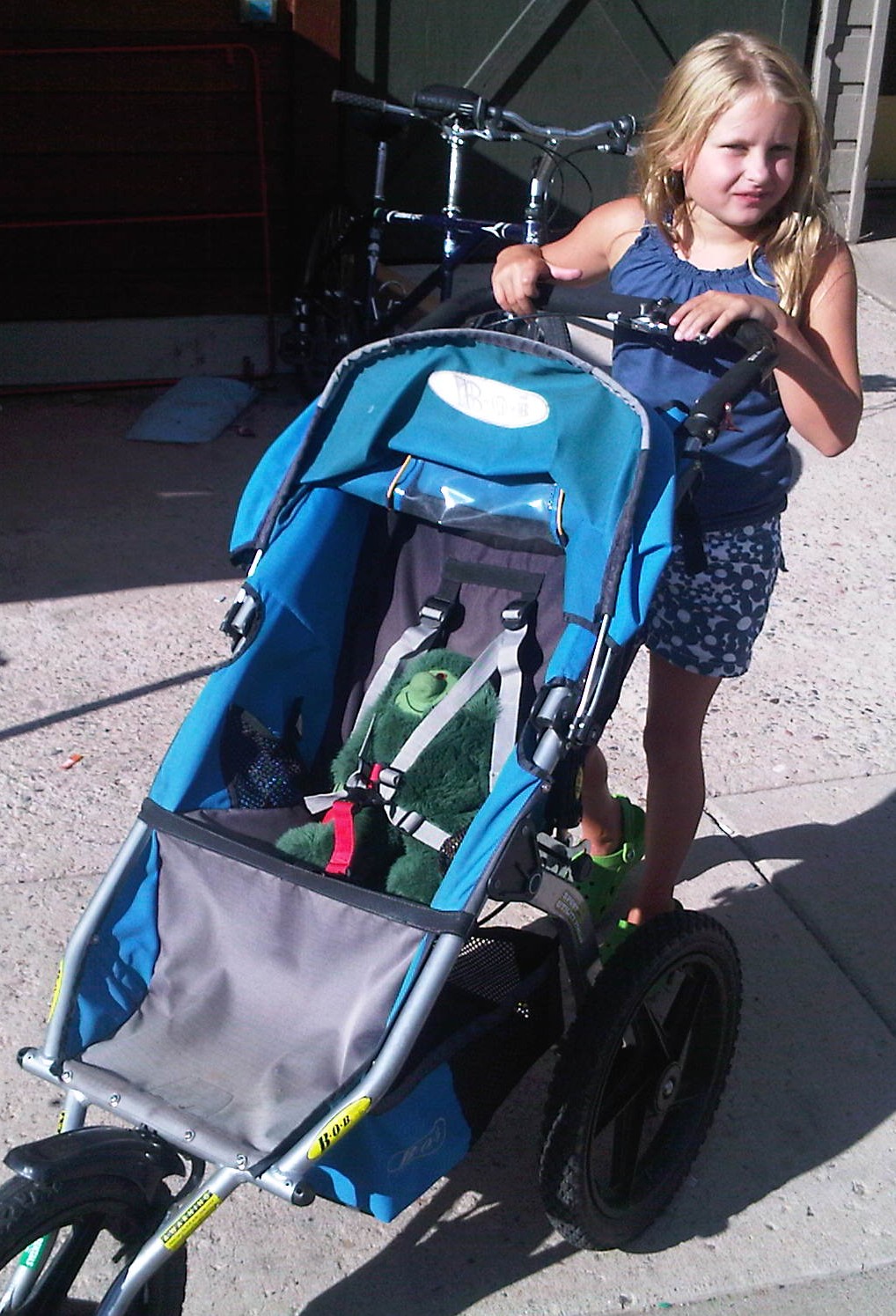
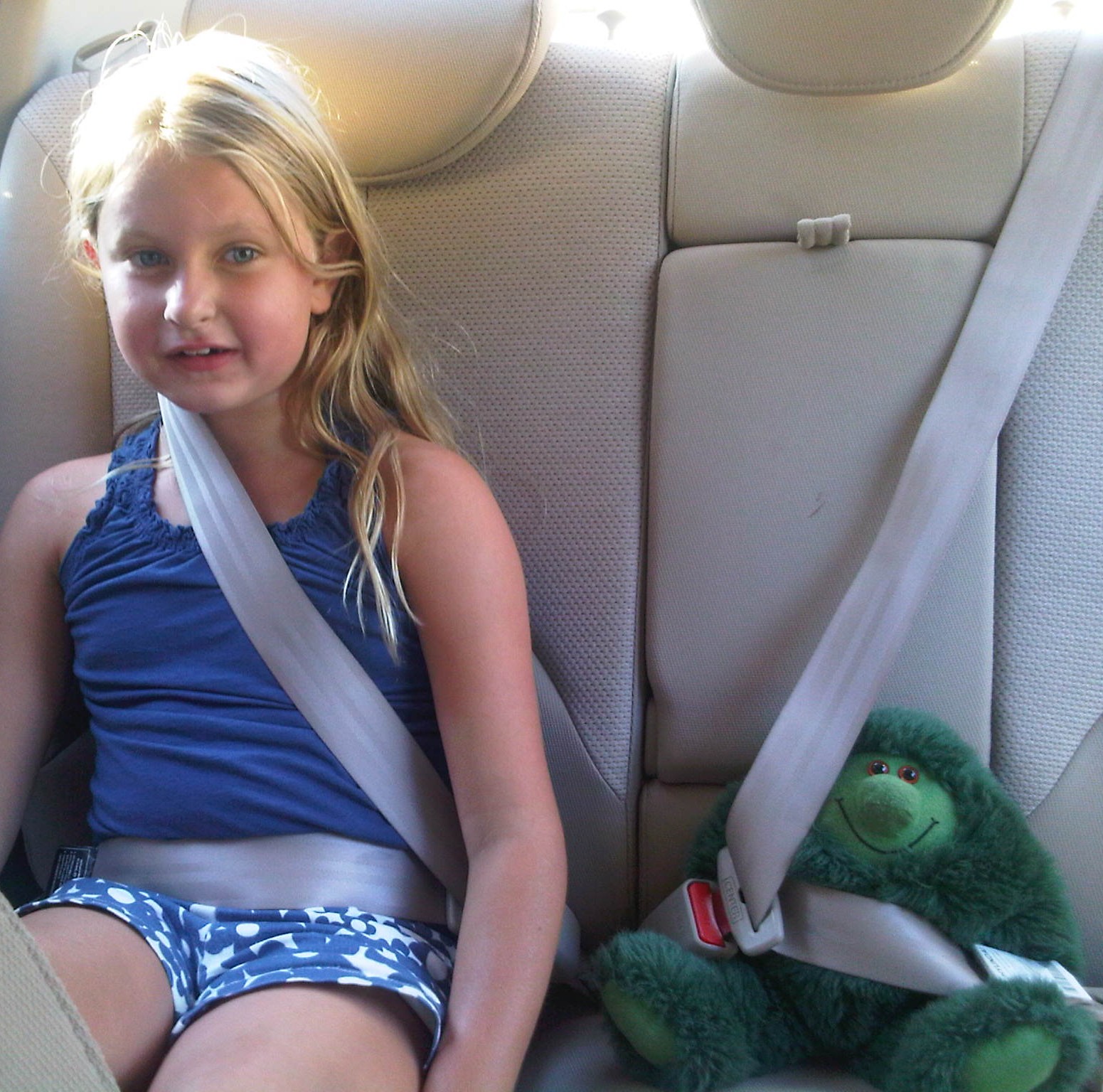
Later in the afternoon, Joe took her out to play. She insisted on bringing her stuffed animal Muzzy along. See the attached photos Joe took after Emma buckled Muzzy’s seat belt in the car and then strapped him into a jogger, pushing him down one of the local bike paths. This new affectionate attachment to her stuffed monster-animal pal is another very encouraging sign. Muzzy recently accompanied her in a hospital bed, and now that he seems to have fully recuperated, she’s taken him for an outing in the countryside.

Emma may not care much about prickly porkmepines, but she sure does love her fuzzy Muzzy. And that’s just fine with you.

The Washing Machine

“Should we put Emma in the washing machine?!” Emma asked, while pointing to the washing machine filled with clothing.  Then before I could answer, she shouted gleefully, “NO!!   We cannot put Emma in the washing machine!”  At which point Emma began to laugh hysterically.  “Should we put Mommy in the washing machine?” Emma asked, still laughing and pointing at me.

“Good idea, Em.  But will I fit?” I asked.

“NO!”  Emma shrieked with laughter.  “You cannot fit in the washing machine.  Mommy’s too big!”

“But maybe I could squeeze inside if I scrunched down into a teeny little ball,” I said, sucking my cheeks in and curling my arms up next to my sides.

“NO!”  Emma shouted.  “You cannot fit inside the washing machine.  Emma’s too big!”

“Emma’s too big?  Or Mommy’s too big?”  I asked, laughing along with her.

“Emma AND Mommy too big!  We cannot put Emma in the washing machine,” Emma said.

This went on for quite some time, with me asking if we should put a whole variety of people in the washing machine:  Daddy, Nic, Granma, Uncle Andy, Uncle Victor, Aunt Toni, Uncle Chris…  the list went on.

Each time Emma would answer, “NO!  We cannot put  Nic in the washing machine. Nic is too big!” or “NO!  We cannot put Daddy in the washing machine.  Daddy’s too big!”

“What about Merlin?  Should we put Merlin in the washing machine?” I asked, expecting the same answer from her.

But Emma surprised me by saying, “Yes.”

Taken aback I didn’t say anything for a second.  Then I repeated, “We should put Merlin in the washing machine?”

“Yes!”  Emma said.

“Are you sure?” I asked buying for time and trying to figure out how to save poor Merlin from such a murky fate.

“YES!”  Emma shouted.  “We can put Merlin in the washing machine!”

“Nooooooo!  We cannot put Merlin in the washing machine,” I said.

Emma threw her head back and laughed and laughed.  I don’t know that I have seen her derive so much joy from anything in days.

Poor Merlin.

Emma’s Language

Emma’s language continues to fascinate.  What follows are a number of examples demonstrating Emma’s creative use of the English language.

This morning she said tearfully, “ Rope?”

I now know she was asking me to help her find Merlin’s cat toy, which Emma has become particularly fond of.  It resembles a fishing rod, only it’s plastic and at the end of a thinner plastic “line” is a cat’s version of a fishing fly.  The “fly” has feathers in royal blue and black though ours, or I should say, Emma’s no longer has any feathers.  Just a few defeated bristles are all that remain.  I tried to get Emma to call the toy “Merlin’s cat catcher”.  Emma repeated the words and then said, “rope,” in a matter-of-fact tone.  Fair enough, saying rope is certainly easier than the tongue twister I was suggesting.  Emma’s interest in Merlin’s toy is not to engage Merlin in any sort of play.  She likes to hold it and chew on the thinner plastic line.  Merlin, under the misguided impression it is still his toy, leaps at the bristled end and tries to grab it in his mouth.  Emma ignores him unless prompted by one of us to use it to play with him.  At which point she will whip the thing around her head so violently Merlin runs away.  Mission accomplished.  No one can accuse Emma of not being able to creatively problem solve.

“Leash?” Emma said the other day.  “Leash” is short hand for any number of things:  tape measure, jump rope, belt or dog’s leash.  It began out in Colorado where she loves to hold the leash attached to one of my mothers’ two German Shepherds.  She is actually terrified of most dogs, including my mother’s.  Giving her the leash to hold is one way to calm her when we are taking the dogs for a walk.  But since we do not own a dog in New York City I know when she asks, she is looking for my tape measure or less frequently her jump rope.

This morning Emma sat on the floor and looked at some work sheets that had been sent home in her backpack.  There were a series of numbers referring to corresponding red dots.  Emma looked at the number and said, “What’s that letter?”  She then counted the red dots, ” One, two, THREE!”

“What’s that number, Emma?”  I said.  “It’s a number.”

Dutifully Emma repeated, “What’s that number?  One, two, three, four.  FOUR!” She looked up at me and smiled.  “What’s that letter?”  She said pointing to the number 6 on the next work sheet.

“It’s a number, Em.  Look these are numbers and this,” I drew the letter A, “is a letter.  Can you see the difference?”

Emma nodded her head.  “A”, she said.

It was not clear she understood the difference.

As I watched her counting and naming the numbers I thought about how it must all seem so arbitrary to her.  A number, a letter, a rope, a leash, a toy…  All things we learn to identify at a very young age and never think about again.  But for Emma this is not the case.  Why would the symbol for a quantity – say the number 3 – be any different than the letter G if one does not understand quantity?  If one continues along this line of thinking all the names we apply to letters in the alphabet must seem incomprehensible.  Why is the letter H called “Aich”?  It’s phonetic sound doesn’t offer any clues either as it’s the sound one makes when hit in the solar plexis or something resembling a whispered “huh”.   As anyone knows who has attempted to learn the English language, for every rule there is an exception, making it an exceedingly difficult language to learn.

The other night Emma was recounting our trip to Costa Rica, something she often does.  She tapped her stomach and said, “Now go bang-bang!”  Which means she was remembering how her stomach hurt.  “Now see thunder.” She added.  Meaning she remembered her headache.  “Make you cry.”  She said and proceeded to pretend cry while looking at her reflection in the mirror.

We have an African Senufo Bird in our loft which is a primitive statue carved from wood.  It stands about five and half feet tall and Emma refers to it as – “giraffe”.  I have corrected her on numerous occasions, but she remains unconvinced.

Yesterday, seated next to Emma while she ate her breakfast, she looked at my upper arm and said,  “Ahhhh… you bit.”  She made a sad face while pointing to three scars on my arm, which I received when I broke my shoulder about 14 years ago.  The doctors inserted three metal rods into my arm to facilitate the mending of the broken bones.  Emma has never mentioned the scars, so it was interesting that she took notice and then showed genuine compassion for what she imagined must have happened – that I bit myself.  Something Emma does to herself when her frustration becomes unbearable.  That Emma was relating the scars on my arm to an action she often takes and was identifying with it was remarkable and very hopeful.

I have come to appreciate Emma’s use of language.   I would like to become fluent in it.

Playing Me

Emma is extremely agile and very athletic.  We had the following conversation while she was navigating her way along the top of our couch in the living room.  She has very good balance.

Emma:  (Pretending to lose her balance) Uh – oh!  If you fall down, you have to go see Dr. Karlsrud!  Toni!  Toni Karlsrud.

Me:  Toni?  My sister Toni?  Are you thinking of my sister?

Emma:  Toni comes, Dr. Toni Karlsrud.

Me:  Not Toni Karlsrud, just Dr. Karlsrud.

Emma (Laughing): Dr. Just Karlsrud.

Me:  Emma!  No not Dr. Just Karlsrud, her name is Dr. Karlsrud.

Emma:  Just Karlsrud!  You have to get down!

Me:  Emmy, you know what her name is.  (Pause) What’s her name?

Emma:  Dr. Toni Just Karlsrud.

Me (Looking over at Richard):  I know she knows her name.

Richard:  I think she’s playing you.

Me: Really?

Richard (Laughing): Yeah.

Emma:  You have to be careful.  Uh… uh… don’t fall!  (She pretends to teeter.)

Me:  Hey Em!  What’s your doctor’s name?

Emma:  (Laughing) Dr. Just Karlsrud.

This morning while waiting for the bus, Emma was walking along the top of the little metal fence surrounding the tree in the front of our building, something she often does and has never fallen down from.

Emma:  Be careful.  You fall down, you have to go see Dr. Karlsrud!

Me:  Oh now she knows her name.

Richard:  Told you she was playing you.

Nic (Laughing):  Totally!

Me (Shaking my head):  Wow.  She’s good.