Tag Archives: special needs

Skill Set

People talk about their particular “skill set” for this or that job.  My “skill set” does not include great coping skills.  Just because I have a daughter who happens to be autistic doesn’t mean I innately know how to manage every situation, which comes with a child with special needs.

When Nic was first born, I opted to go the natural route and though the labor was seemingly endless, (38 hours) once he appeared, we were back home by that evening.  The first night was utter hell.  Every time his breathing changed I was up like a shot, staring intently at him wondering whether his congested breathing was normal.  I remember thinking this was why mothers stayed that first night in the hospital.
“I wish he came with a manual,” I said to Richard.

But he didn’t.  As all parents know, our children don’t come with a “Coping Skills for Idiot Parents” guide book as much as we wish they did.

Emma was born, again natural child birth and this time in a free standing birthing center.   She was born at 4:30PM and we were home by 9:00PM.  I felt something akin to terror because in addition to being a completely different infant than Nic, she seemed so uncomfortable, much more than Nic had, who was my only frame of reference.   I remember thinking that I had the whole mothering thing down, having honed my skills on Nic.  And then there was Emma, proving me wrong from the first breath she took, which came out as more of a disgruntled moan than a breath.

“What’s wrong with her?” I asked the midwife.  Her displeasure from that first second the air touched her skin all too apparent.  I knew right away I had no idea what I was doing.  I was in over my head.

I continue to feel that way now and Emma just turned nine years old in January.  She is growing like a weed on Miracle Gro, with no sign of slowing down.  You’d think I’d have this whole mothering-a-special-needs-child-thing down by now.  It turns out I’m a slow learner.  I do not understand what she says a great deal of the time.  I don’t have some sort of internal interpreting device where she says something incomprehensible and I’m able to translate.

“What did she say?” people often ask me.

I haven’t a clue.

“Why did she do that?” people will question.

Don’t ask me.

Every now and again I have an idea, but I also know there’s a 50% chance I’ve got it wrong.

When Emma begins screaming that her ears are popping and she needs help, there is a second where I wonder what I can possibly do that will make a difference.  I go through the predictable routine, try to get her to yawn, offer her a piece of chewing gum, try to speak calmly to her and not give in to my desire to yell back.

When both the children were toddlers I was pushing them in their double stroller, (the Hummer of all child transportation devices ever invented) when we passed a woman screaming at her child.

“You are behaving like a brat!” she yelled at the little boy who couldn’t have been older than five.  “A brat!” she continued.  “You cannot get what you want by screaming!” she screamed.

It was one of those moments when you put your head down and just keep walking.  Unless you have it in you to say something kind and loving to this screaming stranger, do not stop, do not entertain the idea you’re input will be taken as anything other than criticism or condescending, just keep walking.   But it exemplified what almost all of us have done at least a few times in our lives.  The hypocrisy we all catch ourselves in if we look deep enough.

Coping?  It’s not in my skill set.  But I keep showing up and maybe that’s a skill in and of itself.
The World of Autism

This morning we are going to an open house of yet another special ed. school.   The first time I toured a school for autistic children, Emma had been diagnosed a few months before, in the fall of 2004.  We were still in shock and reeling from the new world we suddenly found ourselves in.  The school had locked doors and a security guard at the front desk.  It was clean with walls painted in cheerful colors.   The unmistakable high-pitched keening cry, a sound one only hears coming from an autistic child in distress, emanated from a number of the classrooms.  I remember fighting back the urge to flee.  All the parents were herded into a little room with cafeteria-style tables and chairs.  No one sat down, as though to do so was more of a commitment than any of us were willing to make.

It was my first foray into the world of special education schools where the parents do not speak to one another with the cheerful optimistic small talk one finds in a regular school setting.  The question and answer period is often marked with parents breaking down in tears mid sentence.  There is an overlay of sadness, often despair, parents (and I am describing myself as much as I am of others) who are still in a state of profound disbelief.  There are always a couple of parents who seem to have made it through the mourning process a bit quicker than the rest of us, the ones who seem to have found a level of acceptance, which the other parents have yet to realize.

Visiting various schools now, is different in that Richard and I know what to expect.  We have gone to so many in the intervening years since Emma’s diagnosis, we are better prepared.  And yet, I am still caught off guard, on those rare occasions when I find myself unable to contain my emotions in the middle of an interview.  The tell tale break in my voice, the constriction in my throat, the flood of tears, which inevitably follow and the attempt to pull myself together.   The admissions directors are so used to this they all have Kleenex boxes prominently placed on their desks.  They take it in stride and are almost always sympathetic, brushing aside ones apologies.  Nothing like a child with special needs to make our facades crumble.  Talking about the weather just doesn’t hold much appeal when your child’s life is on the line.

“But I didn’t realize it was so serious,” someone I know said to me once when I said I couldn’t donate to his charity, citing Emma’s autism as the reason our finances were stretched so thin.

Perhaps when compared to other childhood afflictions, autism seems like lightweight stuff, but talk to a parent with an autistic child and you’ll come away with a different sense.  We are all desperate.  I have yet to meet a parent who isn’t.  Some of us have more acceptance, have managed to find ways to deal with our endless stresses better or are better at putting on a cheery front, dig a bit and the darkness, the pain is always there.

I have a great friend who said to me once, “Don’t take this wrong, but whenever I’m really down about something going on in my life, I call you and feel much better. “

I know what she means.  I have a good friend who’s going through a truly horrific divorce at the moment, everyone’s behaving badly, their child caught in the middle and I feel such relief, because in addition to what we are going through with Em’s autism, we could be in the midst of that as well.  Thankfully we are holding onto each other, leaning into one another with the full weight of our emotions.

“You’re like an ox,” Richard said to me once referring to my healthy constitution.  Then he broke into a rousing rendition of – “She’s a brick… (beat) house, mighty, mighty…” making us both collapse with laughter.

Richard and I are strong and as a team we’re even stronger.  It’s going to take more than autism to bring us down.

Progress

At 2:30AM this morning, Emma appeared at the side of our bed.  “Carousel photos?” she asked, her voice tense with agitation.

“Em,” I began in a quiet voice.

“It’s okay,” she interrupted me.  “Take a deep breath, it’s going to be okay.”

“Yes, Em.  That’s right and right now it’s time to go back to sleep.”

“Photos!” she said with urgency.  It was clear, she felt I was not taking her seriously enough.

“Yes, I know Em.  We will find them tomorrow, I promise, but right now you have to go back to bed,” I said getting up.

“It’s okay,” Emma repeated as she took my hand and allowed me to lead her back to her bedroom where both the lights were on as well as a lit flashlight, lay on her bed, amidst piles of books and photographs.

It looked as though she’d been up for quite some time, before making her way into our bedroom as a last ditch effort to find the missing photograph.

She carefully took her blanket from it’s designated pouch and pushed all the books and pictures from her bed to the ground.  “Time to go to sleep,” she said.

“That’s right Emmy.  It’s going to be okay.”

“No school bus,” she said.

“Yes, you have school in the morning, but it’s time to go to sleep now and we’ll find your photo in the morning,” I said, turning out the light.  I sat with her for a second, listening to her breath.  “I love you Em,” I said and then I left.

As I made my way back to our bedroom, I marveled at the fact Emma was not screaming, not even a whimper could be heard from her room.  She had returned to her own bed, having obsessed about a missing photograph, which months ago would have been enough to set her off for a good two or more hours.  Perhaps even more incredible was the fact she went back to sleep, not to rise again until after the rest of us had awakened.

These are the seemingly small events, which added together create a larger picture of progress.

This morning when I got up I noticed a pile of her photographs on the seat of the armchair in our bedroom.  I picked them up and put them near Emma’s bedroom door.  About ten minutes later Emma appeared, carrying the pile of photographs.  “You found them!” She exclaimed.  Though I knew she meant that she’d found them and her relief was all too apparent.

Kisses

It was 1:48AM when Emma appeared at the side of the bed this morning.  Ever cheerful she said, “You have to ask Mommy.  Mommy?  Can I come get you in the other room?”

“But Emmy, it’s the middle of the night.”

“Good job asking Mommy!” Emma said brightly.  Then in a more subdued tone she said, “You have to wait til it’s light out.  Is it light out?  Yes!”

“Em, it’s not light out.  Look.  It’s dark.  It’s pitch black,” I said grumpily.  “You have to go back to your room and go to sleep.”

I felt Emma’s face near mine, her breath on my cheek as she bent down and kissed me.  “Kiss Mama,” she whispered.

“Ah, Emmy.  Thank you.  Come on.  Go pee and then you have to go back to your bed,” I said holding her body close to mine.

“You have to go pee,” Emma said as she ran off to the toilet.  As we made our way back to her bedroom she said, “You didn’t wake Nic.  You have to ask Mommy!”

“That’s right Em.  You didn’t wake Nic.  Thank you.  He needs to sleep.”  I held her hand as we walked toward her bedroom.

She hopped into bed, “Mommy!  Can I get you in the other room?”

“No, Em.  You have to go back to sleep in your own bed.  Remember?  You have to try to sleep now.”

Wide-awake and fully alert Emma sat up in bed.  “Mommy?  Mommy?”

“Yes Em?”

Emma leaned over and gave me another kiss.   “Emma kiss Mommy,” she said, proudly.

“Emmy, that is so nice.  I love when you give me kisses,” I stroked her head.  “Now come on, let’s lie down.”

“Mommy stay with Emma?” she asked wriggling down under the duvet.

“Yes, I’ll stay with you for a little while, but you have to go back to sleep.”

“The flushing carousel is closed,” Emma said sadly.  “The horses are sleeping.  Shhhh, you cannot go there.  You have to wait.”

“Are the horses sleeping, Em?”

“Yes.  The horses are sleeping now.  It’s broken,” she said.  Then she leaned over and kissed me again.  “Kiss Mommy.”

An hour and a half later and after many more kisses, Emma finally fell back to sleep, one leg draped over mine, an arm wrapped around my body, her face so close to mine I could feel every exhalation on my face.  As I lay there with her, I remembered how as a baby Emma was so uncomfortable with human touch.  It was as though it was physically painful for her to have skin-to-skin contact.  Now, Emma seeks out what once repelled her.

I read once years ago of a doctor who theorized all children, no matter their cognitive issues had to develop through a specific set of behaviors or would suffer the consequences later on.  For example if the child didn’t crawl, it would show in their development in other unexpected ways, learning disabilities, fine motor issues, etc.  He hypothesized the reverse was therefore true as well.  If a child no matter how delayed, was encouraged to go through a missed stage or came to it on their own, the child would show signs of positive cognitive development elsewhere.

Hope.  One must always hope.

A Balanced View

When writing about Emma I am often struck by how other people view what we write.   “She sounds just like my four year old,” is something I have heard more than once.   We walk a fine line of not wanting to exaggerate the tiny steps of progress she makes, with the desire to write honestly about her life as we witness and interact with it.

For example if I write of how Emma is now sleeping through the night, only very occasionally wetting her bed, hasn’t worn a diaper since June 9th, 2010, is verbally more precocious, is displaying wonderful eye contact more and more frequently, seems to understand more, has an increased interest in being read to, tolerates more situations with increasing ease, it sounds almost miraculous.  And in many ways it is.

If I then give a detailed description of a day spent with her – such as yesterday when we went not only to the Bronx zoo, but to a nearby playground afterward – describe how she never once acknowledged the hundreds of children around her, much less exchanged eye contact or words, all the while carrying a two foot long stick which she refused to release even when on the monkey bars, her utterances, her overall deficiencies appear glaring.  If I insist then on adding how she attempted to sit opposite us on the subway, made odd whooping noises and whenever the doors to the subway closed with the accompanying ding-dong sound, Emma cheerfully sang, “Gank – You!” replicating the exact tone of the warning sound indicating all passengers needed to get inside the subway before it left the station, one is left with a very different sense of who she is.  Yet both would be accurate and correct.

A balanced view is the goal of this blog.  Neither an exaggerated version of her abilities nor deficits is what we endeavor.  The trouble is, it isn’t always easy.  Given a mood, a less than ideal night with too little sleep, work stresses, marital stresses, all effect how Emma comes across on paper.  There’s no way to really portray her with all her idiosyncrasies without it seeming somehow off.  I read past posts and barely recognize her or us, for that matter.  The edges are smoothed the disagreements remain just that and not the melodramas they can feel to those intimately involved.  Perhaps it is a positive thing.  In the end we are the stories we tell, we become the edited versions we choose or in this case we choose to tell for Emma.  Who knows what she would say, were she able to.  Perhaps one day she will be able to do so and will choose to.  My guess is it will be a very different story than the one we are telling.

A Zen Koan

Living with an autistic child, forces one to “think out of the box.”  Emma’s mind is, to a neuro-typical person, a tangled web of odd phrases, misplaced pronouns, questions posed that may be statements or may be questions, interchangeable tenses, words used literally within non literal contexts.   I often find myself feeling I have been given a Zen koan when I’m with Emma.  For those who may not know what a koan is, it is a non-answerable verbal puzzle.  One of the most famous Zen koans is:  Two hands clap to make a sound.  What sound does one hand make?  The answer is – there is no answer and if you attempt to verbalize one you miss the point.

Emma’s behavior is often perplexing, her speech difficult to decipher, her desires often impossible to understand.  And just as with a Zen koan, if one attempts to apply intellect and reasoning to Emma’s actions, one will have missed the point.  My best, most joyful moments with Emma are when I am simply present.  No agenda, no preconceived plan of action, no desired outcome, just present in her company, enjoying her without judgment.

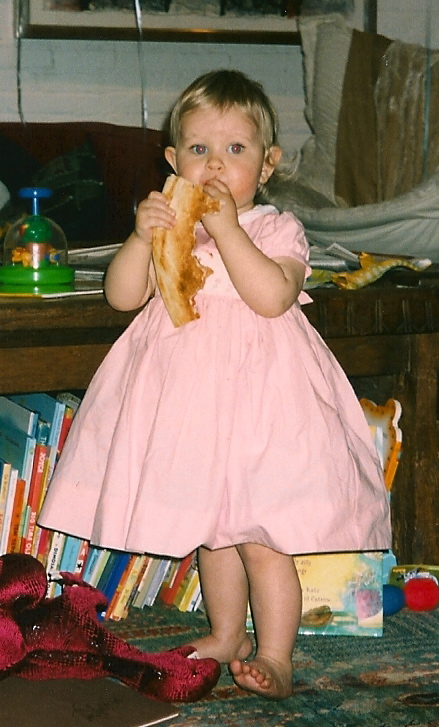
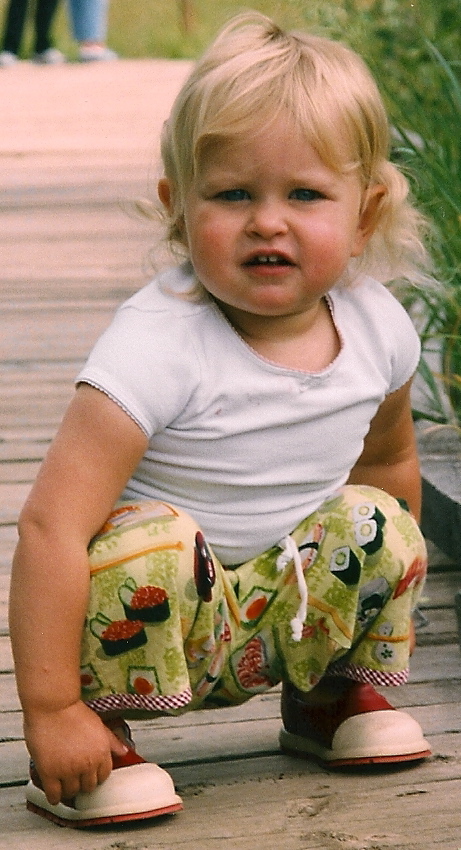
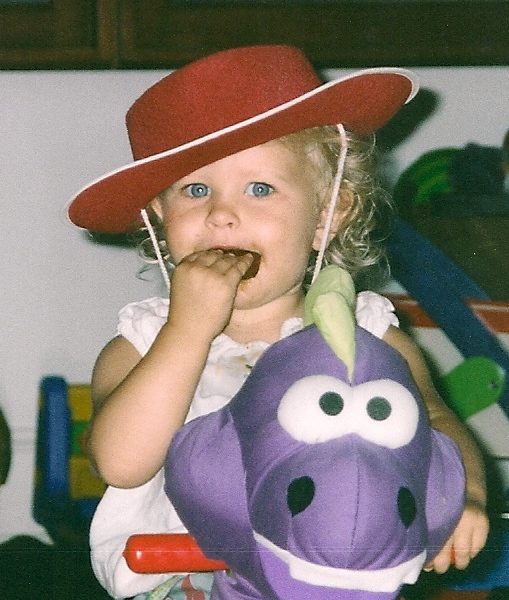
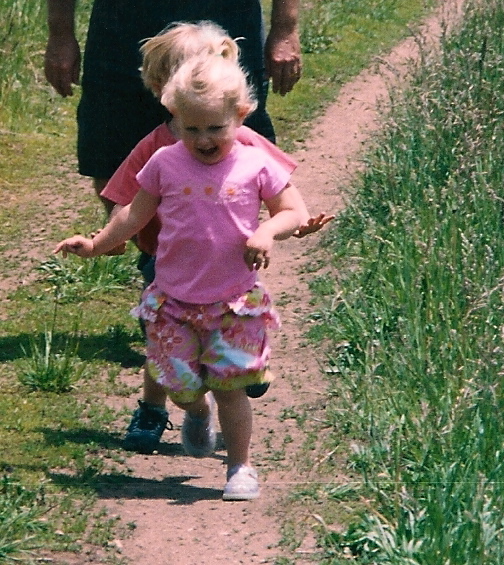
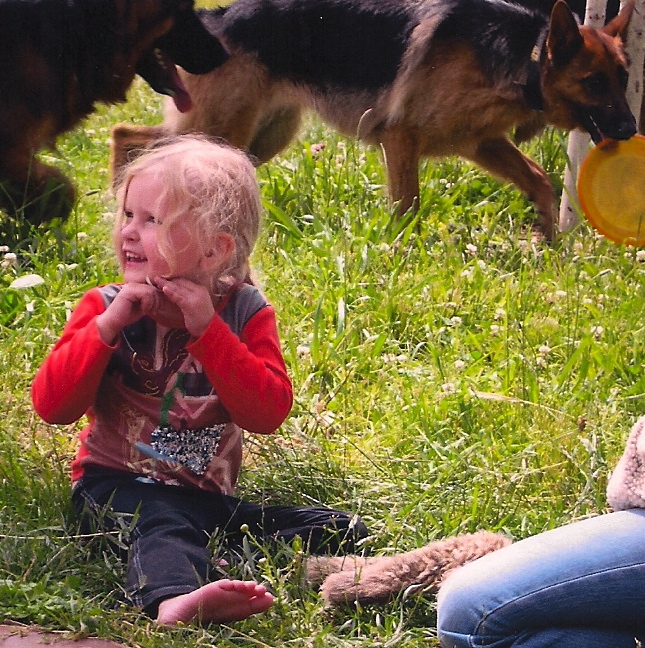
Here are some of my favorite photos of Emma when she was young before all eye contact went away and one taken over the weekend now that her eye contact has returned.

Jessie & “Dolls”

Autistic children are known for their inability to engage in imaginary play.  A defining moment for my husband, Richard and me was when it was pointed out Emma did not seem interested in any form of pretend play.  Until then I had reasoned:  she was too much of a tomboy, she didn’t like dolls, she was like my sister, it ran in the family.  But the truth was; not only did Emma lack any interest in dolls, she showed no interest in stuffed animals or toys of any kind including horses, a favorite of my sister’s when she was small.

When Emma began playing with her monster, Muzzy, we were elated.  Despite the comments other children, especially little girls who saw Emma, made.  “Mommy, why does she have a monster in her stroller?” One such child asked in puzzled wonder this summer.

“I don’t know honey,” the mother said, looking from me to Emma with a speculative glance as she grabbed her child’s hand and hurried away.

Comments aside, we were ecstatic.  Muzzy was the first toy Emma had shown any sustained interest in.  Granted she played with Muzzy in an odd way – tossing him in the air while laughing, throwing him on the ground so he would, “hurt his head” – it was play however unusual, which suggested tremendous progress.  See Em & Muzzy, Emma’s Pal Muzzy & The Porkmepine and Panama – Day 3.

Last night when Emma disappeared into her bedroom only to emerge moments later carrying not one, but two of her dolls, I was again ecstatic.

“Richard!” I whispered.  “Look!”

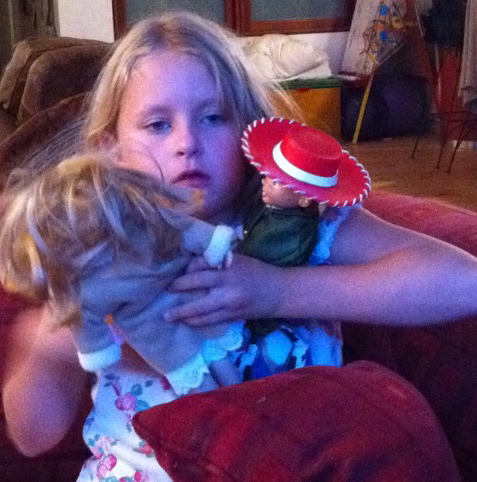
Emma sat on the couch holding Jessie who had on a fabulous green coat over her chaps and another doll I’d forgotten we even had.  Granted the doll’s hair looked like a “bad hair day” poster child, but Emma seemed unaware and proceeded to hold each in one hand making them bop up and down.

“It’s Jessie,” Emma said, surveying her red cowboy hat with a discerning eye.

“And what about her?  What’s her name?” I asked gesturing to the other doll.

“Dolls”, Emma said.

“But what’s her name?” I asked again.

“Her name Dolls,” Emma said, turning her back to me.

Emma with Jessie and “Dolls”

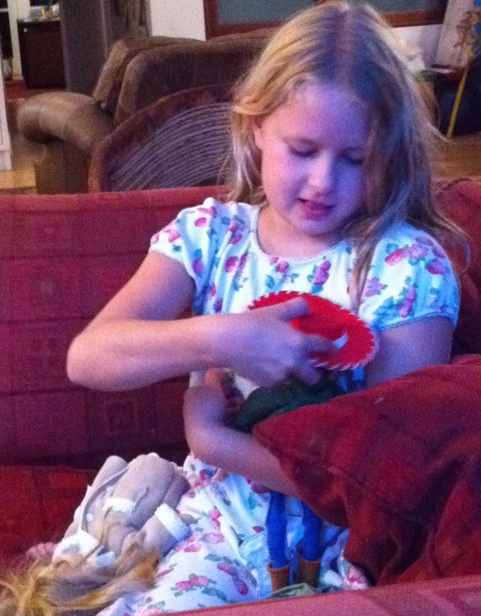
Emma did not engage in much language as she played and rebuffed our attempts to “play act”.   But she said hi to Jessie and observed Jessie was hot and needed to take her hat and coat off.  She repeated this with “Dolls”.

Emma Taking Off Jessie’s Hat

At a certain point she looked over at Richard with an impish grin and said, “Dolls fall down?”

“Is the doll falling down?” I said.

“Uh!  Uh!  Uh! Uh!” Emma laughed before flinging the doll to the floor.  Then she pretended to cry and said, “Doll crying, doll hurt.  Doll hurt her head.”

“Oh no!  Did she fall?  Is she alright?”

“Down, down, down!  Help you up, help you up!” Emma said in a sing songy voice.

“Who’s going to help her up, Em?” I asked.

“Help you up,” Emma said again.

“Are you going to help her?” I asked.

“Doll, Doll, come!” Emma said.   Emma leaned down and made the doll pat her head while saying, “Doll hurt her head.”

Emma became stuck in a verbal loop with the above dialogue, repeating it over and over again.

Richard and I suggested she be the one to help Doll up, which she finally did.

“Thank you!” Emma said as she lifted Doll up and gently placed her on the couch.  “Doll crying, Doll see Mommy, Doll hurt her head,” Emma said.

“Oh, no!  Let me see,” I said.

“Hi Mommy, time to go home,” Emma said without giving me Doll.

“Can I hold her, Em?” I asked.

“Time to go home,” Emma repeated, ignoring me.  Then she put Doll’s coat back on and laid her carefully on the ground.  “Good night,” she said, pretending to be the doll.

“Good night Dolls,” Emma said, in response.

Hey it’s play, no matter how bizarre.  It is imaginary play.  Each tiny step of progress, no matter how small, is progress.

What Now?

Richard and I have both been worrying since we returned to New York City.  We worry Emma has flat lined or worse begun to regress.  She seems more irritable, for the past three nights she has gotten up at 3:45AM, 4:00AM and last night at 2:30AM.  She seems more easily frustrated, quicker to tantrum, less able to tolerate anything she is not able to directly control.

I must add; I am tired, which always affects my outlook, casting everything in a grey laden tone.  I do not know whether I can trust my perceptions.  Is Emma really regressing or am I just tired?  She woke us at 2:30AM last night and though I was not the one returning her to her own bed until she fell back asleep, I felt guilty.  Richard was with her and would be facing a full workday as well.  He had also covered for me, “flying solo” as he put it on both Sunday and Monday morning, as I was an attendee and exhibitor at the WIE Symposium with my jewelry.

I stayed up for over an hour tormenting myself.  Is she regressing?  Have the stem cells had any impact?  What will we do now?  What if none of this works?  What will happen to her?  How will we continue?  My thoughts devolved as the minutes ticked by.

The stem cell treatments have, until recently, provided me with such hope.  I hoped they would make a significant improvement cognitively, in her speech, in her ability to tolerate frustration.  I hoped they would allow us to have a conversation with her.  I hoped they might even help her attend at school, learn eventually to read and write.  Now I am not so sure.  I am feeling beaten down.  What will become of Emma?

I do not know.

We are in uncharted waters.  No one can predict what our autistic children will be like in five years, ten years.  No one can show us autistic children, now adults and say to us – if you do this, this and this, your child will be like this adult.  Functioning, living independently, able to hold a job, have relationships with people who genuinely love them for who they are and not because they are being paid to care for them.

I spent yesterday at the first annual WIE Symposium  (Women, Inspiration, Enterprise).  The day was sponsored by the White Ribbon Alliance, a non-profit, attempting to help pregnant women all over the world have a safe pregnancy and childbirth.  I listened to women who have traveled the world tell horrifying stories of the women and children they have met and are trying to help.

One of the speakers spoke of how all children are our children.  She said it is up to all of us to ensure all children are given opportunities, food, medicine etc.  And I thought about Emma.  Richard and I both hold jobs.   We were both born and raised in the United States.  I have a family who is involved.  We have been given opportunities which vast portions of the world’s population do not have available to them.  And yet, we both have felt the profound isolation which comes with having a child with special needs.  And it is profound.

Mellody Hobson, President of Ariel Investments on a panel – “Business as Usual” told a story of a moment when the market crashed, she called her boyfriend in despair.  He reminded her she was from Chicago.  Not sure where this was going, she said something like, “And?”

“What do you do when there’s a blizzard?” He asked.

She was exasperated, couldn’t figure out the point to his line of questioning and began getting impatient.

“You look at your feet, you don’t look up, because you’ll fall.  So you look at your feet and you keep walking,” he said.

Later, each panelist was asked what advice had proven most helpful to them over the years, Mellody said she’d been told to smile.  Mellody is an African-American woman who said she made the decision she did not want to be “an angry black woman.”  She spoke of how it was important to her to carry on her life with elegance.  She told another story about conducting a meeting at her office only to have the first gentleman who arrived hand her his coat.  She said nothing, hung it in the closet and proceeded to sit at the head of the conference table where she began the meeting.

The last panel was on Philanthropy and Advocacy.  A young African girl, Nthabiseng Tshabalala was on the panel and spoke last.  She looked to be about Emma’s age, perhaps a few years older.  She spoke beautifully about her experiences and ended with, “I am here because I am educated, you (gesturing to the moderator Sarah Brown) are here because you are educated, all of you are here because you are educated”, and again I thought of Emma and all the children in this country who are not “educated”.  Where does that leave us?  Where do we go from here?

For today I am going to look at my feet and keep walking.

“Do something for someone else,” Diane Von Furstenberg told a young audience member, seeking advice.  “And fake it ‘til you make it.”

I’ll try that as well.

“But She Looks So Normal!”

Is what someone said to me the other day when I mentioned the reason Emma wasn’t responding immediately was because she’s autistic.  And when Emma finally did respond, it was with a reply which had no application to the question asked.

If we went on looks alone, we would all be in trouble.  However in Emma’s case it both serves her as well as complicates things.  People look at Emma and assume she’s “normal”.  They see an athletic, cheerful child.  It is difficult for people to believe she cannot communicate as other children her age do.

I have had the experience of being told on more occasions than I can count, “Oh my toddler does that too!”  or “She sounds just like my son!” and then they go on to tell me stories about their impish child’s antics which remind them of Emma.  Except that Emma is not an extremely tall two-year old who is acting out.  She is an autistic eight-year old who’s verbal skills continue to progress at a snail’s pace.  When people comment she is like a two-year old, they are right in some ways, but in most ways it is an incorrect assumption.  Emma is not “delayed”, she’s autistic and there is a vast difference between the two.

Explaining Emma to our son Nic, has forced me to become aware of just how complicated it is to describe her.  To say that she is doing something – biting herself, for example – as a way to get attention, would be incorrect.  Emma is not seeking attention.  I believe she is trying to gain control around a situation, which is uncontrollable.  The pain she causes herself is more tolerable than the pain she feels from a situation she has no power over.

When I look at her brain scans and see the lack of symmetry, the bright colors, which should be dark, like a strange Rorschach test gone wildly awry, I try to detect patterns.  I try to make sense of what I’m seeing, but cannot.

“Emma’s brain is not like ours,” I tell my son and myself in times of upset.  She does not think, feel, see or hear as we do.  She is decidedly “other”.

But how to explain this to the family on the airplane we recently took when asked if they wouldn’t mind sitting across the aisle from their grown children so that we might sit next to Emma?

When they refused, the father added, “I don’t see what the big deal is, you’re sitting near her, just the aisle’s between you.”

How does one then explain how agitated Emma will become?  How can one really make people understand, who have little or no contact with autistic children or if they have, one unlike Emma?  Of course Emma did become agitated and eventually we found two kind souls many rows back who were happy to take our seats so we could sit next to Emma, disaster narrowly averted.

“I can’t imagine what it must be like to parent an autistic child,” a friend of mine said a few weeks ago.

“I can’t imagine what it’s like to have two neuro-typical children,” I responded.  Afterwards, I thought about our conversation.  I really cannot imagine.  Emma informs every aspect of our lives.  When Emma says or does something new we record it.   Every milestone, each new word uttered is met with astonished elation.

I remember when Richard and I were planning our wedding.  A friend of Richard’s told us to take a few moments to absorb everything that was happening because it would go by so quickly.  We took his advice and to this day I can remember the beautiful floral wreath arrangements hanging from each lighting fixture, the candles casting their golden shadows across the room, Richard’s handsome face as I walked down the aisle toward him.  I remember because I stopped for a moment and took the time to take it all in.

Emma has provided us with something similar.  Her progress is so slow.  We celebrate each and every tiny step forward.  Of course we are also forced to spend much more time than we’d like, being present for the steps not taken, the fumbles, the excruciating process of growing up in a world where people do not understand, who judge Emma and us, assume she’s a “normal” child who is just being obstinate, difficult or “spoiled”.

The trick is to savor it all, I suppose.  A trick I continue to work on.

Desperation & Coping (Part Two)

For the first two years after Emma was diagnosed we did an aggressive intervention of ABA (Applied Behavior Analysis) therapy – 40 hours a week with additional speech therapy and Occupational therapy.  Advocates of ABA believe it is the only therapeutic intervention for autism that has any scientific validity.  Others have questioned those studies, claiming Lovaas used only the highest functioning children to obtain his results, which were published in 1987.

Regardless, ABA did not help Emma.  In fact, she “flat lined”.  We were called into the principal’s office of the pre-school she was then attending and were told Emma’s lack of progress was a “red flag”.   While other children at her pre-school flourished, going on to be mainstreamed even, Emma stalled out, unable to generalize the things she learned in the classroom setting, unable to make progress.  I have spoken to dozens of parents whose children have been helped using ABA, parents who swear it was the single most important thing they did for their child, and yet, for Emma, ABA did not help.  It is easy to feel angry, blame the therapy, blame the child, blame something rather than acknowledge how baffling and insidious autism is.

It was around this period when we found Stanley Greenspan and began his DIR/Floortime therapy with Emma.  For more on Stanley Greenspan see “A Tribute to Stanley Greenspan”.

While Emma responds much better to the DIR model, she still continues to confound experts in the field.  She has not progressed as quickly as any expected or hoped.

When Emma was first diagnosed we were given a diagnosis of PDD-NOS.  We were told to watch her, that perhaps she would “grow out of it” or if not, then at least we would have begun an aggressive early intervention program which would undoubtedly have her mainstreamed by the time she was in kindergarten.  This was not to be, however.  Emma was not mainstreamed when she reached the age to enter kindergarten.  In fact, her diagnosis changed to “Autism” and though she was considered “mildly” autistic, by the time she was 7, she was categorized as moderately so.  How to explain this?

We cannot.  None of the “specialists” we’ve seen can either.  The only thing that has really changed is all those “specialists” no longer offer their long-term view of where she’ll be in another few years.  Gone, are the comforting talks of how she’ll soon be mainstreamed, no longer do we hear the cheerful prediction that she’s – “on her way”.

Desperation can make for odd decisions, but for those of us who have attempted to manage our feelings of overwhelm as we do our best to live our lives with an autistic child, it is a feeling we are all too familiar with.  Richard and I have tried any number of remedies. Were I not the mother of an autistic child I would respond to many of the very things we’ve tried with an incredulous shake of my head.  When someone tells me their child has had several hundred treatments in a hyperbaric chamber, I do not think – Poor fools, they really are clutching at straws – I take notes.  How could anyone believe ____________________ (fill in the blank) would work?  We don’t believe as much as we hope.   We will do anything we can to help our daughter.

Desperation?  Probably.

Coping?  Absolutely.

Emma – August, 2010

A Conundrum

We are often baffled by words Emma says which we do not understand the context or meaning of.  See Emma’s Language and Sunday Morning’s Conversation for more.   A few weeks ago we were dumbfounded by the utterance, “cheese-solos” which Emma requested over and over again.  Prior to that it was something that sounded like, “atta-tah”.  It turned out the first was cheese doodles, evidently given to her as a snack at her school, but since we never bought them, it took a moment of sheer genius on Joe’s part to make the connection.  The latter turned out to be, “go to town” as in “No we’re not going to go to town.”  Except Emma would say, “No, we’re not going atta-tah.”  Even as a baby, Emma’s first words were, “All done!” though it sounded more like “ah-dah”.  As she has grown older the words continue to confound us, but even when they are intelligible they often do not make sense to any of us.  For the past few weeks in answer to the question – what would you like to do today? – Emma has responded with, “Go to downtown Aspen, push the button game?”

One day last week Joe, determined to get to the bottom of this, spent some two hours in town with Emma trying to figure out what she meant.  He came home as perplexed as when he’d left.

So when Emma said to me, “Downtown Aspen?  Push the button game?”

I inwardly groaned as I knew we would be spending a great deal of time wandering around town trying to find a game which I no longer was convinced she even knew what or where it was played.  But Nic was at the skateboard park with my friend Claudia, so I figured I would go wherever Emma pointed me and see where our adventure took us.

“Go this way,” Emma said from the back seat of the car, pointing in the direction leading toward Independence Pass.

“But Em, that will take us out of town,” I said.

Emma nodded her head.  “Go downtown?” she said with the inflection making it sound like she was posing a question.

“If I turn left Em, we will be heading out of town,” I said, hoping this would clarify things.

“Yes,” Emma said.

“Okay,” I said, taking the next left leading us out of town.  “Is this the right way?” I asked after a few minutes.

“Yes?” Emma said.

“Okay, Em.  You want to go out of town.  This is not downtown, this is leaving town,” I said.

“Leave town?” Emma repeated.

“Where should I go now?” I asked as we passed the turn off to the Aspen Club.

“Go this way?” Emma said.

“Which way, Em.  You have to point,” I said looking at her in the rear view mirror.

“Go this way?” Emma said pointing to the turn off for the cemetery where both my grandparents are buried as well as my father and a number of family pets.

“Oh, do you want to go to the cemetery?” I asked.

“Cemetery?” Emma repeated.  “Push the button game?”

“Okay, Em,” I said as we neared the padlocked gates.  I stopped the car.  “Is this where you play push the button game?”

“No!  Downtown Aspen!” Emma cried.

“But Em, I’ve been asking you where you want to go and you told me to come here. I’ve gone exactly where you wanted, I just can’t understand where it is you want to go,” I said, exasperation and exhaustion crept into my voice.

“Go downtown Aspen?”  Emma managed to say in between tears.

“But Em we just were downtown, remember?  We spent at least 45 minutes downtown with Muzzy in the stroller,” I said.

“Go downtown, push the button?”  Emma repeated sobbing.

“Em.  I give up.  I don’t know where you want to go.  Should we go back to Granma’s?”

“Push the button,” Emma, now inconsolable, cried.

As I turned the ignition on, Richard called asking how things were going and where we were.  He agreed to come meet us at the skateboard park and said he’d take Emma.

The entire way back into town, Emma cried in the back seat, “Push the button!”  Then she paused and said, “Shhhh!  You have to be quiet.  Stop screaming.”  Listening to her I could hear the echo of other people in her life, speaking to her.  Not only was she repeating what had been said to her, she was also adopting the tone and inflection of the many people in her life who have cared for her over the years.

Hours later, while Nic, Claudia and I sat outside the fountain in the middle of town, Richard and Emma appeared.

“Hey!  How did it go?” I asked.

“Well, my theory regarding the push the button game was correct,” Richard said triumphant.

“What theory?” I asked.

“I told you the other day,” Richard said.

“You did not!” I said.

“I did.”

“Tell me.”

“It’s a water sculpture and fountain on the other side of the mall.  If you look at it from a certain angle it kind of looks like a hot tub and she pretends to push a button to make the water jets come on.”  Richard looked at us.

“I cannot believe it,” I said, looking at Emma who was happily sitting on the chair across from me.  “You’re a genius,” I said to Richard.

“The only problem with being a genius is no one recognizes it,” Richard said.

Hope For Emma?

I have spent several hours starting different blog posts over the weekend and this morning, but have been unable to finish any of them.  I am still raw after the phone call Richard and I had with the director of the Stem Cell transplantation program at Children’s Hospital in Boston and the director of the Stem Cell Research Program also at Children’s Hospital in Boston.  See the previous post below, written by Richard on Friday.  An hour after our phone conversation in which they both expressed their concern with the stem cell treatments we have taken Emma to in Central America we received an email from them saying:  “We know that you are trying to do the best for your daughter, but given the issues we discussed, George and I think that you should not go back for stem cell treatment.”

I am feeling overwhelmed with emotions at the moment which is why I am having such a difficult time writing a post.  This blog is about Emma, not my fragile emotional state and though I have certainly written of the difficulties in parenting an autistic child I have tried to always keep Emma front and center – she is the star of this blog.  And yet, it is hard for me to write about anything at the moment because this blog is also about our hopes for Emma.  At the moment my hope is in short supply.

From Joe (Emma’s Therapist for the Past Five Years)

Joe, Emma’s therapist, who came to us five months after we received her diagnosis, was initially trained in ABA (Applied Behavioral Analysis).  As Emma regressed using ABA, Joe was the first to agree with us that we should find another methodology which might work better.  When we found Stanley Greenspan (who died April 27th, 2010 – next post will be a tribute to him) Joe was an eager participant in learning how to do Stanley Greenspan’s DIR (developmental, individual-difference, relationship-based) therapy with Emma.  Joe has since become the “Zen Master” of DIR.  He is brilliant at it and watching him work with Emma is a profound experience.  The following is a post by Joe.

“I was watching ABC’s Nightline last night, which aired a story about a pro-surfer who has autism. Watching his intensified focus on the waves certainly reminded me of Emma’s physical grace and all of her athletic talents – skiing in particular. They described the teenaged surfer as someone who’s “mastered the seas but still struggles on land.” On the water he feels relaxed, but on land he must face the pressure and anxiety of social interactions. Like Emma, the surfer has no physical indication of any disorder so his inability to respond appropriately to social interactions (or simply say hello) is often interpreted as rudeness. This is one of the dozens of catch 22’s of autism – wanting her to be seen and treated just like anyone else but also expecting others to be understanding/non-discriminatory once they find out she’s autistic.

The surfer’s story ended by crediting his autism for opening this door for his talents to shine: a door which may have otherwise remained shut.  While Emma’s autism has come with its vast array of difficulties and challenges, it has also opened similar doors for her talents to shine. While I feel many of Emma’s abilities are innate, I believe a stage needed to be set in order for them to be unveiled. So I end this story by crediting Emma’s parents, Ariane and Richard, for all of their endless efforts to open every door and set every stage possible for her. As for her athletic talents, giving her the opportunity to swing herself at 18 months, getting her into gymnastics at 2 years old, and strapping her into skis at 3 years old is just a fraction of all of the sensory input she was constantly provided with at such an early age. While Emma continues to shine in the spotlight, I credit her director and choreographer, Ariane and Richard, for making it happen.”