Tag Archives: parenting an autistic child

Preventative Measures

The New York Times published a piece in August of this year about the role the environment plays in the rise of autism.  It begins with the question asked by many people who are hoping to become parents  – What can we do to decrease the risk?

I have often thought about what I would have done differently, knowing what I now know.  There are a number of things, things I didn’t know to do or not do when I was pregnant with Emma.  There are a few things that appear to have some scientific basis to them, such as taking prenatal vitamins at least three months before getting pregnant and continuing to take them for the duration of the pregnancy.  I began taking them when I learned I was pregnant with Nic, though interestingly, with Emma I was taking them before I became pregnant with her and continued throughout the duration of my pregnancy.  I would not have eaten any fish of any kind during any part of my pregnancy.  I ate grilled swordfish a couple of times in my second trimester with Emma.  I also used fingernail polish remover a couple of times and had my hair highlighted once during my third trimester.   I would have stopped using all artificial sweeteners and I would have been more careful after the 9/11 attacks by not going downtown to Richard’s office in Soho to work.  Beyond those incidences, I did not take any drugs of any kind, not even aspirin, I didn’t consume caffeine or alcohol, I did not have an amniocentesis, avoided all and any invasive procedures, had two sonograms and gave birth naturally in a birthing center.  It seems unlikely that anything I did while pregnant contributed to her autism, but who knows?

After giving birth I would have done a number of things differently.  From the moment she took her first breath I would have eliminated all onion, garlic, dairy and wheat from my diet while I was breast feeding.  During those first few months when she was so uncomfortable and “colicky” I would have kept a food journal to see if there were other foods I was consuming that upset her and then eliminated those.  Since Emma seemed so uncomfortable when I breast fed and much preferred drinking breast milk from the bottle, I would have tried different techniques in swaddling her or having some sort of soft cloth between us so our skin to skin contact wasn’t so uncomfortable for her.  I would have started brushing therapy (click link for more detailed information on brushing) with joint compressions (see link for a detailed description of joint compression exercises) during this period as well.

Then there are the things I wish I had done much sooner such as  Dr. Marion Blank‘s literacy program instead of all those hours spent doing ABA.  I wish I had discouraged Emma from sucking her thumb.  I would not have introduced corn, soy, wheat, dairy or any foods that are thought to be problematic for some children.  I would have obtained an evaluation much sooner as well as taken her to a neurologist and had an MRI done before she was 18 months old.

Had I done all of those things, would any of it made a difference?  Except for introducing Dr. Blank’s program right away, which I am convinced would have made an enormous difference, who knows?  How much of a role does the environment play?  How much is due to genetics?  I have questions, lots of questions.  None of which will likely be answered any time soon.

For more on Emma’s journey through a childhood of autism, go to:   www.Emma’s Hope Book.com

Three Weeks and Two Days

Today marks exactly three weeks and two days since Emma began the modified gluten free/casein free/soy free/potato free/corn free/peanut free/banana free/chocolate free/cocoa free/red, blue, purple skinned fruit & vegetable free diet.  (Breathe.  I think I may have left some things out, but I can’t remember now.)

Last night she ate a tiny piece of catfish and coconut rice.  I soaked the catfish fillets in beaten quail eggs and almond milk, then drenched them in a mixture of coconut flour, quinoa flour & oat flour with some salt, before sauteing in ghee.  The coconut rice has become my new favorite dish.  Instead of cooking the rice in water I use coconut milk, making it creamy with a slightly nutty flavor.  However Emma is not quite as enthusiastic by my culinary inventiveness as the rest of the family.  Still, she did eat some and then was allowed to eat her new mainstay – green grapes and honeydew melon.  Except that when I offered her a few pieces of honeydew melon this morning she began to scream as though I’d amputated a limb.  As I’ve said before, she’s one tough customer.

In addition to all of this, ideally she should be on a rotation diet, meaning no food is to be repeated for at least four days.  (Laugh hysterically.  Then try to calm down and remember to breathe.)  Um.  Right.

“So how’s the rotation diet part going?”

“Not so much.”

That short dialogue sums it up.

As far as any changes we’ve witnessed – we think we may see an uptick in her desire for physical affection.  It’s hard to say this definitively, but we have all been getting more spontaneous hugs and kisses it seems.  I think her eye contact is better, again, it’s a subtle shift, if at all.  She has become more perseverative, so on the advice of her doctor we’ve reduced the Malvin, Piperine and one other, whose name eludes me at the moment, drops back to two daily instead of three.  I cannot tell if her chronic constipation is better as I have no way of knowing what she does, if anything, at school.  She does not seem particularly uncomfortable, but then she rarely does.  Emma also takes a magnesium supplement, Taurine, one drop of dopamine, several multi-vitamins as well as cod liver oil, which bizarrely, she actually seems to like.

And, because of this diet I now have become versed in such unlikely ingredients as – Guar Gum, (used as a thickener in place of cornstarch, it comes from the Guar or cluster plant grown in northern India and Pakistan.  The seeds are hulled and ground into flour)  Xanthum Gum, (also used in many gluten free recipes as a thickener and to add volume to baked goods.  It is derived from corn.  However, because it is derived from corn sugars and during the process, all corn sugars are removed, it should be okay for Emma.  This is according to her doctor.  I did find a corn free xanthum gum from Namastefoods.com, just to be safe.)  Arrowroot, (used as a thickener, found in South America, got it’s name from being used to treat wounds from a poisoned arrow.)  How’s that for a bit of trivia?

For more on Emma’s journey through a childhood of autism, go to:   www.Emma’s Hope Book.com

What They Don’t Tell You

Here are some things you will not find in your research on autism:

You will not learn how this diagnosis will affect your marriage or other members of your family.  You will not be told how it may fundamentally alter your perceptions of what is “normal”, how it may change your view of human beings, how it can force you to question small talk and why we behave the way we do, how it will transform your outlook on life, how it will change you, how your life and everything you assumed to be true, is no longer what you thought.

Having a child with autism may cause you to feel things you never dreamed possible.  You may know moments of joy and moments of despair you could not have imagined.  You may find yourself going to untold lengths in the hope of helping your child.  You may feel distracted, unable to concentrate.  Your work and career may suffer.  You may learn what it is to be sleep deprived.  You will come to know what it means to feel desperation.  You will know sorrow in a way no one can prepare you for.  You will know happiness in a way no one can prepare you for.  Sometimes you may feel both sorrow and happiness within the same day, within the same hour, within the same minute.

You may spend money you do not have on yet another treatment, yet another doctor, yet another specialist, yet another therapy, yet another intervention, all the while rationalizing that if it helps, it will all be worth it.  You may contemplate doing things you would have scoffed at before your child was diagnosed.  You may find yourself doing things that defy logic and have no medical basis.  You may listen to implausible, anecdotal stories and think – we will try that next.  You may dream your child is speaking to you in complex, beautifully self aware and revealing sentences.  You may wake from those dreams believing for a few seconds they were real and not a dream.  You will pray that you might dream again.  You will welcome sleep, as you never believed possible.  You may ache with sadness because your child is crying and in pain and your presence brings them no solace.  You may question every maternal instinct you have.

You may feel ecstasy from being hugged, unprompted.  You may feel the exquisite joy from having your child reach for you, ask for you, call for you.  You may know the joy that comes with seeing your child work so hard at something that does not come easily to them.  You may celebrate when they use the correct pronoun, even though they are no longer a toddler, when they learn to get dressed on their own, drink from a cup, say hello to you without being asked or simply acknowledge your presence.  You may feel a gratitude you would not have believed possible.  You may cry from happiness when they say a word, any word, even if you are the only person who can understand what the word is.  You will know what it is to appreciate commonplace things – eye contact, the correct use of the words “me”, “you” and “I”, physical contact initiated by your child, a word, any word spoken.

You will feel a fierce love for your child that seems to come from a place that is not of this world.  You will know what it is to love unconditionally and you will understand what that really means.

For more on Emma’s journey through a childhood of autism, go to:   www.Emma’sHopeBook.com

An Overview

On autism.com‘s web site, they write:

“What is the Outlook? Age at intervention has a direct impact on outcome–typically, the earlier a child is treated, the better the prognosis will be. In recent years there has been a marked increase in the percentage of children who can attend school in a typical classroom and live semi-independently in community settings. However, the majority of autistic persons remain impaired in their ability to communicate and socialize.”

After receiving an autism diagnosis for one’s child, most people go to the internet to learn more.  Quotes like this one abound.  What these sites do not say, cannot say, is what will specifically help your child –  What interventions, if any, will make a difference, what biomedical, dietary & behavioral approaches will work?

This quote is also from autism.com’s website:

Conclusion Autism is a very complex disorder; and the needs of these individuals vary greatly. After 50 years of research, traditional and contemporary approaches are enabling us to understand and treat these individuals. It is also important to mention that parents and professionals are beginning to realize that the symptoms of autism are treatable–there are many interventions that can make a significant difference.

The logo for the national parent support group, the Autism Society of America, is a picture of a child embedded in a puzzle. Most of the pieces of the puzzle are on the table, but we are still trying to figure out how they fit together. We must also keep in mind that these pieces may fit several different puzzles.”

A parent of a child with autism quickly finds they will need to read enormous amounts, speak with a great many “specialists”, sift through the endless opinions (often stated as fact), and try to make sense of all the various articles, papers, news items and books currently in print on autism.  In addition they may watch the numerous documentaries, interviews, YouTube clips and all the other visual forms that exist relating to autism.  Having done all of that a parent must make decisions as to what they can and cannot do, what they can and cannot afford to do in their attempts to help their child.  While they are making these decisions, they must cope with their own emotions, trying hard to keep depression, worry, panic, fear, sadness and guilt at bay.  They must learn to manage these feelings while continuing to research and do what they are able to with the hope something they try might just help their child.

But most important perhaps, we must never give up.  We must try in our darkest hour to see the light.  We must treasure our child’s differences, celebrate our child’s uniqueness, rejoice in our child’s strengths.

Years ago Richard and I went to a couple’s therapist.  He listened to us both individually and then asked us to meet with him together.  As we sat side by side on his couch he told us he didn’t want to hear about our latest disagreement, he was much more interested in hearing from each of us what the other had done right in the last 24 hours.  We were told to go home and keep a journal, recording all the things the other had done that was kind, thoughtful and helpful.  He encouraged us to examine each act, to consider things we perhaps took for granted.  It was the single most helpful advice anyone ever gave us.

This blog is a version of that exercise.  While I do my best to accurately document Emma’s progress or lack of, while continuing to try different interventions, I also try my best to celebrate her.  Let me concentrate on her strengths while I continue to do everything in my power to help her build on those same strengths and perhaps she’ll discover new ones.

For more on Emma’s journey through a childhood of autism, go to:   www.Emma’sHopeBook.com

Emma – The Performer

I have a tripod with a hotlight set up for the trunk show I’ve been doing these past two days.  I turn the hot light off whenever possible as it’s so bright and, well, hot.  Even though the weather has turned fall-like, the sun pouring in through the windows facing south, serve to warm the place so much that I am often opening windows to let the cool air in.  But every time Emma is here she turns the light back on.  At first I thought she liked the warmth it generates.  Then I noticed she liked to sit directly in front of it, but far enough away that the heat from the light couldn’t be felt.  She was sitting in a spot light.  The kind of bright theatrical lighting one sees shining on a diva singing an aria.  You can tell where I’m going with this.  This morning, just so there would be no mistake, Emma grabbed a toy microphone and began singing and dancing under the glare of the light.

Richard came out from the back.  “Do you see what she’s doing?”

“She’s a diva.”

We watched Emma crooning away and shook our heads.  That’s our little girl – drawn to the lights as only a natural born performer could and would be!

On a food side note – Emma ate three forkfuls of the meatloaf I made last night, dipped in applesauce.  (My mother used to serve applesauce with meatloaf, which is how I came up with the idea.) Not only is this incredible and unprecedented, but all the more so because I steamed a head of broccoli, 7 spears of asparagus and two large carrots, then pureed them and mixed them in with the meat before putting it in the oven to bake.  Last night marked the most vegetables Emma has consumed in seven years!  Even though the amount she actually ate was miniscule, it was better than nothing.  She also ate two pieces of rice quesadilla.  Just to be perfectly clear, not two bites, two PIECES, whole wedges.  I bought the rice tortillas from Trader Joe’s, spread it with grated Sheep’s milk cheese and baked it in the oven.  A huge success.  Then I pushed my luck by making another rice milk smoothie, which she refused, even though I thought it delicious.

For more on Emma’s journey through a childhood of autism, go to:   www.Emma’sHopeBook.com

The Search for GF/CF Cupcakes

Yesterday we received a call from Emma’s school because she was hysterical and couldn’t calm down.  Evidently a child in her class had a birthday and the parent sent in cupcakes, which Emma couldn’t eat.  There are few things Emma loves more than a birthday celebration and cupcakes are an integral part of that.  So when Emma wasn’t allowed to eat the cupcakes, she was beside herself.  Eventually she was able to calm down, but it took awhile.

I was with a client when the call came in and couldn’t speak with her, but told the school I would make cupcakes with her when she returned home.  (I have made at least four batches of cupcakes to date, none which she will actually eat.  She and Joe made a batch – she ate two right away and a third the following day, then refused to touch them again.)  But yesterday I found my old tried and true recipe for cupcakes.  Emma has always loved the cupcakes from this recipe, so I substituted gluten free flours and hoped for the best.  Emma enthusiastically poured sugar into the ghee, helped whip everything together, occasionally dipping her finger into the batter and eating it – all a good sign.  I had her help me spoon the batter into the muffin tins and put the whole thing in the oven.  When they were done, beautifully fluffy and perfect looking, Emma eyed them critically before speeding away, saying nothing.

“Hey Em, look!  They look perfect.”  I held one up for inspection.

“No?”  Emma said in that questioning way of hers.

“Oh, Em.  Just taste it.”  I could see she wasn’t going to like them.

Nic came over and picked one up.  “These look great, Mom.  Can I have one?”

I have always taken pride in my culinary skills, but Emma is one tough customer.  She did finally taste one before putting it down again and expressing her displeasure.

“I can’t believe she doesn’t like these.  They’re so good!” Nic managed to say between mouthfuls.

Ah well.  The search for a cupcake recipe Emma will enjoy continues.

For more on Emma’s journey through a childhood of autism, go to:   www.Emma’sHopeBook.com

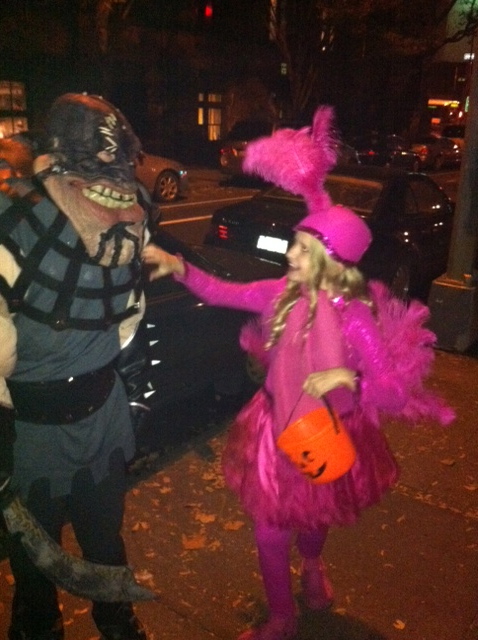
Halloween in New York

(Something odd happened in almost every photograph taken – either Emma’s or my eyes look creepy.  I figured since I was dressed as a “Fallen Angel” I should post the one with my weird eyes.)

In New York City, a great many people, adults and children alike get dressed up for Halloween.  And not just those who walk in the epic Halloween Parade that begins in the village and winds its way north until it ends just a block from where we live.   (This is in explanation to those of you who might think we’re peculiar – though we probably are.)  We live in Chelsea where at least eight blocks of brownstones go all out for Halloween.  New Yorkers take their Halloween very seriously.  The brownstones don’t just have a couple of fabulous pumpkins on their stoops, the building’s facades are covered in cobwebs, enormous black hairy spiders hang from windows and doors, strobe lights blink, Halloween themed music blares from speakers rigged outside (Michael Jackson’s Thriller is a big hit), a coffin with a corpse that suddenly comes alive decorates a front garden, dismembered limbs hang from trees, a couple of the brownstones even used dry ice to create a fog that meandered down the block. People travel from all five boroughs to trick or treat on these eight blocks, they have become so renowned.

We usually try to get an early start as the streets become so crowded it’s almost impossible to squeeze through the crowds by 8:00PM. What with Richard’s broad shoulders from his executioner’s costume and my tattered wings, we were like a double-wide, the Hummer of costumes, taking up most of the sidewalk, requiring us to walk single file.  I clocked half a dozen people inadvertently with my wings, though everyone was forgiving – one man even said in a reverential whisper – “I’ve been touched by an angel.”

Richard upstaged all of us though.  Every now and again I would turn to find him nowhere in sight.  Ten minutes later he would catch up, having been grabbed by someone who insisted on having their photo taken with him.

One of many Chelsea brownstones transformed for Halloween

Emma laughs with her scary dad

One of the dozens of shops open late for Halloween – This unicorn was one of my favorite costumes – look at the pose!

Luckily, Emma has never eaten the Halloween candy given to her, much to her brother Nic’s delight.  She did say at one point, while holding a lollipop, “Just taste it!”

“No, that’s okay, Em.  You don’t need to taste it.”  I smiled at her.

“Just lick it!”  She began unwrapping the lollipop.

“Oh that’s okay, Em.  You don’t have to lick it.”

“It’ll make you sick,” she said, putting it back in her halloween basket.

For more on Emma’s journey through a childhood of autism, go to:   www.Emma’sHopeBook.com

Day 13

Today is the thirteenth day of putting Emma on the modified gluten free/casein free diet.  She has found a few things she likes to eat, is slowly expanding her choices, but there are only a couple of things she seems happy to eat and many more that she eats begrudgingly.  Most of the things I offer, she’ll taste, but will then say, “Now it’s all done.  Please Mommy I don’t like that.”

Meanwhile we continue with her studies.  I have not seen any noticeable change there.

Parenting a child with autism is like going on a trek in the Himalayas.  There are moments when you feel you’re not going to make it, your pack is too heavy, your muscles are tired and sore.  You wonder how you’ll take another step, the terrain is too steep and unforgiving.  But there are other moments of untold beauty.  Moments when you look around and see the mountains stretched out before you, the view so majestic it takes your breath away.

For more on Emma’s journey through a childhood of autism, go to:   www.EmmasHopeBook.com

Day 10

Riding the wave of my previous day’s success, I fully expected to come home last night to find Emma agreeable to whatever was placed on her plate.  With visions of cheerful family dinners in my mind I set about making Hollandaise Sauce (with those duck eggs and Ghee).  Making hollandaise is a meditative endeavor, I’ve learned.  I cannot carry on a conversation with someone else while preparing it.  I must be focused, attentive with a certain amount of serenity or the whole thing curdles or separates.  I didn’t have any lemons, so I used a lime instead and all went fairly well, though it wasn’t as thick as the hollandaise I usually am able to whip up.  I steamed the asparagus, cooked the salmon steaks, drizzled everything with hollandaise and called everyone to the table where upon Emma took one look at her miniscule serving and said, “No!  I don’t want to taste it.  It’s okay.  It’s okay.  Just lick it.  You have to put your finger in it to taste.  Just one bite.  Taste it.  I don’t want to taste it!  I don’t like this.”  And then she began to whimper.

It was one of those Sybil moments, with Emma scripting using her “stern” voice, then mimicking a TA at her school to take one bite, just one bite, then Emma’s own sad voice pleading and on it went.  Finally I said, “Em you have to taste it, then you can have some grapes and apple (skinned).

“Okay, okay, okay,” she said, dipping her finger into the hollandaise.  “Taste it!”  She smelled the hollandaise, then tentatively licked her finger before looking at me with an expression of pure misery.  “I don’t like it, Mommy.  I don’t like this.”

My family dinner a la Norman Rockwell fantasy fizzled and I felt an overwhelming desire for someone to come and feed her for a month or two – get her eating a whole variety of lovely, nutritional foods before disappearing again.

Later Nic came over to me and put his arms around me.  “Hey Mom?”

“Yeah Nic?”

“I don’t mind this diet so much.  I still get to eat all my favorite things.”  He smiled at me.

“Oh, Nic.  That’s so nice of you.  You’ve been such a trooper with all of this.”  I gave him a hug.  “Thanks for being such a good sport.  It means a lot to me.”

“It’s no problem, Mom.”

This morning as I made my way to my studio I thought about when we tackled Emma’s bedwetting.  We did our homework, found an alarm to alert us to when she’d peed, whereupon we rushed her to the bathroom and eventually she was out of diapers, sleeping through the night with no accidents.  All of that seems like ages ago, but in fact it was just over a year now.  It took three solid months before she learned to use the toilet without incident during the night.  I expect it will take that much time or longer for her to become accustomed to eating new and different foods.

For more on Emma’s journey through a childhood of autism, go to:   www.EmmasHopeBook.com

Day 3

I didn’t have time yesterday to go into Emma’s response to being told she could no longer have her usual breakfast of the past six years – cheerios with milk and 2 slices of whole wheat toast with butter and raspberry jam or her weekend breakfast of pancakes (mix from William’s & Sonoma) with chocolate chips.  Did I mention she cannot eat chocolate?

I had the foresight to put everything that she can no longer eat into bags, which I then hid or, if it was perishable, threw away.  Except that I forgot about her whole wheat bread.  Sunday morning – Day 1 – there it sat on the kitchen counter like a beacon calling lost ships to shore.  She figured out pretty quickly that things were not going to be “breakfast as usual” and went for the bread before I could grab it or her.  I then had to wrestle her to the ground, as she screamed and tore at my clothing like a rabid beast.  It’s tough to maintain ones composure in such circumstances.  When she realized I intended to throw the bread away, she screamed and clawed at it, eventually crumpling into a heap on the floor, sobbing.  “Nooooooooooo!  Please Mommy.  I want toast with raspberry jam!”

I offered her the granola, then some oatmeal, all of which she refused and finally sat with her as she wept.  I tried to hold her, but she pushed me away.  I know not to take Emma’s rejection of me personally, it’s one of the many things about her autism that has always baffled.  She has never derived any comfort or pleasure from being physically soothed when she was upset.  As a baby it seemed as though she were missing that most basic human instinct, seeking contact from another human being.  It was as though self preservation was not part of her makeup.

Yesterday there was no weeping, but she had a fever and runny nose.

“Classic junkie symptoms,” a recovered addict I know informed me, after I told him what we were doing.

“What do you mean?”

“When I was a junkie, I told my dealer, heroin was great for curing the common cold.  She laughed at me and said – no you idiot.  You’re jonesing.  That was my moment of realization.  I was hooked and I hadn’t known it until then.”

“So what are you saying?  You think this fever is withdrawal?”  I sat down, incredulous.

“Maybe.  Hey I’m just thinking out loud.  What do I know?”

Still his words have stuck with me.  Maybe it’s just a coincidence.  Maybe she has a cold.  Her throat is red and I don’t see how that can be from any kind of withdrawal.  Still it’s weird.  This morning she had a fever again and her “cold” or whatever this is doesn’t seem to be better.

She continues to refuse almost everything offered.  Making whimpering noises whenever I ask her to sit at the dining room table to eat with us.  Today she finally had a slice of ham, some green grapes and some sheep’s milk cheese.  It’s the most she’s eaten in two days!

For more on Emma’s journey through a childhood of autism, go to:   www.emmashopebook.com

A Comment

A follower of this blog wrote the following response to yesterday’s post.  I posted it here as it beautifully sums up exactly what my husband, Richard and I also feel and why we work as hard as we do with Emma.

“I think maybe this is what most parents or carers of children with autism aspire to.  Not to extinguish quirks and unique personality traits, rather to help our children function in this world, to cope, to survive, to find happiness. It is not as simple as just accepting someone as being unique when they can’t go out in public without dropping to the ground and self harming over some issue or they can’t even attend to their own most basic needs when they  become distressed, when there is an unavoidable change in routine, when they cannot even travel safely in a car or bus ( we’ve been there believe me), when they have no way to communicate their needs or to even tell a parent they are in pain or scared or hungry, when they want to reach out to a friend, but don’t know how and so are left friendless, when they struggle to eat because the food repulses them, struggle to even hold a fork or use a knife. That is not something I will accept for my children. I want more for them than that. As a mother I have had to watch my children cry in pain and be unable to hold them in my arms and give them this most basic of comfort, rather being forced to witness their anguish and left helpless. These are things that need to be changed and worked on. If that is a “cure” bring it on I say.”

I have never met the woman who wrote this comment, but we have been corresponding now for awhile.  She has two children on the spectrum, each utterly unique.  Her comments are always thoughtful and insightful.  Though we live on separate continents with several oceans between us, we have a great deal in common.  So, to you Liz – thank you for blazing a trail and sharing about it.  You have helped me more than you can know.

For more on autism and my daughter, Emma’s journey through it, go to:  www.EmmasHopeBook.com

On the Spectrum

I was asked recently why I am trying so desperately to overcome autism.  It’s a valid question and it made me think about the challenge of writing about one’s child in a way that honestly captures that child with all their complexities.  A week or so ago I wrote in my post entitled A Cure – “Emma cannot function in our world, she is not mainstreamed, she cannot take a shower, wash her hair and dry herself off without support.  We are not discussing nuances here.  We are talking about a child who is more than “quirky”.  My husband, Richard and I love quirky.  Quirky is GREAT!  We’ll take quirky.  But that’s not what Emma is.”

To me, that summed up why we continue to search, why we continue to try various things, but it does not adequately describe Emma.  Emma cannot function in our world without hands on support.  We cannot have a conversation with her or ask her questions.  I am still trying to capture Emma on video and post some clips on here, but haven’t had the time to do that yet.  The question I began this post with, made me realize that for someone reading this blog they cannot know her through my writing.  Perhaps one gets a sense of her, but there’s too much left out, too much I don’t think to mention, the cadence and inflections of her speech, the words, which I can understand, but which may not be understood by someone else.  I try to give an accurate portrait of her, but in the end, it is just that, an interpretation and not representative of the whole.

When we first received Emma’s diagnosis I was determined to find a “cure”.  I felt sure that I would find one too.  (Hubris?   Arrogance?  Ignorance?  Stupidity? Denial?  All of the above?)

After those first few years I realized I might not find a cure for what ailed Emma.  And after another few years and three trips to Central America for stem cell treatments under our belt, a “cure” seemed more and more elusive.  I have come to accept that.  Perhaps more importantly, I am less focused on the miracle of a cure and more focused on pushing Emma to expand her world.  There’s a balance we have tried to achieve with Emma.  We try to follow her lead whenever possible, but we also encourage her to stretch and do things beyond her comfort zone.  Our most recent attempts to expand her diet is a case in point, her literacy and math program are another.

Which isn’t to say that I don’t continue to research and do everything in my power to find treatments to help her.  I am convinced Emma’s digestive issues are exacerbated by her environment – the foods she ingests, the air she breathes, the water she drinks.  This Friday I am taking Emma to a doctor who has worked with hundreds of children on the spectrum.  He and I spoke on the phone yesterday for over an hour, going over her history, her GI issues (inflammations and ulcerations), chronic constipation, recurring strep throat, porous teeth, cracked heels and limited diet.  While a few years ago, I would have eagerly anticipated this appointment with the same degree of excitement the devoted view a visit from the Pope, I no longer do.  I have come to see all of these people, no matter what letters may follow their name, with tempered interest.

Last week Emma’s school bus matron told us Emma refused to buckle her seat belt and when the bus matron tried to help her, Emma kicked her hard in the chest.  We immediately went over with Emma the behavior we expected from her.  We rehearsed buckling her seat belt and made sure she had her ipod and ear buds with her so she could amuse herself once she was seated.  We went over the importance of not hurting another person.  We tried to consider what sort of support she might need to help her control herself.  We are lucky in that Emma seems to have understood and has not struck nor tried to get up from her seat while on the bus since.

As we waited for her bus this morning, I coached Emma, “Emma, it’s nice to say good morning to people.  She’s a nice lady and saying – Good Morning – will make her smile.

When Emma boarded the bus this morning she said, “Good morning, nice lady.”

The bus matron beamed.

There are many people with an autism diagnosis who are on the “mild” end of the spectrum or fall in the “gifted” category of Aspergers or are considered “high functioning”.  These children are often mainstreamed or learning at grade level or above.  And while they have tremendous hurdles, often requiring support into their adult lives, they occupy a different level of hurdles from those who, like Emma are moderately autistic.

I had a friend whose child was unable to walk or even lift his head.  He, too, was diagnosed with autism, though severely so.  That child faced developmental and physical problems far beyond anything Emma has had to deal with.  For me to compare the two would have been ludicrous.  At this point my goal is to get Emma to a higher level on the spectrum.

For more on Emma’s journey through a childhood of autism, go to:   www.EmmasHopeBook.com

Emma and Food

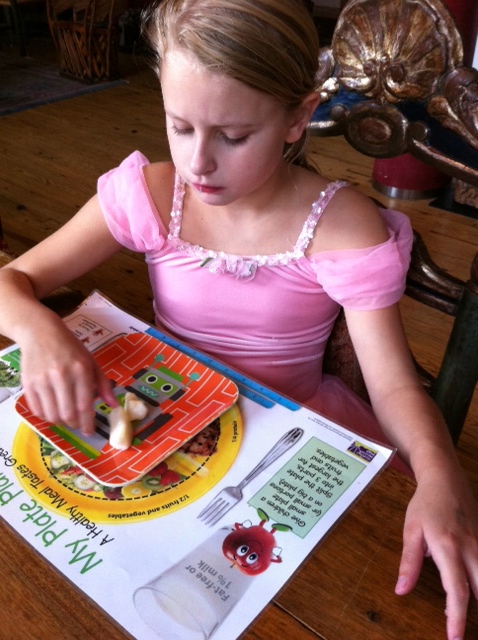
I have been keeping a chart of the new foods Emma has tried these past six days.  To date she has sampled:  pear, banana, apple, blueberry, raspberry, watermelon, honeydew melon, papaya, raisin, dried apricot, homemade granola, oatmeal with banana and raisins, chicken, (catfish, kale – totally pushing my luck last night with those two)  and the piece de resistance – vegetable frittata!  To date her favorites are watermelon, pear, banana, apple, raisin, chicken and the frittata.

I am also reading the Gut and Psychology Syndrome (GAPS) by Natasha Campbell-McBride.  It is a diet created by Dr.Campbell-McBride who “healed” her own son diagnosed with autism.  It is a daunting proposition, which requires one to forego almost all foods (saving a meat broth which one is suppose to consume every 30 minutes or so) for a few days to several weeks in order to allow the gut to heal before slowly introducing easily digested foods until eventually the child is able to eat a wide range of foods.   This diet is so draconian in the beginning, it makes going gluten and casein free look like a picnic.   Still I continue to do my research.  I guess you either have to laugh or cry.  I’m going with laughter at the moment.  Tears to follow, I’m sure.

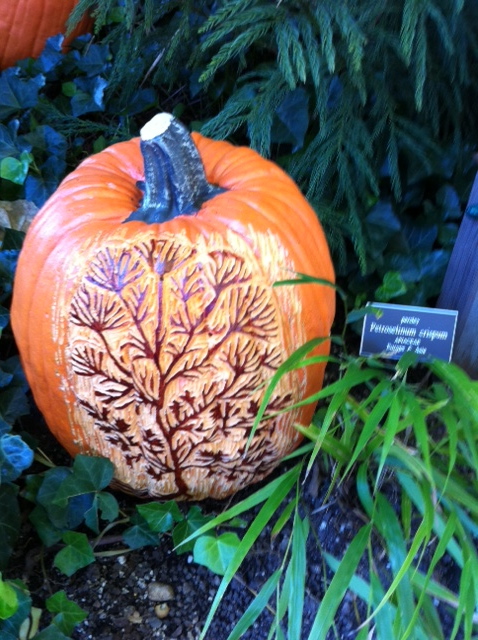
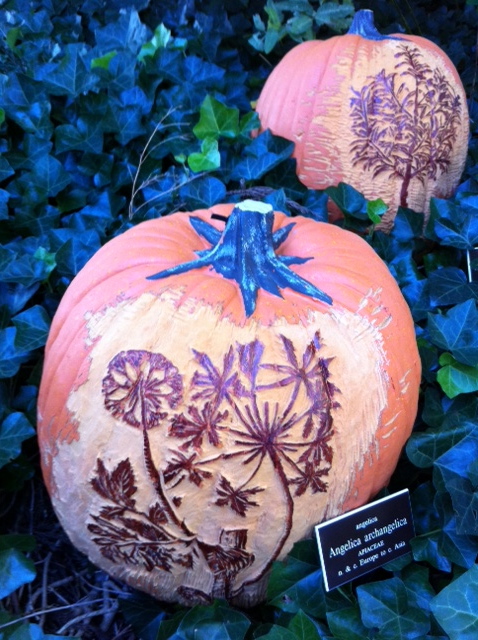
Over the long weekend we took the children to the New York Botanical Gardens.  It was in the 80’s and gorgeous.

The Haunted Pumpkin Garden

The “Herb” Garden

As delightful and creative as these pumpkins were, Emma was much more concerned with getting on the tram that runs through the grounds of the Botanical Gardens.

“She loves various modes of transportation,” Richard observed when we finally secured four seats on the tram.

Yup.  That’s our Emma.

For more on Emma’s journey through a childhood of autism, go to:   www.EmmasHopeBook.com

Em

Emma holds an uncanny resemblance to a fictitious children’s book character.

Okay, so we haven’t gotten the whole handstand-on-the-handlebars thing down yet, but I’m sure that’ll be next.

Merlin watches and waits.

He just cannot help himself.

Food update:  Emma ate a blueberry last night.  This morning – one blueberry, (not her favorite) a slice of apple, a slice of pear and a piece of banana!

After eating all of that she said, “No more medicine.”

I’ve got my work cut out for me.

For more on Emma’s journey through a childhood of autism and our attempts to help her, go to: www.EmmasHopeBook.com

Emma and Food

I’ve written about this before – Emma’s limited diet.  It’s self-imposed.   As her parent and someone who struggled with an eating disorder for 22 years, I have been reluctant to get too involved in her food other than to make a few half-hearted attempts to offer her other foods I thought she might like.  By the way, Nic, her older brother eats a wide range of foods, even eating a curried rice with cauliflower and chickpeas dish I made the other night, without complaint.  (He was being a good sport, I know.)

When we first received Emma’s diagnosis I immediately put her on a gluten free/casein free diet as so many families found it helped their child.  Some even found their child lost their diagnosis after going on it.   We had her on the diet for more than three months and saw her lose 10% of her body weight with no other noticeable change.  At the time we were working with a DAN (Defeat Autism Now) doctor, who specialized in allergies and nutrition.  During that time she became even pickier about what she’d eat and by the time we took her off of the diet, she was eating soy yogurt and scrambled eggs, shunning “good” foods she once ate, such as vegetables, chicken or fish.  Years later someone told me that soy is another food to be avoided and that may have been the reason we saw no change.  All these years later, I still wonder whether we did the diet wrong, if we’d removed all soy products, perhaps we would have seen some significant change.

A friend of mine suggested the GAPS diet, created by Dr. Natasha Campbell-McBride who “fully recovered” her own child with her diet.  The problem is, there isn’t a single thing allowed on this diet that Emma currently eats.  In addition it is a labor intensive diet, requiring one to make homemade condiments – such as mayonnaise, ketchup, etc as well as yogurt.  BUT – I am still willing to look into it and have purchased the book describing the diet as well as the cookbook with various recipes.  (Richard is groaning as he reads this as he no doubt is remembering the fanaticism with which I tackled the GFCF diet.)

Before I even contemplate starting the GAPS diet, I will take her to a new pediatrician who is said to be versed in autism and am trying to encourage her to try some new foods.  I intend to document our progress and (hopefully) hers on this blog.

Last night I introduced Emma to a piece of Comice pear, peeled.

She was tentative, but eventually after smelling it, licking it and touching it, she finally ate it!

This morning I gave her a small bite of a Fuji apple, which she immediately picked up and ate without hesitation.  Tonight I will go out on a limb and try a raspberry.

Emma on her way to the school bus this morning.

If anyone reading this has had success with any sort of diet, please contact me with what you tried and any progress you saw in your child.

For more on Emma’s journey through a childhood of autism, go to:   www.Emma’sHopeBook.com