Tag Archives: literacy

A Work In Progress

As we have added more work to Emma’s already busy schedule, I have had to adjust my own schedule to accommodate.  Since her new school year began this week, I am now doing her literacy session before the bus comes to take her to school in the morning, while Richard gets Nic ready.

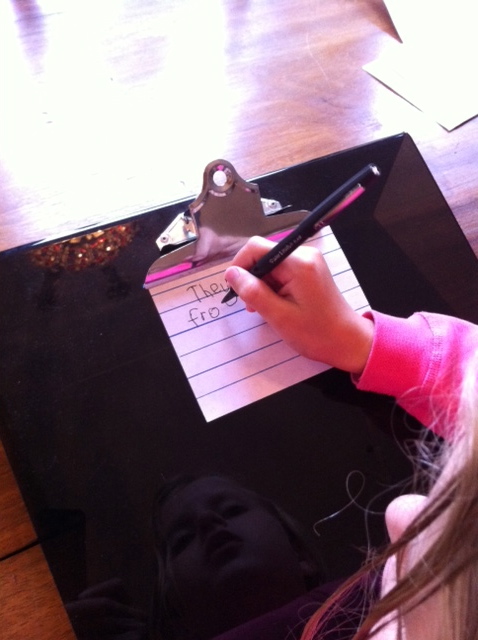
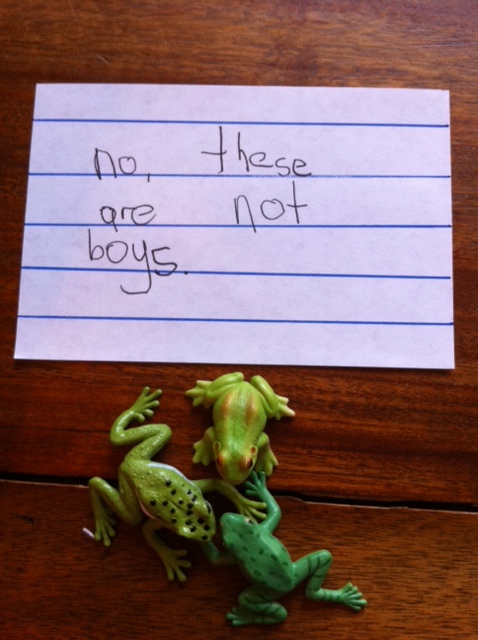
This morning we worked on the word “boy”.  Emma wrote this in answer to my question – “Are these boys?”

“What are they?”

Wait for it…

Yes, they most certainly are!

The beauty of this is that all of it is done non-verbally.  Emma is able to concentrate fully on answering the questions posed by either writing or typing the sentences on the computer.  Today she learned how to use the shift key while hitting the appropriate letter to create an upper case letter to mark the beginning of a sentence.  The grin on her face when she wrote:  “Here are some boys.  They are sitting.” complete with punctuation and upper case letters for the “H” and the “T” was as close to euphoria as one can get.  She even giggled when she was finished and beamed at me with pride.

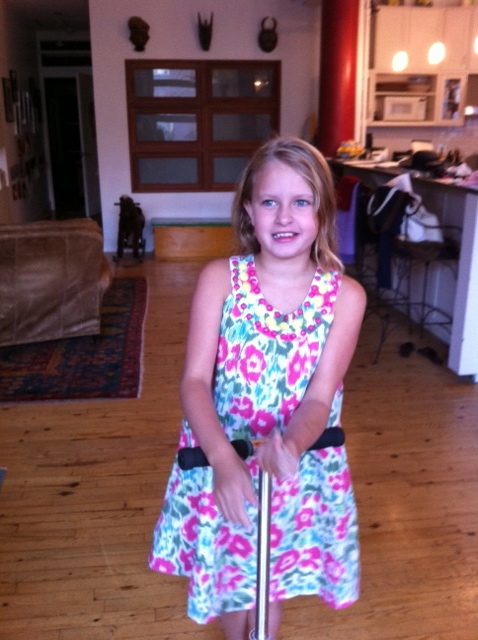
This is the dress Emma chose to wear to school today.

For more on Emma’s journey through a childhood of autism, go to:   www.EmmasHopeBook.com

We Have to Keep Trying – Autism

When Emma was first diagnosed, she was four months away from her third birthday.  Since that fall, now seven years ago, we continue to show up for her in ways we could not have imagined.  As many of you with a child with autism know, engaging your child can be complicated.  Emma cannot have a “conversation” the way her neuro-typical brother, Nic can.  We cannot have discussions with her, there is no easy back and forth of ideas and opinions.  Because Emma is rigid in her desires, outings can become problematic if they are not kept to a strict schedule.  The central park carousel must be ridden and then we must go to the zoo, but only after we have watched the brass animals go around when the clock strikes every half hour.  Once in the zoo we must watch the seals being fed and then go see the penguins, followed by the aging and now blind seal, then the polar bear and finally a visit to the bats, before we can leave.  Often Emma will then insist on a visit to the petting zoo where she is more interested in patting the metal replicas of the animals, which then make the appropriate animal sounds, than the real animals.

When both the children were toddlers we were frequent visitors to the American Museum of Natural History on the upper west side of Manhattan.  During the winter months I often took the children four or five times a week.

“Once the kids are older, I hope never to go to that museum again,” I grumbled to Richard one afternoon after an exhaustive five hours spent there.  “And can we add every playground that exists?”  I added.

And then we got the diagnosis and everything was up for grabs.

My time with Emma now includes listening to music and dancing together, walks and yes, lots of playgrounds, amusement parks, the zoo, the various carousels the city has to offer, swimming, but also reading and her literacy program.  Richard still takes Emma to see “the snake bite boy”, which is Emma’s name for the American Museum of Natural History.  But it is during Emma’s “study room” sessions that I see her progress in real, identifiable and concrete ways.  It doesn’t matter whether I am feeling optimistic or not, the evidence is there, right in front of me.  We have kept a record of those first hours when she was learning to form the letter “a” to now, when she is struggling to write two and three sentences at a time.

This morning was a difficult session.  She was required to write three sentences from memory.  At a certain point I said, “We cannot give up, Em.  We have to keep trying.  I know it’s hard, but you can do this.”

Those words were probably more meaningful to me, than to her.  They would be an apt mantra for me to repeat to myself every morning.

No matter what, we cannot ever give up.  We have to keep trying.

For more on Emma’s journey through a childhood of autism, go to:   www.EmmasHopeBook.com

Literacy and Autism

We have been working intensively with Emma on her reading, writing, typing and more recently math and verbal skills.  The reading, writing and typing program we began in January.  It was at this time that she painstakingly learned how to form each letter of the alphabet.

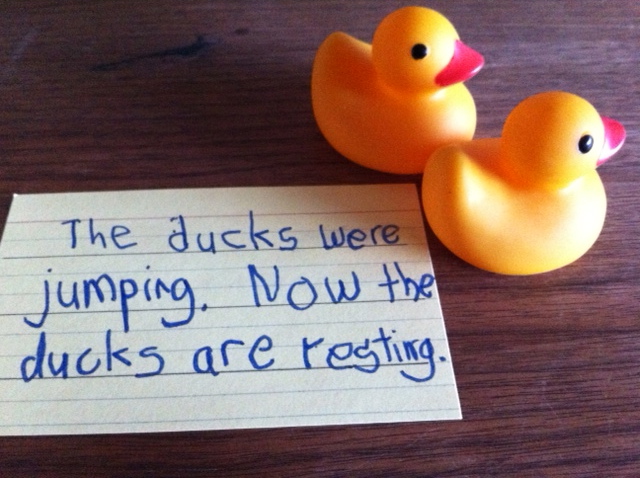
This morning Emma wrote this, in answer to the written question – Did the cat jump? – after I had made the cat jump.

In answering the question – Did the boy jump? (the boy as seen in this photo was lying in a bed) Emma wrote:

In accessing Emma’s progress, I need to compare her to herself and not other children.  I have seen over the years how easy it is to become discouraged when I compare Emma to her brother or any neuro-typical child or even other children on the spectrum – unless they are much more severe.

“This isn’t going to be a sprint,” Richard once observed, after seeing yet another neurologist.

And it isn’t.  Emma is making slow and steady progress.  We work with her for about three hours every day on her literacy, math and verbal exercises.  There has been no instantaneous miracle.  She has not begun to write on her own in complete, complex and revealing sentences.  She has not gotten to the point where she is able to tell us what it is like for her to be her.  She cannot answer questions regarding anything remotely abstract.  (Which doesn’t mean I don’t continually hold out hope that one day she will.  I do.)  But at the moment, I am happy to reflect on her slow, steady progress and it fills me with joy to work with her each morning and to see these beautiful sentences that she constructs on her own.

Someone once asked me – Is it good enough?

The idea being that I had a preconceived notion of how I wanted something to be and anything short of that meant it was an utter failure.  Sometimes being “good enough” is still pretty fabulous.  So yes – Emma’s progress is good enough.  In fact, it’s better than good enough, it’s wonderful.

For more on Emma’s journey through a childhood of autism, go to:  www.EmmasHopeBook.com

What Matters

We are leaving soon.  Back to New York City where our other life awaits us.  The children need to get ready for a new school year, medical forms need to be filled out, bus companies need to be contacted and confirmed, school supplies need to be bought.  Nic will be entering 6th grade and there’s a certain excitement in that.  Emma doesn’t enter a “grade”.  She will be placed in a class with other children on the spectrum, who are near to where she is academically.  I am always filled with trepidation at the start of a new year regarding Emma.  It is difficult not to give in to fears and worries.  Will she excel?  Will her new teacher and classroom be a good fit?

The truth is, Emma has progressed more in the past seven months than she has in five years.  We attribute this to the literacy program we began in January of this year.  We have now added a math program as well as a verbal program.  Emma is working each day for about three hours on these various programs.  It has been amazing to witness.  Progress.  This is the word every specialist we’ve ever spoken to has used.  Is she progressing?  And the answer to that question is a resounding – Yes.  We cannot predict what the future holds for Emma.  We cannot know how far she will go.  But as long as she continues to progress we know we are on the right track. I heard someone say once – Progress, not perfection.  It’s an apt thought for any of us.

Emma at dusk last night

For more on Emma’s journey through a childhood of autism, go to: www.EmmasHopeBook.com

Deficits and Assets – Autism

It is easy to see what’s wrong – with the world, with other people, with ourselves.  When Emma was diagnosed with autism we were told about all that was “wrong” with her.  Her deficits were listed with great care:  Her eye contact was weak.  She showed little interest in interaction with others, she didn’t point, she didn’t ask questions about others, she showed little awareness of others, she seemed oblivious to others pain or feelings.  Her verbal skills were delayed, her fine motor skills were delayed, her ability to play, to project, to engage in any sort of fantasy or pretend play was almost non-existent.  The list went on and on.

But what of her assets?  What about all the things she did that showed tremendous creativity and intelligence?  Where was the balance in her many and varied evaluations?

When Emma went to a Special Education Pre-School I met a little boy who couldn’t have been older than three.  He was pointing to all the signs in the building and reading them.  I exclaimed to one of the therapists standing nearby how incredible this seemed to me.  She then told me he was hyperlexic and that they discouraged him from reading as it wasn’t “normal”.

I have never forgotten that.  Here was a child with an unusual ability.  A talent that could be used to further his education and perhaps interests and yet it was being discouraged.  Is that what we want from our children – to be “normal”?  What do we sacrifice in our attempts to “fit in”, to adapt, to be like everyone else?

Emma has a beautiful voice and a love of performing.  If we have guests over she asks to “sing a song” for them as she did last night.  Sometimes she needs to be reminded that the song must eventually end as she can get into a loop, singing the same refrain over and over again.  She hasn’t mastered the whole concept of “losing ones audience”.  But we encourage her singing and desire to perform just as we encourage Nic to practice his Alto Sax and the piano.  Emma has a great many assets, things she loves doing over and over again.  With Nic we use the word “practicing”, with Emma we say she is “perseverating.”  Yet in her perseveration Emma is practicing as much as Nic is.  The difference is, Emma will do the same thing over and over again for hours, whereas Nic will practice for 20 or 30 minutes and move on to something else.

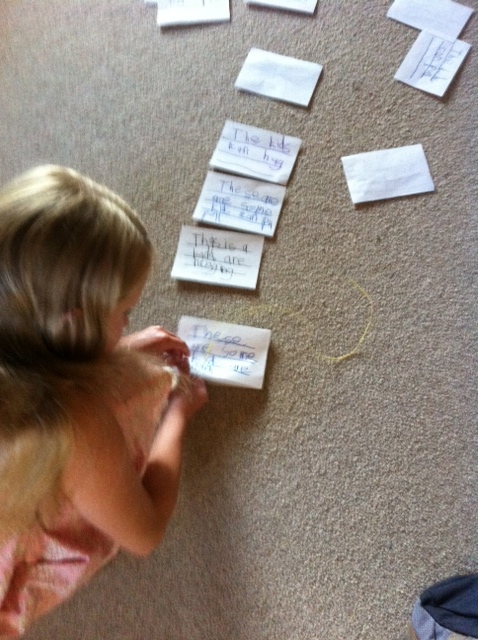
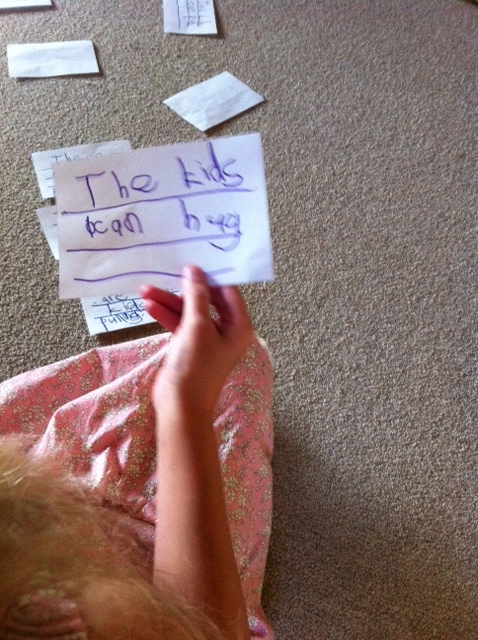
Last night as guests began to arrive, Emma was upstairs in her “study room”, sitting on the floor in her party dress writing.  When I went upstairs, this is what I saw.

She was talking to herself and picking up each piece of paper then reading it before placing it back down and moving to the next.

As we had run out of lined paper, she had made the lines herself, before writing the sentence – The kids can hug.

Now this scene isn’t exactly “normal”, on the other hand very little in our household is.

For more on Emma’s journey through a childhood of autism, go to:  www.EmmasHopeBook.com

Bumps In The Road

Inevitably in life we have all experienced things that have forced us to slow down, perhaps take another route, do things differently than we would have liked.  I think of these things as bumps in the road.  I try to refrain from judging them as good or bad, but just as the way things are.  There are some moments I’m better at achieving this kind of calm perspective than others.  It’s easy for me to feel all that is happening at work is “horrible”, but the truth is, a series of events have been set into motion and I have had to make the decision to fight back, to defend myself or allow another person to harm me and in harming me, harm my family.

Emma experiences her own “bumps” along the way.  Things that happen, which force us to change well laid plans.  Plans she is excited about and is looking forward to.  But more and more, lately, Emma has taken these things in stride.  She is learning to adapt to a world that is often precarious, constantly changing and shifting.  It is a wonderful thing to witness.  We all must adapt to our ever changing circumstances.

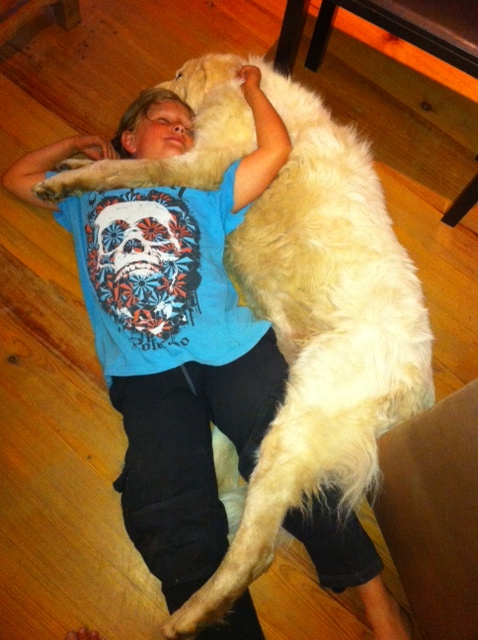
Emma makes me happy –  Both my children do.  Try not to smile while looking at this next photograph.

I dare you.  No smiling.  Come on, it’s impossible not to feel a tiny degree of joy, right?  I love that.

Here’s another photograph that can’t help but bring a smile to my face.

This was done yesterday during Emma’s “study room”.  She is writing longer and more complex sentences.  Her reading is coming along beautifully.  Excuse me while I jump up and down with excitement!

So no matter how heinous things get at work, I have my family.  My beautiful, amazing family – and that’s all I need to bring things into the proper perspective.

For more on Emma’s journey through a childhood of autism, go to:  www.EmmasHopeBook.com

These Last Few Days

Every day for the past month, Emma has gone on the bus to summer camp with her brother, Nic and her therapist Joe, shadowing her.  Joe tells me this year has been terrific.  Emma has tried new things, been engaged and interacted with the other children more than the year before.  Today is their last day before coming out to join me in Aspen.  Because it’s their last day, Nic told me, they can do whatever they like.  Nic said he was probably going to play soccer, practice his archery, swim “a bunch of times” in the the lake and do gymnastics.

I am interested to hear what Emma will do.  When I called last night, she was with Joe in her “study room” so I couldn’t speak to her to ask.  Not that I would have gotten a clear answer.  The future and past are difficult concepts for Emma to express.  I never know when I speak with her if she’s referring to something she wants to do, did do, will do in the future or wished she could have done in the past. Despite my confusion in regards to what time frame is being referenced, Emma is usually without complaint.

Emma at camp – 2011

Every afternoon upon returning from camp, Joe and Emma go into her “study room” where she works on her literacy program.  I haven’t worked with her for the last ten days, so I am eager to see how she is coming along.  Emma’s literacy program, perhaps more than anything else, has caused a significant shift, in Emma, but also in me.  The progress she’s made since this January when she was just learning to form her letters, to now, where she is writing one and two sentences, is tremendous to see.  But I also feel she is gaining a certain degree of self confidence.  Working with her has been incredible as I know how hard it is for her, but she continues to do the work anyway.

Sleep, wake up, sleep, wake up, go on the airplane and see Mommy!

For more on Emma’s journey through a childhood of autism, go to:  www.EmmasHopeBook.com

A Brilliant Mind

I have maintained in previous posts, that I continue to believe in my daughter’s brilliance.  Current IQ tests do not account for children who are non-verbal or with limited or impaired speech.  I have no way of knowing what Emma’s IQ is, but I can tell you there are things Emma does, on a daily basis, indicating her mind is capable of some pretty astonishing leaps.  What follows are a number of examples.

Our refrigerator light is out.  The first thing I did was replace the bulb, only to find that wasn’t the problem.  A little later Emma opened the refrigerator door and pressed a switch on the ceiling of the refrigerator and immediately all the lights came back on.

“Wow Em!  How did you know to do that?” I asked incredulous.

“Lights broken,” Emma said, nodding her head up and down as she removed her caramel yogurt from the frig.

“Yeah, but how did you get them back on?” I went over to her and watched as she reopened the door and pressed on the little white button that activates the lights when the door is opened, something I did not realize until Emma showed me.  The lights flickered for a second and then went out.  Emma reached up and matter-of-factly jiggled the switch and the lights came back on.

“There,” she said, with a certain degree of satisfaction.

After a few days of all of us wiggling the switch, the lights flickered on and off feebly one last time before remaining permanently off and I had to call the company to get the light switch replaced.  Now to many of you, this may seem completely commonplace, but I can tell you, I had spent quite a bit of time trying to figure out what was causing the problem.   I should have saved my time and just asked Emma.

Yesterday while Emma and I worked on her literacy program requiring her to choose the word “leg” from several options, she positioned the cursor over the correct button then clicked on the space bar.  Then she looked over at me with a mischievous grin as if to say – did you see that?

Again, hitting the space bar instead of clicking on the mouse or the return key never would have occurred to me.

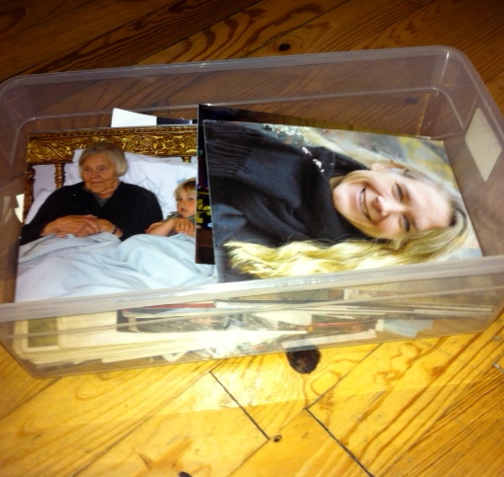
Another thing I’ve noticed while working with Emma is that she has an amazing ability to see patterns.  So, for example, if I show her a series of “words” but with only parts of the letters showing such as:  _a_s,  r_ _ _, _e_ _, _ _s_ and ask her to find the one that can be “eats” she will find the correct one immediately, less than a second, faster than I am able to.  I am consistently amazed by this.  It is in keeping with her ability to know instantly when a photograph is missing from her pile.

Emma’s box of photographs – over 200

The other day Emma was singing while shooshing around on her scooter.  Richard was reading in the rocking chair, Merlin happily nestled in his lap.  “You know what she’s doing right?” Richard said looking over his reading glasses at me.

“Yeah,” I said without looking up.

“She’s created her own carousel.  Do you hear her?  She’s singing all the songs they play on the carousel.  And watch.  She’s going around and around on her scooter in the same direction as the carousel.”

I stopped reading and watched and listened.  Emma was currently singing “Georgy Girl” one of the many songs they play at the Central Park Carousel.

“I wonder if she’s singing the songs in the correct sequence,” he wondered out loud.  “We’ll have to make a note of that next time we go.”

Emma riding on the Central Park Carousel

These are only a few examples of Emma’s brilliant mind.  There are countless others.

We, as a society have a tendency to view ourselves and others with a critical eye.  We are taught early on to look at our deficits and then do all we can to take corrective measures to make up for those deficits.  I don’t believe this kind of thinking is helpful with children diagnosed with autism.  The deficits pile up unbidden until that’s all we can see.  Our children are routinely viewed as “less than” as we struggle to help them.  I feel strongly a more balanced approach is necessary.  Our children are often brilliant.  If I approach Emma with this in mind, I am able to more fully help her, by focussing on her talents, on the things that are easy for her and using those assets to help her with the things that are more difficult.   In addition I find I can learn a great deal from her.

For more on Emma’s journey through a childhood of autism, go to:  www.EmmasHopeBook.com

Dreams For Emma – Autism

A follower of this blog and mother of two children on the spectrum asked me if Emma used an ipad.  I wrote about Emma’s ipad last fall for both this blog as well as the Huffington Post, so in responding to her email, I reread both those posts.  The one for Emma’s Hope Book is entitled Emma and Lists.  What struck me was how far Emma has come since then.  I looked at the date – September 24th, 2010 – and while yesterday I was feeling a bit discouraged with Emma’s ongoing struggles with handwriting, I cannot help but feel incredibly optimistic with her progress after reading those posts.  It’s funny how rereading something I’d written less than a year ago can have such an impact, but it has.

Emma has certainly come a long, long way.  In the post “Emma and Lists” I write about how when I am feeling a little sad or discouraged I make lists.  I go on to recount my current lists, (hopes) for Emma.  “Help Emma with Reading,”  “Help Emma with writing,” are two such items.  I remember when I wrote that post, thinking that these were dreams, perhaps dreams I might not ever see accomplished.  And yet, here I am in July of 2011 and not only are both these dreams coming true, but so are others that I hadn’t even thought to put on my list.  Things like:  beginning math concepts, writing in full sentences, learning to type, following three and four step commands.  These are all things Emma is in the process of learning.

I will try to remember to take a photograph of Emma’s handwriting this afternoon.  She is coming along.  She is learning, she is progressing.  It’s easy to forget, though.  I forgot that last September I could only hope Emma might one day learn to read and write.  That she is now doing so is remarkable and wonderful.  Last fall we were still riding on the wave of our success with having finally gotten her out of diapers at night.  We were still struggling with getting her to sleep through the night.  I’d forgotten all of that.  It seems so much longer than ten months ago.  It feels as though years have slipped by.

I haven’t dared dream for awhile now.  But rereading those posts reminds me of how important it is to have dreams, for ourselves, for our children.

For more on Emma’s journey through a childhood of autism, and to see how far she’s come in one year go to:  www.EmmasHopeBook.com

Summer Camp For Emma

For the last three summers we have enrolled Emma in summer camp with her therapist, Joe shadowing her.  The director of the camp has been incredibly accommodating, allowing Joe to shadow Emma and doing all he can to provide Emma with a “typical” camp experience among her neuro-typical peers.  Each year the other children, while often not exactly clear on why Emma behaves as she does, have been incredibly patient and eager to help when Joe told them she was  just learning to speak and sometimes didn’t understand all that was going on.  Each summer one or two little girls have taken it upon themselves to help Emma, self assigning themselves to her, urging her to join in and making sure she stayed with the group.  The first two summers we signed her up for two weeks and since it went so well, we went ahead and signed her up for a full month, just like her brother, Nic this year.  Yesterday was her first day.

Summer Camp last year

“No not going to go to Becky’s class.  Going to go on the bus to summer camp!”  Emma said yesterday morning as I fixed her breakfast.

“Are you excited, Em?”  I asked.

“Yes!” she shouted.  Then, “Going to go to summer camp with Nicky and Joe.  Going to go swimming in the lake!  Not going to take the school bus, no!  Going on different bus.”

“Yeah, Em.  That’s right.  It’s a different bus.  Which one do you want to wear?” I asked, holding up three different skorts.

“This one!” she grabbed hold of a pink skirt with shorts attached.  “And this one!” she said taking a white t-shirt from me.  “And this one,” she added, pulling a white and blue striped two piece bathing suit from the drawer.

“Okay, and how about we take this one for back up?” I held up a colorful one-piece suit in front of her.

“No, no, no!  This one.”

“Yes, I know you want that one, but we’ll just bring another one in case you need it too.”

“No mommy.  Just this one,” she insisted, jabbing her finger at the two piece.

Emma often reminds me of the children’s book character, Olivia.  Olivia is a pig who loves clothes, particularly accessories with stripes and shoots around on her scooter.  Which is where the similarities end – not the pig part, just the scooter and love of clothing and striped accessories.

When the bus arrived, Emma, Nic and Joe climbed the stairs amid shrieks of excitement and greetings.  Several children from last summer were riding the bus again and as the bus moved away from the curb, I could still hear the excited voices of the children.

When everyone arrived home yesterday afternoon, I asked Emma if she had fun.

She literally jumped up and down she was so happy.  But even during the summer, we must continue to work with Emma on her reading, writing and now, math.  Joe and I worked out that if he came early each morning, he could work one session of math in before they left for camp, while every afternoon I will do a session of her reading and writing.  Yesterday we worked on the word cat/cats.  Emma is coming along beautifully with increasingly difficult sentences which she now types out on the computer using her two index fingers or writes by hand – something that is by far the most challenging for her.  Pointing to an illustration of a man, I said, “This is not a kid.  This is a man.”  Then she was to write these two sentences from memory.  It was the only one which tripped her up, all the other exercises she did, often without hesitation, beautifully.  Such as when I pointed to a group of frogs jumping and asked, “Are these frogs jumping?”

Emma then typed – Yes, these frogs are jumping.

Progress, lots of wonderful progress!

For more on Emma’s journey through a childhood of autism, go to:  www.EmmasHopeBook.com
Emma and Art

This morning we had our parent/teacher conference with Emma’s team of teachers and therapists.  I am rarely told anything that completely catches me off guard at these meetings.  But this morning when her teachers related to us how Emma loves doing craft projects, I must admit I was astonished.

“Did you see the bracelets she made?  We sent them home in her backpack,” one of her teachers asked.

“Yes,” I said.  “But I assumed someone helped her with them.”

“No, no!  She did those all by herself,” I was told.

To say I was ecstatic is an understatement.  When I was pregnant with Emma I dreamed of the day when she would be old enough for me to teach her to knit, sew, embroider, do art projects, just as my mother had done with me.  Some of my favorite childhood memories are of my mother and I knitting, sewing, embroidering the figures for the nativity scene we made together one christmas that we still display on the mantle above my mother’s fireplace each December.  But up until now, Emma showed little if any interest in art projects, her fine motor skills are one of her biggest challenges, so my hopes of one day doing these things with her were pushed aside for the more pressing issues of helping her learn to read and write.

I am always looking for things Emma and I can do together.  Things that do not include her favorite outings – which can be very rigid and exacting – the Central Park Zoo, the American History Museum and the Central Park Carousel.  These are regulated outings with specific things that must be done in a particular order, “go see snake bite boy” in the museum, “go see bats” at the zoo.  One day, frustrated with Emma’s desire to ride the carousel over and over again I decided to just continue riding it to see how long she would do so before she asked to leave.  It took almost an hour and more than a dozen rides before she said, “All done.”  I was so dizzy I thought I was going to throw up and the next day she wanted to go back and do it all over again.

Emma has always shown an incredible memory for music, will hear a song once and then months later will hum or sing the entire song without missing a note.  I assumed, until now, that Emma’s artistic leanings were contained in her musical abilities. But every now and again I have wondered whether Emma might find some other medium with which to express herself since both her parents are artistic as is her Granma (she’ll deny this, but she is a terrific artist who did pencil sketches of us when we went on trips together that were amazing) and her great-grandmother was extremely artistic as well.  It definitely runs in the family, so to hear that Emma is deriving pleasure from her art projects at school is terrific.

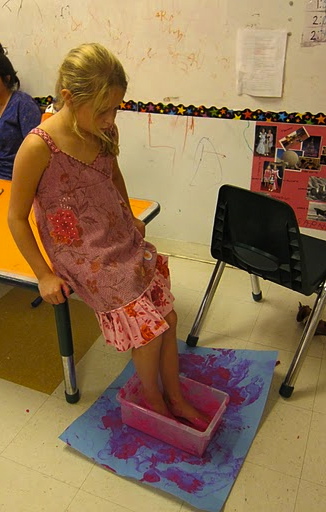
Emma at school using her feet to paint.

We have a bin filled with art supplies buried somewhere in Emma’s closet at home.  When I get home this evening I will pull it out.

For more on Emma’s artistic leanings and her journey through a childhood of autism go to:  www.EmmasHopeBook.com
A Light Bulb Moment

This morning Emma, Joe and I went into “Emma’s Study Room”, which is where we go to work on Emma’s literacy program.  Emma asks to do this each morning.  Earlier this morning Joe and I discussed various strategies to help Emma with the handwriting portion.  Up until this morning’s session, the handwriting part has been extremely difficult for Emma.  Her anxiety level (and mine) have been counter productive – with Emma fidgeting, pushing her chair away from the desk and saying things like – “study room all done now.”

We began with the video – a short story about a man washing his car with a rag.  Emma seemed mildly uninterested, but watched the short clip and then was asked to find the word from a series of sentences, which she did with little problem.  She then was instructed to spell the word, again with few problems and when the computer portion was over we went to the handwriting part.  But today we implemented some other techniques that we had used in the first part of the literacy program, exercises she was familiar with and as a result had no problem doing.  We then moved on to the more problematic spelling of the single three letter word, but this time Emma had no problem!  As I watched her work, I could see that something had clicked.  It was an amazing moment.  It reminded me of the moment when Helen Keller finally realizes the water dribbling through her hand is the word Annie Sullivan is spelling for her.

I felt such unbelievable joy witnessing Emma “getting it”.  The look on her face, the smile… it was priceless.  To say that I am proud of her is a vast understatement.  I am ecstatic for her as well as proud, so very, very proud of her.

We continued through the other exercises with amazing results.  At a certain point I looked over at Joe and made a Can-You-Believe-This?! face.  And after we were finished I went to tell Richard, overwhelmed with happiness and relief.  What I witnessed was the beginning of reading and writing comprehension and it beats the joy I felt when Emma took her first steps.

As a side note, I will be adding the link to this blog on each post as various posts are getting picked up elsewhere.  For those who read Emma’s Hope Book already, just ignore and for those of you new to it, welcome!

Learning

Since the family is now here, I’ve been getting up with Emma, so everyone else can sleep.  Emma typically wakes by 6:30AM and often a bit earlier.  Usually we go downstairs and sit together on the couch.

“Go to other pool?” Emma said this morning.

“Okay, but Joe just drove in from Denver last night, so maybe tomorrow.”

“Go to Glenwood pool tomorrow,” Emma said, nodding her head.

“Yeah.  Maybe tomorrow.  Joe’s probably pretty tired today.”

“Joe’s coming,” Emma replied.

“No.  He’s here!” I said pointing upstairs.  “He got in late last night.   He’s sleeping,” I explained.

“Joe’s sleeping.  Joe!  Can we go to the other pool?  I want to go to the Glenwood pool!”

“Okay, Em.  We’ll ask Joe when he wakes up.  How about doing our work in the study room?” I asked.

“Do study room in Mommy’s bed,” Emma said.  Before I could answer she added, “No, not going to do study room in Mommy’s bed.  We have to go to Mommy’s office just with Joe!”

“Exactly, Em.  We have to show Joe what we’re doing.” I told her.  “We have to wait until Joe wakes up.”

“We have to wait,” Emma said.

After Emma made her toast and ate it, she said, “Go see Joe.”

“We have to wait, Em.  He’s tired.  We need to let him sleep.  Okay?”

“We have to wait,” Emma said sadly.

Eventually Joe appeared and Emma jumped up and down, “It’s Joe!  Joe’s here!  Go to study room with Joe?”

Emma and I are doing the next level of her literacy program.  It’s a big step from what we’d been doing and it’s difficult for Emma.  We watch a video and then do some computer work spelling one word.  It is the same word repeated over and over in the story.  Emma then must find the right letters on the keyboard to spell the word as well as find the word within the story.  Emma does pretty well with all of that, but when we go to handwriting, it’s as though Emma has forgotten all her letters that we’ve been working on over the past few months.

The first day I found myself becoming frightened and by yesterday I felt abject terror.  Terror at the idea she won’t be able to do this next level, frightened that it’s more than her mind can retain.  I imagine she senses my fear in addition to her own anxiety and the whole thing snowballs, making it even more difficult for her.  I am relieved Joe is here, so that he can work with her a few times.  Perhaps his calm demeanor will have a positive effect on her, allowing her to relax enough that she can just concentrate on the work.

“Your fear is palpable,” Richard observed last night.

“I know it is,” I answered.  “I am terrified she won’t be able to learn this.  And then I go off to the next thought and the next, it’s horrible.”

And it is.  But it’s my fear and has little to do with anything that is actually happening.  I must learn to manage this fear as it’s getting in the way of Emma’s learning.  I must compartmentalize it.  My worries are not helping Emma.  I say this in my head while I am working with her – these are my fears, they are not real, they are just thoughts.  They do not mean anything, they are just fears.  They are not real, they are not real.

Repeat as necessary.

Ups and Downs

I was reading an article this morning on RNA interference when the following quote by a pharmacology professor caught my eye – “A lot of excitement for RNAi was irrationally high to begin with, and now is irrationally low.”

It reminded me of how I have felt each and every time we have gone to South America for one of Emma’s stem cell treatments.  In the beginning I am elated, sure this will be the thing that causes her to crawl out from beneath the fog of her autism.  Then after we’ve returned home, I am guardedly hopeful, watching, waiting and after a few more weeks I’m convinced the whole thing was an exercise in heartache, stress and worry.

I go from the extreme high of wishing myself into believing this will prove a miracle to the low of believing it’s a complete waste of time or worse.  What I have not managed as well is that whole grey area residing between those two states.  Which is why the brain scans are so essential.  Though I have moments of disregarding those as well.  If I relied entirely on my perceptions, often clouded by feelings, desires, wishes, expectations, I would be making some very poor decisions.

We have been working with Emma on her handwriting and teaching her to type using a program developed by a literacy specialist.  It has proven to be quite an incredible experience.  Emma is now writing legible letters and is able to match two and three letter words.  She is also learning to type on a computer keyboard.

A couple of things I’ve realized:

1) Most written words are written in lower case letters, yet most writing programs teach upper case letters first.

2) All the letters on a keyboard are in upper case, making it very difficult for a child to translate the letter from lower to upper or vis a versa.  Something I had never “noticed” before until we began working on typing with Emma.  She is getting the hang of it, but it’s been interesting.

3) The letters Gg, Qq, Ee, Rr, Bb, Dd and Aa are completely different depending on whether they are in lower or upper case.

As I am not a teacher – these rather obvious items I’ve listed are something I had taken for granted until now.  I am amazed how well Emma is doing.  She seems to understand the same letters can look different and yet are the same.   But, and I do need to say this, Joe and I have been working with her for a number of weeks now and I was feeling discouraged that she wasn’t progressing as well as she should.  She still has trouble writing the lower case letter e.  K is often difficult and she makes her lower case s too big.  We needed to tape one of my sessions with her to send to the literacy specialist who developed the program (Joe did a great job taping) and Richard was the one who transferred it into a file we could email.

When I got home last night Richard said, “I edited the tape.  Emma’s doing really well!”

“Do you think so?”

“Oh yeah.  It’s amazing!”  Richard’s excitement was so authentic, it made me wonder why I wasn’t “seeing” it.

“Really?” I asked again.

“Yeah!  She’s doing great!”

That conversation was one more example of how two people living with the same child can view that child’s progress very differently.  My expectations are something I need to constantly keep in check.  If I look at the tape of Emma and how she is moving forward in a number of ways, I can see the progress and it’s impressive.

If I then compare Emma to what Nic was doing at her age, I am back in despair.

“So don’t do it,” a friend of mine said the other day when I related this.

And that’s really the point.  Living in the grey is sometimes a lot harder than one would think.

Soma Mukhopadhyay’s Workshop

A number of people contacted me regarding the documentary – A Mother’s Courage – the documentary about an Icelandic woman’s search to help her autistic son.  The documentary tracks the journey of a mother who interviews many and eventually goes to Austin, Texas where Soma Mukhopadhyay has created the Halo Clinic.  Soma is the mother of a non-verbal autistic child, Tito.  (Tito is no longer a child.) Soma developed a program, Rapid Prompting Method, to teach her son to read and write.  Tito has gone on to write several books, despite being non-verbal.

Joe, Emma’s therapist and I drove out to the Bronx this past Saturday where Soma was leading a workshop.  Soma described RPM as a method to “empower the student and express himself.”  Soma’s method takes a non-judgmental view of self-stimulatory behaviors.  She believes they are clues that can help us interact and teach the autistic child.  Soma never once implied nor does her website that her method is a “cure” for autism.   RPM is a means by which autistics can learn to communicate.

For those of us who parent an autistic child, that is an amazing and wonderfully hopeful prospect.  There is not a day that passes when I do not have the thought – I wish I knew what Emma was thinking.  I wish I had a window into her world.  The idea that Emma might one day be able to read and write is something I have hardly dared to wish for.

Toward the end of the workshop, Soma’s son Tito wrote on the large pad of paper Soma had propped up on an easel:  “I think you are talking too loud.”  Soma had been speaking into a microphone.  She held the microphone to his mouth so he could hear how he sounded as he made a noise into it.   It was a light hearted moment, a moment of a teenager commenting on his mother.

Tito writes in his book – The Mind Tree:  “One day I dream that we can grow in a matured society where nobody would be ‘normal or abnormal’ but just human beings, accepting any other human being – ready to grow together.”

I have ordered Soma’s book describing in detail her Rapid Prompting Method.  I am guardedly optimistic.

For more information on Soma and her work with her son Tito, go to:  www.halo-soma.org