Tag Archives: children with special needs

Emma & Our Barbeque

Last night we walked up to our cabin for a barbeque.  I posted once before about our cabin –  “Zurcher’s Folly” dated July 5th, 2010 – it’s a one room, rustic cabin with no electricity, only cold running water and an outhouse just far enough away to make you reconsider the urgency, particularly if it’s in the middle of the night and you’re female.

A group of us made our way down the hill and over the stream that each summer the beaver dam up, and then up a little way until we rounded the bend and caught a glimpse of the cabin’s red roof.  Emma was ahead of us riding on the four-wheeler with my nephew, Bridger.

Em & Bridger Heading Out on the Four-Wheeler
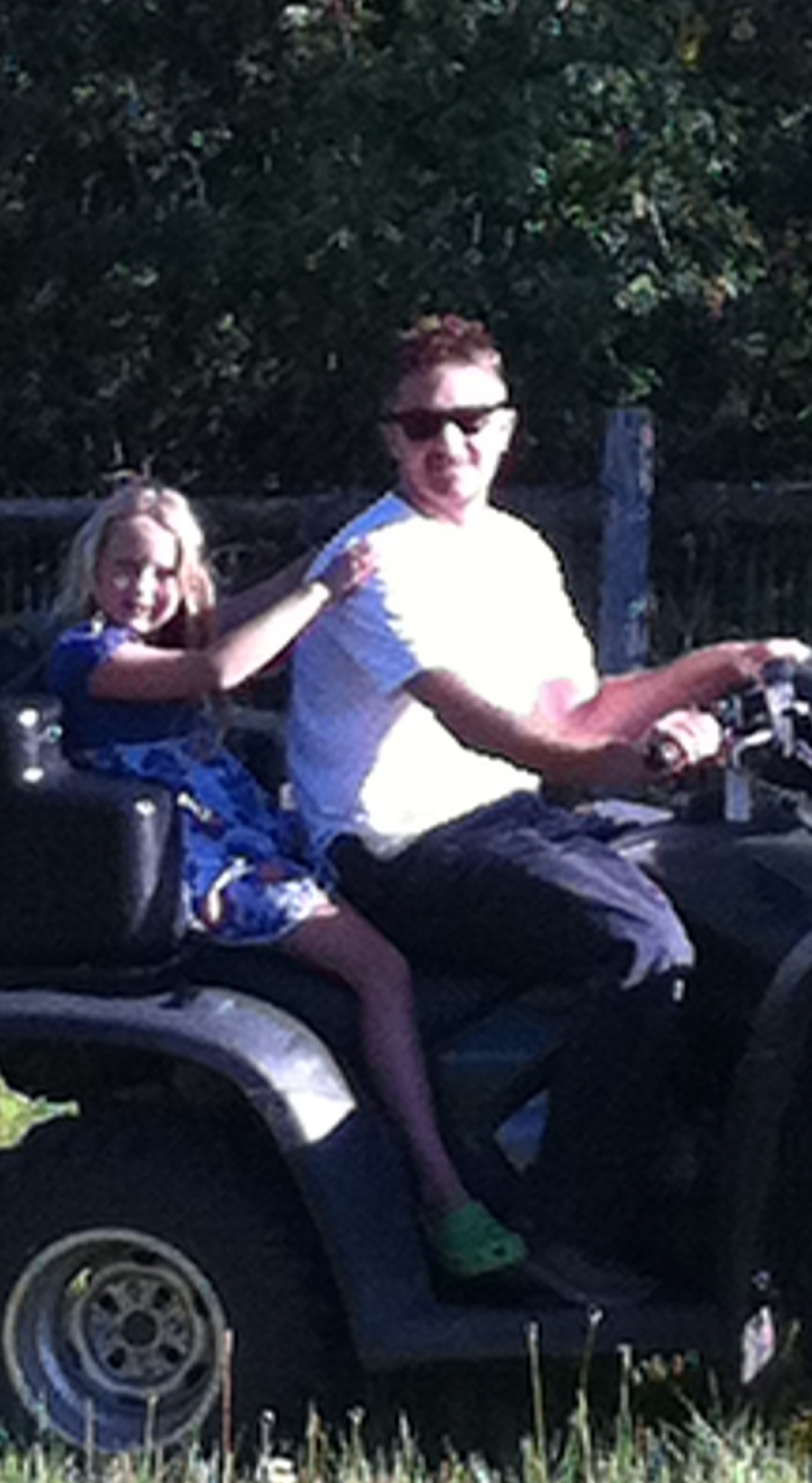
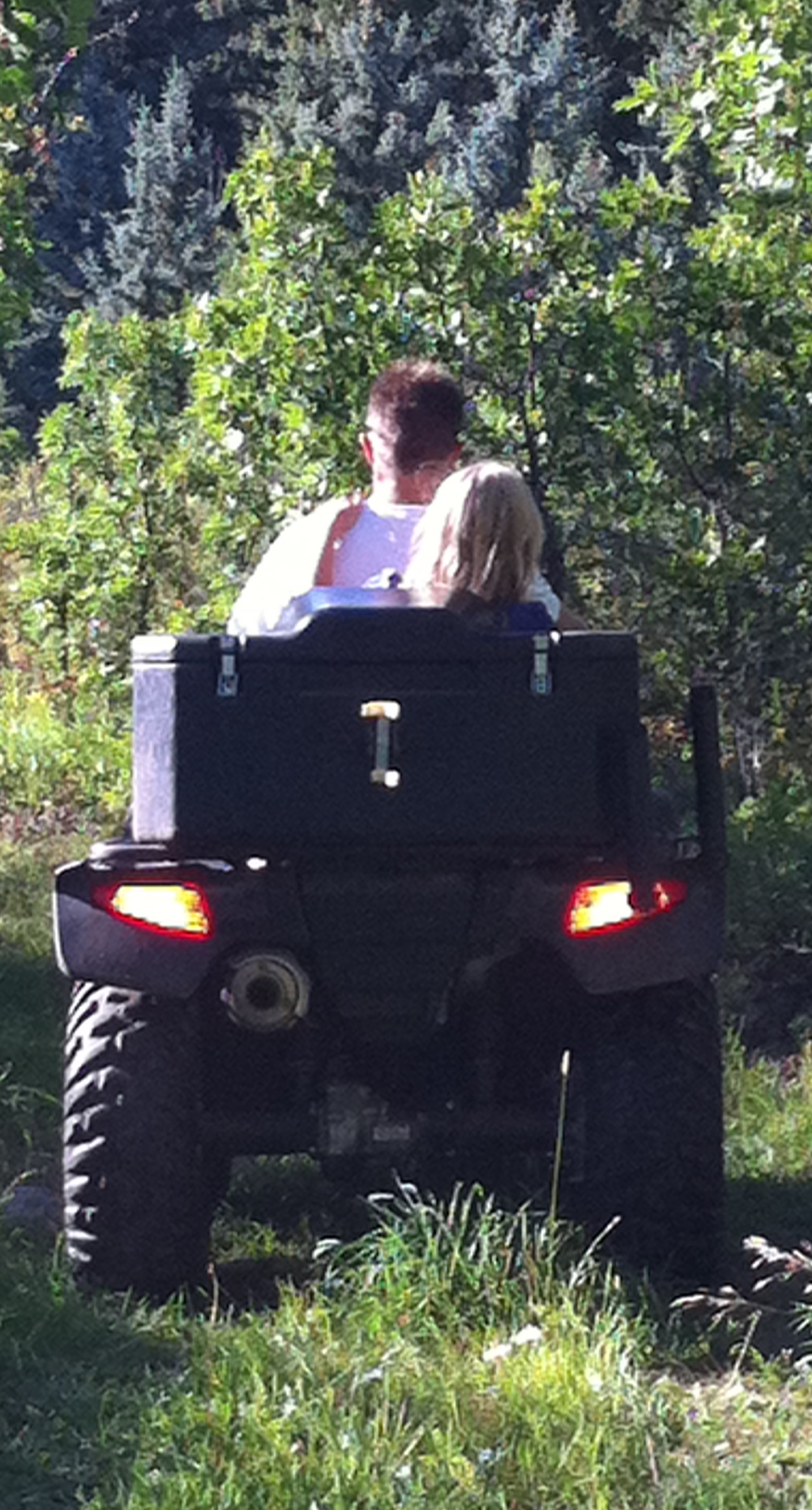
Colter, my other nephew was leading the way in a piece of machinery I actually do not have a name for, but it looks formidable, with much of our food in the back.  It was a procession and Emma was ecstatic riding along with Bridger as the rest of us trudged behind bringing up the rear.

Briger & Em Lead the Way
The Rest of Us on Foot
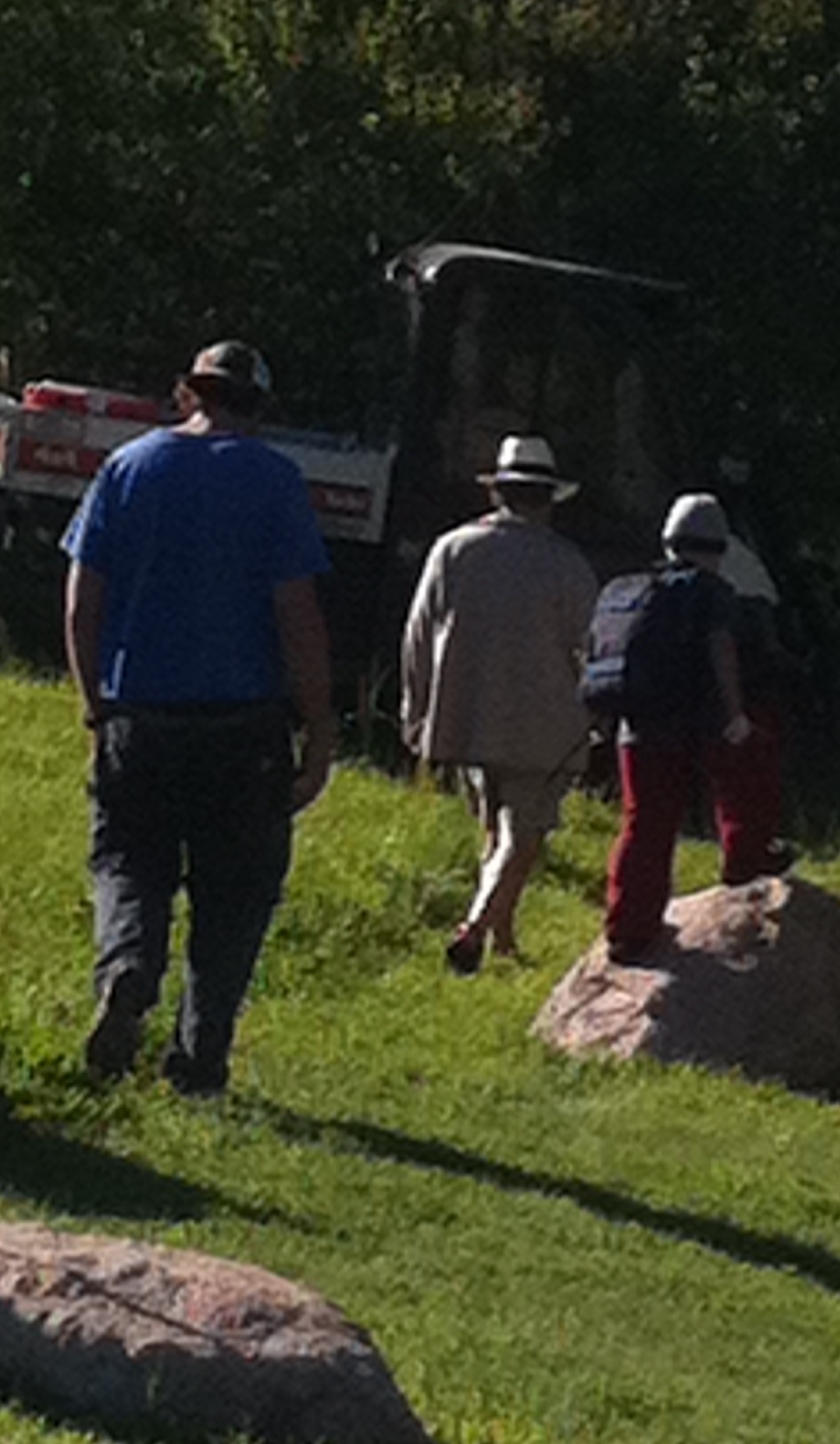
 

The dogs frolicked and fought over various sticks, pushing and shoving like small children, very nearly toppling my mother over on a few occasions.  As the cabin came into view everyone picked up the pace, dashing up the log steps and throwing themselves onto the now bare mattresses (they were once covered in quilts my mother and I meticulously made, but the mice got to them and now they are without) which serve as beds, sleeping two or three each.
“Have dinner?”  Emma asked, wasting no time in getting down to the essentials.

“You have to wait.  We’re going to eat together,” Richard said.

“Snack?” Emma asked.  It was good to see her father’s negotiating skills had not passed her by.

Then when none of us responded immediately she said, “Muzzy have snack?”  It was her killer instincts at work, going straight for the jugular.  What parent in their right mind could veto that?   Particularly as this was displaying everything we have dreamed of, attachment to a toy, pretend play…

Smart kid, I thought.

“Sure Em.  What does Muzzy want?”

“Yogurt!” Emma said.

“What kind?” Joe asked, never one to pass up an opportunity to get more language from her.

“I want yogurt,” Emma said.

“Yes, but what kind of yogurt?  Do you want peach yogurt?  Blueberry yogurt?” Joe continued.

“I want vanilla yogurt!” Emma said.

“Got it,” Joe said, rummaging around in his pack.

As Joe produced the vanilla yogurt, Emma sat down on the bench at the table, which occupies most of the floor space in the cabin.

“Here you are,” Joe said, setting it down in front of her.  “What do you need?”

“A spoon!” Emma answered.

She peeled open the foil cover and said to Muzzy, “Open wide!”

Muzzy’s Snack
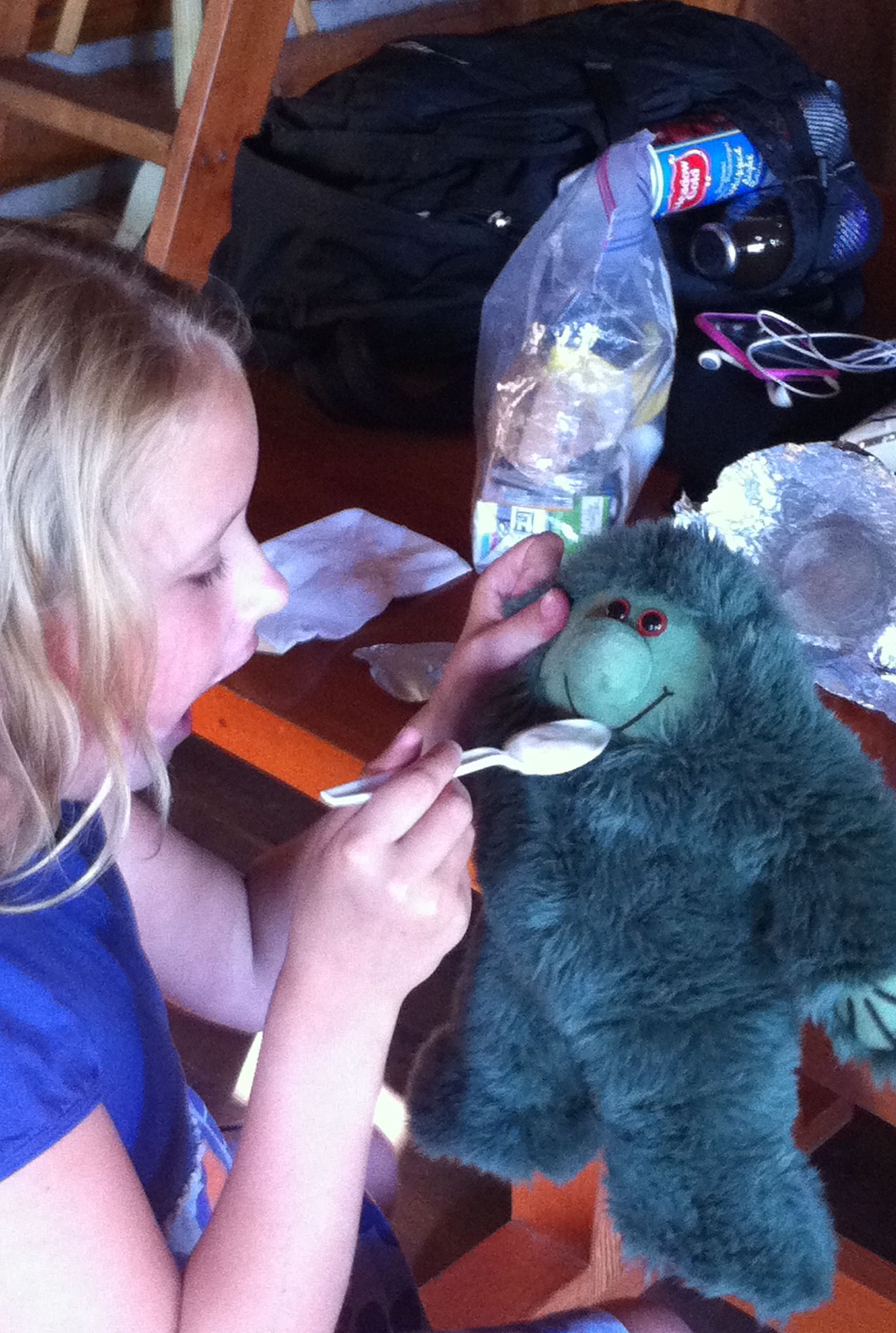
“Mmmmm…  all done.  Now it’s Emma’s turn,” she said, after pretending to spoon the yogurt into Muzzy’s mouth.

“It’s my turn,” Richard said.

Emma looked at him.

“You say – it’s my turn,” Richard said.

“It’s my turn,” Emma repeated.

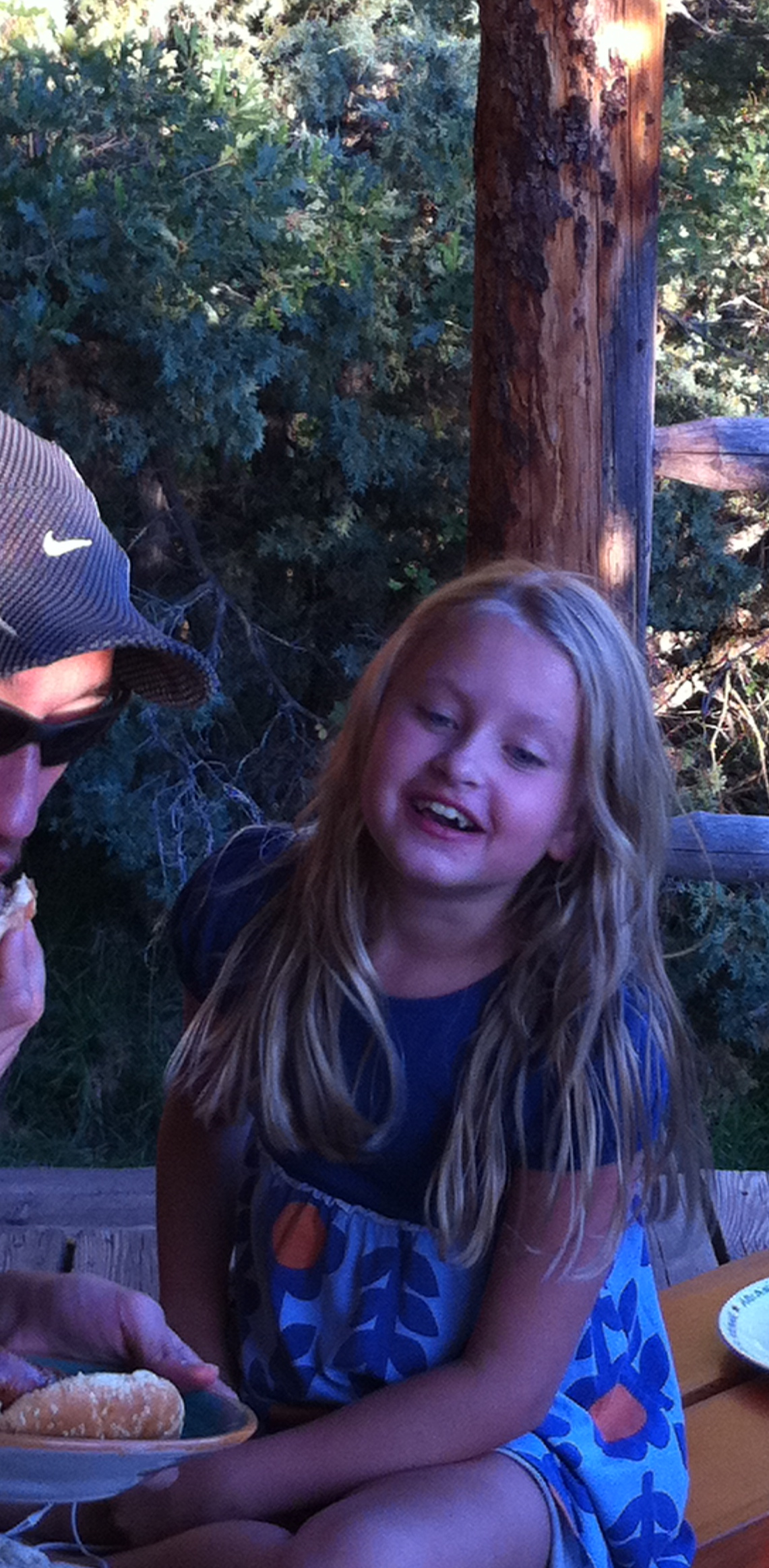
By the time the coals were ready and the burgers and hot dogs grilled, Emma had eaten her entire dinner.  She sat with us as we ate, serenading us with her favorite songs.  At times she became caught in a favorite refrain and needed to be reminded she had already sung that part several times and it was time to sing something else.

Emma Singing
“Go back to Granma’s?”  Emma said after awhile.

“No Em.  We aren’t going back until it’s dark,” Joe explained.

A little while later after we’d roasted marshmellows for our s’mores, Emma said, It’s getting dark!  Time to go back to Granma’s house!”

“You’re right Em.  It is getting dark.”

And with that she charged off as we gathered up our things.

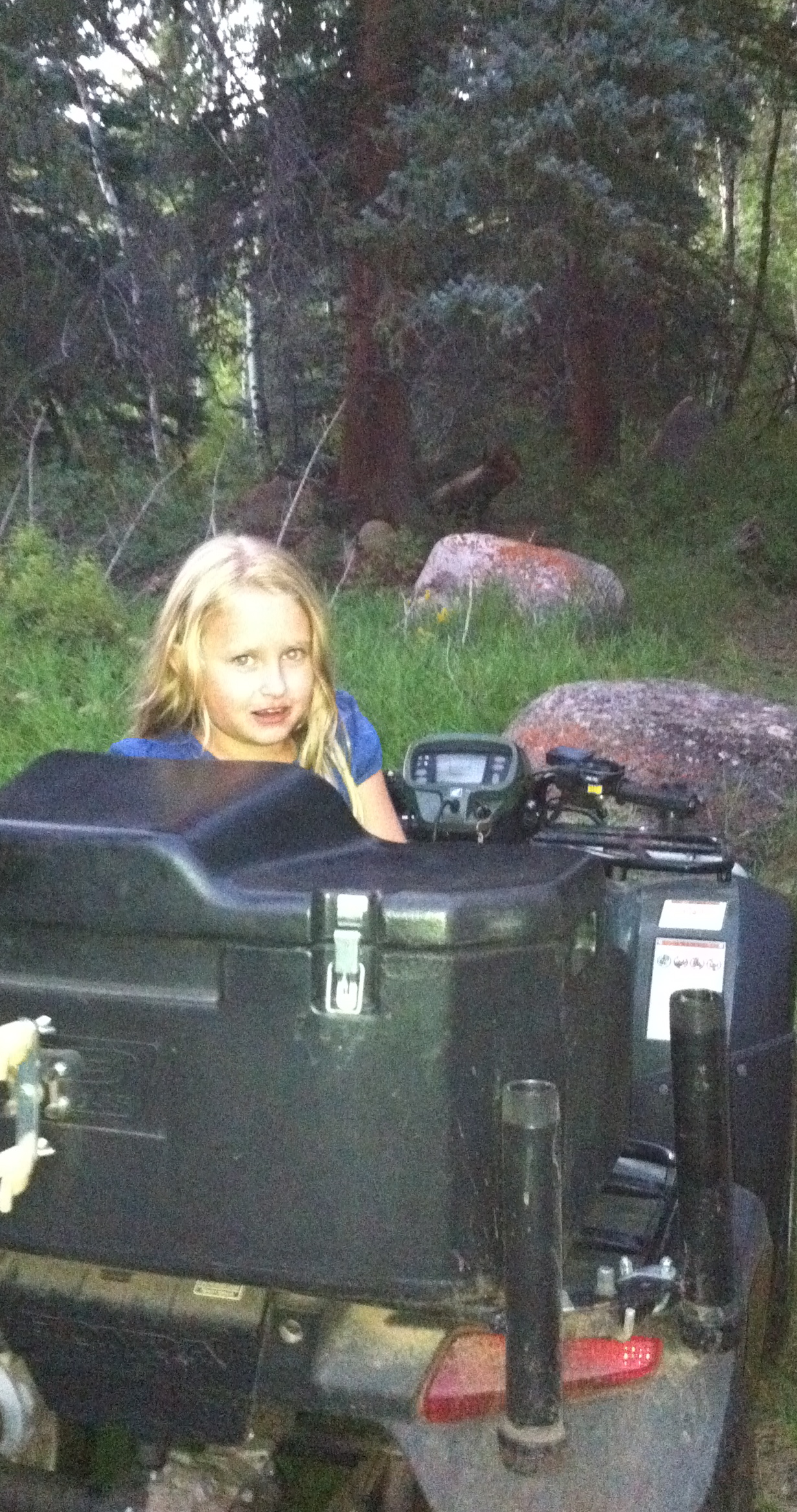
Emma Waiting To Return To Granma’s House
When we were back at the house, Emma looked at Bridger, waved her hand goodbye and said, “Bye Bridger!  Thank you for the ride in the four-wheeler!”

Emma waving Goodbye and Thanking Bridger
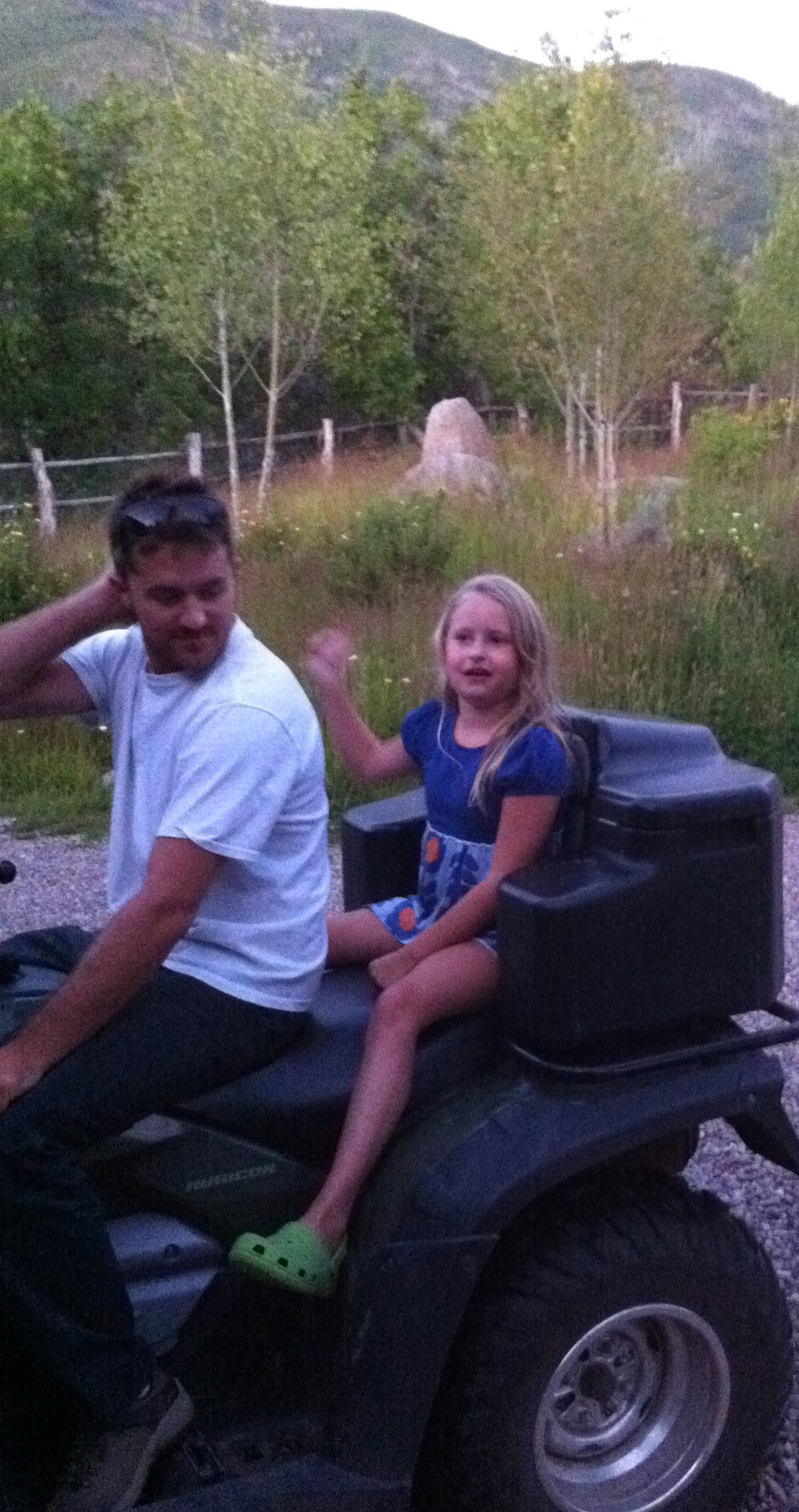
Richard, Joe and I stared at each other in astonishment, literally with our mouths open.  This was unprecedented.  In the past we would have prompted Emma to say exactly what she said.  That she did it without anyone reminding her, entirely on her own, with terrific eye contact and waving her hand…

It was nothing short of amazing!

May I just comment on the incredible eye contact in almost all of these photos?  Have any of you who loyally follow this blog seen such great eye contact?!

It’s unbelievable!
Em & Muzzy

Emma’s attachment to her green furry monster, Muzzy has grown to such a degree I feel compelled to honor Muzzy with his own post.

There are a number of significant early “signs” of autism:  An absence of pointing as a toddler, unresponsiveness to ones own name and a complete lack of interest or emotional attachment to inanimate objects such as stuffed animals or dolls, to name just a few.  Emma could be counted on to display all three of these things from an early age.  So it has been with great excitement we are witness to her growing desire to bring Muzzy with her on outings.  It is an attachment, which made itself apparent to us during her first stem cell treatment.  Emma asked to take Muzzy into the operating room and the doctors agreed it would be fine.  It was during that initial trip that Emma said to the anesthesiologist, “Muzzy first.”  Thankfully everyone was wonderfully good-natured and went through the motions of putting Muzzy under before it was “Emma’s turn.”

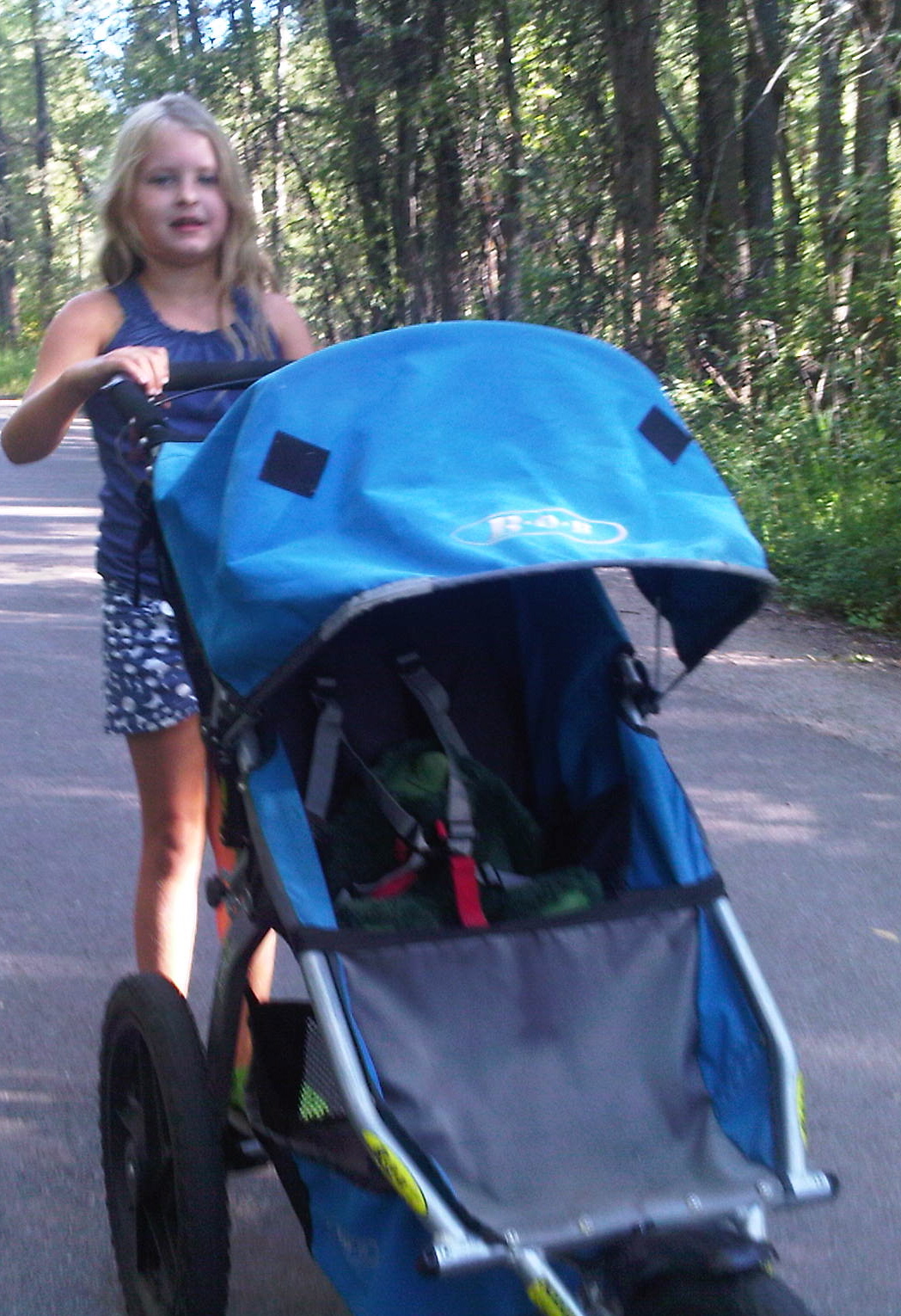
On a recent excursion with Joe, Emma insisted they take the jogger stroller out.  When they returned, I had Joe go over the outing in detail as I took notes.  Joe also took a video, which I haven’t been able to figure out how to post, so I’ve transcribed much of it.  I am always struck by Joe’s ability to use any opportunity to draw more language from Emma.

“Em, you’re too big for the jogger,” Joe said.

“Jogger stroller!” Emma said.

“Who’s going to go in the jogger?  Am I going to sit in it?” Joe asked pretending to climb in.

“NOOOOOO!” Emma said squealing with delight at the absurdity of it.

“I can’t fit!”  Joe exclaimed.

“Too big!” Emma said.

“Yes, I’m too big!” Joe said.  “Who do you want to go in the jogger?”  Joe asked.

“Muzzy!” Emma shouted twirling him around her head by one large furry arm.

“Oh!  You want to put Muzzy in the jogger?”  Joe asked.

“Yes!  Put Muzzy in the jogger.  Go for a walk!”  Emma jumped up and down.

“Okay, where should we go?”

“Muzzy needs to put on his seat belt,” Emma said, carefully buckling Muzzy in.

“Which way should we go?” Joe asked.

Emma carefully pulled up the “hood” on the canopy of the stroller, a flap of fabric covering a plastic window to peer down at Muzzy, checking to be sure he was all right.  “Muzzy sleeping,” she said.

“Big Muzzy is okay.  Esta bien!” Joe said in his Muzzy voice.

“This way!” Emma said, pointing east.  “Muzzy needs to go in the rain jogger,” Emma said.

“Do you think it’s going to rain?” Joe asked.

Emma stopped and lifted the flap to check on Muzzy.  “No!” Emma laughed.  “Let’s go this way, down the hill.”  Emma peered into the jogger stroller at Muzzy and asked him, “Do you want to go fast?”  Then she started running, pushing the stroller ahead of her.

“Do you want to go slow or fast?” is the type of question we often ask Emma as it is still hard for her to answer an open ended question and so we give choices.  Joe is terrific at coming up with choices for her, often one will be ridiculous such as –  Emma do you want to have some yogurt or should we eat this stick?  Emma will then laugh at how absurd this is and choose yogurt.  When we trained with Stanley Greenspan he emphasized the use of choices to increase language and back and forth dialogue.  It is not as easy or simple as it may seem.  I have found myself grappling for creative choices and coming up empty many times.

“How’s Muzzy doing?” Joe asked after a little while.

“Muzzy sleeping,” Emma said.  She stopped running and looked into the stroller.  “Do you want to go back to sleep?” she asked.  Looking at Joe she said, “Muzzy wants a snack.”

“Muzzy’s hungry?” Joe asked.

“Yeah.  Muzzy wants some vanilla yogurt,” Emma said.

After they stopped for a snack and continued on several miles, Emma said, “Time for Muzzy to go back to Granma’s house.  Muzzy needs to put on PJ’s.”

“Then what should we do?”

“Brush teeth, Muzzy go back to sleep,” Emma said.

Theories

Autism is nothing without theories.  Specialists, doctors, scientists, geneticists, parents, everyone has a theory when it comes to autism.

Richard claims I have more theories regarding autism than the most versed specialist.  And he’s right, I do.  The only difference is, I freely admit 95% of them turn out to be wrong and the remaining 5% have no validity because while they may prove right for Emma on any given day, they do not hold up long term or within the larger autism population.

Richard and I have a running joke about my desire, my need for theories.  When we are confronted with any new behavior from Emma, Richard will look at me and say, ”And your theory is?”

The beauty of having theories is, autism remains an enormous question mark and so the most impractical of theories hold weight if for no other reason than because they are difficult to prove wrong.  There is so much more we do not know than we do.  The other thing about theories is they give us  (me anyway) hope.  Hope that we’re moving forward.  Hope that maybe this line of thinking is going in the right direction.  Hope that the theory will lead to another theory, which in turn will prove to be true, leading us to a cure, a cause, something, anything…  No matter how crazy, the theory stands until proven otherwise and with autism that may be for a long time.  It’s something, anything, to go on amidst the great expanse of unknown.

Richard usually leaves the theorizing to me, so I was surprised when he said to me last night, “I have a theory.’

“Really?” I said looking at him to be sure he wasn’t making fun of me.

“Yes,” he said.

“Great!  Tell me more.” I said.

“Emma is doing great. “

“And your theory is?” I prodded.

“That is my theory.  She’s doing great.  The other day she and I were walking down the street.  I passed her and stepped off the curb to hail a taxi, but she didn’t see me.  She looked around, her eyes got really big and then she said something, I can’t remember what.  But she was scared and didn’t know where I was.  I called out to her – Emma!  I’m right here!  When she saw me, she cried out – There’s Daddy!  There’s Daddy!  I found you!  That’s never happened before,” Richard paused.  “She was really frightened when she thought I wasn’t there,” he said.

Suddenly I remembered when Emma was three and we went to New Paltz for the weekend.  We stayed at a huge rambling hotel right out of The Shining.  Richard and I in one room, the children with Joe in an adjoining room.  At around 2:00AM I heard a door slam, thinking nothing of it I started to go back to sleep.  Five minutes later our door opened and Joe said, “Is Emma with you guys?”  In a panic all of us threw on clothes and began searching the labryinthian hallways calling for Emma.  We split up hoping we might cover more ground that way, I ran to the front desk and reported her missing to the hotel staff.  It was the dead of winter, snow drifts piled up around the hotel, I was terrified Emma might open one of the self locking doors to the outside and not be able to get back in.  She was bare foot with just her nightgown on.  After about 20 minutes when panic had turned to ice – when your body no longer feels it is your own – one of us found her.  It was either Joe or Richard, I can no longer remember, but I know I began to cry in relief.  She was holding hands with some man who worked for the hotel.  He was quietly talking to her – at that time she had almost no language – and leading her back to the front desk.   I was in tears, thinking of all the horrible things that might have happened to her.  But Emma acted as though nothing unusual had occurred.

Richard continued, “Her sentences are becoming more complex, she’s become much more engaged, she talks all the time now and it’s not just because she wants something.  She’s talking to connect with us.  She wants to connect with us.  And except for the other night, she hasn’t wet the bed in almost a month now.”  He looked at me and then added, “She’s doing great.”

I remember when Emma turned four we had a big birthday party for her, hired a musician to come and play the guitar and sing kid friendly songs.  Emma was dressed up in one of her “party” dresses with a tiara on.  She spent most of the party trying to lie down inside of the musician’s guitar case, ignoring all the other children and the music.  I remember plastering on a smile for our guests, at one point I excused myself and wept in the back, giving myself two minutes to cry before returning to the party and pretending everything was fine.  I didn’t fully understand her sensory issues; I hadn’t developed any theories at that point.  I was still in the process of reading everyone else’s theories regarding autism.

“It’s a good theory,” I said to Richard.

“Yup.  I like it,” he said.

Emma’s School Bus

Emma came home this evening and said, “Sad.”  This was in answer to my question, “How are you?”

“Why Emma?  What happened?” I asked.

“Emma have to go on the school bus.  Emma make you sad,” she said, frowning and nodding her head.

“What do you mean?” I asked kneeling down so my eyes were on the same level as hers.

“You have to wait!  You have to sit!  Emma cry.  Emma bite yourself,” Emma looked directly at me as she said this.

“Why do you have to wait, Emma?” I asked.

“Want to go to Becky’s class.”

“Did your bus come to school early?”  I asked trying to piece together what Emma was trying to tell me.

“You have to wait.  Want to go to Becky’s class.”

“Did someone tell you, you had to wait?” I asked.

Emma nodded her head.  Shouting and pointing her finger she said, “I told you! SIT DOWN!”

At this point I was more than a little alarmed.  “Emma, who said that to you?”

Emma didn’t answer at first, then nodded her head.  “Yeah,” she said in a sad voice.

These kinds of responses from Emma only highlight how difficult it can be to communicate with her and understand her.

“Did the bus driver say that to you or the bus matron?” I asked, knowing these were the only two people on the school bus.

“Bus driver said – I told you NO!  Sit down!”  Emma said in a loud stern voice.  Then in a quieter voice she said, “Emma cry.  Emma so upset.”

I think it was at this point in the conversation when I went to the computer and wrote an email to our lawyer, ccing Richard and Emma’s head teacher, the head master and social worker.  I have no idea what kind of recourse is available to us and so we need advice.  What I do know is that we have had to deal with the Office of Public Transportation since Emma began going to school five years ago.  Emma’s bus arrives between 7:20AM and 7:40AM to take her some fourteen blocks to her school, which begins at 8:30AM.  When I called to complain about the early pick up time, insisting that it cannot possibly take an hour to drive fourteen blocks even if three of them are cross town blocks, I was told the bus picks up many other children who go to several nearby special education schools before Emma is eventually dropped off at her school.  In other words, Emma is driven around the city for close to an hour.  For years now I have questioned the logic in this and have been:  hung up on, yelled at or told this is the way the route is mapped out and there’s nothing that can be done.

A few years ago I was determined to have the bus change their pick up time from 7:15AM to something later.  For two months I went back and forth with various people at the Office of Public Transportation, sometimes calling three and four times in a single day.  By the time they finally agreed to change Emma’s pick up time the semester was coming to an end and we started anew with a new bus company and driver after the break.  Which is another bizarre thing.  Are special needs children the only ones who have a new bus company, new bus driver, new bus route every three to four months?  How is it that neuro-typical children in New York City have the same bus for the entire school year, often for several years in a row?

In the past few weeks I have noticed when the bus pulls up that there seem to be only one or two other children on the bus as was the case Thursday morning, no other children.  Emma was the only child.  So unless the bus is picking up children after Emma, it is driving fourteen blocks (which should take about ten minutes depending on traffic.  If the bus arrives early, (picks Emma up at 7:25AM drives ten minutes to her school, getting there by 7:35AM) it sits idling outside the school until the school’s doors open at 8:25AM.  Which means (if I am correct) Emma is waiting in the bus alone for almost an hour.

What makes all of this particularly horrifying to me is we put Emma on the school bus and cross our fingers she will be treated well and with respect, she will arrive safely at her school in a timely manner, but we cannot know what really goes on because Emma cannot tell us.  We have to trust.  And at this moment I no longer trust.

Rules

Emma can be very strict.  She is a stickler for rules.  Merlin (see yesterday’s post) is not supposed to jump up onto the counters or dining room table.  If he does, Emma shouts, “Merlin!  Get down!”  Even if he hasn’t jumped up on the counter (yet) Emma will remind him, “Merlin!  You may not get up on the table.”

If we have a vase of flowers on the dining room table Emma will repeatedly warn Merlin (whether it applies or not) “Merlin, kitty, you cannot eat the flowers!”  Then she’ll laugh.

These are all things she has heard us say at some point and Emma is a terrific mimic.  She will not only repeat the things she hears us say, but she will mimic the tone.  There’s a word for what she does.  It is – echolalia – common among autistic children.  Echolalia is the parroting or echoing of sentences and phrases heard.   Emma does not make the sorts of linguistic mistakes commonly heard in young children.  She does not say things like – I bringed it to her – something often heard from young neuro-typical children as they try their best to navigate the English language.  On the other hand Emma will say – Bye Emma! When saying good-bye to someone, whose name is definitely not Emma.  It is what she hears them say to her when they or she is leaving.  Why would she say anything else!?  To Emma “Bye Emma” means a parting of ways.  Or, as in the case of a dinner party we had a few months ago, Emma felt it was time for everyone to leave, she announced – “Dinner is all done!  Bye Emma!”  When our guests, understandably confused, said, “Oh!  Are you going now?” but did not themselves show any sign of leaving, Emma began bringing them their coats, saying, “Bye! Bye Emma!”  while vigorously waving her hand good-bye.  Needless to say she cleared the place out within minutes, despite our reassurances that it was not time to go yet and wouldn’t they like to stay and have some coffee or tea.

For Emma, however, we had eaten, she had patiently waited while this occurred.  She knew there would be dessert after which she would be allowed to blow out the candles on the dinner table while singing “Happy Birthday” (Any party is a birthday party and remarkably some guest almost always is about to have or has just had a birthday – so it confirms Emma’s ‘party = birthday party’ theory.)  Once Emma has sung Happy Birthday, usually several times and with all of us joining in for the third or fourth “last time” rendition – it is time to go to bed.  Emma has a difficult time understanding that we may not be ready for bed.  We may want to move into the living room to talk, have some tea or coffee and enjoy each other’s company.  This, for Emma, is not how it should be, it is her bedtime now and so it should be everyone elses too.  This sort of flexibility does not fit into her “rules”.  The guests should leave and if they do not, then Emma must remind them.

When Emma was beginning to talk she did not say single words, but whole sentences.  See previous post – “Emma at Ten Months Old”.  As Emma grew older, she would repeat things she heard others say.  But the things she latched on to were things said with a great deal of emotion, or, as Stanley Greenspan used to say, “high affect”.  Sometimes these comments were in context, but other times they were arbitrary.  A dear friend of mine who has two children just a bit younger than mine admonished her son in the playground one day while we were there.

“Rogan NO!”  She shouted, as her son dashed toward the gate leading out onto 10th Avenue.  Emma, for the next four years mimicked her in all sorts of situations.  Often it was when she wanted to go somewhere, but knew she shouldn’t, but just as often it was arbitrary.  Emma would shout, “Rogan NO!”   Sometimes she would add  “You have to come back!”  And sometimes she would just use the short hand version  “NO!”  But we knew from the way she said it, the tone she used who she was mimicking.  She had captured the voice perfectly.  A few years ago we ran into my friend with her children in the park and Emma upon seeing her, immediately said, “Rogan, NO!”  Fortunately my friend has a good sense of humor and didn’t take offense.

Emma does the same thing with another friend of ours.

“Jack!” Emma will shout in a stern voice.  Then “Jack!  Jack!  Jack!”  Said in rapid succession.  She captures the child’s name and the anxiety ridden pitch perfectly.  At Nic’s birthday party a few years back, Emma, upon seeing Jack’s father, started shouting – Jack!  Jack! Jack!

“I guess that’s how I sound, huh?” The father said, looking slightly embarrassed.

How to explain?

For Emma, rules help her cope in a world run riot.  Rules provide sameness and from that, Emma derives comfort.  Though Emma has been known to question some of the rules she does not like.  “We cannot make pancakes,” Emma will say, knowing it is a school day.  She hopes maybe we will make pancakes anyway and this is as close to a question as we often get.  But once confirmed, “No we cannot make pancakes this morning.  It’s Wednesday,” one of us will say, Emma will begrudgingly accept this.  It is our rule after all.

“Sleep, wake up, sleep wake up, sleep wake up, pancakes!” Emma will respond.

“Yes.  That’s right.  Pancakes on Saturday and Sunday.”

“Make pancakes with Mommy?”  Emma will say with a sly grin, trying one last time to see if this ‘rule’ can be suspended if for only one day.

“Pancakes with Mommy on Saturday.  Today is Wednesday.”

“Okay,” Emma will say.

The Search

One of the things I realized early on in my search to help our daughter was, there are a number of people who believe they know what causes autism and many more who believe they can cure it.  There is also a tremendous amount of money to be made from desperate parents, like myself.   I cannot tell you how often I took Emma to an alternative “healer” who claimed, if I just kept going and paying them their enormous fee, Emma would be cured.  I do not believe these people meant to deceive, I think they really have convinced themselves their method will cure a child and if it does not, it is because we didn’t give it enough time.

In many ways Bruno Bettelheim’s refrigerator mom is alive and well even if it has taken on a new twist in today’s world.  While no one came right out and said – You are to blame for her autism (and to blame if whatever method they were pushing didn’t cure her) – it was inferred by the questions they asked.  What follows is a sampling of a few of the questions I have been asked over the years.

Did you drink caffeine during your pregnancy?

No.

Did you or do you drink alcohol?

No.

Did you take any sort of medication during your pregnancy or labor?

No.

None?

No.

What about aspirin?

No.

Did you sun bathe?

No.

Did you have an epidural during labor?

No.  No drugs, natural childbirth.

How long did you breast feed?

9 months.

Just nine months?

Yes.  Emma didn’t want to breast feed, she weaned herself.  I wasn’t going to force her to breast feed when it clearly distressed her.

Ahhh…  Did you eat fish?

A couple of times.

What kind?

Grilled swordfish.  I didn’t know about the mercury levels in fish when I was pregnant with Emma.  It was only a few times when we were in Cape Cod.

Uh-huh…

There it was, finally, the answer they were waiting for.  Depending on the practitioner, the questions changed and as a result, my answers, but there always came a point when I gave the “wrong” answer. It always ended the same way with the same look – eyes downcast, a slight sad shake of the head.  I came away from these ‘interviews’ feeling angry, but I also wondered if there was any truth to it.   Maybe the two times I ate grilled swordfish while we were in Cape Cod, really was enough to cause her autism…  I think as a mother, it is second nature to wonder if something one did during pregnancy horribly effected the baby.  To this day I feel tremendous guilt for having unwittingly eaten swordfish during my pregnancy with Emma.  I honestly did not know how toxic our oceans had become.

I have become particularly wary of those who are adamant autism is caused by any one thing.  My guess is, it’s multi-causal, but who knows?  I am also wary of those who speak with absolute assurance they know how to “cure” autism with diets, behavioral therapies and alternative remedies.  Autism is a neurological disorder and while all of these things may play prominent roles in children getting better, I have yet to meet a child who has been cured, in fact, I have yet to meet anyone who has met a child who has been cured.

A Tribute To Stanley Greenspan

We first heard of Dr. Stanley Greenspan and his work through another parent who had seen some success using his DIR/floortime methodology with their autistic child.  I read his book:  The Child With Special Needs, which led to our appointment for a floortime training session with Emma.  We drove to Bethesda, checked into the hotel, took Emma swimming and hoped we might all get a good night’s sleep for what we guessed would be an exhausting day.  In preparation for the meeting, Richard and I watched some of Stanley’s training videos.  We felt we had a vague idea of what was expected of us.  Whether we would be able to engage and interact with Emma in the DIR way or not, we were not so sure.

So it was with some trepidation that we were ushered into Stanley’s office – a small dingy room with some toys, a few broken, Stanley’s desk and piles of papers and books.  Stanley asked us a number of questions, all the while watching Emma intently.  “Okay.  Mom, why don’t we start with you?” He said, still watching Emma.

“Hey Emma!” I said, huge smile, high affect.  “What should we play with?!”

Emma ignored me and wandered over to the couch where Richard was sitting.  I ran over to her, tried again to engage her, “What do you want to do?  Do you want to play with this,” I asked, thrusting an armless doll at her.

The office was hot. I could feel perspiration beading on my upper lip.  After about twenty minutes Stanley said, “Okay Mom.  That’s fine.  Now I need you to take that energy and up it by about 100%.

“You’ve got to be kidding!” I exclaimed.

Stanley smiled at me,  “You have a nice connection with her. “

As he spoke, Emma was busy trying to open the door to leave the office.  I tried to pull her away.  “No, no Emmy, we can’t leave yet, “ I said.

Emma resisted me and continued to turn the door’s handle.

“Em, it’s not time to go yet.  We have to stay here,” I said, pulling on her arm to come with me.

“Block her!  What will she do if you put yourself in the way?” Stanley asked.

I wedged my body between the door and Emma.

Emma tried to reach around me.

“What do you want me to do?” I asked.

Emma tried to push me out of her way.

“Oh!  You want me to move?”

“Don’t make it so easy for her.  Make her tell you what she wants!” Stanley coached.

“Emma, what do you want?” I asked, sure that this was leading to a melt down.

“Open it!” Emma said.

Richard and I gasped.  WOW!  We hadn’t heard Emma say that since she was 13 months old.

Stanley was brilliant.  Keenly observant, unfailing in his critique, he encouraged us to follow Emma into her world.  To interact with her, “playfully obstruct”, “entice her”, were a few of the things he encouraged us to do.  “The worst thing you can do is nothing at all,” he said, as our session came to a close.

When we returned home his insight and words stayed with us. We enrolled Emma in the Rebecca School in New York, which uses the Greenspan DIR approach. It is the only school in New York City using this model.  Richard and I undertook additional floortime training sessions at the Rebecca school and hired their DIR training specialist to work with us at home.  Alex trained Emma’s therapist, Joe as well.  Hence the “Zen Master of DIR” label in the last post.

Dr. Greenspan had a consulting relationship with the Rebecca School and we were privileged to have two sessions with him over the last three years. The entire school faculty was in attendance and Stanley was conferenced in by telephone. Richard and I began each session by updating everyone on Emma’s home life, her progress and problems and our questions on what we could do to help her.  This was followed by her teachers’ review of how Emma was doing at school. Whenever they addressed an area of difficulty, such as Emma’s self-injurious behaviors like biting herself, instead of giving his recommendations immediately, he asked the faculty for their ideas. He listened patiently and then offered his own suggestions, which were always so intelligent and insightful that Richard and I would look at each other with an expression of awe – and gratitude.

Dr. Stanley Greenspan’s ideas and methodology changed everything for us.  His belief in the intelligence and abilities of each and every child were a profound change from the kind of rote “training” we had heard and received in the past. To say that his presence and guidance in our lives will be missed is a vast understatement. It is a great loss for us and for all the parents and children who will never have the opportunity to experience his keen analysis and problem solving ability on an individual basis.  Yet his legacy will live on through his books and videotapes, his DIR Support Services under the brilliant stewardship of his son Jake, a floortime genius in his own right – and with schools like Rebecca School, which have adopted his teachings as their principle therapeutic model, helping countless autistic children and their families like ours move forward one day at a time.

For more information on Stanley Greenspan and his work with Autism read:  Engaging Autism & The Child With Special Needs and go to his web site:  www.stanleygreenspan.com

From Joe (Emma’s Therapist for the Past Five Years)

Joe, Emma’s therapist, who came to us five months after we received her diagnosis, was initially trained in ABA (Applied Behavioral Analysis).  As Emma regressed using ABA, Joe was the first to agree with us that we should find another methodology which might work better.  When we found Stanley Greenspan (who died April 27th, 2010 – next post will be a tribute to him) Joe was an eager participant in learning how to do Stanley Greenspan’s DIR (developmental, individual-difference, relationship-based) therapy with Emma.  Joe has since become the “Zen Master” of DIR.  He is brilliant at it and watching him work with Emma is a profound experience.  The following is a post by Joe.

“I was watching ABC’s Nightline last night, which aired a story about a pro-surfer who has autism. Watching his intensified focus on the waves certainly reminded me of Emma’s physical grace and all of her athletic talents – skiing in particular. They described the teenaged surfer as someone who’s “mastered the seas but still struggles on land.” On the water he feels relaxed, but on land he must face the pressure and anxiety of social interactions. Like Emma, the surfer has no physical indication of any disorder so his inability to respond appropriately to social interactions (or simply say hello) is often interpreted as rudeness. This is one of the dozens of catch 22’s of autism – wanting her to be seen and treated just like anyone else but also expecting others to be understanding/non-discriminatory once they find out she’s autistic.

The surfer’s story ended by crediting his autism for opening this door for his talents to shine: a door which may have otherwise remained shut.  While Emma’s autism has come with its vast array of difficulties and challenges, it has also opened similar doors for her talents to shine. While I feel many of Emma’s abilities are innate, I believe a stage needed to be set in order for them to be unveiled. So I end this story by crediting Emma’s parents, Ariane and Richard, for all of their endless efforts to open every door and set every stage possible for her. As for her athletic talents, giving her the opportunity to swing herself at 18 months, getting her into gymnastics at 2 years old, and strapping her into skis at 3 years old is just a fraction of all of the sensory input she was constantly provided with at such an early age. While Emma continues to shine in the spotlight, I credit her director and choreographer, Ariane and Richard, for making it happen.”

Misconceptions Regarding Autism

Denis Leary made a stir in 2008 when he made public his belief that autism was caused by “inattentive moms and competitive dads”.  His comments echoed Bruno Bettelheim, who in the 1950’s posited autism was caused by emotionally distant mothers whom he referred to as “refrigerator moms”.   While Bettelheim’s theories were largely rejected in the 1960’s, there remains confusion by many people when confronted with an autistic child.   My guess is many people believe autism is a psychological problem as opposed to neurological.  As my mother so beautifully wrote in her post From Emma’s Granma autism is largely invisible.  Because of this, people often assume the child is behaving badly because they are spoiled and the parents are unaware or worse, condone the bad behavior.

Several years ago, Joe, Emma’s therapist, was with Emma in the park when she fell to the ground screaming she wanted to ride the carousel one more time.  Joe, knowing Emma needed to be back home, told her it was time to go.  Emma refused and sat in the mud in her pretty dress crying and screaming.  A group of women stood nearby, watching with looks of shock and concern.

Emma continued in full melt down mode repeating over and over again, “I want to ride on the carousel!”

One of the women asked Emma if she was okay.  When Emma didn’t respond, Joe tried to physically pick her up, thinking she might calm down once he was holding her.

Another woman in the group yelled at Joe, “Don’t touch her!”

“You have no idea what’s going on here,” Joe said, trying desperately to get Emma to cooperate.

“I’m calling the police,” the woman said, pulling out her phone.

Figuring there was nothing he could say or do to make the women understand, he finally was able to pick Emma up and carry her out of the park.

The group of women followed Joe for the next ten to fifteen minutes.  At which point Emma was calmer and Joe was able to get her into the subway and home.

When Joe arrived back at the house, he was visibly shaken.

All of us who have spent time with Emma over the years have experienced versions of Joe’s experience.  I remember being in a playground in Central Park with Emma one weekend.  It was crowded and Emma was having a tough time waiting for her turn on the swing.  Each time one became empty she rushed forward, trying to grab it.  I ran after her, explaining that it wasn’t her turn yet.  Finally one of the father’s of another child turned to me and said, “Hey!  Can’t you control your kid?”

“She’s autistic”, I said.

Before I could explain further he interrupted me and said, “Yeah?  Well my kid likes to paint too.  Who cares?!”

Confused, I said nothing, but as I led Emma back to her place in line I realized he had misunderstood me and thought I’d said, “artistic”.

It became a running joke at our house whenever any of us didn’t want to do something we’d say, “Hey, I’m artistic.”

Food

As Emma began to regress, starting at around 13 months old, it was not just what I believed to be typically “autistic” behaviors – lack of eye contact, delayed speech, obsessive-compulsive behavior, rigidity – that regressed, but things I didn’t expect, such as the restriction of  foods.  Slowly, just as her speech began to disappear, so did her ability to try new foods and after a few years, a paring down of foods that were a staple to her diet fell away as well.

The following is a list of the foods Emma will eat.  Anything else she refuses.

Cheerios

Mango Fruit Leathers

Red Grapes

Bananas

Apples

Wheat toast with Organic Raspberry Jam (must be the red labeled wheat toast from Whole Foods & The Organic Raspberry Jam from Whole Foods)

Horizon Vanilla Milk – occasionally she will drink the Horizon Chocolate Milk

Stonyfield Chocolate Yogurt (She use to eat the caramel yogurt as well, but they discontinued it.)

Motts Apple Juice (this was an issue in Costa Rica as they had a different brand and she refused to drink it, though eventually did, cut with water)

Pirate Booty

Baby Bel Cheese

Grated Cheddar Cheese – must be orange

Pancakes

Maple Syrup

Chips Ahoy (she will not eat any other kind of cookie)

As a baby Emma was a healthy eater and tried just about anything I put in front of her.  At 9 months she ate a mushroom-barley soup I made.  I recorded this milestone in her baby book.

Many people believe that autistic children are unable to process gluten and dairy, others believe that their child has food intolerances which adversely effect their behavior and some believe that a gluten free/casein free diet has cured their child of autism.  While I have never met a cured autistic child or personally know anyone who has, I do know of one child who clearly functions better without dairy in their diet and a number of autistic children who are allergic to a variety of foods.

In October of 2004, we began working with a DAN (acronym for Defeat Autism Now) doctor who was also a pediatric nutritionist/allergist.  We removed all dairy and wheat from Emma’s diet.  At that point she was eating a limited, but varied amount of foods such as scrambled eggs with cheese, a wide variety of fruits, all flavors of yogurt, ham, turkey, chicken, dried fruits, carrots, etc.  In retrospect her diet seemed limitless in comparison to what she whittled it down to.

Once on the gluten free/casein free diet she refused to eat any new foods to substitute for the old.  I stayed up, often until after midnight, baking wheat-free breads made from rice flour, almond flour, and almond butter.  I found web sites that specialized in casein free/gluten free products and recipes.  I developed a way to make my own organic pureed fruit leathers, which I spread onto baking sheets and dried in a low heated oven for 10 hours or over night.  To celebrate her third birthday I made an entire menu of gluten free/casein free foods.  Emma would not touch any of it.  Even refusing the birthday cake I made, which everyone else seemed to like, including Nic.  Though he confided in me later that he didn’t like it as much as a ‘normal’ cake, but didn’t want to hurt my feelings.

After three and a half months and no change in her behavior, other than a 10% loss of body weight, we took her off the diet and slowly introduced her old foods that she once loved.  Only now she refused to eat most of the old “fail-proof” foods too.  It was as though she never liked them to begin with.  The DAN doctor advised us to introduce one food we knew she liked – we chose cheddar cheese – and to give her a great deal of it and then wait to see if we saw a discernable change.  I gave her several ounces of cheese, which she ate and then waited to see what would happen.  After several days and no change, the nutritionist advised us to introduce yet another food.  We repeated this exercise over and over again.

Occasionally now Emma will take a ‘bite’ of some other food – say grilled chicken – with great reluctance and protest.  I remember a friend telling me about her sister who refused to eat any foods that were not “white”.  I was horrified by the story and remember thinking I would never have a child like that, as I prided myself in being an excellent cook and would never tolerate that sort of “behavior.”  I have since come around to the pick-your-battles way of thinking.  The food battle is one I am just not willing to engage in any longer.

Late at night when I am caught in a cycle of worries, I console myself with the idea that there are certain indigenous populations that survive quite well on extremely limited foods, such as a group of Eskimos who survive on whale blubber and little else.  For now that consolation will have to do.

From Emma’s Granma

“I have four grandchildren, and the youngest is Emma.  She is a beautiful blond with blue eyes and a sparkling smile, she skis like a pro, she swims, she climbs the climbing wall at the rec center, she balances on the back of the sofa (while her granma shudders in fear that she might fall), she sings with near perfect pitch, and she is autistic.  When I was growing up such children would have been hidden away.  Anyone who encountered them would have avoided them, other children would have teased them, or worse still, abused them.

My husband spent the last ten years of his life in a wheelchair.  He told me that in social gatherings people avoided him because they didn’t know what to say to someone who was so obviously disabled.  Today men and women in wheelchairs compete at the Olympics.  They race on prosthetic limbs, those who are blind ski with Challenge Aspen.  I have a friend, one of the founders of Challenge Aspen, who skis in a specially designed chair.  She tells me that she skis better now in that chair than she did eighteen years ago when she had full use of her limbs.

Scientific research, skilled therapists and loving families have helped all these people achieve a potential that would have been denied them eighty years ago when I was born. These people are actually lucky because their disabilities are visible, and so scientists and skilled therapists have been funded with the means to investigate all avenues that might lead to improving their lives.

Autism is not visible, but inside of Emma there is also a person yearning to be understood, to be able to communicate, to tell us of her fears, her frustrations, her desires.  She too wants to be  treated with understanding and compassion.

In the family room we have a stage with a curtain.  Emma loves to draw back the curtain and sing and, as her father says, strut her stuff as if to an enormous audience.  One day she too will reach her potential.  One day she will step down from that stage, her inner person will emerge, and she will still sing like an angel, but also she will speak with clarity, she will laugh with us, play games with other children and be able to step off into the future with confidence.

Such is our hope.

But even if none of that turns out exactly as we might wish, one thing is certain, wherever she goes, however she behaves, she will walk in beauty, surrounded with love.”

To see a survey that my mother participated in on the effects of autistic grandchildren and their grandparents, go to:  http://www.iancommunity.org/cs/ian_research_reports/ian_research_report_apr_2010

Toys

When Nic was a toddler, I would frequently take him to our favorite local toy store, Kidding Around, where he would play with the elaborate train set, Tina, the owner, had in the back of the store.  Very popular with the four and under crowd, particularly in the afternoons, we would go in the morning and often, Nic would have the train set all to himself.  Each day of our visit when Nic was just beginning to talk, he would point to something as we were leaving, “That!” he would say, which meant he wanted to take it home with him.

When Emma was about the same age, I took her to Kidding Around, but nothing caught her attention.  I tried to entice her, “Look Emma!  What a pretty doll!  Do you like it?”

She ignored me and wandered off.

Undeterred I went over to the two wooden tree stands filled with large plush hand puppets.  They were lovely and soft, in bright colors and came in a variety of different species, toucans, leopards, dogs cats, horses, as well as mythical creatures and monsters – a favorite of Nic’s.

I thrust my hand in one, a beautiful white unicorn with flowing mane and purple horn, “Emma!  Look!  I’m a unicorn,” I said, in what I imagined a unicorn’s voice would sound like if they existed and could talk.

Emma showed no interest.

The one toy Emma was attracted to was the miniature doll’s stroller, which came in pink and blue.  I placed a baby doll in one of them when I saw her looking at it.  “Look Emmy it’s for the baby doll,” I said.

Emma pulled the baby doll out of the stroller and proceeded to try and sit in it herself.  Terrified that she would break it, I said, “No Emmy!  That’s not for you!  It’s for the baby doll.  You’re too big for this stroller.” Again I placed the doll into the stroller.

Emma threw the doll onto the floor, took hold of the doll’s stroller and careened around the store, heading toward the door.  I chased after her and herded her back inside, admonishing her that she couldn’t go out into the street.  Each time we returned to Kidding Around, out the door she would tear, steering the doll’s stroller around, and a few times into people who were in her path.  It got so that I would block the front door while Nic played in the back, every now and again his little voice calling out, “Mommy!  Emmy’s taken the stroller again!”  I would position myself in front of the only exit, while she would try to maneuver around me, fixated on getting that stroller and herself outside.

“She just doesn’t like toys,” I reported to Richard that evening.  “My sister never played with dolls,” I said when he didn’t say anything.  “Emma’s athletic, just like my sister,” I finished, unsure of why I suddenly felt so defensive.

Talent Show

I was listening to Emma and Lee singing ‘Que Sera, Sera’ after Ariane posted it and was moved to tears as I always am when I hear how heartbreakingly pure and sincere her voice is. It is so sweet that I can’t think of any word to describe it other than angelic.

I first played her ‘Que Sera Sera’ on You Tube about two years ago after hearing a slow and somewhat melancholy version of the song in a Francis Ford Coppola film. I’ve always loved this song, even in the brighter Doris Day version, which Emma prefers, though the way she sings it brings out the poignancy of the lyrics and melody in a way Doris could never even dream of.

Emma has near-perfect pitch and a set of lungs an opera diva would envy. But so much more powerful and affecting than those qualities is the sheer sweetness of her voice, like everything that was good and kind and happy and wonderful in the world was distilled in a golden elixir that pours out whenever she sings that song.

Most of the time, her singing is loud and raucous, though no less heartfelt and touching in its own way, at least to my ears. Emma loves to perform, though there isn’t any trace of ego in her desire to strut her stuff. I guess that’s part of her condition to some extent, a reduced sense of self.

Last night before bedtime she said, “Talent show?” very loudly while I was playing chess with Nic.

“Sure Emma, we’d love a talent show,” I replied, smiling at Nic who smiled back with a “here we go again” sigh and headshake that seemed to sum up all his conflicting feelings – amusement, love, frustration, exhaustion, mild embarrassment. There was no one else in the house, so I’m not sure he felt any embarrassment, other than perhaps a conditioned response to similar, more public displays.

Myself, I was very much looking forward to the show, which turned out to be a medley of Carole King songs for children, culminating in ‘Chicken Soup with Rice’, which she belted out like a Broadway veteran. She always goes for the big finish and this particular song jumps up an octave or two at the end. She totally nailed it. Nic and I laughed and I applauded as loudly as she sang.

People often ask me whether Emma has any special talents. When anyone asks a question like that I figure they’ve been watching “Rain Man” and want to know if she has any savant abilities. I usually say that those types of abilities are associated with what has traditionally been called Asperger’s Syndrome – though I recently read that the medical community wants to abolish that term and use ‘Autistic Spectrum Disorder’ for everyone.

After that disclaimer, I will typically add that she does have an incredible memory and will mention things that happened to her when she was two or three years old. She can also remember very specific catalogues of objects, particularly photos. She really likes photos and home movies – I think they help her talk about and identify people, things and activities she enjoys. She has a shoe box with 100 or more photos inside and she will know instantly if one is missing, setting off a frantic household hunt for the lost picture in order to stave off a total meltdown or some self-injurious behavior, like biting her arm as hard as she can.

She is also extremely advanced in a wide variety of physical activities: skiing, climbing, balancing, jumping, swimming.
And of course, she loves to sing and dance.

There was an award-winning documentary that came out a while back called ‘Autism: The Musical’. It was a very inspiring movie and we thought this might be something Emma would enjoy given her showbiz leanings. When they started a program called ‘The Miracle Project’, based on this concept at her special ed school, we enrolled her and are very excited to see what might come out of it.

Every year at her school they have a talent show and every year, Emma has been the star of the show, soloing in ‘A Spoonful of Sugar’ from Mary Poppins in her debut performance.  Since then she has referred to any of her singing performances as a talent show, which I love. I bought her a number of karaoke video games with microphones but she has been much more enthusiastic about singing along from memory to a DVD or You Tube clip. She has quite an impressive set list for her concerts now, which routinely take place at birthday parties or dinner parties (which are also birthday parties as far as she’s concerned), or whenever the mood strikes her. An audience of one or two is enough, though like most performers she likes to play a full house.

I’ve always thought that she’s a total rock star and someday she’ll be cranking it up on a big stage – leaving our ‘dinner theater’ circuit far behind. Time will tell. For now, I revel in her impromptu serenades and every time she says, “Talent Show?!” my heart skips a beat in happy anticipation.

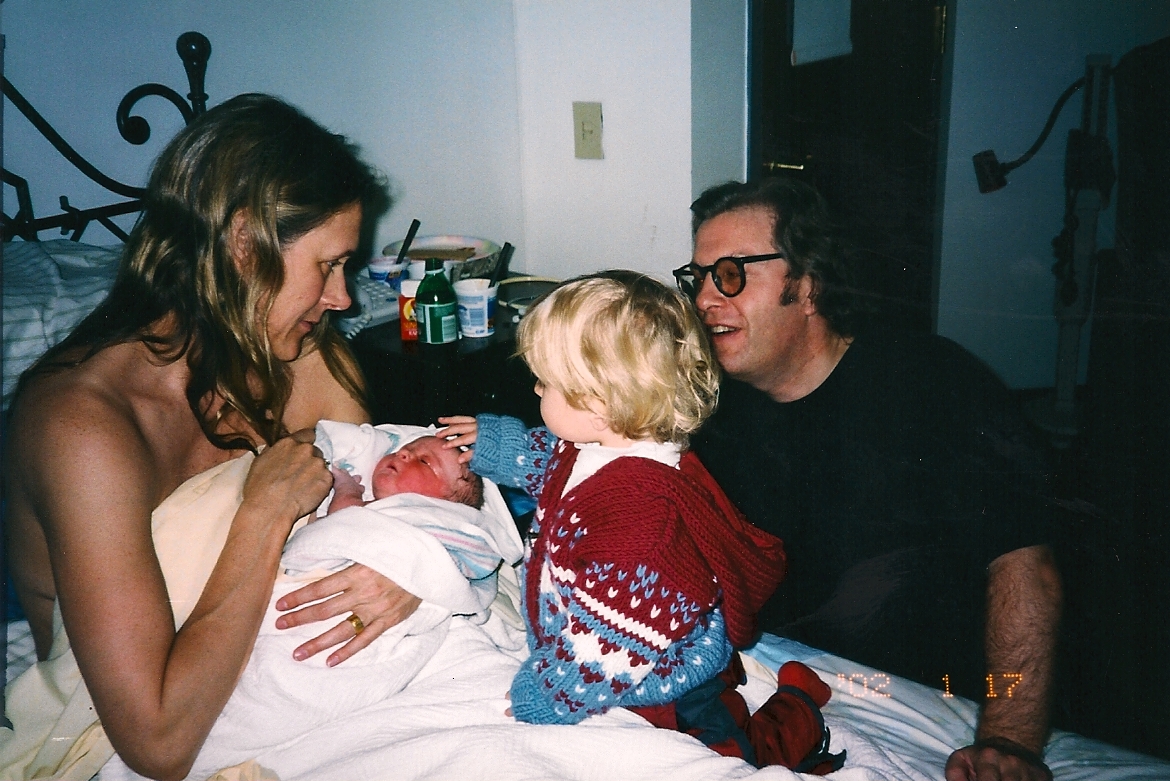
The Birth

(I wrote this yesterday at exactly the same time Richard was making his first entry on this blog.  Soon we will be finishing each other’s sentences..)

“Is she okay?” I asked the mid-wife about a half an hour after Emma was born.

“She’s fine, probably isn’t hungry yet,” the mid-wife responded.

Something about the way Emma seemed to brace herself against my touch, her seeming discomfort with the air in the room, as though it scraped against her skin and somewhere deep down, I felt the beginning of a worry, a tiny twist in my gut.

Emma is our second child.  Nic, her older brother by 21 months, had immediately begun nursing after I gave birth to him.  There was a bond from the instant he left my body, a connection that no cutting of the umbilical cord could sever.

When Emma finally appeared after 19 plus hours of labor she squinted at the lights in the birthing room, seemed to push away from contact with my body, she had no interest in breast feeding, she cried and nothing I did soothed her, it was as though an invisible scrim had unfurled, keeping us apart.  I shrugged the feeling off and reveled in her.

Eventually Emma became hungry enough that she breast fed, but never with any enthusiasm.  Emma did not seem to take solace in breast-feeding or receive any comfort from it.  It was fuel and that was it.  With Nic I use to joke that breast-feeding was kiddy Valium.

When Nic was an infant we bundled him up in a sling and took him with us to a dance performance at the Joyce Theatre.  The couple to my left audibly groaned when we took our seats next to them.  About twenty minutes into the performance, Nic stirred.  I began breast-feeding him.  Immediately he fell asleep.  As we were leaving the couple to my left said, “What’s your secret?  We never heard him make a sound!”  “Breasts,” Richard replied and the other man nodded his head smiling.

With Emma I remember thinking that she was astonishingly independent, even as an infant, that she was following in the footsteps of countless generations of my ancestors; strong women who had blazed trails of their own making, ignoring society’s attempts to dissuade them.  Emma was the embodiment of generations of those women, I decided.

The Beginning (Cont’d)

Some of the books I read:

Let Me Hear Your Voice: A Family’s Triumph over Autism by Catherine Maurice

*Nobody, Nowhere by Donna Williams

*Emergence:  Labeled Autistic by Temple Grandin

*A Slant of Sun: One Child’s Courage by Beth Kephart

*An Anthropologist on Mars by Oliver Sacks

Maverick Mind by Cheri Florance

A Parent’s Guide to Autism: Answers to the Most Common Questions by Charles A. Hart

The World of the Autistic Child: Understanding and Treating Autistic Spectrum Disorders by Bryna Siegel

Handbook of autism and Pervasive Developmental Disorders by Donald J. Cohen & Anne M. Donnellan, ed.

Biological Treatments for Autism and PDD by William Shaw, Bernard Rimland, Pamela Scott, Karyn Seroussi, Lisa Lewis & Bruce Semon

Special Diets for Special Kids by Lisa Lewis

*Sensory Integration and the Child by Jean Ayres

Teach Me Language: A language manual for children with autism, Asperger’s syndrome and related developmental disorders by Sabrina K. Freeman, Lorelei Dake & Isaac Tamir, illustrator

*Engaging Autism by Stanley Greenspan

*The Child with Special Needs by Stanley Greenspan

*Denotes books that were very helpful and continue to be

When I wasn’t reading books on autism and canvassing the internet reading the endless array of therapies being offered, each with it’s own little morsel of hope attached –  perhaps this will be the thing that she responds to – I was scheduling Emma’s early intervention therapists.  There were often 7 therapists in a single day, coming and going.

I look back on that period and wonder what it must have been like for Emma.  How odd it must have seemed to her, but she took it all in stride.  There were a few exceptions, the days when I would sit outside her bedroom door during her therapy, leaning my head against the wall listening to her scream as she tried to leave the room, but the therapist would patiently tell her she could not until they had finished and I would cry, fighting the urge to let her out – all that separated us was the four inch wall of her bedroom.  I remember feeling that everything I thought I knew as a mother – all my maternal instincts were useless.