Tag Archives: autistic

Ups and Downs

I was reading an article this morning on RNA interference when the following quote by a pharmacology professor caught my eye – “A lot of excitement for RNAi was irrationally high to begin with, and now is irrationally low.”

It reminded me of how I have felt each and every time we have gone to South America for one of Emma’s stem cell treatments.  In the beginning I am elated, sure this will be the thing that causes her to crawl out from beneath the fog of her autism.  Then after we’ve returned home, I am guardedly hopeful, watching, waiting and after a few more weeks I’m convinced the whole thing was an exercise in heartache, stress and worry.

I go from the extreme high of wishing myself into believing this will prove a miracle to the low of believing it’s a complete waste of time or worse.  What I have not managed as well is that whole grey area residing between those two states.  Which is why the brain scans are so essential.  Though I have moments of disregarding those as well.  If I relied entirely on my perceptions, often clouded by feelings, desires, wishes, expectations, I would be making some very poor decisions.

We have been working with Emma on her handwriting and teaching her to type using a program developed by a literacy specialist.  It has proven to be quite an incredible experience.  Emma is now writing legible letters and is able to match two and three letter words.  She is also learning to type on a computer keyboard.

A couple of things I’ve realized:

1) Most written words are written in lower case letters, yet most writing programs teach upper case letters first.

2) All the letters on a keyboard are in upper case, making it very difficult for a child to translate the letter from lower to upper or vis a versa.  Something I had never “noticed” before until we began working on typing with Emma.  She is getting the hang of it, but it’s been interesting.

3) The letters Gg, Qq, Ee, Rr, Bb, Dd and Aa are completely different depending on whether they are in lower or upper case.

As I am not a teacher – these rather obvious items I’ve listed are something I had taken for granted until now.  I am amazed how well Emma is doing.  She seems to understand the same letters can look different and yet are the same.   But, and I do need to say this, Joe and I have been working with her for a number of weeks now and I was feeling discouraged that she wasn’t progressing as well as she should.  She still has trouble writing the lower case letter e.  K is often difficult and she makes her lower case s too big.  We needed to tape one of my sessions with her to send to the literacy specialist who developed the program (Joe did a great job taping) and Richard was the one who transferred it into a file we could email.

When I got home last night Richard said, “I edited the tape.  Emma’s doing really well!”

“Do you think so?”

“Oh yeah.  It’s amazing!”  Richard’s excitement was so authentic, it made me wonder why I wasn’t “seeing” it.

“Really?” I asked again.

“Yeah!  She’s doing great!”

That conversation was one more example of how two people living with the same child can view that child’s progress very differently.  My expectations are something I need to constantly keep in check.  If I look at the tape of Emma and how she is moving forward in a number of ways, I can see the progress and it’s impressive.

If I then compare Emma to what Nic was doing at her age, I am back in despair.

“So don’t do it,” a friend of mine said the other day when I related this.

And that’s really the point.  Living in the grey is sometimes a lot harder than one would think.

Intelligence

How can we know what’s really going on inside of a child’s mind who is unable to adequately express themselves?  For neurotypical children we have tests, we ask questions – all verbal or written ways of finding out what they know, whether they’ve learned whatever it is we are trying to teach them.  But what of non-neurotypical children?  How can we really know what they know?

It is this question which causes more confusion than perhaps any other.  Our methods of rating intelligence are deeply flawed.  IQ tests are notoriously incorrect when attempting to gauge the intelligence of a non-verbal person.  Over the years other tests have been created to gain a better idea of intelligence, but nothing we’ve come up with can adequately give us an accurate view of what these children know, what they may be thinking if they could only express themselves.

When confronted with a non-verbal person most of us immediately assume they do not understand and conclude they are not very bright.  Have you ever been to a country whose language you do not speak and noticed how you are treated?  Often it is as though you were an imbecile.  People tend to repeat the same words over and over again, turning the volume up in the mistaken belief your problem is one of hearing as opposed to understanding or being unable to verbalize a response.  We rate intelligence by verbal acuity.

Every now and then we hear of communication devices children have been taught to use, allowing them to communicate in ways they had not been able to previously.  We are astonished at what they say, how lucid and mature they sound.  I’ve read numerous accounts of sessions in which children “speak” to one another in complex sentences, children we would never assume had it in them.  Just because we cannot understand doesn’t mean the person we can’t understand isn’t intelligent or has nothing of interest to say.  All it means is we are not able to understand them.

When Emma was diagnosed with autism at the age of two years and eight months, much of the evaluation conducted by the therapist was directed at us. I remember at the time thinking the process a curious one.  They were evaluating our daughter by asking Richard and me questions which we often had very different answers to.

How many words does she speak?

“Between ten and fifteen,” I’d answer.

“No, no, she knows many more than that,” Richard would say.

And the truth was she did know a great many more than she was articulating, but the actual word count of recognizable words was probably closer to my answer.  So whose answer was more accurate?

Most of us want to feel understood and heard.  Can you imagine what it must be like to know that no matter what you said, it would be met with confusion?  Can you imagine trying to make your needs known only to have them ignored or misunderstood?  Can you imagine what it must be like to have a very complex thought process only to realize no one understands you?

I cannot imagine.  Everyday I am with Emma, I try to and I cannot.

What I do understand is how very lonely it must be.

Progress

At 2:30AM this morning, Emma appeared at the side of our bed.  “Carousel photos?” she asked, her voice tense with agitation.

“Em,” I began in a quiet voice.

“It’s okay,” she interrupted me.  “Take a deep breath, it’s going to be okay.”

“Yes, Em.  That’s right and right now it’s time to go back to sleep.”

“Photos!” she said with urgency.  It was clear, she felt I was not taking her seriously enough.

“Yes, I know Em.  We will find them tomorrow, I promise, but right now you have to go back to bed,” I said getting up.

“It’s okay,” Emma repeated as she took my hand and allowed me to lead her back to her bedroom where both the lights were on as well as a lit flashlight, lay on her bed, amidst piles of books and photographs.

It looked as though she’d been up for quite some time, before making her way into our bedroom as a last ditch effort to find the missing photograph.

She carefully took her blanket from it’s designated pouch and pushed all the books and pictures from her bed to the ground.  “Time to go to sleep,” she said.

“That’s right Emmy.  It’s going to be okay.”

“No school bus,” she said.

“Yes, you have school in the morning, but it’s time to go to sleep now and we’ll find your photo in the morning,” I said, turning out the light.  I sat with her for a second, listening to her breath.  “I love you Em,” I said and then I left.

As I made my way back to our bedroom, I marveled at the fact Emma was not screaming, not even a whimper could be heard from her room.  She had returned to her own bed, having obsessed about a missing photograph, which months ago would have been enough to set her off for a good two or more hours.  Perhaps even more incredible was the fact she went back to sleep, not to rise again until after the rest of us had awakened.

These are the seemingly small events, which added together create a larger picture of progress.

This morning when I got up I noticed a pile of her photographs on the seat of the armchair in our bedroom.  I picked them up and put them near Emma’s bedroom door.  About ten minutes later Emma appeared, carrying the pile of photographs.  “You found them!” She exclaimed.  Though I knew she meant that she’d found them and her relief was all too apparent.

Emma’s Photographs

Emma has found the camera on my iphone4 and is in love or obsessed depending on your definition.  Out of the hundreds, literally hundreds of photographs she’s taken, these are a few of my favorites.  To me, they exemplify her very specific  view of our world, and like Emma, they are beautiful.  But maybe I’m reading too much in them.

Our bedroom

Paintings

Buddha

Self-Portrait

Some thoughts

I have school photos of our two children on my desk in my studio, both are smiling, their blonde hair, much lighter than it is now.  Emma, like her older neurotypical brother, Nic, is looking directly at the camera.  Her two front baby teeth are missing, the adult teeth yet to show themselves.  It is one of the rare photos from that age when she was just five where she is looking at the camera.  I have spent hours staring at that photograph, as though if I looked long enough, some part of her mind will reveal itself to me.

I try to apply logic or project my own emotions onto Emma in explanation of her behavior and find I am wrong time and time again.  When I look at Emma’s brain scans and see the lack of symmetry, the bright colors, which should be dark, like a strange Rorschach test gone wildly awry, I try to detect patterns.  I try to make sense of what I’m seeing, but cannot.

“Emma’s brain is not like ours,” I remind my son, Nic in times of upset.  She does not think as we do.  She is decidedly “other.”  I feel as though I am a perpetual intruder in her life.  At times welcome, just as often not.

The stem cell treatments, like the myriad treatments that came before may not help her in the end.  Or they may not help her to the degree we would like.  Emma may not progress enough to allow her to live an independent life.  But I do not want to look back on these years and feel regret.  Regret we might have done more.  So we continue to wait and watch.

And while we do so, we work on her handwriting, her receptive skills, sequencing, her enunciation, we are teaching her to use a typewriter and we read to her.  It was suggested to us that we read books written for children that are non-fiction instead of the usual array of stories available to beginning readers.  At first I was reluctant to give up the Olivia books, which she took such pleasure in, Dr. Seuss, Go Away Big Green Monster, books Emma has been looking at and heard hundreds of times and which she continues to hear at school.  But at home out came the Learning To Read series about Pompeii, The Titanic, Dolphins, Hungry Plants, then I found other books written for children on such topics as Balto and Helen Keller.   She loves all of them.  She requests them, has asked me to read some of her favorites over again.  I am amazed.  But if I think about it, it makes perfect sense.  For a child who takes things so literally, non-fiction is a perfect fit.  The stories I am reading are for her age level and she enjoys them, which fills me with hope and happiness.

Just because Emma doesn’t process things or communicate the way we neurotypicals do, doesn’t mean she’s not intelligent.  Emma is exceedingly bright.  It’s figuring out how to tap into that intelligence in a way that speaks to her, captivates her and interests her – that’s the challenge.

The Past Tense

Last night as Emma was getting ready for bed, she said, “Remember, he took it.”  She looked over at me and then said, “He take – no, he took it?”

“Took.  He took it.  That’s right Em.  You had it right the first time.”  I was dismayed to hear her correcting herself.  I’ve never heard her do that before.  There have been countless times, Emma has used the past tense, but this was different.  She was using the past tense, then playing with the present tense as though she were trying it on for size and coming to the conclusion the past tense was what was needed.  And she was correct, which made it all the more incredible.

She smiled at me and repeated, “Remember when he took it.”

“Who, Em.  Who took it?” I asked.

She ignored me and continued, “Remember then you running – you ran.”

“You’re remembering our day at Bounce U, aren’t you?”  I said.

“Mmhm,” she answered.  “Mmhm” is new.  It’s something Emma says now instead of “Yes,” which she often said in the past, even when she meant “No.”  Now she says, “Mmhm,” or however you write out the sound of agreement people make which is less than “Uh-huh” and more than “Mmmm.”

“That was a fun day, wasn’t it?”

“Mmhm,” Emma nodded her head and added, “He took the picture!  You have to give it back.  You ran.  That’s funny.”  She sat up and began giggling.

I realize a little explanation is needed here.

On Emma’s birthday – which she shares with Martin Luther King – Richard, Joe, Nic and I took Emma to an indoor playground filled with inflatable structures.  It’s way out in Brooklyn and appropriately named, BounceU.  Emma loves the place and since we’d celebrated her birthday with a party and friends the day before, it seemed the perfect setting to spend her actual birthday.

Once we arrived, we ran into a friend of Emma’s from her school who was there with both her parents, Ryan and Susan.   Ryan had a camera with him, which Emma immediately wanted to take pictures with.  It quickly became a game with Becca’s good natured dad chasing Emma as she ran around taking shots of – the carpeting, people’s feet, her own face, etc. before he caught up with her and took the camera, often hiding it in places she could see.  Emma would then try to sneak the camera away while Ryan pretended not to notice, the whole thing was hilarious and Emma has referred to that day many times since.

Emma continued to giggle.  “He took it.  He want to take a picture.  You ran!”  She was laughing so hard she had to catch her breath.  “No!  You have to give it back!”  This last was said in a stern voice.  “Emma!”  Then she doubled over with laughter and said, “Remember?”

At this point I was laughing too.  “Em, that was such a fun day, wasn’t it.  And you got to spend time with Becca.”

“Yeah,” Emma said, before starting to giggle again.

Em & Becca

Emma’s self portrait

Emma and her Singing

“Sing Zoo Zoo Zoo with your mouth closed?”  Emma said this morning as she was getting ready for school.

“Good idea!” I said.  And then began to sing one of her favorite songs with my mouth closed.

She waited patiently until I had finished the first refrain and then said, “Emma’s turn!”

I knew, before I began singing that she meant she wanted to sing the song with her mouth closed, but since repeatedly correcting her over the years hasn’t made a dent in her continued use of “you” in place of “I” or “me,” I have begun taking her words more literally and seeing how that works.  Other than mildly irritating her, I’m not sure it’s making much of a difference.  The elusive pronoun continues to trip her up.

In addition there are words which she finds impossible to articulate.  A few of them can be found in another of her favorite songs – “Fabulous”.  Emma says – Sandy lot – or something that sounds suspiciously like that, in place of Fabulous as well as humming the word “imported” which is used repeatedly in the song, instead of making an attempt to say some version of the word.

Yesterday I tried more than a few times to have her repeat my enunciation of “imported” first by singing the lyrics “towels imported from Turkey, Turkey imported from Maine…” but when that didn’t help I tried to have her say “imported” all by itself.  I could see how hard she was trying, she watched my mouth as I said the word, she tried her best to mimic me, all to no avail and eventually wandered off into our bedroom where I could hear her singing loudly her own special version of the song, the tune utterly recognizable even as the words were not.

Richard found the lyrics of the song online and printed out several copies so each of us could review and sing along with her when she launched into yet another rousing rendition of it, which happens more than a few times over the course of a day.  Emma articulates a few lines of the song beautifully – “I want MORE!” and”Excuse Me Thank You” then lapses into her “Emmalish” – impossible for anyone to decipher.  Sometimes Emma will allow all of us to join her in singing, but often, particularly when it is her brother, Nic who is singing along she will stop abruptly and yell, “Nicky L. stop singing!”  or “Nic!  Stop talking!”

To which we respond, “No Emma.  Nic can sing too if he wants.”

“Forget it, it’s no fun now,” Nic will say as we wait for him to continue.  “She ruined it.”

Or if Nic does have the fortitude to continue, Emma will stand silently for a moment before seeking refuge in her bedroom and shutting the door.  It seemed as though it was as much a gesture of contempt for the whole unruly scene as a desire to escape the singing.  Nic usually shrugs and returns to whatever it was he was doing before the whole thing began.

I cannot hold a tune.  This is a fact I came to terms with early on in junior high school when I was contently singing along to “Angie” by the Rolling Stones and was ridiculed for my off key trilling.  My ego bruised, I was careful to hum or sing quietly under my breath or in the privacy of my own room.  Something I have continued to do ever since.  Emma however, did not inherit my tin ear.  Hers is the voice of an angel or Broadway singer, (depending on the song) as she belts out songs in decibels I didn’t know were possible.

The other week when we gathered to sing Happy Birthday, the one song anyone can sing off key with abandon, with no fear of ridicule, Emma out sang all of us put together.

“She’s  got a set of pipes on her,” Richard said, proudly when the song had come to it’s end.

“Yup.  She sure does,” we agreed.

Snow Day

Our son Nic has been anticipating this day ever since a month ago when a snowstorm was predicted, but never arrived.  When he woke this morning he had a huge grin on his face.  “It’s a snow day!?” he half asked, half shouted with glee.

“Yup!  It sure is,” I smiled at him.

“Yes!” Nic said, pumping his fist in the air.

“Hey Em,” I said, looking over at Emma who had returned to the comforts of her own bed, having gotten into ours earlier.  “Are you excited it’s a snow day?”

“No school bus,” Emma said in a worried tone.

“That’s right.  No school bus.”

“It’s a snow day!   Do you know what that means, Em?”  Nic asked.

“Yes,” came Emma’s reply.

“Really?  What does it mean?” I asked her, curious to know if perhaps she’d picked up on some of Nic’s excitement and had overheard our explanation that Mayor Bloomberg had declared it a snow day.

Emma snuggled deeper under the covers and said nothing.

“It means there’s no school today because of the snow storm,” I told her.

Interruption alert

I wish to take this moment to say – when we received the THREE phone calls this morning at 5:00AM informing us Mayor Bloomberg had officially declared today a snow day and as a result all public and private schools are closed, I muttered something derogatory about New York City being wimpish and if they wanted to see snow, they should really take a look at what constitutes a “snow storm” in Colorado.  And then fell back asleep feeling more than a little self righteous and indignant.  Upon waking later when Emma crawled into our bed declaring, “someone turned the lights on outside”, I learned Central Park received 19” of snow over night.

“Wow!  Really?  That’s almost a storm by Buffalo’s standards,” Richard commented peering out the window.

When I told him what I was writing for the blog he said, “Yeah, you might want to temper your indignation.  That’s a lot of snow.”

Interruption over

“Yes!” Nic said again.

“No school bus,” Emma confirmed, nodding her head.

“Exactly.  No school bus, no school, no…”

“Stay home,” Emma cut me off.

“Yes, stay home,” I agreed.

“So what do you guys want to do today?” I asked.

Nic said, “Stay home” just as Emma shouted, “Go sledding?”

“Okay.  Stay home first and then sledding,” I suggested.

“Snow day,” Emma said.

The Comedian

Emma is a bit of a clown if she’s given any encouragement.
The other night, Emma nodded her head, while pursing her mouth in a kind of lopsided pucker and said, “I know.  You can’t go on the bike carousel.  It’s closed.”  Her tone was one of sorrow, as though she were sympathetic to the situation, but that it was ultimately beyond her control.  “I know,” she repeated.  “You have to wait.  It’s too cold for the bike carousel.”

Forget that I don’t know what “bike carousel” she was referring to.  The only one I know of is in Battery Park and it most certainly was too cold and snowy to go there.

Emma often carries on whole conversations with herself playing the role of child wanting to go somewhere and benevolent authority figure telling her she cannot do whatever it is.  There is a kind of mimicked sadness as she tells herself she cannot do something and even provides herself with perfectly plausible reasons why whatever it is, can’t be done.  It’s what they call in tennis, playing both sides of the net.

“I want to go on the bike carousel!”  Tone high-pitched, demanding, her face animated even lit up with anticipation and then the response, “I know.”  Sadness, apologetic, followed by the reason why this is impossible,  “You cannot go on the bike carousel, it’s too cold outside.”  Then she adds the facial expression with her mouth twisted to the side, puckered lips and the nodding of her head – it’s almost impossible to witness this performance and not see the comedy in it.

The other day we were all in the elevator with Emma when she went through a similar routine,  “I’m sorry,” she said.  “You cannot go on the swings.  That swing is for babies.  You’re too big.”  This last was said with a stern, though sympathetic tone.  “I want to go on the big swing,” this was uttered in a higher pitched voice.  “I know,” she said, nodding her head and giving the look, which made all of us start laughing.

“Emmy, you can’t go on the baby swing!  It’s too cold!” we said.

“I know,” she said sadly, nodding her head again.  It seemed there was a tiny hint of a smile though as she said it.  “You’re too big!”  Then she laughed.

“Em, make that face,” Nic prompted the other night.  He was referring to her puckered lopsided nodding of the head face.  But instead she just looked at him.

“Nicky!” she said sternly.  “Nicky!  Stop talking!”

“Hey Emma, go like this,” I encouraged, mimicking her expression.  When she finally complied she did it and then seeing all of us laughing she joined us and began laughing too.  “I love that expression, Emma.  You’re funny,” I told her.

“It’s funny,” she said.

On another occasion Emma burst into hysterical laughter for reasons none of us could decipher.  “Hey Em.  What’s so funny?” I asked.

“Justice!  Justice slammed the door,” she said before collapsing into peals of laughter.

“Was Justice being funny?” I asked, hoping to get more out of her.

“Yes!” But the moment was over and she wandered off.  Whatever scenario she was remembering, it was one we couldn’t share with her.

A few weeks ago when Richard and I went to her classroom with cupcakes to celebrate her birthday with her classmates we met Justice.  He and Emma sat together during story time.  On occasion one of them would reach over and stroke the others hair.  It was adorable.  Clearly they feel tremendous affection for one another and it was wonderful to see.  Then Justice began singing in a high pitched gravelly voice, making the teacher admonish him for making her ears hurt, as he and Emma laughed and laughed.

“No Braid!”

Combing through the tangled knot that was Emma’s hair this morning, she cried, “I don’t like hurt.  Ouch, use brush.”  She grabbed the brush next to her and began brushing her hair.  Only Emma’s “brushing” her own hair consists of placing the brush arbitrarily on some portion of her head and pulling down, which is fine if her hair isn’t tangled.  If her hair is tangled, as it was this morning, Emma’s attempts to brush it, only serves to make it more so.

“Okay, Em.  I’m sorry, I didn’t mean to hurt you,” I said, plying the brush from her.

“It doesn’t hurt,” Emma responded.  Which meant it did hurt.

“Here, I’ll use the brush, see?” I said, being careful to not pull on her hair.  How about I make a braid today?”

“NO!  No braid.  Ponytail!”  Emma cried grabbing the brush again.

“Okay.  How about I make pigtails?” I asked.

“Yes.  Pigtails!” Emma said.  She made her hand into a fist and put each fist on either side of her head, indicating where she wanted the pigtails.

“Perfect.  I’ll do that,” I promised.  After I put the pink frilly hair ties in place I said, “Let me see!”

Emma turned toward me and tossed her head from side to side making her hair whip around.  With a huge grin, she shouted,  “Pigtails!”

“Oh Emma you look great.  I love those pigtails.”

“You’re so pretty!” Emma said jumping up and down.

“Yes you are.  Now let’s go brush your teeth.”

When we went into the bathroom, Emma looked at her reflection in the mirror.  “Look at you!” she squealed, grinning at herself.  “You’re so cute!”

As we left to catch her school bus, Emma carefully put her hat on over her pigtails, only the pigtails were so high on her head it made her look as though she had little horns.  I smiled at her as we got into the elevator.

Emma jumped up and down and waved her arms while making a kind of whooping noise, something she does when she’s excited.

“Are you happy?” I asked, smiling at her.

“Are you happy?”  Emma repeated.   After a pause, Emma shouted, “YES!”

“Why?”

Answering “why” questions is usually quite difficult if not impossible for many autistic children.  Emma is no exception.  Usually a conversation, which starts with “Why?” ends as abruptly as it began.

“Hey Em, why do you want to do that?”  “Why do you want to go there?”  “Why are you screaming?” “Why are you sad?” “Why are you hitting yourself?” etc.

99.9% of the time when asked “why?” Emma will either – walk away, not answer or will answer by repeating the question.

“Why?” Emma will respond in a high-pitched voice edged with anxiety.  “Why you hitting,” or “Why want to?”

Repeating the question does not produce positive results.  Repeating the question in a louder voice also does not make a difference.  After all there is nothing wrong with Emma’s hearing.  She hears the question she just has a difficult time responding.  So it was noteworthy when Emma responded to a “why” question the other day.

Emma wanted to have a pair of scissors so as to cut the gym mat we had tied around a standing beam for Nic to use when practicing his karate punches and kicks.

“Emma why do you want to take it down?” Richard asked.

“Because I want to jump into the swimming pool,” came Emma’s surprising response.

Now many of you reading this may be confused by her words, but to us, who understood she meant she wanted to turn the multi-colored gym mat on it’s other side, which happens to be all blue, and pretend it’s a swimming pool, we were in shock that she answered a “why” question and answered it so beautifully with a clear, concise, complete sentence.

When Richard told me I couldn’t believe it.  “Really?” I said, barely able to contain my excitement.  “Really?  She said because?”

Richard nodded his head.

“But that’s amazing!”

“Yup,” Richard said.

So Richard cut the mat down, told her to put on her swimsuit and let her “dive” into the “swimming pool”.

Ah life at the Zurcher-Long’s… it just never gets boring around here.

“Caesar Stop the Music!”

These are the words Emma sings, to the Rihanna song, Please Don’t Stop the Music, which despite our corrections, she insists on singing her way.

“Emma!  It’s not Caesar, it’s Please don’t stop the music!”  We have said on more than one occasion.

Often she will correct herself, only to return to – “Caesar stop the music”, and then she’ll laugh and continue the song.   “Caesar stop the music, Caesar stop the music, Caesar stop the music, Caesar stop the music!”

What follows is pretty garbled and since I don’t know the words to the song, impossible for me to decode.  But after the garbled words she will usually hum, keeping the tune intact, before singing, “I wanna take you away, let’s escape…” more garbled words and humming, before launching into the grand finale, “Caesar stop the, Caesar stop the, Caesar stop the, Caesar stop the music!”

This is Emma at her silliest and yet most endearing.  I know she knows the lyrics.  We’ve corrected her dozens of times.  I know she can say the correct words as I’ve heard her on rare occasion say them.  But “Caesar stop the music” is the way she prefers to sing the song.

That Emma “plays” with words – although that may be a gross misreading of what is actually going on – is something I’ve always found fascinating.  As a toddler, she would say things none of us could understand, but over time we were able to decipher.  Often they were nonsense words, which in no way resembled the actual word used for the object she was referring to, such as “Cokie” for blanket.  For months we thought she was asking to eat a cookie.  And then there are the words she uses to describe things, a kind of poetic beauty, as when she called rain, “bubbles”.  There is a literalness to that – if you examine the rain as it falls from the sky it does resemble tiny bubbles and when it falls to the ground it will often form a bubble, but it isn’t something I would ever have come up with.

Emma also uses words, both descriptive as well as strangely similar to the actual words as she does with the stars in the night, “sorry bubbles”, “cheese solos” for cheese doodles.  It’s interesting to note, for a child who is so literal she cannot come up with a name for her baby doll, but instead calls her, “baby” or “doll” or “girl” that Emma creates such unusual words to describe other things.  It is, perhaps, this literal application to things which we take for granted or do not even notice that makes her choice of words so interesting.

As always I am left wishing I could be inside her body and mind for an hour to feel, hear, see and experience the world as she does.

Emma’s Birthday

Emma and Martin Luther King share a birthday.  It remains to be seen if they will share anything else.  Perhaps one day Emma will be a persuasive speaker perhaps she too will express her abhorrence of violence and injustice.  It’s impossible to know, as Emma is autistic.

Yesterday Emma turned nine.  She has a lifetime ahead of her to tell us what she cares about and how she feels about things.

On Sunday we had a party for her and despite my concern that few children were able to make it, it turned out to be lovely and Emma had a blast.  A number of our friends made the effort to come to the gym we rented for an hour and a half and afterward a group of us returned to our place for gumbo and birthday cake.  Emma was ecstatic – not so much with the gumbo, which she didn’t eat, but the gymnastics party, her guests, the birthday cake, complete with candles and song and all the attention.

Later, Emma disappeared into her bedroom.

“Mom!  Mom!  Look!” Nic yelled.

“You have to see this,” Richard said from the doorway into Emma’s bedroom.

There Emma was, sitting up in her bed, wearing a pair of brand new birthday pajamas, her head resting on a new matching pillow and a padded eye cover around her neck.

Emma wearing her new PJ’s

Several of us crowded into her room, like subjects attempting to catch the attention of a queen.  We “oohed” and “aahed” as she opened each gift presented to her one by one by her brother, Nic.

Emma feeding her new “Geneva” groovy girl

Emma Monday morning with her new baby doll

Now for most parents all of this must seem rather mundane and hardly worth documentation, particularly documenting to the degree we have.  But for Emma, this was a first.  It marked the first birthday she took any genuine delight in opening her gifts and once the gift was opened, took actual pleasure in playing with each present.  Emma sat happily in her bed, her admirers clamored around in adoration, Nic raced back and forth carrying each gift to her as if it were the Holy Grail itself.

And perhaps to Emma, it was.

Wake Up Calls

Last night Emma came into our bedroom every few hours.  The first time was just after midnight, then again at 2:30AM or thereabout, again sometime after 3:00AM and once more, only I was so tired, I can no longer remember what time it was.  The last time she came in, standing beside the bed and looking at me, we told her she had to go back into her room and that we would come get her when it was time to wake up.  When she left, whispering, “Mommy, Mommy come into the other room,” I stayed awake waiting for her return.  Only she didn’t return.  She went back to her room and managed to fall back asleep, something I was unable to do.

So I’m tired.

And when I’m tired things can look a bit bleak.

I know this about myself.

This post is therefore about countering that exhaustion induced bleakness with a more balanced view of Emma and how far she’s come in the last year.

At this time last year, Emma was still wearing a diaper at night.  She was often awake in the middle of the night, unable to go back to sleep without one of us, usually me, lying next to her for the remainder of the night.  Or she would come into our bed, forcing Richard to sleep in her twin bed in her bedroom.  The feeling of utter exhaustion I am currently experiencing was commonplace a year ago.

In addition to the nocturnal awakenings, Emma had a habit of sucking on a strand of her hair, returning home with an encrusted lock, which I had to soak in lukewarm water before brushing out.  Emma was unable to shower by herself, brush her teeth, floss or brush her hair and needed reminders to go to the bathroom. Emma showed no interest in most toys and her language was not as complex as it is now.  Her utterances were in the three to five word category and often were difficult to understand.  Her difficulty distinguishing between pronouns such as “you”, “me”, “I”, “him” and “her” was all too apparent.  More often than not she referred to herself in the third person and often referred to others by calling them – “Emma”.

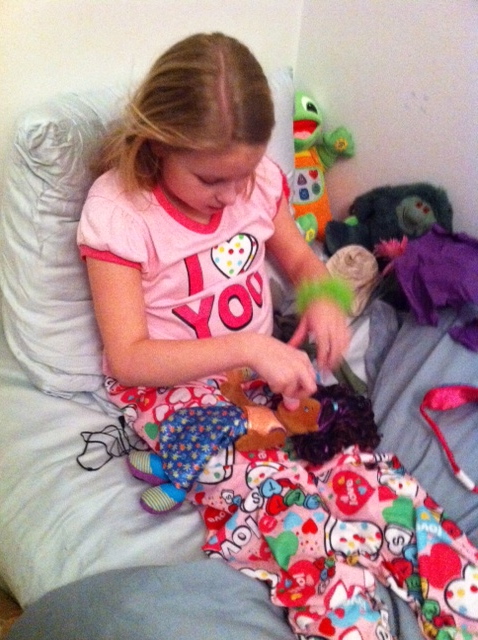
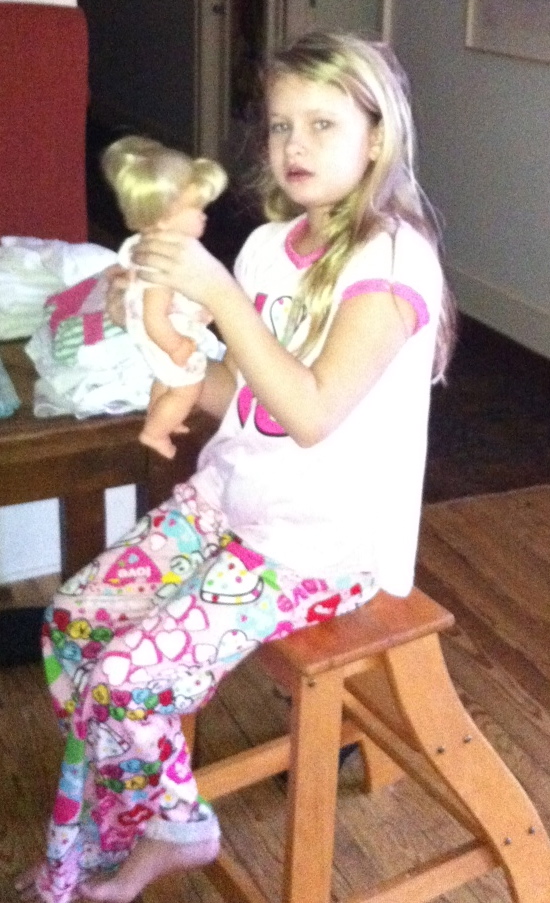
In the last few months, Emma has become enthralled with one of her baby dolls.  Each night for the past week, she comes home, bathes and washes her baby doll’s hair with shampoo, then wraps her in a towel and puts her to bed.  Her pretend play continues to be somewhat literal, in other words she doesn’t pretend to talk for her doll, she isn’t able to “name” her dolls beyond calling them things like:  doll, girl, baby, etc.  But Emma is showing an increased interest in playing with them, taking on the role of “mother” and spends longer periods doing “motherly” things with them.
This is the first year Emma has shown even a remote interest in Christmas and likewise with her birthday.  She has been talking about her birthday and the party we are giving her for over a month now.  Sadly, few children are able to come to her party, as it falls on a three-day weekend and almost everyone is busy or away.  But despite this, we are making sure she and her birthday are celebrated.

Sometimes it takes exhaustion and numerous wake up calls to remind me of just how far Emma has come.

Returning Home

When I finally returned home – after midnight – I crept into both the children’s rooms and stood at the foot of each of their beds for a moment.  Emma lay sprawled out one leg thrown over her duvet despite the cold, one hand clutched a shred of her blanket.  I watched her for a moment, her blonde hair fanned out on the pillow, her chest rising and falling with each breath.

Richard and the children returned to New York the week before me, though it felt as though I hadn’t seen them for a month.  The next morning Emma appeared in our bedroom at 6:29AM.  “Hi Mommy,” she said pointing at me.  “It’s Mommy!  Mommy’s back!” she cried, before climbing into bed beside me.

“Emmy!”  I answered, hugging her.  “It’s so good to see you!  I’ve missed you.”

“Missed Mommy!” Emma said.  Then she gave me a kiss on my cheek.

The following night I read to Emma before turning out the light and leaving.  Emma began breathing rapidly and making little panting noises, expressing her distress at my leaving her.

“It’s okay, Emma.  I’m not going anywhere.  I’ll be in our bedroom when you wake up tomorrow morning,” I tried reassuring her.

“Mommy!  Mommy stay!”  Emma cried.

“Em, I’m not going anywhere,” I repeated.  I’ll be right here.  It’s okay.”

Unconvinced, Emma pointed at me, “You,” she said, then pointed to herself, “and me, in Emma’s bed.”

“Okay Em.  I’ll stay here for a few more minutes and then I’m going to go into my own room.”

By the time I left her, it seemed she had finally fallen asleep, only fifteen minutes later she appeared in our bedroom.  “Mommy!”  She cried.

“It’s okay Em.  I won’t leave.  I’ll be right here when you wake up.”

“Mommy come.  Mommy come into the other room,” Emma pleaded.

I returned her to her bed and sat with her for close to an hour before telling her I was going to go into our bedroom, that I was going to be there when she woke up, that I wouldn’t leave.  “Okay,” she whispered.

Within five minutes she was back in our bedroom crying for me.  I knew how distressed she was.  I knew she was worried I was going to leave again.  I knew she just needed reassurance and eventually she would understand that I wasn’t going anywhere.  But I was also utterly exhausted and by this time it was after midnight.  I could feel my patience dissipating.  “Emma, you have to go back to your bed.  You have to trust me that I’m not going to leave.  I will be here in the morning.  I have to go to sleep now and so do you,” I said.

When Emma didn’t return to her bed, but instead stood staring at me unconvinced, I got up and said, “Emma!  Go to bed NOW!”

Emma turned away.  “Mommy come!”

I followed her into her room, sat on the edge of her bed and said, “Don’t worry, Emma.  I’ll be in the other room when you wake up.  I promise.”

“Okay,” Emma said, holding my arm tightly.

“It’ll be okay,” I said.

Emma nodded her head, “It’ll be okay,” she repeated, not letting go of my arm.