Tag Archives: autistic

Pretty in Red

Emma dislikes wearing clothing that has scratchy tags, is tight fitting, such as skinny jeans and form fitting jackets, anything that binds or doesn’t have some sort of elasticized waist.  I believe it’s her sensory issues that make most clothing so uncomfortable and so I try to find her things to wear that I know won’t bother her.  If it were up to Emma (and it usually is) she would wear nothing but track suits.  Thankfully there are plenty of children’s clothing companies who produce attractive clothing which relies heavily on elastic waistbands and whatever it is they put into clothing to make it stretchy.  But every now and then in a moment of insanity I see something so cute it’s irresistible and out comes the credit card before I’ve taken the time to consider the above prerequisites.  Inevitably the package arrives and Emma takes one quick look at it and says, “No, that’s too small!”

Which is code for – I have absolutely no intention of wearing this, ever.

If I insist, “But Em, just try it on, then you can take it off.”

She will usually comply while saying, “Just try it, then take it off.”

Every once in a while I have been able to get her to wear something other than her leggings with cute t-shirts and a hoodie, but it’s not the norm.   And once the weather gets anywhere near 50 degrees, Emma begins negotiating to wear her crocs.

“Em, it’s still winter out.  You can’t wear your crocs,” I will tell her.

“It’s too cold!” Emma will say, showing me she understands the concept.  “Wear crocs tomorrow,” she’ll say wistfully.

Emma reminds me of the firemen at the fire station across the street from us.  We always know when the weather is above 40 degrees because the firemen begin wearing shorts.  I figure it must be because they’re around all that fire and heat and they crave feeling the bracing cold air on their skin, but perhaps it’s just they are a heartier breed than the rest of us.  Impossible to say, but I keep meaning to take a photograph of the children bundled in their winter coats standing next to the firemen wearing shorts and short sleeved shirts.

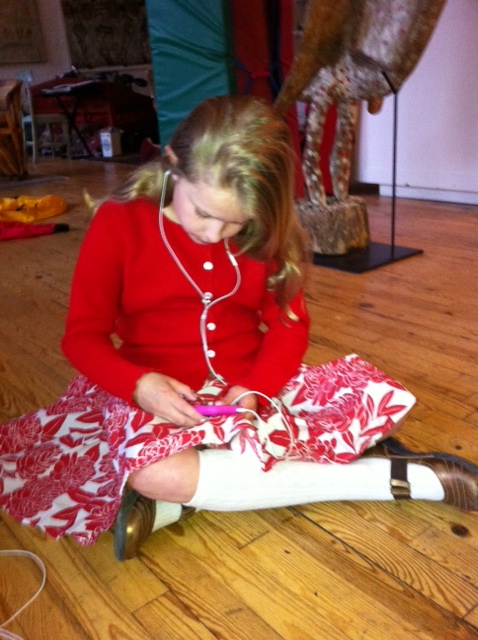
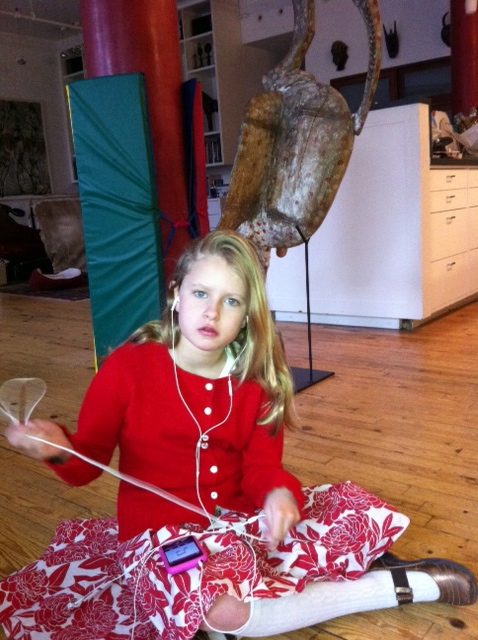
Yesterday the forecast was for a high of 72 degrees, (even though it went up into the 80’s!) so I tentatively pulled out some spring like clothing for Em and held my breath when I presented her with:  a skirt made of cotton, no elastic waist band, soft cotton t-shirt and soft red (wool) sweater, no annoying tags as I had cut them all out.  Then I stood back and watched.  Miraculously Emma put everything on, then chose her shoes, “wear these shoes!” she said cheerfully as she pulled on her socks and pushed each foot into a bronze pump.

“Emma!  You look so pretty!” I told her.

Emma smiled at me and twirled around.  “So pretty!” she repeated.

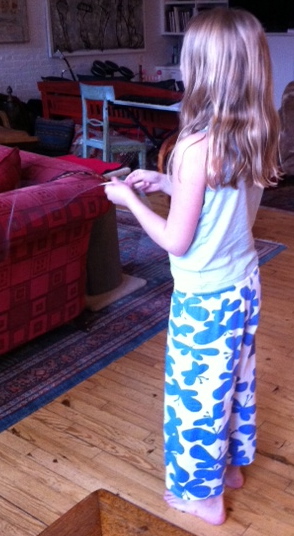
I took pictures because she was so cute in her red and white outfit and who knows when she’ll ever wear it again, so I figured we needed documentation.  Years from now, I’ll say to Richard, “Remember that day in April when she wore that adorable outfit to school?”  Then I’ll pull out these photographs.

Emma getting ready to listen to some music on her ipod

Choosing the music she wants to listen to
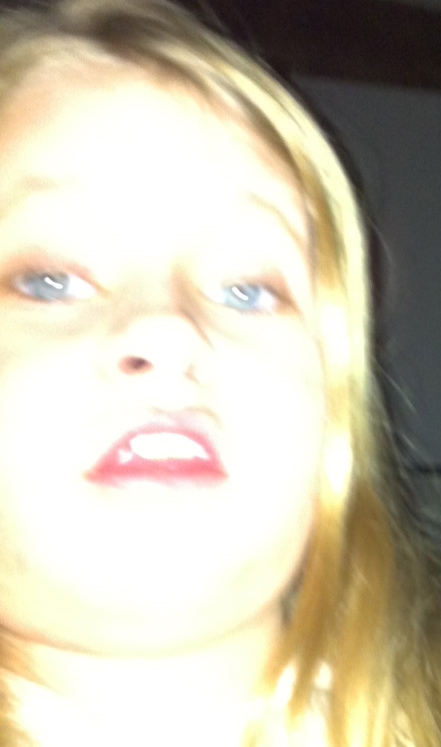
Looking up when I said, “Emma you’re so pretty!”
For more on Emma’s journey through a childhood of autism go to:  EmmasHopeBook
“Strawberry Cake”

Saturday morning Emma said, “Make cake?”

“What kind of cake, Em?” I asked.

“Make strawberry cake?”  Emma said in her usual questioning way.

It’s always interesting to me that Emma will make a statement, but will say it in a way that turns it into a question.  For instance when I ask her – do you want  to wear this?  She will answer, “No?”  which means she doesn’t want to wear it, but is asking if it’s okay not to.  Usually my answer is – okay – or – how about this?  To which she’ll then say – Okay or sometimes she’ll offer an alternative of her own, such as, “Wear this one?”  It’s a clever shorthand using much fewer words, but still gets the meaning across.  When we were in Panama having her third stem cell treatment done, another autistic girl a few years older than Emma did the same thing.  I remember after the procedure she kept saying, “Have chicken sandwich?”  She used the same upward lilt to the ending of the sentence that Emma incorporates.

“You want to make strawberry cake?” I asked Emma, somewhat incredulous as this was something she’s never requested before.

“Yeah!” Emma said jumping up and down.

“Okay.  How about we make a cake tonight?”

“Strawberry cake later,” Emma said.

“Yes, this afternoon.  Okay?”

“Okay,” Emma said.

Later that afternoon, Emma came over to me, “Mommy!  I want to make strawberry cake, please!”

“Okay, Em.  What should we do first?”  I asked as Nic ran over to join us.

“Get a bowl and get out strawberries,” Emma said, taking the container of strawberries from the refrigerator.

“Now what should we do?”  I asked.

“Mush them,” Emma said.

“Okay, here,” I handed her a potato masher.

Emma waited as I removed the stems from the strawberries and put them in the bowl.  Then she began mashing them.  After a little while, (about a minute) she took the milk out and said, “Pour in to mush.”

“Yeah, okay,” I said watching her.

“Mom, are you sure this is a good idea?” Nic asked.

I shrugged.  “I don’t know.  Let’s see what happens.”

“But what about the cake?” Nic asked.

“We can make a batter and add the strawberries to it,” I said, wondering exactly how this was going to work out.  “Hey Nic, why don’t you turn the oven on.”

As Nic turned on the oven, Emma continued to mash the strawberries in with the milk.

“Em, I have an idea, let’s use this,” I offered her a hand blender.  “This will mash the strawberries better,” I added, plugging it in.

“Okay.  Have to mush, mush, mush,”  Emma sang as she worked.  “Mush the strawberries, mush, mush, mush, mush the strawberries.”

Meanwhile I had Nic add a little bit of sugar, mix the flour and baking powder, then cream the butter, sugar and eggs in the electric mixer.

“Hey Em, are you ready to add the strawberries to our cake batter?”

“Yes!”  Emma said, pouring the now blended strawberries into the batter.  “Smell!”  she said, lowering her head so that it was close to the batter.

“Does it smell good?” I asked.

“Yum!”  Emma said.

While the cake was in the oven, Nic and Emma helped me make buttercream frosting.  “Em, should we put strawberries into the frosting?”

“No!”  Emma laughed as though this was the most ridiculous question she’d ever heard.  I looked at Nic.

He shrugged and said, “No strawberries in the frosting, Mom.”

“Okay it’s unanimous.”

When the cake was finished we pulled it out of the oven, let it cool and then Nic and Emma “helped” me frost it, which meant licking the spatula, licking the beater, licking the bowl.   When it was finished I said, “Who wants to have some strawberry cake?”

“I do!” Nic yelled.

“Hey Em, want to taste it?”

“Naaah!” Emma said running to the other side of the room.

“Hey Em.  Come on!  It’s your strawberry cake.  Don’t you want to try it?”

“Okay, just a taste,” Emma said coming over to sniff the cake.

“Mom!”  Nic yelled.  “This is the best cake ever!”

Meanwhile Emma poked at the cake with her fork then tasted the frosting and walked away.  Nic looked over, then rolled his eyes at me.  “Whatever Mom.  It’s a great cake,” he said, taking another mouthful.

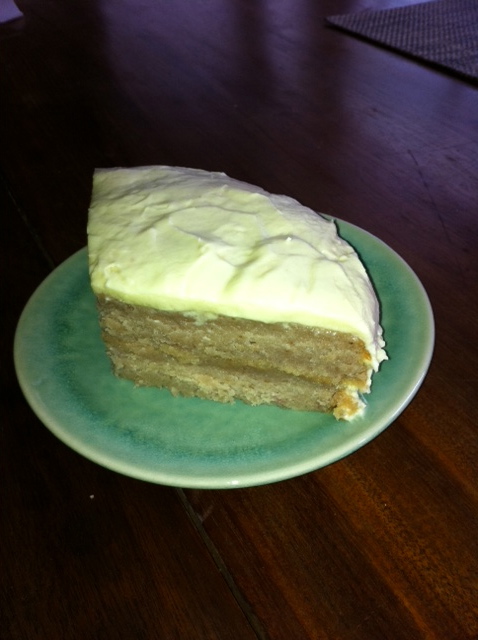
What remains of Emma’s Strawberry Cake

For more on Emma and autism go to:  EmmasHopeBook

Emma’s photographs

About six months ago Emma discovered the camera feature on my iphone.  Since then she’s taken hundreds of photographs, many are of the floor and curtains, which I’ve deleted, as well as self-portraits with weird lighting.  But my favorites – the pictures of her surroundings as she is running, dancing, jumping give the photographs a surreal, slightly hallucinogenic, ethereal quality to them.

Self Portrait

Our living room as viewed by Emma

Emma – Self Portrait

I could go on about her “artistic vision,” what they seem to represent, how they appear to reflect her interior life etc.  But I don’t know how accurate any of my ideas really are and for Emma any thoughts I have on her photographic endeavors are meaningless.  She just likes to take photographs.  Interestingly, she has begun to take fewer photos of herself and her surroundings and more photos of the people who are around her at home – us.  Our much-coddled cat, Merlin remains sadly out of the loop however, as she has yet to photograph him.  Even so, I cannot help but feel this is positive as it indicates a growing awareness and interest in others.

When Emma was a toddler she had piles of photographs she would carry around with her.  If one went missing she knew within seconds and would become increasingly agitated until she was utterly inconsolable.  The only remedy was to recover the missing photograph.  If we couldn’t find it, her upset often went on for several hours.  The missing photograph seemed to represent so much more to her than we could understand.  Although I have come to view her disconsolation as more of an obsessive-compulsion than the shattering of her world, but to her it is probably the same thing.

As Emma’s interest in being behind the camera increases, her desire to look at piles of photographs has lessened. Which is something else I see as a positive change.

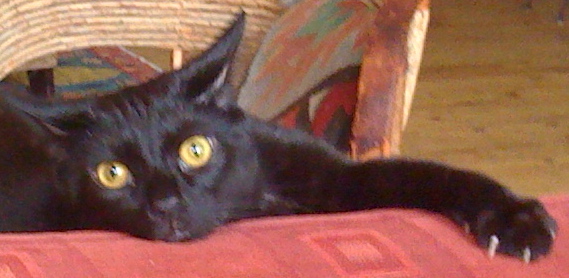
Even though Em didn’t take this photograph of Merlin – one day she might – and it’s important for him to feel included.  Notice the distended claw piercing the fabric on our couch.  Richard is inwardly cringing as he views this photograph.

For more on Emma’s journey through a childhood of autism go to:  EmmasHopeBook.com

The Possibilities Are Endless

Hope.  A few days ago I wrote a post about how I cannot function without an infusion of hope.  One of the most debilitating aspects for a parent with a diagnosis of autism for their child is that it comes with little, if any, hope.  Without any prospect of hope we are faced with darkness, nothing but darkness.

There’s a saying people often repeat when speaking of autism.  It is:  “If you meet an autistic child you have met one autistic child.”  Just as in the general population, no two children are alike, the same holds true for autistic children.  When I go to Emma’s school I am reminded of just how different children on the autism spectrum are.  I’ve met talkative, highly verbal children who have horrific sensory issues, which cause them to melt down in mid-sentence.  I have had conversations with Asperger’s kids who verbally perseverate on a particular topic, but have a terrible time asking any questions of the person they are speaking to.  I have met incredibly affectionate, non-verbal children who hug, hold hands and want to sit in my lap, the lap of a complete stranger.  Show me an autistic child and I will have met that particular child.

When I see a documentary on an autistic child, now grown to full adulthood I find myself wondering if Emma will resemble them.  It’s like picking some arbitrary person on the street and wondering if my almost eleven-year-old, neuro-typical son will resemble that person.  I would never do that.  Yet, I have to remind myself of the absurdity of this exercise and catch myself when I find myself doing it in regards to Emma.  I am reminded of how much I want guarantees of her progress.   I desperately want someone to show me a YouTube clip of Emma 10 years from now.  I want a crystal ball that will tell me, if you do this, this and this, then she will be like this.  And yet, at the same time, I know I don’t really want that.

I cling to the idea that we know very little.  It gives me hope.  For many people the opposite is true.  But when it comes to autism the awareness I would like to see changed is how much we do not know.  Autism is an enormous question mark.  In fact that is the symbol that comes to mind when I think of it. There is tremendous hope in that question mark.  It means the possibilities are endless.

For more on Emma’s journey through a childhood of autism go to:  www.EmmasHopeBook.com

The Suggestions Autism Inspires

I have been trying to find a probiotic that Emma might be willing to take with little success.  Yesterday I asked the man in a health food store for help and when I mentioned it was for my autistic daughter he asked the usual questions regarding her diet (limited), her activity level (high), etc.  I am usually reluctant to get involved in such a conversation as I am almost always inundated with well meaning advice.  Advice that has little, if anything, to do with my original question and advice I have received by literally hundreds of people in the last seven years.  Yesterday proved no different.

“You need to train her to eat healthy foods,” he began.

I smiled in response while remembering the last time we attempted to get Emma to take something she didn’t want to take.  It took three adults holding her down, while I tried to force a spoonful of antibiotics in her mouth.  She writhed around and blew the contents of the spoon out of her mouth with such force it hit me in the face.  Richard stood up at that point and said, “We can’t do this.  There has to be another way.”

My face dripping with Emma’s saliva mixed with the pink sticky antibiotics we had forced into her mouth, I was inclined to agree.

“She should eat only raw fruits and vegetables,” the man in the health food store continued, warming to his subject.

I stared at him and said, “I really am just interested in finding a chewable probiotic that she might actually try.”

Undeterred, the man continued and then said, “You should call this man, he can help your daughter.”

“Is he a doctor?” I asked.

“Oh no!” the man said, looking horrified.

“Is he a specialist in autism?”

“No, no, nothing like that,” the man said, scribbling down a name and phone number.

“So who is this person?” I asked.

“He has vitamins, special vitamins,” he answered.

I looked around the store.  A store well stocked with vitamins of every kind and said, “Look, I am sure this person is a lovely human being, but I don’t need vitamins at the moment.  Thank you anyway.”

“No, no, this man is different,” he said as I turned to leave.

“They always are,” I answered.

Over the years I have had conversations with so many people I can no longer count, exactly like this one.  During those first few years I even took Emma to a number of people I had heard about from others, who claimed to have some inexplicable cure, vitamins, tinctures of homeopathic remedies, healers, people who I am sure believed that what they were doing could and would make a difference, and perhaps they did for someone else’s child.  But whatever it was never made a difference for Emma.

I have had people contact me insisting their child, nephew, grandchild was miraculously healed, began speaking in full sentences etc. as the direct result of whatever magical potion they were telling me about.  It’s not that I think all these people are making up success stories, they are far too passionate for that, it’s that I have heard so many of these stories, literally hundreds of them and they are always of something different.  Each remedy is an anecdotal story of a child the person knows, and yet I have never been told about the same remedy working for anyone else.

One of the things I have learned over the years is that one can spend every last dime one has on these potions, healers, etc. and there will never be an end to it.  One can spend every moment running from one referral to the next, one remedy to the next and there will always be a new one around the next corner.  At a certain point, one cannot continue to investigate every single suggestion given, it simply is not possible from a financial standpoint or time-wise, but most importantly – one must ask the question – what is this doing to my child?

I have no doubt the man in the health food store genuinely thought he was doing me a tremendous favor by telling me about his friend.  What he couldn’t know was that I have hundreds and hundreds of scraps of paper with names and phone numbers scribbled down of people just like his “vitamin man”.

After I left the health food store I was able to locate a chewable probiotic at Whole Foods that miraculously, Emma was willing to chew.  I will see if it makes a difference, though I am not holding my breath.

For more on Emma’s journey through a childhood of autism go to:  www.EmmasHopeBook.com

Birthday Parties

Birthday parties, anticipated with great excitement by neuro-typical children, are something parents of autistic children often dread.  Many autistic kids have sensory issues, which cause them to crash when they are over or under stimulated.  Emma has both and it’s impossible to predict what might trigger her.  Crashing for Emma can mean perseverating on some seemingly insignificant thing – a missing photograph, a stick she picked up and by mistake dropped, a portion of packing tape, a magazine no one knew she cared about that was inadvertently thrown away.  These are the things she uses to calm herself and there’s nothing like a party to trigger the desire for items used for self-soothing suddenly and without warning.  In the past we have witnessed all of the above as well as her wanting something we cannot understand and therefore cannot help her find, which leads to crying or worse, a full melt down.  When in the later mode, we must physically remove her from wherever we are and get her home as expeditiously as possible, something onlookers find baffling and frightening.

A few years ago Emma was invited to a little girl’s birthday “Tea Party”, which took place in the Rose Club of the Plaza Hotel.  Red velvet banquets and gold gilded chairs with couples speaking in hushed tones made me inwardly groan, when we arrived.  How was I going to keep Emma occupied?  What if she was disruptive, unable to sit still?  When the menu was delivered I barely went through the motions of opening it – what was the point?  I knew she wouldn’t eat anything from the menu.  I had the foresight to bring food I knew she’d eat and just hoped the service was quick, given there were eight little girls with a variety of disabilities attending.  My memory of that party is of running after Emma and trying my best to keep her from jumping on the beautifully upholstered furniture or sliding down the marble banister, Mary Poppins style, while avoiding the glares of the hotel staff.

The only other party to rival that one was when Emma turned four.  Given Emma’s love of music, we hired a musician to come to our apartment. We invited a number of children from her special education preschool as well as some neuro-typical children Emma and her older brother, Nic had known since they were babies.   Emma spent most of the party attempting to lie down inside of the musician’s guitar case as the other children danced, ran around or sat politely listening to the music and singing along when appropriate.  My husband, Richard and I took turns excusing ourselves and each went separately into our bathroom where we allowed ourselves a few minutes to cry, before mustering up the strength to return to our guests, doing our best to act as though everything was fine.

That was also the year we had been called into a parent/teacher conference at her special education preschool only to be told our daughter’s development was a “red flag” and that she had “flat-lined”.  It was a tough year.  A year Richard and I still refer to when we feel doubtful of Emma’s current progress.  That year marked a time of desperation, sadness and a general feeling of impotence on our part.   It seemed whatever therapy we tried, whatever medical interventions we took on, nothing made a difference.

Emma’s most successful birthday parties have been when we’ve rented a gym, as we did a few months ago for her 9th birthday (we’re learning) or when we’ve planned the party in some other equally active place.  This past birthday, we rented a gym for her birthday party and the following day took her and Nic to Bounce U in Brooklyn where she ran into a friend from her special education school and everyone had a blast.

Emma at Bounce U

For more on Emma’s journey through a childhood of autism go to: www.EmmasHopeBook.com

A Marathon

“This is a marathon, not a sprint,” Richard and I remind each other on a regular basis.  I have written before about how when Emma was first diagnosed we were given a great many reassurances that while Emma certainly needed early intervention, many who worked with her felt sure she would be mainstreamed by the time she was in Kindergarten.  When the day for her to enter Kindergarten came and went we began to slowly go through the process of realizing 1) no one knew what lay ahead 2) no one was any better at predicting how Emma would develop cognitively or neurologically and 3) we needed to pace ourselves because Emma’s future was an enormous question mark.

During those years I rarely thought about Emma being a teenager, going through adolescence or what it might mean to have a young autistic adult living with us.  I was too focused on all her therapies, learning as much as I could, trying to find specialists who might help her, to spend much time contemplating the distant future.  As time went on and after countless parent/teacher conferences where the reports were less than stellar, despite all they were doing at school and all we were doing at home, it occurred to us that we were in this for the long haul with no guarantees of any definitive outcome.

As with a marathon, we have learned we must pace ourselves.  And as with running, the more I am able to remain present and in the moment, the better off I feel and am.  Emma spends ninety percent of her time in the moment.  She has achieved what eludes most of us.

Emma this morning

For more on Emma and autism go to: www.EmmasHopeBook.com

Hide And Seek

Games are difficult for Emma to understand.  When she was much younger, unless it was a physical game such as chase, and only if she was the one being chased, games held little interest.  The old standards, Candy Land, Shoots and Ladders, Old Maid, Go Fish all sit unused in some drawer at our house as Nic moved on to Monopoly, checkers and eventually chess, which he continues to play.

A few years ago Emma engaged in a game at a day camp with some other girls where they stood in the shallow end of a pool and threw a ball to one another while singing – The Wonder Ball Song.  Emma was able to catch the ball and even threw it to the next girl, but this was unusual and so we documented it with photographs.

The Wonder Ball Game

A few years ago I tried to explain Hide and Seek to her.  She seemed to understand that it involved counting and running, but the whole hiding part eluded her.  We showed her some “sample” hiding places, but when it was her turn to hide, she was usually found standing in the middle of a room shouting, “There you are!” when one of us appeared in the doorway.

“No, no Em.  You have to find a new hiding place and then you have to be quiet so we can’t find you,” we tried to explain.

We even persuaded Nic, who was a master at hiding in impossible-to-find locations, to take her with him to hide.  But we always knew, no matter how brilliant his hiding place was, where they were because Emma couldn’t stay quiet.

“You have to be quiet,” Emma would say loudly.

Interestingly as I was writing this, Emma came into the room and said to me, “Play hide?  You have to count.  Come find me,” and then she ran out of the room to hide making me wonder whether she really is reading at a much higher level than we think or if it’s just a coincidence.

Not willing to pass up an opportunity to engage, I counted to twenty and then yelled, “Ready or not here I come!”

Emma is predictable in her hiding choices.  She almost always wriggles under the bed sheets of her bed.  So I called out as I looked in other places, “I wonder where Emma is?” while looking in the bathroom and Nic’s room before finally going into Emma’s room where a huge wiggling lump could be seen under the sheets.  “Hmmm.  I don’t see Emma anywhere!” I said.

“Waaaaa!” Emma screamed before I could shout it first.

“There you are!” I said tickling her.

When she scooted out from under the sheets I said, “Okay, it’s my turn to hide.  You have to find me.  You have to count to twenty.  Okay?”

“Okay,” Emma said.

I heard her begin counting, but at around six her voice trailed off.  After a few minutes I called out, “Em, you have to find me!”

She ran past the room I was hiding in, so I called out, “Hey Em!  Where are you going?  Come find me over here!”

After further searching she found me.  “Waaaaa!” she yelled gleefully.

“Ahhhhh!” I yelled back.  “Okay your turn to hide.  One, two, three…” I counted.

When I opened my eyes, Emma was sitting directly in front of me on the floor.  “Em, I thought you were going to hide,” I said.

“Hiding all done,” she told me, so I tickled her instead.

I know this doesn’t sound like much, but it shows a desire to engage, a desire to initiate and a desire to play with others.   All of which, are huge steps for Emma.

For more on Emma and autism go to:  www.EmmasHopeBook.com

The Tricky Diagnosis Of Autism

When Emma was first given a diagnosis, we were told she might not be autistic, time would only tell, but that for the time being they were giving her a diagnosis of PDD-NOS, which is the acronym for Pervasive Developmental Disorder Not Otherwise Specified.  PDD is often thought of as a milder form of autism or as was explained to us, the diagnosis given when the child has enough “autistic-like” behaviors to require intervention, but doesn’t display all of them.  As time went on however, Emma’s “milder” version of autism grew into the more solidly defined autism.

I remember speaking with her neurologists saying we were lucky in that Emma was mildly autistic and one of them said, “Well no, she isn’t mild.”

“Really?  Where do you think she falls on the spectrum?” I asked, genuinely surprised.

“She’s moderate,” one of them said, kindly.

I was so stunned, I couldn’t speak.  We had been assured by so many “professionals” in the field that her autism was mild, it never occurred to me they might be wrong in their assessment.  Even when we kept trying the various behavioral therapies recommended with little progress, I continued to cling to the “mildly autistic” assessment.  I kept thinking it must be something we were doing wrong.  We weren’t giving her enough applied behavioral analysis, despite the 40 hours a week we had implemented.  I thought of it as a kind of  toddler boot camp, unfortunate, yet necessary.  When we then trained with the brilliant Stanley Greenspan, I assumed we were not doing his floortime “right”.  In essence I blamed our ability to adequately implement the various therapies as the reason she wasn’t progressing more quickly.

When we began having regular QEEGs done, which showed us images of her brain compared to her neurologically typical peers I was given the visual explanation I needed to understand what we were up against.  There was no denying the vast difference between her lit up non-symmetrical brain and the brains of same age children not on the spectrum.  It was only then that I began to fully take in just how much we do not know about autism.  Years later, I now question anyone who claims definitively to know what will or will not help, what course they are sure we should take.  It is the professionals who have the humility to admit all they do not know, whom I find myself interested in speaking with.

When Emma was about four we took her up to Boston to visit a well known and extremely well thought of gastro-intestinal doctor, Dr. Timothy Buie.  I asked a series of questions and he never once answered with the sort of assurance I had become used to.  Most of my questions he said he couldn’t answer because he didn’t know for certain.  We left Boston with the tests showing Emma’s numerous ulcerations and inflammation to her GI tract.  But with no solid answers as to why or how this had happened to such a young child.  I continue to have tremendous respect for that doctor who continues to devote his life to finding answers, but has the humility to acknowledge how much we still do not know and understand when it comes to autism.

A Light Bulb Moment

This morning Emma, Joe and I went into “Emma’s Study Room”, which is where we go to work on Emma’s literacy program.  Emma asks to do this each morning.  Earlier this morning Joe and I discussed various strategies to help Emma with the handwriting portion.  Up until this morning’s session, the handwriting part has been extremely difficult for Emma.  Her anxiety level (and mine) have been counter productive – with Emma fidgeting, pushing her chair away from the desk and saying things like – “study room all done now.”

We began with the video – a short story about a man washing his car with a rag.  Emma seemed mildly uninterested, but watched the short clip and then was asked to find the word from a series of sentences, which she did with little problem.  She then was instructed to spell the word, again with few problems and when the computer portion was over we went to the handwriting part.  But today we implemented some other techniques that we had used in the first part of the literacy program, exercises she was familiar with and as a result had no problem doing.  We then moved on to the more problematic spelling of the single three letter word, but this time Emma had no problem!  As I watched her work, I could see that something had clicked.  It was an amazing moment.  It reminded me of the moment when Helen Keller finally realizes the water dribbling through her hand is the word Annie Sullivan is spelling for her.

I felt such unbelievable joy witnessing Emma “getting it”.  The look on her face, the smile… it was priceless.  To say that I am proud of her is a vast understatement.  I am ecstatic for her as well as proud, so very, very proud of her.

We continued through the other exercises with amazing results.  At a certain point I looked over at Joe and made a Can-You-Believe-This?! face.  And after we were finished I went to tell Richard, overwhelmed with happiness and relief.  What I witnessed was the beginning of reading and writing comprehension and it beats the joy I felt when Emma took her first steps.

As a side note, I will be adding the link to this blog on each post as various posts are getting picked up elsewhere.  For those who read Emma’s Hope Book already, just ignore and for those of you new to it, welcome!

Learning

Since the family is now here, I’ve been getting up with Emma, so everyone else can sleep.  Emma typically wakes by 6:30AM and often a bit earlier.  Usually we go downstairs and sit together on the couch.

“Go to other pool?” Emma said this morning.

“Okay, but Joe just drove in from Denver last night, so maybe tomorrow.”

“Go to Glenwood pool tomorrow,” Emma said, nodding her head.

“Yeah.  Maybe tomorrow.  Joe’s probably pretty tired today.”

“Joe’s coming,” Emma replied.

“No.  He’s here!” I said pointing upstairs.  “He got in late last night.   He’s sleeping,” I explained.

“Joe’s sleeping.  Joe!  Can we go to the other pool?  I want to go to the Glenwood pool!”

“Okay, Em.  We’ll ask Joe when he wakes up.  How about doing our work in the study room?” I asked.

“Do study room in Mommy’s bed,” Emma said.  Before I could answer she added, “No, not going to do study room in Mommy’s bed.  We have to go to Mommy’s office just with Joe!”

“Exactly, Em.  We have to show Joe what we’re doing.” I told her.  “We have to wait until Joe wakes up.”

“We have to wait,” Emma said.

After Emma made her toast and ate it, she said, “Go see Joe.”

“We have to wait, Em.  He’s tired.  We need to let him sleep.  Okay?”

“We have to wait,” Emma said sadly.

Eventually Joe appeared and Emma jumped up and down, “It’s Joe!  Joe’s here!  Go to study room with Joe?”

Emma and I are doing the next level of her literacy program.  It’s a big step from what we’d been doing and it’s difficult for Emma.  We watch a video and then do some computer work spelling one word.  It is the same word repeated over and over in the story.  Emma then must find the right letters on the keyboard to spell the word as well as find the word within the story.  Emma does pretty well with all of that, but when we go to handwriting, it’s as though Emma has forgotten all her letters that we’ve been working on over the past few months.

The first day I found myself becoming frightened and by yesterday I felt abject terror.  Terror at the idea she won’t be able to do this next level, frightened that it’s more than her mind can retain.  I imagine she senses my fear in addition to her own anxiety and the whole thing snowballs, making it even more difficult for her.  I am relieved Joe is here, so that he can work with her a few times.  Perhaps his calm demeanor will have a positive effect on her, allowing her to relax enough that she can just concentrate on the work.

“Your fear is palpable,” Richard observed last night.

“I know it is,” I answered.  “I am terrified she won’t be able to learn this.  And then I go off to the next thought and the next, it’s horrible.”

And it is.  But it’s my fear and has little to do with anything that is actually happening.  I must learn to manage this fear as it’s getting in the way of Emma’s learning.  I must compartmentalize it.  My worries are not helping Emma.  I say this in my head while I am working with her – these are my fears, they are not real, they are just thoughts.  They do not mean anything, they are just fears.  They are not real, they are not real.

Repeat as necessary.

Blocked Ears & the Internet

Emma has a blocked Eustachian tube in her ear.  And if I might remind our loyal readers, I did actually mention this in a previous post after searching for several hours on the Internet – having googled such random things as:  ears, ears popping, earache, etc.   I concluded in that post I must avoid the Internet when attempting to diagnose my daughter’s complaints – though now, it turns out, googling random words is exactly what is called for in such circumstances.

The remedy is a bit more difficult to enforce.  The remedy being she is causing the pain in her ears by grabbing hold of her nose, clamping her mouth shut and blowing forcefully out of her now firmly held nose.  Other than turning her face red, I wasn’t aware that other dangers lurked from this seemingly innocent act.  Trying to convey all of this to Emma is proving to be a bit more difficult than simply saying – Hey Em.  Don’t do that.  It’s making things much worse and besides that, you probably wouldn’t have any ear problems in the first place if you just stopped.

She looks at you saying all of this, nods her head and then promptly grabs her nose as though you’ve just given her the go-ahead.  Nothing helpful comes up when I google any words remotely associated with any of this other than a few non-related ads about a new Disney Resort called Aulani in Hawaii.  I am tempted to explore how this ad came up when googling autism and ear sensitivities, but really why waste the time?

I’m going out on a limb here, but as I have said before and been proven wrong more times than not, anyone reading this will take it all with a grain of salt –  Emma is highly sensitive to the air pressure and it turns out, so am I.  Only I wasn’t aware of this until Emma started complaining of her own ears.  Throughout the day now I am aware of a slight pressure within my ears and I immediately wonder if Emma is feeling the same thing.  The difference being I can at least attempt to articulate the sensation and realize it is not life threatening, it will eventually go away and is one of those things in life, like sore muscles that one just puts up with knowing it will be okay, no need to panic.

However this is not the way Emma perceives it.  She is thrown into a state of panic and it is heart wrenching to witness.

I will spend some more time on the Internet, before going into work, having had my faith in Google restored.

Aspen, Work & Richard

I am in Aspen working, having left Richard and the children back in New York.  Emma’s ears continue to hurt her.   Richard had to take her to an ear specialist yesterday afternoon.  The last few times I’ve called I could hear Emma in the background crying plaintively, “I need help!  Ears popping!”.

I don’t know what it’s like to be a father leaving his wife and children behind for work, but I can tell you as a Mom, it feels pretty awful.  I feel terrible that Richard is left coping with the myriad details required, the organizing of both children, dealing with one who doesn’t feel great, getting referrals to doctors, arranging appointments, ensuring Nic is taken care of, juggling IEP meetings, seeing Emma’s neurologist, rearranging his own work schedule to accommodate all of the above.

And meanwhile here I am in Aspen.  Even when you tell someone you’re there to WORK, you can see the little smile on their face, “Uh-huh,” they usually respond.  “It’s gotta be tough.”

So no, one cannot expect much sympathy, and if I go on about how tired I am, I can expect little other than a slight nod of the head followed by the slightly sarcastic, “Yeah, I bet.”  Sometimes they’ll even add a barely audible, “Ski much?”

Despite the fact I have no intention of skiing, am working everyday most people find any utterance even remotely sounding like a complaint, tiresome.  Which makes Richard’s response all the more remarkable.

“Of course you must go,” was his reply when I told him about some of my commitments here.  There was no need for discussion.  It was a given, I would go, Richard and the children will join me in another five days.  I am grateful to him for that.

When I call then and hear Emma’s little voice whimpering and Richard’s exhausted voice telling me, “Everything’s fine,” I know he’s putting on a brave front.  I know how exhausting it is to hold down the fort in the other’s absence.   I know he’s worried about Emma, as am I.  The difference is he’s the one who is making and keeping the appointments with all the various doctors, not me.  And no matter how hard I am working, no matter how many hours I put in, it doesn’t compare to what Richard is doing back in New York.  As I write this I can look out my window and gaze upon the Rocky Mountains jutting up, the blue sky contrasted against their snowy peaks.  My concerns for Emma are muted by physical miles, I cannot hear her distress except when I call.  I am not in the trenches with Richard.

I am lucky, very, very lucky.

My Greatest Fear

My single greatest fear is when Richard and I die Emma will be institutionalized.  It is a nightmare I try hard not to dwell on.  So when I read articles like this one from the New York Times, http://www.nytimes.com/2011/03/13/nyregion/13homes.html

regarding the rampant abuse in homes for disabled people I am more than horrified.  I am terrified and left feeling nauseous.  It is like waking from a nightmare only to realize the nightmare is real.

The final line in the article is a quote from a memo that was sent out to all staff at a group home:  “DON’T report in your notes that an Incident Report was filled out,” the instructions said, adding: “IF IT ISN’T DOCUMENTED, IT WASN’T DONE.”

That final quote says it all.  The utter disregard for humanity, the unwillingness to see the disabled, whether mentally or physically, as nothing more than easy prey has become so commonplace as to be suitable for a memo.

Over the years we have heard Emma repeat things said to her, things she even now repeats, years later.  Often they are things said to her in anger, and because she mimics the person, is so good at capturing their tone, their accent if they have one and their inflections, we often have been able to determine who has said these things to her.  Usually they are benign comments such as – “don’t put playdoh in your mouth” or “line up!” or “Emma!  Sit down!”  Nothing abusive, all within what one might expect from teachers, caregivers, therapists etc.

But once, Emma came home and started yelling – “Sit down!  You sit down right now!”  “No you cannot leave!”

From those words I was given enough information to ask her a number of questions and realized her bus driver was yelling at her.

The next morning we spoke with her driver who it turns out was getting to her school before the school was open and so, instead of telling us and changing her pick up time, decided to let the bus sit idling outside the school for half and hour with Emma in it.  When she stood up to leave, seeing that they were at her school and with little sense of time, the driver started yelling at her.  Fortunately she had enough language for us to figure out what was going on.  We immediately complained to the Office of Public Transportation, wrote a letter to our lawyer and put a stop to it.  The next morning she had a new driver and a new pick up time.

We have been lucky so far.

More on Emma’s Ears…

The good news is Emma’s ears look fine.  The bad news is her throat is a little red and evidently strep continues to make its way through the New York City schools.  So we had yet another strep test done.  The immediate results were negative, but we’ll know more today or tomorrow once the culture has had a chance to grow.  So Emma is staying home today on the off chance she does have strep and so she won’t needlessly contaminate her fellow students.

As I write this, Emma is leaping around the living room singing, while waving a thin strip of plastic around like some sort of experimental ribbon dance.   Every now and again she stops and stands very still while twirling the plastic around and around, seemingly mesmerized by it only to continue jumping, singing and dancing a few minutes later.

It’s impossible to know what Emma is thinking or feeling.  I watch her and make assumptions, much as I did yesterday regarding her ears, only to find that perhaps she has strep.  I think I’ve said this before, but autism throws all maternal instincts right out the window.  Whenever I think I have an idea of what’s going on with Emma I am almost consistently proven wrong.  She complains of her ears, look at her throat.  She complains of her ears, I suspect her throat (pride myself in being a quick learner) and it turns out it’s her ears.  It’s as though there’s some sort of “Emma’s Law” out there, whatever I think is going on – I’ll be wrong.   You think you’ve figured this out?  Ha!

Yesterday I did what many parents do when confounded by their child’s ill health.  I went to the internet and googled – ear pressure, ear popping and a number of other things.  All of which was fine until I read about a troubling condition some children are afflicted with called – Blocked Eustachian Tube – a decongestant was recommended followed by a visit to the doctor and Barotrauma, the only suggestion being a doctor’s visit.  Emma’s pediatrician didn’t mention either of these things.  But now I’m convinced Emma has some horrific condition which will only be remedied with invasive procedures, possibly surgery and I’m traveling for work tomorrow, so it’ll be up to Richard to cope with all of this in my absence.  No one has said any of this to me, these are the conclusions I have come to after going onto the Internet for an hour.

All of which is to say – I must avoid the internet when it comes to diagnosing my child’s ear problems.