Tag Archives: autistic

Hide and Seek

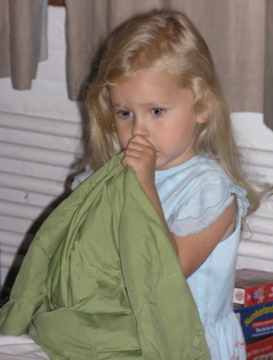
Like many children, Emma loves nothing more than a rousing game of Hide and Seek.  Except Emma doesn’t like to look for anyone, she just wants to be the one to hide, always.  She also only likes to hide in one place.
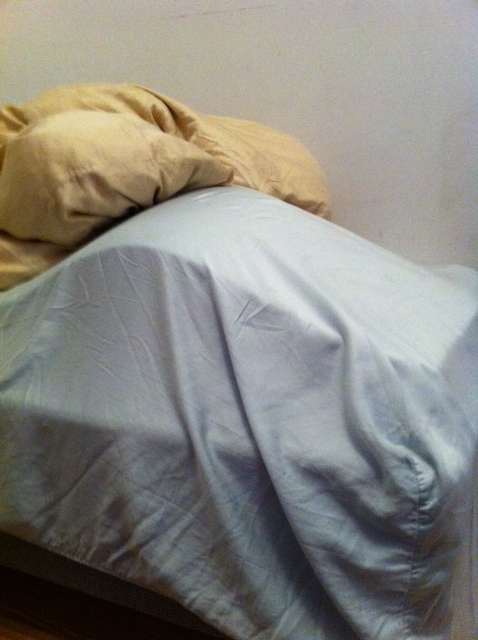
Which kind of defeats the whole purpose of the game.  Because not only is she utterly predictable, she’s also really hard to miss.  Never-the-less, we do our best to play the part of surprised “seeker”.
“Hmm, I wonder where Emma is?  Let’s see…  could she be in here?”  Dramatic throwing open of various closet doors and curtains, followed by, “No.  Not in here.  I wonder where she could be hiding?!”  There’s a great deal of crouching down, looking under chairs, the bed, her desk, while muttering, “Gosh, I can’t imagine where she could be!”

All of this is done while Emma variously – sings, hums, makes loud breathing noises or whispers to herself , “No, not going to find Emma under the mattress!”

That she is also squirming around makes her hard to miss, still we do our best to play the part given us.  Eventually if we are taking a very long time to “find” her, she’ll give us a little help.
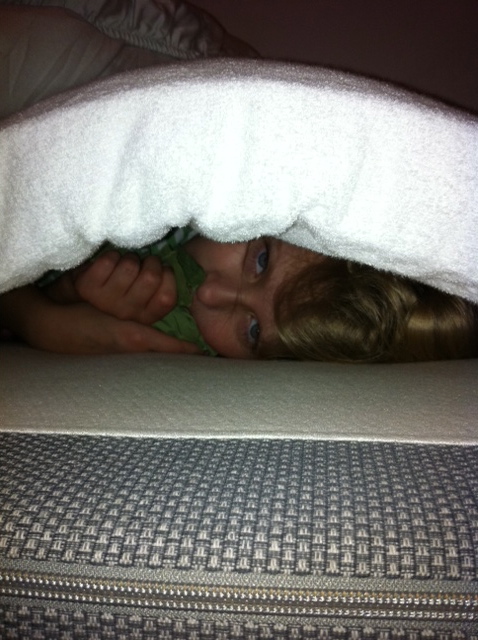
By yanking off the fitted sheet to reveal herself and yelling, “There she is!”

In the theatre world, this would be called stealing lines, hogging the stage or any number of disparaging phrases.  But to Emma she’s simply trying to help us out and we appreciate it.

“Oh!  There you are,” we shout before grabbing a limb and tickling her mercilessly.

“Let go!  Let go, let go, let go!”  Emma squeals.

“No, no, no.  I’m not going to let go.  I’m going to tickle you and tickle you and tickle you..”

The other day while in the midst of just such a moment, Nic appeared in the doorway to Emma’s bedroom, “What are you guys doing?”

“We’re playing hide and seek, want to play?” I asked.

“Yeah okay,” Nic agreed, somewhat reluctantly as he knew Emma would only want to hide underneath her mattress again.

“Should I count or do you guys want to find me?” I asked.

“You and Nicky hide?” Emma said.  Meaning she wanted to hide with Nic.

But I pretended not to understand as every interaction can be an opportunity to teach (we’re trying to help Emma with her pronoun reversal problems), “Oh okay.  So you’re going to find me and Nic?”

“NO!  Mommy find.  Emma and Nic hide!”

“Emma you have to say, Nic and I are going to hide.”  Nic took her finger and made her point to herself, “Me, Emma.  You say me,” then he looked up at me with an expression of mild exasperation.  “No wait, that’s not right.”

I nodded my head.  “It’s okay, Nic.  You’re doing great.”

“Okay, okay,” Nic said, starting over again.  “Em, you have to say I.  I’m going to hide with Nic or Nic and I are going to hide.”

At this point Emma had lost all interest and was trying to get one of her favorite youtube videos up on her computer.

“Come on Em.  One last game,” I encouraged.

“Five minutes then computer,” Emma said.

“Yes. One, two, three, four, five…”

For more on Emma’s journey through a childhood of autism and an interview with her older brother Nic, go to: www.EmmasHopeBook.com

Emma’s Pretty Dress

This morning I asked Emma,  “Hey Em.  Come over here and help me pack your lunch.”

“Okay, okay, okay,” she said while running over to the open frig.  “Hmmm… let’s see,” she said, peering into the refrigerator as though she was contemplating the delicious short ribs with coconut rice, Ceci made for us the other day or maybe the sliced turkey, to make a sandwich.  (Emma doesn’t eat meat, not because she’s a vegetarian, though she is, or because of some political or ethical statement, but because in her rigidity she only eats about seven different foods, which made this scene all the more comical.  After a pause she reached for her old stand-by, caramel yogurt and soy pudding.  “Caramel yogurt,” she said, as though this were something new that she just thought she might try for a change, dropping it into the bag I held open for her.  “Soy pudding,” she added.  This is what Emma has for lunch every single day, unless the store has run out or we haven’t had time to get to the store to replenish her stock.

“Do you want any cheese?” I asked, despite the fact the cheese usually comes home in her back pack and when it doesn’t I imagine she’s opened the red wrapping, taken off the wax and then thrown everything away.  None of us have actually seen her eat the cheese in a long time, so I was surprised when she answered, “Yes.  Cheese.”  It may be that Emma is so used to having the cheese, it’s no longer a matter of wanting to actually eat it as much as it’s been going into her lunch every day for so long, she feels it should be there, whether she wants to eat it or not is beside the point.

“How about some grapes?” I opened the drawer with fruit in it.

“Yes, yes, grapes,” Emma grabbed the bag and tossed it on the counter.  “And…” she paused, looked around, “How about some pirate’s booty?”

“Do you want one bag or two?”

“Two?” Emma said in that questioning way of hers.  “There,” she said, as she watched me add two bags of Pirate’s Booty to her lunch.  “Now we have to get dressed,” she reminded me.

“Okay Em.  What do you want to wear to school today?”  I opened her closet.

“No, no, no, no!  This one!” she said, grabbing hold of one of two party dresses she has.

“Oh that’s a pretty dress!” I pulled it off the hanger for her and handed it to her.  “Do you want the flouncy under skirt that makes it poofy?”

“No, no!” Emma laughed, as though this question was altogether too ridiculous to contemplate.

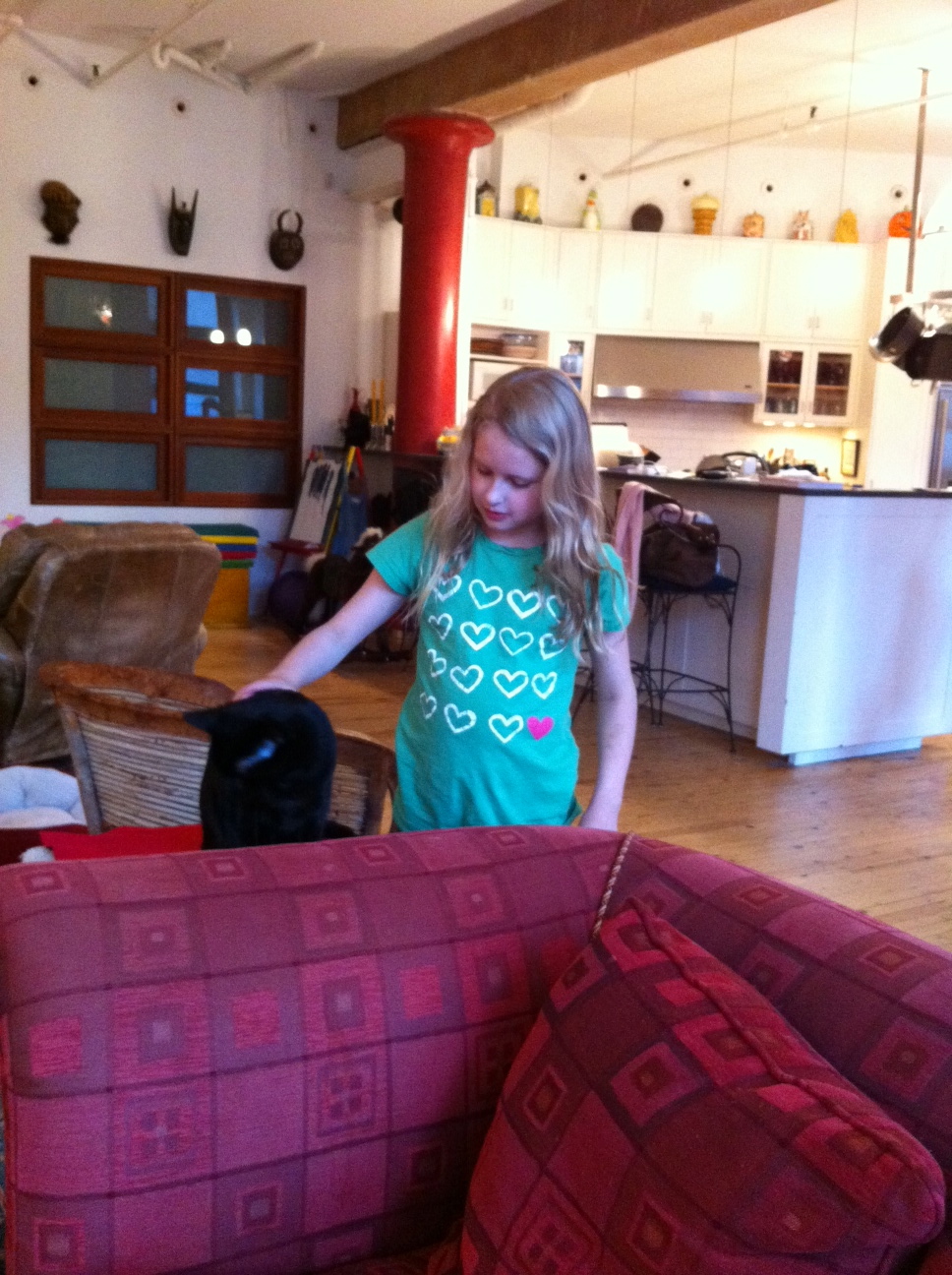
Emma wearing her pretty dress this morning.

Emma looked at herself in the mirror.  “Wow!  You’re so pretty!” Emma said, twirling around.

For more on Emma’s journey through a childhood of autism from Richard’s perspective, go to:  www.EmmasHopeBook.com
Vestibular & Proprioceptive Movement

From the moment Emma could walk (14 months – she went from crawling to running) she would do what we used to call, Emma’s circuit training.  This was before we knew she was autistic and didn’t realize that this was Emma’s very specific way of trying to get the kind of vestibular and proprioceptive movement she so craved.  In fact, it all looked so “normal” or “not autistic” that it took me a long time to understand this was a kind of stimming.  For more on stimming from previous posts, go to:  Compulsions & The Velcro Strip.

I was always trying to find something that might engage Emma.  When we were at the toy store, I found a mermaid finger puppet with long black hair and a blue sequined tail.  I brought it home and to my delight and surprise Emma grabbed hold of it and ran from the living room down the hallway to the front door.  When she reached the front door she swiveled around and raced back to the living room.  This went on for quite sometime and I was so excited I’d found a toy that she liked, I didn’t spend too much time wondering at the peculiarity of her “play”.  A few weeks later I found another mermaid finger puppet and a doll’s stroller and brought both home, only to have Emma completely ignore the new blonde mermaid finger puppet, but she loved the baby stroller.

Emma’s favorite circuit training, which was also how we came to call it that, was the obstacle course she would do in our living room, over and over and over and over again.  She ran from the living room couch into the TV area, jumped up on the couch there, crawled through a tunnel we had set up, ran into the kitchen, around the butcher block island, down the hall to the front door and back again.  Even better was to do all of this with the baby stroller, which she pushed along her route, knocking things over as she sped along.  I wasn’t alarmed by her circuit training, after all, Emma’s older neuro-typical brother, Nic used to spin around until he became so dizzy he’d fall down.  Kids do these things, right?  Right?!

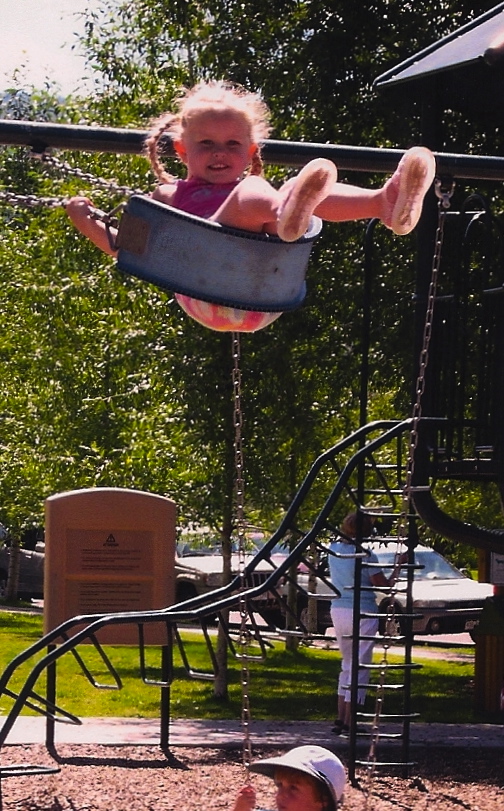
When I took the children to the playground, Emma wanted to go on the swings for as long as she could before the lines became so long she had to get off to give another child the chance to swing, at which point she would get off only to get back in line. She wasn’t much interested in playing with other children.  She wanted, needed to swing.  At her special education school she is allowed to go to the sensory gym periodically, the idea being that children who crave vestibular and proprioceptive movement become more regulated when given the opportunity to swing, have their bodies pressed in the squeeze machine, etc.  Only Emma never seems to get more regulated.

The principal at her school laughed and said, “I’ve never seen a kid who didn’t get tired… ever!”

And she doesn’t.  When we are in Aspen during the winter, Emma will ski for five hours, go to the Aspen Recreational Center where she’ll swim for another two to three hours, then climb on the climbing wall before going grocery shopping, where she’ll push the “customer in training” shopping carts, then stop up at the barn where she will do a weight lifting workout before coming home and demanding that we play a couple dozen games of hide and seek.  Even then she’ll get up bright and early the next morning at 6:00AM sharp if we’re lucky, 5:00AM, if we’re not.

Emma – age 5

For more on Emma’s journey through a childhood of autism and our exhausted attempts to keep up, go to:  www.EmmasHopeBook.com

An Inability to Generalize

I first heard that term used in reference to Emma almost seven years ago now.  It was one of those things people say, in this case her early intervention therapists, where you hear the words, you know what they are saying, but how exactly this is being applied to one’s own child suddenly doesn’t seem clear at all.

Emma, like many children diagnosed with autism, has a difficult time applying something she’s learned in different situations and settings.  For example when she was much younger, I tried to teach her what a t-shirt looked like by holding up an actual t-shirt, one of hers with a pink heart on it, she was able to remember what that particular t-shirt looked like and called it a “t-shirt”.  If I then took out a different t-shirt, one of mine or a different colored t-shirt from her drawer, she was not necessarily able to understand that this too was called a “t-shirt”.  If I showed her a flashcard with a green t-shirt and explained that this was the color green and then pointed to a slightly different shade of green, and perhaps on a chair, she wasn’t able to tell me that the color I was pointing to was green.  Temple Grandin, speaks about this at length, she calls it “thinking in pictures.”  She says she stores images in her mind and then flips through the images to come up with the correct one to fit the word being used.  She then goes on to describe how problematic this retrieval system is for her.  One can easily understand how difficult that must be.

Over the weekend I worked with Emma on two words:  “yes” and “not”.  “Yes” was a bit easier for her to incorporate into her writing, but “not” completely threw her.  If I said, “Emma, what are these?” and pointed to a picture of three trucks.  She answered correctly, “These are trucks.”  If I then asked her, “Are these trucks?” pointing to the trucks, she was able to understand that if you answer, “Yes, these are trucks” it didn’t change the structure of the sentence, one just needed to add “yes” to the beginning of the sentence.  But if I then asked, “Emma, are these trucks?” while pointing to three frogs, she had a terrible time answering, “These are not trucks.”  When I asked her, “Emma, give me the one that cannot walk,” from a field of four objects: a bus, a truck, a plane and a kid,” she handed me the kid.

I know Emma understands what “not” means, but in this context she was baffled.  It reminded me of those first few years when we were new to all of this, and almost constantly perplexed by almost everything she said and did.  I remember watching in dismay as she proceeded to memorize several hundred flashcards that her therapists used with her.  The therapist would hold up a card with a picture of a bike, and Emma would shout, “bike!”, the card with a dress, Emma would yell, “dress!” and on it went.  I fully expected her to go on to a regular kindergarten, at the rate she was going.  But very quickly I realized that though she had no trouble with her memory, could memorize some 400 flashcards, she could not use the information beyond the flashcards.  In other words, the information wasn’t being translated across a larger field.  She did not use the words, we now knew she knew in everyday sentences.  If we went out into the park and I saw a kid on a bike and said, “Em, look!  What’s that kid riding on?” she couldn’t tell me it was a bike.  It didn’t look exactly like the flashcard with a bike.  For one thing it was a kid’s bike and for another it had pink plastic tassels on the handlebars and a little bell with a picture of Dora on it.  This bike looked completely different from the bike on the flashcard and so Emma was at a loss as to what this new thing was called.

The good news is, Emma now can identify a bike, any bike, but it took awhile.  This is what we are up against when trying to teach Emma.

For more on Emma’s courageous journey through a childhood of autism and our admiration for her, go to: www.EmmasHopeBook.com

Emma with her green blanket when she was 3.

The Early Signs of Autism

I have been thinking a great deal about those first clues, the things Emma did that we now know were the first warning signs of what ended in a diagnosis of autism.  The CDC has a website with a checklist – “Learn the Signs” .

According to their checklist, at 3 months, Emma was developing as any neuro-typical child, by seven months there were only one or two things on the checklist that she didn’t do.  Both fall under the “Language” category.

“Responds to own name” is the first and at 7 months Emma did respond to her own name, but not all the time.  I remember a friend reassuring me that her kids, who were older than Emma, didn’t respond every time she called to them either.  Still, it was the first red flag.

“Can tell emotions by tone of voice” – this is difficult.  I made some notes in her baby journal that she seemed preoccupied, but I can see how I and others would have dismissed this as being overly worried.

Everything else on the checklist were things Emma was doing – Ability to track moving objects, transfers object from hand to hand, sits with, and then without, support on hands, rolls both ways, (front to back, back to front.)

The 1 year checklist has more things that Emma was clearly not doing, but again, they were not black and white, such as:  “Shy and anxious with strangers.”

Emma wasn’t shy or anxious around anyone.  In fact, I remember thinking, with a certain degree of pride that this was an expression of her self confidence and independence.

“Cries when mother or father leaves.”  Again, a sign of her independence, I thought and sometimes she would cry when I left, just not often.

“Shows specific preferences for certain people and toys.”  She did, but not to the degree Nic had.  She seemed indifferent to people and rarely asked for toys, something I attributed to her solid sense of self.

“Maybe fearful in some situations.”  Emma showed no fear toward anyone or anything.  We had no idea this was not a good thing.

“Does not search for objects that are hidden while he or she watches.”  I remember Nic loved a picture book by Richard Scarry.  It had a little animal (I can’t remember what kind) that was somewhere on every page, but often difficult to find.  He loved scanning the picture and pointing to the mouse.  When Emma was his age, she had no interest in the book, let alone locating the tiny hidden creature.  It was the same with the mouse in “Good Night Moon”.  Nic loved pointing out the mouse that is always somewhere on each and every page.  Emma would push my hand away when I said, “Emma!  Where’s the mouse?”

I told myself it was because the book didn’t interest her and not because it was indicative of a larger problem.  I remember being baffled by her degree of disinterest.  But I also remember telling myself that children are different and she just wasn’t as interested in books the way Nic had been.  Finding the hidden animal, something Nic and I spent hours doing, was not enjoyable for Emma and while it made me sad that I couldn’t share this with her, I shrugged it off as yet another example of her temperament.

When I look at these checklists I am still struck by how many more things Emma did do than didn’t.  Even on the 2 year checklist, the majority of bullet points were things she did.

Which is why diagnosing autism is so tricky.  Many believe “autism” is a misnomer.  They believe it is actually a word being used to house a wide variety of different issues.  If they are right it would explain the intractable nature of “autism” and why it continues to confound.

For more on Emma’s journey through a childhood of autism and a trip down memory lane, go to:  www.EmmasHopeBook.com
“When Did You Know?”

People often ask this question and the answer is complicated.  Looking back it’s easy to see the signs, things we never associated with autism, but now know were clues.  As a baby she was like any other colicky baby, cheerful in the morning and early afternoon, cranky by late afternoon, screaming by evening and inconsolable by midnight.  She would scream and fuss until 2:00AM or 3:00AM when she would finally fall asleep.  After about three months she was better and began sleeping longer.  Our pediatrician told us this was typical with babies who have colic and from all that I’ve read, it is.  Except that many autistic children also have digestive problems that plague them well beyond infancy.  Some believe GI issues occur more frequently in children who are diagnosed with autism than in neuro-typical children.  Others believe there is absolutely no connection and dispute the studies showing a slight increase in GI issues with autistic children.

I can’t speak for other families, but Emma has always had GI issues something we had confirmed when we took her to Boston for a colonoscopy and endoscopy showing us her multiple ulcerations and inflammations.  When she was a toddler she was a “good eater”, basically ate anything I put in front of her.  I noted in her baby journal when she was 12 months old that she loved the mushroom barley soup I made one snowy winter day.  Talk about random, as Nic would say.  The only thing she really disliked were peas.  Hated them, spat them out and threw the bowl to the floor.  But other than strained peas, Emma had a varied and healthy diet at that time.   As she grew older and the “autism” became more pronounced, her diet became more “autistic” too.  In other words she became less willing to try new things, more rigid in her desire for sameness and eventually became the picky eater that she is today.  People who blame GI issues on picky eating, haven’t met Emma.  Her GI issues have plagued her since the first day of her life.

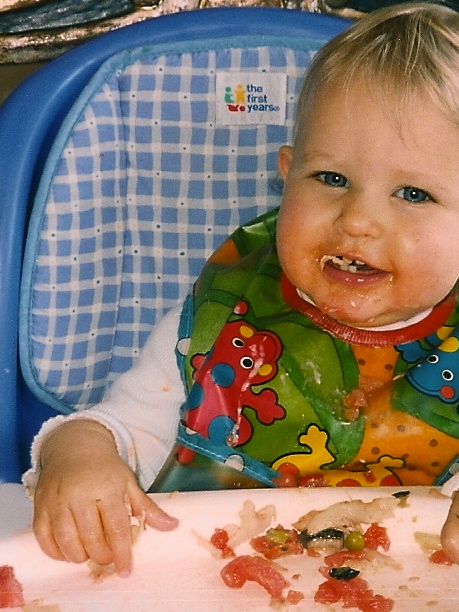
Emma with a variety of food on her tray including one hated pea.  This was taken before she tossed the pea to the ground.

The most telling clue, was the fact that Emma seemed so utterly indifferent to friends and other family members.  I remember when Nic was still a baby, maybe eight months old, my mother came to visit us.  We told him she was coming and he was very excited to see his Granma.  The last time he’d seen her was when he was three months old.  When she arrived, I went to greet her at our elevator, with Nic in my arms, he was so excited he began bouncing up and down, and reaching for her.  It was incredible to witness as he seemed to really know her.  Yet, when Emma saw my mother as a baby she seemed neither happy nor upset by this new person’s presence.  My mother’s arrival seemed to make little difference to her.  I remember making a mental note of this at the time and as with so many things one cannot understand, I chalked it up to her independence.

Rationalizing behaviors I couldn’t make sense of became commonplace.  It was a skill I fine tuned over the coming days, weeks and months.

I didn’t know.

For more on Emma’s journey through a childhood of autism and first clues, go to:  www.EmmasHopeBook.com
Building Blocks & Autism

Sadly, I have no new photographs of Emma petting Merlin.  After that one brief encounter she has returned to ignoring him.  He seems to take it all in stride, poor kitty.  But it leads me to another topic I keep meaning to write about – building blocks.  Not the literal kind, but the developmental kind.  Children typically go through a series of advancements in their speech, physical abilities, etc.  There are specific physical milestones –  lifting their head, turning over, crawling, standing walking, and on it goes.  A foundation is being laid down which further progress is built upon.

What I have seen with Emma is less a foundation and more a series of seemingly unrelated events.  We see her do or say things never to be repeated or if they are, not for many months or even years.  I’m not sure I would have noticed this, except that I’ve made a habit of noting everything she does and then writing about it.  She pets Merlin and then instead of tentatively reaching out to him again the following day, it’s as though she never spent those few minutes petting him.

It reminds me of when she was just over a year old.  She would learn to say something – “play catch” and we assumed that these two words would now be added to the other words she had, such as ba-bye, dada, ah da (all done), hi, okay and no.  We expected to hear them uttered again.  At the time, knowing absolutely nothing about autism, we weren’t looking for signs of anything being wrong.  When she didn’t repeat – play catch – we assumed it was because she didn’t want to play, not that it was a one time event, never to be spoken again.

When I look at her baby journals, (which I discontinued after she was diagnosed – more about that some other time) the first two and a half years of her life, I am struck by the words she knew by the time she was thirteen months old.  Including the ones I’ve listed above she said, Bertie (the name of our elderly cat), Ma-ma, Nic, and Ra-ra (our caregiver).  I was concerned with her lack of language, but it wasn’t as though she wasn’t speaking at all and then she’d come out with something like “play catch” and I would sigh a huge sigh of relief and push my concerns aside.  Except that she never said play catch again.  The full list of words she spoke as a thirteen month old were either salutations or proper nouns of the main people in her life.  Other than the one time she said, “play catch” she did not use any  verbs or nouns.  It was at around this time, between thirteen and fifteen months of age that she would seem to learn a new word or phrase – “play catch”, but also, “chase me” and “go out”.  Some of them, like “chase me!” she would say many times but at around eighteen months she suddenly stopped.  We never heard her say those two words again.  It was as though there were some sort of black hole sucking all those words and phrases away.

Still we fully expected to hear her say those words again, that she did not was something we didn’t realize until much later.  At the time we were sure it was because she chose not to, as opposed to something neurologically wrong.  Why would one assume something was terribly wrong when she would come out with a new phrase or word the next week?  It wasn’t until we were told she was autistic, and only after much research did I begin to look back on all those hopeful notes from her baby journals and see a pattern.  There was not the steady building of a foundation of words, ever added upon to become an extensive and diverse vocabulary.  Instead there were a few scattered words and phrases some repeated, some never heard again.  Arbitrary words, perhaps she heard us say and repeated, but the milestones were not being reached in the time frame one normally would expect.

What I see now is that Emma is slowly, slowly building a vocabulary, but it is at a snail’s pace and it does not follow a neuro-typical trajectory.  Still she is advancing in her own haphazard way.  Who knows, she may even pet Merlin again.

For more on Emma’s criss-crossing journey through a childhood of autism and my ongoing attempts to make sense of it all, go to:  www.EmmasHopeBook.com

Merlin & Emma

Our male black kitty, Merlin doesn’t get a lot of play on this blog.  Mainly because Emma completely ignores him and so, try as I might, I rarely can figure out how to work him in to any posts since Emma’s the star of this blog.  Every now and then I am able to squeeze in some random mention of him, such as these few posts: Do You Think She’s Okay? and Emma’s Photographs, but it’s really a cameo role he’s been relegated to, nothing close to what he deserves.

“Emma, Merlin’s sleeping in the rocking chair, don’t push him off,” Nic cried out last week as Emma tipped the rocking chair on end so he toppled to the ground.  Where upon she happily occupied the rocking chair smiling to herself.

There’s a certain ruthlessness to Emma’s interactions with Merlin.  And while she seems interested in our neighbor’s cat, Lester, asks to visit him and always requests visiting the cats and kittens in the pet store, she appears completely disinterested in Merlin.

“Go see Lester kitty?” Emma asked a couple of weeks ago.

“But what about our kitty?” Richard asked.

“Yeah, Em.  What about Merlin kitty?” Nic chimed in.

“Go see Lester,” Emma said going to the front door as though this was just as good a time as any to pay him a visit.

“Em, we have to call Bob and Cynthia before we go visit.  We can’t just go over there now,” I explained.

“Go see Lester kitty later,” Emma said.

“Yes.  But we can play with Merlin now.  Want to play with Merlin?” I asked.

“No,” Emma said matter-of-factly and walked away.

So when Emma and I were home the other day and Merlin jumped up onto his scratch post, I said, “Oh look, Emma!  Merlie’s come to say hi!”  When she turned to look at him I said, “I bet he’d love it if you pet him.  He loves being pet.”

To my amazement she stroked his back while saying, “Merlie.  Petting Merlie,” as I rushed for the camera.  These are a little out of focus, okay, a lot out of focus because I was hurrying to capture the moment before Emma lost interest.

Merlin gets Emma’s attention

Finally, having waited so long…

Months…

Years…

Merlin was purring, he was so happy…

A final moment of affection between Merlin and Em

And then it was over.  Who knows if she will revert back to ignoring him or callously pushing him off whatever surface he’s asleep on because she wants to sit there.  Everything changes.

For more on Emma’s journey through a childhood of autism and Merlin’s cameo appearances, go to: www.EmmasHopeBook.com
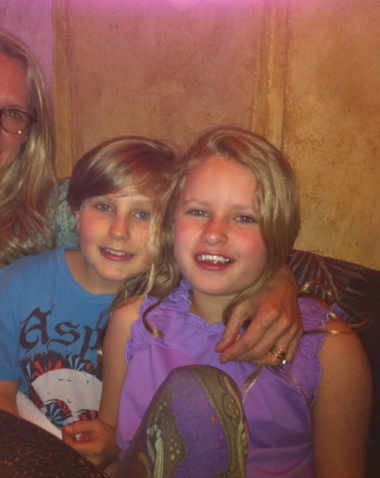

Bonding

I gave birth to Emma in a birthing center here in Manhattan.  It was a relatively “short” labor being just shy of 20 hours, compared to Nic who took more than 38 hours to appear.  Okay, it wasn’t remotely “short”, but that was the word everyone kept using when predicting how long it would take, and compared to Nic, it was certainly short-er, but that’s really the only way you can use any version of the word “short” in describing my labor with either of my children.  Richard caught Nic, as he likes to say, as if he were a football being hiked during a long, boring and tedious game.  The first hands Nic felt were Richard’s.  The first face he became aware of was Richard’s and they bonded immediately.  Not so with little Em.

First of all the labor was more painful or maybe it was just that I wasn’t as exhausted and so I can remember it better.  Richard was comforting me and holding my shoulders when I began to push.  When Emma appeared the midwife was the one pulling her from me before placing her onto my chest.  Richard missed that “father/daughter” moment of connection those first few seconds of her life.  Later, when he didn’t feel the same kind of innate bonding he’d had with Nic, we assumed it was because he wasn’t there to catch her.  For years I felt badly that I’d asked him to hold me and as a result he wasn’t able to be there to hold her.  But as with so many things in life – it’s easy to look back and see things differently when you know the outcome.

When Emma was diagnosed it kind of closed the book on the whole – I should have let Richard catch her during her birth – it was the one bit of guilt the diagnosis freed me of.  As time went on we saw how Emma seemed aloof around friends and other family members.  We came up with ways to rationalize her seeming indifference.  She was independent, she liked doing things on her own, she was her own person, she knew what she wanted, had a mind of her own, etc.  These were all things we said to ourselves and each other as we tried to make sense of Emma during those early years.

Yesterday Emma said to me, “Go swimming at the Y with just Mommy?”

“Yeah.  Okay.  Just the two of us,” I agreed.

Later when we returned home I said to Richard, “I’m not sure why Em wanted just me to go with her.  She pretty much ignored me every time I tried to engage her at the Y today.”

“You’re the only one she’s ever really physically bonded with, Ariane.  You’re the only one whose lap she likes to sit in.  You’re the only one she really likes to be held by.  It’s always been that way,” Richard said.

This morning as I was getting ready to take Nic down to his bus, I heard Emma giggling and Richard laughing, “Emma!  What are you doing?”

I turned around to see Emma climbing from the window sill onto her dad’s shoulders, unprompted, of her own volition and utterly happy.

Everything changes.

For more on Emma’s journey through a childhood of autism and our attempts to keep up, go to:  www.EmmasHopeBook.com

Emma and The Peach Gum

Last night Emma arrived home in tears.  It turns out she had swallowed a piece of peach flavored gum and her therapist, Joe, who had warned her that if she swallowed the gum he would not give her another piece, wouldn’t allow her to have another.  He offered her two other flavors to no avail.

“No!  Peach gum!” Emma cried when I went into her bedroom to sit with her.

“But Em, you swallowed it and Joe told you, you couldn’t have another piece if you swallowed it,” I said, stroking her hair.

“No!” Emma shouted, tears streaming down her face.  “NO!  Peach gum!”

“How about a different flavor?  But you can’t swallow it or you won’t be able to have another piece of any kind,” I offered.

“No, no, no, no.  Peach,” Emma insisted.

I often wonder, when Emma is derailed by something, seemingly rather insignificant, if there isn’t a whole series of events – perhaps unrelated – that have lead up to this kind of monumental upset.  It reminds me of days I’ve had, when everything that could go wrong does.  I get to work and my printer won’t scan, the cartridge is out of ink and I don’t have a back up, I can’t remember my password to upload images that have been requested to my FTP site, my merchant account isn’t showing my latest sales transaction, my gem setter calls to tell me he’s chipped a stone, I forgot to bring some documents I need from home, etc.  and then after all that I go home, having put in nine or ten hours of work, tired and grumpy and find a light bulb has blown in the living room. It just seems too much.  Meanwhile my husband wanders in, sees me and says innocently, “Hey, what’s going on?”

Those words are what flip the switch and suddenly I feel nothing but rage.

Is that what it’s like for Emma sometimes?  Only she can’t take a deep breath and explain that her day has been a nightmare of frustrations and mishaps, while the other person nods their head and says things like, “God that sounds awful.  Here why don’t you put your things down and let’s talk about it.”  Or “I know just what you mean.  It’s been a hell of a day.”  Poor Emma can’t say any of those things.  She doesn’t have the words to tell me how she’s feeling she can’t keep it together for one more second, so she just screams and cries and if things are really bad, bites or hits herself.

This morning one of her therapists emailed me, telling me about some of her frustrations at school yesterday.  I thought about how upset she was when she came home and it all began to make sense.  She had a bad day.  I can relate to that.  I have bad days from time to time too.  But I can pick up the phone and rant about it to one of my girlfriends or I can call my husband and tell him or I can sit and try to be quiet for a few minutes, “sit with the discomfort of it all”, as a meditation teacher I knew referred to those moments when it all feels unbearable.  The point is I don’t have to be alone with those feelings of frustration.  I can reach out and by reaching out I mitigate the feelings.

“You were frustrated, you scream, you bite,”  Emma told her therapist yesterday.  Emma was doing what we all do when we’re upset, trying to communicate her feelings with another human being.

Emma on a good day when she was seven.

For more on Emma’s journey through a childhood of autism and how that effects her older brother, go to: www.EmmasHopeBook.com

Emma and Art – Part 2

As promised, I arrived home yesterday evening and found the art bin in Emma’s room.  After brushing off the dust I pulled it out into the living room.  “Hey Em.  Look!  Let’s make something together!” I gestured at the pop beads, the wooden beads, the string, the glitter, paint and brushes.

“No, no, no, no, no!”  Emma said, casting an eye at the art supplies before returning to the vigorous twirling of her velcro strip.

“Oh come on!  Look at these things.  These look great.  Let’s make something with these,” I said, digging into the bin and producing a bag filled with brightly colored wooden beads.

“No, no, no, no, no!  Mommy go away!  Go away!”  she said, whipping her plastic strip around so that it made crackling noises.

I sat there looking at the bin and then at her.  “Are you sure?” I asked.

“Mommy no!  Go away!   Go away!   Go away!”  she said very quickly so the words all slurred into each other.

“Go away!” is new for Emma.  She says this either when she is going into the bathroom, a very good sign in my opinion, or when she is doing something she thinks we might object to.  That she was now using these same words to indicate displeasure with a suggestion seemed like an advancement as well.  This is a child who just months ago might have bitten her arm or hand or punched herself in the face to express her dislike of an idea.  I was relieved to hear her say – Go away!   And while it might not be considered the most polite response to someone who is trying to engage in an activity with her, it’s certainly a step up from self injurious behavior.  We parents of autistic children take what we can get.

An old familiar feeling of determination crept into my thinking, as I sat on the floor with the art bin before me.  Right, I thought, we need better art supplies.  Wooden beads and pop beads just weren’t going to do it.  As I considered what sorts of things to look for, it occurred to me that I have a great many things at my studio which I will never use.  Drilled gemstones I bought years ago when I first began designing jewelry, glass beads, cooper and brass wire, as well as lots of silk thread in dozens of beautiful colors.   I have a wide assortment of origami paper, leftover from the year I became obsessed with paper folding while pregnant with my son, Nic.  We have glitter, paint, construction paper, tissue paper, scraps of hand pressed paper, pipe cleaners, all the things one might need to make a wide variety of art projects.

“Okay, Em.  Don’t worry.  We can make something together another time,” I said, dragging the bin back into her room.

Emma followed me.  She bent her head down so that it was about an inch away from mine and said, “Play – Don’t say Mommy?”

“Don’t say Mommy” is a chase game where Emma and sometimes her brother Nic will come very close and say, “Don’t (two second pause)  say  (two second pause)  Mommy! (shouted)” and then they run screaming through the house while I chase them.  This game usually involves lots of doors being slammed and beds being torn apart as they burrow under sheets and blankets.  A variation on this game is – don’t say Daddy!  When we catch up to them, we walk very, very slowly giving them plenty of time to hide and ruin whatever bedroom they’ve sought refuge in, we tear the blankets off them while saying in a loud voice, “AHHHHHHH!  There you are!  I found you!” followed by villinous sounding laughter and tickling until they cry for mercy.  This game can go on for a very long time, so we have found, for the sake of ourselves and our neighbors, it’s important to put limits on it.

“Okay, but just two games and then we have to get into PJ’s and brush teeth.”

Emma stared at me intently with a little grin on her face and a wild look in her eyes, “Okay, okay.  Don’t… say… Mommy!” and off she went like a shot, her feet thumping against the floor as she disappeared into our bedroom.

Art will have to wait one more day.

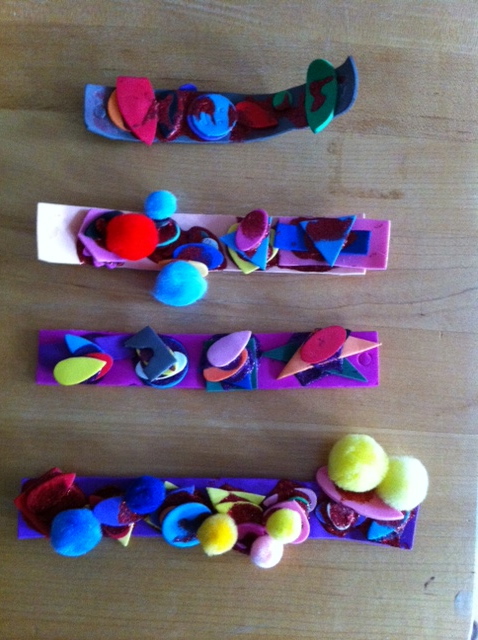
Emma’s art project brought home from school.

What makes these significant is the detail, the number of “bracelets” she made and the fine motor skills required to make them.  For any neuro-typical preschooler, these would be commonplace, but for Emma these bracelets show a marked improvement in her finger dexterity, concentration and focus, not to mention the sheer artistry. (Okay I’m totally biased, but they are pretty fabulous!)

For more on Emma’s continuing journey through a childhood of autism go to:  www.EmmasHopeBook.com

Emma and Art

This morning we had our parent/teacher conference with Emma’s team of teachers and therapists.  I am rarely told anything that completely catches me off guard at these meetings.  But this morning when her teachers related to us how Emma loves doing craft projects, I must admit I was astonished.

“Did you see the bracelets she made?  We sent them home in her backpack,” one of her teachers asked.

“Yes,” I said.  “But I assumed someone helped her with them.”

“No, no!  She did those all by herself,” I was told.

To say I was ecstatic is an understatement.  When I was pregnant with Emma I dreamed of the day when she would be old enough for me to teach her to knit, sew, embroider, do art projects, just as my mother had done with me.  Some of my favorite childhood memories are of my mother and I knitting, sewing, embroidering the figures for the nativity scene we made together one christmas that we still display on the mantle above my mother’s fireplace each December.  But up until now, Emma showed little if any interest in art projects, her fine motor skills are one of her biggest challenges, so my hopes of one day doing these things with her were pushed aside for the more pressing issues of helping her learn to read and write.

I am always looking for things Emma and I can do together.  Things that do not include her favorite outings – which can be very rigid and exacting – the Central Park Zoo, the American History Museum and the Central Park Carousel.  These are regulated outings with specific things that must be done in a particular order, “go see snake bite boy” in the museum, “go see bats” at the zoo.  One day, frustrated with Emma’s desire to ride the carousel over and over again I decided to just continue riding it to see how long she would do so before she asked to leave.  It took almost an hour and more than a dozen rides before she said, “All done.”  I was so dizzy I thought I was going to throw up and the next day she wanted to go back and do it all over again.

Emma has always shown an incredible memory for music, will hear a song once and then months later will hum or sing the entire song without missing a note.  I assumed, until now, that Emma’s artistic leanings were contained in her musical abilities. But every now and again I have wondered whether Emma might find some other medium with which to express herself since both her parents are artistic as is her Granma (she’ll deny this, but she is a terrific artist who did pencil sketches of us when we went on trips together that were amazing) and her great-grandmother was extremely artistic as well.  It definitely runs in the family, so to hear that Emma is deriving pleasure from her art projects at school is terrific.

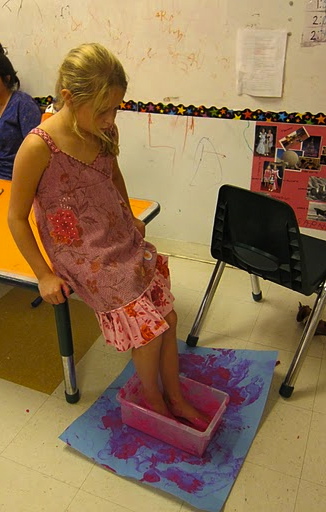
Emma at school using her feet to paint.

We have a bin filled with art supplies buried somewhere in Emma’s closet at home.  When I get home this evening I will pull it out.

For more on Emma’s artistic leanings and her journey through a childhood of autism go to:  www.EmmasHopeBook.com

Autism & Emma’s Loose Tooth

I forgot to mention in yesterday’s post, Emma yanked her tooth out at some point in the movie theatre as we watched Hoodwinked Too this past Sunday.  I don’t know when, all I know is that when we proceeded out of the theatre into the light of early evening, I looked over at her and saw the gaping bloody hole in her gum once occupied by a tooth, her lower left incisor, to be exact.

“Oh my gosh, Em.  What happened to your tooth?”  I asked.

“Pulled out your tooth!” She said happily, bouncing up and down.

“I can see that.  But where is it?  Where did you put your tooth?”

“You threw it.  In the movie theatre, yeah,” Emma said, nodding her head up and down.

“God, Emma.  I can’t believe you just chucked it,” Nic said, no doubt thinking of the money she had essentially just tossed away, being well versed in the ways of the “tooth fairy.”

As a quick aside here, Nic caught on to the whole tooth fairy thing years ago.  “Mom, you can stop telling me about the tooth fairy.  I’m not stupid,” he said to me several years ago.

“I don’t know what you’re talking about, Nic,” I said, feigning shock.

“I know you and dad sneak into my room at night,” he pantomimed tiptoeing like a cat burglar with an evil expression on his face as he said this,  “and leave money.”  He looked at me, but I kept my face blank.  Exasperated he said triumphantly, “You guys are the tooth fairy!”  He said this with the kind of flourish one might expect from Hercule Poirot or Columbo as they sum up a particularly tricky mystery.  Okay, I’m dating myself, but you get the picture.

“You threw it!”  Emma said, evidently pleased with herself.

I looked over at Richard who shrugged and kept walking.

“I think we have three of her teeth.  All the others are on the floor of various school buses and now the floor of the movie theatre,” I said.

“I think there’s one somewhere in the vicinity of the Central Park carousel,” Richard added, thoughtfully.

“She’s never really taken to the whole tooth fairy concept,” I said.

“Yeah, right,” Nic laughed and rolled his eyes.

In fairness to Emma, it is an odd concept, one we tried to explain to her when her first baby tooth looked as though it might come out soon.

“So Em, when your tooth comes out you have to save it, okay?” I said, kneeling down so I was eye level to her.

She ignored me.

“And you give it to Mommy, okay?  We’ll put it under your pillow and the tooth fairy will come and take it and leave you money,” I said, realizing how bizarre this sounded to someone who takes things literally and has no concept of money, before I’d even finished.  “Okay, Em?”  I asked as she squirmed away from me.

Later that day the tooth was gone, where she put it we have no idea.  As with all of Emma’s teeth, there is a ruthless quality to her handling of her baby teeth.  They become loose and she will often say, “Pull it out!”  I’m never sure if that’s a direct request, though she did ask Joe once, about a year ago, but he refused.  The next time  I notice the tooth, it is inevitably gone.  How she manages to yank it out, without us knowing, without a sound or cry of pain, is one of the many mysteries of all things Emma.  The way she experiences pain is exemplified in all those missing teeth.  I can still remember the agony of loosing my baby teeth, the days of pain I would endure.  Emma, apparently feels none of this.

“Tooth missing!” she exclaimed  when she returned home from school yesterday.  She opened her mouth and pointed at the place her tooth once inhabited.  “You threw it!”  Then she laughed and jumped up and down.  “You threw it in the movie theatre!”  She laughed, whipping her plastic velcro strip around her head like a lasso.

Emma wielding her plastic strip

For more on Emma’s tolerance for pain and her continuing journey through a childhood of autism go to:  www.EmmasHopeBook.com

Our Family & Autism

Yesterday I slept in.  It was lovely.  When I woke Emma and Nic greeted me with a Happy Mother’s Day song (complete with pompoms and a loosely choreographed dance) that was so wonderful I wished I’d recorded it.  My thoughtful and doting husband made me a fabulous breakfast and then Emma and I went to her study room.  We are working on the concept of two or more as in – “Some frogs”, “What are these?”  “These are trucks.” etc.  After the study room we went swimming at the Y, something Emma has been requesting we do for weeks now.  It was completely empty and for the first half hour we had the entire pool to ourselves.  This is unheard of in New York City!  We then went to see Hoodwinked Too – a movie Nic has wanted to see since it came out, followed by dinner at a restaurant.  A little something for everyone.

For those of you who do not have an autistic family member this must seem like a perfectly normal way to spend a day.  But for those of you who are like us, you already know without me saying another word, how incredibly, gutsy and insane it is to even attempt the things I’ve just casually listed.  Let me explain.

Because of the issue of transitions, never easy for Emma, her very specific sensory issues coupled with her need for routine and sameness, a day as I’ve described can be a veritable minefield of upsets and cause untold anxiety for Emma. With this in mind we prepared Emma for the day by going over the key points with her – study room, lunch, swimming, movie in the movie theatre, dinner, cupcakes at home – and repeated this list throughout the day, often with Emma interjecting for clarification, “not movie at home, movie in movie theatre!”

The swimming was easy, it is something Emma absolutely loves to do and we try to arrange at least one day a week when she can go, though this isn’t always as simple in New York City as it may sound.  Needless to say we do not live in one of those coveted buildings in New York City with an indoor pool.  However, there are a number of excellent pools throughout Manhattan and so it is not impossible to arrange.  After we swam, (Emma was ecstatic and we all had a great time) we made our way to the movies.  This transition can be tough for Emma ending with protests, tears or worse.  Movies are not something she particularly enjoys and even though this was a kid friendly animated movie, Emma was just as likely to find it intolerable.  It is difficult for her to sit still through the trailers, she doesn’t like the 3-D glasses (I don’t either) and unless it has lots of music, the movie usually does not hold her interest for long.  Emma then will begin standing up in her chair, looking at the people sitting in back of us and saying in a very loud voice, “NO!  You have to be quiet!”  which they find utterly confusing as none of them have spoken.   Emma is just as likely to put her index finger to her lips and make a loud “SHHHHHHHH!” noise, followed by “You have to be quiet!”  Other movie goers find this equally baffling, as we do our best to quiet her.  We always come prepared knowing one of us may have to leave with her, taking her to a nearby playground until the movie is over.  But yesterday she sat through the entire movie, with very little squirming and no audible protest.

After the movie we walked to a restaurant, a little trendy upscale diner with loud rock and roll music (a plus for Emma & Nic who knew all the songs) and with fast service.  Even so, going out to eat is not something we do often as a family as it can end with drinks knocked over, loud utterances of “Time to go now!” from Emma or she will simply get up and leave with one of us racing after her.  This restaurant was one of those places that doesn’t really get crowded until after 8:00PM so we had no trouble securing one of their much sought after booths at 6:30PM.  Emma has such a limited number of foods she’ll eat, we came prepared with her favorites, which she happily ate when our food was served and then patiently waited for us to finish.

Nic and Emma sitting in a booth at the restaurant.

Richard, ever the thoughtful boy scout had bought cupcakes from Magnolia Bakery the day before, thinking Emma was more likely to get into the celebratory spirit if there were cupcakes for dessert waiting for us at home.  So after we ate our dinner we made a pit stop at a playground across the street before going home to eat cupcakes.

Except when we returned home and brought out the cupcakes Emma said, “No thank you,” and wandered off to her bedroom.

“Wow, that’s new!  She doesn’t want one?” I looked at Richard incredulous.

“Hey, everything changes,” Richard said with a shrug.

By 8:00PM both children were in their pj’s, teeth brushed and flossed and in bed.

It was a perfect Mother’s Day.

For more on Emma’s journey through a childhood of autism go to:  www.EmmasHopeBook

Compulsions

I’ve been thinking a great deal about “stimming” which was the topic of yesterday’s post.  Stimming or self-stimulation is the word used for what many children and adults do who have been diagnosed with autism.  It is the repetitive behavior, often as varied as the personalities of the person engaged in it, used to self-regulate or calm oneself.  Many people with autism suffer from a wide range of sensory issues.  Emma may well experience light and sound differently than I do, for example.  I know she experiences physical pain differently.  A small, seemingly incidental scratch causes her to howl in pain, clutching the injured body part, scratching at it or rubbing it vigorously.  Yet a fall, that looks extremely painful, will be ignored.  Days later a large bruise might appear or swelling, which only makes one that much more aware of how it must have hurt and yet she didn’t seem to notice.

Sometimes Emma will plug her ears with her fingers when someone is speaking, often it is when one of us join her in singing a song.  I’ve noticed she does this when her air conditioner is on as well.  The low hum it makes is something she is unable to tolerate.  All of these examples are specific to Emma.  And it makes me wonder whether there are many other things I cannot know about;  does she see certain colors in a way that is painful?  Are some colors brighter to her, even garish and therefore hurt her eyes to look at?  I know certain sounds hurt her ears, sounds like that hum of her air conditioner, does it merely bother her or is it actually painful?  I can’t know.  What I do know is that if  one was bombarded with images, noise, sensations that I could not verbalize, would I not seek refuge in something I could control?  I don’t know, but I think I would.  Is Emma, when she twirls the plastic backing to the velcro strip around and around, soothing herself from an overload of external senses?  It seems likely.

Yet how is this so different from addictive behavior?  Is it not somewhat similar or in the same general ball park?  If someone engages in hours of video game playing or round after round of Solitaire on their computer or Spider (my particular favorite), how is this not also a kind of stimming?  At the very least it is certainly perseverative behavior.   If the game was just played once or for a few minutes that would be one thing, but what of the person(s) who plays endless games, one after the other?  A friend of mine said to me a few months ago, “Sometimes I ask myself – how many times do I have to win before I’ll stop and say that’s enough?  Because when I win there’s no real satisfaction or feeling that – okay now I’m won, it’s time to stop.  I mean how many hours have I wasted playing a really stupid game on the computer over and over again?”  I’m guessing many people can relate to this.  Even if they aren’t into computer generated games, there are other things many of us engage in, mindless “games” or habits we do that we wish we didn’t.  Consider all the games, video games, obsessive exercising, compulsive eating, compulsive dieting, any and all obsessions, compulsions or habits that get in the way of our lives or health, all the things we do while knowing they aren’t good for us and yet we can’t help ourselves from doing them anyway?

When I watch Emma twirling her strip of plastic, while jumping up and down and singing I am reminded of my own perseverative behaviors, the hours I’ve spent doing mindless activities, all to what end?  Am I too, calming myself?  Is this my own brand of self soothing?  I have harsher judgements about my activities, particularly computer games, than I do of Emma’s activities.  I have even, periodically deleted all games from my computer or mechanical device, only to reinstall at a later date.  Certainly there is a compulsiveness to my behavior and I would even go so far as to say an obsessiveness.  I do not mean to suggest my OCD tendencies are remotely the same as what Emma must go through on a daily basis, that would be insensitive and dismissive of her very serious sensory and neurological issues, but I throw this out as something I’ve noticed and can relate to in a very superficial way.  Of course I could be completely wrong about all of this and anyway I have to hurry so that I can finish today’s crossword before starting my day.

For more on Emma’s journey through a childhood of autism and obsessive behavior go to:  www.Emmashopebook.com