Tag Archives: autistic

Zombies

The night before Joe took the kids on their holiday, Richard and Nic watched Shaun of the Dead, a British zombie movie that is more comedy than scary.  Emma insisted she be allowed to watch too, and while Richard was worried it was too gruesome and that even though it’s a comedy she might be frightened by the walking dead and gore, I thought it would be alright if she watched for a little while.  I draw the line at any movie with sexual content, explicit or even suggested, but zombies, no problem.

“Watch a movie together!”  Emma said.  She snuggled under the covers next to me and then when all the zombies are breaking into the Winchester Pub where the few remaining survivors have holed up, she popped her head up, bugged her eyes out and made biting motions with her mouth.

“Oh Emma!  Are you a zombie?” I laughed.  “Richard!  Look at Emma.”

To say that it was hilarious, would be an understatement.  Her depiction was nothing short of brilliant and by the way, extremely convincing.

“Emma let me see!” Nic shouted above the groaning zombie noises.  For the remaining minutes of the movie we took turns making zombie faces and pretending to bite each other, before collapsing into giggles.

Emma and Nic are spending the day at a water park before heading home this evening.  When we spoke to the kids yesterday, Emma said, “Mommy had to stay home.   Mommy couldn’t go to the new hotel.  Just Nic and Joe.”   She said she was having fun, but then went back to talking about how I had to stay home.

“She misses you,” Richard observed when we got off the phone.

I miss my little zombie too.

I have to have surgery tomorrow morning, so I may not be able to post anything for a few days.  It’s nothing life threatening, but I will be out of commission for a while, maybe, probably, unless I turn into a zombie instead.  Either way, I’m sure I’ll be as good as new in no time at all.

For more on Emma’s journey through a childhood of autism, go to:    Emma’s Hope Book

Research & Books on Autism

My mother sent me a fascinating article in Discover Magazine by Carl Zimmer, entitled The Brain.  A neuroscientist who specializes in autism, Eric Courchesne, has detected a pattern in the MRI scans of individuals with autism.  He found that within the first year of life the brains of children with autism are significantly larger than those of same age neuro-typical children.  He also found that a neural explosion takes place during that period, which then tapers off by age five and by the time some of those children are teenagers their brains actually had begun to shrink.  He goes on to say that this points to the origins of autism occurring during the second or perhaps third trimester of pregnancy.  He speculates that it may be a virus and/or some sort of environmental influence that triggers the overproduction of neurons during that period.

This theory is one that Emma’s neuoropsychopharmacologist suggested to us many years ago.  I am interested to see where this research will take us.

Someone asked me the other day what books on autism I recommend.  There are three specifically that I think are essential reading for anyone interested.  The first, Autism and Representation edited by Mark Osteen is an exploration of the various ways autism is represented in film, books and other forms of public media.   It is one of the more interesting books written on the subject of autism.  The other two are written by the late Clara Claiborne Park about her daughter whom she calls Elly in the first book, The Siege and by her real name Jessy in the second, Exiting Nirvana.  These two books were pivotal for me in the years following Emma’s diagnosis.    Elegant, intelligent and beautifully written, I cannot recommend any books written by the parent of a child with autism more highly.  She was the first to write of her relentless desire to understand, support and help her daughter during that unfortunate period in time when mothers were blamed for their child’s autism.  When I learned of Clara Park’s death in July, 2010, I wept.

For more on Emma’s journey through a childhood of autism, go to:   Emma’s Hope Book

A Blessing or A Curse

I rewrote and submitted my Waging War post for the Huffington Post.  They changed some of the tenses (I hate when they do that) and published it last night – click here.  Someone commented, “It is great that you come to the realizatio­n that you can accept your child for who she is. However, I know very few parents of autistic children who confuse their children with their children’s disorder — whether or not they wage a war against autism. Children are blessings, autism is a curse.”

That comment made me think about how difficult it has been, for me anyway, to separate Emma from her autism.   I have always loved my daughter.  I have not loved her autism.  Even now, that concept continues to evolve.  I accept that this is how things are, I accept that she has autism, I accept that because she has autism there are many, many things we must do to support and help her.  I accept that there are things that will take much, much longer for her to  learn and other things that she comes to with no trouble at all.  I accept that who she is has as much to do with the autism piece as it does the Emma piece, that in fact the two are not separate.

Any parent with a child on the spectrum has wondered what their child would have been like had they not had autism.  Would she still have near perfect pitch?  Would she still have an amazing memory, the sort of memory that remembers specific people, places and events when she was two years old?  What sorts of things would she like doing?  Presumably her favored activities: the carousel, the zoo, The American Natural History Museum and FAO Schwartz would have worn out their welcome by now.  Would she still fear dogs?  Would she be the sort of child who had many friends or just a few very close friends?  What classes would she excel in?  What subjects would captivate her?  Where does the autism end and Emma start?  Can we really do that?  Can we really separate the two?  Emma’s autism informs every aspect of her life.  And yes, she is a blessing.  Exactly as she is, with autism or without it.

Nic & Em at the Metropolitan Museum of Art

For more on Emma’s journey through a childhood of autism, go to:   Emma’s Hope Book

The Shower

Emma washed her hair this morning.  By herself.  With almost no input from me.  Emma is ten years old.  Emma has autism.   I used to think those few sentences would suffice.  Keep it short and sweet, age, diagnosis, what more needs to be said?  But I was wrong.  Most people who do not live with a child with autism have little or no idea how monumental something like washing her hair unaided is.  Okay, so I stood outside the shower and had to do a little coaching – “Lather the shampoo on the top of your head too, Em.  Good, now behind your ears, don’t miss the hair on the sides, just above your ears.  No, not like that, Em.  Like this.”  Then I demonstrated by pretending to shampoo my own hair, as she watched me and did her best to mimic my movements.

For the past four years, since Emma began preferring showers over baths, Richard or I have aided her in washing herself and her hair.  Richard’s swimsuit hangs in our bathroom, damp evidence of his continued support.  The few times I tried to let Emma wash her hair on her own, I regretted it. Once her hair dried, revealing large patches of unwashed and now even greasier hair, it was all too apparent that help was still required.  As with everything, it is not that Emma cannot eventually wash her own hair, it’s that it takes a great deal longer for her to learn.  Years, actually.  Many, many years.  “Maybe we should move to France,” I suggested one day after a particularly lengthy and difficult session trying to get Emma to rinse the shampoo out of her hair.  Richard looked at me quizzically.

“They don’t take bathing as seriously as we Americans do.”  (To all French people whom I have now possibly offended, forgive me for my blatant stereotyping.)

“Uh-huh.”

A bit later Nic announced that he too, would like to move to Paris.  When I inquired as to why he thought this was a good idea, he mentioned the museums, the great food, I’m pretty sure he even said something about their coffee being superior, a beverage he isn’t allowed to have.  But I knew his desire had more to do with the fact he doesn’t love showering either.

When Emma got out of the shower, she pulled a towel around her body.  Carefully she began to dry her feet, legs, stomach, arms, just as she has been coached to do for all these years.  “Em, you’re doing such a great job,” I said.

“Drying by myself,”  she said, sternly.  Then she corrected herself, “I’m doing it by myself.”

I nodded and smiled at her.

“Mommy, go away,” she said.

So I did.

For more on Emma’s journey through a childhood of autism, go to:   Emma’s Hope Book

A Birthday Party

Emma does not get invited to many birthday parties.  In fact I can count on one hand the number of times she’s been invited to a birthday party in the last year.  Okay, make that one finger.  Don’t misunderstand me, there is no resentment here.  The children with whom Emma goes to school all have autism in varying degrees, food allergies are rampant, each kid has their own specific sensory issues, some have physical challenges as well, so for a parent to take on the idea, let alone put into action, the planning of a birthday party, is a major undertaking.  The other children Emma knows or has any contact with are either her cousins or friends from before her diagnosis and most of them are Nic’s age, not Emma’s.

So when my cousin invited her to her daughter’s birthday party, Emma was so excited, she talked about it for at least a week prior to the actual party, which was this past Saturday afternoon.  Richard was sick with some nasty bronchial sounding cold, lending him a – come hither – husky quality, opted to stay home and not risk infecting all the children and their families with his germ riddled body.  (TMI – too much information – as Nic would say.)  Emma insisted on wearing a black shirt, embellished with little beads at the neckline, leggings and a plaid skirt, all but the leggings were a size too small, despite my suggesting she wear something a size larger.  “No!  Please!  I want to wear this one!” She pleaded.

When we arrived, Emma said hello to all her cousins and though I kept my eye on her the entire time, she did very well.  There were some 30 children aged 5 – 12, mostly girls and mostly Emma’s age – 10.  The family had hired a couple of clowns who did an hour long routine, with gags, pratfalls and “magic” such as the man pretending to eat a piece of kleenex while the woman demands that he spit it out, only to have her pull the kleenex from his mouth, but instead of kleenex coming out, yards of multi-colored tissue pour forth, leaving one to wonder how he managed to get all of that in his mouth in the first place.  An hour is a long time for a child who may or may not understand all of what is being said and done, to sit.  But sit she did.  Right in the front with all the other girls, watching and though I don’t think she laughed at any of their antics, she did seem intrigued.

After the show ended, the other children ran around playing chase while Emma played with the string of a balloon.  When it was time for us to leave, Emma put on her shoes and coat and said, “We went to Gaby’s birthday party at Gaby’s house.”  And by the time the elevator let us out onto the street, Emma looked up at me and said, “We went to Gaby’s house a long time ago.”

For more on Emma’s journey through a childhood of autism, go to:   Emma’s Hope Book

Waging War – Not So Much

I think of myself as pretty determined.  Someone who doesn’t take “no” for an answer.  A person who doesn’t give up easily.  When Emma was diagnosed I thought of “autism” as something to battle, wage a war on.  I saw it as something we needed to get rid of, a detrimental condition, which needed to be excised.   Emma is not “high-functioning” and while there are many people who reject these delineations of high and low functioning in describing autism, I do not know many parents of children with autism who fall in the moderate to severe category who object.  A child who needs support with daily living skills, while also being non-verbal or almost non-verbal has a very different set of issues than a high-functioning child who is mainstreamed and will most likely need support in holding down a job.  Both will need support, but one will need a great deal more and may never have the opportunity to live independently.  There is a difference.

In the over seven years since I learned of autism and first heard the word applied to my daughter, I find I am slowly letting go of the desire to wage an all out war on Emma’s autism and have been coming around to a slightly different view.  A view I hope will prove to be more productive and less stressful, for all of us.  Allow me to state the obvious – Emma is a little girl, first and foremost.  She is funny, has a great sense of humor, loves music and dancing, loves to perform.  Emma feels tremendous anxiety when she doesn’t know how to do something or is asked a question she doesn’t have the words for or is unable to fully grasp the concept of.  She tries hard.  She makes Herculean attempts to do what is asked of her.  She has sensory issues, which I still do not fully know how to help her with.  She has internal issues I no longer expect anyone to be able to diagnose.  And she is my daughter.

A few years ago she went through a period when she raided my lingerie drawer on a regular basis.  Richard and I (and sometimes guests) would be sitting in the living room when all of a sudden Emma would burst forth, donning a bra and pair of my underwear, but otherwise naked.  The bra haphazardly flung around her shoulders, the cups puckered, the underwear sagged and falling off, she gripped a corner in one hand to ensure they didn’t completely abandon her.  The first time she did this, Richard began laughing, while our guest, I think it may have been an electrician who was fixing a blown lighting fixture stared in stunned silence from his perch on a ladder, while I  hustled her back into our bedroom, out of view.  The second time she appeared, wearing the same combination – never any of the more colorful and attractive lacy lingerie I happen to own, always the same set of sensible, no-nonsense skin-toned bra and underwear – I was able to laugh with Richard, before telling her to go put everything back.  Her raid-mommy’s-lingerie-drawer episodes were interspersed with raiding my shoes, thankfully never at the same time, it was one or the other, for which I am grateful.   Her favored pair of shoes was a pair of red suede pumps, which she would clomp around in.  During these forays into my things, Richard would say things like – “She’s mommy’s little girl!”  or “She’s such a girl!”

That I love her, goes without saying.  She is my daughter, Emma.  Who happens to have autism.  The autism piece is complicated, the beautiful little girl/daughter piece is not.  I used to view Emma’s autism as something separate from her.  I used to think of it as something, like a tumor that needed to be removed.  I am coming around to having a less draconian point of view.  I am beginning to have some acceptance around it.  I find myself thinking less about ridding her of it and more about helping her be all that she can be.  Waging war has been exhausting.  Maybe, in the end, it all comes down to nothing more than semantics, but I am tired of battling something that does not need to completely define my daughter.  I am lucky, Emma is verbal, Emma has shown that she can and will learn to read, write, communicate more appropriately, focus, and is able to understand abstract concepts such as time, names, part vs whole, same vs different, etc.  It just takes a great deal more practice and time.

For more on Emma’s journey through a childhood of autism, go to:   Emma’s Hope Book

Teaching a Name

When Emma was a year old, in a moment of impatience we bought her a baby doll for Christmas.  Despite the fact she showed no interest in dolls of any kind, despite the fact she showed little interest in any of the toys we tried to entice her with.  Emma was much more of a doer than a child who sat happily playing with a toy.  This was a kid who liked to move.  Take her to the playground and she made the other kids look lethargic.  I admit, I took a certain degree of pride in her rejection of all toys and her desire to move and run and slide instead.  Emma’s disinterest reminded me of my father who shunned all holidays, grousing that they no longer celebrated what they were intended to, but instead fed the insatiable Hallmark Greeting Card’s appetite for cheap sentimentality and  had become a financial boon for ad agencies.  His grumpiness about it all, increased with his age.   Emma’s resolute rejection of all toys, her disinterest in videos, movies, and anything else that required her to sit still, would have made my father proud.

The baby doll we purchased was pudgy, with blonde pigtails, and came with a little toilet, hairbrush, mirror, bathrobe and towel.  All that was missing was a mani/pedi kit and perhaps some massage oil.  I bought a couple of little playsuits for the doll and wrapped everything up in pretty paper with a big satin ribbon.  We had to help Emma as she showed no enthusiasm in her gifts piled under the Christmas tree.  She begrudgingly humored us by tearing open the present, but showed no excitement, it was as though it were a chore,  something that was expected of her.  When she saw the baby doll, securely fastened in it’s box with a clear window so that she could see it, but not actually reach it, she lost all interest and wandered off.  “Emma, look!  It’s your very own baby doll!”  I exclaimed.  “What are you going to call her?”  Being ignored during those early years was something we had grown used to.  Still, I persisted, carrying the baby doll over to her, I said, “What’s her name?”  Emma refused to look at me or the baby doll.

Years later, during out DIR (Developmental, Individual Difference, Relationship-based Model, also known as floortime) phase, the baby doll, now joined by a number of other baby dolls, groovy girls, Jessy and Woody from the Toy Story, Tim Burton’s Corpse Bride, each one evidence of our ignorance and dogged determination to engage her in the world of make believe, lay untouched in a pink plastic bin near her bed.  In a moment of inspiration I yanked the baby doll from its bin and thrusting it in Emma’s face, asked, “Oh look Em!  What’s her name?”  Emma said nothing, but I persisted.  “What do you call her, Em?”  And then Emma spoke.  “Doll,” she said.  “Yes, but what will you call her?”  I was nothing, if not determined.  “Is her name, Tabitha or Katherine, Anastasia, Cynthia?  What’s her name, Em?”  The idea that naming something was not a concept Emma fully grasped, never occurred to me.  When Emma then repeated the names I was throwing out, I eventually gave up and as I was leaving, Emma said, simply, “Doll.”

And of course, she was right.  It was a doll.  To Emma that was all she was.  A doll.  For a child with little or no ability to understand the world of make believe, the idea of naming a doll, must have seemed bizarre.  Why would one do that?

Last weekend, at Barnes & Noble, I showed Emma a book called Biscuit, a beginning reader book.  Emma took the book from me, sat down on the carpet and pointed to the first word.  “Biscuit, that word says Biscuit.  That’s the dog’s name,” I said.  Emma nodded and continued to read the book, stumbling over a couple of unknown words, but for the most part being able to get through it with little help from me.  As I sat with her I remembered her baby doll and it occurred to me, she does not fully understand the concept of naming.  It is something I will attempt to teach her this weekend.

For more on Emma’s journey through a childhood of autism, go to:  Emma’s Hope Book.com

A Case of Mistaken Identity

The latest issue of the magazine AARP arrived last week.  It’s the hot potato in our house as Richard will place it on the keyboard of my computer or by my things to take to work.  When he’s not looking I will then surreptitiously put it on his desk in our office, both of us denying that we’ve had anything to do with it.  “Did you put this on my computer?” I’ll ask, waving the magazine in front of him as I head out to work.  “Nope.  Didn’t see it,” he’ll reply.  “You know, it’s your magazine.  It’s addressed to you,”  I’ll inform him, as though he hadn’t noticed or that this will change the fact that we are both over 50 and therefore deserving of its presence in our home.  Truthfully, I am careening toward 52 at a frightening pace.  How did I get here – I find myself wondering.

Last Friday, there it was on my desk, a reminder of the passing of time.  Sharon Stone graced the cover, beaming, in all her youthful beauty.  The only indicator of her advancing age were the reading glasses dangling from her right hand.  I admit, I took some solace in seeing that she too requires reading glasses.  Emma bounded into the office and plopped down on my lap.  She looked at the photo of the dazzlingly gorgeous Sharon Stone and said the most beautiful words perhaps she has ever uttered, “It’s Mommy!”  she exclaimed, before demanding to watch a YouTube video.  (It must be said, I did NOT correct her, I should have, I know.)  She could have asked for anything at that point.  The world was hers for the taking.

In a moment of pure vanity, a moment I admit to being ashamed of,  I showed her the magazine last night, just to see if she hadn’t somehow changed her mind.  Sure enough, she glanced at it and said, “There’s Mommy!”

Love that kid.

For more on Emma’s journey through a childhood of autism, go to:  Emma’s Hope Book

Service Dogs and Marriage

There’s a terrific story in the New York Times about service dogs for people and children with disabilities.  (This post is also about marriage, bear with me. I know it’s a little convoluted.)  The article begins with a couple, who in 1999 adopted two babies from Russia, only to realize after a few years that their son was not developing in the same way as their adopted daughter.  After much distress and many specialists, a developmental pediatrician diagnosed the child with fetal alcohol spectrum disorder.  As the child’s behavior became more problematic and as he grew bigger and stronger, the family’s concerns grew too.  The mother heard about an agency providing children with disabilities service dogs and so she brought this up to her husband, whose initial response was negative.  Over time he came around, they got a service dog, the boy bonded with it, the family was able to sleep through the night without disruption from their son; it’s a wonderful story full of hope for those with disabilities and their families.

As I read the article I had the following thought process:  We need to get a service dog for Emma!  (Forget that she is terrified of dogs.)  If we got a service dog for Emma, she would get over her fear of dogs, which would lead to her finding this particular dog calming, (forget that she’s not an out-of-control child to begin with) and the dog would help her sleep longer on the weekends.  (Forget that we live in New York City and the dog would need to be taken out first thing in the morning.)  Because he would help her sleep past 6:00AM on the weekends, we would also be able to and wouldn’t that be lovely?  (See above parentheses.)  I will not bore you with the details of my continued thinking, anyone with even a passing familiarity with the – If You Gave A Mouse A Cookie – series will know how convoluted the mind can get, if one encourages it.  Suffice it to say, I went from service dog for Emma, to thinking about our adored cat, Merlin, whom Emma ignores, to a meditation on how fortunate I am to have such a sensible and loving husband (who would be completely against this whole idea and he would be right).

Which brings me back to marriage.  I am in no way an authority on marriage, what I can say about it, is to state the obvious – It’s helpful to marry someone you really admire and like.  Adoration is helpful too.  Richard and I joke that it took us about ten years to muscle our way into a good, strong marriage, but thankfully we both kept showing up.  This is where a healthy dose of determination and tenacity can work in ones favor.  Neither of us are particularly good at giving up, in fact, we both tend to stick with something long after we probably should have let it go.  But in our marriage sticking with it has proven advantageous.  It doesn’t hurt that I adore, like, love AND admire the man, even when he’s grumpy.  Even when he doesn’t agree with me.  Even when he shoots down my wonderfully creative ideas – such as getting Emma a service dog – (an idea I haven’t actually verbalized, but know he would not want to discuss) I still love him.  I know somewhere in the dark recesses of my mind that even if he’s not right, he has a point.  A point, that with time, I might be able to come around to, at least, hearing.

It helps that I married an almost perfect man of course.  I know.  I’m very, very lucky.

For more on Emma’s journey through a childhood of autism, go to:   Emma’s Hope Book

This morning Emma wore her new shoes to school

New York City

Every weekday morning I get off the subway and as I walk to my studio, I see a version of this (minus the large truck and woman carrying a newspaper) –

Seeing Manhattan in front of me as I walk to work fills me with optimism; anything seems possible.  It reminds me of that first evening when I flew into JFK Airport to attend Parsons School of Design.  After hailing a cab, all my belongings packed in the trunk, we drove toward Manhattan.  I looked at the city’s breathtakingly beautiful skyline and knew I was home.  That was in August of 1981.  I love New York City.  I love the buildings, I love the parks, I love the art, the museums, the theatre.  I love that on any given night one can see world class dance, music, performance or dine at some of the best restaurants in the world.  I love the diversity of New York, a city that draws people from all over the world.

When I am with Emma, my beautiful girl who gallops more than walks, her head down, her arms flailing about, no one pays attention.  I am grateful when we are in the subway and the doors close with the accompanying bell sound and Emma mimics that bell, but says “Dank you!” in the same tone and volume, most people don’t bother to look up.  They’re New Yorkers after all, far too busy to be concerned with the weird utterances of a child.

I love how the city is in a constant state of flux.  The view from our living room windows, once dominated by the World Trade Center towers, show an ever shifting skyline of downtown Manhattan, a constant reminder of how everything changes, whether we want it to or not.

For more on Emma’s journey through a childhood of autism, go to:   Emma’s Hope Book

Supplements and Doctors

We are currently giving Emma eight different supplements recommended by the naturopathic physician I have been taking her to.  I am not a big pill taker, in fact I must be in extreme pain before I’ll think to take an aspirin and even then, Richard usually has to remind me.  “Honey, why don’t you take some advil?” he’ll say.  “Oh!  Good idea.  I hadn’t thought of that.”  Then Richard will smile at me with a look usually reserved for a very young child.

My deep distrust in the medical community stems from my father’s horseback riding accident when he broke his back and lay hospitalized in a coma when I was just nine years old.  The doctors were skeptical regarding his recovery, some even wondered whether he would come out of his coma at all, while others suggested he would remain paralyzed for the remainder of his life.  When he came to and months later after grueling daily sessions of physical therapy began to walk and even start horseback riding again, I concluded it was all an inexact and questionable science.  Actually my issues with medicine are more likely genetic and coded in during utero, but in any case, I don’t trust doctors.   I view hospitals with the same degree of horror others view a sinkhole, it would probably not be an exaggeration to say I have a phobia toward them.

The fact that I am the driving force in giving Emma eight different supplements, while Richard (who pops aspirin like they’re chiclets) rolls his eyes and wanders off into another part of the house, is nothing short of ironic.

“I have a theory about all of this.”  I made this announcement yesterday morning as I prepared to leave for my studio.  I can’t be sure, but I think Richard muttered something derisive under his breath.  I ignored him.  “I think these supplements have healed the cracks on her heels.  They’re almost all gone.”

“You don’t think all the lotion I rub into her feet every morning and night and making her wear socks has anything to do with that?”  Richard asked, with what sounded to me like an unnecessarily aggressive tone.

“Well let’s stop doing that and see if her feet get worse,” I reasoned.

“No.  We are not going to stop the thing that is probably helping her feet heal.”  Richard countered.

“I’m just saying, if you want to know for sure, we would need to stop and see if the cracks come back,” I said.

“Look, if you want to stop, then go ahead after they’ve completely healed, but we’re not going to stop before that.”

And here’s the thing – Richard’s probably right.  Every evening and morning before Emma gets dressed, Richard carefully rubs ointments and lotions into the cracks on her feet, then he painstakingly finds socks (in colors that match her shoes) and gives them to her to put on before she slips on her Uggs.  Because that’s the kind of amazing guy he is – thoughtful, kind, caring and a devoted dad.  He has been doing this for over a month now and sure enough the cracks on her feet have almost completely healed.

When I took Emma to the naturopath last week he looked at her feet and noticed how nicely the cracks were healing.  I described how Richard was caring for them with lotions and insisting Emma wear socks.  He nodded his head and said, “Well at least they’re healing.”  But I could tell he thought it was from the supplements I’ve been giving her.  I asked him if he thought the cracks could be healing from wearing socks and all the lotion we’ve been putting on.  He shook his head and said, “Socks and lotion aren’t doing that.”

Maybe, but maybe not.  In any case, I’m really glad I have a husband who’s on top of the whole lotion part and we’ll keep giving her supplements in the hope they are doing something positive too.

For more on Emma’s journey through a childhood of autism, go to:   Emma’s Hope Book

An Afternoon With Emma

Joe, Emma’s therapist and all around amazing guy, is sick.  He has a cold and in seven years has never called in sick. Never. Not once.  Seven years.  So I urged Joe to take a sick day, and finally, after much arm twisting, I convinced him.  I admit my methods of persuasion were more threatening than persuasive, but sometimes one must resort to such tactics.  In retrospect, the thing that finally seemed to convince him was when I said something about how I would have to seriously hurt him if one of us caught the nasty bug lurking within his body, or words to that affect.

The end result was – I picked Emma up from school. Never one to pass up an opportunity for a dramatic entrance, Emma came running toward me shouting, “It’s Mommy!”  She was so excited she actually bounced up and down.  Once outside she turned serious, “We have to go to the doctor.”  She nodded her head and looked resigned.

“Not today, Em!  We are not going to go to the doctor today.  Joe doesn’t feel great, so you and I are going to go get some groceries, do our study room and then you’re going to help me make dinner!”

“Grocery shopping, study room, cereal and toast!”  Emma said.

“No.  Catfish, cole slaw and roasted sweet potatoes,” I corrected her.  “And you’re going to help me.”

“We’re going to spend the afternoon together, just you and me,” Em said, pointing to me with an enormous grin.

“Yes, we are.”

Emma then reached over and in a rare display of unprompted affection, held my hand!  Wow.  Typically, holding hands with Emma is like holding on to the tail of a greased pig, in other words, it’s not easy,  a certain degree of tenacity and determination are required.  But yesterday, she reached over and held my hand, her cold little hand in my gloved one and suddenly the clear, blue sky looked a whole lot bluer.  Filled with a sense of awe at the beauty of life, we entered Whole Foods, whereupon I turned to her and said, “I’m going to need your help getting our groceries.”

“I’m going to help you,” Emma said, tossing her backpack and then herself into the back of the grocery cart.

Later, Emma helped me dredge the catfish in cornmeal and flour, while Nic peeled the sweet potatoes and prepared them for roasting.  “Help Mommy,” Emma said at one point.

“Yes, you are.”

For more on Emma’s journey through a childhood of autism, go to:   Emma’s Hope Book

Breaking Routines

I have written about Emma’s need for routines.  Like many children with autism, the desire to do the same thing, whether it’s watch Mary Poppins for the two thousandth time (not an exaggeration) or go to the Central Park Zoo, followed by a visit to FAO Schwartz and ending with a visit to the American Museum of Natural History, has an obsessive compulsive urgency to it.  Emma has gotten much, much better about being more flexible, but this Sunday morning Emma became fixated on going to the zoo.  Despite the fact she went to the Bronx Zoo with a caregiver the weekend before and the Central Park Zoo the weekend before that, despite the fact going to the zoo is less about leisurely strolling through the various artificial habitats and looking at the animals who reside there and very much about a specific route that must be held to.

During those increasingly rare times I have indulged Emma’s request to go to a place, like the zoo, I end up running after her while she zips from one thing to the next.  At the Central Park Zoo, given her preference, she will begin with a visit to the bat cave, racing past the exotic birds, stand for less than three minutes peering into the dark cave while saying, “Look at the bats!  Be careful, the bats will bite you!” before tearing off, regardless of what I might think to say to engage her in an attempt to slow the routine down, past the Colobus Monkeys and outside again to stare at some other type of monkey who reside on a few strategically placed rocks in the middle of a man-made lake.  Then it’s off to see the old, decrepit and now blind seal, into the penguin and puffin house, then back outside to watch the sea lions being fed.  If we’ve missed a feeding, we must wait until the next feeding.  Emma will patiently sit until the next show and then watch until the last unfortunate fish has been tossed into the gaping mouth of a lucky sea lion, before we are allowed to leave.

But Sunday is the day we try to do something together as a family.  Sunday is the day we attempt to take everyone’s desires into consideration.  Sundays can be difficult.  Nic, more often than not, wants to go see a movie or get together with a family we know who has children Nic’s age, Richard, being the amazing man that he is, is often game to go with the flow and I will do just about anything that doesn’t involve going to one of Emma’s favored haunts.  (Lest anyone think I’m a dreadful mother, may I just defend myself here and say I have been to the American Museum of Natural History several thousand times and would be grateful if I never went there again, literally, for the rest of my life, likewise to the zoo, any zoo for that matter and, while we’re at it, any carousel, anywhere in the entire world.)  It may sound harsh, but there it is.

So when Emma launched in about going to the zoo this past Sunday morning, I said simply, “Not today, Em.”

“Go with Mommy!”  Emma cried pointing at me.  “Just you and me, go to the zoo.”

It was heartbreaking to hear her carefully using the correct pronouns, requesting me, specifically.  Never-the-less I stood firm.  Then Emma brought out the big guns.  “Mommy talk to Daddy,” she cried.  “Mommy talk to Daddy about the zoo.”   It was a stroke of manipulative genius, pitting one parent against the other, knowing that where Mommy wasn’t caving, Daddy just might.  I actually had to leave the room, I felt such a welling up of pride.  She’s becoming quite the negotiator I thought, as I prepared for our “study room” session.

By the time Emma was halfway into our literacy session, the obsession with the zoo had ebbed and when we ended our session with sitting still for five minutes, the obsessive grip no longer held her.   We ended up having a lovely Sunday with Nic and Emma going to their gymnastics class, on the way to Union Square we happened upon an Occupy Wall Street protest, giving me ample subject matter to photograph, before meeting some friends in Union Square.  Emma and I made a brief visit to Barnes and Noble and then home, where we did some more literacy work before Nic and I made custom made hamburgers, cole slaw and french fries for dinner – inspired by the Food network’s favorite burgers show, which aired over the weekend – only ours were better.

Occupy Wall Street Protest
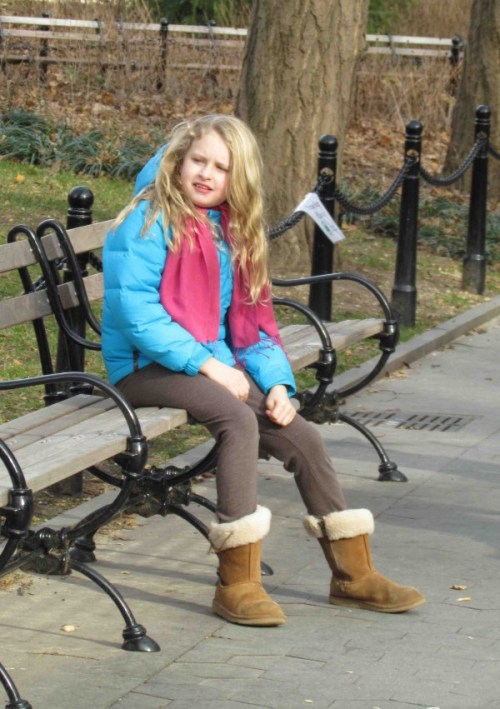
Em waiting for me
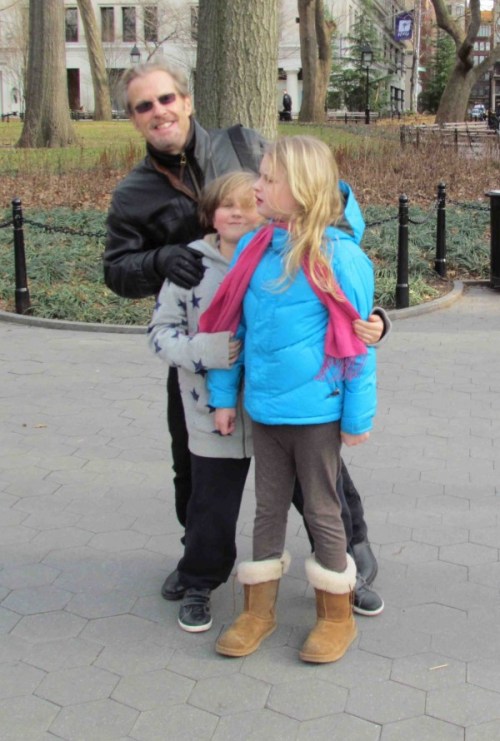
The Family – Who’s that devilishly handsome man (Gasp!) with those two adorable children?
For more on Emma’s journey through a childhood of autism, go to:   Emma’s Hope Book

Questions

Last night, just to mix things up, Emma watched Lilo and Stitch.  When Lilo says – Aliens are attacking my house – Emma howled with laughter and then repeated that line several times as she was getting ready for bed.   So here are a few questions I have for Emma that I wish she could answer – Why is that line so funny to you?  What does the word, “alien” mean to you?  If you had the words, what would you say the movie was about?

I realize I sound like an annoying english teacher, but I actually really would like to know what she would say, if she could.  And while we’re at it, here are a couple more questions I’d ask if I could:

What do you hear?  Do you hear what I hear or is it different for you?  Is the pitch different, the volume, do other sounds compete with each other?  Is it hard to tune some noise out and concentrate on the person who’s speaking to you?  Is all noise equal?  What do you see?  Is it just like sound?  Do you see patterns?  When you look at your box with hundreds of photographs, do you see the images or do you see a pattern or do you see something else and if you see a pattern, does that pattern soothe you?  What is it about the string you like to hold and twirl, why do you like it?  What does it feel like?  What do you think about?  Do you have questions, but don’t ask them because you don’t have the words?  Do you understand the larger concepts of a story?  A movie?

Finally, the ultimate question, the question I will never know the answer to, even if Emma is one day able to answer all the questions I’ve just listed:

What’s it like to be you?

For more on Emma’s journey through a childhood of autism, go to:   Emma’s Hope Book

Pooh Bear and Emma

Often before bed Emma asks if she can watch one of two movies – Mary Poppins or Winnie the Pooh.  She has been watching these same two movies for the past five years and in the case of Winnie the Pooh, going on eight years.   Typically we tell her she can watch whichever movie she’s chosen for twenty minutes or so before bedtime when I read to her.  Last night she chose Winnie the Pooh.  I sat next to her, but wasn’t really paying attention as I was reading an email, when I realized she was talking and looking over at me.  This was unusual.  Emma will often repeat much of the dialogue, particularly her favorite parts of the movie which, having watched literally thousands of times, she has memorized.  But last night she wasn’t just repeating the dialogue.  Last night she was talking – about the movie – to me!

It took me a couple of seconds to understand what she was saying, but it went something like this.

Emma laughing.  “He’s stuck!”  More laughter.  “He can’t get out.  Ooof!  Pooh bear is stuck.  Yeah.  He cannot get out.”  Emma points to the screen while looking at me.

I look at the television, inwardly feeling nothing short of elation that she is initiating contact, that she wants to share her amusement at Pooh’s predicament with me!  “Oh no!  You’re right.  He’s stuck.  He ate too much honey.”

Emma nods her head.  “Don’t… feed… the …bear!” she shouts at the same time that Rabbit says this while pounding a sign with these words into the ground with his fist.  “Rabbit’s angry!”

“Yes, he is!  He doesn’t want Pooh stuck in his house.”

“Pooh can’t get out,” she says, laughing.

“Pooh was so hungry, he ate and ate and ate all of Rabbit’s honey.”

“Now he can’t get out.”  Emma says, watching the television.

“He ate so much, his belly got so big, now he’s too big to get out.”

Emma shrieks with laughter.  “Oh no! Oh no!  I’m stuck!”

“You aren’t stuck, Em.  Who’s stuck?”

“Pooh’s stuck!”

This continued throughout the entire scene until Pooh gets thin enough that he can be pulled out.  While Christopher Robbin and the rest of the animals pull Pooh bear, Rabbit pushes him from behind and he finally shoots out of the hole like a cannonball and lands inside of a tree, which just happens to be filled with honey.

“Pooh’s eating!  He likes honey!”  Emma says, pointing to the part when Christopher Robin says – Don’t worry Pooh.  We’ll get you out!  (of the tree) and Pooh says, through mouthfuls of honey – Don’t hurry!   Yum!  Yum!

Emma thought this hilarious.  “Oh no!  He’s stuck again!”  Then she collapsed into a fit of giggles with her hand on my arm.

For more on Emma’s journey through a childhood of autism, go to:   Emma’s Hope Book