Tag Archives: autism & parenting

The Early Signs of Autism

I have been thinking a great deal about those first clues, the things Emma did that we now know were the first warning signs of what ended in a diagnosis of autism.  The CDC has a website with a checklist – “Learn the Signs” .

According to their checklist, at 3 months, Emma was developing as any neuro-typical child, by seven months there were only one or two things on the checklist that she didn’t do.  Both fall under the “Language” category.

“Responds to own name” is the first and at 7 months Emma did respond to her own name, but not all the time.  I remember a friend reassuring me that her kids, who were older than Emma, didn’t respond every time she called to them either.  Still, it was the first red flag.

“Can tell emotions by tone of voice” – this is difficult.  I made some notes in her baby journal that she seemed preoccupied, but I can see how I and others would have dismissed this as being overly worried.

Everything else on the checklist were things Emma was doing – Ability to track moving objects, transfers object from hand to hand, sits with, and then without, support on hands, rolls both ways, (front to back, back to front.)

The 1 year checklist has more things that Emma was clearly not doing, but again, they were not black and white, such as:  “Shy and anxious with strangers.”

Emma wasn’t shy or anxious around anyone.  In fact, I remember thinking, with a certain degree of pride that this was an expression of her self confidence and independence.

“Cries when mother or father leaves.”  Again, a sign of her independence, I thought and sometimes she would cry when I left, just not often.

“Shows specific preferences for certain people and toys.”  She did, but not to the degree Nic had.  She seemed indifferent to people and rarely asked for toys, something I attributed to her solid sense of self.

“Maybe fearful in some situations.”  Emma showed no fear toward anyone or anything.  We had no idea this was not a good thing.

“Does not search for objects that are hidden while he or she watches.”  I remember Nic loved a picture book by Richard Scarry.  It had a little animal (I can’t remember what kind) that was somewhere on every page, but often difficult to find.  He loved scanning the picture and pointing to the mouse.  When Emma was his age, she had no interest in the book, let alone locating the tiny hidden creature.  It was the same with the mouse in “Good Night Moon”.  Nic loved pointing out the mouse that is always somewhere on each and every page.  Emma would push my hand away when I said, “Emma!  Where’s the mouse?”

I told myself it was because the book didn’t interest her and not because it was indicative of a larger problem.  I remember being baffled by her degree of disinterest.  But I also remember telling myself that children are different and she just wasn’t as interested in books the way Nic had been.  Finding the hidden animal, something Nic and I spent hours doing, was not enjoyable for Emma and while it made me sad that I couldn’t share this with her, I shrugged it off as yet another example of her temperament.

When I look at these checklists I am still struck by how many more things Emma did do than didn’t.  Even on the 2 year checklist, the majority of bullet points were things she did.

Which is why diagnosing autism is so tricky.  Many believe “autism” is a misnomer.  They believe it is actually a word being used to house a wide variety of different issues.  If they are right it would explain the intractable nature of “autism” and why it continues to confound.

For more on Emma’s journey through a childhood of autism and a trip down memory lane, go to:  www.EmmasHopeBook.com

Emma and The Peach Gum

Last night Emma arrived home in tears.  It turns out she had swallowed a piece of peach flavored gum and her therapist, Joe, who had warned her that if she swallowed the gum he would not give her another piece, wouldn’t allow her to have another.  He offered her two other flavors to no avail.

“No!  Peach gum!” Emma cried when I went into her bedroom to sit with her.

“But Em, you swallowed it and Joe told you, you couldn’t have another piece if you swallowed it,” I said, stroking her hair.

“No!” Emma shouted, tears streaming down her face.  “NO!  Peach gum!”

“How about a different flavor?  But you can’t swallow it or you won’t be able to have another piece of any kind,” I offered.

“No, no, no, no.  Peach,” Emma insisted.

I often wonder, when Emma is derailed by something, seemingly rather insignificant, if there isn’t a whole series of events – perhaps unrelated – that have lead up to this kind of monumental upset.  It reminds me of days I’ve had, when everything that could go wrong does.  I get to work and my printer won’t scan, the cartridge is out of ink and I don’t have a back up, I can’t remember my password to upload images that have been requested to my FTP site, my merchant account isn’t showing my latest sales transaction, my gem setter calls to tell me he’s chipped a stone, I forgot to bring some documents I need from home, etc.  and then after all that I go home, having put in nine or ten hours of work, tired and grumpy and find a light bulb has blown in the living room. It just seems too much.  Meanwhile my husband wanders in, sees me and says innocently, “Hey, what’s going on?”

Those words are what flip the switch and suddenly I feel nothing but rage.

Is that what it’s like for Emma sometimes?  Only she can’t take a deep breath and explain that her day has been a nightmare of frustrations and mishaps, while the other person nods their head and says things like, “God that sounds awful.  Here why don’t you put your things down and let’s talk about it.”  Or “I know just what you mean.  It’s been a hell of a day.”  Poor Emma can’t say any of those things.  She doesn’t have the words to tell me how she’s feeling she can’t keep it together for one more second, so she just screams and cries and if things are really bad, bites or hits herself.

This morning one of her therapists emailed me, telling me about some of her frustrations at school yesterday.  I thought about how upset she was when she came home and it all began to make sense.  She had a bad day.  I can relate to that.  I have bad days from time to time too.  But I can pick up the phone and rant about it to one of my girlfriends or I can call my husband and tell him or I can sit and try to be quiet for a few minutes, “sit with the discomfort of it all”, as a meditation teacher I knew referred to those moments when it all feels unbearable.  The point is I don’t have to be alone with those feelings of frustration.  I can reach out and by reaching out I mitigate the feelings.

“You were frustrated, you scream, you bite,”  Emma told her therapist yesterday.  Emma was doing what we all do when we’re upset, trying to communicate her feelings with another human being.

Emma on a good day when she was seven.

For more on Emma’s journey through a childhood of autism and how that effects her older brother, go to: www.EmmasHopeBook.com

Autism & Emma’s Loose Tooth

I forgot to mention in yesterday’s post, Emma yanked her tooth out at some point in the movie theatre as we watched Hoodwinked Too this past Sunday.  I don’t know when, all I know is that when we proceeded out of the theatre into the light of early evening, I looked over at her and saw the gaping bloody hole in her gum once occupied by a tooth, her lower left incisor, to be exact.

“Oh my gosh, Em.  What happened to your tooth?”  I asked.

“Pulled out your tooth!” She said happily, bouncing up and down.

“I can see that.  But where is it?  Where did you put your tooth?”

“You threw it.  In the movie theatre, yeah,” Emma said, nodding her head up and down.

“God, Emma.  I can’t believe you just chucked it,” Nic said, no doubt thinking of the money she had essentially just tossed away, being well versed in the ways of the “tooth fairy.”

As a quick aside here, Nic caught on to the whole tooth fairy thing years ago.  “Mom, you can stop telling me about the tooth fairy.  I’m not stupid,” he said to me several years ago.

“I don’t know what you’re talking about, Nic,” I said, feigning shock.

“I know you and dad sneak into my room at night,” he pantomimed tiptoeing like a cat burglar with an evil expression on his face as he said this,  “and leave money.”  He looked at me, but I kept my face blank.  Exasperated he said triumphantly, “You guys are the tooth fairy!”  He said this with the kind of flourish one might expect from Hercule Poirot or Columbo as they sum up a particularly tricky mystery.  Okay, I’m dating myself, but you get the picture.

“You threw it!”  Emma said, evidently pleased with herself.

I looked over at Richard who shrugged and kept walking.

“I think we have three of her teeth.  All the others are on the floor of various school buses and now the floor of the movie theatre,” I said.

“I think there’s one somewhere in the vicinity of the Central Park carousel,” Richard added, thoughtfully.

“She’s never really taken to the whole tooth fairy concept,” I said.

“Yeah, right,” Nic laughed and rolled his eyes.

In fairness to Emma, it is an odd concept, one we tried to explain to her when her first baby tooth looked as though it might come out soon.

“So Em, when your tooth comes out you have to save it, okay?” I said, kneeling down so I was eye level to her.

She ignored me.

“And you give it to Mommy, okay?  We’ll put it under your pillow and the tooth fairy will come and take it and leave you money,” I said, realizing how bizarre this sounded to someone who takes things literally and has no concept of money, before I’d even finished.  “Okay, Em?”  I asked as she squirmed away from me.

Later that day the tooth was gone, where she put it we have no idea.  As with all of Emma’s teeth, there is a ruthless quality to her handling of her baby teeth.  They become loose and she will often say, “Pull it out!”  I’m never sure if that’s a direct request, though she did ask Joe once, about a year ago, but he refused.  The next time  I notice the tooth, it is inevitably gone.  How she manages to yank it out, without us knowing, without a sound or cry of pain, is one of the many mysteries of all things Emma.  The way she experiences pain is exemplified in all those missing teeth.  I can still remember the agony of loosing my baby teeth, the days of pain I would endure.  Emma, apparently feels none of this.

“Tooth missing!” she exclaimed  when she returned home from school yesterday.  She opened her mouth and pointed at the place her tooth once inhabited.  “You threw it!”  Then she laughed and jumped up and down.  “You threw it in the movie theatre!”  She laughed, whipping her plastic velcro strip around her head like a lasso.

Emma wielding her plastic strip

For more on Emma’s tolerance for pain and her continuing journey through a childhood of autism go to:  www.EmmasHopeBook.com

Our Family & Autism

Yesterday I slept in.  It was lovely.  When I woke Emma and Nic greeted me with a Happy Mother’s Day song (complete with pompoms and a loosely choreographed dance) that was so wonderful I wished I’d recorded it.  My thoughtful and doting husband made me a fabulous breakfast and then Emma and I went to her study room.  We are working on the concept of two or more as in – “Some frogs”, “What are these?”  “These are trucks.” etc.  After the study room we went swimming at the Y, something Emma has been requesting we do for weeks now.  It was completely empty and for the first half hour we had the entire pool to ourselves.  This is unheard of in New York City!  We then went to see Hoodwinked Too – a movie Nic has wanted to see since it came out, followed by dinner at a restaurant.  A little something for everyone.

For those of you who do not have an autistic family member this must seem like a perfectly normal way to spend a day.  But for those of you who are like us, you already know without me saying another word, how incredibly, gutsy and insane it is to even attempt the things I’ve just casually listed.  Let me explain.

Because of the issue of transitions, never easy for Emma, her very specific sensory issues coupled with her need for routine and sameness, a day as I’ve described can be a veritable minefield of upsets and cause untold anxiety for Emma. With this in mind we prepared Emma for the day by going over the key points with her – study room, lunch, swimming, movie in the movie theatre, dinner, cupcakes at home – and repeated this list throughout the day, often with Emma interjecting for clarification, “not movie at home, movie in movie theatre!”

The swimming was easy, it is something Emma absolutely loves to do and we try to arrange at least one day a week when she can go, though this isn’t always as simple in New York City as it may sound.  Needless to say we do not live in one of those coveted buildings in New York City with an indoor pool.  However, there are a number of excellent pools throughout Manhattan and so it is not impossible to arrange.  After we swam, (Emma was ecstatic and we all had a great time) we made our way to the movies.  This transition can be tough for Emma ending with protests, tears or worse.  Movies are not something she particularly enjoys and even though this was a kid friendly animated movie, Emma was just as likely to find it intolerable.  It is difficult for her to sit still through the trailers, she doesn’t like the 3-D glasses (I don’t either) and unless it has lots of music, the movie usually does not hold her interest for long.  Emma then will begin standing up in her chair, looking at the people sitting in back of us and saying in a very loud voice, “NO!  You have to be quiet!”  which they find utterly confusing as none of them have spoken.   Emma is just as likely to put her index finger to her lips and make a loud “SHHHHHHHH!” noise, followed by “You have to be quiet!”  Other movie goers find this equally baffling, as we do our best to quiet her.  We always come prepared knowing one of us may have to leave with her, taking her to a nearby playground until the movie is over.  But yesterday she sat through the entire movie, with very little squirming and no audible protest.

After the movie we walked to a restaurant, a little trendy upscale diner with loud rock and roll music (a plus for Emma & Nic who knew all the songs) and with fast service.  Even so, going out to eat is not something we do often as a family as it can end with drinks knocked over, loud utterances of “Time to go now!” from Emma or she will simply get up and leave with one of us racing after her.  This restaurant was one of those places that doesn’t really get crowded until after 8:00PM so we had no trouble securing one of their much sought after booths at 6:30PM.  Emma has such a limited number of foods she’ll eat, we came prepared with her favorites, which she happily ate when our food was served and then patiently waited for us to finish.

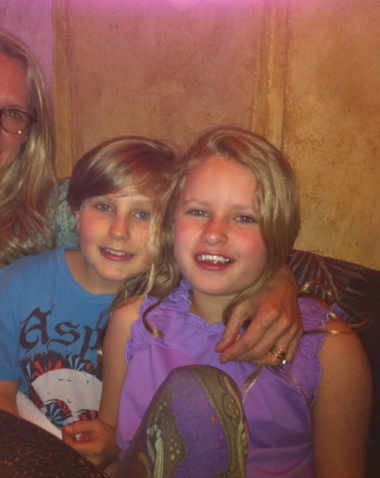
Nic and Emma sitting in a booth at the restaurant.

Richard, ever the thoughtful boy scout had bought cupcakes from Magnolia Bakery the day before, thinking Emma was more likely to get into the celebratory spirit if there were cupcakes for dessert waiting for us at home.  So after we ate our dinner we made a pit stop at a playground across the street before going home to eat cupcakes.

Except when we returned home and brought out the cupcakes Emma said, “No thank you,” and wandered off to her bedroom.

“Wow, that’s new!  She doesn’t want one?” I looked at Richard incredulous.

“Hey, everything changes,” Richard said with a shrug.

By 8:00PM both children were in their pj’s, teeth brushed and flossed and in bed.

It was a perfect Mother’s Day.

For more on Emma’s journey through a childhood of autism go to:  www.EmmasHopeBook

The Velcro Strip

Emma’s balloon string has been officially replaced.  She now carries a long plastic strip, the kind you peel off a self adhesive velcro strip.  How such a bizarre and unlikely item came into her possession is anyone’s guess.

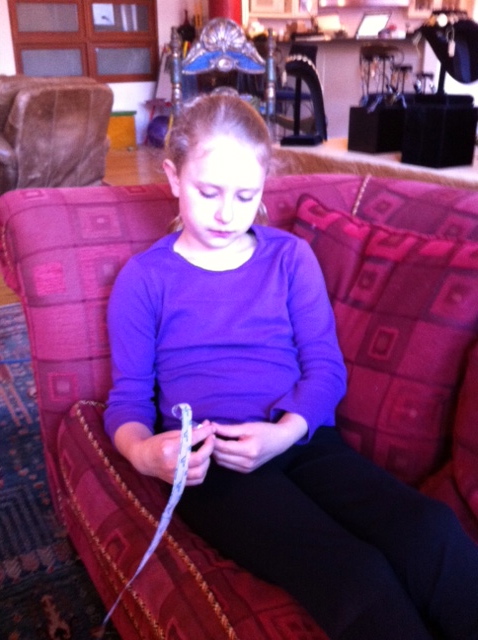
Emma with her plastic velcro strip this morning before going to school.

Over the past year or more Emma has become attached to an assortment of long, thin objects.  The first was a stick she picked up on a playground near the Bronx Zoo.  One can never know when an object will become a coveted one.  But I remember that stick because she wouldn’t let go of it, even when she swung on the monkey bars at the playground.  It was an odd thing to watch her movements so clearly hindered by her refusal to let go of that long stick.  When we made our way to the subway for the long ride home, we told her she could not bring the stick with her.  She didn’t put up a fight and I thought nothing more of it until I saw her, upon our return home, reach down to pick up another stick from the planter outside our building’s front door.

” No Em.  The stick stays outside,” I told her and she complied.

But it became a habit, each and every time we left the house she would find a stick and carry it with her.  A few months later she found a long plastic strip used to bind packages and began carrying, twirling and waving that around while inside our home.

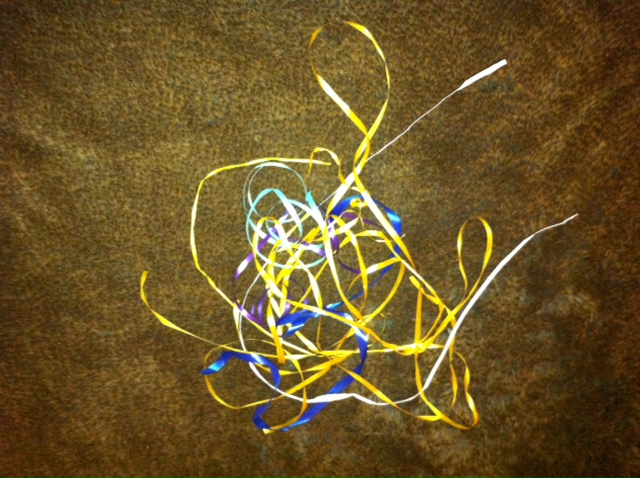
Emma’s assortment of “strings”.

There are a few thoughts on this sort of behavior with autistic children.  Some believe the items should be removed.  The idea being the child should not be allowed to have them as they increase “stimming”.  Stimming – shorthand for self-stimulation is a word, which is much used when speaking of autism.  It is the repetitive behavior the child/person uses to soothe, calm or regulate themselves.  The objects are varied and can be anything from spoons to things like running water.  But some children do not engage an object at all.  These children do things like  hand flapping, twirling, spinning, rocking and even head banging, while others stare at their own fingers that they wave in front of their eyes, others tap their fingers rapidly, hum or grunt, bite or twirl their hair, lick surfaces or smell things.  What marks their behavior from so called neuro-typical behavior such as pacing, doodling and thumb twirling is the child who is autistic may engage in these behavior for hours at a time, often getting in the way of daily living and learning.

Others believe the child should be allowed to stim and feel it is better to allow the child to self regulate.  They believe it is, in fact, cruel to remove the source of comfort for these children/adults who are autistic.  Many people believe learning can take place despite the stimming.

I don’t fall squarely into either camp.  Richard and I have done our best to give her the freedom to have some objects – balloon strings, velcro strips etc. while telling her she cannot bring sharp, pointed or objects we think might accidentally hurt her into the house.  We do not allow her to have her “Coqui” aka scraps of blanket outside her bedroom because she can sit for hours at a time sucking her thumb, which is doing untold damage to her teeth.  When I am working with Emma she may not have anything in her hands as I need her hands free to type, write etc.  But when she has gotten dressed, brushed her teeth, straightened her room, she can race around the house on her scooter, carrying whatever long piece of string/plastic/packaging tape she likes.  It’s difficult to know whether we are doing the right thing, but for the moment this middle ground seems to work or, at the very least, not cause too much damage.

Earlier this morning when I was trying to take a picture of Emma with her velcro strip, she wouldn’t look at the camera.

“Hey Em.  Can you look at the camera?” I asked.

“Say cheeeeese!”  Emma said scrunching her face up into a hapless and obviously forced “smile”.

“No not like that.  Think of something happy.  What makes you happy?” I asked, pointing the camera at her.

“Mommy makes me happy,” she whispered.

And that makes me happier than she can ever know.

For more on Emma’s journey through a childhood of autism and arbitrary items that hold her interest go to:  www.EmmasHopeBook.com

Emma’s Handwriting

As those of you who follow this blog know, Joe (click on “Joe” to read an entire post devoted to him regarding his tireless efforts and hard work with our daughter, Emma) and I have been working diligently with Emma on her reading and writing skills and comprehension.  So when she requested Sunday morning to “go to the study room”, I wasn’t particularly surprised.  Just as she inquired however, Nic and his friend Max, who had spent the night, wandered into the kitchen asking for french toast.

“Hang on, Em.  Let me make the boys breakfast and then we’ll do study room,” I said.

“Study room now?”  Emma replied.

“Would you like to write something?” I asked pulling a pad of writing paper out.

“Yes.” Emma said, much to my surprise as handwriting is by far the most challenging aspect of the literacy program we’ve implemented for Emma.

“Okay.  Here.  Go ahead while I make breakfast.”  As I began the preparations for french toast I could see Emma at the dining room table writing.  I quelled the urge to go over and look.

After a few minutes Emma said, “Good job drawing hand!”

I went over to see and saw that above the drawing of her left hand she had written, “This a kid”.

What was remarkable about this was that she came up with this sentence on her own, did not copy it from anywhere, initiated the whole thing, used an upper case “T” to begin the sentence and other than the absence of the “is” and a period at the end, wrote a complete, grammatically correct sentence.  This is not a child who is learning their alphabet, this is a child who is reading and writing.  It was breathtakingly exciting.

“Good drawing hand!” Emma said when she saw me staring down at her work.

“Em!  You wrote – This a kid – that’s fantastic!” I answered.  “Look, you just forgot the is,” I said pointing to the space between this and a.  It’s fantastic!  And this has is in it, so it’s easy to forget.”

“Yeah!” Emma said, smiling broadly.

“I love how you wrote that, Em.  It’s so great!” I said staring at her handwriting and feeling tremendous pride.

“You writing,” Emma said.

“You have to say – I’m writing,” I told her.

“I’m writing,” she said.

“Hey, let’s write – This is a hand,” I said while writing the words to the right of her hand drawing.  “Now you write – hand,” I instructed.

Emma carefully took the marker and wrote – hand – underneath mine.

“That’s great.  And look, let’s write – Emma’s hand – here,” I said.

“Yeah.  That’s Emma’s hand!” she said, pointing.

“Wow, Em.  This is terrific,” I told her.

“Study room now?” Emma asked.

“Yes!  Let’s do your study room now,” I said.  “But first let’s write – This is a kid – again.”

Very methodically Emma took a separate piece of paper and wrote – This is a kid.  Then she reached over and made the toy kid sit on the edge of the page.

“Em, I’m so proud of you,” I told her.

“Emma’s writing!” Emma said, happily.

“I’m writing.  You say – I’m writing,” I said.

“I’m writing!”  Emma repeated.

Yes, she is.

For more on Emma’s journey through a childhood of autism go to:  EmmasHopeBook.com

Clothing Autism

This morning I asked Emma, “Do you want to wear pants or a dress to school today?”

“Pretty dress,” Emma said without hesitation.

“Okay.  Which one?” I pulled two dresses out for her to choose from.

“Other one?”  Emma said-asked.  “This one?”   She pulled at her red and white print skirt she’d worn just the day before.

“No.  How about picking a different one.  You just wore that one,” I said, wondering if I should let her wear it again.  After all I wear a uniform of sorts to my studio most days – a pair of jeans and t-shirt of some kind.  Her skirt had been washed and ironed, there was no reason why she couldn’t wear it twice in one week.  Nic wears a school uniform to school everyday and I must admit it makes life easy.

When Emma was first diagnosed I became aware of how I was dressing her with painstaking care each morning.  It was as though I were trying to cloak her autism in pretty dresses, making sure her hair was neatly braided with different colored ribbons.  As she grew older I became less fastidious about her clothing, but I am still aware of my complicated feelings when I see her wearing some bizarre outfit of her own choosing.  Often when a caregiver has let her choose what she wants with no editing.  Socks worn with crocs, leggings that are too small, now resembling capris, the two inch gap of skin between pant and sock, the t-shirt in some color, ill-matched with the rest of the outfit.  I inwardly cringe and I admonish myself for being so shallow.  I just want her to fit in and when she’s dressed in such a way that only seems to advertise loudly how different she is, it breaks my heart.  Still I do my best to temper those feelings.

“You rarely get the chance to be frivolous,” a friend of mine said the other day.

“But it’s ridiculous.  I know,” I answered.

Once when I brought the subject up to my husband, Richard, he replied, “But people do respond differently to her when she’s wearing a pretty dress.”

And he’s right they do.  They tell her how pretty she looks and she smiles and twirls around.  I know it really is absurd, but I want people to be kind to her.  I want people to smile at her and they do when she’s dressed nicely.  I know how silly all of this sounds.  I know this isn’t going to help her autism.  I know I’m talking about something as idiotic as how she appears and has nothing to do with substance, but I also know that people react to her in a more complimentary way.

“Please don’t ever let her wear a velour track suit,” I begged Richard before leaving on a trip a few months ago.

“I love velour!”  Richard said.

“Well of course you do, just don’t let her wear one, okay?”

“She doesn’t own a velour track suit,” he answered, seriously.

“Yeah, but you might feel compelled to buy one while I’m gone,” I said.

“It’s going to be okay, honey.  I think I can handle this,” he said.

And of course he did handle it all beautifully while I was away, just as he always does.

“Okay.  This one,” Emma said, patting at a pretty white, turquoise and orange skirt.

“Oh that’s perfect!” I said, pulling it out of the closet.

“It’s perfect!” Emma repeated, bouncing up and down on the bed.

For more on Emma’s journey through a childhood of autism go to:  www.EmmasHopeBook.com

I Believe…

Every year we have a meeting with the Board of Education aka BOE.  Yesterday morning was our scheduled meeting time, but because Richard has been ill, I went alone.  I do not look forward to these yearly meetings.  And as yesterday morning got off to a bumpy start I was doing my best to bolster myself for what I knew was going to be an emotionally  difficult time.  They always are.  It is at these yearly meetings when we go over Emma’s IEP (Individualized Education Program).  Each year the BOE sends someone from their department into Emma’s classroom to observe her for a half an hour.  From that observation, a report is written, almost always a report we read with dread.  It’s not that they are unreasonable or unfair, though sometimes Emma is unrecognizable, it’s that they are stripped down to the basics.

A sample from one of these reports:  “Emma came down from the cabinet and lay down on a rug.  At 9:07, she remained lying on the rug.  At 9:08, she went out of the classroom and came back barefooted with a plastic box.  A teacher assistant showed her two bottles of paint.  She said, “no” loudly…”  The report goes on to depict a low functioning autistic child (Emma) who is somewhat responsive to the teacher’s assistant, at times non-compliant and with almost no verbal language.

This year Emma was also assessed by a psychologist sent from the BOE.  This report was even more troubling: “Emma is minimally verbal, spoke in single word utterances, or short, attenuated sentences for the most part, was able to repeat simple phrases heard, and was echolalic.”  The report goes on:  “Emma was able to hold a pencil somewhat awkwardly and make a scribble, or simple circular motion.  She was unable to copy simple vertical and horizontal lines, or any simple recognizable geometrical designs.”

As her mother it is difficult to read these reports.  I look at my daughter, my beautiful, funny, athletic Emma and I see her potential.  I choose to believe she is capable of so much.  I choose to believe she understands so much more than she appears to.  I choose to believe she will one day read and write.  I choose to believe one day she will communicate with us.  She will tell us what it’s like for her.   I choose to believe these things because to do otherwise is not a life I want to live.  But when I am confronted with reports such as the ones I’ve quoted from, it makes me question, even if for only a moment these choices, these so called beliefs of mine.  What if I’m wrong?  A question I always follow with – what does it matter if I’m wrong?  Because if I’m wrong, I won’t find out until I’m very old or will never know because I’ll be dead. I will always choose to believe I’m right about Emma.  I have to.  All the work we do with her every single day is because I believe in her abilities.  I believe she can do more.  I believe she is capable of so much.  When I tell her we have to do yet another reading exercise or writing exercise I am doing so because I believe she can.  When I read to her about Harriet Tubman or Helen Keller or Balto or the discovery of King Tut’s tomb,  I believe she is taking it all in.  When I ask her if I should keep reading and her answer is always – yes – I take that as confirmation of my beliefs.  I know I am making a choice.  I know my decision to believe these things are based on very little, but never-the-less I believe.

I believe in Emma.

For more on Emma’s journey through a childhood of autism and my journey in parenting an autistic child, go to:  EmmasHopeBook.com

Emma waiting for her school bus this morning

A Marathon

“This is a marathon, not a sprint,” Richard and I remind each other on a regular basis.  I have written before about how when Emma was first diagnosed we were given a great many reassurances that while Emma certainly needed early intervention, many who worked with her felt sure she would be mainstreamed by the time she was in Kindergarten.  When the day for her to enter Kindergarten came and went we began to slowly go through the process of realizing 1) no one knew what lay ahead 2) no one was any better at predicting how Emma would develop cognitively or neurologically and 3) we needed to pace ourselves because Emma’s future was an enormous question mark.

During those years I rarely thought about Emma being a teenager, going through adolescence or what it might mean to have a young autistic adult living with us.  I was too focused on all her therapies, learning as much as I could, trying to find specialists who might help her, to spend much time contemplating the distant future.  As time went on and after countless parent/teacher conferences where the reports were less than stellar, despite all they were doing at school and all we were doing at home, it occurred to us that we were in this for the long haul with no guarantees of any definitive outcome.

As with a marathon, we have learned we must pace ourselves.  And as with running, the more I am able to remain present and in the moment, the better off I feel and am.  Emma spends ninety percent of her time in the moment.  She has achieved what eludes most of us.

Emma this morning

For more on Emma and autism go to: www.EmmasHopeBook.com

The Tricky Diagnosis Of Autism

When Emma was first given a diagnosis, we were told she might not be autistic, time would only tell, but that for the time being they were giving her a diagnosis of PDD-NOS, which is the acronym for Pervasive Developmental Disorder Not Otherwise Specified.  PDD is often thought of as a milder form of autism or as was explained to us, the diagnosis given when the child has enough “autistic-like” behaviors to require intervention, but doesn’t display all of them.  As time went on however, Emma’s “milder” version of autism grew into the more solidly defined autism.

I remember speaking with her neurologists saying we were lucky in that Emma was mildly autistic and one of them said, “Well no, she isn’t mild.”

“Really?  Where do you think she falls on the spectrum?” I asked, genuinely surprised.

“She’s moderate,” one of them said, kindly.

I was so stunned, I couldn’t speak.  We had been assured by so many “professionals” in the field that her autism was mild, it never occurred to me they might be wrong in their assessment.  Even when we kept trying the various behavioral therapies recommended with little progress, I continued to cling to the “mildly autistic” assessment.  I kept thinking it must be something we were doing wrong.  We weren’t giving her enough applied behavioral analysis, despite the 40 hours a week we had implemented.  I thought of it as a kind of  toddler boot camp, unfortunate, yet necessary.  When we then trained with the brilliant Stanley Greenspan, I assumed we were not doing his floortime “right”.  In essence I blamed our ability to adequately implement the various therapies as the reason she wasn’t progressing more quickly.

When we began having regular QEEGs done, which showed us images of her brain compared to her neurologically typical peers I was given the visual explanation I needed to understand what we were up against.  There was no denying the vast difference between her lit up non-symmetrical brain and the brains of same age children not on the spectrum.  It was only then that I began to fully take in just how much we do not know about autism.  Years later, I now question anyone who claims definitively to know what will or will not help, what course they are sure we should take.  It is the professionals who have the humility to admit all they do not know, whom I find myself interested in speaking with.

When Emma was about four we took her up to Boston to visit a well known and extremely well thought of gastro-intestinal doctor, Dr. Timothy Buie.  I asked a series of questions and he never once answered with the sort of assurance I had become used to.  Most of my questions he said he couldn’t answer because he didn’t know for certain.  We left Boston with the tests showing Emma’s numerous ulcerations and inflammation to her GI tract.  But with no solid answers as to why or how this had happened to such a young child.  I continue to have tremendous respect for that doctor who continues to devote his life to finding answers, but has the humility to acknowledge how much we still do not know and understand when it comes to autism.

My Greatest Fear

My single greatest fear is when Richard and I die Emma will be institutionalized.  It is a nightmare I try hard not to dwell on.  So when I read articles like this one from the New York Times, http://www.nytimes.com/2011/03/13/nyregion/13homes.html

regarding the rampant abuse in homes for disabled people I am more than horrified.  I am terrified and left feeling nauseous.  It is like waking from a nightmare only to realize the nightmare is real.

The final line in the article is a quote from a memo that was sent out to all staff at a group home:  “DON’T report in your notes that an Incident Report was filled out,” the instructions said, adding: “IF IT ISN’T DOCUMENTED, IT WASN’T DONE.”

That final quote says it all.  The utter disregard for humanity, the unwillingness to see the disabled, whether mentally or physically, as nothing more than easy prey has become so commonplace as to be suitable for a memo.

Over the years we have heard Emma repeat things said to her, things she even now repeats, years later.  Often they are things said to her in anger, and because she mimics the person, is so good at capturing their tone, their accent if they have one and their inflections, we often have been able to determine who has said these things to her.  Usually they are benign comments such as – “don’t put playdoh in your mouth” or “line up!” or “Emma!  Sit down!”  Nothing abusive, all within what one might expect from teachers, caregivers, therapists etc.

But once, Emma came home and started yelling – “Sit down!  You sit down right now!”  “No you cannot leave!”

From those words I was given enough information to ask her a number of questions and realized her bus driver was yelling at her.

The next morning we spoke with her driver who it turns out was getting to her school before the school was open and so, instead of telling us and changing her pick up time, decided to let the bus sit idling outside the school for half and hour with Emma in it.  When she stood up to leave, seeing that they were at her school and with little sense of time, the driver started yelling at her.  Fortunately she had enough language for us to figure out what was going on.  We immediately complained to the Office of Public Transportation, wrote a letter to our lawyer and put a stop to it.  The next morning she had a new driver and a new pick up time.

We have been lucky so far.

Skill Set

People talk about their particular “skill set” for this or that job.  My “skill set” does not include great coping skills.  Just because I have a daughter who happens to be autistic doesn’t mean I innately know how to manage every situation, which comes with a child with special needs.

When Nic was first born, I opted to go the natural route and though the labor was seemingly endless, (38 hours) once he appeared, we were back home by that evening.  The first night was utter hell.  Every time his breathing changed I was up like a shot, staring intently at him wondering whether his congested breathing was normal.  I remember thinking this was why mothers stayed that first night in the hospital.
“I wish he came with a manual,” I said to Richard.

But he didn’t.  As all parents know, our children don’t come with a “Coping Skills for Idiot Parents” guide book as much as we wish they did.

Emma was born, again natural child birth and this time in a free standing birthing center.   She was born at 4:30PM and we were home by 9:00PM.  I felt something akin to terror because in addition to being a completely different infant than Nic, she seemed so uncomfortable, much more than Nic had, who was my only frame of reference.   I remember thinking that I had the whole mothering thing down, having honed my skills on Nic.  And then there was Emma, proving me wrong from the first breath she took, which came out as more of a disgruntled moan than a breath.

“What’s wrong with her?” I asked the midwife.  Her displeasure from that first second the air touched her skin all too apparent.  I knew right away I had no idea what I was doing.  I was in over my head.

I continue to feel that way now and Emma just turned nine years old in January.  She is growing like a weed on Miracle Gro, with no sign of slowing down.  You’d think I’d have this whole mothering-a-special-needs-child-thing down by now.  It turns out I’m a slow learner.  I do not understand what she says a great deal of the time.  I don’t have some sort of internal interpreting device where she says something incomprehensible and I’m able to translate.

“What did she say?” people often ask me.

I haven’t a clue.

“Why did she do that?” people will question.

Don’t ask me.

Every now and again I have an idea, but I also know there’s a 50% chance I’ve got it wrong.

When Emma begins screaming that her ears are popping and she needs help, there is a second where I wonder what I can possibly do that will make a difference.  I go through the predictable routine, try to get her to yawn, offer her a piece of chewing gum, try to speak calmly to her and not give in to my desire to yell back.

When both the children were toddlers I was pushing them in their double stroller, (the Hummer of all child transportation devices ever invented) when we passed a woman screaming at her child.

“You are behaving like a brat!” she yelled at the little boy who couldn’t have been older than five.  “A brat!” she continued.  “You cannot get what you want by screaming!” she screamed.

It was one of those moments when you put your head down and just keep walking.  Unless you have it in you to say something kind and loving to this screaming stranger, do not stop, do not entertain the idea you’re input will be taken as anything other than criticism or condescending, just keep walking.   But it exemplified what almost all of us have done at least a few times in our lives.  The hypocrisy we all catch ourselves in if we look deep enough.

Coping?  It’s not in my skill set.  But I keep showing up and maybe that’s a skill in and of itself.

Home

“Go on airplane?” Emma said yesterday morning.

“Yes, but first we’ll have breakfast, then study room, then brush teeth and then go on the airplane,” I told her.

After listening to me, Emma nodded her head and said, “Go on airplane.”

All that other stuff was filler, it was the airplane part Emma cared about.  “Right,” I said.

At the Aspen airport there was the usual congestion, lines, children running around, harried people, stern looking airport security.  When flying with Emma I used to bring along a letter from her school saying she was autistic etc.  But it never seemed to make a difference, so I stopped.  Despite the fact Emma is the world’s greatest traveler there are problems which inevitably arise when flying with her.  Little misunderstandings, which I’ve described in previous posts, not important enough to spend time going into again.

Emma, as I’ve written before, will not eat anything served on the airplane.  She will not drink any of the liquids they serve, the apple juice on the Denver to New York flight is out of the question as it is served from a can, something she won’t tolerate, she will only drink water from a water fountain, impossible when in Aspen, difficult even in New York City during the winter months and unavailable on airplanes.  So we brought two of her last, appropriately packaged vanilla milks and pirate booty, some grapes – they must be seedless red grapes, a banana and some fruit leathers.  All of which is fine, except the vanilla milks cause us problems every single time.  Curiously in New York I will tell security she’s autistic and we are almost always cheerfully waved through, but never in Aspen.  The Aspen airport is a stickler for going through the correct protocol, no matter how tedious.  I know to take the vanilla milk out, show it to airport security and wait for the predictable grumblings from the people behind us as the entire line is put to a stand still.  I hate the “pat downs” where you are taken aside and searched, so this time Joe volunteered to be the one to endure it, while I watched Emma.

Traveling alone with Emma is particularly daunting as she might run off and no one appears to have the slightest understanding of autism and the difficulties this presents to the lone parent who is being pulled aside, frisked, trying to keep an eye on the carry on as well as calling to Emma who often disappears into the crowds.  To say this is a tense and upsetting time would be putting it mildly.  It is nerve wracking and often frightening as one never knows if Emma will run off – to the bathroom, try to exit the area, run outside to an awaiting aircraft headed to – who knows where – suffice it to say, it’s not fun.

But yesterday morning Joe, being the trooper that he is, volunteered and so they went through his and Emma’s carry on, with all their various swabs and strange looking equipment, it took about ten minutes all told, and I kept reminding myself, as we waited, that this was, though annoying, nothing more than an inconvenience in this post 9/11 age, which we all find ourselves in.

Once we made it through security all went fairly well, the weather was perfect, the passengers were all boarded when I became aware of two little girls sitting in the row behind, their parents, directly behind me and Emma.  The little girls couldn’t have been older then 3, their voices still had that high pitched squeaky sound only heard in a toddler.  The father helped get them settled, made sure they each had their stuffed animal, there was some fighting between the girls about who’s special toy was whose, but other than that it was what any parent of two toddlers would expect. (Not that I would know, but I’m guessing here.)  Some bickering, lots of talk from the parents about the importance of sharing, requests from the girls for candy, cheerios, something to drink.  It became comical when the father, having spent at least 10 minutes procuring various sweets and snacks, muttered to his wife, “Can I just sit for two seconds without feeding someone?”

Meanwhile there Emma was, content to stare silently out the window, happy to be on an airplane and going home.

Inspired by the family behind me, I asked, “Hey Em.  Do you want a snack?”

“No,” she said and continued to stare out the window.

Flying with Emma

Emma is a joy to travel with.  Unlike most children, she sits quietly in her seat and is content to listen to music, look out the window, watch a video or look at books.  But there are certain misunderstandings, which inevitably arise when traveling with Emma as well.

Yesterday as we boarded the airplane leaving New York City to Denver, a nice woman behind us asked if Emma was 9.  I told her she was and she replied that her daughter was 9 too and she understood how hard it could be to travel with a nine-year old.  I said, “Oh, is your daughter autistic?”

The woman looked at me in surprise and said, “No.  She’s nine.”

It was one of those peculiar conversations where you realize you’ve misunderstood the intent of the other person.  I immediately thought, because Emma kept getting out of the line leading to the aircraft, that she knew Emma was autistic.  But it turns out she had no idea and was simply commiserating with someone who also had a nine-year old child and was flying with her.  My first impulse was to say, “Oh no.  Emma is great to travel with.  She’s not like that at all!”  But I decided it was best to keep walking and find our seats.

Later during the flight when Emma needed to go to the bathroom, the flight attendant said, “Poor thing, she’s still asleep,”  as Emma kept trying to push open the door to the bathroom which was occupied, despite my repeated attempts to stop her.  Again I just smiled.

Later on the flight from Denver to Aspen, (we were one of the lucky few who actually made it into Aspen yesterday!) the flight attendant leaned over to Emma and said, “Do you have your seat belt on?”

“Umhmm,” Emma said, curled up on the seat by the window.

“Really?” he said.  Where?  Do you have it around your chest, your knees?  I don’t see a seat belt.”

Emma just smiled at him and nodded her head.

“Emmy, put your seat belt on,” I interjected as I could hear the growing irritation in the harried flight attendant’s voice.  She immediately did so.

“Oh!  So you weren’t telling me the truth, were you?” the flight attendant said.

I put my hand gently on his elbow and said, “She’s autistic and didn’t understand you.”

“Oh dear.  I’m so sorry,” he replied before quickly moving along the aisle.

And so it goes.  This sort of thing happens constantly with Emma.  People assume she’s fine, she looks fine after all, and respond accordingly.  There’s always a moment when either I say something or they begin to realize they are dealing with someone who is a bit different than what they thought.  It’s a surreal moment, when the other person is caught off guard, before they’ve had time to make an adjustment.  Usually people are incredibly kind, very occasionally we meet someone who isn’t.   I don’t have any one method of responding.  Often I say nothing.  I mean what’s the point really?

Routine

Emma is not alone in liking her routines.  She is most comfortable when she knows she will do something she enjoys or is use to.  What separates Emma from the rest of us is that instead of being able to adjust when her routine is disrupted, she is thrown completely off-balance to a degree that often catches even us by surprise.

Last night Emma went through her nighttime routine of getting ready for bed.  After her teeth had been brushed she came to find me in the back where I was reading.

“Just five minutes,” she said as she got into our bed.  “Just five minutes with Mommy.”

“Hey Em.   Okay five minutes, then you’ll go back to your bed,” I agreed.

About ten minutes later I looked up from my book and realized Emma had fallen asleep.  There was a moment when I wondered if I should just let her sleep and try to carry her into her bed later, but she’s gotten so big, short of carting her out on a gurney, this is no longer an option.

“Hey Emmy,” I whispered as I put my arm around her.  “You have to go to sleep in your own bed.”

She resisted me.  “Stay here with Mommy,” she muttered.

“Come on.  I’ll take you back to your bed.”  I held out my hand and waited for her to get up.

“Go with Mommy into the other room,” she said.

Ever compliant, she allowed me to lead her back to her own bedroom where she got into bed.  “Mommy sing a song?”

Having sung her a lullaby I went back to my book, relishing in the fact Emma was back asleep in her own bed without a fuss, something I am still consistently surprised by.

Half an hour later, cries from Emma’s room could be heard.  She tearfully offered us her flashlight, a gift from my brother, which glows in the dark.  “It’s broken,” she sobbed.

We tried replacing its batteries with no success and finally placated her with promises of repairing it in the morning.

Another half hour went by and then there Emma was, like a spectre, at the foot of our bed.  “Mommy come!” she cried.

This went on for about an hour.  Emma would tearfully return to her bed, one of us would sit with her for a few minutes, tuck her in, say good night and leave, only to have her reappear ten or fifteen minutes later, crying about something else.  It’s like watching a pin ball ricocheting around, from one thing to the next until eventually Richard took her back to her bed and for whatever reason, this time she was able to go back to sleep.

Emma is sensitive to the slightest variation in her routine.  It is something we know about her and do our best to accommodate.  When she was little we use to mix things up on purpose.  We tried to avoid routines with the mistaken idea that if she were not allowed to have any routines, she would learn to adapt to change more easily.  But this proved wrong and impossible.  Emma would go along with things as chaotic as they might be, but the instant we did something, anything more than a few times, she would become fixated on doing the same, over and over again.  In addition the children’s school, our own work requirements, all need a schedule, as do regular bedtime, meals etc.

There are a number of studies being done on the link between autism and obsessive-compulsive disorder.  I don’t know if Emma has a comorbid diagnosis of OCD, but until one witnesses such behavior, it is almost impossible to explain the panic, the sheer terror, disruption causes them.