Tag Archives: autism children

From Joe (Emma’s Therapist for the Past Five Years)

Joe, Emma’s therapist, who came to us five months after we received her diagnosis, was initially trained in ABA (Applied Behavioral Analysis).  As Emma regressed using ABA, Joe was the first to agree with us that we should find another methodology which might work better.  When we found Stanley Greenspan (who died April 27th, 2010 – next post will be a tribute to him) Joe was an eager participant in learning how to do Stanley Greenspan’s DIR (developmental, individual-difference, relationship-based) therapy with Emma.  Joe has since become the “Zen Master” of DIR.  He is brilliant at it and watching him work with Emma is a profound experience.  The following is a post by Joe.

“I was watching ABC’s Nightline last night, which aired a story about a pro-surfer who has autism. Watching his intensified focus on the waves certainly reminded me of Emma’s physical grace and all of her athletic talents – skiing in particular. They described the teenaged surfer as someone who’s “mastered the seas but still struggles on land.” On the water he feels relaxed, but on land he must face the pressure and anxiety of social interactions. Like Emma, the surfer has no physical indication of any disorder so his inability to respond appropriately to social interactions (or simply say hello) is often interpreted as rudeness. This is one of the dozens of catch 22’s of autism – wanting her to be seen and treated just like anyone else but also expecting others to be understanding/non-discriminatory once they find out she’s autistic.

The surfer’s story ended by crediting his autism for opening this door for his talents to shine: a door which may have otherwise remained shut.  While Emma’s autism has come with its vast array of difficulties and challenges, it has also opened similar doors for her talents to shine. While I feel many of Emma’s abilities are innate, I believe a stage needed to be set in order for them to be unveiled. So I end this story by crediting Emma’s parents, Ariane and Richard, for all of their endless efforts to open every door and set every stage possible for her. As for her athletic talents, giving her the opportunity to swing herself at 18 months, getting her into gymnastics at 2 years old, and strapping her into skis at 3 years old is just a fraction of all of the sensory input she was constantly provided with at such an early age. While Emma continues to shine in the spotlight, I credit her director and choreographer, Ariane and Richard, for making it happen.”
The Kiss

Last night, after Richard and I realized Lost was NOT airing a new episode, we decided to watch the amazing documentary “A Mother’s Courage”, which a number of people saw and contacted me about.  Emma was sitting in bed next to me, (she does not go to sleep much before 9:00PM, despite waking at around 6:00AM).  I was propped up on some pillows with my knees bent.  Emma ran her index finger up and down my arm, saying, “You may NOT hit Mommy.  You have to be gentle.”

Emma wants to hit the people she is most fond of.  All of us tell her when she does this, “You may NOT hit, Emma.  You have to be gentle.”

Sometimes I’ll add, “Look, Emma.  Like this,” and then I’ll stroke her arm or face.  So last night Emma was parroting this and, it seems to me, practicing.

I laughed when she ran her finger up my arm.  “That tickles,” I said.

Emma laughed, “Be gentle.”

I nodded my head, watching the television as the documentary began.

And then Emma leaned over, with a enormous grin on her face and kissed my left knee.  Emma has never initiated a kiss like this.  She kisses me good-bye or when I get home from work.  She’ll kiss me back when I kiss her or when I ask her to.  To kiss me as she did last night, for no apparent reason other than because she wanted to – it was one of those moments – a indescribably beautiful, touching, magical, moment.  I looked over at Richard.  “Did you see that?  Did you see that!?  She kissed me!”

I looked back at Emma, “Thank you Emmy.  I love that!”

She beamed at me and said, “Kiss Mama.”

And then I held her and I wept.

Misconceptions Regarding Autism

Denis Leary made a stir in 2008 when he made public his belief that autism was caused by “inattentive moms and competitive dads”.  His comments echoed Bruno Bettelheim, who in the 1950’s posited autism was caused by emotionally distant mothers whom he referred to as “refrigerator moms”.   While Bettelheim’s theories were largely rejected in the 1960’s, there remains confusion by many people when confronted with an autistic child.   My guess is many people believe autism is a psychological problem as opposed to neurological.  As my mother so beautifully wrote in her post From Emma’s Granma autism is largely invisible.  Because of this, people often assume the child is behaving badly because they are spoiled and the parents are unaware or worse, condone the bad behavior.

Several years ago, Joe, Emma’s therapist, was with Emma in the park when she fell to the ground screaming she wanted to ride the carousel one more time.  Joe, knowing Emma needed to be back home, told her it was time to go.  Emma refused and sat in the mud in her pretty dress crying and screaming.  A group of women stood nearby, watching with looks of shock and concern.

Emma continued in full melt down mode repeating over and over again, “I want to ride on the carousel!”

One of the women asked Emma if she was okay.  When Emma didn’t respond, Joe tried to physically pick her up, thinking she might calm down once he was holding her.

Another woman in the group yelled at Joe, “Don’t touch her!”

“You have no idea what’s going on here,” Joe said, trying desperately to get Emma to cooperate.

“I’m calling the police,” the woman said, pulling out her phone.

Figuring there was nothing he could say or do to make the women understand, he finally was able to pick Emma up and carry her out of the park.

The group of women followed Joe for the next ten to fifteen minutes.  At which point Emma was calmer and Joe was able to get her into the subway and home.

When Joe arrived back at the house, he was visibly shaken.

All of us who have spent time with Emma over the years have experienced versions of Joe’s experience.  I remember being in a playground in Central Park with Emma one weekend.  It was crowded and Emma was having a tough time waiting for her turn on the swing.  Each time one became empty she rushed forward, trying to grab it.  I ran after her, explaining that it wasn’t her turn yet.  Finally one of the father’s of another child turned to me and said, “Hey!  Can’t you control your kid?”

“She’s autistic”, I said.

Before I could explain further he interrupted me and said, “Yeah?  Well my kid likes to paint too.  Who cares?!”

Confused, I said nothing, but as I led Emma back to her place in line I realized he had misunderstood me and thought I’d said, “artistic”.

It became a running joke at our house whenever any of us didn’t want to do something we’d say, “Hey, I’m artistic.”

Food

As Emma began to regress, starting at around 13 months old, it was not just what I believed to be typically “autistic” behaviors – lack of eye contact, delayed speech, obsessive-compulsive behavior, rigidity – that regressed, but things I didn’t expect, such as the restriction of  foods.  Slowly, just as her speech began to disappear, so did her ability to try new foods and after a few years, a paring down of foods that were a staple to her diet fell away as well.

The following is a list of the foods Emma will eat.  Anything else she refuses.

Cheerios

Mango Fruit Leathers

Red Grapes

Bananas

Apples

Wheat toast with Organic Raspberry Jam (must be the red labeled wheat toast from Whole Foods & The Organic Raspberry Jam from Whole Foods)

Horizon Vanilla Milk – occasionally she will drink the Horizon Chocolate Milk

Stonyfield Chocolate Yogurt (She use to eat the caramel yogurt as well, but they discontinued it.)

Motts Apple Juice (this was an issue in Costa Rica as they had a different brand and she refused to drink it, though eventually did, cut with water)

Pirate Booty

Baby Bel Cheese

Grated Cheddar Cheese – must be orange

Pancakes

Maple Syrup

Chips Ahoy (she will not eat any other kind of cookie)

As a baby Emma was a healthy eater and tried just about anything I put in front of her.  At 9 months she ate a mushroom-barley soup I made.  I recorded this milestone in her baby book.

Many people believe that autistic children are unable to process gluten and dairy, others believe that their child has food intolerances which adversely effect their behavior and some believe that a gluten free/casein free diet has cured their child of autism.  While I have never met a cured autistic child or personally know anyone who has, I do know of one child who clearly functions better without dairy in their diet and a number of autistic children who are allergic to a variety of foods.

In October of 2004, we began working with a DAN (acronym for Defeat Autism Now) doctor who was also a pediatric nutritionist/allergist.  We removed all dairy and wheat from Emma’s diet.  At that point she was eating a limited, but varied amount of foods such as scrambled eggs with cheese, a wide variety of fruits, all flavors of yogurt, ham, turkey, chicken, dried fruits, carrots, etc.  In retrospect her diet seemed limitless in comparison to what she whittled it down to.

Once on the gluten free/casein free diet she refused to eat any new foods to substitute for the old.  I stayed up, often until after midnight, baking wheat-free breads made from rice flour, almond flour, and almond butter.  I found web sites that specialized in casein free/gluten free products and recipes.  I developed a way to make my own organic pureed fruit leathers, which I spread onto baking sheets and dried in a low heated oven for 10 hours or over night.  To celebrate her third birthday I made an entire menu of gluten free/casein free foods.  Emma would not touch any of it.  Even refusing the birthday cake I made, which everyone else seemed to like, including Nic.  Though he confided in me later that he didn’t like it as much as a ‘normal’ cake, but didn’t want to hurt my feelings.

After three and a half months and no change in her behavior, other than a 10% loss of body weight, we took her off the diet and slowly introduced her old foods that she once loved.  Only now she refused to eat most of the old “fail-proof” foods too.  It was as though she never liked them to begin with.  The DAN doctor advised us to introduce one food we knew she liked – we chose cheddar cheese – and to give her a great deal of it and then wait to see if we saw a discernable change.  I gave her several ounces of cheese, which she ate and then waited to see what would happen.  After several days and no change, the nutritionist advised us to introduce yet another food.  We repeated this exercise over and over again.

Occasionally now Emma will take a ‘bite’ of some other food – say grilled chicken – with great reluctance and protest.  I remember a friend telling me about her sister who refused to eat any foods that were not “white”.  I was horrified by the story and remember thinking I would never have a child like that, as I prided myself in being an excellent cook and would never tolerate that sort of “behavior.”  I have since come around to the pick-your-battles way of thinking.  The food battle is one I am just not willing to engage in any longer.

Late at night when I am caught in a cycle of worries, I console myself with the idea that there are certain indigenous populations that survive quite well on extremely limited foods, such as a group of Eskimos who survive on whale blubber and little else.  For now that consolation will have to do.

The Carousel

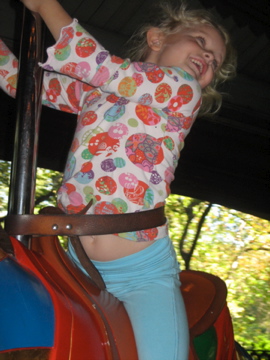
Emma loves movement, she always has.  This is Emma riding the carousel in Central Park.


In occupational therapy they call it – craving vestibular movement,  and she does.


She is happiest when she is moving!  And every now and then, I get nervous.


Needlessly… because she’s fine.

From Emma’s Granma

“I have four grandchildren, and the youngest is Emma.  She is a beautiful blond with blue eyes and a sparkling smile, she skis like a pro, she swims, she climbs the climbing wall at the rec center, she balances on the back of the sofa (while her granma shudders in fear that she might fall), she sings with near perfect pitch, and she is autistic.  When I was growing up such children would have been hidden away.  Anyone who encountered them would have avoided them, other children would have teased them, or worse still, abused them.

My husband spent the last ten years of his life in a wheelchair.  He told me that in social gatherings people avoided him because they didn’t know what to say to someone who was so obviously disabled.  Today men and women in wheelchairs compete at the Olympics.  They race on prosthetic limbs, those who are blind ski with Challenge Aspen.  I have a friend, one of the founders of Challenge Aspen, who skis in a specially designed chair.  She tells me that she skis better now in that chair than she did eighteen years ago when she had full use of her limbs.

Scientific research, skilled therapists and loving families have helped all these people achieve a potential that would have been denied them eighty years ago when I was born. These people are actually lucky because their disabilities are visible, and so scientists and skilled therapists have been funded with the means to investigate all avenues that might lead to improving their lives.

Autism is not visible, but inside of Emma there is also a person yearning to be understood, to be able to communicate, to tell us of her fears, her frustrations, her desires.  She too wants to be  treated with understanding and compassion.

In the family room we have a stage with a curtain.  Emma loves to draw back the curtain and sing and, as her father says, strut her stuff as if to an enormous audience.  One day she too will reach her potential.  One day she will step down from that stage, her inner person will emerge, and she will still sing like an angel, but also she will speak with clarity, she will laugh with us, play games with other children and be able to step off into the future with confidence.

Such is our hope.

But even if none of that turns out exactly as we might wish, one thing is certain, wherever she goes, however she behaves, she will walk in beauty, surrounded with love.”

To see a survey that my mother participated in on the effects of autistic grandchildren and their grandparents, go to:  http://www.iancommunity.org/cs/ian_research_reports/ian_research_report_apr_2010

The Big Piano

I was just reading Ariane’s post about the toy store and it made me think of some of my own experiences. When we go to the big Toys R Us store in Times Square it’s the same deal — she can walk by aisles of Barbie dolls and Dora the Explorer toys without even a glance at anything. Instead she’ll head straight to the big ferris wheel.

FAO Schwarz is one of her favorite (and compulsive) stops on any trip to Central Park.

“Go to carousel. Go to zoo. Go to FOShwarz. Go to Apple store. Take the train, go home,” she’ll say on our way out the door on a Sunday afternoon, reciting her agenda and expectations for the day. At FAO she will immediately head to the hackysack kiosk, not to play with anything or watch the other kids playing, but to watch herself in the video monitor.

From there we head upstairs to the big piano and she’ll easily spend an hour running back and forth across the keys. Occasionally she’ll look at a train set afterward, if she can control the button that makes it stop and start.

We passed a toy counter filled with stuffed Sesame Street characters and I tried to engage her interest.

“Who is this Emma?”
“Cookie monster.”
“And who is this?”
“Big Bird.”

She had no interest in any of it but at least she answered the questions. And so it goes. The one exception:

Sometimes when we pass the section with the frilly princess dresses, she will stop and hold one up and say, “Pretty dress.”

And if it’s really pretty, she might add, “Get it daddy.”

Toys

When Nic was a toddler, I would frequently take him to our favorite local toy store, Kidding Around, where he would play with the elaborate train set, Tina, the owner, had in the back of the store.  Very popular with the four and under crowd, particularly in the afternoons, we would go in the morning and often, Nic would have the train set all to himself.  Each day of our visit when Nic was just beginning to talk, he would point to something as we were leaving, “That!” he would say, which meant he wanted to take it home with him.

When Emma was about the same age, I took her to Kidding Around, but nothing caught her attention.  I tried to entice her, “Look Emma!  What a pretty doll!  Do you like it?”

She ignored me and wandered off.

Undeterred I went over to the two wooden tree stands filled with large plush hand puppets.  They were lovely and soft, in bright colors and came in a variety of different species, toucans, leopards, dogs cats, horses, as well as mythical creatures and monsters – a favorite of Nic’s.

I thrust my hand in one, a beautiful white unicorn with flowing mane and purple horn, “Emma!  Look!  I’m a unicorn,” I said, in what I imagined a unicorn’s voice would sound like if they existed and could talk.

Emma showed no interest.

The one toy Emma was attracted to was the miniature doll’s stroller, which came in pink and blue.  I placed a baby doll in one of them when I saw her looking at it.  “Look Emmy it’s for the baby doll,” I said.

Emma pulled the baby doll out of the stroller and proceeded to try and sit in it herself.  Terrified that she would break it, I said, “No Emmy!  That’s not for you!  It’s for the baby doll.  You’re too big for this stroller.” Again I placed the doll into the stroller.

Emma threw the doll onto the floor, took hold of the doll’s stroller and careened around the store, heading toward the door.  I chased after her and herded her back inside, admonishing her that she couldn’t go out into the street.  Each time we returned to Kidding Around, out the door she would tear, steering the doll’s stroller around, and a few times into people who were in her path.  It got so that I would block the front door while Nic played in the back, every now and again his little voice calling out, “Mommy!  Emmy’s taken the stroller again!”  I would position myself in front of the only exit, while she would try to maneuver around me, fixated on getting that stroller and herself outside.

“She just doesn’t like toys,” I reported to Richard that evening.  “My sister never played with dolls,” I said when he didn’t say anything.  “Emma’s athletic, just like my sister,” I finished, unsure of why I suddenly felt so defensive.

Talent Show

I was listening to Emma and Lee singing ‘Que Sera, Sera’ after Ariane posted it and was moved to tears as I always am when I hear how heartbreakingly pure and sincere her voice is. It is so sweet that I can’t think of any word to describe it other than angelic.

I first played her ‘Que Sera Sera’ on You Tube about two years ago after hearing a slow and somewhat melancholy version of the song in a Francis Ford Coppola film. I’ve always loved this song, even in the brighter Doris Day version, which Emma prefers, though the way she sings it brings out the poignancy of the lyrics and melody in a way Doris could never even dream of.

Emma has near-perfect pitch and a set of lungs an opera diva would envy. But so much more powerful and affecting than those qualities is the sheer sweetness of her voice, like everything that was good and kind and happy and wonderful in the world was distilled in a golden elixir that pours out whenever she sings that song.

Most of the time, her singing is loud and raucous, though no less heartfelt and touching in its own way, at least to my ears. Emma loves to perform, though there isn’t any trace of ego in her desire to strut her stuff. I guess that’s part of her condition to some extent, a reduced sense of self.

Last night before bedtime she said, “Talent show?” very loudly while I was playing chess with Nic.

“Sure Emma, we’d love a talent show,” I replied, smiling at Nic who smiled back with a “here we go again” sigh and headshake that seemed to sum up all his conflicting feelings – amusement, love, frustration, exhaustion, mild embarrassment. There was no one else in the house, so I’m not sure he felt any embarrassment, other than perhaps a conditioned response to similar, more public displays.

Myself, I was very much looking forward to the show, which turned out to be a medley of Carole King songs for children, culminating in ‘Chicken Soup with Rice’, which she belted out like a Broadway veteran. She always goes for the big finish and this particular song jumps up an octave or two at the end. She totally nailed it. Nic and I laughed and I applauded as loudly as she sang.

People often ask me whether Emma has any special talents. When anyone asks a question like that I figure they’ve been watching “Rain Man” and want to know if she has any savant abilities. I usually say that those types of abilities are associated with what has traditionally been called Asperger’s Syndrome – though I recently read that the medical community wants to abolish that term and use ‘Autistic Spectrum Disorder’ for everyone.

After that disclaimer, I will typically add that she does have an incredible memory and will mention things that happened to her when she was two or three years old. She can also remember very specific catalogues of objects, particularly photos. She really likes photos and home movies – I think they help her talk about and identify people, things and activities she enjoys. She has a shoe box with 100 or more photos inside and she will know instantly if one is missing, setting off a frantic household hunt for the lost picture in order to stave off a total meltdown or some self-injurious behavior, like biting her arm as hard as she can.

She is also extremely advanced in a wide variety of physical activities: skiing, climbing, balancing, jumping, swimming.
And of course, she loves to sing and dance.

There was an award-winning documentary that came out a while back called ‘Autism: The Musical’. It was a very inspiring movie and we thought this might be something Emma would enjoy given her showbiz leanings. When they started a program called ‘The Miracle Project’, based on this concept at her special ed school, we enrolled her and are very excited to see what might come out of it.

Every year at her school they have a talent show and every year, Emma has been the star of the show, soloing in ‘A Spoonful of Sugar’ from Mary Poppins in her debut performance.  Since then she has referred to any of her singing performances as a talent show, which I love. I bought her a number of karaoke video games with microphones but she has been much more enthusiastic about singing along from memory to a DVD or You Tube clip. She has quite an impressive set list for her concerts now, which routinely take place at birthday parties or dinner parties (which are also birthday parties as far as she’s concerned), or whenever the mood strikes her. An audience of one or two is enough, though like most performers she likes to play a full house.

I’ve always thought that she’s a total rock star and someday she’ll be cranking it up on a big stage – leaving our ‘dinner theater’ circuit far behind. Time will tell. For now, I revel in her impromptu serenades and every time she says, “Talent Show?!” my heart skips a beat in happy anticipation.

Emma Singing

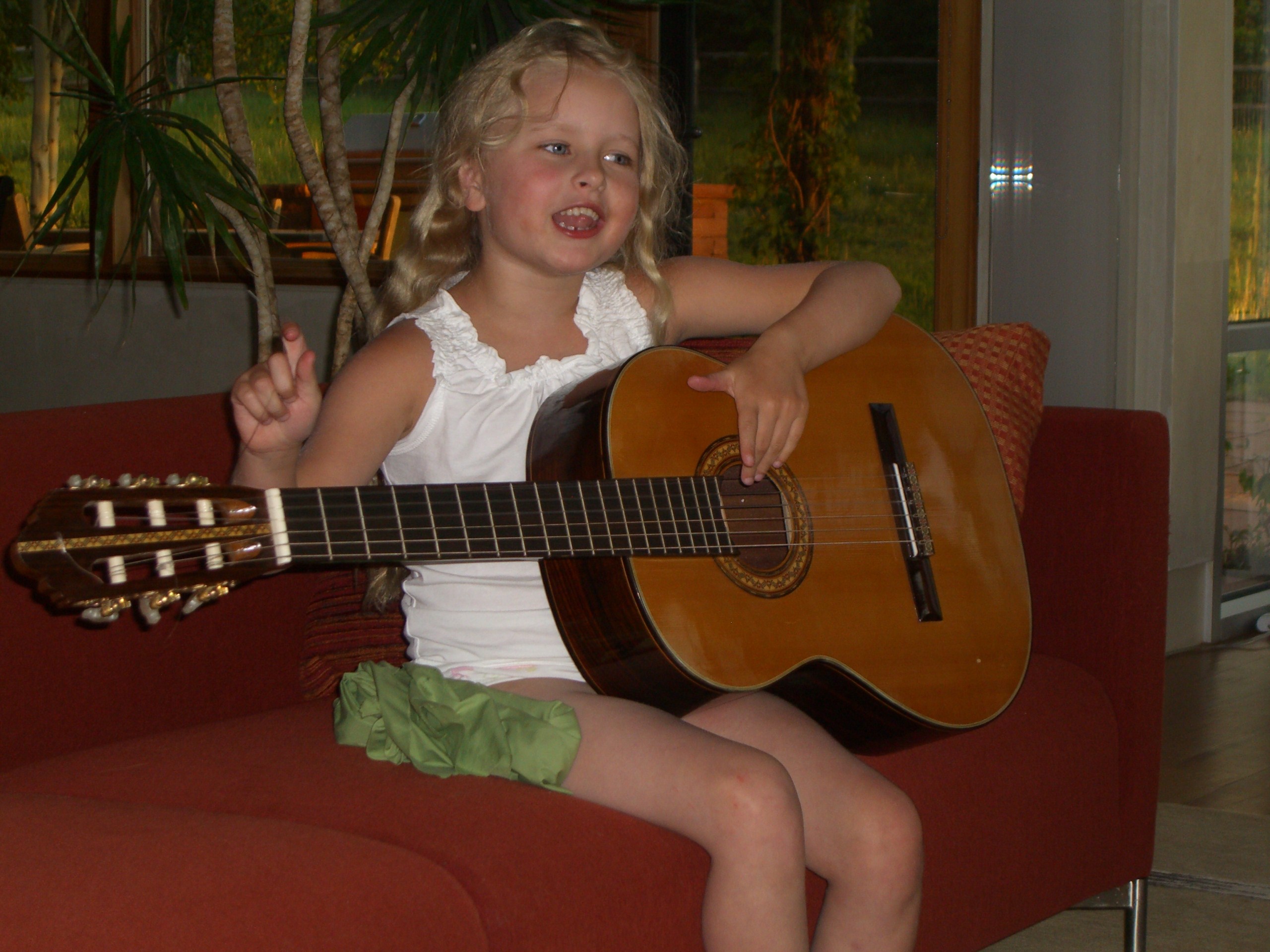
Emma loves to sing.  When she was an infant I realized she responded much better to words if they were sung to her.  So I did or tried to sing as much as I could, even though my voice is weak, Emma didn’t seem to mind.  Emma, however has a lovely voice.

The following is an audio clip of Emma singing with Alycea – our assisant – Que Sera, Sera.

Emma Singing

The Birth

(I wrote this yesterday at exactly the same time Richard was making his first entry on this blog.  Soon we will be finishing each other’s sentences..)

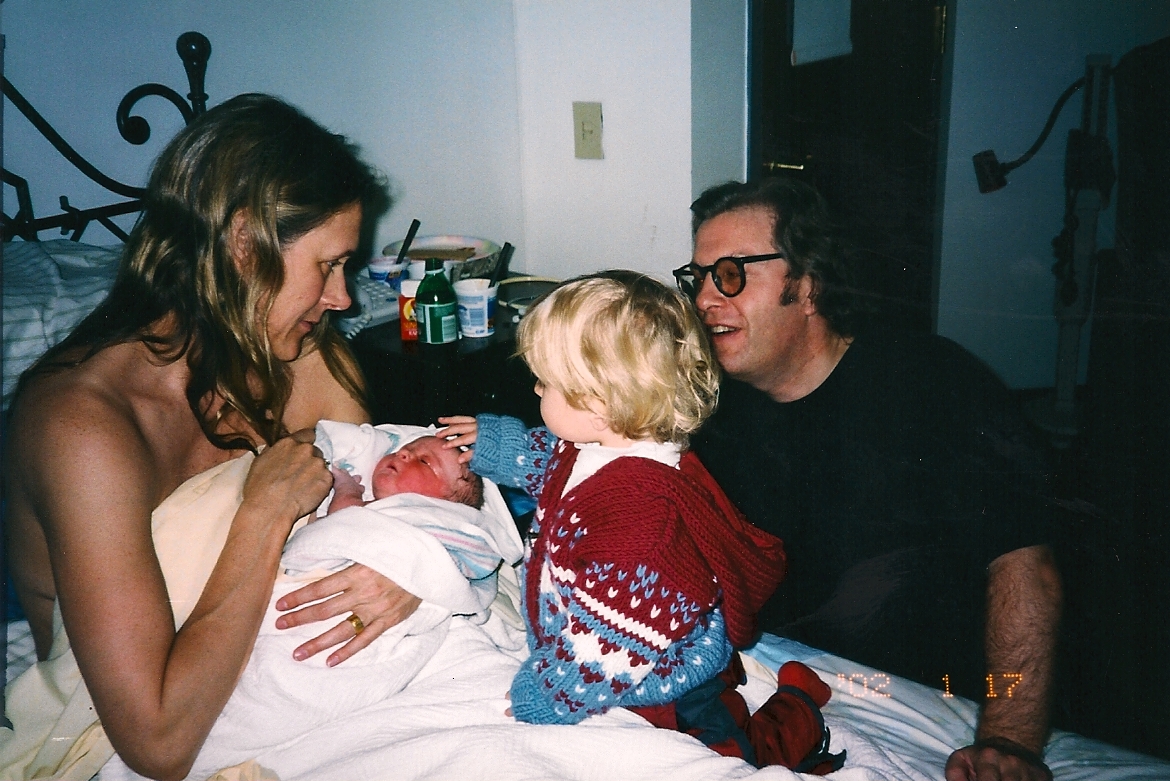
“Is she okay?” I asked the mid-wife about a half an hour after Emma was born.

“She’s fine, probably isn’t hungry yet,” the mid-wife responded.

Something about the way Emma seemed to brace herself against my touch, her seeming discomfort with the air in the room, as though it scraped against her skin and somewhere deep down, I felt the beginning of a worry, a tiny twist in my gut.

Emma is our second child.  Nic, her older brother by 21 months, had immediately begun nursing after I gave birth to him.  There was a bond from the instant he left my body, a connection that no cutting of the umbilical cord could sever.

When Emma finally appeared after 19 plus hours of labor she squinted at the lights in the birthing room, seemed to push away from contact with my body, she had no interest in breast feeding, she cried and nothing I did soothed her, it was as though an invisible scrim had unfurled, keeping us apart.  I shrugged the feeling off and reveled in her.

Eventually Emma became hungry enough that she breast fed, but never with any enthusiasm.  Emma did not seem to take solace in breast-feeding or receive any comfort from it.  It was fuel and that was it.  With Nic I use to joke that breast-feeding was kiddy Valium.

When Nic was an infant we bundled him up in a sling and took him with us to a dance performance at the Joyce Theatre.  The couple to my left audibly groaned when we took our seats next to them.  About twenty minutes into the performance, Nic stirred.  I began breast-feeding him.  Immediately he fell asleep.  As we were leaving the couple to my left said, “What’s your secret?  We never heard him make a sound!”  “Breasts,” Richard replied and the other man nodded his head smiling.

With Emma I remember thinking that she was astonishingly independent, even as an infant, that she was following in the footsteps of countless generations of my ancestors; strong women who had blazed trails of their own making, ignoring society’s attempts to dissuade them.  Emma was the embodiment of generations of those women, I decided.

The Beginning (Cont’d)

Some of the books I read:

Let Me Hear Your Voice: A Family’s Triumph over Autism by Catherine Maurice

*Nobody, Nowhere by Donna Williams

*Emergence:  Labeled Autistic by Temple Grandin

*A Slant of Sun: One Child’s Courage by Beth Kephart

*An Anthropologist on Mars by Oliver Sacks

Maverick Mind by Cheri Florance

A Parent’s Guide to Autism: Answers to the Most Common Questions by Charles A. Hart

The World of the Autistic Child: Understanding and Treating Autistic Spectrum Disorders by Bryna Siegel

Handbook of autism and Pervasive Developmental Disorders by Donald J. Cohen & Anne M. Donnellan, ed.

Biological Treatments for Autism and PDD by William Shaw, Bernard Rimland, Pamela Scott, Karyn Seroussi, Lisa Lewis & Bruce Semon

Special Diets for Special Kids by Lisa Lewis

*Sensory Integration and the Child by Jean Ayres

Teach Me Language: A language manual for children with autism, Asperger’s syndrome and related developmental disorders by Sabrina K. Freeman, Lorelei Dake & Isaac Tamir, illustrator

*Engaging Autism by Stanley Greenspan

*The Child with Special Needs by Stanley Greenspan

*Denotes books that were very helpful and continue to be

When I wasn’t reading books on autism and canvassing the internet reading the endless array of therapies being offered, each with it’s own little morsel of hope attached –  perhaps this will be the thing that she responds to – I was scheduling Emma’s early intervention therapists.  There were often 7 therapists in a single day, coming and going.

I look back on that period and wonder what it must have been like for Emma.  How odd it must have seemed to her, but she took it all in stride.  There were a few exceptions, the days when I would sit outside her bedroom door during her therapy, leaning my head against the wall listening to her scream as she tried to leave the room, but the therapist would patiently tell her she could not until they had finished and I would cry, fighting the urge to let her out – all that separated us was the four inch wall of her bedroom.  I remember feeling that everything I thought I knew as a mother – all my maternal instincts were useless.

The Beginning

“Does she ever point?” the evaluating psychologist asked us one day toward the end of another grueling session where Emma was suppose to play with a series of plastic ‘nesting’ cups.  Emma showed zero interest in the nesting cups or, for that matter, in any of the other dozens of toys the woman had brought with her.  Richard and I looked at each other and slowly shook our heads, no.  “Is that important?” I remember one of us asking.  “Yes, a typically developing child will always point to things that they are either interested in or want to know the word for.”  I will never forget that instant as it became a defining moment in the evaluation.  The evaluation that ended in a diagnosis of PDD-NOS when Emma was two and a half .

It had been only a month before – August of 2004 when Emma stopped speaking almost completely.  She had begun to slide more and more into her own world which did not seem to include any of us.  Her interest in anything ‘outside’ diminished. But she seemed to have a busy internal life, one that we were not privy to, nor able to share with her.  I dealt with the diagnosis with my usual pull-up-your-boot-straps-let’s-figure-this-thing-out-and-fix-it attitude.  I come from a long line of strong, independent women and this was the mode I fell into.  The first thing to do, I thought, was find out what autism was.  I had no idea, my only reference was a mixture of “Rain Man” and some books I had read as a young adult, which posited that the mother was ultimately to blame and that autism was the child’s emotional response to an unloving, controlling mother.  Undaunted, off I went to the book store where I spent hours reading.  The first book was about a woman living in New York City whose child was diagnosed with autism and so she adopted a vigorous program of ABA therapy, hired a young girl to help her and after a few years, the child was normally functioning and off to a main stream school.  Another book recommended a casein/gluten free diet.  I remember talking with one of Emma’s early intervention therapists who said she thought Emma would be mainstreamed by the time she was in kindergarten.  I had it in my mind that we were in for a few tough years, but with perseverance and a great deal of hard work, we would see this thing through.  I can do this, I thought and when it was all behind us, we would look back with a smile and say, “oh remember when..”

But ABA did not help Emma.  She has a phenomenal memory and memorized all 400 of the ABA flash cards, but when presented with a similar object, one that she knew from the flash card – such as a blue t-shirt – yet if I held up a blue blanket or one of her blue shirts, she could not tell us what the color was.  It became frighteningly clear that Emma could not generalize the information.

Back to the book store I went, returning home with an arm load of new books on autism.

Our Emma

What lengths would you go to if your child were diagnosed with autism?

This blog is about what we have learned, what we have done and continue to try in the hope that we may help our daughter Emma, now 8 years old, lead a life that includes deep friendships and the powerful bonds that result from being able to communicate with one another.  A life that is enriched by our interactions..  this is what I dream of for her and what drives us to go to such extremes to help her, hopefully, achieve some day.

Five and a half years ago we received the news that she had been diagnosed with PDD-NOS (pervasive developmental disorder – not otherwise specified).  Since then it has been nothing less than a wild roller coaster ride of hope, disillusionment, gratitude, determination and perseverance.

Here are some of the therapies we have tried in the last five plus years:

Gluten/Casein free diet – no noticeable change after five months

Homeopathy – up to 13 tinctures a day delivered orally – suppose to help her gut issues – no noticeable change after more than 10 months.

Cranial Sacro Therapy – did seem to help her constipation issues at first, but over a longer period (close to a year) did not appear to help enough to warrant continuing.

Qigong Master – suppose to help regulate her “energy flow” and promised to “cure” her autism – no discernible change after almost 6 months.

Chelation – we did one round before discontinuing upon advisement from a number of lead and metal specialists out of Albert Einstein College of Medicine.

Detox Foot pads – Pads that supposedly draw toxins from the body while she slept.  No noticeable change after several months.

Brushing Therapy – Emma became very hyper as a result of brushing therapy and after her sleep became disrupted we discontinued.

Auditory Integration Therapy – while this therapy did not seem to adversely effect her, it did not appear to help either.  We discontinued after a few years when she began objecting to it.

Hyperbaric Chamber – We did not do more than 10 sessions.  So I cannot comment on whether this may have helped or not.  We discontinued because we were starting the stem cell therapy and wanted to do one over the other.

ABA (Applied Behavioral Analysis) – 40 hours per week – we discontinued after two years when Emma began regressing.

Stanley Greenspan’s Floortime Therapy – We continue to use Stanley’s DIR methods.  Emma has made noticeable improvements in language – both receptive and expressive – as well as shows a real interest in initiating play with others, both adults and peers, as well as a huge uptick in imaginary play as a result.

Stem Cell Therapy – The Institute for Cellular Medicine – Costa Rica

We took our daughter Emma for her first bout of stem cell treatments with the hope that they might help her autism in March, 2010.  The Institute for Cellular Medicine was introduced to us by Emma’s neuroscientist in New York City.  This treatment is in it’s infancy, they have only treated about 100 autistic children, but are seeing promising results.  The stem cells were harvested from umbilical cord blood and mixed with her own blood serum..  They then injected this mixture intrathecally and intravenously on Tuesday and again on Thursday.  She was sedated for all procedures.  Emma had a bad reaction to the first round, evidently fluid leaked from her spinal cord causing blinding headaches and vomiting.  We were able to calm her with pain medication and by Wednesday evening she felt much, much better.  We decided to go ahead with Thursdays treatment and had them sedate her after the procedure to ensure that she lie flat and thus lessen the likelihood of seepage from her spine.  She was also given a drug to reduce nausea.  She rested in the hospital with us by her side for almost four hours.  We have been told that we should not expect to see any significant change for a month or two.  We will be returning to Costa Rica for round two in August.