Tag Archives: autism and parenting

Emma and Food

I’ve written about this before – Emma’s limited diet.  It’s self-imposed.   As her parent and someone who struggled with an eating disorder for 22 years, I have been reluctant to get too involved in her food other than to make a few half-hearted attempts to offer her other foods I thought she might like.  By the way, Nic, her older brother eats a wide range of foods, even eating a curried rice with cauliflower and chickpeas dish I made the other night, without complaint.  (He was being a good sport, I know.)

When we first received Emma’s diagnosis I immediately put her on a gluten free/casein free diet as so many families found it helped their child.  Some even found their child lost their diagnosis after going on it.   We had her on the diet for more than three months and saw her lose 10% of her body weight with no other noticeable change.  At the time we were working with a DAN (Defeat Autism Now) doctor, who specialized in allergies and nutrition.  During that time she became even pickier about what she’d eat and by the time we took her off of the diet, she was eating soy yogurt and scrambled eggs, shunning “good” foods she once ate, such as vegetables, chicken or fish.  Years later someone told me that soy is another food to be avoided and that may have been the reason we saw no change.  All these years later, I still wonder whether we did the diet wrong, if we’d removed all soy products, perhaps we would have seen some significant change.

A friend of mine suggested the GAPS diet, created by Dr. Natasha Campbell-McBride who “fully recovered” her own child with her diet.  The problem is, there isn’t a single thing allowed on this diet that Emma currently eats.  In addition it is a labor intensive diet, requiring one to make homemade condiments – such as mayonnaise, ketchup, etc as well as yogurt.  BUT – I am still willing to look into it and have purchased the book describing the diet as well as the cookbook with various recipes.  (Richard is groaning as he reads this as he no doubt is remembering the fanaticism with which I tackled the GFCF diet.)

Before I even contemplate starting the GAPS diet, I will take her to a new pediatrician who is said to be versed in autism and am trying to encourage her to try some new foods.  I intend to document our progress and (hopefully) hers on this blog.

Last night I introduced Emma to a piece of Comice pear, peeled.
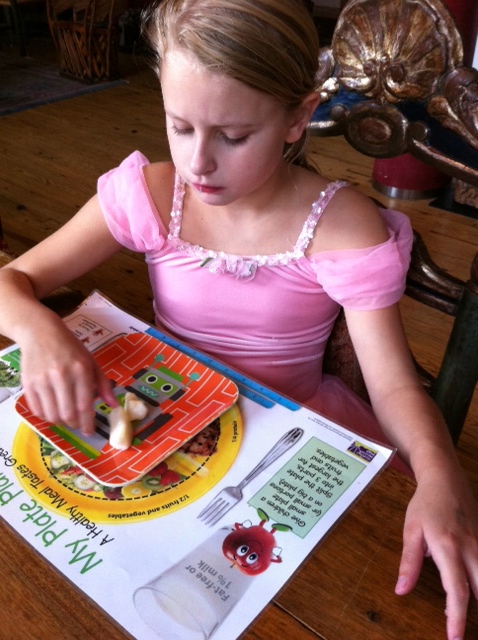
She was tentative, but eventually after smelling it, licking it and touching it, she finally ate it!
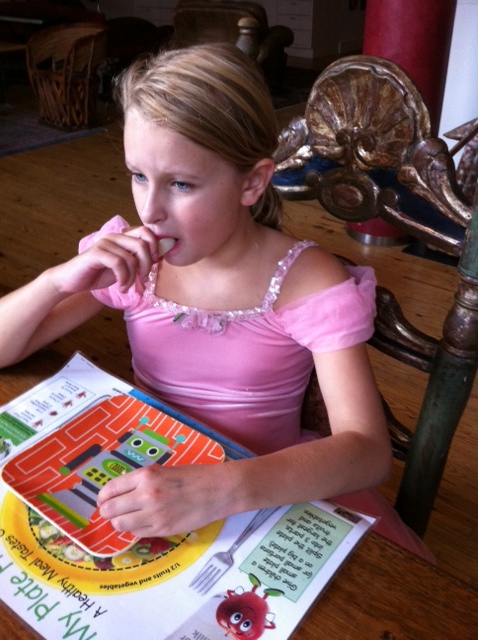
This morning I gave her a small bite of a Fuji apple, which she immediately picked up and ate without hesitation.  Tonight I will go out on a limb and try a raspberry.

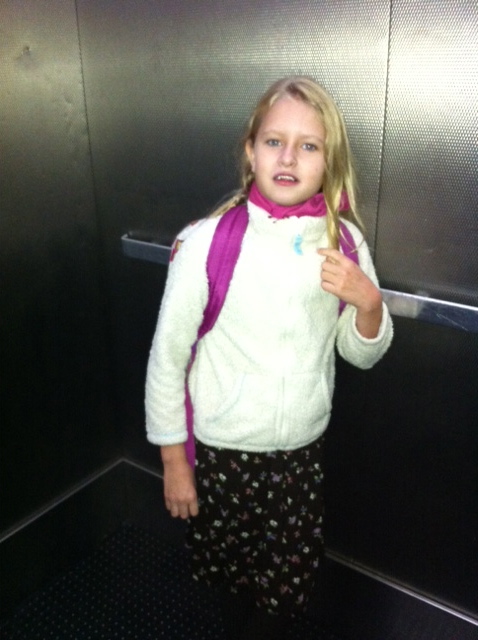
Emma on her way to the school bus this morning.
If anyone reading this has had success with any sort of diet, please contact me with what you tried and any progress you saw in your child.

For more on Emma’s journey through a childhood of autism, go to:   www.Emma’sHopeBook.com
Waking Nic – Autism

Last night Emma woke Nic up – again.

“No Mom, it was really bad.  She woke me up like five times. I swear Mom, FIVE times,” he held up one hand and wiggled all five fingers at me.

“What did you say to her?” I asked, stroking his somewhat greasy hair, while wondering if I should insist he wash it before school, then deciding he would be late for his bus and anyway it wasn’t all that bad.

“I told her she had to leave.”  He leaned against me, and said, “I told her – Emma!  You have to go back to your own room.”

“What did she do?” I asked.

“She went back to her room.  But then she came back. Like at three, then five, then six.”  He looked at me and pretended to fall asleep, collapsing in a heap on my lap.

“Hey Emma!” I called.  “You cannot wake up Nic.  It’s not okay to wake up Nic.”  But if I’m telling the truth, I was just a tiny bit relieved that she woke up Nic and not me.  I rationalized this “bad mother” thought with – He’s young and can handle sleep deprivation much better than I can.   Meanwhile Nic continued to mime sudden unconsciousness by falling on the ground, back on his bed, then into my arms, like some sort of narcoleptic preteen.

“You cannot wake up Nicky!”  Emma parroted, using her stern voice.

“Yeah, Em.  That’s just not cool,” Nic said.

I told Emma that since she woke up her brother, she couldn’t bring her  beloved “string” (a piece of packing tape) out of her bedroom.  She was very upset by this and said, “You cannot wake Nicky.  But listen, if you wake Nicky no string.”  Then she began to cry.

By the time it was time to go down to wait for her school bus, Emma was calm and said, “It’s okay.  Next time you cannot wake Nicky.  Then string can come out of the bedroom.”

I gave her a hug.  “That’s right Em.  It’ll be okay.”

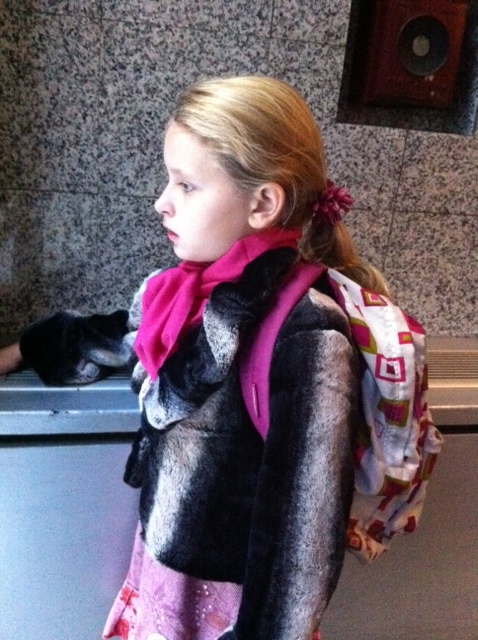
Emma waiting for her bus this morning wearing a “pretty dress”.

“I Am In Here” – Autism

There’s a terrific new book entitled:  I am in here:  The Journey of a Child with Autism Who Cannot Speak But Finds Her Voice by Elizabeth M. Bonker and Virginia G. Breen.  The title is a line from the poem  Me written by Elizabeth when she was 9.   The story is yet another example of a nonverbal child with autism who was helped by Soma Mukhopadhyay’s Rapid Prompting Method.  Elizabeth’s mother, Virginia has tried any number of therapies with the hope that something, anything will help her daughter.  It is not a story about a cure, but rather a message of hope in the face of continual struggle and perseverance.

Virginia writes about using a three pronged approach in her battle with autism – Mind (academics), body (biomedical interventions and diets) and Spirit (the more difficult concept of something greater than ourselves, which Elizabeth seems to have a solid grasp of.)  The mind, body & spirit concept particularly resonated with me as it was this very idea which captured my grandfather, Walter Paepcke’s imagination when he envisioned a place of contemplation and learning in his creation of what came to be known as the “Aspen Idea” more than 60 years ago in Aspen, Colorado.

I can claim full allegiance to the mind and body portion of this, however I must admit the spiritual piece continues to allude me.  Though a close friend of mine said to me recently that for a person who professes not to believe, I certainly spend a great deal of time thinking, reading and discussing the subject.  She then said, “It’s kind of like the wife who’s husband everyone knows is having an affair.  She’s the last to know.”  When I answered her with a perplexed look, she said somewhat exasperated, “Come on, Ariane.  You’re the most spiritual non-spiritual person I’ve ever met.”

I’m pretty sure she meant that as a compliment.

For more on our journey with Emma through her childhood marked by autism, go to:   Emma’s Hope Book

Yes, but… – Autism

A blog follower recently contacted me saying how exciting it is to see how much Emma is progressing.   Whenever someone says this to me, my first reaction is surprise, followed by a shot of hopefulness and finally curiosity.  What exactly do they see?  How is she progressing in their opinion?  So I almost always ask, “In what ways do you see her progressing?”

I then listen intently, making a mental note of the various things.  And then, and I’ve noticed this happens almost every time, I think – Yes, but _________ .  Here is the current list of my “Yes, buts…”

Yes, but she still sucks her thumb and as a result the shape of her mouth has changed, resulting in her front top and bottom teeth no longer meeting because of her massive over bite.  (This thought usually leads to a whole laundry list of anticipated horrors about dentistry, orthodontistry, the worry of how we will have to have her hospitalized to have braces put on – this is what we had to do when she had a cavity) and the exorbitant cost of  all of this.  I become acutely aware of how fast my heart seems to be beating.  Suddenly I am nauseous, can’t eat and wander around feeling ill.  Which leads me to my next – Yes, but:

Yes, but she only eats a half dozen things, all of which are either dairy or wheat and though we put her on a wheat free/ dairy free diet when she was first diagnosed to zero effect, maybe we did it wrong.  A vegetable has not touched her lips in more than six years.  Maybe we missed something.  Maybe there’s something else here that we should be doing.  I then am led to Google and several hours later I emerge from the black hole that only Google can provide, having learned about the dozens of diets all with the ominous warning that early intervention is key.  Which, to my mind, means we’ve missed the boat as she is now at the ripe old age of nine and a half.  If I’m feeling really panicked – almost ten!

Last night I mentioned to Richard my current litany of – yes, buts.

“You’re spiraling off again,” he observed, after I’d finished.  Then he looked at me with an expression of concern.  He sighed and said, “I know, honey.”

I understand that my thoughts, shooting off to the next catastrophe, are my convoluted way of protecting myself.  However that “protection”, all those, “Yes, buts” are what block me from fully enjoying Emma’s amazing accomplishments.

Yes, but…

For more on Emma’s journey through a childhood of autism, go to:  www.Emma’s Hope Book.com

Biting and Other Self Injurious Behaviors – Autism

Yesterday Emma came home from school with her forearm covered in bite marks.  I sat down next to Emma on her bed and gently touched her arm.

“You bit!”  She said sadly.

“I can see that,” I said, stroking her arm.

“I want to unlock it,” she said, twirling a scrap of what was once her blanket around and around her index finger.  “I want cokie,” she added.

I continued to stroke her arm.

“You cannot bite!  Emma!  No biting!”  She shouted.

When Emma is very upset, she begins to script.  In other words she mimics things others have said to her using the same tone of voice and if they have an accent, she’ll say the words with the same accent.  It’s a bizarre experience to listen to your upset child alternate between using someone else’s words, tone and inflections and her own voice, as though she were auditioning for all the roles in a play with an ensemble cast.  Sometimes she’ll throw me into the mix – “Oh sweetheart!”  and then severe and scolding – “You cannot bite!  That is not okay,” with her own pleading, “I want cokie, I don’t want to lock it up,” then the logical, calm tone of a teacher or therapist, “You can have cokie later.  First go to the roof, then you can have cokie.”  Her face crumples up while she fights back the tears, often losing the battle and collapsing into an anguished heap of heaving sobs and cries.

At a certain point, when her frustration, anger and upset become more than she can bear she turns it inward and becomes violent toward herself.  The emotions too great for her to contain, she bites herself, leaving the imprint of a full set of teeth upon her arm or finger or hand.  Once, when I held her arm to prevent her from hurting herself she jerked her other arm away and punched herself hard in the face.  The force with which she did this, took my breath away.

I mentioned on this blog, once before, when I was younger I struggled with bulimia.  A more accurate description would be less a struggle and more a complete and utter surrender to the eating disorder.  A therapist I was seeing at the time talked of the act of vomiting as self inflicted violence and I remember being furious with this description.  I wasn’t being violent toward myself, I was simply pursuing a thinner physique.  But after years and years of therapy and then recovery I came to recognize the violence in what I had done to myself for all those years.  When I see my own daughter hurting herself it is impossible for me not to reflect on those years of frustration and rage.

Emma’s acts of self injurious behavior are expressions of her rage, frustration and there is an added piece to this, I am convinced – the desire to control the pain, coupled with her many and varied sensory issues.  I think the combination is deadly.  But how to help her?

That is the question I have no solid answer to.  For now we are trying to explore other ways for her to get her sensory needs met without hurting herself.  However I know from having engaged in destructive behavior for more than two decades how entrenched and addictive that behavior can become.  There are no easy solutions, but then autism itself is like that.

For more on Emma’s journey through a childhood of autism, go to:   www.EmmasHopeBook.com

Having a Daughter with Autism

Someone asked me the other day – What’s it like having a daughter with autism?

The flippant response would be – I don’t know what it’s like to have a daughter without autism.  But the more thoughtful answer is a bit longer and more complicated.  My own experience of being a daughter to a mother with whom I feel deeply connected to, a connection that many, I have learned over the years, do not have certainly plays a role in my answer.  I have always felt my mother and I share something that goes beyond the usual feelings of responsibility and gratitude toward someone who gave so much in order that I might have a good life.  It is as though we share something much more than the history and past of living under the same roof for the first 17 years of my life, something I cannot adequately put into words.  We have a closeness, a bond and yes, a friendship that only a few of my female friends can relate to regarding their own mothers.  I have often said that if my mother were not my mother, I would wish she were.  I don’t actually know many people who can truthfully say that about their mothers.  I am lucky.  I get that.

So when I was pregnant with Emma, I fully expected to have a similar experience.  I knew right away she was a girl.  Don’t ask me how, I just knew it.  For one thing I began to wear pink, a color I never liked until Emma entered my being and for another I craved spinach and blue cheese during my first trimester, as opposed to steak and all things meat when pregnant with Nic.  Okay so I’m not being completely serious – though all of this is true – the pregnancy was different with Em, it just was.  Without meaning to or even consciously trying to, I visualized my soon to be daughter.  I knew she would have blonde hair, blue eyes and broad shoulders, as both Richard and I share these things, but beyond that I couldn’t know. I sang to her, just as I did when I was pregnant with Nic, I talked to her, read to her and dreamed about her.

While pregnant with Emma, I was walking on Fifth Avenue one afternoon, when I passed The American Girl store.  It reminded me of my first and favorite doll, Maribelle, a gift from my mother to me when I was little.  Maribelle came in a blue and grey striped trunk complete with shoes, gowns, dresses, she even had a fur coat!  (I still have Maribelle – she and her trunk reside upstairs in my mother’s house.) I saved her, intending to give her to my own daughter, were I fortunate enough to have one. Looking through the large windows of the store I fantasized of the day I would bring my daughter there and how she would choose a special doll.  A doll that would be like Maribelle was to me – a companion, a doll she would whisper secrets to and spend hours upon hours playing with.

Richard and I were not the kind of parents intent on placing our yet-to-be-born children on waiting lists of the most coveted New York City preschools, looking to the day we could sit listening to our child’s speech having graduated  from Harvard Summa Cum Laude.  Ours was a more unconventional approach – at one point we fantasized about putting all of our belongings in storage and traveling the world for a few years.  We spent many an evening discussing the places we wanted to travel to, which included Tanzania, Lebanon, Egypt, Brazil, Morocco and Laos.  We poured over guide books and vowed that once both children were out of diapers we would make our fantasies reality.  We had no way of knowing that Emma wouldn’t be out of diapers until she was eight and a half years old.  We couldn’t know that once she was out of diapers we would be scrambling to cover the staggering cost of her care, making any dreams of extensive travel abroad impossible to seriously contemplate, not to mention the sheer logistics of traveling to a foreign country with a child with special needs.

(To be continued.)

For more on Emma’s journey through a childhood of autism, go to:   www.EmmasHopeBook.com

Autism’s Murky Future

Yesterday the New York Times ran a front page piece entitled – Autistic and Seeking a Place in an Adult World.  I am always so grateful when I see anything on autism, even when I am not told anything I don’t already know.  I am particularly grateful when I see something on autism on the front page of the New York Times.  For those of us who are parents of a child with autism, the looming question of what will happen when our child becomes an adult is something we do not have the luxury to ignore.  Yet, the answer is not readily available to us, either.  There is no road map by which we can look to.  The future of our children is very much up in the air.  It is a tricky balance keeping the fear at bay, while also being practical and realistic about ones child’s future and how we might ensure she is taken care of should she not be able to hold down a job and live independently.

My message of hope on The Hope Installation at the entrance to the High Line

The truth is we cannot know what Emma will be like in another eight years, all we can do is continue to work as intensely and extensively with her as we currently are.

So this evening when I come home from work, I will work on the word – does.  After we spend an hour or so going over the word, both using it in hand written sentences and as well as typing sentences with it, we will also use the word verbally as when I lay out a frog, a boy, a bus and a dog and say, “Hand me the one who does not eat.”  After we have done all of that we will play some games using the word “does” and finally we will go over a list of words she has already learned and review them.  Somewhere during all of this – dinner will be prepared, Nic’s homework will get done, stories will be read and everyone will eventually go to bed.

For more on Emma’s journey through a childhood of autism, go to:  www.EmmasHopeBook.com

Emma’s Sense of Humor – Autism

Emma’s sense of humor, much like everything else about her, is… quirky.  As a baby, Emma squealed with excitement when we popped out from behind things and yelled, “Boo!”  As Emma grew older she continued to delight in anything resembling silliness.  We were filled with hope when, during one of Emma’s many early intervention therapy sessions, she offered some play-doh to the therapist, only to pull it away just as the therapist reached for it.  Emma howled with laughter as the confused therapist realized Emma was playing a joke with her.

Afterward the therapist made a point of telling us how Emma’s sense of humor suggested tremendous potential, how she was expressing a desire to interact, how unusual this was for a child with autism to want to initiate in such a creative way.  Emma continues to display her silliness and creativity in surprising ways.

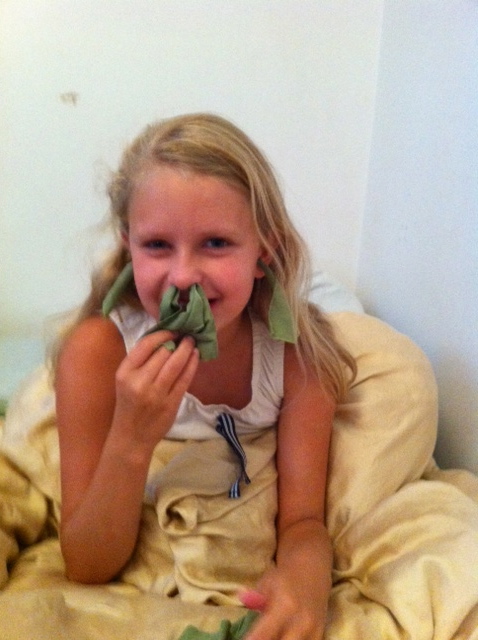
Emma with what’s left of her cokie  (this use to be a crib blanket filled with down).

When I came into her bedroom and saw her I said, “Em!  What are you doing with cokie?!”

To which she laughed, “Stick cokie up your nose.”

“That’s so gross, Em!”

“No not going to stick cokie up your nose, stick cokie in your ears,” she replied, still laughing.

“Ew!”

“That’s funny,” she then said.

It reminded me of when we took Nic out to eat at a Japanese restaurant.   “Look Mommy!”  He said as he unwrapped his chopsticks and stuck each into a corner of his mouth.    “I’m a walrus,” he managed to say.

My grandmother was known for, after a few drinks, rolling a napkin up, and placing it above her upper lip pretended it was a mustache – so maybe it’s genetic and not a display of extreme intelligence after all.  Not that she wasn’t extremely intelligent, she was…

For more on Emma’s journey through a childhood of autism, go to:   www.EmmasHopeBook.com

In the Playground – Autism

Yesterday while at the playground, Emma pushed a little boy off of a roundabout.  It wasn’t clear why she did this, though it reminded me of a game they played at camp where the little girls stood in line by the pool and then pushed the girl in front into the water.  (I can hear the defensiveness in this sentence, I know. But let me continue.)  The boy was seated on the edge of the spinning circle, like a giant saucer, filled with a dozen other children.  A few children were on the ground pushing, while running to make it go faster.  The children seated within the saucer were shrieking with laughter and then the little boy went flying off.  The child’s mother, understandably upset, was furious with Emma and yelled at her that this was unacceptable behavior.

I was seated with a friend of ours whose son was playing with Nic.  I noticed Nic staring at me with a horrified expression and making gestures with his hands for me to come.  When I reached him he told me what had happened.  “She just pushed that kid off, Mom.”

“Which kid?” I asked Nic.

“That one,” he pointed to a young child being led away by his mother.  “We were all just playing and this one kid was spinning the thing around really fast.  Emma was laughing and that boy was sitting pretty close to the edge and then Emma just pushed him and he went flying.  The mom got really mad and started yelling at Emma.”

“Okay.  Thanks Nic.”

I made Emma get off and had her sit on a bench next to her father.  I told her she was to sit still until I returned.  I then ran after the mother and her son, apologizing and explaining to her that Emma has autism.  I told her how very sorry I was and inquired after her son, who seemed frightened and confused.  I told him Emma hadn’t meant to hurt him.  The mother told me, with an apologetic look that Emma’s behavior wasn’t okay.  I nodded my head and agreed with her.  She then said, “Oh dear, I didn’t know.  I hope I didn’t scare her when I yelled at her, but I was so upset.”

I assured her that Emma was fine and again apologized for Emma’s behavior.  When I returned to where Emma was seated I said, “Emma.  You cannot push other children.  It is not okay to do that.  You could have hurt him.  Do you understand that, Emma?”

“You cannot push,” Emma said, nodding her head.

“That’s right.  You cannot push.”

“Go back?”  Emma asked, pointing to the spinning saucer.

“No.  You can sit here next to me.”

“One minute,” Emma said.

“Ten minutes.  You will sit next to me for ten minutes Emma.  And you may not play on that again.  You can run around and do other things.  And Em, if you push again, you will go home.  It’s not okay.  You could have hurt that little boy.”  Emma looked down at her hands.  “Do you understand, Em?  It’s not okay to push.”  I watched her for any sign of understanding.  She continued to stare down at her hands, which were in her lap.  “Em.  Do you understand?”

“Yes, mommy.  You cannot push.  It’s not okay.”

It is times like these that I feel at a loss.  We so rely on communicating through speech that these sorts of situations feel impossible with Emma.  She showed no sign of understanding, she wasn’t angry, she didn’t seem particularly upset, if anything she seemed completely baffled by the whole situation.  “Emma.  Why did you push him?”  I finally asked.

“You pushed.  It’s not okay to push,” was her response.

One hears about aggression in children with autism all the time.  Emma, when upset, frustrated or angry, usually hurts herself.  Biting her arm or hand is her most common reaction, but a few times she’s thrown something or punched herself in the face.  It is difficult to witness these acts of violence against herself.  It is even more difficult to make her understand why it’s not okay to hurt herself.

But this episode in the playground was different.  Emma wasn’t acting out in anger, evidently she’d had no interaction at all with the little boy she pushed.  What was going through her head?  Why did she push him?  It’s impossible to know.  But I do have a few ideas, none of which dismiss her behavior, but they do explain what may have happened.  Emma craves sensory input.  Often children who crave vestibular movement can be calmed by having ten minutes or so of it.  Emma appears to never be satisfied no matter how much she gets.  Richard and I have had countless conversations with her various therapists about this.  In our neuro-typical world we call people like this “thrill-seekers”.  In the world of autism it’s called sensory integration disorder –

Someone once explained to me that it’s a bit like having a body part fall asleep and the desire to stomp, pinch or hit that body part in the hope of “waking” it. Roller coasters, swings, trampolines, carousels, anything that moves quickly and erratically are Emma’s way of “waking”.  Pushing the boy was not an act or display of aggression as much as it was an unconscious response to her craving more movement.  It may be that he brushed against her by mistake or perhaps he was too close to her or she may not have been aware of him at all.  Unfortunately none of this helps the child who was pushed or his mother.

For more on Emma’s journey through a childhood of autism, go to:  www.EmmasHopeBook.com

Asking – Autism

I remember the first time Emma’s older brother, Nic asked permission to do something.  He was about 14 months old and he asked if it was okay to take a particular toy with him to the playground.  It was noteworthy for a number of reasons, but as his mom, I remember thinking how incredible it was that this tiny child understood that if you asked, rather than just did something, chances were you would be able to do whatever it was.  The whole “polite” thing wasn’t part of the equation yet, but it soon came to be, shortly thereafter.

With Emma it was different right from the beginning.  For one thing, she didn’t ask questions as much as demand that her basic needs were met.  Because her language was severely delayed, she would often drag one of us to the refrigerator and indicate what she wanted.  As she didn’t “want” our attention, toys or many of the things other neuro-typical children do, there was less motivation to ask for things.

As Nic grew older his questions became more complicated and interesting.  Suddenly we were discussing such topics as religion, questioning the existence of God and if there was a God, who made him.  Could there be a heaven without a “God”, why did people die, was there life beyond our planet earth, how did we come to be and what was our purpose, where did the earth come from, how is it possible that the universe is infinite and what does that mean, exactly.  Nic also became curious about Richard and my experiences.  He wanted to know if I’d ever felt scared (yes!), whether I was nervous when in front of new people (often), when did I know what I wanted to be when I grew up (that concept continues to evolve), when did Richard and I meet, and the questions have never stopped.

Emma does not ask questions about life and the world.  She has never asked me a personal question.  But she has learned to ask for things that she needs or wants.  Often the question is a demand with an upward lilt added, making the demand more palatable, as in  – “Go to the zoo?”  “See the snake bite boy?” “Apple juice?”  However lately her questions have changed slightly.  It’s a subtle difference, but I have noticed it a number of times in the last few days.  This morning she came into the study (this in and of itself is startlingly new as in the past she would simply ask from where ever she was and then when no one responded because no one heard her, she would begin to scream until someone appeared) but today she found me and said, “Mommy?”  Then she waited for me to respond.  When I looked up, she said, “Can I have a caramel yogurt?”  Again she waited for my response.  This too is different.  In the past she might have asked if I was standing nearby and then after uttering the words she would have raced off, not waiting for a response.  The question was rhetorical.

“Sure Em.  Go have a caramel yogurt,” I said.

To which she ran off, only to reappear a few minutes later saying, “Okay.  Last one caramel yogurt?  Eat one more and then it’s all done.”

“Yeah.  Okay, Em.  That sounds good.  Go have another one.”

“Okay!”  She yelled as she went back into the kitchen.

Last night she found me in the bathroom, where I was brushing my teeth.  “Mommy?”  She waited.

“Yes, Em?”

“Can I watch Winnie-the-Pooh?”  Again she stood looking at me expectantly, waiting for my answer.

“Sure Em.  But first put on your nightie and brush your teeth.  Okay?”

“Okay!”  she said tearing off to change.

I cannot describe my surprise at her actually waiting for me to respond.  This is new and a welcome change.

For more on Emma’s journey through a childhood of autism, go to:  www.EmmasHopeBook.com

Siblings – Autism

Nic is Emma’s older, neuro-typical brother.   Nic is eleven, about to enter the sixth grade and an all around amazing kid.  Having Emma as his younger sister is often difficult for Nic, though he usually doesn’t complain.  The siblings of children with autism are often burdened with responsibilities far beyond their years.  Despite our attempts to encourage Nic not to take on the role of her personal body guard, supervisor and parent, he often does on his own accord.  He can’t help himself.  He worries about Emma.

Nic has witnessed horrific and violent melt downs.  He has seen Emma punch herself in the face, bite herself repeatedly on the hand or arm.  He has stood by helplessly as she screamed and shrieked her frustration at not being understood.  He has joined in countless searches for such bizarre and arbitrary items as a missing balloon string, a piece of packing tape, a scrap of paper, a specific photograph or a microscopic shred of what is left of her blanket.  He has panicked with us when one of us uttered the dreaded words:  “Where is Emma?”

Nic is older than Emma by 21 months, yet he is very much the adult to her childlike innocence.   In an effort to give Nic time to enjoy himself without the stresses that can come with Emma, Richard and I spend at least one day a week with Nic, alone.

So yesterday, instead of going into my studio I asked Nic if he wanted to hang out with me.

“I’d love that Mom,” he said, nodding his head.  “We’ll have some Mom and son time.”

We ended up going to Elephant and Castle (a place that’s been around for almost forty years and where I used to love going when I was in college because of their bowls of latte) for lunch.  We discussed the coming school year, who he hoped would be in his class and what teachers he hoped to have.

“What are the top five things you like best about yourself?” I asked.

“I like that I’m a good person, I’m kind, thoughtful, I care about people, I want to help people and I work really hard.”

“You do!  That’s all so true,” I said.

“I like that I’m an average skateboarder,” he added.

“You’re a really good skateboarder.  What do you mean by that?”

“I like that I’m okay, but not great yet, it gives me something to work toward.  Cause like if I was really great and already knew everything, that wouldn’t be as much fun,” he took a bite of his cheeseburger.  “Mom, you’ve got to try this.  It’s amazing!”  He offered me a bite of his burger.

“Okay, if you could change anything about yourself, what would it be?” I asked.

“I’d be a genius,” he answered without hesitation.  “What about you?”

“I’d be more patient and not so quick to anger,” I said.

“I think you’re perfect just the way you are, Mom.  I don’t think you have to change a thing,” he said, patting my arm.

“Wow, Nic.  That’s such an incredibly kind and lovely thing to say.”

“It’s okay Mom.  It’s true,” he said looking at me and smiling.

That’s Nic – kind, supportive, incredibly loving and thoughtful.

After we had lunch we went to the movies, then took a walk and talked some more.

“This was a great day, Mom.  Thanks for suggesting it,” Nic said as we made our way home.

“I loved it, Nic.  I loved spending today with you.”

“Yeah, me too.”

We walked together in silence for awhile, then Nic said,  “Mom?”

“Yeah Nic?”

“Do you think we could get a dog?”

For more on our family’s journey through Emma’s childhood of autism, go to:  www.EmmasHopeBook.com

We Have to Keep Trying – Autism

When Emma was first diagnosed, she was four months away from her third birthday.  Since that fall, now seven years ago, we continue to show up for her in ways we could not have imagined.  As many of you with a child with autism know, engaging your child can be complicated.  Emma cannot have a “conversation” the way her neuro-typical brother, Nic can.  We cannot have discussions with her, there is no easy back and forth of ideas and opinions.  Because Emma is rigid in her desires, outings can become problematic if they are not kept to a strict schedule.  The central park carousel must be ridden and then we must go to the zoo, but only after we have watched the brass animals go around when the clock strikes every half hour.  Once in the zoo we must watch the seals being fed and then go see the penguins, followed by the aging and now blind seal, then the polar bear and finally a visit to the bats, before we can leave.  Often Emma will then insist on a visit to the petting zoo where she is more interested in patting the metal replicas of the animals, which then make the appropriate animal sounds, than the real animals.

When both the children were toddlers we were frequent visitors to the American Museum of Natural History on the upper west side of Manhattan.  During the winter months I often took the children four or five times a week.

“Once the kids are older, I hope never to go to that museum again,” I grumbled to Richard one afternoon after an exhaustive five hours spent there.  “And can we add every playground that exists?”  I added.

And then we got the diagnosis and everything was up for grabs.

My time with Emma now includes listening to music and dancing together, walks and yes, lots of playgrounds, amusement parks, the zoo, the various carousels the city has to offer, swimming, but also reading and her literacy program.  Richard still takes Emma to see “the snake bite boy”, which is Emma’s name for the American Museum of Natural History.  But it is during Emma’s “study room” sessions that I see her progress in real, identifiable and concrete ways.  It doesn’t matter whether I am feeling optimistic or not, the evidence is there, right in front of me.  We have kept a record of those first hours when she was learning to form the letter “a” to now, when she is struggling to write two and three sentences at a time.

This morning was a difficult session.  She was required to write three sentences from memory.  At a certain point I said, “We cannot give up, Em.  We have to keep trying.  I know it’s hard, but you can do this.”

Those words were probably more meaningful to me, than to her.  They would be an apt mantra for me to repeat to myself every morning.

No matter what, we cannot ever give up.  We have to keep trying.

For more on Emma’s journey through a childhood of autism, go to:   www.EmmasHopeBook.com

Literacy and Autism

We have been working intensively with Emma on her reading, writing, typing and more recently math and verbal skills.  The reading, writing and typing program we began in January.  It was at this time that she painstakingly learned how to form each letter of the alphabet.

This morning Emma wrote this, in answer to the written question – Did the cat jump? – after I had made the cat jump.

In answering the question – Did the boy jump? (the boy as seen in this photo was lying in a bed) Emma wrote:

In accessing Emma’s progress, I need to compare her to herself and not other children.  I have seen over the years how easy it is to become discouraged when I compare Emma to her brother or any neuro-typical child or even other children on the spectrum – unless they are much more severe.

“This isn’t going to be a sprint,” Richard once observed, after seeing yet another neurologist.

And it isn’t.  Emma is making slow and steady progress.  We work with her for about three hours every day on her literacy, math and verbal exercises.  There has been no instantaneous miracle.  She has not begun to write on her own in complete, complex and revealing sentences.  She has not gotten to the point where she is able to tell us what it is like for her to be her.  She cannot answer questions regarding anything remotely abstract.  (Which doesn’t mean I don’t continually hold out hope that one day she will.  I do.)  But at the moment, I am happy to reflect on her slow, steady progress and it fills me with joy to work with her each morning and to see these beautiful sentences that she constructs on her own.

Someone once asked me – Is it good enough?

The idea being that I had a preconceived notion of how I wanted something to be and anything short of that meant it was an utter failure.  Sometimes being “good enough” is still pretty fabulous.  So yes – Emma’s progress is good enough.  In fact, it’s better than good enough, it’s wonderful.

For more on Emma’s journey through a childhood of autism, go to:  www.EmmasHopeBook.com

Hope – Autism

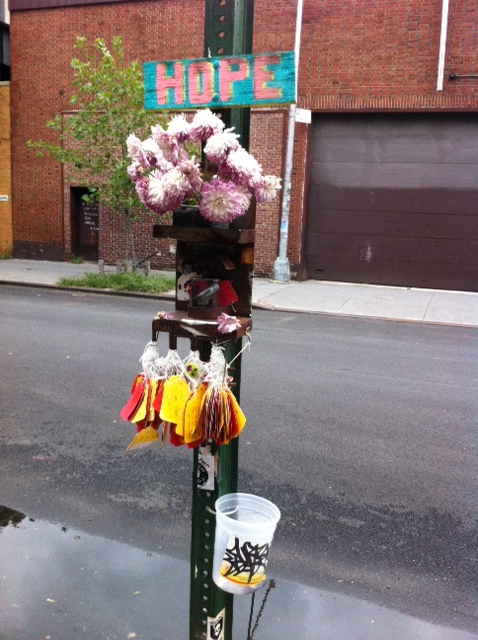
For those of you planning a trip to New York City, you must take in the High Line, New York City’s most creative and interesting park, built on the old elevated tracks on the west side of downtown Manhattan.  The High Line spans more than twenty blocks and eventually will end at 34th Street.  Last Sunday we came upon this art installation at the bottom of one of the High Line’s many entrances/exits.

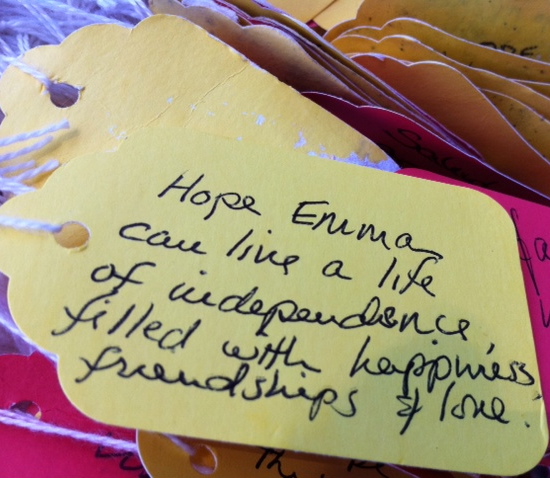
On each of the little red and yellow tags people had written what they hoped for.  One said, “Cure Ann of her cancer” another said, “I hope I will love Miquel forever”, and still another read, “Please make Mom get better”.

Love and health were the most popular “hopes”.  I would have written one of my own had I’d thought to bring a pen with me – Let Emma live an independent, happy life, filled with loving relationships.  I guess the thing about hope is it keeps us moving forward.  Hope allows us to get through tough times.  I am reminded of the prayer of Saint Francis of Assisi:  “Where there is hatred, let me sow love; where there is injury, pardon; where there is doubt, faith, where there is despair, hope…”  Regardless of ones beliefs, these words have given solace to a great many, myself included.

For more on Emma and her journey through a childhood of autism, go to:  www.EmmasHopeBook.com

What Matters

We are leaving soon.  Back to New York City where our other life awaits us.  The children need to get ready for a new school year, medical forms need to be filled out, bus companies need to be contacted and confirmed, school supplies need to be bought.  Nic will be entering 6th grade and there’s a certain excitement in that.  Emma doesn’t enter a “grade”.  She will be placed in a class with other children on the spectrum, who are near to where she is academically.  I am always filled with trepidation at the start of a new year regarding Emma.  It is difficult not to give in to fears and worries.  Will she excel?  Will her new teacher and classroom be a good fit?

The truth is, Emma has progressed more in the past seven months than she has in five years.  We attribute this to the literacy program we began in January of this year.  We have now added a math program as well as a verbal program.  Emma is working each day for about three hours on these various programs.  It has been amazing to witness.  Progress.  This is the word every specialist we’ve ever spoken to has used.  Is she progressing?  And the answer to that question is a resounding – Yes.  We cannot predict what the future holds for Emma.  We cannot know how far she will go.  But as long as she continues to progress we know we are on the right track. I heard someone say once – Progress, not perfection.  It’s an apt thought for any of us.

Emma at dusk last night

For more on Emma’s journey through a childhood of autism, go to: www.EmmasHopeBook.com