Category Archives: Speech

Emma’s Language

Emma’s language continues to fascinate.  What follows are a number of examples demonstrating Emma’s creative use of the English language.

This morning she said tearfully, “ Rope?”

I now know she was asking me to help her find Merlin’s cat toy, which Emma has become particularly fond of.  It resembles a fishing rod, only it’s plastic and at the end of a thinner plastic “line” is a cat’s version of a fishing fly.  The “fly” has feathers in royal blue and black though ours, or I should say, Emma’s no longer has any feathers.  Just a few defeated bristles are all that remain.  I tried to get Emma to call the toy “Merlin’s cat catcher”.  Emma repeated the words and then said, “rope,” in a matter-of-fact tone.  Fair enough, saying rope is certainly easier than the tongue twister I was suggesting.  Emma’s interest in Merlin’s toy is not to engage Merlin in any sort of play.  She likes to hold it and chew on the thinner plastic line.  Merlin, under the misguided impression it is still his toy, leaps at the bristled end and tries to grab it in his mouth.  Emma ignores him unless prompted by one of us to use it to play with him.  At which point she will whip the thing around her head so violently Merlin runs away.  Mission accomplished.  No one can accuse Emma of not being able to creatively problem solve.

“Leash?” Emma said the other day.  “Leash” is short hand for any number of things:  tape measure, jump rope, belt or dog’s leash.  It began out in Colorado where she loves to hold the leash attached to one of my mothers’ two German Shepherds.  She is actually terrified of most dogs, including my mother’s.  Giving her the leash to hold is one way to calm her when we are taking the dogs for a walk.  But since we do not own a dog in New York City I know when she asks, she is looking for my tape measure or less frequently her jump rope.

This morning Emma sat on the floor and looked at some work sheets that had been sent home in her backpack.  There were a series of numbers referring to corresponding red dots.  Emma looked at the number and said, “What’s that letter?”  She then counted the red dots, ” One, two, THREE!”

“What’s that number, Emma?”  I said.  “It’s a number.”

Dutifully Emma repeated, “What’s that number?  One, two, three, four.  FOUR!” She looked up at me and smiled.  “What’s that letter?”  She said pointing to the number 6 on the next work sheet.

“It’s a number, Em.  Look these are numbers and this,” I drew the letter A, “is a letter.  Can you see the difference?”

Emma nodded her head.  “A”, she said.

It was not clear she understood the difference.

As I watched her counting and naming the numbers I thought about how it must all seem so arbitrary to her.  A number, a letter, a rope, a leash, a toy…  All things we learn to identify at a very young age and never think about again.  But for Emma this is not the case.  Why would the symbol for a quantity – say the number 3 – be any different than the letter G if one does not understand quantity?  If one continues along this line of thinking all the names we apply to letters in the alphabet must seem incomprehensible.  Why is the letter H called “Aich”?  It’s phonetic sound doesn’t offer any clues either as it’s the sound one makes when hit in the solar plexis or something resembling a whispered “huh”.   As anyone knows who has attempted to learn the English language, for every rule there is an exception, making it an exceedingly difficult language to learn.

The other night Emma was recounting our trip to Costa Rica, something she often does.  She tapped her stomach and said, “Now go bang-bang!”  Which means she was remembering how her stomach hurt.  “Now see thunder.” She added.  Meaning she remembered her headache.  “Make you cry.”  She said and proceeded to pretend cry while looking at her reflection in the mirror.

We have an African Senufo Bird in our loft which is a primitive statue carved from wood.  It stands about five and half feet tall and Emma refers to it as – “giraffe”.  I have corrected her on numerous occasions, but she remains unconvinced.

Yesterday, seated next to Emma while she ate her breakfast, she looked at my upper arm and said,  “Ahhhh… you bit.”  She made a sad face while pointing to three scars on my arm, which I received when I broke my shoulder about 14 years ago.  The doctors inserted three metal rods into my arm to facilitate the mending of the broken bones.  Emma has never mentioned the scars, so it was interesting that she took notice and then showed genuine compassion for what she imagined must have happened – that I bit myself.  Something Emma does to herself when her frustration becomes unbearable.  That Emma was relating the scars on my arm to an action she often takes and was identifying with it was remarkable and very hopeful.

I have come to appreciate Emma’s use of language.   I would like to become fluent in it.

Emma’s Language

I am lying in bed reading.

Emma comes running in looking for me.  She stops when she sees me.  Huge smile.  In her hand she has two pieces of what are left of her blanket she calls“cokie”.   She drapes the smaller piece on my arm and says, “That one Binky, mine!  Ohhhhh!” She runs to the other side of the room.

“Emma!” I say in an animated voice.  “Are you letting me have your cokie?!”

“Wait a second.  That one cokie,” she says holding the larger piece of her old blanket in her hand.  She jumps up and down.

“Is this piece mine?” I ask.

“That one Binky.  Awww…” She says in her sing-songy voice.

“I have Binky and you have Cokie?” I ask.

Emma twirls around holding her blanket.  “What’s boy?”

I put my ipad away and sit up.  “What is boy, Emma?”

Emma seems to not hear me.  “What’s ee- day? Boy gone.  Yes!” She says while continuing to twirl in place.  “Booooooy..” She says the word as though it were several syllables.  Her voice rising in the middle of the “o” sound and coming down at the end, stretching it out, playing with the sounds.  She pauses and stops twirling.  “Ee-day is gone.” She begins to twirl again.

“Who’s ee-day? “ I ask.

“Ee-day move away.  Ee-day is gone.”

“Emma, do I know ee-day?

“Ee-day move away.”  She begins to jump up and down.  “That’s right.  Boooooy, ee-day gone.  Ee-day is gone.  Ee-day is gone.”  Emma stands still and continues twirling a piece of her hair around her finger.  “What’s watch your finger?  What’s boys?  What’s watch your?  What’s watch, wash your finger?”

“Are you saying watch or wash, Emma?”

“Booooy – wash your finger’s gone,” Emma sings the words.

“Emma, is it wash – like washing soap or watch, like you watch Elmo?”

Emma says nothing.  She stands still with her head cocked to one side and twirls the lock of hair. Twirl, twirl, twirl.   She stares at the piece of hair as she twists it around.

“Or are you saying watch out!” I ask.

Emma looks at me, “WATCH OUT!  WATCH YOUR FINGER!  BE CAREFUL!!”  She shouts while jumping up and down.  Then she begins to laugh.

“Did someone at school tell you to watch your finger because it might get caught in something?” I ask.

“You have to be careful.  Watch your finger!” Emma says.  She runs over to me and yanks away the piece of her blanket still draped on my arm.  She runs away and then comes back and gently places the scrap on my head.  “Ahh, it’s your Binky.”

Earlier that day Emma was taking a shower.  “Emma make sure you use the soap,” I tell her.

She dutifully washes her body with soap.

“Now make sure you rinse your body off.”

Emma stands just to the side of the spray, soap covering her.

“Wash the soap, Emma,” I say.

Emma holds the bar of soap under the water.

Okay, that makes sense, my mistake, I think.  “No not the bar of soap, the soap on your body,” I explain.

Emma moves under the spray and proceeds to wash the soap off of her body.

I don’t know what Emma hears or what goes on for her when she is being spoken to.  I do know she takes things literally, as when I told her to wash the soap, meaning wash the soap off her body.  Often, as in the first conversation, Emma seems to be working through something, though it’s not clear to me what.  Either that or she likes the sounds and is playing with the sounds of the words and their various meanings.  My guess is there is much more going on than I am able to figure out.  I am almost always perplexed by Emma’s language.  It is foreign to me and while I am learning to speak a little of it, I have a long, long way to go.

Rules

Emma can be very strict.  She is a stickler for rules.  Merlin (see yesterday’s post) is not supposed to jump up onto the counters or dining room table.  If he does, Emma shouts, “Merlin!  Get down!”  Even if he hasn’t jumped up on the counter (yet) Emma will remind him, “Merlin!  You may not get up on the table.”

If we have a vase of flowers on the dining room table Emma will repeatedly warn Merlin (whether it applies or not) “Merlin, kitty, you cannot eat the flowers!”  Then she’ll laugh.

These are all things she has heard us say at some point and Emma is a terrific mimic.  She will not only repeat the things she hears us say, but she will mimic the tone.  There’s a word for what she does.  It is – echolalia – common among autistic children.  Echolalia is the parroting or echoing of sentences and phrases heard.   Emma does not make the sorts of linguistic mistakes commonly heard in young children.  She does not say things like – I bringed it to her – something often heard from young neuro-typical children as they try their best to navigate the English language.  On the other hand Emma will say – Bye Emma! When saying good-bye to someone, whose name is definitely not Emma.  It is what she hears them say to her when they or she is leaving.  Why would she say anything else!?  To Emma “Bye Emma” means a parting of ways.  Or, as in the case of a dinner party we had a few months ago, Emma felt it was time for everyone to leave, she announced – “Dinner is all done!  Bye Emma!”  When our guests, understandably confused, said, “Oh!  Are you going now?” but did not themselves show any sign of leaving, Emma began bringing them their coats, saying, “Bye! Bye Emma!”  while vigorously waving her hand good-bye.  Needless to say she cleared the place out within minutes, despite our reassurances that it was not time to go yet and wouldn’t they like to stay and have some coffee or tea.

For Emma, however, we had eaten, she had patiently waited while this occurred.  She knew there would be dessert after which she would be allowed to blow out the candles on the dinner table while singing “Happy Birthday” (Any party is a birthday party and remarkably some guest almost always is about to have or has just had a birthday – so it confirms Emma’s ‘party = birthday party’ theory.)  Once Emma has sung Happy Birthday, usually several times and with all of us joining in for the third or fourth “last time” rendition – it is time to go to bed.  Emma has a difficult time understanding that we may not be ready for bed.  We may want to move into the living room to talk, have some tea or coffee and enjoy each other’s company.  This, for Emma, is not how it should be, it is her bedtime now and so it should be everyone elses too.  This sort of flexibility does not fit into her “rules”.  The guests should leave and if they do not, then Emma must remind them.

When Emma was beginning to talk she did not say single words, but whole sentences.  See previous post – “Emma at Ten Months Old”.  As Emma grew older, she would repeat things she heard others say.  But the things she latched on to were things said with a great deal of emotion, or, as Stanley Greenspan used to say, “high affect”.  Sometimes these comments were in context, but other times they were arbitrary.  A dear friend of mine who has two children just a bit younger than mine admonished her son in the playground one day while we were there.

“Rogan NO!”  She shouted, as her son dashed toward the gate leading out onto 10th Avenue.  Emma, for the next four years mimicked her in all sorts of situations.  Often it was when she wanted to go somewhere, but knew she shouldn’t, but just as often it was arbitrary.  Emma would shout, “Rogan NO!”   Sometimes she would add  “You have to come back!”  And sometimes she would just use the short hand version  “NO!”  But we knew from the way she said it, the tone she used who she was mimicking.  She had captured the voice perfectly.  A few years ago we ran into my friend with her children in the park and Emma upon seeing her, immediately said, “Rogan, NO!”  Fortunately my friend has a good sense of humor and didn’t take offense.

Emma does the same thing with another friend of ours.

“Jack!” Emma will shout in a stern voice.  Then “Jack!  Jack!  Jack!”  Said in rapid succession.  She captures the child’s name and the anxiety ridden pitch perfectly.  At Nic’s birthday party a few years back, Emma, upon seeing Jack’s father, started shouting – Jack!  Jack! Jack!

“I guess that’s how I sound, huh?” The father said, looking slightly embarrassed.

How to explain?

For Emma, rules help her cope in a world run riot.  Rules provide sameness and from that, Emma derives comfort.  Though Emma has been known to question some of the rules she does not like.  “We cannot make pancakes,” Emma will say, knowing it is a school day.  She hopes maybe we will make pancakes anyway and this is as close to a question as we often get.  But once confirmed, “No we cannot make pancakes this morning.  It’s Wednesday,” one of us will say, Emma will begrudgingly accept this.  It is our rule after all.

“Sleep, wake up, sleep wake up, sleep wake up, pancakes!” Emma will respond.

“Yes.  That’s right.  Pancakes on Saturday and Sunday.”

“Make pancakes with Mommy?”  Emma will say with a sly grin, trying one last time to see if this ‘rule’ can be suspended if for only one day.

“Pancakes with Mommy on Saturday.  Today is Wednesday.”

“Okay,” Emma will say.

This Morning’s “Conversation”

(Showing Emma this photograph)

Emma splashing

A:  Hey Emma!  What do you see?

Em:  He putting on the sprinkler.

A:  Who’s “he”?

Em:  He putting on his feet in the sprinkler.

A:  Who is that?

Em:  Emma.  Emma putting he feet in the sprinkler.

A:  Her.  Her feet in the sprinkler.

Em:  Her.

A:  You’re putting your feet in the sprinkler.

Em:  Yeah.

A:  Was that fun?

Em:  Yeah.

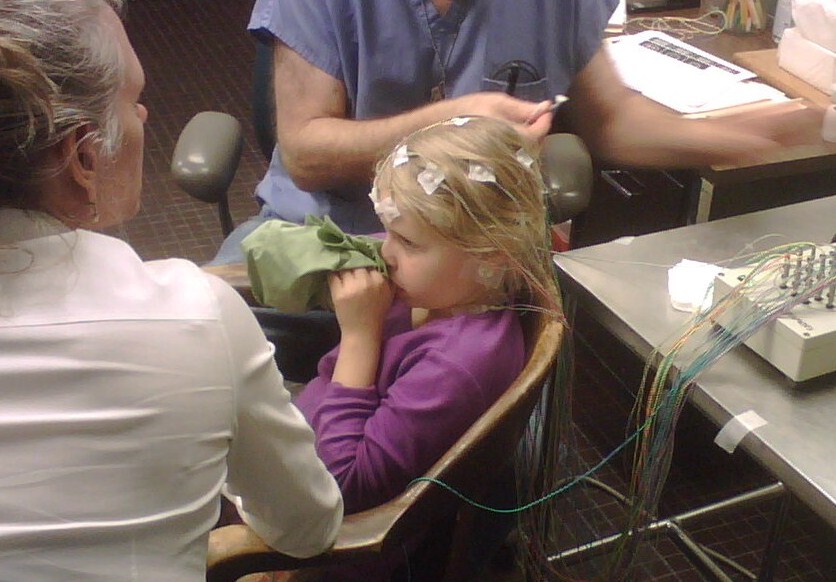
(I show her this photograph)

Me:  What about this?  What’s going on in this photograph?

Em:  Dr. Halper.

Me:  What’s he doing?

Em:  Just Toni Karlsrud.

Me:  Is that Dr. Karlsrud?

Em:  Nooooo!  (Laughing) Dr. Halper.

A:  What’s happenig to you?

Em:  (Touching photograph.)  Goes beep, beep, beep, beep.

A:  You’re having a QEEG done.  It measures your brain waves.

(Emma gets up and walks away.)

A:  Emmy!  Come back!

Em:  Where are you going?

A:  Emmy!  Come back!

(I follow her into the other room where Richard is.)

A:  Hey Em, do you know why you’re having a QEEG done?

Em:  Now goes beep, beep, beep…  (while she says this she is touching various points on her head where the electrodes are placed.)  beep, beep, beep, beep… (she touches her arm) beep.

A:  They don’t put one on your arm!

Em:  (Laughs) Beep!

A:  Do you know why this is being done to you?

Em:  Beep, beep, beep, beep.

A:  It’s looking at your brain.  It measures your brain waves.

Em:  Beep, beep.

A:  Do you like going to see Dr. Halper and having a QEEG?

Em:  Yeah!

A:  Should we go pick out what you’re going to wear today?

Em:  Yeah, sit for one more minute.

A:  Okay.

Tests

We took Emma and Nic to a center specializing in hearing tests.  The tests for Emma came back negative for hearing loss, though the center did recommend hearing therapy for Nic.  Nic was sensitive to loud high pitched noises, like the fire truck’s sirens from the fire house across the street from where we lived.   He would run away from the sound covering his ears and crying.  Emma didn’t seem bothered by noise, in fact, Emma seemed to enjoy noisy situations, loved parties, the more, the merrier, it seemed.  Up until we received the results from the hearing tests I convinced myself this was the crux of the problem.  I remember telling my mother about a book I’d read regarding hearing loss and how it can lead to a variety of behavioral problems.  Surely this was what ailed Emma.

When the hearing tests came back negative, I had to modify my thinking.  Okay so her hearing was fine, this was good news, right?    It didn’t feel like good news.

We set up an evaluation through Visiting Nurse Service of New York.  VSNY is a not-for-profit organization providing health care in New York City.   There were pages of paperwork to be filled out prior to the evaluation.

Some of the questions were:

Does your child look at or turn to sounds?

YES!

Does your child respond to favorite people, making happy sounds or smiling?

YES!  She’s very happy with a jubilant, infectious laugh.

Does your child imitate you when playing a game, such as peek-a-boo?

YES! Another bull’s eye.  Maybe things were going to be fine after all.

Does your child engage in “make-believe”, such as playing with a doll or truck or playing house?

Okay, no, but she’s not interested in dolls, she’s more of a tom-boy.  She likes to run around and be outside.

Does your child indicate when she wants something?

Well no, but Emma never seems to want anything – so it’s not applicable – right?

Does your child interact with peers?

No.

Does your child use one or more words to ask for what he/she wants?

She did… sometimes, okay, not often.  She said “chase me” when she was about 16 months old, but as her language regressed, “chase me” went the way of all the other phrases – into the great abyss.

Does your child look up when you call to him/her?

Well, no.

And so it went.  Each question – like a nail being pounded into a plank – shutting out the possibility she was going through some sort of freakish delay which would right itself if left alone and not questioned.

For more information on Visiting Nurse Service go to:  www.vnsny.org

For more information on Emma’s evaluation see earlier posts:  The Beginning  and Hug Witness.

Emma At Ten Months Old

I sat in the pediatrician’s office with Emma squirming on my lap.  “She’s not really talking.  I mean she says words grouped together, but not single words.”

“Like what?” the pediatrician asked.

“Ba-bye, Da-da, Ah-done… things like that.”

“Smart kid,” the pediatrician said, checking Emma’s reflexes.

“So there’s nothing to worry about?” I asked.

“She looks great,” the pediatrician laughed, as Emma scooted across the room one leg jutted out in a crab-like crawl.

Thirteen Months

“So I shouldn’t worry, right?” I asked the young master’s degree student, studying speech therapy, who was Nic’s ‘teacher’ at his pre-school.

She nodded, “Some kids, especially the ones who are more athletic often have delayed speech.”  She looked at me with a smile.  “And her brother is pretty precocious, sometimes their younger siblings are slow to speak.  I’m sure it’ll come in time.”

I was turning into one of those neurotic New York moms.  It was classic.  I needed to stop worrying, Emma was fine, I told myself as Nic and I walked home from his pre-school.

Twenty-two Months

“Do you think she might have a hearing problem?” I asked my girl friend.

“But she looked up when that siren went by,” she reasoned.

“Yeah, I know,” I said, watching Emma push an empty swing.  “Watch this.  Hey Emma!” I called out.

No response.

Louder, “Hey Emma!”

Nothing.

Now shouting, “Emma!  Emma!  Look at Mommy!”

But Emma continued to play with the empty swing.

“Okay, but half the time my kids don’t look at me when I call them either.  Kids do that,” my friend said.  “Don’t they?”  She looked at me with half a smile.   “Anyway who wouldn’t be mesmerized by that swing?” she added, putting her arm around me and giving me a squeeze.

Thrity-One Months

“When was the last time you heard Emma say, Chase me?” Richard asked.

I thought for a few seconds.  “When was the last time you heard Emma say anything?” I asked in answer.

This was the conversation that poked the final hole in my bubble of denial.   It was August and we had rented a house in Cape Cod.   I remember standing in the living room, looking outside, watching the children.  Nic and Emma were on the porch in their ‘swimming pool’ a make-shift plastic tub we’d filled with water.

The mask I had so meticulously constructed for myself and my family fell away revealing something I couldn’t identify and could not understand.  I remember telling myself to breathe through the rising panic that threatened to consume me.   And then I remember feeling the feeling that I would feel many times in the ensuing years.  Failure.  Something was terribly wrong with my child and I had failed to see it, failed to do something about it.

As often happens when I feel overwhelmed, I began to make a mental list of actions I would take the instant we returned to New York.    The first two items on my list were:  get a hearing test done and get an evaluation.

Playing Me

Emma is extremely agile and very athletic.  We had the following conversation while she was navigating her way along the top of our couch in the living room.  She has very good balance.

Emma:  (Pretending to lose her balance) Uh – oh!  If you fall down, you have to go see Dr. Karlsrud!  Toni!  Toni Karlsrud.

Me:  Toni?  My sister Toni?  Are you thinking of my sister?

Emma:  Toni comes, Dr. Toni Karlsrud.

Me:  Not Toni Karlsrud, just Dr. Karlsrud.

Emma (Laughing): Dr. Just Karlsrud.

Me:  Emma!  No not Dr. Just Karlsrud, her name is Dr. Karlsrud.

Emma:  Just Karlsrud!  You have to get down!

Me:  Emmy, you know what her name is.  (Pause) What’s her name?

Emma:  Dr. Toni Just Karlsrud.

Me (Looking over at Richard):  I know she knows her name.

Richard:  I think she’s playing you.

Me: Really?

Richard (Laughing): Yeah.

Emma:  You have to be careful.  Uh… uh… don’t fall!  (She pretends to teeter.)

Me:  Hey Em!  What’s your doctor’s name?

Emma:  (Laughing) Dr. Just Karlsrud.

This morning while waiting for the bus, Emma was walking along the top of the little metal fence surrounding the tree in the front of our building, something she often does and has never fallen down from.

Emma:  Be careful.  You fall down, you have to go see Dr. Karlsrud!

Me:  Oh now she knows her name.

Richard:  Told you she was playing you.

Nic (Laughing):  Totally!

Me (Shaking my head):  Wow.  She’s good.

Talent Show

I was listening to Emma and Lee singing ‘Que Sera, Sera’ after Ariane posted it and was moved to tears as I always am when I hear how heartbreakingly pure and sincere her voice is. It is so sweet that I can’t think of any word to describe it other than angelic.

I first played her ‘Que Sera Sera’ on You Tube about two years ago after hearing a slow and somewhat melancholy version of the song in a Francis Ford Coppola film. I’ve always loved this song, even in the brighter Doris Day version, which Emma prefers, though the way she sings it brings out the poignancy of the lyrics and melody in a way Doris could never even dream of.

Emma has near-perfect pitch and a set of lungs an opera diva would envy. But so much more powerful and affecting than those qualities is the sheer sweetness of her voice, like everything that was good and kind and happy and wonderful in the world was distilled in a golden elixir that pours out whenever she sings that song.

Most of the time, her singing is loud and raucous, though no less heartfelt and touching in its own way, at least to my ears. Emma loves to perform, though there isn’t any trace of ego in her desire to strut her stuff. I guess that’s part of her condition to some extent, a reduced sense of self.

Last night before bedtime she said, “Talent show?” very loudly while I was playing chess with Nic.

“Sure Emma, we’d love a talent show,” I replied, smiling at Nic who smiled back with a “here we go again” sigh and headshake that seemed to sum up all his conflicting feelings – amusement, love, frustration, exhaustion, mild embarrassment. There was no one else in the house, so I’m not sure he felt any embarrassment, other than perhaps a conditioned response to similar, more public displays.

Myself, I was very much looking forward to the show, which turned out to be a medley of Carole King songs for children, culminating in ‘Chicken Soup with Rice’, which she belted out like a Broadway veteran. She always goes for the big finish and this particular song jumps up an octave or two at the end. She totally nailed it. Nic and I laughed and I applauded as loudly as she sang.

People often ask me whether Emma has any special talents. When anyone asks a question like that I figure they’ve been watching “Rain Man” and want to know if she has any savant abilities. I usually say that those types of abilities are associated with what has traditionally been called Asperger’s Syndrome – though I recently read that the medical community wants to abolish that term and use ‘Autistic Spectrum Disorder’ for everyone.

After that disclaimer, I will typically add that she does have an incredible memory and will mention things that happened to her when she was two or three years old. She can also remember very specific catalogues of objects, particularly photos. She really likes photos and home movies – I think they help her talk about and identify people, things and activities she enjoys. She has a shoe box with 100 or more photos inside and she will know instantly if one is missing, setting off a frantic household hunt for the lost picture in order to stave off a total meltdown or some self-injurious behavior, like biting her arm as hard as she can.

She is also extremely advanced in a wide variety of physical activities: skiing, climbing, balancing, jumping, swimming.
And of course, she loves to sing and dance.

There was an award-winning documentary that came out a while back called ‘Autism: The Musical’. It was a very inspiring movie and we thought this might be something Emma would enjoy given her showbiz leanings. When they started a program called ‘The Miracle Project’, based on this concept at her special ed school, we enrolled her and are very excited to see what might come out of it.

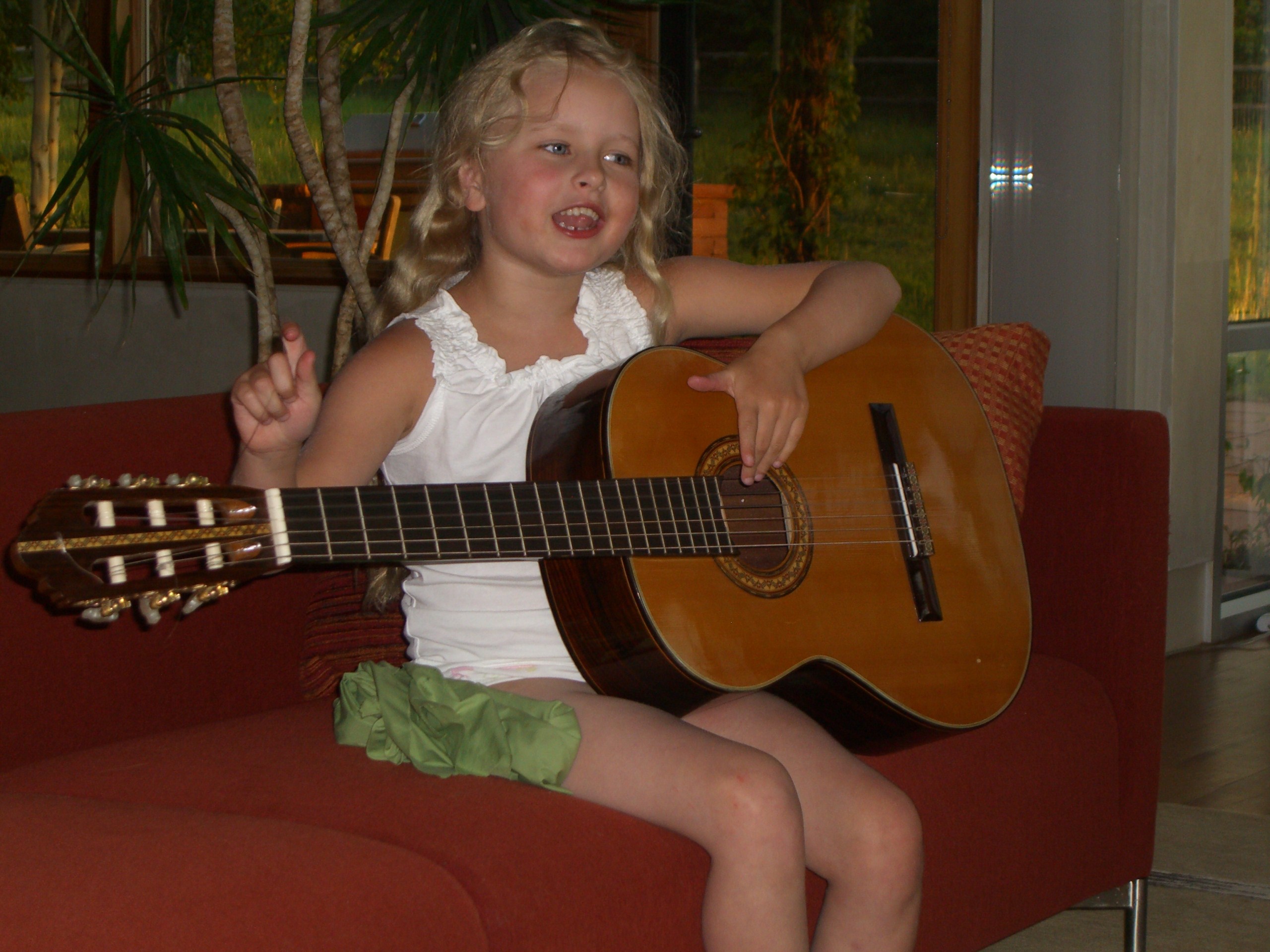
Every year at her school they have a talent show and every year, Emma has been the star of the show, soloing in ‘A Spoonful of Sugar’ from Mary Poppins in her debut performance.  Since then she has referred to any of her singing performances as a talent show, which I love. I bought her a number of karaoke video games with microphones but she has been much more enthusiastic about singing along from memory to a DVD or You Tube clip. She has quite an impressive set list for her concerts now, which routinely take place at birthday parties or dinner parties (which are also birthday parties as far as she’s concerned), or whenever the mood strikes her. An audience of one or two is enough, though like most performers she likes to play a full house.

I’ve always thought that she’s a total rock star and someday she’ll be cranking it up on a big stage – leaving our ‘dinner theater’ circuit far behind. Time will tell. For now, I revel in her impromptu serenades and every time she says, “Talent Show?!” my heart skips a beat in happy anticipation.

Emma Singing

Emma loves to sing.  When she was an infant I realized she responded much better to words if they were sung to her.  So I did or tried to sing as much as I could, even though my voice is weak, Emma didn’t seem to mind.  Emma, however has a lovely voice.

The following is an audio clip of Emma singing with Alycea – our assisant – Que Sera, Sera.

Emma Singing