Category Archives: Parenting

Spitting

As I put Emma on the bus this morning, the bus matron said, “No spitting today!”
“Has she spit?” I asked.
“Yes! Yesterday, the whole ride she was spitting,” both the driver and matron confirmed.
“Emma,” I said standing in the stairwell of the bus, “you may NOT spit. Do you understand?”
“Okay,” Emma said softly.
“If she spits again, let me know right away,” I told the driver. “And if you’re right near her when she spits, put your hand up in a halt position, like this,” I said demonstrating, “Then say, “No! No spitting!” in a stern, but calm voice.
“Alright,” the matron said. “Thank you so much.”
As I went into our building I wondered if I would be receiving a phone call in the next 15 minutes. Sure enough, 10 minutes later my phone rang.
“She just spit at the driver,” the matron announced. “Here, she can hear you.”
“Emma! This is NOT okay. You cannot spit. Do you understand me?”
“Okay,” Emma whispered.
I hung up the phone and sat down. Emma has been doing exceptionally well at home. She is sleeping in her own bed, going to the bathroom in the middle of the night when she needs to, going back to her own bed. In addition she does not take her blanket out of her room, carefully puts it in her “Cokie Pouch” before leaving her room, doesn’t suck her thumb outside her bedroom and the few times she has, immediately stopped when reminded.
That she continues to test the waters outside of our home is something that isn’t altogether surprising. The problem is coming up with solutions to ensure she not continue unacceptable behaviors outside our home.
“You know if we tell her she can’t have a cupcake when she gets home, she’ll stop,” Richard said to me when I discussed the bus episode with him.
“Yeah, I know. I think that’s what we’re going to have to do,” I said.
“Do You Think She’s Okay?”

This morning I woke as usual at 6:25AM. Merlin, whose internal clock tells him it’s time for loud purring and affection typically paws at my nose somewhere between 5:00 & 5:30. I have always viewed my nose as “distinctive” however to Merlin it apparently resembles a mouse. By 6:40 I was out of the shower and by 6:45 in the kitchen, which was curiously dark and empty. Richard was in Nic’s room waking him, I could hear their voices speaking softly to one another, Merlin mewed at me, demanding to have a treat and Emma’s bedroom door remained firmly closed.
“Do you think she’s okay?” I asked Richard when he reappeared.
“Has this ever happened before?” Richard asked in answer.
“No.”
“Maybe she wants to spend some down time with Cokie,” Richard said, though he sounded unconvinced.
“You think?”
“I don’t know.”
“I’m getting worried.”
“Well what do you think could have happened?” Richard asked.
“I don’t know. She fell out of bed in the middle of the night, knocked herself unconscious or…”
“God, I thought I was the only one who had those kinds of morbid thoughts,” Richard said.
“Think I should go in and look?” I looked over at him. “I don’t want to wake her if she really is just sleeping. Maybe I should give her another ten minutes? Or I could just go in and peek, very quietly. But maybe it’s better to let her sleep…”
Richard, all too familiar with this kind of answer where I am essentially playing both sides of the net, nodded and wandered off.
Nic appeared wearing a short sleeved t-shirt, a shirt he loves and would wear to bed if allowed.
“Nic – it’s not even 40 degrees outside.”
“Yeah, but it’s really hot at school.”
“Please change your shirt.”
Nic returned wearing a long sleeved shirt, the short-sleeved shirt poking out from underneath the bottom. The whole outfit had a kind of disheveled, rumpled chic to it. Definitely not okay for school, however, even though it was “Casual Friday”. “What?” he asked, when he saw the look on my face.
“You’re kidding, right?” I asked him.
As Nic turned to go, muttering under his breath, Emma shot into the study on her scooter.
“Hey! Good morning Em!”
“Good job waiting ‘til it’s light out!” she said.
“You’re not kidding!”
Emma has never slept later than the rest of us, other than a couple of times at her Granma’s house in Colorado and then only after a full week of skiing all day, every day. It has never happened in New York. The wonders do not cease…

On The Right Track

This morning Emma’s scooter could be heard shooshing through the hallway toward our bedroom. “Hi Mommy!” she said as cheerful as ever, despite the fact it was 4:20AM. I groaned inwardly but managed to meet her cheerfulness with a somewhat less convincing, “Hi Em.” I looked over at her, “It’s too early. You have to go back to your bed.”
Without missing a beat she made a u-turn on her scooter and could be heard to say as she retreated, “You have to go back to sleep now. You have to wait til it’s light out. Then you can see Mommy!”
I literally held my breath, waiting for the screams to shatter the early morning quiet. “Do you think this will really work?” I asked Richard who appeared unconscious.
“Yeah,” he muttered, not moving a muscle.
I watched him for a few seconds for any sign of movement, any sign, which could be taken as encouragement for more conversation. When none came I stared at the ceiling marveling at the silence. Was it really possible? Could it be that she had returned to her room and was lying in her own bed quietly waiting for it to be “light out”? It seemed impossible. This was the last thought I had before surrendering to a fitful sleep. Every 20 minutes or so I woke up, listening for the cries, which never came.
At 6:30AM I rose. As I went into Nic’s room to wake him, I peered around the corner into Emma’s room. It was still quite dark so I didn’t trust what I was seeing at first. There she was, sound asleep in her own bed. I was astonished. So much so that I stood there for several seconds. By the time I’d woken Nic, turned on the lights in the kitchen and dining room, Emma shot out of her room on her scooter looking groggy, but pleased with herself. “Now you can see Mommy! Good job waiting til it’s light out,” she said, congratulating herself.
“That was really terrific Em,” I told her. “Not only did you go back to your own bed without crying, you went back to sleep!” I knelt down to give her a hug. She wriggled away from me, but I caught the smile on her face. “I’m proud of you, Em.”
This is the FIRST time Emma has gone back to bed without –
a) insisting one of us accompany her,
b) screaming when one of us dared not accompany her
c) coming back to our bedroom repeatedly.
“Did you notice she didn’t have Cokie with her when she came into our bedroom?”
“I didn’t think you were even awake, let alone noticing things,” I said.
“Of course I was awake.”
“She’s never done this before. It’s really incredible!”
“We’re on the right track,” Richard said.

Emma Painting – Some Additional Thoughts

What struck me as I watched Emma paint the other day was how she has placing the colors on the paper.  She was not simply dipping her brush into the paint as it was placed on her palette.  She was looking at the colors then very methodically placing them on the paper in a specific way.  In the beginning with a slash of color near the middle of the paper, she then added another slash nearby.  As I watched she continued with a streak of color on one side fanning out from the middle.  She did not simply alternate colors – first one side then the other, but seemed to consider where the next color would go.   None of this was done in a perseverative way.  What struck me was how non-perseverative the process was.  She seemed to study her choices of both color and their placement before putting brush to paper.

This morning I said, “Hey Em!  Want to paint?”

“No thank you,” she said as she shot by me on her scooter.

“Hey Nic!  Want to paint something?” I asked.

“No. I’m good, Mom,” came his reply.

Autism – Questions

How much does my child really understand?  What is she thinking?  What is it like to live in her body?  What sounds does she hear?  Does she know what she wants to say, but somewhere in between the thought and the attempt to verbalize it, the meaning becomes lost?  Does she believe she is saying something, only to have us respond with bewilderment?  What does she see?  What does she feel?

Many autistic children through various communication devices have allowed us to see and hear what they are thinking and feeling.  What they are able to tell us is both heartbreaking as well as miraculous.  Heartbreaking because they are aware of so much more than they appear, they know they are different, they know so much more than they are able to communicate, have complicated, busy inner lives, know anxiety, stress, depression, joy, boredom.

When Emma first spoke she said, Da-da, ah-done, and a series of other words and phrases typical of a baby learning to speak.  There was little to give us concern.  What was unusual was the language acquired did not serve as building blocks upon which more language was added.  At the age of 18 months Emma said – Chase me – we heard her say that for a few months, then it disappeared, never to be heard again.  There were many words acquired then seemingly forgotten.

In the field of autism, this is referred to as regressive autism.  Typically a child follows a neuro-typical child’s development, but at around 15 – 30 months begins to regress.  However we continue to see our eight-year old Emma “learn” things, only to forget them later.  Emma’s progress is not the steady progress one sees with neuro-typical children.  Hers is more of a hic-cup.  She paints with her brother, we document it, take photographs, exult in what amazing progress this means, only to have her never repeat the action.  Countless times my husband and I have recounted to one another something Emma has said or done only to see it never repeated.  The idea of a base of knowledge being constructed, the logical progression of a skill acquired, leading to another and another has not been Emma’s path.  We are teased into believing something has been learned only to see our expectation and hope thwarted.  We are left waiting.  Yet some other action will then occur – wholly unexpected – to raise our hopes anew.

Once when Emma was about three I took her to the dentist where it was found she had one tooth more on the bottom than is usual and one less than the norm on the top.

“Is this unusual?” I asked the dentist.

“Why shouldn’t it be?  Everything else about her is,” the dentist smiled.

I think of Emma’s progress and often despair.  Yet why should her progress follow the same path as a neuro-typical child’s?   Emma leap frogs where other children slowly, methodically climb.  Emma shows tremendous bursts of cognition followed by lethargy and meltdowns.  This is Emma’s way.  Hers is not the path of other children.  But it is a path, nevertheless.  One I feel privileged to accompany her on.

Kisses

It was 1:48AM when Emma appeared at the side of the bed this morning.  Ever cheerful she said, “You have to ask Mommy.  Mommy?  Can I come get you in the other room?”

“But Emmy, it’s the middle of the night.”

“Good job asking Mommy!” Emma said brightly.  Then in a more subdued tone she said, “You have to wait til it’s light out.  Is it light out?  Yes!”

“Em, it’s not light out.  Look.  It’s dark.  It’s pitch black,” I said grumpily.  “You have to go back to your room and go to sleep.”

I felt Emma’s face near mine, her breath on my cheek as she bent down and kissed me.  “Kiss Mama,” she whispered.

“Ah, Emmy.  Thank you.  Come on.  Go pee and then you have to go back to your bed,” I said holding her body close to mine.

“You have to go pee,” Emma said as she ran off to the toilet.  As we made our way back to her bedroom she said, “You didn’t wake Nic.  You have to ask Mommy!”

“That’s right Em.  You didn’t wake Nic.  Thank you.  He needs to sleep.”  I held her hand as we walked toward her bedroom.

She hopped into bed, “Mommy!  Can I get you in the other room?”

“No, Em.  You have to go back to sleep in your own bed.  Remember?  You have to try to sleep now.”

Wide-awake and fully alert Emma sat up in bed.  “Mommy?  Mommy?”

“Yes Em?”

Emma leaned over and gave me another kiss.   “Emma kiss Mommy,” she said, proudly.

“Emmy, that is so nice.  I love when you give me kisses,” I stroked her head.  “Now come on, let’s lie down.”

“Mommy stay with Emma?” she asked wriggling down under the duvet.

“Yes, I’ll stay with you for a little while, but you have to go back to sleep.”

“The flushing carousel is closed,” Emma said sadly.  “The horses are sleeping.  Shhhh, you cannot go there.  You have to wait.”

“Are the horses sleeping, Em?”

“Yes.  The horses are sleeping now.  It’s broken,” she said.  Then she leaned over and kissed me again.  “Kiss Mommy.”

An hour and a half later and after many more kisses, Emma finally fell back to sleep, one leg draped over mine, an arm wrapped around my body, her face so close to mine I could feel every exhalation on my face.  As I lay there with her, I remembered how as a baby Emma was so uncomfortable with human touch.  It was as though it was physically painful for her to have skin-to-skin contact.  Now, Emma seeks out what once repelled her.

I read once years ago of a doctor who theorized all children, no matter their cognitive issues had to develop through a specific set of behaviors or would suffer the consequences later on.  For example if the child didn’t crawl, it would show in their development in other unexpected ways, learning disabilities, fine motor issues, etc.  He hypothesized the reverse was therefore true as well.  If a child no matter how delayed, was encouraged to go through a missed stage or came to it on their own, the child would show signs of positive cognitive development elsewhere.

Hope.  One must always hope.

Trick or Treat?

Halloween, wildly anticipated by our son Nic, was an occasion for dress up followed by cake for Emma.  “Have Halloween party and cupcake?” Emma asked yesterday afternoon.

“We aren’t having a party, but we will go out trick or treating and we can get you a cupcake while we’re out,” I said, knowing Emma wouldn’t care about the candy she acquired while trick or treating.

“Get cupcake?  Have cupcake now?” Emma said.

“In a little while, Emma.”

“Go trick or treating,” Emma said with a bit less enthusiasm.

For Emma it was all about the cupcake.  The cupcake, which would give her the opportunity to sing – Happy Birthday, regardless of the fact no one was celebrating a birthday.  Cupcakes = Birthdays = singing = joy, pure and simple.

Emma insisted on wearing her one-and-a-half-inch heeled, pointy-toed witch’s shoes, her black witch’s hat and completed the entire outfit by carrying a black broom.  “Mommy carry candy bag?”  Emma asked when we got outside.

“No Em.  This is for you.  You have to hold the bag and when we get to the first house you open the bag and say – Trick or Treat!” I coached.  We went through the same routine last year and the year before that.

“Trick or treat!” Emma repeated happily while Nic rolled his eyes.

“Mom, she doesn’t even care about the candy,” Nic said in a tone of resigned disbelief.

“I know Nic,” I said.

As we made our way out to join the quickly gathering crowds in Chelsea, Emma ran ahead.  Her head down, witch’s hat with its purple band jutting upward, her little heels clicking as she went.  “Em!  Em!  Wait!” One of us would periodically yell.

It was cold last night.  But Emma seemed impervious to the chill.  She accompanied us for the 20 blocks we roamed, up and down, back and forth, without complaint.  We stopped along the way to buy her a cupcake, where one of the customers standing in line upon seeing us, was heard to say, “This is what I love about New York City – the people have such commitment!”

We attempted to teach Emma to say Trick or Treat and either take a piece of candy from the bowl being offered or open her bag so that the offerings could be dropped inside.  She never really got either action down and by the end of the night I stopped trying to coach her.  She was content to walk along with us, watching Nic dart in and out, filling his bag.

Nicky!  Nicky L!” Emma occasionally shouted when she lost sight of him.  By the time we returned home, Emma struggled out of her witch’s costume, replacing it with one of her many princess dresses, where upon she dug into her cupcake with relish.

“Yum, yum!”  Emma said, smiling broadly, her face covered in icing.

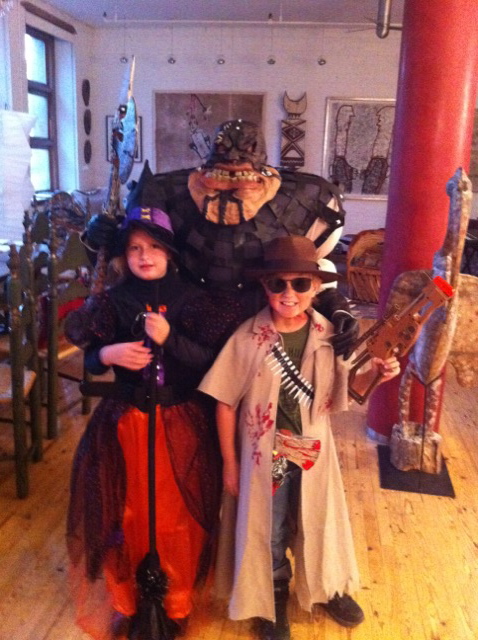
Halloween 2010 – Emma, Richard & Nic

Flash Cards

“Four, three, two, one,” Emma said, in answer to my request she brush her teeth in preparation for bedtime last night.

This was different than the “one more minute” response we have become accustomed to.

“Don’t you make me come get you,” Emma said in her cheerfully mischievous voice.

After the teeth brushing routine – a compilation of various techniques and quirks from all of us:  flossing first – Richard’s contribution, brushing front and inside gums first, then teeth – mine, ending with brushing the tongue – Joe’s, concluding with a mouthful of fluoride, swish, swish and then spit – Emma’s dentist.  Nightgown donned, Emma raced around the house on her scooter, until I interrupted her with, “Let’s do some work, Em!”

Emma ran over to the couch where I prepared her flash cards.  These were sent home to her last week and have twenty or more sight words written in black marker on pink index cards.  Words such as “huff”, “puff”, “blow”, “straw”, “stick”, “brick”, “pig”, “house”, “down”, words taken from The Three Little Pigs, which is being studied in Emma’s class.  A week ago I laid out three random cards and said, “Emma, pick out the word, “pig”.  Immediately she picked up the index card with the word “pig” on it.  I continued to go through all of the index cards, with no hesitation on Emma’s part.  Her accuracy was close to 100%.  I then increased the number of cards displayed to four, then five, then six.  By six, Emma was making more mistakes, seemed distracted and so I reduced the field back to five.  Challenging for Emma, but still extremely accurate if she could be convinced to take the time to look and not stare out the window while idly jabbing her finger in the general direction of the table.

“Take your time, Em,” I encouraged.  “Look at the word.  Which one is the word “blow”? I asked.

Emma leaned over and blew the index card with the word “blow” written on it.  Then she looked at me and laughed.

I pointed to the card with “house”.  “What does that say?” I asked.

Emma stared at the cards lying on the table and sucked her thumb.  She looked away, staring out the window.

“Hey Em.  What does that say?” I asked again.

No response.

“Can you pick up the card that says, “house”? I asked.

Immediately Emma reached over and chose the correct card.

As with so many things regarding Emma, one is left with a feeling of bewilderment, curiosity mixed with wonder.  Emma, who still cannot articulate the words in the song “Twinkle, Twinkle, Little Star”, will chose the word “brick” when asked to.  Emma who appears uninterested in any stories remotely age appropriate, who continues to struggle and squirm when asked to attend to any one thing for more than ten minutes will sit singing song after song for hours.  She will look at her pile of over one hundred photographs and knows, almost instantly when one is missing.  Emma, whose memory for events and people in her life continues to astound us and yet is not able to identify the number one when asked to.

This is Emma.

The Shower

This morning I told Emma she had to take a shower and wash her hair.

“One more minute,” came the response.  This is the standard response to almost everything asked of her.

“Okay.  One more minute,” I said.

“Don’t you make me come get you,” Emma said with a sly grin, the pronoun confusion in full swing.

“Oh I’m going to come get you!  I’m going to come get you right now!” I said, pulling her legs as she shrieked with laughter and flailed about.

Once in the bathroom, Emma turned on the shower, undressed and stepped in.  “Ewwww!  Too cold!  You have to wait,” she said as she retreated to the safety of the room.  Tentatively she put her hand in to test the water.  “Nice and warm,” she announced before stepping into the shower.

“Okay, Em.  Remember you have to take the shampoo bottle and open the top.”  As I spoke, reminding her of what the steps were, she did as I said.  She put shampoo on her head and stood still.  “You have to rub the shampoo in.  Remember?   You have to wash your hair,” I reminded her.

“You have to wash your hair,” Emma repeated.

With a little help, Emma managed to wash her hair.

“Towel!  I need a towel!” Emma said, using the correct pronoun.

“Here you are!” I said, offering her a washcloth, which she held over her eyes.  “You need to rinse your hair, Em.  You have to get all the soap out.”

“You need to rinse,” Emma repeated.

I then walked her through washing her body with soap, naming each body part, reminding her she needed to rinse the soap off.  A few weeks ago I received a phone call in the middle of our shower routine and when I returned Emma was standing in the shower covered with soap.  When she saw me she turned the water off and said, “Shower all done!”

“No Em!  You need to rinse the soap off,” to which she took the bar of soap and put it under the water spray – washing it off.  “Your body, Em.  You need to rinse the soap off of your body,” I corrected myself.

Once out of the shower, unless reminded Emma will simply get dressed or more likely, run to our bed where she will snuggle under the sheets, soaking wet.  “You have to dry off, Em.  Remember?”

Again I name all her body parts.   Upon hearing them, she dutifully dries each part and then runs to our bed, laughing.

“Emma washed your hair,” Emma announced when I joined her in our bedroom.

“Yes, Em.  You did a terrific job washing your hair,” I answered.

“Emma wash your hair again?” Emma said with a grin.  Without waiting for an answer she shouted, “No!  You cannot wash your hair again.  You already took a shower!”

This is Emma’s idea of hilarity.  And it is pretty funny watching her scream with laughter at the very idea of going back into the shower.

That’s our Emma.

A Balanced View

When writing about Emma I am often struck by how other people view what we write.   “She sounds just like my four year old,” is something I have heard more than once.   We walk a fine line of not wanting to exaggerate the tiny steps of progress she makes, with the desire to write honestly about her life as we witness and interact with it.

For example if I write of how Emma is now sleeping through the night, only very occasionally wetting her bed, hasn’t worn a diaper since June 9th, 2010, is verbally more precocious, is displaying wonderful eye contact more and more frequently, seems to understand more, has an increased interest in being read to, tolerates more situations with increasing ease, it sounds almost miraculous.  And in many ways it is.

If I then give a detailed description of a day spent with her – such as yesterday when we went not only to the Bronx zoo, but to a nearby playground afterward – describe how she never once acknowledged the hundreds of children around her, much less exchanged eye contact or words, all the while carrying a two foot long stick which she refused to release even when on the monkey bars, her utterances, her overall deficiencies appear glaring.  If I insist then on adding how she attempted to sit opposite us on the subway, made odd whooping noises and whenever the doors to the subway closed with the accompanying ding-dong sound, Emma cheerfully sang, “Gank – You!” replicating the exact tone of the warning sound indicating all passengers needed to get inside the subway before it left the station, one is left with a very different sense of who she is.  Yet both would be accurate and correct.

A balanced view is the goal of this blog.  Neither an exaggerated version of her abilities nor deficits is what we endeavor.  The trouble is, it isn’t always easy.  Given a mood, a less than ideal night with too little sleep, work stresses, marital stresses, all effect how Emma comes across on paper.  There’s no way to really portray her with all her idiosyncrasies without it seeming somehow off.  I read past posts and barely recognize her or us, for that matter.  The edges are smoothed the disagreements remain just that and not the melodramas they can feel to those intimately involved.  Perhaps it is a positive thing.  In the end we are the stories we tell, we become the edited versions we choose or in this case we choose to tell for Emma.  Who knows what she would say, were she able to.  Perhaps one day she will be able to do so and will choose to.  My guess is it will be a very different story than the one we are telling.

Books

When Emma was very young, she barely tolerated being read to.  Unlike her older neuro-typical brother, Nic, who requested certain favorites over and over again, only to be delighted when a new book was presented, Emma would take hold of a select few and flip rapidly through the pages.  It became apparent her interest was less about the book and more about the action of holding it and turning its pages.  During those early years, before we were given her diagnosis I remained baffled by her behavior.
We are a reading family.  Our home is filled with books on a wide variety of topics, fiction, non-fiction, poetry, memoirs, biography, it’s all there.  When Nic was born I looked forward to introducing him to the books, which captured my attention and imagination when I was a child.  We read to Nic every night and often still do.

When Emma was born, out came the now tattered edition of The Hungry Caterpillar, Brown Bear, Brown Bear, What do you see? Good Night Moon, its spine broken, held together with tape and hundreds of others.  But Emma would squirm in my lap, push the book away, whimper and struggle until eventually I let her go.  I was tenacious though and regularly took the children to Books of Wonder, the local bookstore where Nic promptly sat on the floor amidst a growing pile of books.

“Can I have this one?” he asked.  “And this one?”

Emma went to the bookshelves, scanned them and upon seeing a book she was familiar with would pull it down.  I don’t remember her ever pulling down a book we didn’t already own until she began going to preschool.  Then we would purchase one or maybe two books she knew from school and she would flip through the pages like some sort of speed-reader.  It was the same when she looked at photographs.  Not really seeing them, there was no studying the photo or in the case of a book, the illustration.  She methodically turned each page, seemingly without seeing.

Over the years Emma has shown a greater tolerance for the books we continue to try and entice her with.  She has learned to sit patiently with me while I read to her.  Sometimes she appears to even enjoy it.  When she likes a book after I have finished reading it to her, she will grab the book from me and say, “Emma’s turn!”

Over the past six months I’ve noticed Emma is much more curious about the books I proffer.  Now at night I typically choose one book Emma knows and has requested, at the moment her two favorites are Olivia Forms a Band and The Three Little Rigs, and several she’s never seen or expressed any desire in sitting through.  Within the past month I have read, The Cat in the Hat, McElligot’s Pool, Dr. Seuss’s Sleep Book, If I Ran The Zoo, Olivia Saves the Circus, Olivia and the Missing Toy, The Giving Tree, the list goes on.

When I was pregnant with Emma, I fantasized I would read to her and Nic at night the books I remember being read to by my mother.  Every Sunday night my father would take my brothers to the living room where he would read King Arthur and the Knights of the Round Table, The Hobbit, among others.  My fathers’ booming voice would make its way down the hallway into my parent’s room where my sister and I were lying on either side of my mother.  We would roll our eyes at each other and occasionally my sister would request that she be allowed to sit with our brothers and listen to whatever my father was reading.  Meanwhile my mother read:  Mary Poppins, Winnie the Pooh, and later books such as My Family and Other Animals.  I can still remember my heartbreak when a book came to a close. A few times I even cried when a book came to its conclusion because I could not stand it had come to an end.

That Emma is showing pleasure in being read to, fills me with joy.

Just one more small step forward…

My Emma

A mother with her little girl, about Emma’s age stand patiently in line for the bathroom on our flight to Denver.  Methodically her mother braids her daughter’s long, blonde hair, then places her arms around the child’s upper body.  Her daughter puts her own hands on top of her mother’s, tilts her head up and smiles at her mother.

I marvel at how such a simple gesture, probably gone unnoticed by either of them, is utterly foreign to me.  I long for such a simple exchange with Emma.  I get them, but they are rare.  When they do come, seemingly out of nowhere, I am usually caught off guard and brought to tears, tears of relief and joy and something else, something closer to grief.

I think of Emma, standing in a similar line, on this same airplane route flying from New York’s La Guardia to Denver several years ago.

“Potty?” Emma says, anxiety rising in her voice.

“Yes, we have to wait in line,” I say.

“Potty?!” Emma says again, her voice slightly louder, the anxiety has crept up a notch.

I count the number of people in front of us, there are four, but one’s a couple so maybe they don’t both have to go, perhaps they’re just keeping each other company I reason.  Five minutes, tops, I think.

“We have to wait,” I say again, grim determination steeling into my tone.  I take a breath when another person vacates the only bathroom, reducing our line to three.  I look behind me at the two bathrooms at the back of the plane, the line snakes up the aisle, at least half a dozen are waiting.

“Have to use the potty,” Emma says now close to tears.

The woman in front of us turns to look at the whining child, my child.  “She can go ahead of us,” she says kindly.

“No she can’t,” her husband, counters.

“Scott!  Of course she can.  Go on, go ahead of us,” she glares at her husband who is shaking his head in annoyance.

Grateful, I thank them, ignore the husband’s irritated glare and go to the head of the line, pulling Emma ahead of me.   Anxiety, stress – will she wet her pants?  Did I bring enough pairs of underwear and a full change of clothing if she does  Embarrassment, humiliation… it’s all there.

I return my thoughts to the little girl with her mother behind me, looking for any sign that she might be uncomfortable.  There are none – mother and daughter, utterly relaxed standing close to one another, as though this were the most natural thing in the world.

“Compare and despair,” a friend of mine once said to me.  And it is true, though I cannot always help myself.  Whenever we are with friends with small children, whenever we are at a playground, any time I see a child I find myself asking – did Emma do that when she was that age?  Did Emma ever to do that? And then the inevitable follow up question, which serves to slam the door shut on all further questions – will she ever do that?

Who knows?

I am away for the next four days, yet my children and husband are here with me, everywhere I go.  I find there’s great solace in that.

A Cry For Help

“Mommy!  I need help!” Emma said last night at 3:30AM.  Her cheeks damp with tears, her face conveyed the discomfort she felt.

“Here Em, try to yawn.  Go like this,” I said opening my mouth wide and moving my lower jaw from side to side.  We’ve been over this, countless times in the past week.  It was the same dialogue, just a different day, different hour of the night.  I became aware of the pressure in my own head, making my ears pop.  The air pressure outside must have changed during the night I thought.

Emma has become hypersensitive to any slight change in air pressure.  She tries to pop her ears by holding her nose and blowing, turning her face red until the pressure is alleviated.  Sometimes her method seems to even work.  One of us taught her to do this on an airplane once, I can no longer remember when or which one of us.  But it served its purpose and now she’s convinced it will help any time she feels any pressure.  The problem is, it also appears to cause the uncomfortable sensation and exacerbates the pressure when we are firmly on land and not flying in an airplane.  Explaining this to Emma has not proven helpful.  She cannot understand the subtleties of the situation.  When in an airplane hold your nose and blow out, when on land try to yawn.

“Mommy!  Mommy!”  Emma cried.  Her eyes searched mine, panic rising.

“I know baby, come here,” I said.  I tried to massage her ears by pulling gently on the lobes.  I pretended to yawn hoping this would produce a yawn from her.  It did not.  Emma does not yawn in response to seeing someone else yawn the way most of us neuro-typicals do.  When I yawn, Emma watches me and continues doing whatever it is she was doing before I yawned.  I found my mind going off on a tangent about what this means, mirror neurons and the like.

“Mommy!  I need help?” Emma said this last as though it were a question.  As though she were asking – Do you need help?  Instead of what she means, a demand for some assistance, a plea to have her mother make the pain go away.  Except I cannot make the pain go away, I can only try to get her to yawn.  I tried again.

“Do this Em,” I pretended to yawn, only this time I actually did yawn.

Emma watched me intently.  She opened her mouth and breathed out.  She could not make the connection.  She wasn’t able to make her ears pop, she was unable to reduce the pressure even if only momentarily.  Emma held her nose and breath, pushing her cheeks out, like a trumpet player.

“There.  That’s better,” she said.  A second later she was at it again, crying and requesting help.

I stroked her head and tried to talk in a soothing tone.  “It’ll be okay, Em,” I said, unsure what else to say or do.

Emma nodded her head.  “You have to yawn,” she said.

“That’s right Em.  Try to yawn,” I agreed.  I waited a few seconds then asked, “Is it better now?”

“Yes.  Better,” she said.  “Time to go to sleep.  It’s okay,” she said, snuggling down under the sheets.

“Yes.  Good idea.  Try to sleep,” I said.

As I write this I am aware of the continued pressure in my head.  I wonder if I have this feeling all the time, but just shut it out.  Now I too am hyper aware of the sensation.  Not painful exactly, but uncomfortable.  I imagine what it would feel like if I didn’t know it was due to the changing weather, the fluctuating air pressure.  I do not panic when I feel it because I know it will go away of its own accord and it’s not intolerable.  But what if I couldn’t understand what it was?  What if I couldn’t understand the explanations given to me?  What if it was just something that happened, seemingly arbitrarily, with no remedy?

Would I panic?  Would I cry out for help?

Yes.  I would.

“It’s Light Out”

Good job waiting til it’s light out.  You didn’t wake up Mommy.  High five!”  Emma said this morning as I was getting dressed.

“But Em, you did wake up Mommy.  Remember?  You were crying in the middle of the night for Mommy,” I said.

“You have to pull on Mommy’s robe.  Mommy!  Can I come get you in the other room?”  Emma said looking at me sadly.

“No Em.  You have to try to stay in your own bed at night.  You have to wait until it’s light out,” I said, peering out the window at the decidedly unlit grey sky.  Rain pummeled the sidewalk below.  How confusing this must be to Emma.  After all it was not light out this morning at 6:30AM when all of us needed to get up and begin our day.  In fact, it was extremely dark.

Last night in addition to her ears bothering her, Emma managed to lose her scrap of what was once a blanket, which she calls “Cokie”.  The 2:00AM wake up call reverberated throughout our home.  I have a vague memory of waking up, confused and saying to Richard, “Is that Emma screaming?”   When we are in Colorado Emma’s middle of the night screams sound similar to the coyote, who kill their prey out in the field below our bedroom window.

“Yup,” Richard said wearily.

“Okay.  I’ll get her,” I said, donning a bathrobe.

“You sure?”

“Yeah.  I’ll try to get her back to sleep,” I answered.

When I went into Emma’s room she was sitting on her bed with all the lights on crying, “Cokie!  Cokie!”

“Okay, Em.  It’s okay,” I said.

“You have to look,” Emma said, helpfully.

“Yes.  We have to look.  I’ll help you,” I said, digging around under her bed.  “Here it is, Em,” I said holding up a tattered strip.

Emma grabbed her Cokie from me and began sucking her thumb.  “There you are!  There’s Cokie!”

Last night Richard and I, having missed the unusually early starting time of Bloody, Bloody Andrew Jackson, managed to get tickets for Next to Normal.  Knowing nothing about the play, we took our seats with no expectations.  The play was brilliant.  The subject matter though surprising, about a mother who is bi-polar and the burden this places on the rest of the family, is beautifully depicted.   Throughout the play I thought of Emma and Nic.

During the first act the mother goes to her psychopharmacologist who tells her it’s an inexact science and later when she again complains about the drugs she has been given, he tells her there is no cure, but asks her to stay with him and not give up on the meds.

While we have not put Emma on medication, we have tried any number of other things.  Always with the assurance, whatever it is will help, always with the slight retraction when it has not.

“Sleep, wake up make pancakes?”  Emma said this morning.

“Yes, Em, tomorrow we can make pancakes together,” I said.

“It’s Nic’s Mommy,” Emma said pointing to me.

“I am Nic’s mommy.  And I’m your mommy too,” I said.

“It’s Mommy,” Emma said, kissing me on the cheek.

I held her to me and said, “That’s right, Em.  I love you.”

“It’s light out,” Emma said pointing out the window.

“Yes, Em.  It’s light out.”

Unreliable Witness

Yesterday I received a call from Emma’s school saying she was crying and her ears hurt.  She was inconsolable.  By the time I arrived to pick her up, she was cheerful and eager to, “Go see Doctor, you have to say ahhhh.”

“No I don’t think so, Em.  I think she’ll want to check your ears, make sure you don’t have an ear infection,” I told her.

When we were ushered into the doctor’s office, Dr. K. said to Emma, “Emma, can you shut my door?”  To which Emma immediately got up, ran over to the door and shut it.

“Thank you, Emma,” the doctor said.  She then proceeded to check Emma’s ears, which were fine.  After the exam I discussed some of our concerns regarding Emma’s progress.

“But she’s doing really well,” Dr. K. said.  “Her language…  She’s speaking more each time I see her,” she added.

I thought about a conversation I had with my brother, Andy a couple of weeks ago.  Andy is a physicist, whose thoughtful opinion I have come to rely on.  He called one morning, as he often does, while on his way to work.  I began crying as I told him how worried I was about Emma.  “I just don’t know that increased eye contact is enough to warrant another round of stem cell treatments,” I said.

Andy reminded me eye contact was the manifestation of a great deal more than “just eye contact”.  He went on to say that an increase in eye contact was significant as it suggested an increase in relatedness as well as cognitive awareness.  He told me he saw it as extremely positive and advised me to not be quite so easily discouraged.  By the time we ended our conversation, I felt much better.  I felt a tremor of hope.

As I sat listening to Dr. K., I realized – I am an unreliable witness.  Whether it is because I am impatient, have high expectations or am too emotionally caught up in the daily struggle to see the improvements others see, it is clear to me, I cannot entirely trust my perceptions of my daughter.

I have mentioned this before, but whenever we go to Colorado, about four times a year, my mother can be counted on to say, “You know, she’s better.”

To which I predictably respond, “Really!  Do you think so?  In what way?”  I cannot say how many times my mother and I have had the above conversation.  One that is repeated with many of our close Coloradoan friends as well.

I am reminded of my recent post regarding Emma.  How my favorite times spent with her are when I have no agenda, no expectations.

How’s Emma?

Emma is.