Category Archives: Parenting

Emma’s Ears

For the last few days Emma has been complaining that her ears are popping.  I think it’s caused by changing air pressure, which she is extremely sensitive to, but maybe it’s indicative of something more, so we will take her to the pediatrician this afternoon, yet again.  Interestingly, I have noticed my own ears “popping” or more accurately the pressure in my ears.  We have had a change in the weather, something that might explain the sensations Emma is experiencing.

Last night Emma was cheerfully playing in her room and then there was silence.  I was in the living room reading.  I looked up from my book and waited.  Animated chatter followed by silence never bodes well.  So it wasn’t a surprise when I heard her whimpering and then, “I need help!  I need help!”

“What’s wrong Em?” I called.

“Ears popping, I need help!”  she cried.

“Okay, Em.  Don’t worry.  It’ll be okay,” I told her.

I tried to get her to yawn and when that didn’t work, demonstrated how to swallow, taking big exaggerated gulps of air and finally when none of those things worked, offered her a piece of gum.  “No gum!” she cried.

Taken aback and baffled, as she has never rejected the offer of gum, on the contrary, she usually requests it, I asked, “Why not?”

“No gum!” Emma sobbed.

“Okay then try to yawn again,” I suggested.

Emma grabbed her nose, clamped her mouth shut and blew until her face turned red.  This technique terrifies me as I imagine she’s blowing out her ear drums or doing untold damage, but my worries appear unjustified.

“There,” she said. “Ears all better,” with which she stood up and ran back into her room where I could hear her bouncing on the bed.

I stood in her doorway, “You okay now, Em?”

“Mommy go,” she commanded.

A few minutes later I could hear her crying, “Popping!  Ears popping!  I need help!”

And so it went last night for over an hour, back and forth, with me feeling increasingly impotent as Emma cried out in pain.

Emma holding a cold bottle of water to her ear, hoping it will alleviate the pressure
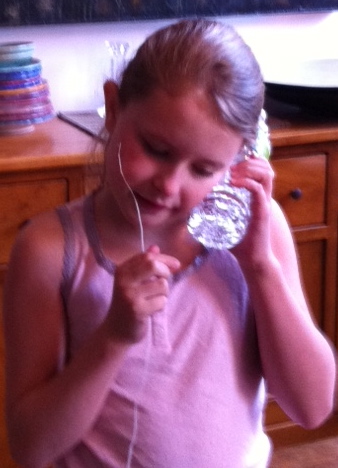
I no longer remember when we first heard about her ears bothering her, but it has certainly been within the last year or two.  We have weeks when they don’t seem to bother her and then a few weeks when they do.  Other than keeping a supply of gum on hand, it’s not clear what else we can do.  Her pediatrician checked her ears just a few weeks ago – they were fine.  We will go in again today, but my guess is they will again be fine.

Emma is sensitive to things I am unaware of.  However as I sit typing, I am hyper aware of the continuing pressure in my own ears.  But I know it will eventually go away and the discomfort isn’t so bad, so I occupy myself with work and all the things I must get done today.  Is this what Emma experiences?  Is her discomfort the same or much, much worse?  Does she feel something more extreme?  Her hypo and alternatively hypersensitivities make things I consider an annoyance, unbearable for her.

So we go to her pediatrician today, tomorrow we have an appointment with her neurologist and I will mention all of this to him as well.  Perhaps they will have some ideas.

Skill Set

People talk about their particular “skill set” for this or that job.  My “skill set” does not include great coping skills.  Just because I have a daughter who happens to be autistic doesn’t mean I innately know how to manage every situation, which comes with a child with special needs.

When Nic was first born, I opted to go the natural route and though the labor was seemingly endless, (38 hours) once he appeared, we were back home by that evening.  The first night was utter hell.  Every time his breathing changed I was up like a shot, staring intently at him wondering whether his congested breathing was normal.  I remember thinking this was why mothers stayed that first night in the hospital.
“I wish he came with a manual,” I said to Richard.

But he didn’t.  As all parents know, our children don’t come with a “Coping Skills for Idiot Parents” guide book as much as we wish they did.

Emma was born, again natural child birth and this time in a free standing birthing center.   She was born at 4:30PM and we were home by 9:00PM.  I felt something akin to terror because in addition to being a completely different infant than Nic, she seemed so uncomfortable, much more than Nic had, who was my only frame of reference.   I remember thinking that I had the whole mothering thing down, having honed my skills on Nic.  And then there was Emma, proving me wrong from the first breath she took, which came out as more of a disgruntled moan than a breath.

“What’s wrong with her?” I asked the midwife.  Her displeasure from that first second the air touched her skin all too apparent.  I knew right away I had no idea what I was doing.  I was in over my head.

I continue to feel that way now and Emma just turned nine years old in January.  She is growing like a weed on Miracle Gro, with no sign of slowing down.  You’d think I’d have this whole mothering-a-special-needs-child-thing down by now.  It turns out I’m a slow learner.  I do not understand what she says a great deal of the time.  I don’t have some sort of internal interpreting device where she says something incomprehensible and I’m able to translate.

“What did she say?” people often ask me.

I haven’t a clue.

“Why did she do that?” people will question.

Don’t ask me.

Every now and again I have an idea, but I also know there’s a 50% chance I’ve got it wrong.

When Emma begins screaming that her ears are popping and she needs help, there is a second where I wonder what I can possibly do that will make a difference.  I go through the predictable routine, try to get her to yawn, offer her a piece of chewing gum, try to speak calmly to her and not give in to my desire to yell back.

When both the children were toddlers I was pushing them in their double stroller, (the Hummer of all child transportation devices ever invented) when we passed a woman screaming at her child.

“You are behaving like a brat!” she yelled at the little boy who couldn’t have been older than five.  “A brat!” she continued.  “You cannot get what you want by screaming!” she screamed.

It was one of those moments when you put your head down and just keep walking.  Unless you have it in you to say something kind and loving to this screaming stranger, do not stop, do not entertain the idea you’re input will be taken as anything other than criticism or condescending, just keep walking.   But it exemplified what almost all of us have done at least a few times in our lives.  The hypocrisy we all catch ourselves in if we look deep enough.

Coping?  It’s not in my skill set.  But I keep showing up and maybe that’s a skill in and of itself.

The World of Autism

This morning we are going to an open house of yet another special ed. school.   The first time I toured a school for autistic children, Emma had been diagnosed a few months before, in the fall of 2004.  We were still in shock and reeling from the new world we suddenly found ourselves in.  The school had locked doors and a security guard at the front desk.  It was clean with walls painted in cheerful colors.   The unmistakable high-pitched keening cry, a sound one only hears coming from an autistic child in distress, emanated from a number of the classrooms.  I remember fighting back the urge to flee.  All the parents were herded into a little room with cafeteria-style tables and chairs.  No one sat down, as though to do so was more of a commitment than any of us were willing to make.

It was my first foray into the world of special education schools where the parents do not speak to one another with the cheerful optimistic small talk one finds in a regular school setting.  The question and answer period is often marked with parents breaking down in tears mid sentence.  There is an overlay of sadness, often despair, parents (and I am describing myself as much as I am of others) who are still in a state of profound disbelief.  There are always a couple of parents who seem to have made it through the mourning process a bit quicker than the rest of us, the ones who seem to have found a level of acceptance, which the other parents have yet to realize.

Visiting various schools now, is different in that Richard and I know what to expect.  We have gone to so many in the intervening years since Emma’s diagnosis, we are better prepared.  And yet, I am still caught off guard, on those rare occasions when I find myself unable to contain my emotions in the middle of an interview.  The tell tale break in my voice, the constriction in my throat, the flood of tears, which inevitably follow and the attempt to pull myself together.   The admissions directors are so used to this they all have Kleenex boxes prominently placed on their desks.  They take it in stride and are almost always sympathetic, brushing aside ones apologies.  Nothing like a child with special needs to make our facades crumble.  Talking about the weather just doesn’t hold much appeal when your child’s life is on the line.

“But I didn’t realize it was so serious,” someone I know said to me once when I said I couldn’t donate to his charity, citing Emma’s autism as the reason our finances were stretched so thin.

Perhaps when compared to other childhood afflictions, autism seems like lightweight stuff, but talk to a parent with an autistic child and you’ll come away with a different sense.  We are all desperate.  I have yet to meet a parent who isn’t.  Some of us have more acceptance, have managed to find ways to deal with our endless stresses better or are better at putting on a cheery front, dig a bit and the darkness, the pain is always there.

I have a great friend who said to me once, “Don’t take this wrong, but whenever I’m really down about something going on in my life, I call you and feel much better. “

I know what she means.  I have a good friend who’s going through a truly horrific divorce at the moment, everyone’s behaving badly, their child caught in the middle and I feel such relief, because in addition to what we are going through with Em’s autism, we could be in the midst of that as well.  Thankfully we are holding onto each other, leaning into one another with the full weight of our emotions.

“You’re like an ox,” Richard said to me once referring to my healthy constitution.  Then he broke into a rousing rendition of – “She’s a brick… (beat) house, mighty, mighty…” making us both collapse with laughter.

Richard and I are strong and as a team we’re even stronger.  It’s going to take more than autism to bring us down.

The Isolation of Autism

Much has been said about the isolation accompanying autism.  Because of the problems autistic children have in communicating, isolation is often an issue.   Even those who are verbal, often have problems with repetitive language, are unable to engage in “small talk” or cannot move fluidly from one topic to another, thus separating them from their peers.  We are not able to discuss with Emma how she feels about not having a group of friends she hangs out with.  She isn’t able to tell us what it’s like for her to live in our world.  These are conversations we hope to engage in with her one day, but at present, they are not something we can have.  The best I can do is imagine and speculate what it must be like for her.

However there is another isolation I can speak of and that is the isolation felt by the parents of an autistic child.  It is a feeling Richard and I have grown accustomed to.  It comes with the territory.  Most of the time it doesn’t bother me, but every now and again, when something happens which makes me feel particularly sad, I have no one other than my husband whom I feel I can turn to.  (I am fortunate to have that, as many people do not.)  Soon after we received Emma’s diagnosis, Richard formed a support group.  There were anywhere from 12 to 5 of us who met once a month.  Richard was hit harder with the sense of isolation than I was, because as a man, it was much more difficult for him to find other men who were willing to sit through the discomfort of seeing their friend upset, knowing there was nothing they could do to fix it.  Women have an easier time with that, it seems.  In any case, Richard formed a support group, where he was almost always the only man.  We met for a few years and then people fell away over time because of work demands or they moved out of the city and eventually the whole thing dissolved.

Emma’s school has a monthly parent group.  I attended it a few times years ago, but it was moderated by a well meaning and no doubt, extremely capable young women, who did not have an autistic child or any children for that matter, and I felt very much an outsider, not a great feeling to have in a support group and so I stopped attending.  Over the years I have come to rely on a group of women with whom I meet once a month.  We’ve been meeting for going on six years now, incredibly, and they have been there for me since the beginning.  I am incredibly grateful to this group of women, but even so, there are days, like today when I do not feel I can call even one of them.

Sometimes, not often, but every now and again, I am overwhelmed with what I can only describe as grief.  Grief that Emma has not progressed more, that anything resembling a main stream school is out of the question for her, grief that she is not able to carry on a conversation that a two year old is capable of having.   Suck it up, I tell myself.  There is always someone out there who has it worse.  Do something for someone else.  Pick up the phone and call someone who is struggling.  Ask them if you can help.  So I do.  These small, tried and true actions are all I know to pull myself up and out. It’s not that any of these things will change anything, it’s that by doing these things, by reaching out to help someone else, I am changing my own despair, even for a few minutes.  There’s a whole world out there of suffering.  Sometimes helping someone else, is the best I can do.

Home

“Go on airplane?” Emma said yesterday morning.

“Yes, but first we’ll have breakfast, then study room, then brush teeth and then go on the airplane,” I told her.

After listening to me, Emma nodded her head and said, “Go on airplane.”

All that other stuff was filler, it was the airplane part Emma cared about.  “Right,” I said.

At the Aspen airport there was the usual congestion, lines, children running around, harried people, stern looking airport security.  When flying with Emma I used to bring along a letter from her school saying she was autistic etc.  But it never seemed to make a difference, so I stopped.  Despite the fact Emma is the world’s greatest traveler there are problems which inevitably arise when flying with her.  Little misunderstandings, which I’ve described in previous posts, not important enough to spend time going into again.

Emma, as I’ve written before, will not eat anything served on the airplane.  She will not drink any of the liquids they serve, the apple juice on the Denver to New York flight is out of the question as it is served from a can, something she won’t tolerate, she will only drink water from a water fountain, impossible when in Aspen, difficult even in New York City during the winter months and unavailable on airplanes.  So we brought two of her last, appropriately packaged vanilla milks and pirate booty, some grapes – they must be seedless red grapes, a banana and some fruit leathers.  All of which is fine, except the vanilla milks cause us problems every single time.  Curiously in New York I will tell security she’s autistic and we are almost always cheerfully waved through, but never in Aspen.  The Aspen airport is a stickler for going through the correct protocol, no matter how tedious.  I know to take the vanilla milk out, show it to airport security and wait for the predictable grumblings from the people behind us as the entire line is put to a stand still.  I hate the “pat downs” where you are taken aside and searched, so this time Joe volunteered to be the one to endure it, while I watched Emma.

Traveling alone with Emma is particularly daunting as she might run off and no one appears to have the slightest understanding of autism and the difficulties this presents to the lone parent who is being pulled aside, frisked, trying to keep an eye on the carry on as well as calling to Emma who often disappears into the crowds.  To say this is a tense and upsetting time would be putting it mildly.  It is nerve wracking and often frightening as one never knows if Emma will run off – to the bathroom, try to exit the area, run outside to an awaiting aircraft headed to – who knows where – suffice it to say, it’s not fun.

But yesterday morning Joe, being the trooper that he is, volunteered and so they went through his and Emma’s carry on, with all their various swabs and strange looking equipment, it took about ten minutes all told, and I kept reminding myself, as we waited, that this was, though annoying, nothing more than an inconvenience in this post 9/11 age, which we all find ourselves in.

Once we made it through security all went fairly well, the weather was perfect, the passengers were all boarded when I became aware of two little girls sitting in the row behind, their parents, directly behind me and Emma.  The little girls couldn’t have been older then 3, their voices still had that high pitched squeaky sound only heard in a toddler.  The father helped get them settled, made sure they each had their stuffed animal, there was some fighting between the girls about who’s special toy was whose, but other than that it was what any parent of two toddlers would expect. (Not that I would know, but I’m guessing here.)  Some bickering, lots of talk from the parents about the importance of sharing, requests from the girls for candy, cheerios, something to drink.  It became comical when the father, having spent at least 10 minutes procuring various sweets and snacks, muttered to his wife, “Can I just sit for two seconds without feeding someone?”

Meanwhile there Emma was, content to stare silently out the window, happy to be on an airplane and going home.

Inspired by the family behind me, I asked, “Hey Em.  Do you want a snack?”

“No,” she said and continued to stare out the window.

“It’s Mommy!”

Every evening Joe, Emma’s therapist, and Emma pick me up from my store in town.  Emma pushes the door open and, upon seeing me says, “Hi Mommy!”  Then she points at me and says, “It’s Mommy!” as though this were the first time she’d seen me in a very long time.

“Hi Emma!”  I respond.  “I’m so happy to see you!”

Often she’ll stand back from me.  Looking at me with an expression of pleasure mixed with something else I haven’t been able to decipher, she usually says again, “It’s Mommy!”

It’s almost as though she doesn’t expect to find me there each evening.  As if she thinks I might be somewhere else and my presence is just a fluke.  Or perhaps it’s that she’s not used to seeing me at the store.  We’ve only been open a few months now and normally Joe, Emma and I are home in New York where I go to my studio each day.

After introducing Emma to whoever might be in the store when she comes, I almost always ask her, “What did you do today?”

“Go back to Granma’s house with Mommy?”  Emma will answer with an edge of anxiety.

“Yes, I’m coming with you,” I reassure her.  “What did you do today?”

Typically Emma will respond with a list of things she did.  Though this is by no means a comprehensive list.  Many times it’s not clear whether she is stating what she actually did, what she might have done in the last few days or what she wanted to do, but didn’t have time to.   “Really?”  I’ll say.  “You went bowling, sledding and skiing?”  I’ll ask, looking to Joe for confirmation.

Joe likes to let Emma speak for herself and so he usually will wait to see if she responds appropriately.  If she’s just said something completely outrageous he’ll interject, but more likely Emma will correct herself on her own as she did last night.

“No skiing,” she said.  “Bowling and wheel carousel.”

“Oh!  Did you find a real carousel?” I asked, wondering if this was a new addition to the Aspen area.

“Yeah!  Wheel carousel!”  Emma responded.

“Where is it?” I asked Joe.

“It’s a metal wheel in El Jebel,” Joe explained.

“Oh, like a merry-go-round?”

“Yes.”

“Did you have fun?” I’ll asked.

“YEAH!”  Emma said.  She almost always will respond to that question with enthusiasm.  No one can accuse Emma of not being happy.  She spends the greater part of her day in a state of bliss, always has.

When we drove home Emma waited in the back seat, allowing me to get out first to collar the dogs, before vacating the car.

By the time she appeared in the kitchen I had hung up my coat and was talking to my mother.  “It’s Mommy!”  Emma said, pointing at me as though she hadn’t just spent the last twenty minutes with me.

Then she held out her arms to me, indicating that she’d like me to hug her, which I never pass up the opportunity to do.

Emma’s “Study Room”

Every morning, since we arrived in Aspen, Emma wakes up somewhere between 5:30 – 6:00AM and comes into my bedroom to snuggle and sing songs.  At around 6:30AM I will say, “Ready to go to work?”

“One more minute,” is Emma’s usual response.

After a few minutes I’ll say, “C’mon.  Let’s go!”

“Time to go to the study room!” Emma will say in a sing-songy voice.

Emma’s “study room” is the room adjoining my bedroom with a desk, my computer, a fax/scanner/copier machine and a twin bed, where one of the children often sleep if they don’t feel well.  Though neither of them has chosen to sleep there for over a year now.

We go into Emma’s “study room” to work on writing individual letters, sequencing, and typing.  The letter “s” is difficult for Emma and she still needs occasional wrist support, but otherwise her handwriting is coming along beautifully.

“Good!” she’ll say after she’s made a particularly good looking “e”.

“Beautiful!” I’ll agree.

“No,” she’ll say after trying to make a “c” but the lower part ended up below the line.

Sometimes she’ll self correct and I’ll say, “No.  It’s okay Em.  That’s a fine looking “t”.

“Okay,” she’ll say.

Typically we then move on to typing.  I hold up a series of letters, which she then points to the corresponding letters on a sheet resembling the pad on a computer.  Same formation, same positioning of letters except they are all in lower case, just like the letters I hold up.  The letter “q” she confuses with a “p’, but other than that she’s doing incredibly well.  Then we move onto the computer itself, which is much trickier as the letters are all in upper case and she must translate them from the lower case letters I hold up to the correct upper case letters on the keyboard pad of the computer.

Finally we end with a series of sequencing exercises using colored tiles and letter tiles. Sometimes I have to cover the letters or colored tiles and she must remember what they were.  If they are random, say – red, white, yellow – she often can’t remember what they are.  But if the colors are in a pattern – yellow, black, black, yellow – she almost always gets them right.

“No, no, no,” she said, yesterday when she put the wrong tiles down, after I covered the four tiles.

“Try again,” I said.

“There,” she said when I lifted the paper covering the four tiles and she saw she’d gotten them right.

As the sessions go on they become more difficult, until eventually we will move on to reading.

We almost always end our sessions with quietly sitting opposite each other for a few minutes.  Emma calls this “deep breathing time.”  Except we don’t breath deeply, we just sit, hands in our laps and stare into the mid distance.  After we’ve sat for a few minutes, I’ll put my hands on Emma’s shoulders and say, “Good!”  She always gives me a huge grin, before running off.

A year ago, I would have been dismayed, had I been able to peek into the future and seen Emma doing these exercises.  Which just goes to show, I should never try to predict the future and never underestimate what she is capable of.

Flying with Emma

Emma is a joy to travel with.  Unlike most children, she sits quietly in her seat and is content to listen to music, look out the window, watch a video or look at books.  But there are certain misunderstandings, which inevitably arise when traveling with Emma as well.

Yesterday as we boarded the airplane leaving New York City to Denver, a nice woman behind us asked if Emma was 9.  I told her she was and she replied that her daughter was 9 too and she understood how hard it could be to travel with a nine-year old.  I said, “Oh, is your daughter autistic?”

The woman looked at me in surprise and said, “No.  She’s nine.”

It was one of those peculiar conversations where you realize you’ve misunderstood the intent of the other person.  I immediately thought, because Emma kept getting out of the line leading to the aircraft, that she knew Emma was autistic.  But it turns out she had no idea and was simply commiserating with someone who also had a nine-year old child and was flying with her.  My first impulse was to say, “Oh no.  Emma is great to travel with.  She’s not like that at all!”  But I decided it was best to keep walking and find our seats.

Later during the flight when Emma needed to go to the bathroom, the flight attendant said, “Poor thing, she’s still asleep,”  as Emma kept trying to push open the door to the bathroom which was occupied, despite my repeated attempts to stop her.  Again I just smiled.

Later on the flight from Denver to Aspen, (we were one of the lucky few who actually made it into Aspen yesterday!) the flight attendant leaned over to Emma and said, “Do you have your seat belt on?”

“Umhmm,” Emma said, curled up on the seat by the window.

“Really?” he said.  Where?  Do you have it around your chest, your knees?  I don’t see a seat belt.”

Emma just smiled at him and nodded her head.

“Emmy, put your seat belt on,” I interjected as I could hear the growing irritation in the harried flight attendant’s voice.  She immediately did so.

“Oh!  So you weren’t telling me the truth, were you?” the flight attendant said.

I put my hand gently on his elbow and said, “She’s autistic and didn’t understand you.”

“Oh dear.  I’m so sorry,” he replied before quickly moving along the aisle.

And so it goes.  This sort of thing happens constantly with Emma.  People assume she’s fine, she looks fine after all, and respond accordingly.  There’s always a moment when either I say something or they begin to realize they are dealing with someone who is a bit different than what they thought.  It’s a surreal moment, when the other person is caught off guard, before they’ve had time to make an adjustment.  Usually people are incredibly kind, very occasionally we meet someone who isn’t.   I don’t have any one method of responding.  Often I say nothing.  I mean what’s the point really?

Routine

Emma is not alone in liking her routines.  She is most comfortable when she knows she will do something she enjoys or is use to.  What separates Emma from the rest of us is that instead of being able to adjust when her routine is disrupted, she is thrown completely off-balance to a degree that often catches even us by surprise.

Last night Emma went through her nighttime routine of getting ready for bed.  After her teeth had been brushed she came to find me in the back where I was reading.

“Just five minutes,” she said as she got into our bed.  “Just five minutes with Mommy.”

“Hey Em.   Okay five minutes, then you’ll go back to your bed,” I agreed.

About ten minutes later I looked up from my book and realized Emma had fallen asleep.  There was a moment when I wondered if I should just let her sleep and try to carry her into her bed later, but she’s gotten so big, short of carting her out on a gurney, this is no longer an option.

“Hey Emmy,” I whispered as I put my arm around her.  “You have to go to sleep in your own bed.”

She resisted me.  “Stay here with Mommy,” she muttered.

“Come on.  I’ll take you back to your bed.”  I held out my hand and waited for her to get up.

“Go with Mommy into the other room,” she said.

Ever compliant, she allowed me to lead her back to her own bedroom where she got into bed.  “Mommy sing a song?”

Having sung her a lullaby I went back to my book, relishing in the fact Emma was back asleep in her own bed without a fuss, something I am still consistently surprised by.

Half an hour later, cries from Emma’s room could be heard.  She tearfully offered us her flashlight, a gift from my brother, which glows in the dark.  “It’s broken,” she sobbed.

We tried replacing its batteries with no success and finally placated her with promises of repairing it in the morning.

Another half hour went by and then there Emma was, like a spectre, at the foot of our bed.  “Mommy come!” she cried.

This went on for about an hour.  Emma would tearfully return to her bed, one of us would sit with her for a few minutes, tuck her in, say good night and leave, only to have her reappear ten or fifteen minutes later, crying about something else.  It’s like watching a pin ball ricocheting around, from one thing to the next until eventually Richard took her back to her bed and for whatever reason, this time she was able to go back to sleep.

Emma is sensitive to the slightest variation in her routine.  It is something we know about her and do our best to accommodate.  When she was little we use to mix things up on purpose.  We tried to avoid routines with the mistaken idea that if she were not allowed to have any routines, she would learn to adapt to change more easily.  But this proved wrong and impossible.  Emma would go along with things as chaotic as they might be, but the instant we did something, anything more than a few times, she would become fixated on doing the same, over and over again.  In addition the children’s school, our own work requirements, all need a schedule, as do regular bedtime, meals etc.

There are a number of studies being done on the link between autism and obsessive-compulsive disorder.  I don’t know if Emma has a comorbid diagnosis of OCD, but until one witnesses such behavior, it is almost impossible to explain the panic, the sheer terror, disruption causes them.

Monster Bugs

Last night I pulled out the dozen or more non-fiction children’s books I have for Emma.
“Pick two,” I instructed, fanning them out for Emma to see.

Emma pointed to Monster Bugs & Escape North – The Story of Harriet Tubman, bypassing Volcanos, Whales, Big Cats, Thomas Jefferson and George Washington’s Dog. “This one?” Emma said.

“Okay.  Monster Bugs and Harriet Tubman, it is!”

“Say it with your mouth closed,” Emma said, putting her hand over my mouth.  “Monster Bugs!” she demonstrated with her lips together so that it sounded more like “mummerbum.”

I began reading in an animated voice, lips sealed as Emma shrieked with laughter.  “Hab you eber looked ab a bug up clobe?” I read.  Every time I opened my mouth to annunciate the words she would cover my mouth with her hand.  “Emmy stop!” I said, twisting away from her hand.

“Mouth closed!” Emma laughed.

“Okay, one more sentence with my mouth closed and then we’re going to read it the other way,” I told her.

Nic, who came to see what all the laughter was about, sat next to me on Emma’s bed.  “Don’t worry Mom.  I’ll make sure she doesn’t cover your mouth again,” he reassured me.

“You might see horns…” I began, as Emma clapped her hand firmly over my mouth.

“Emma!  Let Mommy read the story,” Nic said, laughing.

“But the beetle fires boiling-hot gas from its rear end,” I read.

“I love this book,” Nic said, peering over my shoulder at the picture of the beetle shooting gas into an unsuspecting mouses mouth and nose.  “That is so awesome!”

“Mummerbum!”  Emma laughed.

As we continued to make our way through the book, with Nic asking for clarification on specific bugs, particularly the more gruesome and scary ones and Emma repeating the words with her mouth closed, I thought of how when I was pregnant with Emma I looked forward to reading stories to both the children.  When Emma was little she didn’t have any patience for books and only was interested in them if we allowed her to hold them so she could flip through their pages.  The book and its pages interested her, the act of flipping the pages methodically without really looking at the pictures seemed far more interesting to her than the story within the book.  But in the last few years her interest in books has increased and now she seems to genuinely want us to read to her, even requesting specific books while rejecting others.  It was wonderful to see her looking at the illustrations, pointing to the hairy tarantula while saying, “Maranmula!” with her mouth closed.

Nic was impressed with the Stink bug and the Praying Mantis who cleans its face like a cat after consuming a baby bird.

When I finished reading Monster Bugs, we moved onto Escape North!  A quarter of the way through, Nic nudged me and pointed to Emma.

I looked over to see she had fallen asleep.

“We’ll finish this one tomorrow night,” I whispered to Nic.

“No!  Read me the rest,” he said.

“Okay.  I’ll read it again to Emma tomorrow.”

“Good idea, Mom,” Nic said snuggling down next to me.

Pain

When Emma was a toddler, about a year old, maybe two years old, she had a little scratch from the tag on the back of her shirt.  It seemed so insignificant, hardly worth noticing, except that Emma screamed as though her entire body had been scalded.  I remember at the time thinking it strange, that her response seemed too extreme for such a tiny scratch.

There were other incidences which also caught my attention for the very opposite reason.  She would stub her toe or get scratched by a cat or have a huge knot in her hair, none of which would cause her to even gasp.  When she grew older I was terrified of the day when she would start to lose her baby teeth, convinced this would set off such cries of pain, with no remedy other than to wait until the tooth came out of it’s own accord.  However this was not to be the case.  In fact, Emma grabbed hold of the loose tooth and simply yanked it out of her mouth, dropping it to the ground, as though it were nothing more than an irritant, like a pebble in ones shoe.  Evidently her school bus is littered with her baby teeth as she would board the bus in the morning with a loose tooth only to come home and announce, “Threw it away,” when asked what happened to her tooth.

“Where?  Where did your tooth go?” we would ask.

“On the bus,” Emma replied matter-of-factly more than once.

About six months ago Emma was reported to have said to Joe, “Joe!  Pull it out!” and then opened her mouth so that he could remove the offending tooth, which he didn’t, so she did.  Joe was able to intercept the tooth before she was able to toss it in the gutter.

I don’t think we have more than two or maybe three of Emma’s baby teeth, despite the fact she’s lost at least eight or more by this point.  We tried to tell her about the tooth fairy, but she was utterly uninterested and wandered away before we had finished.  The idea a “fairy” would come to gather up her loose teeth, leaving behind money, was not a concept Emma had any use for.

Last Friday Joe called to tell me Emma was whimpering and saying her ear hurt.  I immediately called the pediatrician then looked at Emma’s throat for signs of strep.  Sure enough there was the tell tale white spot on one side of her throat.

“No say AHHH!” Emma said, pointing at her throat.

“Well, let’s wait and see what the doctor says, Em.  Does your throat hurt?”

“Yes.  Ears.”  Emma replied.

“Your throat and your ears hurt?” I asked.

“Yes.”

I remembered the last time I’d taken her to the pediatrician because her ears were bothering her, only to be informed that in fact she had strep, again.

Upon our arrival I proudly stated that I was sure it was strep and went on at length about how I couldn’t believe Emma had somehow contracted strep making this the third time since the school year began.  The pediatrician smiled and nodded her head as she examined Emma who kept insisting “No AHHHH!”  Meaning she didn’t want to have the doctor swab the back of her throat.

“Just ears,” Emma said repeatedly.

The instant the pediatrician looked in Emma’s left ear she looked up and said, “Raging ear infection.”

“What?” I asked, thinking I’d misheard, so convinced was I that Emma had strep.  “But what about that white dot on her throat?”

The pediatrician shrugged.  “Could be food, not sure, but her ear is bright red.  An ear this red should be extremely painful.”  She said looking at Emma.  “I’m surprised she isn’t complaining more.  It’s a really bad infection.”

I watched as Emma played cheerfully with the doctor’s stethoscope.  Observing her, one would never know her little body was host to a horrific ear infection.

“So that’s it?” I asked, still unable to believe she didn’t have strep.

“Yup.  Antibiotics will clear it up, but give her children’s advil in the meantime, that ear has got to hurt,” the pediatrician said.

By the time I had procured the prescription and the children’s advil and returned home, Emma was running around, playing happily.

“Hey Em.  How do you feel?  Does you ear hurt?”

“Yes.” Emma said before racing off down the hall with Joe in hot pursuit.  Shrieks of laughter could be heard.

One of autisms defining features is what specialist call sensory integration issues.  They can range from hypo to hyper and are often a mixture of the two.  In Emma’s case she has both and we still cannot anticipate which one we are witnessing.

Ups and Downs

I was reading an article this morning on RNA interference when the following quote by a pharmacology professor caught my eye – “A lot of excitement for RNAi was irrationally high to begin with, and now is irrationally low.”

It reminded me of how I have felt each and every time we have gone to South America for one of Emma’s stem cell treatments.  In the beginning I am elated, sure this will be the thing that causes her to crawl out from beneath the fog of her autism.  Then after we’ve returned home, I am guardedly hopeful, watching, waiting and after a few more weeks I’m convinced the whole thing was an exercise in heartache, stress and worry.

I go from the extreme high of wishing myself into believing this will prove a miracle to the low of believing it’s a complete waste of time or worse.  What I have not managed as well is that whole grey area residing between those two states.  Which is why the brain scans are so essential.  Though I have moments of disregarding those as well.  If I relied entirely on my perceptions, often clouded by feelings, desires, wishes, expectations, I would be making some very poor decisions.

We have been working with Emma on her handwriting and teaching her to type using a program developed by a literacy specialist.  It has proven to be quite an incredible experience.  Emma is now writing legible letters and is able to match two and three letter words.  She is also learning to type on a computer keyboard.

A couple of things I’ve realized:

1) Most written words are written in lower case letters, yet most writing programs teach upper case letters first.

2) All the letters on a keyboard are in upper case, making it very difficult for a child to translate the letter from lower to upper or vis a versa.  Something I had never “noticed” before until we began working on typing with Emma.  She is getting the hang of it, but it’s been interesting.

3) The letters Gg, Qq, Ee, Rr, Bb, Dd and Aa are completely different depending on whether they are in lower or upper case.

As I am not a teacher – these rather obvious items I’ve listed are something I had taken for granted until now.  I am amazed how well Emma is doing.  She seems to understand the same letters can look different and yet are the same.   But, and I do need to say this, Joe and I have been working with her for a number of weeks now and I was feeling discouraged that she wasn’t progressing as well as she should.  She still has trouble writing the lower case letter e.  K is often difficult and she makes her lower case s too big.  We needed to tape one of my sessions with her to send to the literacy specialist who developed the program (Joe did a great job taping) and Richard was the one who transferred it into a file we could email.

When I got home last night Richard said, “I edited the tape.  Emma’s doing really well!”

“Do you think so?”

“Oh yeah.  It’s amazing!”  Richard’s excitement was so authentic, it made me wonder why I wasn’t “seeing” it.

“Really?” I asked again.

“Yeah!  She’s doing great!”

That conversation was one more example of how two people living with the same child can view that child’s progress very differently.  My expectations are something I need to constantly keep in check.  If I look at the tape of Emma and how she is moving forward in a number of ways, I can see the progress and it’s impressive.

If I then compare Emma to what Nic was doing at her age, I am back in despair.

“So don’t do it,” a friend of mine said the other day when I related this.

And that’s really the point.  Living in the grey is sometimes a lot harder than one would think.

Intelligence

How can we know what’s really going on inside of a child’s mind who is unable to adequately express themselves?  For neurotypical children we have tests, we ask questions – all verbal or written ways of finding out what they know, whether they’ve learned whatever it is we are trying to teach them.  But what of non-neurotypical children?  How can we really know what they know?

It is this question which causes more confusion than perhaps any other.  Our methods of rating intelligence are deeply flawed.  IQ tests are notoriously incorrect when attempting to gauge the intelligence of a non-verbal person.  Over the years other tests have been created to gain a better idea of intelligence, but nothing we’ve come up with can adequately give us an accurate view of what these children know, what they may be thinking if they could only express themselves.

When confronted with a non-verbal person most of us immediately assume they do not understand and conclude they are not very bright.  Have you ever been to a country whose language you do not speak and noticed how you are treated?  Often it is as though you were an imbecile.  People tend to repeat the same words over and over again, turning the volume up in the mistaken belief your problem is one of hearing as opposed to understanding or being unable to verbalize a response.  We rate intelligence by verbal acuity.

Every now and then we hear of communication devices children have been taught to use, allowing them to communicate in ways they had not been able to previously.  We are astonished at what they say, how lucid and mature they sound.  I’ve read numerous accounts of sessions in which children “speak” to one another in complex sentences, children we would never assume had it in them.  Just because we cannot understand doesn’t mean the person we can’t understand isn’t intelligent or has nothing of interest to say.  All it means is we are not able to understand them.

When Emma was diagnosed with autism at the age of two years and eight months, much of the evaluation conducted by the therapist was directed at us. I remember at the time thinking the process a curious one.  They were evaluating our daughter by asking Richard and me questions which we often had very different answers to.

How many words does she speak?

“Between ten and fifteen,” I’d answer.

“No, no, she knows many more than that,” Richard would say.

And the truth was she did know a great many more than she was articulating, but the actual word count of recognizable words was probably closer to my answer.  So whose answer was more accurate?

Most of us want to feel understood and heard.  Can you imagine what it must be like to know that no matter what you said, it would be met with confusion?  Can you imagine trying to make your needs known only to have them ignored or misunderstood?  Can you imagine what it must be like to have a very complex thought process only to realize no one understands you?

I cannot imagine.  Everyday I am with Emma, I try to and I cannot.

What I do understand is how very lonely it must be.

Progress

At 2:30AM this morning, Emma appeared at the side of our bed.  “Carousel photos?” she asked, her voice tense with agitation.

“Em,” I began in a quiet voice.

“It’s okay,” she interrupted me.  “Take a deep breath, it’s going to be okay.”

“Yes, Em.  That’s right and right now it’s time to go back to sleep.”

“Photos!” she said with urgency.  It was clear, she felt I was not taking her seriously enough.

“Yes, I know Em.  We will find them tomorrow, I promise, but right now you have to go back to bed,” I said getting up.

“It’s okay,” Emma repeated as she took my hand and allowed me to lead her back to her bedroom where both the lights were on as well as a lit flashlight, lay on her bed, amidst piles of books and photographs.

It looked as though she’d been up for quite some time, before making her way into our bedroom as a last ditch effort to find the missing photograph.

She carefully took her blanket from it’s designated pouch and pushed all the books and pictures from her bed to the ground.  “Time to go to sleep,” she said.

“That’s right Emmy.  It’s going to be okay.”

“No school bus,” she said.

“Yes, you have school in the morning, but it’s time to go to sleep now and we’ll find your photo in the morning,” I said, turning out the light.  I sat with her for a second, listening to her breath.  “I love you Em,” I said and then I left.

As I made my way back to our bedroom, I marveled at the fact Emma was not screaming, not even a whimper could be heard from her room.  She had returned to her own bed, having obsessed about a missing photograph, which months ago would have been enough to set her off for a good two or more hours.  Perhaps even more incredible was the fact she went back to sleep, not to rise again until after the rest of us had awakened.

These are the seemingly small events, which added together create a larger picture of progress.

This morning when I got up I noticed a pile of her photographs on the seat of the armchair in our bedroom.  I picked them up and put them near Emma’s bedroom door.  About ten minutes later Emma appeared, carrying the pile of photographs.  “You found them!” She exclaimed.  Though I knew she meant that she’d found them and her relief was all too apparent.

Some thoughts

I have school photos of our two children on my desk in my studio, both are smiling, their blonde hair, much lighter than it is now.  Emma, like her older neurotypical brother, Nic, is looking directly at the camera.  Her two front baby teeth are missing, the adult teeth yet to show themselves.  It is one of the rare photos from that age when she was just five where she is looking at the camera.  I have spent hours staring at that photograph, as though if I looked long enough, some part of her mind will reveal itself to me.

I try to apply logic or project my own emotions onto Emma in explanation of her behavior and find I am wrong time and time again.  When I look at Emma’s brain scans and see the lack of symmetry, the bright colors, which should be dark, like a strange Rorschach test gone wildly awry, I try to detect patterns.  I try to make sense of what I’m seeing, but cannot.

“Emma’s brain is not like ours,” I remind my son, Nic in times of upset.  She does not think as we do.  She is decidedly “other.”  I feel as though I am a perpetual intruder in her life.  At times welcome, just as often not.

The stem cell treatments, like the myriad treatments that came before may not help her in the end.  Or they may not help her to the degree we would like.  Emma may not progress enough to allow her to live an independent life.  But I do not want to look back on these years and feel regret.  Regret we might have done more.  So we continue to wait and watch.

And while we do so, we work on her handwriting, her receptive skills, sequencing, her enunciation, we are teaching her to use a typewriter and we read to her.  It was suggested to us that we read books written for children that are non-fiction instead of the usual array of stories available to beginning readers.  At first I was reluctant to give up the Olivia books, which she took such pleasure in, Dr. Seuss, Go Away Big Green Monster, books Emma has been looking at and heard hundreds of times and which she continues to hear at school.  But at home out came the Learning To Read series about Pompeii, The Titanic, Dolphins, Hungry Plants, then I found other books written for children on such topics as Balto and Helen Keller.   She loves all of them.  She requests them, has asked me to read some of her favorites over again.  I am amazed.  But if I think about it, it makes perfect sense.  For a child who takes things so literally, non-fiction is a perfect fit.  The stories I am reading are for her age level and she enjoys them, which fills me with hope and happiness.

Just because Emma doesn’t process things or communicate the way we neurotypicals do, doesn’t mean she’s not intelligent.  Emma is exceedingly bright.  It’s figuring out how to tap into that intelligence in a way that speaks to her, captivates her and interests her – that’s the challenge.