Category Archives: Marriage

An Overview

On autism.com‘s web site, they write:

“What is the Outlook? Age at intervention has a direct impact on outcome–typically, the earlier a child is treated, the better the prognosis will be. In recent years there has been a marked increase in the percentage of children who can attend school in a typical classroom and live semi-independently in community settings. However, the majority of autistic persons remain impaired in their ability to communicate and socialize.”

After receiving an autism diagnosis for one’s child, most people go to the internet to learn more.  Quotes like this one abound.  What these sites do not say, cannot say, is what will specifically help your child –  What interventions, if any, will make a difference, what biomedical, dietary & behavioral approaches will work?

This quote is also from autism.com’s website:

Conclusion Autism is a very complex disorder; and the needs of these individuals vary greatly. After 50 years of research, traditional and contemporary approaches are enabling us to understand and treat these individuals. It is also important to mention that parents and professionals are beginning to realize that the symptoms of autism are treatable–there are many interventions that can make a significant difference.

The logo for the national parent support group, the Autism Society of America, is a picture of a child embedded in a puzzle. Most of the pieces of the puzzle are on the table, but we are still trying to figure out how they fit together. We must also keep in mind that these pieces may fit several different puzzles.”

A parent of a child with autism quickly finds they will need to read enormous amounts, speak with a great many “specialists”, sift through the endless opinions (often stated as fact), and try to make sense of all the various articles, papers, news items and books currently in print on autism.  In addition they may watch the numerous documentaries, interviews, YouTube clips and all the other visual forms that exist relating to autism.  Having done all of that a parent must make decisions as to what they can and cannot do, what they can and cannot afford to do in their attempts to help their child.  While they are making these decisions, they must cope with their own emotions, trying hard to keep depression, worry, panic, fear, sadness and guilt at bay.  They must learn to manage these feelings while continuing to research and do what they are able to with the hope something they try might just help their child.

But most important perhaps, we must never give up.  We must try in our darkest hour to see the light.  We must treasure our child’s differences, celebrate our child’s uniqueness, rejoice in our child’s strengths.

Years ago Richard and I went to a couple’s therapist.  He listened to us both individually and then asked us to meet with him together.  As we sat side by side on his couch he told us he didn’t want to hear about our latest disagreement, he was much more interested in hearing from each of us what the other had done right in the last 24 hours.  We were told to go home and keep a journal, recording all the things the other had done that was kind, thoughtful and helpful.  He encouraged us to examine each act, to consider things we perhaps took for granted.  It was the single most helpful advice anyone ever gave us.

This blog is a version of that exercise.  While I do my best to accurately document Emma’s progress or lack of, while continuing to try different interventions, I also try my best to celebrate her.  Let me concentrate on her strengths while I continue to do everything in my power to help her build on those same strengths and perhaps she’ll discover new ones.

For more on Emma’s journey through a childhood of autism, go to:   www.Emma’sHopeBook.com

Que Sera, Sera

I’m the silent partner. On Emma’s Hope Book anyway. It’s been a long time since I posted an entry. Ariane has always been the driving (and writing) force of Emma’s Hope Book, but I’ve been completely MIA lately. I went on interferon/ribovirin treatment two months ago. I knew the side effects were going to be extreme, but it turned out to be much worse than I could have imagined – one of those cases where if the disease doesn’t kill you, the cure will. I was basically an invalid, physically and mentally. I had to quit the treatment just so I could function and it took a month before I felt well again.

Ariane did an amazing job holding down the fort while I was laid up. She does an amazing job all the time. I’m very lucky and very grateful. Frankly, it’s been a rough patch for all of us lately. “We’ll get through this,” Ariane said a few minutes ago, kissing the top of my head as she scurried back and forth, preparing for a jewelry trunk show.

“Yep,” I nodded, “we always do.”

Of course, exactly what “this” means is open to debate. I guess it means “today”, because our lives never seem to get less complicated, difficult or worrisome for any significant length of time. This is true of any family I imagine, but Emma’s autism contributes greatly to our never-ending “whack-a-mole” game.

Her progress with language, reading and writing continues at a steady pace – a daily miracle from my perspective. Yet at the same time, she has had a recurrence of her difficulties with being able to go to the bathroom, which we thought was long behind us. Two steps forward, one step back.

I finished my novel a while ago and it is being shopped around by my agent. Ariane submitted a proposal for a book about Emma and our family. Both of us are stressed, bracing ourselves and hoping for good news. The day before I went on the interferon treatment, a conflict with my business partner developed that seems irresolvable, adding to the career pressure. Obviously, I would prefer to have enough success as a writer to provide well for the family, just as Ariane would like her jewelry business and her own writing efforts to be wildly prosperous. I’m sure they will be. It’s a lot easier for me to have faith in Ariane’s talents and potential for good fortune. I come from Irish stock.

Every night for the last week Emma has gone to bed listening to a CD of lullabies recorded by the talented and lovely Alycea Ench. The first song is “Que Sera, Sera.”

The second is “Somewhere Over the Rainbow.” I sit in bed with Emma and listen to these incredibly poignant melodies and lyrics, so full of hope and unattainable longing. Do they speak to Emma with the same desperate yearning I hear? Does she question whether she will ever have a chance to experience the normal phases of life the rest of us take for granted? Or does she just like listening to the Alycea’s lovely voice as she sings:

Que Sera, Sera

When I was just a little girl

I asked my mother, “What will I be?”

“Will I be pretty? Will I be rich?”

Here’s what she said to me:

Que Sera, Sera

Whatever will be will be

The future’s not ours to see

Que Sera Sera

What will be will be.

When I was young I fell in love

I asked my sweetheart, “What lies ahead?”

“Will we have rainbows day after day?”

Here’s what my sweetheart said:

Que Sera Sera

Whatever will be will be

The future’s not ours to see

Que Sera Sera

What will be will be.

Now I have children of my own

They ask their mother, “What will I be?”

“Will I be handsome? Will I be rich?”

I tell them tenderly:

Que Sera Sera

Whatever will be will be

The future’s not ours to see

Que Sera Sera

What will be will be.

Somewhere over the rainbow

Somewhere over the rainbow

Way up high,

There’s a land that I heard of

Once in a lullaby.

Somewhere over the rainbow

Skies are blue,

And the dreams that you dare to dream

Really do come true.

Someday I’ll wish upon a star

And wake up where the clouds are far

behind me.

Where troubles melt like lemon drops

away above the chimney tops.

That’s where you’ll find me.

Somewhere over the rainbow

Bluebirds fly.

Birds fly over the rainbow.

Why then, oh why can’t I?

If happy little bluebirds fly

Beyond the rainbow

Why, oh why can’t I?

As Ariane said yesterday in her post, unless Emma is stressed out about one of her OCD issues or unable to attain her most basic needs, she is so incredibly happy in the moment. Blissful. So I doubt very much that she questions what the future holds in store for her — any more than she wonders what lies over the rainbow. She is here. Now. It is Ariane and I that so achingly desire for her to feel and experience all the things kids her age normally go through: having friends, playing games, chattering back and forth.  And as she grows older: dating, falling in love, raising her own family.

Just trying to imagine that kind of normal life for Emma and the rest of us is almost impossible for me. As I write this, I cannot clearly picture it. Even as a fantasy, this truly lies over the rainbow. But even if I can’t visualize it, I have never lost hope that it is possible. In fact, I believe with all my heart that it will happen — someday, somehow – and our little bluebird will fly.

In the meantime, we will get through this — today. As for tomorrow? Que, Sera, Sera.

Bonding

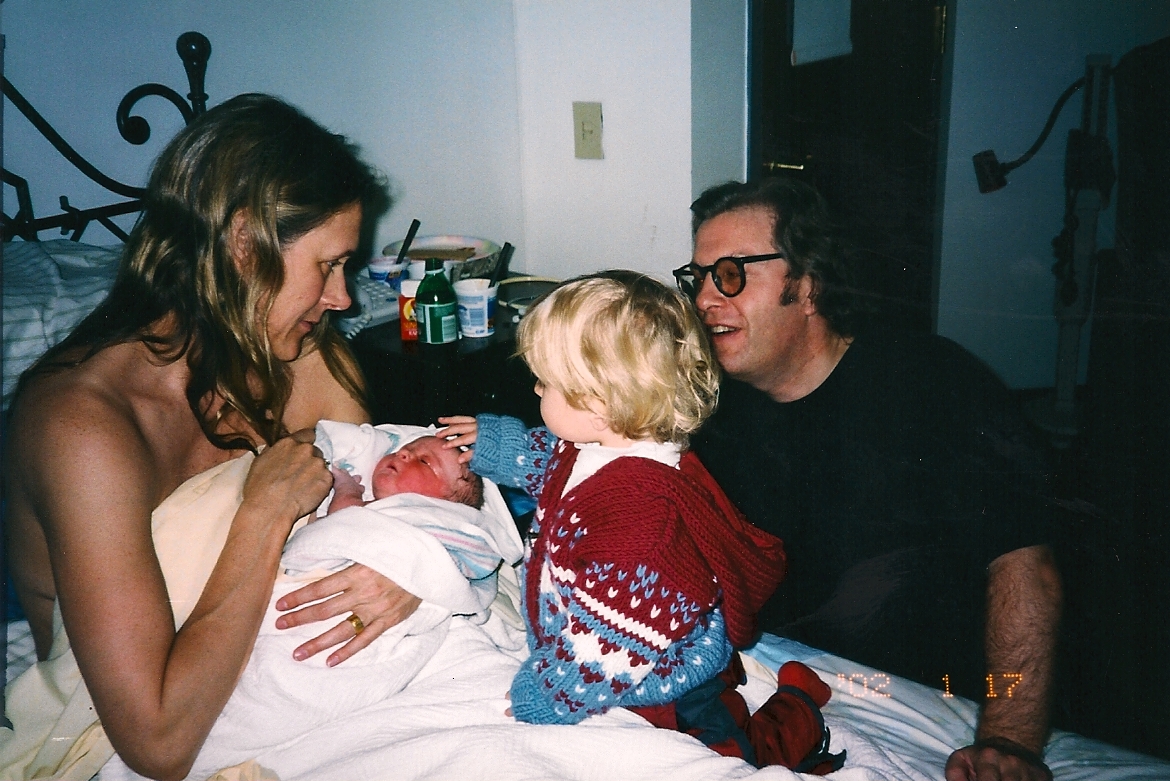
I gave birth to Emma in a birthing center here in Manhattan.  It was a relatively “short” labor being just shy of 20 hours, compared to Nic who took more than 38 hours to appear.  Okay, it wasn’t remotely “short”, but that was the word everyone kept using when predicting how long it would take, and compared to Nic, it was certainly short-er, but that’s really the only way you can use any version of the word “short” in describing my labor with either of my children.  Richard caught Nic, as he likes to say, as if he were a football being hiked during a long, boring and tedious game.  The first hands Nic felt were Richard’s.  The first face he became aware of was Richard’s and they bonded immediately.  Not so with little Em.

First of all the labor was more painful or maybe it was just that I wasn’t as exhausted and so I can remember it better.  Richard was comforting me and holding my shoulders when I began to push.  When Emma appeared the midwife was the one pulling her from me before placing her onto my chest.  Richard missed that “father/daughter” moment of connection those first few seconds of her life.  Later, when he didn’t feel the same kind of innate bonding he’d had with Nic, we assumed it was because he wasn’t there to catch her.  For years I felt badly that I’d asked him to hold me and as a result he wasn’t able to be there to hold her.  But as with so many things in life – it’s easy to look back and see things differently when you know the outcome.

When Emma was diagnosed it kind of closed the book on the whole – I should have let Richard catch her during her birth – it was the one bit of guilt the diagnosis freed me of.  As time went on we saw how Emma seemed aloof around friends and other family members.  We came up with ways to rationalize her seeming indifference.  She was independent, she liked doing things on her own, she was her own person, she knew what she wanted, had a mind of her own, etc.  These were all things we said to ourselves and each other as we tried to make sense of Emma during those early years.

Yesterday Emma said to me, “Go swimming at the Y with just Mommy?”

“Yeah.  Okay.  Just the two of us,” I agreed.

Later when we returned home I said to Richard, “I’m not sure why Em wanted just me to go with her.  She pretty much ignored me every time I tried to engage her at the Y today.”

“You’re the only one she’s ever really physically bonded with, Ariane.  You’re the only one whose lap she likes to sit in.  You’re the only one she really likes to be held by.  It’s always been that way,” Richard said.

This morning as I was getting ready to take Nic down to his bus, I heard Emma giggling and Richard laughing, “Emma!  What are you doing?”

I turned around to see Emma climbing from the window sill onto her dad’s shoulders, unprompted, of her own volition and utterly happy.

Everything changes.

For more on Emma’s journey through a childhood of autism and our attempts to keep up, go to:  www.EmmasHopeBook.com

Aspen, Work & Richard

I am in Aspen working, having left Richard and the children back in New York.  Emma’s ears continue to hurt her.   Richard had to take her to an ear specialist yesterday afternoon.  The last few times I’ve called I could hear Emma in the background crying plaintively, “I need help!  Ears popping!”.

I don’t know what it’s like to be a father leaving his wife and children behind for work, but I can tell you as a Mom, it feels pretty awful.  I feel terrible that Richard is left coping with the myriad details required, the organizing of both children, dealing with one who doesn’t feel great, getting referrals to doctors, arranging appointments, ensuring Nic is taken care of, juggling IEP meetings, seeing Emma’s neurologist, rearranging his own work schedule to accommodate all of the above.

And meanwhile here I am in Aspen.  Even when you tell someone you’re there to WORK, you can see the little smile on their face, “Uh-huh,” they usually respond.  “It’s gotta be tough.”

So no, one cannot expect much sympathy, and if I go on about how tired I am, I can expect little other than a slight nod of the head followed by the slightly sarcastic, “Yeah, I bet.”  Sometimes they’ll even add a barely audible, “Ski much?”

Despite the fact I have no intention of skiing, am working everyday most people find any utterance even remotely sounding like a complaint, tiresome.  Which makes Richard’s response all the more remarkable.

“Of course you must go,” was his reply when I told him about some of my commitments here.  There was no need for discussion.  It was a given, I would go, Richard and the children will join me in another five days.  I am grateful to him for that.

When I call then and hear Emma’s little voice whimpering and Richard’s exhausted voice telling me, “Everything’s fine,” I know he’s putting on a brave front.  I know how exhausting it is to hold down the fort in the other’s absence.   I know he’s worried about Emma, as am I.  The difference is he’s the one who is making and keeping the appointments with all the various doctors, not me.  And no matter how hard I am working, no matter how many hours I put in, it doesn’t compare to what Richard is doing back in New York.  As I write this I can look out my window and gaze upon the Rocky Mountains jutting up, the blue sky contrasted against their snowy peaks.  My concerns for Emma are muted by physical miles, I cannot hear her distress except when I call.  I am not in the trenches with Richard.

I am lucky, very, very lucky.

The World of Autism

This morning we are going to an open house of yet another special ed. school.   The first time I toured a school for autistic children, Emma had been diagnosed a few months before, in the fall of 2004.  We were still in shock and reeling from the new world we suddenly found ourselves in.  The school had locked doors and a security guard at the front desk.  It was clean with walls painted in cheerful colors.   The unmistakable high-pitched keening cry, a sound one only hears coming from an autistic child in distress, emanated from a number of the classrooms.  I remember fighting back the urge to flee.  All the parents were herded into a little room with cafeteria-style tables and chairs.  No one sat down, as though to do so was more of a commitment than any of us were willing to make.

It was my first foray into the world of special education schools where the parents do not speak to one another with the cheerful optimistic small talk one finds in a regular school setting.  The question and answer period is often marked with parents breaking down in tears mid sentence.  There is an overlay of sadness, often despair, parents (and I am describing myself as much as I am of others) who are still in a state of profound disbelief.  There are always a couple of parents who seem to have made it through the mourning process a bit quicker than the rest of us, the ones who seem to have found a level of acceptance, which the other parents have yet to realize.

Visiting various schools now, is different in that Richard and I know what to expect.  We have gone to so many in the intervening years since Emma’s diagnosis, we are better prepared.  And yet, I am still caught off guard, on those rare occasions when I find myself unable to contain my emotions in the middle of an interview.  The tell tale break in my voice, the constriction in my throat, the flood of tears, which inevitably follow and the attempt to pull myself together.   The admissions directors are so used to this they all have Kleenex boxes prominently placed on their desks.  They take it in stride and are almost always sympathetic, brushing aside ones apologies.  Nothing like a child with special needs to make our facades crumble.  Talking about the weather just doesn’t hold much appeal when your child’s life is on the line.

“But I didn’t realize it was so serious,” someone I know said to me once when I said I couldn’t donate to his charity, citing Emma’s autism as the reason our finances were stretched so thin.

Perhaps when compared to other childhood afflictions, autism seems like lightweight stuff, but talk to a parent with an autistic child and you’ll come away with a different sense.  We are all desperate.  I have yet to meet a parent who isn’t.  Some of us have more acceptance, have managed to find ways to deal with our endless stresses better or are better at putting on a cheery front, dig a bit and the darkness, the pain is always there.

I have a great friend who said to me once, “Don’t take this wrong, but whenever I’m really down about something going on in my life, I call you and feel much better. “

I know what she means.  I have a good friend who’s going through a truly horrific divorce at the moment, everyone’s behaving badly, their child caught in the middle and I feel such relief, because in addition to what we are going through with Em’s autism, we could be in the midst of that as well.  Thankfully we are holding onto each other, leaning into one another with the full weight of our emotions.

“You’re like an ox,” Richard said to me once referring to my healthy constitution.  Then he broke into a rousing rendition of – “She’s a brick… (beat) house, mighty, mighty…” making us both collapse with laughter.

Richard and I are strong and as a team we’re even stronger.  It’s going to take more than autism to bring us down.

Our Tenth Anniversary

Today is Richard and my tenth wedding anniversary.  For those of you who know how old our son, Nic is, it will not take long to calculate the years do not add up.  This is because, Nic, at 8 months old was at our wedding, wearing a little black velvet tuxedo, with his chubby cheeks and bald head, he was adorable.  Richard and I have never been ones to go the conventional route.

Richard planned a whole day of indulgences for us, today.  So last night we both went to sleep early as we knew we had to get Emma up and ready to meet her ski buddy, get Nic organized before going into town to begin our day together.  At around midnight both of us were woken by screams, emanating from Emma’s bedroom.  In the darkness Emma’s figure could be seen standing by the window looking north east onto the upper ditches of Red Mountain.

“Emmy, what’s going on?”

“I need help!”  she cried.

“Okay.  Come on.  Let’s sit on your bed.  It’s going to be okay,” I said, as Emma pulled at her ears.

“I need help!  Ears popping!” Emma screamed.

“Emma, it’s okay,” Richard said.

“Come on, baby, sit down next to me,” I instructed.  “Go like this,” I told her, demonstrating a yawn.

Emma watched me, as she always does when her ears hurt from the changing weather outside.  “It’s okay,” she said.  Then she held her nose and blew, causing her face to turn red.

“That’s not going to help, Emma.  That will only make it worse,” Richard said.

“Here.  Do this,” I said, demonstrating again.

After ten minutes or so of continuous cries for help, I told Richard to go back to bed and I stayed with Emma, trying to stay calm amidst her pleas for help.

I massaged her ears, pulling gently on them, hoping it would ease the pressure a little, all the while aware of the pressure in my own ears.  Emma is so incredibly sensitive to the sensations within her own body, and often they cause her great pain.  I looked out the window and saw the clouds, which have enveloped the valley these past few days were lifting.

“Mommy!  I need help!  You have to stop screaming,” Emma said tearfully.  “Belly go bang, bang.”

“Em do you have to throw up?”

“Yes, belly go bang bang,” she said running into the bathroom.  We sat together in the bathroom for awhile.  “Daisy!  You cannot hit.  I need a bandaid!  You have to wash it,” Emma scripted, taking a number of older conversations and putting them together in some sort of creative medley.

“Where does it hurt, Emmy?” I asked.

“Here,” she said rubbing her chest.  “I want a bandaid!  I want to get into the pool. It’s broken.”

I stroked her head and brought a bowl from the kitchen to place next to her bed.  I was able to get her back into her bed where she lay, occasionally whimpering.   After a few hours she was able to fall asleep with me by her side.

When she woke up this morning, I said, “Let’s go see if Daddy’s awake.”

“Okay,” she said.

Upon seeing me, Richard said, “Happy Anniversary Honey.”

We laughed as Emma leapt into bed beside us.  “No banging!” Emma said.

“Do you still feel sick?” I asked.  “Do you feel okay, Em?”

“Yes,” Emma said pulling the sheets over her head.

Together we can do what neither one of us would want to do alone.

A Little Gratitude

Emma stealthily crept into Nic’s bed last night, without waking him and was found by Richard when he went to wake Nic at just minutes before 7:00AM this morning.

“Good job waiting!” Emma said as she bounded into our bedroom and snuggled under the sheets.

Richard, having spent well over an hour with her in the middle of the night getting her back to sleep, was in the other room.  I was getting dressed and said nothing.  I was at a loss for words.  She sounded so proud of herself.  Did she not understand that in fact, she had not slept in her own bed, had gotten up at just past midnight to come into our bedroom where she woke both of us up?  Did she no longer remember Richard went back to her bedroom with her and stayed there until after 1:00AM, making sure she was asleep before returning to our bed?  At some point after Richard left her she must have woken up once more and snuck into Nic’s bed, being sure not to wake him.  After all we told her she mustn’t wake Nic.  Technically she did not wake him, but she didn’t stay in her own bed either.

The night before she was up screaming, “Mommy!  Mommy!  Come!  Mommy come!”  Heart-rending cries, unbearable, the guilt in not responding overwhelmed me.

“I’ll get her,” Richard said, grimly.

For the past couple of nights now, Richard has gone to her before her screams woke Nic, sitting with her for more than an hour in the middle of the night.  Trying to calm her, trying to get her to understand we need to sleep, she needs to sleep, she cannot wake us.  Yet, she does anyway.  It is easy to feel discouraged, despair even, but the truth is, she is making progress.  The 2:30AM wake-up calls are now occurring just after midnight.  She is not wetting her bed.  She is (until last night) staying in her own bed, after Richard returns her to it.

“Mommy!”  Emma cried.  Five years ago, I would have given anything to have her cry out for me.  I would have given anything for her to acknowledge me at all.  Now she does and I groan.  It is Richard who bears the brunt of these middle of the night pleas.  It is Richard who suffers the next day, trying to defog his brain enough to make sense of the work before him.  It is Richard who stumbles through the day, trying to maintain a placid demeanor, not giving in to the impatience, despair and fear that lurk on the edge of his thoughts.

I must get my work done and leave the studio early today so as to be home in time to greet Nic’s bus at 3:45PM this afternoon, allowing Richard to go out with friends who are in town.  It is the least I can do.  I sit here in my studio gazing out at the Chrysler Building, feeling immense gratitude, gratitude for having a husband who places his family first, who demonstrates his love for us on a daily basis.  I am incredibly fortunate.

I have the luxury of enough sleep and a mind clear enough this morning (thanks to my husband) that I am able to remind myself, Emma is progressing.  It’s two steps forward, one step back, but she is making progress.

I don’t know how people do this without an active participating partner.

I cannot imagine.

Transitions

Transitions can be difficult for all of us, but particularly troubling for autistic children.  One of the defining characteristics of autism is an insistence on sameness and routine.  When a routine is disrupted the autistic child suffers.  Anything I write regarding this will be an understatement.  How can I describe the abject terror in Emma’s eyes when she cannot adequately communicate her fears and anxiety?  I cannot.

Emma has had meltdowns, several in a day since we returned home.   They tend to increase in intensity in the late afternoon, early evening when she is tired.  When I examine the behavior it continues to baffle.  Last night was a perfect example.  I was preparing to go out when Emma who was listening to a music video suddenly screamed,  “I need help!”  And then bit herself on her forearm.  The bite didn’t draw blood, but it was hard enough that we could see the teeth marks and it immediately began to swell.  She tends to switch arms and so both of her forearms have bruises on them from previous biting.

“It’s not okay to bite, Emma, I said, kneeling down.  “What’s going on?” I asked,

“No biting!” Emma yelled and then said, “I need help!”

“What do you need help with?” Richard asked joining us.

“You have to ask Mommy.  You have to pull on Mommy’s shirt,” Emma said, mimicking Joe.

“Do you want to listen to a different video?” I asked, confused.

“NO!”  Emma wailed.

“Okay. Emma, you have to take your thumb out of your mouth, so that I can understand you,” I said.

“Mommy, I need help to look for it,” Emma said.

“What are we looking for?” I asked.

Emma got down on her hands and knees and began crawling around on the floor.

“Em, tell me what we’re looking for?” I asked, joining her.

“I think she lost the foam to her earbuds,” Richard said.

“Em, are we looking for the foam?” I asked.

“Yes!” Emma wailed.

It turned out Emma had thrown the foam covering one of the ear buds onto the ground, for some unknown reason.  Once the foam was found, I joked to Richard as I left, “I’m leaving, I may not come back.”

“I don’t blame you,” he said.

“My phone will be turned off, text me if you need me,” I said. When I returned home Richard looked exhausted.

“How bad was it?” I asked.

“Bad.” Richard answered.

After I left Emma went from one upset to the next, she cried about the video not downloading quickly enough, once that was fixed there was a missing photograph.  See “Photographs” for more on this.  And on it went through out the night until she finally fell asleep around 8:00PM.

Looking at my husband, I knew how he was feeling.  There’s the thought of – I just need to get through this next hour.  And once Emma’s fallen asleep the sense that the tenuous shred of hope we both desperately cling to is fraying.

“Do you want to talk about it?” I asked.

“I really don’t,” Richard said.

I nodded.

For more on Marriage go to:  “Marriage (Part 1)” & “Marriage (Part 2)”.

A Wish

The parent of a severely disabled child asked me a few weeks ago what I wanted for Emma.  She was referring to the long term, the far off future.

“I’m assuming you’re not expecting her to go to Harvard,” she said.

Well no, I thought.  That has never been a goal for either of my children, but I didn’t say that to her.  Instead I said, “I want her to be able to live independently.  I would like her to have friendships, to be able to find something she loves doing and takes pride in.  I would like her to be a kind, thoughtful person who is able to contribute in some way to society and our world,” I stopped for a minute.  “I guess I want her to feel good about who she is in the world.”

She nodded her head.

When Richard and I decided we wanted to try to have children we spent many hours discussing our views on parenting and childrearing.  We were in agreement with almost everything.  Neither one of us cared what college our child went to or even if they went to college.  We both agreed we were more concerned with our children finding a career they loved.   We agreed we wanted them to be kind, to be generous, to consider others and to behave in ways which foster that.  We agreed we did not care what their sexual orientation turned out to be and we did not own them.  We both felt strongly our children, if we were lucky enough to have any, were not an extension of ourselves, but independent beings.  We agreed it was our duty to guide and advocate for them until they were old enough to advocate for themselves.

When I was pregnant with Nic I asked my mother if she had any advice for me.  She said, “Love them with all your heart, tell them how much you love them as often as you can and one day they’ll forgive you.”

It was the single best piece of advice anyone has ever given me.  We as parents will make mistakes, we will use a harsher tone than we meant to or are even aware of, we will say things in anger we didn’t mean, we will model behavior that is not always exemplary, we will do things we wish we hadn’t.  But we can say – I’m sorry.  I made a mistake.  And we can convey our love for our children as often as we are able to.

When Richard and I first received Emma’s diagnosis we were given a barrage of information.  We were told to get Emma between 35-40 hours a week of ABA therapy.  We trained with the ABA coordinator so we could continue using ABA with Emma after the therapists left.  I remember thinking after the hundredth flashcard maybe I should just hold her.  Emma wouldn’t let anyone else hold her, but if I sat in the rocking chair she would crawl into my lap.  I would put my arms around her with her head resting on my chest and we would sit like that together for up to an hour sometimes more.  During that early period it was the one thing I felt I could do with Emma, which no one else was able to do.  It seemed more important than forcing her to do yet another puzzle or one more sequencing game.  I reasoned, for a child who appeared emotionally cut off from other human beings, holding her was a kind of therapy too and perhaps as essential if not more essential than any of her other therapies.

Those hours spent with Emma in my lap were bliss.   Whether the physical affection made a difference or not I cannot know for sure.  My guess is it did and continues to make a difference.  To this day I remember as a little girl sitting between my mother’s legs by our swimming pool and leaning my small body against hers, her arms wrapped around me.  There is something about physical touch, which promotes a state of well being unlike anything else.

It is that state of well being I wish for both my children.

Theories

Autism is nothing without theories.  Specialists, doctors, scientists, geneticists, parents, everyone has a theory when it comes to autism.

Richard claims I have more theories regarding autism than the most versed specialist.  And he’s right, I do.  The only difference is, I freely admit 95% of them turn out to be wrong and the remaining 5% have no validity because while they may prove right for Emma on any given day, they do not hold up long term or within the larger autism population.

Richard and I have a running joke about my desire, my need for theories.  When we are confronted with any new behavior from Emma, Richard will look at me and say, ”And your theory is?”

The beauty of having theories is, autism remains an enormous question mark and so the most impractical of theories hold weight if for no other reason than because they are difficult to prove wrong.  There is so much more we do not know than we do.  The other thing about theories is they give us  (me anyway) hope.  Hope that we’re moving forward.  Hope that maybe this line of thinking is going in the right direction.  Hope that the theory will lead to another theory, which in turn will prove to be true, leading us to a cure, a cause, something, anything…  No matter how crazy, the theory stands until proven otherwise and with autism that may be for a long time.  It’s something, anything, to go on amidst the great expanse of unknown.

Richard usually leaves the theorizing to me, so I was surprised when he said to me last night, “I have a theory.’

“Really?” I said looking at him to be sure he wasn’t making fun of me.

“Yes,” he said.

“Great!  Tell me more.” I said.

“Emma is doing great. “

“And your theory is?” I prodded.

“That is my theory.  She’s doing great.  The other day she and I were walking down the street.  I passed her and stepped off the curb to hail a taxi, but she didn’t see me.  She looked around, her eyes got really big and then she said something, I can’t remember what.  But she was scared and didn’t know where I was.  I called out to her – Emma!  I’m right here!  When she saw me, she cried out – There’s Daddy!  There’s Daddy!  I found you!  That’s never happened before,” Richard paused.  “She was really frightened when she thought I wasn’t there,” he said.

Suddenly I remembered when Emma was three and we went to New Paltz for the weekend.  We stayed at a huge rambling hotel right out of The Shining.  Richard and I in one room, the children with Joe in an adjoining room.  At around 2:00AM I heard a door slam, thinking nothing of it I started to go back to sleep.  Five minutes later our door opened and Joe said, “Is Emma with you guys?”  In a panic all of us threw on clothes and began searching the labryinthian hallways calling for Emma.  We split up hoping we might cover more ground that way, I ran to the front desk and reported her missing to the hotel staff.  It was the dead of winter, snow drifts piled up around the hotel, I was terrified Emma might open one of the self locking doors to the outside and not be able to get back in.  She was bare foot with just her nightgown on.  After about 20 minutes when panic had turned to ice – when your body no longer feels it is your own – one of us found her.  It was either Joe or Richard, I can no longer remember, but I know I began to cry in relief.  She was holding hands with some man who worked for the hotel.  He was quietly talking to her – at that time she had almost no language – and leading her back to the front desk.   I was in tears, thinking of all the horrible things that might have happened to her.  But Emma acted as though nothing unusual had occurred.

Richard continued, “Her sentences are becoming more complex, she’s become much more engaged, she talks all the time now and it’s not just because she wants something.  She’s talking to connect with us.  She wants to connect with us.  And except for the other night, she hasn’t wet the bed in almost a month now.”  He looked at me and then added, “She’s doing great.”

I remember when Emma turned four we had a big birthday party for her, hired a musician to come and play the guitar and sing kid friendly songs.  Emma was dressed up in one of her “party” dresses with a tiara on.  She spent most of the party trying to lie down inside of the musician’s guitar case, ignoring all the other children and the music.  I remember plastering on a smile for our guests, at one point I excused myself and wept in the back, giving myself two minutes to cry before returning to the party and pretending everything was fine.  I didn’t fully understand her sensory issues; I hadn’t developed any theories at that point.  I was still in the process of reading everyone else’s theories regarding autism.

“It’s a good theory,” I said to Richard.

“Yup.  I like it,” he said.

Marriage (Part II)

When Emma was diagnosed I threw myself into researching autism.  I was determined to find out everything I could.  I quit my job and devoted every spare second to reading books, trolling the internet for information, talking with specialists, etc.  It was Richard who, one night said to me, “Ariane this isn’t healthy.”

“What are you talking about?” I said indignantly.

“You can’t even see it…  this searching, every second spent reading about autism.”

I remember I was furious with him.  Here I was devoting every second of my free time trying to help our daughter and he was telling me it wasn’t healthy?!

Richard took a deep breath and continued, “You have to go back to work, do something with your creativity. Do something that has nothing to do with autism.”

He was right.  My life had lost all semblance of balance.  And so I did.  I found the career and creative outlet I had been looking for my entire adult life.

The summer after the diagnosis Richard was under tremendous pressure at work. I told him I would take the kids with me to stay with my mother in Colorado for a few weeks so he could have a break and not worry about showing up for the children and me.  The point is we watch out for each other and we encourage each other to have some balance in our lives.

Early on we realized the importance of down time.  Because with an autistic child, all the therapies, no matter which one works for your child, emphasize constant involvement with your child during their waking hours.  I cannot remember ever, in the last six years, sitting down to read the paper without feeling a tiny tremor of guilt.  I should be engaging Emma in some sort of “play” no matter how tired I am.  In addition, not only are you suppose to interact with your child every waking moment, but you are suppose to interact with a child who often does not want to be interacted with.  Despite this, you must pursue them or as Stanley Greenspan used to coach, seduce them.  Add to the mix the lack of sleep, a full work week with all the stresses which come with owning several businesses and… okay you get the picture.  It’s tough.

So Richard and I decided we each needed an evening out.  We picked a night, mine is Tuesday, Richard’s Friday. On my night off I go out with a friend, see a movie or often, just stay at my studio and work late into the night.  We also have a standing date night.  It is sacrosanct.   We have a caregiver booked for the same evening every week.  Both of these nights have been crucial to the well being of our marriage and family.

Over a decade ago during a particularly difficult time in my life I took a walk along 23rd Street where I lived.  It was a clear beautiful spring day and a single crocus had pushed its way up and out of a crack in the sidewalk, a single flowering plant amidst concrete.  I remember thinking how strange it was I hadn’t noticed it before.  After all it was right outside the front door of the building I lived in.

Last week, as I was taking Nic down in the elevator to catch his school bus, he was grumbling about Emma waking him up in the middle of the night.  I reached over and affectionately tousled his hair.

“Mom!  Stop fluffing me!” he said.

I smiled, “I am not fluffing you.”

“You’re trying to make me look like a daffodil,” he laughed, shoving his hoodie over his head.

And I thought of that crocus so long ago pushing up through the great expanse of concrete against all odds.

At a dinner party years ago someone asked each of us to use one word to describe our partner/spouse.  When it was my turn I said, “Kind.”  Richard is of course many things, but that is the word I still think of which sums him up better than any other.

I am a better person as a direct result of being with Richard.  I am pretty sure he feels the same.  We push each other to do the right thing.  We encourage each other to stretch beyond what is comfortable.  We challenge each other.  I can say the same thing about both Nic and Emma.  Each of them pushes me to show up in ways I could not have imagined.  Each of them challenges me to dig deeper, to practice more patience, to stretch, to work a bit harder.  Emma has taught me to appreciate seemingly insignificant things, a hug, a kiss, the unexpected laugh and my life and marriage are the better for it.

A few weeks ago a friend of mine, who is going through a stressful time in her marriage said, “Life is hard, suffering is optional.”

Being able to see the crocuses makes it a bit less so.

Marriage (Part I)

(*I have come to regret beginning this post with these statistics as I think it takes away from the main point.  ALL marriages will inevitably encounter stresses that will place a strain on the best of marriages.  It is not about blaming autism.  It is life.)

The divorce rate of parents with an autistic child is said to be 80%.  However I have found no studies to support this statement or even any articles showing where this seemingly arbitrary number came from.  Challenges of any kind can strain relationships.  As the parent of an autistic child in addition to the stress and financial strain, there are the legal hoops one must jump through to get ones child basic services with the Board of Education, the Board of Public Transportation, insurance companies, the lawyers, the hearings, the paper work and the sheer bureaucracy of advocating for your child.  It is the workload equivalent to running a small business if not more.  When you add the fact that many autistic children have disruptive sleep patterns causing further complications to a family already struggling to cope, you have a situation that will test the strength of any marriage, no matter how solid.

Richard and I have certainly had to weather our disagreements, though fortunately around the big issues:  methodologies, treatments, our vision and hopes for Emma – we agree.  I know of a couple of instances in which one of the couple just couldn’t cope any more and the diagnosis pushed them over the edge and out of the marriage.   I remember early on after we had received Emma’s diagnosis I looked at Richard and said, “How are we going to get through this?”

Richard replied, “Together.”

And for us in many ways it’s that simple.  (Though I need to be reminded of this from time to time.)  We don’t do it alone.  When I am having a moment usually in the middle of the night perseverating on some worry about something I have little control over or which simply hasn’t happened yet – will Emma ever live independently or who will take care of her when we die or will she ever be able to read and write or will she need tens of thousands of dollars worth of dental work because she still sucks her thumb (yes) or will she ever be out of diapers (these are a few examples from my current playlist) or any number of concerns ricocheting around in my head like a pinball, Richard will reassure me, “It’s going to be okay, we’ll get through this.”  There are times when I feel as though I am trying to claw my way out from a dark abyss of fear that ambushes me, pulling me down.  Richard and I have a kind of short hand for this.

“You’re spinning out,” he’ll say after listening to me for a while.

“I know,” I will reply and I do know.  The knowledge doesn’t help me stop myself.

And then he talks me down or if that fails, because I can be stubborn, he will listen a while longer before finally interrupting me with, “Okay, my turn.  You’re totally out of control.”  His is the blunt, direct approach.  It can be quite productive.  He will then go on to point out why my thinking is deranged.  90% of the time I can listen to him and calm down.  Richard has his own version of spinning out, but it’s usually work-related.  Which isn’t to say he doesn’t worry about Emma or Nic, he does, it’s just he is better at having some perspective on them and doesn’t get as easily thrown into the “doomsday pit” of despair.

When Emma is having a melt down, which can go on for quite some time, we pitch hit.  One of us will try to soothe her and when the other sees it isn’t going well – our patience is fraying – the other will jump in.  Most of the time one of us is able to maintain a calm the other is lacking.  Of course this leaves poor Nic fending for himself.  Though Nic, too, has gotten quite adept at calming things down.  “Here’s what you guys need to do,” he’ll say, looking up from his latest drawing of some fanged, blood dripping, all powerful monster.  “You can’t let her get away with this.  She won’t stop and she needs to learn she has to stop.”

Richard and I look at each other with raised eyebrows.

“You need to choose the thing that’s most important and work with her on that first.  Because otherwise it’s just too much,” he’ll add.

Smart kid.  (A post devoted to siblings of autistic children next week.)

The Birth

(I wrote this yesterday at exactly the same time Richard was making his first entry on this blog.  Soon we will be finishing each other’s sentences..)

“Is she okay?” I asked the mid-wife about a half an hour after Emma was born.

“She’s fine, probably isn’t hungry yet,” the mid-wife responded.

Something about the way Emma seemed to brace herself against my touch, her seeming discomfort with the air in the room, as though it scraped against her skin and somewhere deep down, I felt the beginning of a worry, a tiny twist in my gut.

Emma is our second child.  Nic, her older brother by 21 months, had immediately begun nursing after I gave birth to him.  There was a bond from the instant he left my body, a connection that no cutting of the umbilical cord could sever.

When Emma finally appeared after 19 plus hours of labor she squinted at the lights in the birthing room, seemed to push away from contact with my body, she had no interest in breast feeding, she cried and nothing I did soothed her, it was as though an invisible scrim had unfurled, keeping us apart.  I shrugged the feeling off and reveled in her.

Eventually Emma became hungry enough that she breast fed, but never with any enthusiasm.  Emma did not seem to take solace in breast-feeding or receive any comfort from it.  It was fuel and that was it.  With Nic I use to joke that breast-feeding was kiddy Valium.

When Nic was an infant we bundled him up in a sling and took him with us to a dance performance at the Joyce Theatre.  The couple to my left audibly groaned when we took our seats next to them.  About twenty minutes into the performance, Nic stirred.  I began breast-feeding him.  Immediately he fell asleep.  As we were leaving the couple to my left said, “What’s your secret?  We never heard him make a sound!”  “Breasts,” Richard replied and the other man nodded his head smiling.

With Emma I remember thinking that she was astonishingly independent, even as an infant, that she was following in the footsteps of countless generations of my ancestors; strong women who had blazed trails of their own making, ignoring society’s attempts to dissuade them.  Emma was the embodiment of generations of those women, I decided.

The Beginning

“Does she ever point?” the evaluating psychologist asked us one day toward the end of another grueling session where Emma was suppose to play with a series of plastic ‘nesting’ cups.  Emma showed zero interest in the nesting cups or, for that matter, in any of the other dozens of toys the woman had brought with her.  Richard and I looked at each other and slowly shook our heads, no.  “Is that important?” I remember one of us asking.  “Yes, a typically developing child will always point to things that they are either interested in or want to know the word for.”  I will never forget that instant as it became a defining moment in the evaluation.  The evaluation that ended in a diagnosis of PDD-NOS when Emma was two and a half .

It had been only a month before – August of 2004 when Emma stopped speaking almost completely.  She had begun to slide more and more into her own world which did not seem to include any of us.  Her interest in anything ‘outside’ diminished. But she seemed to have a busy internal life, one that we were not privy to, nor able to share with her.  I dealt with the diagnosis with my usual pull-up-your-boot-straps-let’s-figure-this-thing-out-and-fix-it attitude.  I come from a long line of strong, independent women and this was the mode I fell into.  The first thing to do, I thought, was find out what autism was.  I had no idea, my only reference was a mixture of “Rain Man” and some books I had read as a young adult, which posited that the mother was ultimately to blame and that autism was the child’s emotional response to an unloving, controlling mother.  Undaunted, off I went to the book store where I spent hours reading.  The first book was about a woman living in New York City whose child was diagnosed with autism and so she adopted a vigorous program of ABA therapy, hired a young girl to help her and after a few years, the child was normally functioning and off to a main stream school.  Another book recommended a casein/gluten free diet.  I remember talking with one of Emma’s early intervention therapists who said she thought Emma would be mainstreamed by the time she was in kindergarten.  I had it in my mind that we were in for a few tough years, but with perseverance and a great deal of hard work, we would see this thing through.  I can do this, I thought and when it was all behind us, we would look back with a smile and say, “oh remember when..”

But ABA did not help Emma.  She has a phenomenal memory and memorized all 400 of the ABA flash cards, but when presented with a similar object, one that she knew from the flash card – such as a blue t-shirt – yet if I held up a blue blanket or one of her blue shirts, she could not tell us what the color was.  It became frighteningly clear that Emma could not generalize the information.

Back to the book store I went, returning home with an arm load of new books on autism.