Category Archives: Autism

Panama – Day 5

We are in the clear.  Emma made it through the second treatment with no side effects.  She stayed in the clinic for two hours after the procedure was over to ensure she didn’t develop any complications.  Our biggest challenge was not worrying about her reaction to the procedure, but in keeping her occupied since she was feeling so terrific she wanted to:  swim, go back to the mall, ride on the carousel, find a water slide, go bowling, all of the above.

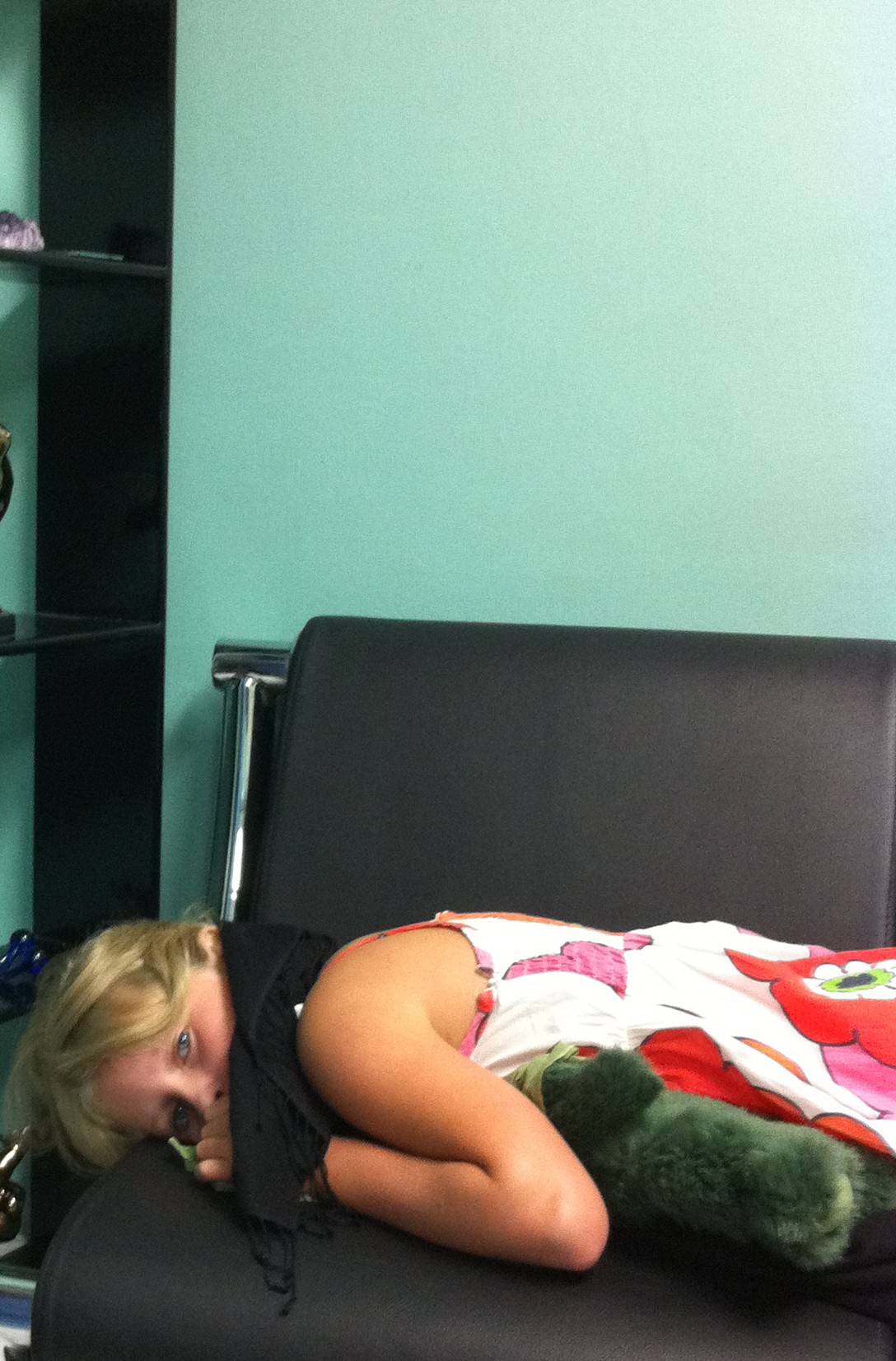
Emma waiting to have the stem cell treatment.

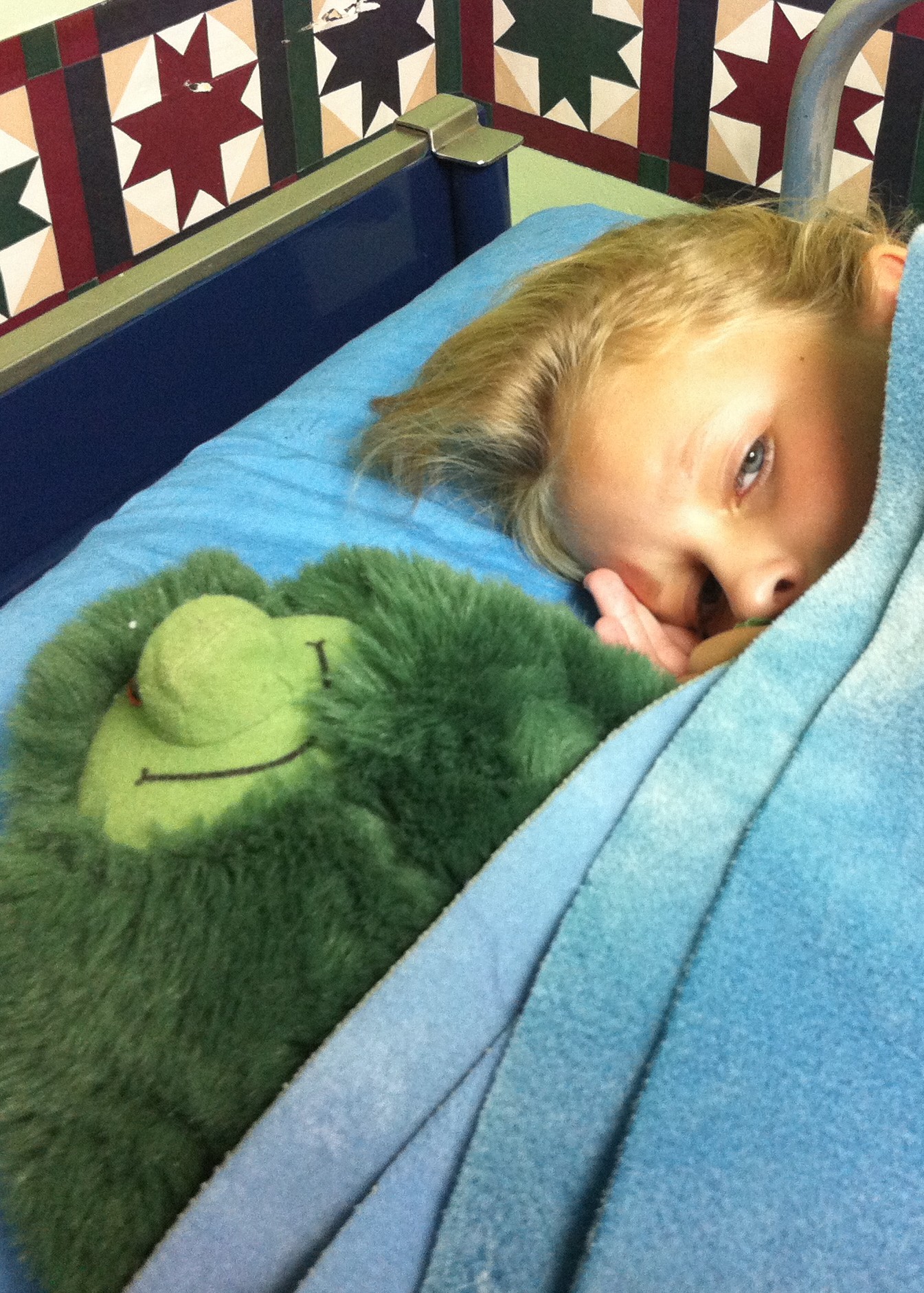
Emma awake.

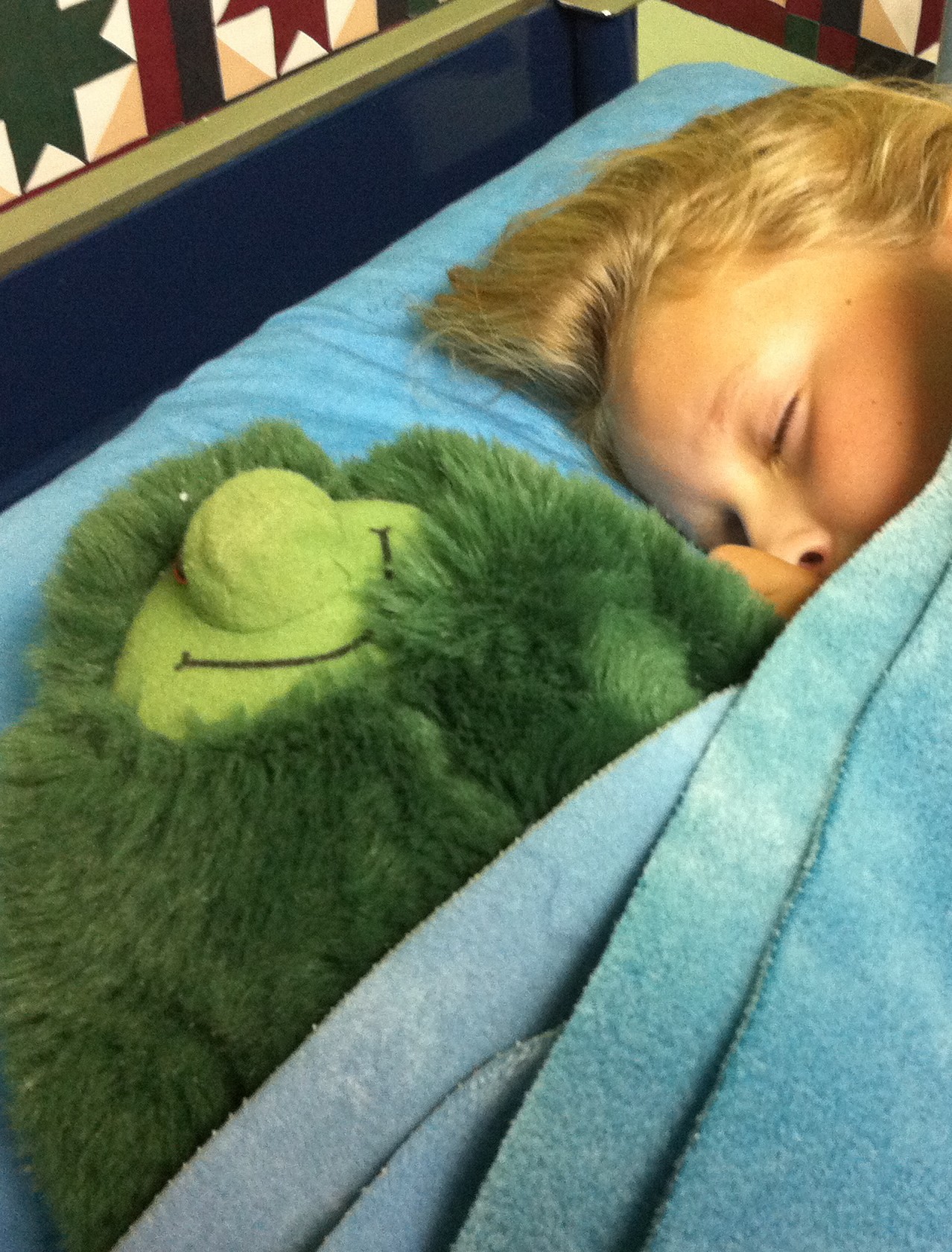
I took this photo and Emma said, “Now go back to sleep.”   Then she closed her eyes.

I asked Richard how he was feeling, now that we were through the second round of stem cell treatments.

“It’s strangely anti-climactic and I’m tired.  It’s not as though I was expecting her to begin quoting Shakespeare, but there’s a kind of post-partum depression feeling.”  He stopped talking for a second then said, “Do you feel it too?”

“Yes, very much so.  I feel as though I’ve been given a sedative.”

“And now we wait,” he said.

“Right.”  I said.   “We wait and try to stay in the present.  I think that’s the hardest part in a way, trying not to think about the future with a lot of fantasies and projections.”

A couple of noteworthy things…  Emma’s recent interest in Muzzy, her green stuffed monster is a positive sign.  She brought Muzzy into the operating room both times and used him to express some of her fears and anxiety.  She has insisted on taking him out with her whenever we’ve gone anywhere during this trip.   In addition to her growing affection for Muzzy is the more elaborate pretend play she is engaging in with more frequency.   She has not wet the bed for 18 nights, even has gotten up in the middle of the night to pee on her own without prompting.  Since we’ve been in Panama Emma has been sleeping in her own bed.  All of these things are positive signs!

Panama – Day 4

Emma began yesterday with a long swim.  She has devised a game where she leaps into the pool with a towel wrapped around her waist.  For some reason this strikes her as the height of hilarity.  Then she drags herself, still wearing the towel, out and onto one of the lounge chairs where she sits and announces to anyone within listening distance that in fact, she has just jumped into the pool wearing a towel.  Regardless of the listener’s reaction, Emma breaks into peals of laughter before leaping into the pool again – with the soaking wet towel.

After Emma’s swimming pool escapades, we ventured off to La Vieja – the old city.

Emma in the ruins discovered in 1519, only to be destroyed by Henry Morgan in 1691.

After visiting the Artisnal Market exhibiting local crafts and going to La Vieja museum we drove to a mall where we were told was a carousel and some other children’s rides.  Emma was ecstatic.

However once she had taken four rides on the carousel, we suggested we look for some of the other rides we had been told of.  There were three.   Two, which she was too big to ride in and one, the teacup ride, which she was the right height for but was empty and they wouldn’t let her on unless another child showed up.  Emma took the first disappointment in stride, “Too big,” she said, nodding her head, the smallest frown appearing on her forehead as she tried to reason this out.  But when she was not allowed to ride inside the teacups because of a lack of other children she began to fret.  “Go on cup ride?” She whimpered.

“Yes, but we need to wait until some other children come to ride too,” We tried to explain.

Our explanation was weak and we knew it, but there was nothing to be done.  Joe and I went to plead with the “supervisor” to see if we could convince them to let her ride on it anyway.  They were resolute.  Emma began to cry, “Go on cup ride?  Go on ride.  You have to wait.  I said no!”

“It’s okay Em, we can wait and see if another child comes, then you can go on the ride too.”

Even while saying this to her, the weakness of the argument was all too apparent.  Why one other child should make a difference was not something any of us could explain.  Was there a balancing issue, weight distribution problem?  Who knows, but our Spanish being what it was, even Joe’s fairly good Spanish, would not sway them.  Meanwhile Emma became increasingly distraught.  All the joy from the carousel was now replaced by a kind of frantic, perseverative mindset.  Eventually another child did come along and Emma was able to ride in the teacup.  It was not a joyful ride. It was as though she no longer could obtain any amount of actual pleasure from the ride.   It had fallen into the “must do” category, an action, which must be taken, but with no enjoyment attached.  There was an addictive quality to the desire.  It was as though she were caught in a rut of thinking, nothing could be said or done to quell.

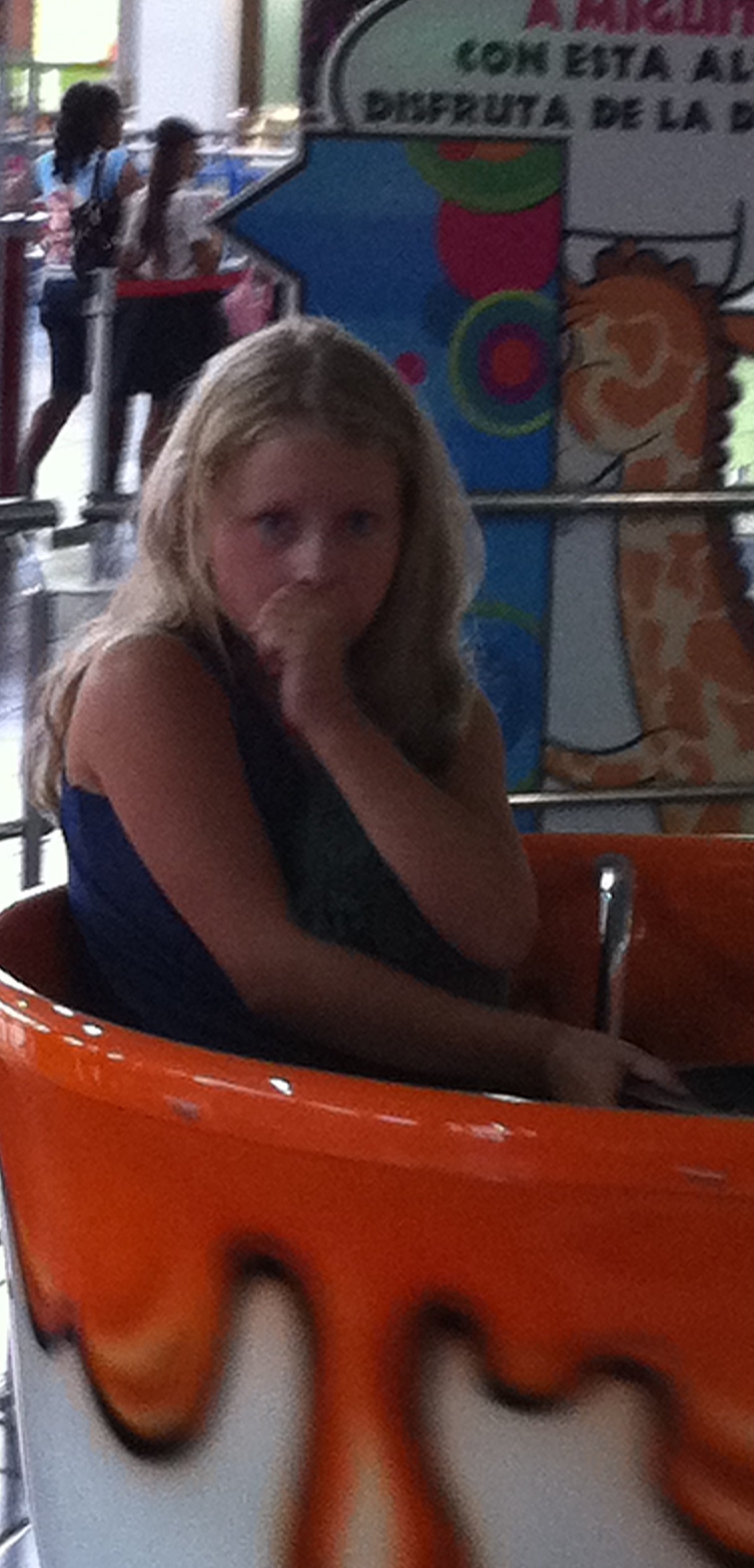
Emma riding in the teacup.

Once the teacup ride was over Emma went back to the other two, which she was too big for and insisted on riding in either of those.

“Ride in train?” She asked, anxiety creeping into her voice.  “You’re too big, you have to wait,” she said.

“Em, let’s go see if we can find the big indoor playground.  You can bounce,” One of us encouraged.

“No.  Ride?” Emma said.

“Emmy, we can’t go on these other rides and only on the teacup ride if there’s another child.”

“Ride in cup?”  Emma said.

Eventually we were able to pull her away and began to look for the indoor playground.  Emma was unhappy and sucking her thumb, clasping Muzzy to her and repeating the same phrase over and over again.  “Ride on carousel?”

“Okay, let’s ride on the carousel,” Richard said.

It was decided Richard would scout ahead to see if he could find the indoor playground while Emma rode on the carousel a few more times.  Once Richard was out of sight, however, a train came by stopping at the carousel.  So we took the train which runs the length of the shopping mall.  Immediately Emma perked up.

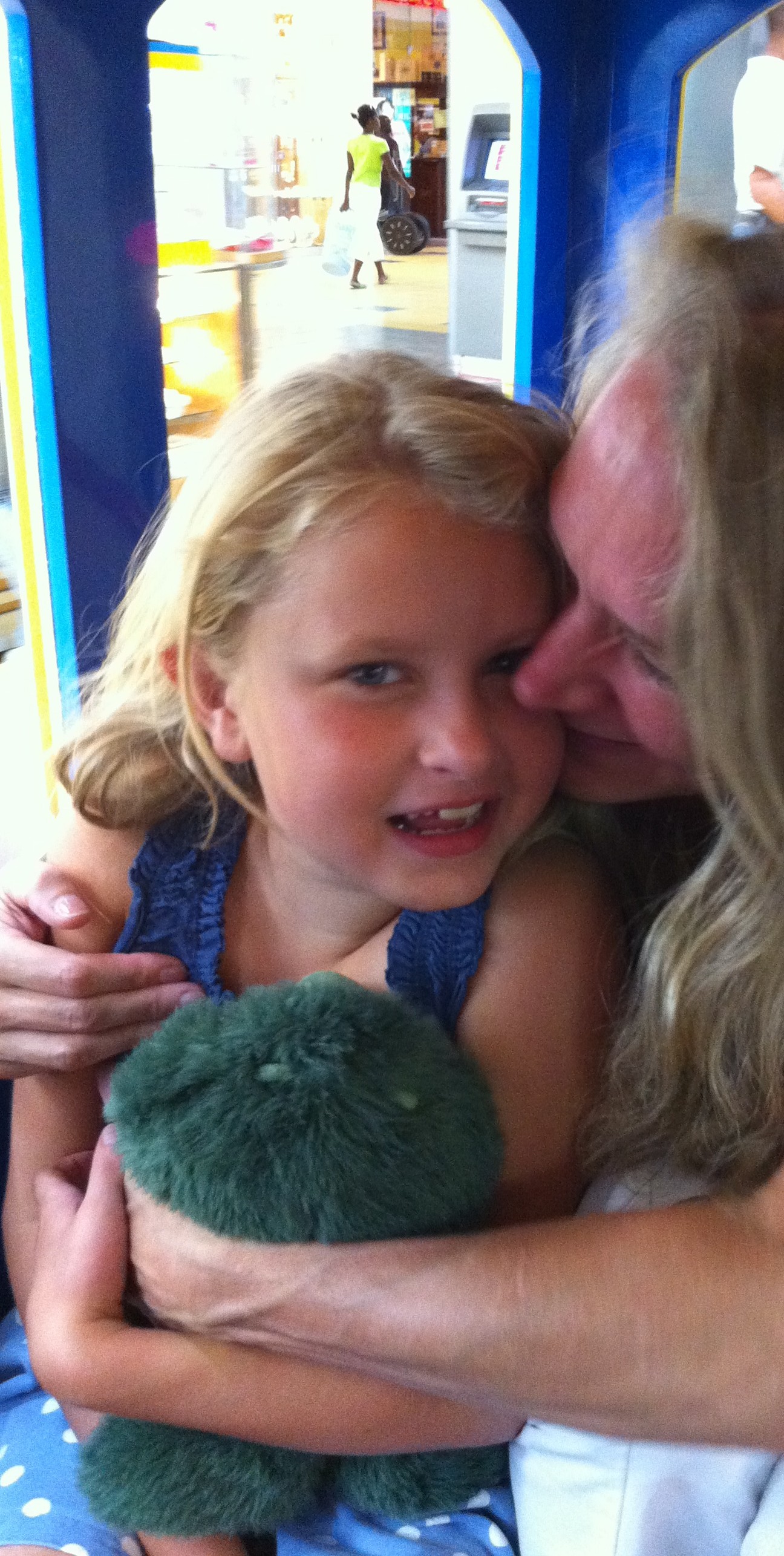
Emma in the train with Muzzy & me.


Back to the carousel and then to a round elevated platform where Emma made up a game she called:  “Swing game”.

The Swing Game went on for quite some time, with Emma running around the parimeter of the elevated circle with Muzzy as one of us tried to catch her.

Today we go into the clinic for the second stem cell treatment.  We have been preparing her.

Emma:  Take Muzzy to hospital.  You have to put the mask on. Last time.

Richard:   Yes.  Today is the last day of the hospital.

Emma:  Then bye-bye hospital.  Sleep, wake up, go to play swing game!  Go on airplane, go see Granma!

Richard:  Yes, that’s right.  Tomorrow we rest and then Saturday we go on the airplane to see Granma.

Emma:  I’m so excited.

As are we all.

In Panama (Day 1)

It’s the rainy season here in Panama.  We’ve been told even by Panamanian standards this has been an unusually rainy one.  In fact, we just saw lightening and heard thunder close to the condo we’ve rented for the week.  To which Emma said, “Ohhh!  It’s thunder!  So scary.  It’s raining bubbles.   Now go swimming.  The swimming pool’s closed.”

All of this was said quickly without a pause.  I managed to confirm it was raining, but Emma seems to have the entire situation under control.

This morning we go into the clinic and speak with the doctors.  When we were in Costa Rica for round one they interviewed us, video taped Emma and then we went to the hospital to have fluid removed from her spinal column and blood drawn.   I believe this is the protocol for today as well.

When I arrived last night, Emma was sitting at a table in the living room listening to music on her ipod.  She turned and saw me enter the room, “It’s Mommy!  Mommy stay at Granma’s house,” she said.

“Emma!  Hi!!” I said.  I ran over to her and knelt down, “Emma!   I want a hug.”  I put my arms out and she leaned into me with a huge smile on her face.

“It’s Mommy!  Mommy stay at Granma’s house,” she said again.

“Yes, but now I’m here with you,” I said as I held her tightly to me.

“It’s Mommy!”  Emma whispered to me as she hugged me.

“I’ve missed you!” I whispered back.  I stood up with Emma’s arms still wrapped around me and twirled her around.  Emma laughed and wrapped her legs around my waist, gripping me even tighter as we twirled around and around.

It was a lovely welcome to a long day.

Later as we brushed her teeth she pointed to the reflection of me in the mirror and said, “It’s Mommy.”

I pointed to her reflection and said, “It’s Emma!”

Emma laughed.

As I tucked her into bed she said, “Night Mommy.”

I said, “Do you want me to lie down next to you for a minute?”

“Yes!”  Emma said, smiling.

I cuddled up next to her and put my arm around her waist.  She grabbed my hand and pulled my arm around her.  “Emma’s sleeping,” She whispered.

“I love you, Emma,” I said.   I waited for her to say, “So much.”  But she was already asleep.

Baseline

Before and after. Since we are not involved in any control group study, we need to establish a baseline reading of Emma’s brain waves before the stem cell treatment next week and then again afterward, probably a month or two post-procedure.

Joe and I will take Emma to the NYU brain research lab today where she will have a QEEG brain scan. It measures alpha, beta, delta, gamma and theta brain wave activity in the various regions of her brain illustrated with nifty color-coded pictures of her brain cross-sectioned from above and from the side. Black, navy blue, and brown – good news. Orange, yellow and red – not so good. We won’t see the results until after we come back from Panama so it will be a while until we can say anything about the ‘before’ baseline scan.

I’m hoping that we will see our doctor today and I’ll have an opportunity to ask him some more questions about the stem cell therapy. If so this will be a two-part entry. Before and after. If not, then it’s a brief blog today.

Questions

“Do you think Emma will ever ask us a question?”

When Ariane asked me that question, I had to pause and think about it. Had Emma ever asked us any questions? After a few more seconds of scouring the memory bank, I answered.

“She asks us questions all the time,” I said. “They’re just simple questions.”

“Go to snake bite museum?”

“Watch Elmo movie?”

“Take a plane, see Grandma?”

“Have some apple juice?”

As far as I can remember, all of her questions are requests to have her needs met or requests for information or clarification, which are also needs-related.

“Go to snake bite museum?”  Request for needs to be met.

“Take a plane, go see Grandma?” Request for information related to needs.

She will also frequently make statements that are stealth questions, often with her voice rising up slightly at the end of a sentence like you do when asking a question.

“No see Becky today. No school bus.” Then she will look up at you expectantly, requesting an affirmation.

“That’s right Emma, today’s Saturday, there’s no school today.”

We probably say “That’s right Emma” more than any single phrase to her. As a consequence, she also says “That’s right” all the time.

“No take the bus.”

“That’s right Emma, no school bus today.”

“That’s right! No school bus today!”

“So what do you want to do Emma?”

“Make pancakes?”

“Sure Emma, let’s make pancakes.”

“Yaaaaaaay!”

When Ariane asked me the question about Emma asking a question, I instantly knew what she really meant by that. That’s why I had to pause a few seconds and think about whether she had or not.

“Why does Grandma live so far away?”

“How do they get all the music into an iPod?”

“Where is California? How long does it take to get there?”

“Why are the buildings so tall here?”

“How come they keep all the animals in cages at the zoo?”

“When am I going to be a grown-up?”

These are all simple questions you might hear from any four-year old child. They seem light years away from Emma’s capabilities right now. Why? When? How? Where? What? These questions never seem to materialize, at least not in that form.

“Can I?” “Have some?” “Go there?” Yes, they are all questions, but not the kind you expect to hear from a girl who is eight years old. Her teachers at school have told us she has made progress in asking questions, and will even tell us examples of the what, where, when, how and even some why questions she has asked. I can cite some examples too, though they don’t use the actual W words.

When and where questions are the easiest:

“Get on a plane, go see grandma?” That’s a when question in disguise. She wants to know when we are going.

If we are in an unfamiliar area she might ask a where question like, “Go find swimming pool?” Most kids would ask, “Where can we find a swimming pool around here?”

“Get on a plane, go to hospital (hosspull)?” That’s a when and sort of a where question. She wants to know when we are going for the stem cell treatment and where are we going, which foreign country do we have to fly five hours to reach because our government can’t get it together to have these treatments available here. Ha. Ha.

“Daddy, movie is broken. Daddy help?” That’s a when and how question. How can you get this thing working again? When can I watch Mary Poppins?”

What questions are a rare breed, at least the kind of what questions normal kids ask that stem from curiosity about something unfamiliar. She doesn’t seem to have that curiosity for more information about what something is, how it works, or why it is the way it is.

The rarest of the rare are why questions, and the rarest of the why questions, the albino elephants of the question world, are why questions related to abstract thought.

“Why do bad things happen to good people?”

If we ever hear Emma ask a question like that, we are home free!

Presto, chango. “That’s a normal kid you got there mister!”

Why questions related to feelings are the low hanging fruit we strive to harvest, planting the seeds for them by asking her why she feels the way she feels, usually when her emotions are very intense – intensely happy, or intensely upset.

“Why are you so upset Emma? Why are you so sad (or angry, or frustrated)?

“Emma is so upset (…because…) Emma can’t find cokie.” (her blanket).

If she can truly understand a why question like that, and she does hallelujah, then she can ask one too. Since her receptive language (comprehending what we say) is stronger than her expressive language (communicating her thoughts), this is how we practice with her.

I know she asked me a why question once, related to my feelings. Probably something like “Why is daddy upset?” but I can’t remember exactly what it was.

Maybe Ariane, Joe or one of her teachers or therapists could add more examples they have witnessed in the comments section below. The more we can list, the more hope we have. Hope is the name of the game here (and the name of the blog).

I’d be lying to you if I didn’t have a great deal of hope that this next stem cell treatment will yield a few how and what questions.

If we get a few whysGravy.

The Path of Most Resistance

“No more camp,” Emma said, sitting near my face on the bed. It was sometime between 5:30 and 6:00 AM — my morning wake-up call.

“Camp all gone. Get on the plane, go see grandma,” she added hopefully.

“No Emma. One more week of camp, then we get on the plane and go to the hospital, meet mommy, then go to grandma’s house,” I corrected her.

Then came her inevitable follow-up: “Pancakes?”

I’m guessing she really misses mommy and Nic from her first-thing-in-the-morning declaration that camp needed to be over right now, and it was time to get on a plane. I’m flying solo with Emma this week. Actually Joe is my copilot, working the day shift, taking her to camp until we fly to Panama Sunday and meet up with Ariane.

We spent the morning après pancakes getting ready for our Central Park outing. I’d offered to take her to Coney Island but she surprisingly passed, opting for Victoria Gardens instead. We rode the rides, had lunch and then Emma wanted to “go to the sprinklers” – which meant a nearby playground with a water spray.

On the way over we passed by the carousel, which was closed for repairs. She took it well, no crying, no screaming, no meltdown – she seemed to ‘get it’ that it was closed and that was that. I thought of all the times I’d been in the park with her and she had one of those spectacular tantrums because she wanted to do something and I said no, because we had to do something else or go home. She was so well behaved this time, and we had such an easy day in the park thus far that I wondered if maybe those tantrums were a thing of the past now – that she had mastered another level of growth and maturity — that she had learned how to cope with frustration and disappointment without going haywire.

We went to the playground. She splashed and romped for quite a long while then said she wanted to go home. As we left she started walking north toward 72nd street. “No Emma, we’re going this way,” I said, pointing downtown.

“No this way!” she shouted, almost instantly frantic. “Take the orange train!”

“Emma, the orange train doesn’t run on weekends, we have to take the red train,” I said, trying to sound as reasonable as I could, but already feeling a tsunami of dread cresting above my head.

“NOOOOOOOO! TAKE THE ORANGE TRAIN!” she screamed, then followed it up with an instant cascade of crocodile tears followed by ear-splitting screams when I said, once again as calmly as I could, “Emma there’s no orange train today.”

And so it goes.

That was always one of my favorite Kurt Vonnegut lines. Such a perfect synopsis of life’s ceaseless challenges, fleeting success and predictable disappointment.

She kept screaming for the next half hour while I weathered, for what seemed like the millionth time, the looks of panic, concern, confusion, irritation and scowling judgment, or more accurately, indictment. Why was this pretty little girl screaming like that? What is that awful man doing to her? Who is he? Why isn’t he comforting her? Is she crazy? Some kind of spoiled brat?

And on and on and on. I could have ended it all instantly by simply doing what she wanted, walking where she wanted to walk, doing what she wanted to do, whether there was an orange train running or not. It sure would have made both our lives easier, not to mention the lives of all the traumatized onlookers.

And then what? Emma is a smart little girl who wants what she wants, like any other kid. But if I rewarded her tantrum with the gift of doing exactly what she wanted when she wanted it, the only lesson that would be learned was that screaming works, and the louder you scream, the more you cry, the better it works. I could have taken the path of least resistance, and believe me, I would have definitely preferred to — if my comfort were the only thing that mattered. But my comfort was as expendable as my desire to look virtuous or shield myself from embarrassment. I had to do the right thing for her and for me, regardless of the incriminating glares and withering head shakes.

I went to the nearest bench and sat down. Eventually Emma followed and sat next to me, still crying and screaming. I asked her if she wanted to take a taxi or the red train. More screams and crying. I explained over and over that the orange train wasn’t running and it made me wonder whether she is capable of understanding something even that simple. Ultimately she calmed down and said, “Take a taxi?” Part question, part capitulation.

“Okay Emma, we’ll take a taxi. Do you want to listen to your iPod?”

“Yes daddy.”

And so it goes.

Emma at Camp

These photos are from last year, but until I can get some photos from this year, they will have to do.

Emma leaping with abandon into the lake.

Playing “Wonder Ball”.  The children stand in a circle singing:  “Oh the wonder ball goes round and round, pass it quickly you are bound.  If you’re the one to hold it last you are out! Boom!  Boom!”

Emma loves this game and we have even played it at home seated on the floor of the living room.

Emma with one of two little girls who befriended her and made sure she was included.

Emma woke this morning, saw the grey sky and said, “Uh-oh!  No swimming!”  As swimming is her favorite activity I think she was worried they would not have enough to do.  Joe reassured her as they left to get on the bus that there would be plenty of other activities, including gymnastics, her second favorite thing to do!

Camp

For the past two summers Emma has gone to camp for a couple of weeks.  She attends the same camp her older brother Nic goes to.  It’s about an hour outside of the city with two lakes where the children can go fishing, boating and kayaking, a climbing wall, swimming pool and log cabins.  Last year when we signed Nic up we drove up to see the camp and meet the owner.  Emma was ecstatic when she saw the lakes and the owner said, “Do you think she’d like to come too?”

We discussed her autism and agreed Joe would need to shadow her and facilitate interactions with the other children if it was going to work.  The owner was amenable to everything and willing to take a chance.  The camp also had a strong anti-bullying policy, which appealed to us and so after further discussion we signed her up, agreeing that she should take the bus with the other neuro-typical children.

Last summer turned out to be a huge success.  The other girls in Emma’s unit were kind and inclusive.  Two little girls even took a special interest in helping Emma out with things she didn’t seem to understand and held her hand as they went from one activity to another.  Joe reported to us each afternoon as did the camp manager.  I am, to this day, incredibly grateful to those two little girls in particular who took it upon themselves to help Emma and include her in the group.  Children can so often be cruel to one another particularly if one child is “different” so it was particularly heart-warming to hear of children being so generous and kind.  As a result we signed both Nic and Emma up again for this summer.  Emma began asking about camp in April.

By May, unable to contain her excitement she said to me one morning, “Sleep, wake up, sleep, wake up, go to camp by the lake!”

“No, Em.  Not yet.  The water in the lake is too cold.”

“It’s too cold,” Emma said.

In June Emma said, “No not going to go on the school bus.  Sleep wake up go to camp!”

“Not yet, Em.  In another month and a half,” I said.

“It’s too cold,” she said.

“Well, probably not, but it’s not open yet.”

“It’s closed.  Daddy has to fix it,” Emma said.

“No.  You have to wait.  After we get back from Colorado,” I said.

“You have to wait,” Emma repeated.

When we returned from Colorado each morning she woke up and said, “Sleep wake up sleep wake up, sleep wake up, go to camp!”

“Not for another two weeks Em,” I said.

To which she revised her script, “Sleep wake up sleep wake up sleep wake up sleep wake up sleep wake up sleep wakeup sleep wake up sleep wake up sleep wake up,” she said as she counted out on her fingers how many sleep wake ups there were before the blessed day.  When there were too many or if she forgot where she was in her counting she began to laugh and said very quickly, “Sleepwakeupsleepwakeupsleepwakeupsleepwakeupsleepwakeupsleepwakeup…” until I would stop her.

“Em I can’t keep up!” I said.

She laughed, “Whoa!  Whoa!  You’re gong too fast!”

“That’s right, Em.  You’re saying it so quickly I don’t know how many you’ve said.”

“Pancakes?” Emma said with a sly grin.  As if by squeezing in “pancakes” among all the “sleepwakeupsleepwakeups” she thought I might not notice and actually make them with her.  “Noooooooo!  We cannot make pancakes!  We don’t have time,” She answered herself before I was able to say anything.

Pancakes and camp became a running theme. Entangled in her mind – they are her two most anticipated activities other than going to see her Granma in Colorado.

“Camp?” Emma said as she opened her eyes Monday morning.

“Yes!” I said.  “You’re going to camp with Nickey and Joe!” I said.

“No not going to go on the school bus,” Emma said just to be sure she had the correct information.

“No you’re not going to go on the school bus.  What bus will you take?”

“Going on the bus with Joe and Nickey!” Emma shouted.

“Yes!  And where are you going?”

“You’re going to camp, go swimming in the lake!” Emma said jumping up and down on the bed.

“That’s right!” I agreed.

When Emma returned home from camp the first day I asked her, “So Em.  How was camp?”

Emma didn’t answer.

“Hey Em, did you have fun at camp today?”

“YES!”  Emma said bouncing up and down.

“What did you do?” I asked.

“Swam in the lake!  Emma had so much fun!”  Emma said.

“I’m so glad, Em.  Do you want to go back tomorrow?”

“YES!”  Emma shouted.  “Sleep wake up get on the bus with Nickey and Joe go swimming in the lake!”  She said very quickly.

“Sounds like an excellent plan,” I said.

And that’s exactly what she did.

A Wish

The parent of a severely disabled child asked me a few weeks ago what I wanted for Emma.  She was referring to the long term, the far off future.

“I’m assuming you’re not expecting her to go to Harvard,” she said.

Well no, I thought.  That has never been a goal for either of my children, but I didn’t say that to her.  Instead I said, “I want her to be able to live independently.  I would like her to have friendships, to be able to find something she loves doing and takes pride in.  I would like her to be a kind, thoughtful person who is able to contribute in some way to society and our world,” I stopped for a minute.  “I guess I want her to feel good about who she is in the world.”

She nodded her head.

When Richard and I decided we wanted to try to have children we spent many hours discussing our views on parenting and childrearing.  We were in agreement with almost everything.  Neither one of us cared what college our child went to or even if they went to college.  We both agreed we were more concerned with our children finding a career they loved.   We agreed we wanted them to be kind, to be generous, to consider others and to behave in ways which foster that.  We agreed we did not care what their sexual orientation turned out to be and we did not own them.  We both felt strongly our children, if we were lucky enough to have any, were not an extension of ourselves, but independent beings.  We agreed it was our duty to guide and advocate for them until they were old enough to advocate for themselves.

When I was pregnant with Nic I asked my mother if she had any advice for me.  She said, “Love them with all your heart, tell them how much you love them as often as you can and one day they’ll forgive you.”

It was the single best piece of advice anyone has ever given me.  We as parents will make mistakes, we will use a harsher tone than we meant to or are even aware of, we will say things in anger we didn’t mean, we will model behavior that is not always exemplary, we will do things we wish we hadn’t.  But we can say – I’m sorry.  I made a mistake.  And we can convey our love for our children as often as we are able to.

When Richard and I first received Emma’s diagnosis we were given a barrage of information.  We were told to get Emma between 35-40 hours a week of ABA therapy.  We trained with the ABA coordinator so we could continue using ABA with Emma after the therapists left.  I remember thinking after the hundredth flashcard maybe I should just hold her.  Emma wouldn’t let anyone else hold her, but if I sat in the rocking chair she would crawl into my lap.  I would put my arms around her with her head resting on my chest and we would sit like that together for up to an hour sometimes more.  During that early period it was the one thing I felt I could do with Emma, which no one else was able to do.  It seemed more important than forcing her to do yet another puzzle or one more sequencing game.  I reasoned, for a child who appeared emotionally cut off from other human beings, holding her was a kind of therapy too and perhaps as essential if not more essential than any of her other therapies.

Those hours spent with Emma in my lap were bliss.   Whether the physical affection made a difference or not I cannot know for sure.  My guess is it did and continues to make a difference.  To this day I remember as a little girl sitting between my mother’s legs by our swimming pool and leaning my small body against hers, her arms wrapped around me.  There is something about physical touch, which promotes a state of well being unlike anything else.

It is that state of well being I wish for both my children.

Joe

Yesterday Richard, Emma, Nic and I went to a post wedding party for Joe, Emma’s therapist and Joe’s wife, Angelica.  It is always interesting going to a function together as we never know how Emma will behave.   Will she have a meltdown?  Will she insist on leaving right away?  Will she be so utterly unmanageable that we spend the entire party racing around after her?  When it is a dressy affair, one with speeches and food, which she will have no interest in, it becomes all the more worrisome.  We knew we had a better chance things would go well by the very fact that this was a party for Joe and Emma adores Joe.

Still, we did our best to prepare her before we left.

“We are going to get dressed up, then take a taxi and see Joe!” We told her.

“See Joe!” Emma repeated, nodding her head and twirling in place.

“That’s right Joe and Angelica,” I said.

“It’s a birthday party,” Emma concluded.

“No.  It’s Joe and Angelica’s party celebrating their marriage,” I said, not sure how else to describe a post wedding brunch.

“A wedding-birthday party,” Emma said.

“Well, sort of.  But it’s to celebrate their getting married,” I explained.

“Okay,” Emma said.

“There’s going to be food there and lots of people…” I said.

“And Joe and Angelica!” Emma interrupted me.

“That’s right.  Joe and Angelica will be there.”

“Angelica!  Angelica!”  Emma sang as she twirled in place.

“And there will be a few speeches and we will see a video and then we will come home and change,” I continued.

“Go to Chelsea gym bowling,” Emma said.

“Yeah.  Okay.  We can go bowling at Chelsea Piers afterward,” I said.

“Go with Mommy and Nickey and Daddy,” Emma said.

“Exactly,” I said.

“Okay!  Emma put on a party dress,” Emma said.

“Yes,” I said.

The party was lovely and Emma was terrific, on her best behavior.  Joe’s niece was there, an adorable two-year old in a party dress similar to Emma’s.   They ran around together, though in truth it was Victoria’s exuberant friendliness, undeterred by Emma’s less than attentive response to her, which kept their interactions going.  If Emma sat down, Victoria sat down next to her.  When Emma took her shoes off, off came Victoria’s shoes.  When Emma ran around the room waving her arms, Victoria followed waving her arms as well.  It reminded me of how neuro-typical children behave.  They follow the older child and often mimic them.  Emma never did that.

People ate and chatted with one another.  Both Nic and Emma ran around with the two other children there.  Then Joe stood up to give his speech.  Emma sat down and remained quiet as he spoke.  It was a heart felt speech, incredibly moving and left many of us in tears.

When it was my turn to give a speech, I pulled out my notes.  I had decided, when considering what to say, that perhaps I would use at least some of my time explaining exactly what it is Joe does.  I think it’s easy for people who know nothing about autism to assume he is a glorified babysitter.  Someone who hangs out with Emma and takes her to the park.  This could not be farther from the truth.

When Richard and I went to Bethesda to train in the DIR/floortime method with Stanley Greenspan, who invented it and his son Jake, we were exhausted before the day had ended.  Attempting to engage and evoke language from an essentially non-verbal child who is uninterested in any form of interaction is like nothing I have ever done.  It is physically and emotionally exhausting.  It requires a creativity, quick-thinking, concentration, focus and patience most people simply do not have.  Richard and I have met hundreds of therapists over the years, some have it and many more who do not.  The idea that anyone can effectively work with autistic children is just not true.

Joe is the ninja master, the autism whisperer.  He has a talent for it, an intuitive sense, which I have had the pleasure of observing many, many times.  Joe is not just a gifted floortime therapist, he is also a well trained one.  It is a formidable pairing.

And yet, what I have witnessed time and time again is how Joe and others like him are undermined, their work is seen as little more than babysitting, their profession consistently undervalued.  Devoting ones life to helping children with special needs is a noble calling.  Joe is royalty among the noble.

It was with these sentiments that I rose to give my speech.  I cannot say I got through it flawlessly because I did not.  I stumbled and I had to refer to my notes, I choked up several times and at one point had to stop speaking, as I was completely overwhelmed with emotion.  But mostly I wanted others to understand the importance of what Joe does everyday.   Joe has transformed Emma’s life in untold ways.  His commitment to her, his dedication to her has formed who she is and who she will become.

One story I forgot to mention yesterday was when we were having a hearing with the Board of Education.   Joe had testified as to what he does with Emma.  Richard and I had also testified regarding Joe’s contribution.  During the final cross-examination by our attorney of the attorney for the Board of Education regarding some of her arguments, she looked up from her notes and said, “Well I don’t know.  I’m not a Joe Kennedy.”

When I am with Emma during one of her legendary meltdowns I am fortunate if I have a momentary reprieve when I am able to ask myself – what would Joe say or do in this situation?  The times when I am able to emulate Joe are the times I know I’ve done the right thing.

The Washing Machine

“Should we put Emma in the washing machine?!” Emma asked, while pointing to the washing machine filled with clothing.  Then before I could answer, she shouted gleefully, “NO!!   We cannot put Emma in the washing machine!”  At which point Emma began to laugh hysterically.  “Should we put Mommy in the washing machine?” Emma asked, still laughing and pointing at me.

“Good idea, Em.  But will I fit?” I asked.

“NO!”  Emma shrieked with laughter.  “You cannot fit in the washing machine.  Mommy’s too big!”

“But maybe I could squeeze inside if I scrunched down into a teeny little ball,” I said, sucking my cheeks in and curling my arms up next to my sides.

“NO!”  Emma shouted.  “You cannot fit inside the washing machine.  Emma’s too big!”

“Emma’s too big?  Or Mommy’s too big?”  I asked, laughing along with her.

“Emma AND Mommy too big!  We cannot put Emma in the washing machine,” Emma said.

This went on for quite some time, with me asking if we should put a whole variety of people in the washing machine:  Daddy, Nic, Granma, Uncle Andy, Uncle Victor, Aunt Toni, Uncle Chris…  the list went on.

Each time Emma would answer, “NO!  We cannot put  Nic in the washing machine. Nic is too big!” or “NO!  We cannot put Daddy in the washing machine.  Daddy’s too big!”

“What about Merlin?  Should we put Merlin in the washing machine?” I asked, expecting the same answer from her.

But Emma surprised me by saying, “Yes.”

Taken aback I didn’t say anything for a second.  Then I repeated, “We should put Merlin in the washing machine?”

“Yes!”  Emma said.

“Are you sure?” I asked buying for time and trying to figure out how to save poor Merlin from such a murky fate.

“YES!”  Emma shouted.  “We can put Merlin in the washing machine!”

“Nooooooo!  We cannot put Merlin in the washing machine,” I said.

Emma threw her head back and laughed and laughed.  I don’t know that I have seen her derive so much joy from anything in days.

Poor Merlin.

Theories

Autism is nothing without theories.  Specialists, doctors, scientists, geneticists, parents, everyone has a theory when it comes to autism.

Richard claims I have more theories regarding autism than the most versed specialist.  And he’s right, I do.  The only difference is, I freely admit 95% of them turn out to be wrong and the remaining 5% have no validity because while they may prove right for Emma on any given day, they do not hold up long term or within the larger autism population.

Richard and I have a running joke about my desire, my need for theories.  When we are confronted with any new behavior from Emma, Richard will look at me and say, ”And your theory is?”

The beauty of having theories is, autism remains an enormous question mark and so the most impractical of theories hold weight if for no other reason than because they are difficult to prove wrong.  There is so much more we do not know than we do.  The other thing about theories is they give us  (me anyway) hope.  Hope that we’re moving forward.  Hope that maybe this line of thinking is going in the right direction.  Hope that the theory will lead to another theory, which in turn will prove to be true, leading us to a cure, a cause, something, anything…  No matter how crazy, the theory stands until proven otherwise and with autism that may be for a long time.  It’s something, anything, to go on amidst the great expanse of unknown.

Richard usually leaves the theorizing to me, so I was surprised when he said to me last night, “I have a theory.’

“Really?” I said looking at him to be sure he wasn’t making fun of me.

“Yes,” he said.

“Great!  Tell me more.” I said.

“Emma is doing great. “

“And your theory is?” I prodded.

“That is my theory.  She’s doing great.  The other day she and I were walking down the street.  I passed her and stepped off the curb to hail a taxi, but she didn’t see me.  She looked around, her eyes got really big and then she said something, I can’t remember what.  But she was scared and didn’t know where I was.  I called out to her – Emma!  I’m right here!  When she saw me, she cried out – There’s Daddy!  There’s Daddy!  I found you!  That’s never happened before,” Richard paused.  “She was really frightened when she thought I wasn’t there,” he said.

Suddenly I remembered when Emma was three and we went to New Paltz for the weekend.  We stayed at a huge rambling hotel right out of The Shining.  Richard and I in one room, the children with Joe in an adjoining room.  At around 2:00AM I heard a door slam, thinking nothing of it I started to go back to sleep.  Five minutes later our door opened and Joe said, “Is Emma with you guys?”  In a panic all of us threw on clothes and began searching the labryinthian hallways calling for Emma.  We split up hoping we might cover more ground that way, I ran to the front desk and reported her missing to the hotel staff.  It was the dead of winter, snow drifts piled up around the hotel, I was terrified Emma might open one of the self locking doors to the outside and not be able to get back in.  She was bare foot with just her nightgown on.  After about 20 minutes when panic had turned to ice – when your body no longer feels it is your own – one of us found her.  It was either Joe or Richard, I can no longer remember, but I know I began to cry in relief.  She was holding hands with some man who worked for the hotel.  He was quietly talking to her – at that time she had almost no language – and leading her back to the front desk.   I was in tears, thinking of all the horrible things that might have happened to her.  But Emma acted as though nothing unusual had occurred.

Richard continued, “Her sentences are becoming more complex, she’s become much more engaged, she talks all the time now and it’s not just because she wants something.  She’s talking to connect with us.  She wants to connect with us.  And except for the other night, she hasn’t wet the bed in almost a month now.”  He looked at me and then added, “She’s doing great.”

I remember when Emma turned four we had a big birthday party for her, hired a musician to come and play the guitar and sing kid friendly songs.  Emma was dressed up in one of her “party” dresses with a tiara on.  She spent most of the party trying to lie down inside of the musician’s guitar case, ignoring all the other children and the music.  I remember plastering on a smile for our guests, at one point I excused myself and wept in the back, giving myself two minutes to cry before returning to the party and pretending everything was fine.  I didn’t fully understand her sensory issues; I hadn’t developed any theories at that point.  I was still in the process of reading everyone else’s theories regarding autism.

“It’s a good theory,” I said to Richard.

“Yup.  I like it,” he said.

Pancakes

Emma loves pancakes.  Until recently she was a purist, adamant that the pancakes not contain any other items.  Ours were not the pecan-raisin pancakes or the macadamia-banana pancakes, just pancakes, plain, drenched in pure maple syrup.  One weekend in a moment of elated inspiration I dumped a container of blueberries into the batter only to watch Emma’s face crumple into sobbing tears of despair by my act of betrayal.  I tried, on a few more occasions, to add something to the batter, hoping to expand her limited repertoire of foods.  Each time Emma refused to touch the pancakes and I learned my lesson.  Don’t mess with Emma’s pancakes.

And then we had my cousin and her two girls over for a slumber party one weekend.  We had discussed the “weekend pancakes in the morning routine” prior to their arrival.  When Liesl and Lily arrived they produced a plastic bag filled with chocolate chips.

“We brought chocolate chips for our pancakes,” Lily solemnly informed me.

“Great!” I said.  I looked over at Emma.  “Look Em, Liesl and Lily brought chocolate chips for our pancakes tomorrow morning!”

Emma peered suspiciously at the bag.

“We can make some with chocolate chips and some plain,” I said cheerfully.

Emma said nothing, but there was no mistaking the look of despair on her face.

The next morning we heated up the griddle and the girls and I got out the pancake mix, milk, a whisk, bowl and the chocolate chips.  The girls crowded around, taking turns pouring the milk into the pancake batter and stirring everything together.  I poured some of the batter onto the grill, making sure Emma would have two pancakes before Liesl and Lily dumped most of the contents of the baggie into the remaining batter.  Emma watched in resigned silence.

“It’s okay Em.  I’ve made you some without the chocolate chips,” I said.  “Look, they’re right here.”  I prodded the plain pancakes with the spatula.

When the pancakes were all cooked I said, “Hey Em, how about trying just one pancake with chocolate chips?”

“No!” Emma said loudly in her sing songy voice, edged with panic.

“Okay.  How about one bite?” I offered her the corner of one pancake sullied with a chocolate chip.

“One bite, Emma?”  Emma said, looking as though I’d just offered her someone’s intestine.

“Yes.  Just one bite,” I said.

Emma reached out and took the offered piece, very reluctantly she smelled it, then placed a tiny piece in her mouth.

“Is it good?  Do you like it?”

“Yeah!”  Emma said.  “Okay, okay, one more bite?”  She looked at me expectantly.

“Okay.  Sure,” I said offering her another piece.

Again she ate it.

“Hey Em, how about you take the rest of this pancake and eat it with the Liesl and Lily?”  I said, going over to the dining room table and placing her plate down next to her two cousins.

Emma then proceeded to eat the entire pancake along with the other two plain pancakes.

The next weekend Emma said, “Pancakes with Mommy?”

Yes!  Come on.  Let’s make pancakes,” I said.

“Pancakes with chips?” Emma asked, rooting around the cupboard for a bag of chocolate chips.

“Let’s see if we have any,” I said.  “Otherwise we will go to the store and buy some.”

“Have to get some chocolate chips,” Emma muttered, still searching.  “Here they are!” She exclaimed holding up a bag.

Emma looks forward to Saturday and Sunday mornings with unadulterated excitement and anticipates our pancake mornings by saying on a Wednesday morning, “Sleep wake up, sleep wake up, sleep wake up, pancakes with Mommy!”

“Yes!  We will have pancakes Saturday morning,” I answered.

“Sleep wake up, pancakes with Mommy!” Emma said the other day, hoping to trick me into making pancakes with her on a non-weekend morning.

I was tired and not paying attention,  “That’s right,” I said.

Emma jumped up and down.  “Pancakes!”

Then the realization I’d made a terrible blunder hit me.  I explained why we couldn’t make pancakes; it was a school day, we wouldn’t have time, the bus was coming, etc.

Now it is a given the pancakes we make will include chocolate chips.  Last Saturday morning I asked, “Hey Em!  What about adding sliced bananas with the chocolate chips?”

“No bananas,” Emma said.

On another Saturday I asked, “Should we add some blueberries?”

“No blueberries,” Emma said.  Then offering an alternative she added, “Do you want pancakes with chocolate chips?”

“Sure, Em,” I said.

“Yes, pancakes with chocolate chips!” Emma said.

M

I took Emma whitewater rafting today, while Ariane attended a seminar. Emma asked me to go rafting a few days ago, so I booked it for today and we slathered on the sunscreen. We went rafting last summer, all four of us, with Nic and Emma riding in the front of the raft, getting soaked and laughing like crazy. Nic was attending day camp today, so he didn’t join us. Just me and Em.

I assumed that Emma would want to ride in the front again and asked the guide to accommodate us (and perhaps prevent a meltdown if she was denied her preferred seat selection). The guide said sure, but when we climbed in the raft Emma wanted to ride in the middle instead. I was surprised and a little disheartened to be honest, thinking she had lost her gung-ho enthusiasm.

It was a gorgeous, crystal clear, blue-sky day. The river was running fast with lots of great rapids. Emma sat in the middle of the seat in the middle row. I was behind her to the left, the guide in the stern to her right. In the formerly coveted front row was a mother and father and their daughter Sydney, who looked about three years younger than Emma, but who of course, was talking like she was three years older. They were all laughing and screaming and squealing as they got soaked to the bone in the 40˚ mountain-fed water — acting pretty much like Emma and Nic and Ariane and I did when we rode together last summer.

Emma sat silently for most of the hour long ride, looking around, or maybe not looking around at all. Maybe just staring off in space. It’s hard to tell. I tried to get her more engaged and excited by alerting her to upcoming waves and waterfalls, whooping it up. She seemed to get slightly more jazzed, but not enough to laugh or scream like she would on a carnival ride, or like she did in our last raft ride. I got a little bummed but then I thought about how much Nic’s and Ariane’s company means to her — how much she laughs when we all play together.

“She misses Nic,” I thought. “Misses mommy too.”

It made enough sense that I stopped worrying about her autistic detachment and just enjoyed the ride, which was about as perfect as a raft ride could be. When we hit a calmer stretch, Emma started singing and grabbed the strap they gave her to hold, leaning way back until her head was resting on the seat next to me, whereupon I tickled her chin and elicited those squeals I wanted to hear. This was repeated many more times between the rapids.

I asked, “Are you having a good time Em?”

She replied, “Yeah,” with a smile as convincing as the eager tone of her voice.

“Me too Em,” I said, smiling back at her.

I noticed how much I’d been calling her ‘Em’ lately, instead of Emma. For some reason, the thought popped into my head that Em should be her stage name when she becomes a huge rock star a few miles further downstream. Then I thought ‘M’ would be even better, out-abbreviating Madonna and Cher and other one-named divas — assuring her charismatic status with a single letter. I pictured what the T-shirt ‘M’ logo would look like – maybe a graceful art nouveau scroll – then I got concerned that Bette Midler, ‘The Divine Miss M’ might claim trademark infringement.

SPLASH! My daydreaming came to an abrupt end as I got soaked head-to-toe by a big wave that blasted over the side. Emma sat upright, placid and unconcerned in her self-selected (and very dry) seat in the middle of the boat. “Em, you’re not even wet!” I laughed and the guide laughed too.

“Yeah, looks like she picked the right seat after all,” he added.

Mmm hmm. I guess she did.

Zurcher’s Folly

Yesterday I asked Emma, “Do you want to go to the indoor pool?”

To my surprise she answered, “No.”

“Do you want to go for a walk?” I asked.

She said nothing, which could mean she wanted to or it also might mean she didn’t.  It could go either way.

I needed to be more specific.  “Do you want to go to the cabin?”

“Yes!” She replied.  She ran into the mudroom and grabbed a leash, which she attached to my shorts.  There is a history (as there is with almost everything she does) to the leash.  When she was a toddler, she became absolutely terrified of dogs, all dogs.  We would explain to her that the dogs wouldn’t hurt her and anyway they would be on a leash.  The only way she could be convinced to go on a hike was if she could hold the leash.  Over time that led to putting me on a leash and now it is a given that the dogs run freely, but I am on a leash that Emma holds and occasionally tugs on if I am not going quickly enough or conversely, am going too quickly to force me to slow down.  In any event, it works.

Off to the cabin we went, the dogs racing around fighting over various sticks they found along the way and Emma and I leashed together.

The cabin, one room, no hot water, no electricity, a wood burning stove and fireplace, was nick named “Zurcher’s Folly”.  My immediate family built it log by log and at the time, my father, in particular wondered if it would sit unused.   In the 1970’s the ranch had no houses on it, just fields, shrub, irrigation ditches some beaver dams, herds of elk roamed through each winter, bears and coyote took over in the summer.   The only structures were a barn and the ranch house at the edge of the property where a revolving door of people lived in return for taking care of the irrigation ditches, sometimes boarding horses on the land.

Since the cabin was built various family members have slept in it.  During a brief break between colleges I even lived in it for four months, packing my food and water in, sitting out on the deck looking out onto the Rockies and contemplated life.  The cabin has always held a special place in my heart, a place my family built with their own hands and hard work, a place of solitude, removed from everything else.  Unless an airplane flew overhead one would not know what year it was.  We go out to the cabin at least once every time we come to Aspen.  A pilgrimage of sorts, it is a reminder of what is important in life and what we all love about being in this part of the world.

My two children have been going out to the cabin ever since they were born.  So it was with a certain degree of excitement that Emma and I made our way through the grass and fallen trees before rounding the bend and caught our first glimpse of the cabin’s roof.

Emma immediately began to run.  After I’d unlocked the door, she dropped the leash and fell onto a mouse dung covered platform, which serves as one of two beds.  We stayed there for a few hours, me rereading the journal we keep where everyone who has visited the cabin over the past thirty plus years is encouraged to make an entry, and Emma singing and dancing.

On the way home Emma grabbed the leash once again and tugged on it.

“What?” I asked.

“Go to the indoor pool,” Emma said.

“But it’s too late now, Emma.  We have to go home and get dressed for the picnic we’re going to,” I said.

Emma pretended to cry with an exaggerated facial expression.  Sometimes this leads to Emma actually crying, what begins as a kind of joke can soon turn into the real thing.

I began to sing, “We can’t go to the indoor pool.  We’re going to a picnic.”

Emma picked up where I left off, “I want to go to the indoor pool,” she sang, then looked at me.

“We can’t, we can’t, we can’t,” I sang back.

Then Emma sang, “Tomorrow, tomorrow, tomorrow.”

We went on like this making up verses and melodies, sometimes overlapping each other, sometimes stopping mid “verse” until the other picked it up.

“I could hear you two singing all the way up the trail,” Richard said when we eventually returned to the house.

“Wasn’t that great?” I asked.

“She’s doing great, Ariane,” Richard replied.

And he’s right.

She is.