Monthly Archives: October 2014

Happy Halloween!

For Halloween Richard is going to be a ghoul-ish executioner, complete with bloodied axe and lots of pseudo leather and chains.  We live in Chelsea.  He’s a big hit.  Nic will be a kind of adorable bunny gone rogue.  His pink bunny costume is covered in splattered blood and the bunny head makes it clear that the bunny has gone from prey to predator.  I will be a gangster. Yes I have the plastic tommy gun and black and white patent leather heels that match my black and white pinstriped suit and black fedora.  The only thing missing will be the platinum white hair, I’m sticking with my grey-blonde, thank you very much.  And Emma decided to be a wicked witch, complete with her “witchy-witchy” shoes, black and green striped knee socks, black witch’s dress, sort of like the one in the Broadway show – Wicked and black witch’s hat with black tulle, it’s all very witchy elegance at its finest.

When I asked Emma if she wanted to paint her face green, she looked somewhat horrified by the idea and then typed, “No thanks.”  She’s very polite.

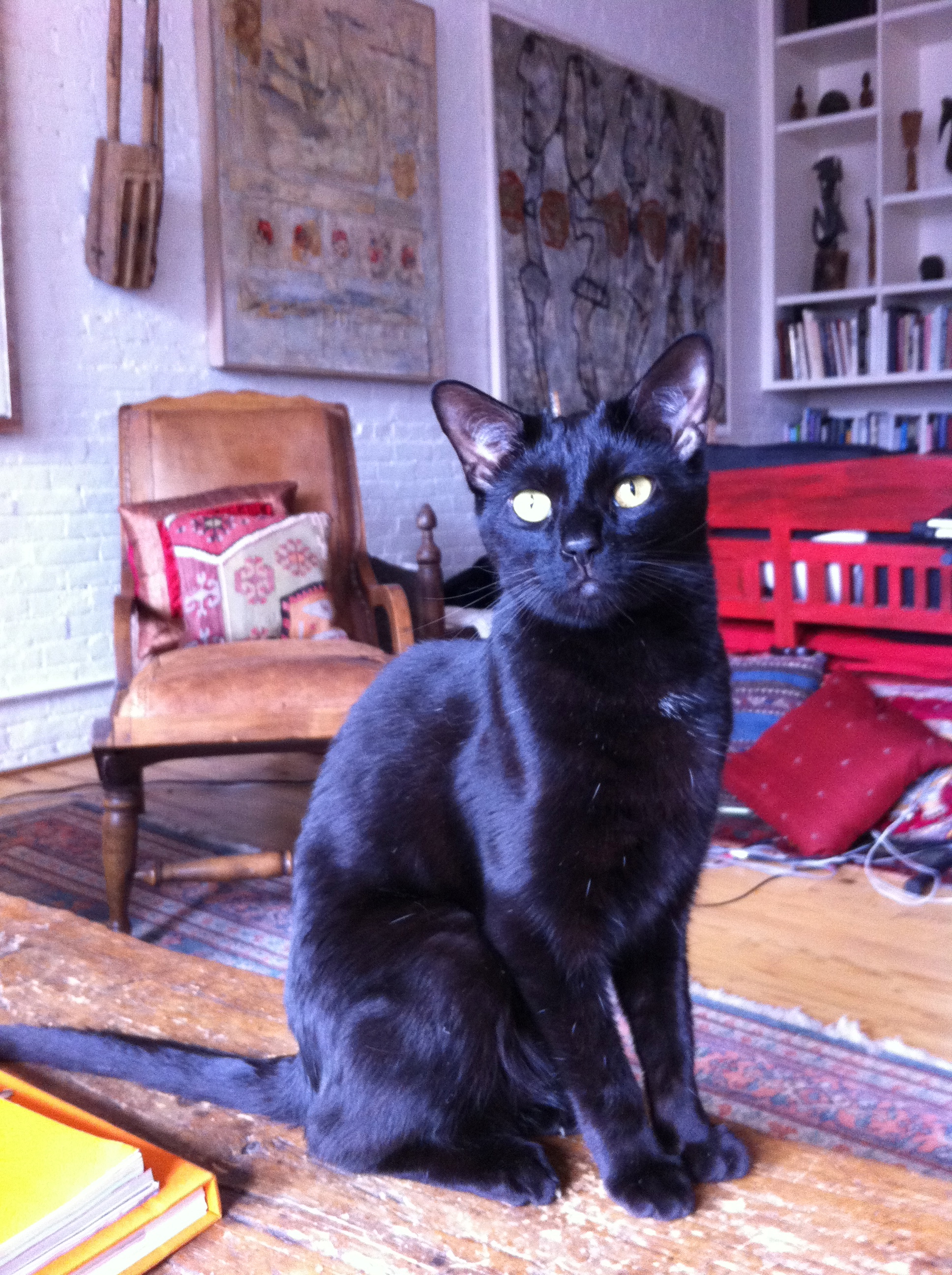
Merlin does not need a costume and will go as is.

IMG_3246

Halloween is a big deal here in New York City.  The halloween parade draws tens of thousands of people and our block is impossible to get to with all the police, crowds of people and barricades.  I would be happy to get dressed up and stay home, answer the door to the few children in our building who might ring the door bell and hand out treats.  However I am the only one who feels this way when it comes to going out for Halloween.

Even though I’m not big on the actual going from door to door and making my way through the crowds of people part of halloween, I do love preparing for Halloween.  I wrote a post about some of this on my other blog, Where Art and Life Meet and posted lots of wonderful photographs of pumpkin carving, halloween wreaths and halloween treats.  So for all you crafts and art lovers, go look at the photographs I posted.

I will end this post with a photograph of one of the many pumpkins we carved last weekend.  This one was made by Richard.  He did not use his executioner’s axe.

A Grinning Pumpkin made by Richard Long

A Grinning Pumpkin made by Richard Long

HAPPY HALLOWEEN!

The Curious Incident of the Dog in the Night-Time: an opinion by Richard Long

Magnificent.

That’s my one word review.  If you want a more detailed critical analysis of the play’s many virtues (the few shortcomings can be filed in the nit-picky drawer), check out Ben Brantley’s New York Times review. I agree with his assessment almost point for point, though I was offended by some of his phrasing, like his description of Christopher, the play’s teenage autistic protagonist as: “a parent’s nightmare.”

That aside, Brantley does a wonderful job describing the exceptional direction, lighting, set design, sound design, choreography, and tour de force acting of Alex Sharp in the role of Christopher. Plus, there’s a great slide show! And a video!

What can I add to the conversation? Well, I’m the father of a soon-to-be-teenage autistic girl, an avid theatergoer, extremely opinionated, harshly critical and always correct. Most pertinently, I’m a person.

One of the things that bugs me about many fictional works with autistic characters is the implied or stated assertion that a specific autistic character represents all autistic people. When Christopher says he thinks that “metaphor” is nonsense early in the play, I admit that I rankled a bit, thinking something along the lines of: Oh, so this playwright thinks all autistic people think and talk with absolute literalism! Emma clearly loves metaphor and uses it very skillfully! Then I clamped down on my kneejerk reaction and recognized that the author was telling Christopher’s truth, not Emma’s. Christopher was a person.

In or out of the theater, I’m really annoyed by the ASD label and the gross misrepresentations of autistic people with cookie cutter characteristics which are total nonsense, particularly when used to define a group comprised of millions of individuals: Lack of empathy and compassion. Literal thinking. I could just as easily write an essay describing the “symptoms” of NASD (Non-Autistic Spectrum Disorder): self-obsessed, easily bored, oblivious to their surroundings, ruthlessly ambitious (or woefully apathetic), etc. etc. etc.

Given the amount of buzz this play is generating, I’m certain most people in the audience knew that the main character was autistic. What assumptions were packed in their bias baggage when they walked in the theater? What new assumptions were bulging out the sides when they walked out? Did they go away thinking Christopher was Autism personified, the spectrum poster boy? I have no idea. Did they automatically assume that the characters of Christopher’s father and mother represented every father of every autistic kid? I certainly hope not.

My own bias baggage was bursting at the seams before the play began. I was hoping for the best (a dear and very generous friend had given us the tickets and I wanted to rave about how wonderful it was) but I braced myself for the worst: the usual onslaught of tired and untrue generalizations about autism. I was very pleasantly surprised that the words “autism” and “autistic” were never spoken by any character. The audience is told that Christopher is in a special-education type school, but there are no teachers or doctors hammering home his diagnosis.

I was relieved that many of my “autistic cliché” buttons remained unpushed, yet there were some scenes that were especially difficult for me, like when Christopher ridicules the non-speaking and more severely disabled kids in his class, calling them “stupid” and “lazy.” I found that very upsetting, since Emma would be one of the kids he underestimates in such a demeaning way. However, I was able to see that viewpoint as Christopher’s truth (or the author/playwright projecting himself into Christopher’s character), which made it less personally offensive. It did hurt to hear things like that, but the pain I experienced was much less than the anguish I felt when Christopher learns how deeply his father has betrayed him.

As the parent of an autistic person, the scenes of Christopher’s journey to London by himself were the most harrowing. Looking back now, I wonder if my experience was really so much different than others in the audience. Perhaps some of them were also parents of autistics, and knew firsthand how terrifying it is to lose sight of your child in a crowd, knowing he or she will be overwhelmed and/or confused by sensory bombardment, or worse, that your child will be unable to speak well enough to tell anyone who their parents are, or where they live.

I’m quite sure that many of the audience members were parents of non-autistics. Maybe they also knew how terrifying it was to lose their children, even though their kids didn’t have sensory or speech issues. And even if they had never experienced that kind of loss as parent, it wouldn’t be hard to imagine it. A lost child is every parent’s worst nightmare (not having an autistic child, Mr. Brantley).

I doubt that this type of situation would be difficult to imagine for people who weren’t parents at all, and never will be. Haven’t we all had a childhood experience of being lost and alone? Don’t we still fear it as adults?

I’m not sure whether these distinctions between audience members really matter, outside of one’s ability to openly experience the inner lives and outward circumstances of the characters. All the characters in this and every well-written play represent some aspect of our shared humanity. Most people can relate in some way to well-drawn characters (even the monsters), because their essential humanity or lack of humanity speaks to our own felt and imagined worlds.

It is mentioned on a few occasions in the play that Christopher, “doesn’t like to be touched.” As Emma’s father, I know how painful it feels to not be able to hug Emma when she’s crying after an injury or upset. I want to comfort her (and myself, if I’m being honest). But Emma doesn’t want me to hug her like that. It makes her feel even more distressed. So yes, I felt that pain acutely every time it happened in the play–and it happened a lot. But again, I suspect that people who never had a parenting experience like mine felt a high degree of empathy (with both Christopher and his parents) when he pushed away his too-huggy mother and father.

One of my favorite recurring elements in the play was a tender hand-touching-hand routine between Christopher and his parents. It was clear that they had developed this interaction as a means of conveying their mutual love, concern, understanding and trust. I wonder what our world would be like if we were obliged to communicate without words when we were hurt or upset–where only a simple, silent pressing of palm against palm had to convey all our thoughts and emotions. I suspect it would be a helpful improvement, at least for us “talkers,” as Emma refers to non-autistic people like myself.

I so often get into trouble with words. Yet as a writer, as well as a person, spoken language is my primary communication toolbox. Emma has said that she doesn’t think in words. I still don’t fully understand what that means, how Emma really does think, or perceive the world, but I imagine it’s more like Christopher than myself.

“I see everything!” Christopher exclaims on the train to London, as scenes of the countryside flash by in the windows. Then he describes everything he sees at an accelerating pace, building to a crescendo of overwhelming sound, light and sensation. Fortunately for all of us, theater isn’t limited to words. Nor was the playwright Simon Stephens and the director Marianne Elliott, who did a spectacular job of utilizing every aspect of the form, to not only entertain, but to touch us as deeply and intimately as two palms pressed silently together.

Curious Incident of the Dog in the Night-Time, TheEthel Barrymore Theatre

“Mistaken Beliefs People Have”

I asked Emma what she wanted to write about this afternoon during her writing session.  She typed, “Deconstructing the mistaken beliefs people have.”

I encouraged her to continue and asked what she was thinking of specifically.  She typed, “Mostly what people think they understand there cannot be, when talking about autism, creating lots of bad ideas that attract unoriginal therapies we must put up with.”

“Wow!  Keep going,” I urged.

“Actors playing roles the audience greets with enthusiasm, but an autistic person who doesn’t speak as expected, or at all, is booed off stages throughout the world.”

“Such a great point,” I said.

Emma typed, “The people of this world need to be exposed to difference and then shown compassion for their ignorance and limited thinking.”

She smiled and then typed, “Put it on the blog!”

And so I am.

Austin1

Scripts – A Communication Bridge

Something happened yesterday that was hugely helpful and gave me some staggering new insights.  I’m hoping this might be helpful to others as well…  The details do not matter, so don’t get caught up in them.

Em and I do the same thing every Wednesday morning, we go visit B. whom Emma loves and also types with.  But this time someone else asked to join us and when I asked Emma what she thought, she said out loud, “Yes!”  She said it with a great deal of enthusiasm, as though she liked the idea.  However I have learned to always verify any spoken words with some other type of confirmation so I held my two index fingers up and said, while indicating the left one, “Yes” or, and then indicated the right finger “no”.  Emma repeated “Yes!” and pointed to my left finger.  Satisfied, we joined the third person and made our way up the street.

A few blocks from our destination, Emma began saying out loud, “City tree house.”  This is a place for small children and it has been the cause of a great deal of anxiety.  I could see, by both the expression on her face and her tone that she was becoming increasingly upset.  By the time we arrived at B.’s Emma was really worried, anxious and very unhappy.   I was doing my best to talk to her about city tree house and how it is one of those places that caters to very small children when  Emma sat down next to B and typed, “You did not listen to my words last time.”  I, thinking she was referring to another conversation we’d had the week before asked if she was referring to that conversation, but she said she wasn’t.  She said that she did not want this other person, who was now sitting in the room, there.  The person said not to worry and immediately got up and left the room

After they left I said, “But I asked you before we left Emma, so I’m confused,” Emma then wrote, “If anxiety rises after choices are made then it may be inaccurate.”

What followed was an incredible conversation about how a decision can be made only to realize that it is the wrong one.  When this happens, go to scripts that are based in memories of anxiety begin.  As we talked I suddenly remembered a conversation I had several years ago with my friend Ibby.  This was a time before Emma was typing with us and I was asking Ibby for her thoughts about some of the things Emma would say out loud that I found baffling.  Ibby told me that I mustn’t try to do a word for word translation, but needed to feel the emotion behind the words and try to understand the context that way.  I remember being utterly confused by Ibby’s explanation and suggestion, but now, today, I get it, in a way I have not understood until now.

I asked Emma to verify all of this before writing about it and she affirmed that I am understanding it correctly.  In the past I would have gotten all tangled up in the specifics of what she was saying.  I would have sought to reassure her about whatever it was.  But now, I understand that these scripts can serve as so much  more.  They can serve another purpose.  They are less about the words spoken and more about the emotions that are attached to them.  So when Em is happy she will often speak of some of her favorite people.  She might reference something that happened more than eight years ago, but that made her feel safe, or a specific time when she was really happy.  I’ve always thought these memories were nothing more than that.  Memories she enjoyed voicing out loud, but nothing more.  But now.  Now, from what she typed, I understand that they are much, much more than random memories.  They are a kind of communication bridge.  A way of saying, I’m happy!  Or I’m feeling really sad, or this is causing me terrible anxiety, but it’s more than just a vague statement about a feeling, it’s actually a brilliant way of trying to convey much more.  It’s a way to communicate a whole series of feelings.

The more I think about the conversation we had, the more I feel I am understanding.  Those scripts are like flashbacks in a movie.  They give us a tremendous amount of information and are symbolic of so much.

Emma ~ 2012

Emma ~ 2012 

Cynthia Kim of Musings of an Aspie wrote about scripting too – Echolalia and Scripting:  Straddling the Border of Functional Language (funnily enough Cynthia and I have done this before, written about the exact same topic on the same day!)

The Assumptions We Make

When I first heard the words “presume competence” I had no idea what that meant.  I cobbled together some ideas of what I’d read and thought it meant and did my best to put them into action.  I did a great deal of “acting as if” and reminded myself, when my daughter wandered off in the middle of my explaining something to her, to keep talking anyway.  When she didn’t seem to look at whatever it was I was showing her I pretended that I knew she was taking it all in.  I pretended I believed, even when I didn’t.  And when my energy was depleted I would not place demands on either of us.  If I wasn’t able to take actions that were centered in presuming competence then I tried not to take any actions at all.

In the beginning the best I could do to show a presumption of competence was to read age appropriate books to her.  This was when Emma was eight years old.  I still remember the first book I read that wasn’t considered “young” for her age.  It was a biography of Balto, the Siberian Husky who raced through a blizzard in whiteout conditions delivering a much needed serum saving countless people sick with diphtheria in Alaska.  After Balto, I read a biography of Helen Keller specifically for children and then, because Emma seemed to enjoy it so much, we read the autobiography of Helen Keller, all the Mary Poppins books, followed by The Wizard of Oz, Alice in Wonderland, The Secret Garden, The Tale of Despereaux, Winn Dixie, Bridge to Terabithia,  Little Women and on and on we went.

At first I was unsure whether she was even listening, let alone enjoying any of these books.  But one night as she settled into bed, and when I didn’t pull out a book, Emma sat up and said very clearly and distinctly, “Helen Keller.”  Emma was not typing yet, so I wasn’t completely sure she really wanted me to read Helen Keller or if she was just saying the name because it was what I’d been reading.  I distinctly remember questioning whether she really wanted me to read the book because it interested her or because this was just part of an established routine and then I had a moment of guilt for doubting her.

As I said, Emma wasn’t typing yet, so there was little we could point to that backed up our decision to presume competence.  There was no “evidence” to suggest what we were doing had anything to do with anything other than a hope and a wish.  As presuming competence is not typically done in the general population or at any of the schools she went to, we were definitely doing things differently.  There were times when I doubted what we were doing. There were times I didn’t believe.  There were times I wondered – what if we’re wrong about all of this.  What if what everyone says is true, really is?  What if?  What if?

In the end I just kept coming back to the thought that presuming competence harmed no one, but to not presume competence and to be wrong would do tremendous damage.   As time went on and it became clear just how many mistakes we had made, I became more determined than ever to err on the side of support, encouragement and believing in her rather than the other way around.  It is strange that the focus is so often on all that is challenging, rather than encouraging all that is not.  Often that thought was the only thought that kept me moving forward.  Sometimes one idea, just a single idea is all it takes.

To presume competence became a living amends and a way of life.  At the very least it is something I can do that is not going to add another item to that lengthy list of mistakes made.

Emma and Balto ~ 2010

Emma and Balto ~ 2010

Question for Non Word Based Thinkers

Four mornings a week Emma begins the day with a Skype call with a professor in New England who is a bio-chemist.  We call him Dr. C on this blog.  They have a close relationship and their conversations flow easily between them.  I am very much the observer most of the time.

This is a sample of one of their more typical exchanges:

Dr. C:  So if water were linear and not bent what effect would this have on life on Earth?

Emma:  Hydrogen would not be able to find connections to create networks, life as we know it could not be.

Dr. C:  Right, so there would be no dipole or tiny magnet, thus water would not align with a + or – side….

The session before this one, Dr. C asked Emma, as a homework project, to construct a Benzene (C6H6) model, which Emma then did.  It looks like this:

Benzene

Benzene

The final piece of the homework assignment was to draw the corresponding Lewis Bond Structure.  This proved much more difficult and took about five attempts before she drew the structure below. (It is awesome and fabulously impressive!)

Lewis Bond Structure

Lewis Bond Structure

The Lewis Bond Structure is basically a replica of the actual three-dimensional model, so much so that you can literally place the model on top of it and it will pair up.  While making the molecular models of things like water, ammonia, methane and carbon dioxide are now fairly easy for Emma, drawing the Lewis Bond Structures are not and it reminds me of a similar problem that writing, handwriting and to a lesser degree typing presents.

I would love to hear other people’s thoughts on why this might be so, but watching Emma cheerfully putting together these models is absolutely fascinating.  And it makes me wonder if this isn’t a key to better understanding how teaching methods might take a page from organic chemistry…

If one thinks in a more three-dimensional way, does it then follow that trying to write, formulate the words to correspond with the thoughts, would present a whole series of challenges?  Doesn’t it suggest that this is more than a “word retrieval” issue?  I’m wondering if there even IS a word retrieval issue, (I plan to ask Emma later) but instead there’s a spatial issue presenting itself as non word based and therefore very difficult to transcribe.

Thoughts?

New Beginnings

Emma suggested I write about “new beginnings and offering ways to practice tolerance and hope for those who despair.”

I asked Emma what she suggested to those who are in despair.  She typed, “Best to give despair less space.”

“Yeah, okay.  How do you suggest people do that?” I asked.

“By filling the mind with all the beauty that is life,” Emma typed.

Yesterday Emma, B. and I talked about what happens when one becomes overwhelmed and how this is a human response, no matter what the neurology.  Overwhelm and feelings of not being able to cope are things all people feel from time to time.  We discussed different ways people try their best to cope: taking a break, taking a nap, acts of kindness, identifying all one has, gratitude, helping others, being alone, quiet, taking a bath or a walk, being in nature…

Emma described her feelings of overwhelm as, “my mind becomes jumbled and louder.”  Her words certainly resonated as this is exactly how I feel as well when everything seems too much and feels more than I can cope with.  Then Emma typed, “there should be practice before it gets too jumbled.”  This then led to a discussion about meditation and how those who meditate regularly call it “practice” because it is something one does daily and can help when “the mind becomes jumbled and louder.”

At the end of a lengthy conversation Emma typed, “I do want to try meditation.” And so we will.

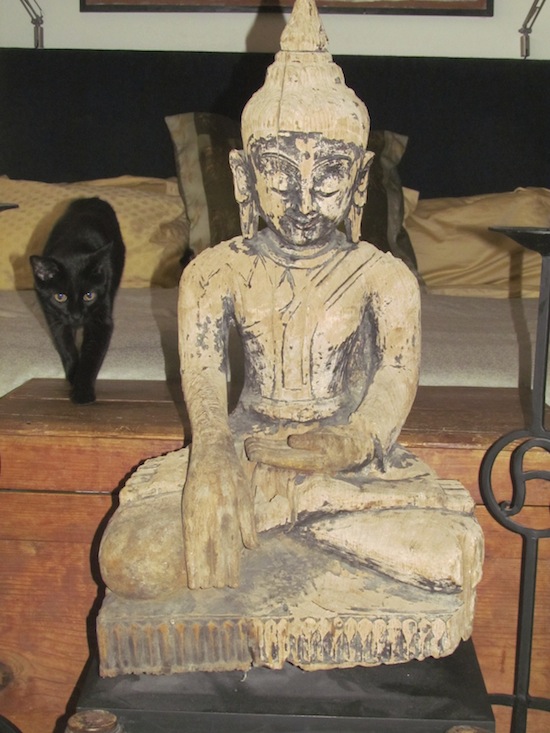
The Buddha with Merlin

The Buddha with Merlin

Raging Screams and Shame

The other week I was present for the following typed exchange by two people.  Both are Autistic and both cannot use spoken language to communicate.  (Their names have been changed, as even though both agreed to have their words published here, this issue is sensitive and distressing, as well as deeply misunderstood by most non autistic people.)

Layla:  You have an extremely loud stomp.  (This was in reference to the noise Jerry made several days earlier and that Layla heard while working in a neighboring room.)

Jerry:  Is that a guess or are you certain?

Layla:  If you tried to hide it then you gave away the secret.

Jerry:  That is what I am behaving like on some days but proud I am not.

Layla: I heard it all and was curious and wanted to give help.

Jerry: Really do you believe that I am not evil?  (J. turns his head so he is staring down at the table.  His body is completely still.  It is a noticeable change from the way he usually sits while having a conversation with Layla.)

Layla:  Evil is not this and best to forgive yourself.

Jerry:  Thank you for not judging me.

Layla:  I  only ask for the same respect.

Jerry:  The deal is on.

I asked Layla and Jerry if I could transcribe their conversation and publish it here because non speaking Autistic people and the way they act in times of stress or overwhelm are so poorly understood.  Non autistic people who witness the actions (often termed “behaviors”) of a non-speaking Autistic person who is overwhelmed, perhaps frightened, often ashamed, unable to control their movements and unable to express themselves are often viewed with annoyance, irritation, fear and/or bewilderment.  As the non-speaking person cannot make themselves understood, they are at the mercy of those who care for them.

As I watched this conversation unfold I was struck, once again, by the disconnect between what most of the world believes about autism and Autistic people and the reality.  Jerry expressed profound shame and upset and Layla responded with  identification and deep compassion.

Their exchange reminded me of something Emma wrote about four months ago after having had a terrible night.  I wrote about that ‘here.’  One of the things she typed was:  “Pounding terror is all that remains.”  More recently she wrote, “The raging screams in my head are starving and want to consume me.”

Raging screams…  Pounding terror…

August, 2014

August, 2014