Monthly Archives: April 2013

Trashing Common Misperceptions About Autism

“Trashing Common Misperceptions About Autism and Autistic People and Creating a New World” – that’s what I first wrote as the title for this post, but it’s a mouthful and given the limit on characters on twitter, I revised it.

We just returned from Tampa where Richard, Em and I went to a screening of Wretches and Jabberers and to stay with my friend Lauri and her family, or as Em referred to it, “Have sleepover with Henry three.”  Which is an apt description because we spent three nights there.  Four days and three nights of paradise.  Four days and three nights of being with another family and a whole group of friends, new and old who didn’t judge, but rather embraced, a truly inclusive group, coming together, eating, laughing, connecting, talking and typing.  It reminded me a little of my experience at the Autcom Conference this past fall, except it was far more intimate and this time my husband and daughter shared the experience with me.  For four days we were given a glimpse of paradise.   A little peek into what our world could be like, but isn’t…  not yet.

Many people believe, erroneously, that Autistic people aren’t as interested in having friends, developing relationships or crave having mentors as we, non-Autistics.  Those people have never seen Henry’s smile when he is around his mentor and friend, Tracy.

Henry & Tracy@USF

Those people who doubt, didn’t witness Emma’s tears last night when we returned home and she made me promise we would see Henry again and have another “sleepover” with him and his family.  They did not witness Henry and Emma’s laughter and joy from being around each other.

Em and Henry hanging out together by the pool
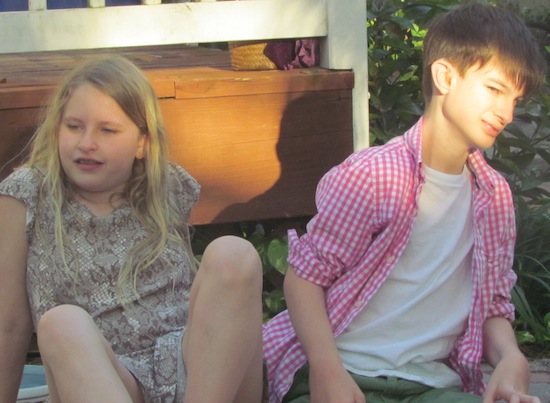
E&H -Friends

Larry takes Emma’s photograph – perhaps the single greatest compliment a person could receive.  (Amy Sequenzia is in the background.)
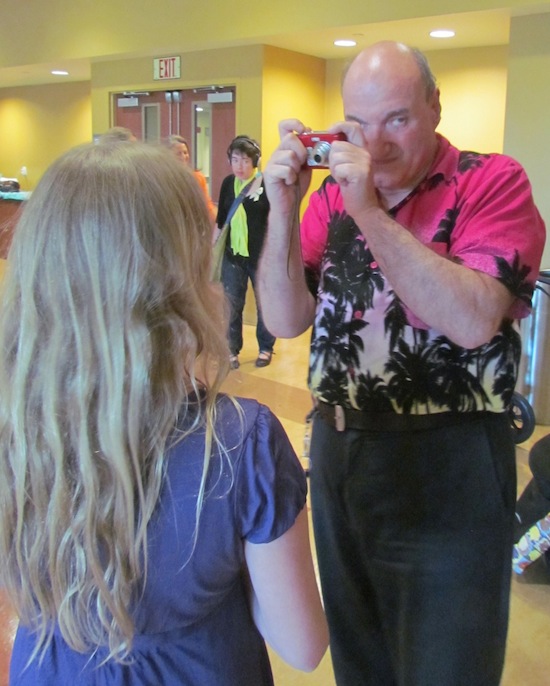
Larry takes Em's photograph

They weren’t there to hear Emma tearfully say last night, “Please Mommy.  Go back to Florida tomorrow?  Play with Henry again soon?”

Just because someone cannot or does not express with words their love for another in the way we might expect, does not mean they do not feel it.

Many believe that if a person doesn’t speak, or speaks with a great deal of scripting and echolalia they are not interested in communicating or have little to say.  Those people have never witnessed a typed conversation between those so-called, “non-speaking” or atypical speakers.

Harvey, Tracy, Pascal and Larry, the stars of Gerardine Wurzburg’s documentary, Wretches and Jabberers

H,T, P & L.

Emma, being the consummate performer that she is, could not resist occupying the seat Larry vacated during a break at the University of Southern Florida, the day before the screening, where she wrote for all to read – “My mom and dad hope to meet more people like Larry and Tracy.  Wow(*!)  I am stirring up a crowd(*.)  time to work with people at home in new york to show them it is the intelligent emma there…”  *punctuation was added by me for the purpose of this post and indicates the smile Em gave and the pause she took between typing “crowd” and “time”.
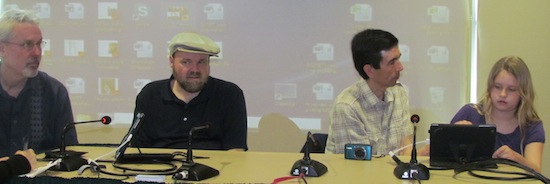
Harvey, Tracy, Pascal & Em @ USF

Em Types@USF

Many people are surprised to learn that even those who do not speak can have wonderfully nuanced senses of humor, can enjoy deep, meaningful friendships, have a great deal to say and are often far more profound than most speaking people are in any given 24 hour period.

A conversation between Tracy, Henry and Emma about getting on board the “inclusion typing train” the night before the Wretches and Jabberers screening.  Tracy is to Henry’s right and out of the picture frame.

H &E type

Tracy, Henry and Emma make a “pitch” to Academy Award winning director, Gerardine Wurzburg who was standing nearby!
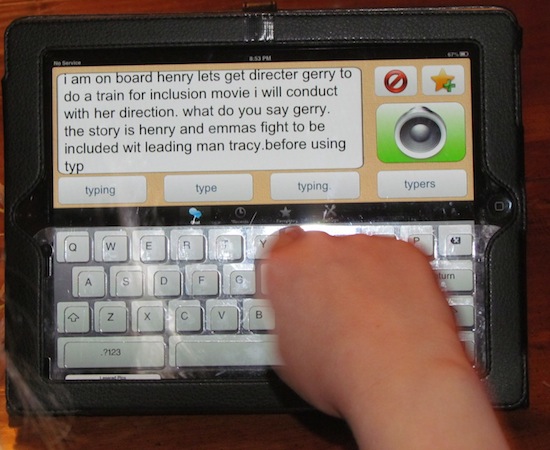
Em types

Em takes Gerry Wurzburg’s photo 

Gerry Wurtzburg

Many people assume Autistics have intellectual limitations commensurate with their “severe” and “moderate” labels, yet given appropriate accommodations this idea has been proven wrong again and again.  Yet another reason those labels are not only meaningless, but actually damaging.

Tracy types in answer to a question from the audience about the impact the documentary and meeting monk Hogan has had on his life.
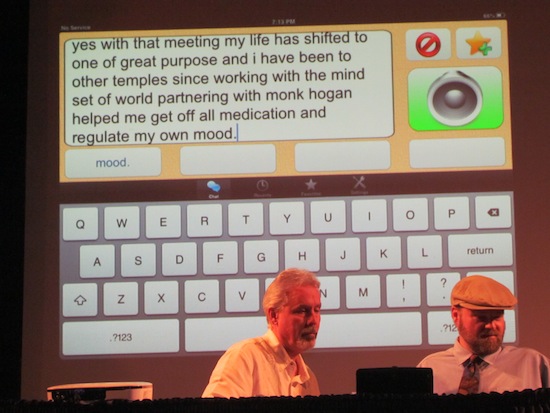
Tracy @ W&J screeening

Many people believe inclusion of Autistics in schools will “bring the other children down” and that inclusion in society will be harmful, when the truth is the opposite with many studies proving this.   (Why this even needs to be proven, is something I am still trying to wrap my mind around!)

Mary Schuh (director of development and consumer affairs at the National Center of Inclusive Education Institute on Disability) and Henry at the Wretches and Jabberers screening at the Tampa Theatre, April 6th, 2013.  Henry is now attending the public school near his home.
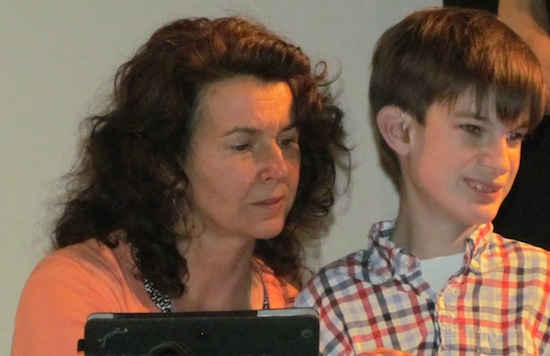
Mary & Henry

These are only a few of the beliefs people have when it comes to autism and Autistic people.  Yet, if people were able to witness a weekend such as the one we just experienced, I guarantee their minds would be changed and we would be one step closer to creating a new world.

*Emma approved this post.

Those Who Influence..

There have been a number of Autistic people who through their writing or by meeting them have greatly influenced my thinking and radically changed how I view autism.  Through their writing and/or our direct interactions I began to question everything I thought I knew.  I began to see that so much of the information I’d been given was false.  It was because of these people that I have a level of understanding about the problems with *functioning labels, the problematic issues surrounding *segregating Autistic children from other non Autistic children not only in the classroom, but in life.  I have a better understanding about how *important the words used to describe autism and Autistic people can do tremendous damage or, conversely shift the conversation to one of better understanding and progress.

*I have put related posts below for each of these topics.

All of this brings me to Ibby.

Ibby was/is someone who radically changed my thinking, and continues to change how I think about autism and my daughter.  I have written about Ibby before ‘here‘ and ‘here‘.  We met at a disabilities conference not quite a year ago, where she was presenting.  Ib has changed my life.  I don’t know how else to describe someone who is not only a close friend, but who has patiently advised me, explained things that I didn’t understand, didn’t judge me, never shamed me, but instead was kind, loving, compassionate and very, very patient with me.  For those of you not familiar with Ibby, I hope you’ll go to her blog and read her writing.  If there is one thing I would like to see change regarding autism”awareness”, it is that the public become familiar with Autistic people like Ibby, who are tirelessly speaking out and patiently trying to bridge the massive gap between public perception surrounding autism and Autistic people, and reality.

There are a number of people who have been crucial in influencing me, Ibby is one of them.

Related topics


What I Wish I’d Been Made Aware of When My Daughter Was Diagnosed With Autism

What follows are some of the things I wish I’d been told (and given) when we learned Emma was Autistic.  These are the things, in retrospect, I wish all those doctors, specialists, pediatricians, therapists and people who dedicate their lives and careers to autism had told me, but did not.  I believe our lives would have changed dramatically had we been told even a few of these things.  It is my hope that for those of you who may be at the beginning of your journey with an Autistic child, this list might help you avoid some of the many, many mistakes we made and a great deal of unnecessary pain.

1.  Seek out the work of Autistic people ~ most of the work I’ve listed was not available when my daughter was diagnosed, but it is now.  Take advantage of all that is out there, these people are leading the way.  If I had to choose just one thing that has had the single greatest impact on my life and the life of my daughter, it is these people.  My gratitude to all of them doesn’t come close to covering how I feel.  I have compiled an extensive list of blogs and books written by Autistic people as well as a couple of documentaries that are a MUST WATCH!   on the “Resources” page on this blog.  Please go take a look.

2. Autism is not a disease.  Read Don’t mourn for us by Jim Sinclair.  This may take some time for you to understand.  It’s okay.  Get the help and support you need so you can better help your child.  Try to think of autism in the same way you think about any groupings, a Mac and a PC, fiction, non-fiction, memoir and young adult, a shirt, a pair of pants, shoes and socks, a microwave and a gas heated oven.  Autistic, Neurotypical, Allistic, (or my personal favorite, coined by a friend) NT-NOS, we are all human beings.   Try not to judge one over another.  Judgment will not help you help your child.

3.  Presume Competence.  (This ‘post‘ helps explain what presuming competence means.)  If a therapy and/or professional does not approach your child with a presumption of competence, please consider finding one who does.  Tremendous long-term damage can come from not presuming competence.  Rethink how you view communication.  Listen to your child, not just to words, but to body language, facial expressions.  You may be surprised by the ways your child is communicating despite not being able to do so verbally.  Teach her to point with her index finger, first with support if needed and as time goes on, fade the support. Give her the appropriate tools and support so that she can learn to type or communicate by pointing to a letter board.    There are many wonderful iPad apps that can help with this.  Begin with sequencing games and colored tiles, or if she’s musical, notes.  Join them together to make patterns.  Show her first, have her mimic.

4.  Do not speak of or about your child as though they cannot and do not understand or hear you  (read Barb Rentenbach’s book for more on this).  This is something we did without thinking for years.  Sadly it is not the only regret I have, but one of many.  Still it is worth repeating.  Chances are your child can and does understand what you’re saying even if they do not show any signs that you recognize.

5.  Throw out everything you think you know and question everything.  There is a massive amount of misinformation/myths disguised as truth and fact regarding autism.  You may hear people say things like “They are in their own little world,” or “they are imprisoned behind their autism” these phrases are perhaps an accurate reflection of what non-Autistic people feel about the Autistic person in their life, but they serve to divide rather than unite and ultimately serve none of us. Be suspicious of anyone who says they know what causes autism or how to “treat” it.  Disregard any organization that describes autism and your child as tragic, an epidemic, a burden or any other word generally reserved for warfare.  If you read or hear something that causes you to feel fear, walk away, it is most likely inaccurate and intended to make you afraid.  None of us are able to help our children when we are terrified.  Fear can cause us to make decisions we will later regret.

6.  Set your child up to succeed.  My daughter is extremely sensitive to criticism.  Saying “No!” or criticizing her does not help her learn, but instead makes her feel badly about herself.  Encourage her with smiles and by asking her to try again.

7. Do not try to make your Autistic child behave like a non Autistic child, instead encourage your Autistic child to be the very best ______ (fill in your child’s name) they can be.  For more, read ‘this‘.

8.  Avoid comparing your child to any other child, Autistic or otherwise.  I have struggled with this one and continue to.  All I can say is, this is a work in progress. I hope one day to “know” this and refrain from doing it as it gets me into “compare and despair” thinking faster than anything else.  Emma is Emma.  She is best served when I remember this fact.

9. We parents are fallible.  We will make mistakes.  I’ve made dozens.  I wish I hadn’t made quite so many.  But I have.  If there is one thing I know without a doubt it is this – I will make mistakes, I am human.  I can admit my mistakes, tell my daughter how sorry I am, make a living amends to her by doing everything in my power not to repeat the mistake and continue to move forward without beating myself or anyone else up.  As my wise mother once said, “Show and tell your children over and over how much you love them, and one day they will forgive you.”

10. Get to know Autistic adults.  One of the single biggest misperceptions surrounding autism is that autism is only seen in children.  Autistic adults are often our best teachers and  many of them are leading the way so that our children’s lives might be better than their own.  These people are courageously and tirelessly pushing back against the deeply ingrained prejudices, biases and misperceptions that are rampant within our society.  (See #1)  It is my goal to honor these people who have beaten a path ahead of my daughter so that she may more easily live in this world that so often will not and does not accommodate her or give her what she needs to flourish.  They are speaking out, let’s all get behind them and give them the microphone so that more can hear what they are saying.  One day, the person holding that microphone might just be your child!

The year after Emma was diagnosed ~ 2005

Em - 2005

Autism Awareness?

It’s interesting to note that the word awareness, when paired with the verb “to be” as in – be aware, is easily visualized and thought of as, “beware” which dramatically changes the meaning.  It no longer is a word of benign information, but instead is a word of caution and fear.  I do not think this is a mistake.  I know it’s cynical of me, but I think Autism Speaks, the single largest organization involved in Autism and the creator of the “Autism Awareness” campaign, chose their wording carefully.  I’d like to think I’m giving them more credit than they deserve, but for a company that spends more on PR than they do on actually helping families and those who are Autistic, I don’t believe I am.

My awareness of autism has dramatically changed over the years.  It has changed because of the information I’ve found and been given.  In the beginning, my information came from books, autism organizations, various professionals, a couple of neurologists, our pediatrician; surprisingly the more “credentialed” the person was, the more likely they were to admit how little they actually knew about autism.  In retrospect this was my first real lesson in awareness – beware of organizations and those who believe they “know” all about autism, whether that is the cause or which specific methodologies, treatments or therapies your child will be best served by, because they do not know, despite how vehemently and persuasively they may speak.

As time went on, I became increasingly aware of my own misery.  The common misery supposedly shared by us parents, dominated the conversations surrounding autism.  I became fixated on the “fact” that autism was the cause of my misery and set about removing it from all our lives.  This is where awareness took me.  This was what I knew and understood.  But this is not the sort of awareness I want to be a part of.  This is not the kind of information I wish I’d gotten, nor is it the information I hope other parents and families will receive.  Those first few months after receiving the diagnosis are critical.  How we talk about autism and by extension our Autistic child changes all that we then do and where we focus our energies.

Autism did not cause me to be miserable.  I was concerned and I was scared, but my daughter’s neurology was factually not what frightened me, it was what I was being told about her neurology that terrified me.  Had someone said to me when we were still trying to get her out of diapers when she was seven years old – “it’s going to be okay, here are a couple of different things you can try, but remember most people do get out of diapers, eventually” I would have felt a little calmer.  Had someone said to us when our daughter was six years old, “read to her age appropriate material, teach her age appropriate lessons” I might have felt confused, I might have had a great many questions, but I wouldn’t have felt the fear I felt when we were informed she could not possibly be placed in a school with her same age peers.  Had someone said to us when we first received her diagnosis, “presume competence, she can and will learn, but she will learn at a different pace, she will learn differently than you might expect” I might have felt concern, but I would not have felt the kind of despair I felt when I questioned whether she was capable of learning at all.

If we want to have more awareness about Autism then let’s have it come from those who are actually Autistic.  Because if you are like me, these are the people who will change your views and shift your mind away from the “tragic” to the far more helpful information that might actually help you help your child.  The kind of information that opened our minds to different forms of communicating, different ways of learning, all those things that have actually aided us in helping our daughter.  Our judgments about her neurology and all it meant to us and her, did not help us do anything but feel more fearful and miserable.

Below is a small list of people I know and am in touch with.  I’ve provided a link to their blog, book(s) or film to each of their names.  I will feature more people who have helped me in my growing awareness during this month of April.  I’ve separated those who can speak, but depending on the circumstances lose speech, with those who mostly do not speak, but ALL communicate.  Want to become aware?  Read their words.

Non-Speaking Autistic:

Amy SequenziaBarb Rentenbach, Peyton Goddard, EmmaTracy Thresher, Henry Frost, Tito Mukhopadhyay

Autistic:

Ibby Grace, GareethKassiane, Paula Durbin-Westby, Landon Bryce, Julia Bascom, E., Renee, Judy Endow, Michael Scott Monje Jr.

Be the Very Best YOU, You Can Be

There’s a great deal of talk about acceptance regarding autism this month, which is a wonderful shift from all the talk about “awareness”.  As I think more about acceptance I am aware of how often I think about “embracing” as in embracing all that each of us is, without trying to mold ourselves to be something we aren’t.  What if instead of doing everything in our power to force our autistic children to behave like some imaginary and impossible non-Autistic version of themselves, we instead encouraged them to be the very best Autistic them they could be?  The same way we do everything in our power to help our non Autistic children be the very best they can be.

Isn’t that what all of us are trying to do?  Aren’t we all trying to be the very best we can each be?  So what does that look like, how do we do that?  Well, by recognizing what we’re good at, for starters.  One of my brothers is an astrophysicist and the other is a micro-biologist.  My mother was a chemist, my father a financial advisor and I don’t have a “science-y” gene in my entire body.  In college I did everything in my power to avoid both science AND economics.  These subjects are of no interest to me.  Were someone to tell me, well, you know, your most successful same age peers all love and excel at these topics, therefore you need to apply yourself more to them, and I was then forced to take these classes and was not allowed to pursue my love of art, drawing, design, literature and writing, I would be miserable.

I don’t want to spend my life crunching numbers, looking at stock portfolios, and peering through microscopes.  None of that interests me.  Hand me a book on quantum physics and I fall asleep.  The only good that comes from giving me books like that to read is the money I save on unfilled Ambien prescriptions.  I will never be, nor do I want to be, a scientist or economist, I accept this fact completely.  I don’t feel ashamed by my lack of interest.  I don’t feel this is something I should feign interest in.  I have other interests and talents; I focus on those and am very happy.  That’s what we all do.  We avoid the things we aren’t so great at, and often have little interest in, and focus on what does interest us and where our talents lie.  If we were lucky we also had parents who encouraged, supported and cheered us on in pursuing those interests.

Why should any of this be different for our Autistic children?  I don’t want Emma to try to be someone she isn’t.  I want Emma to be the very best Emma that she can be.  Which means I need to support her interests and help her find the best way to communicate.  Verbal language is tough for her, typing seems to help her access a part of her mind, that verbal language cannot, so we are doing all we can to support her typing.  How she communicates is not as important as that she be able to.  She loves to perform and sing loudly, so we have a variety of microphones and an amp that she can use to hone her singing skills.  She loves her books, so in between reading her favorite Miss Spider book, I am teaching her about arachnids, what they eat, how long they live, how many legs they have and how they spin webs.  Spiders are actually kind of fascinating. Even though Emma loves the Miss Spider books because one of them includes an electrical storm (lesson plan coming on that topic soon!) and Miss Spider has a great many big emotions, which Emma likes to act out, complete with wringing her hands and pretend tears and cries of anguish, there are a great many topics I can piggy back on, to teach her about things like – the weather, electrical storms, any and all big emotions, pretend and real, etc.

I want to encourage her to explore all of these things and more.  Last night she wanted to watch a really bad movie that she’d seen her brother Nic watching about a two-headed shark who attacks a group of teenagers.  And despite my misgivings about the content (and just awful quality of the movie in general… The acting is phenomenally bad, the shark is the best thing in the movie) it was age appropriate and I figured I could turn it off if it got too gory and awful.  There was a great deal of emoting and blood curdling screams, which Emma thought hilarious.  She kept saying, “Watch out, the shark is going to come and eat you!  Oh no!  He’s going to bite your arm off!”  Then she pretended to bite me.  Bad movie, great time was had by all AND I now have another lesson plan I intend to create regarding sharks!

Be the very best YOU, you can be.  Now that’s the kind of acceptance I can get behind!

Acceptance And A Webinar

When my daughter was diagnosed first with PDD-NOS and later with autism, I easily fell into the ~ I-completely-love-and-accept-my-daughter-but-I-do-not-accept-her-autism ~ mindset.  At the time, this seemed perfectly logical and I didn’t think a great deal more about it.  Autism was the “problem” after all, not her, and once we got rid of the autism, everything else would fall into place.  When people said the word “acceptance” and “autism” in the same sentence I nodded my head yes, while my mind carefully separated autism from my daughter, plucked the word from the sentence and placed it into a box before closing the lid.

It took a very long time for me to understand that my daughter and autism were not to be separated.  And it wasn’t until I began developing real friendships with Autistic adults that I stopped trying or wanting to separate the two.  Acceptance is much more than tolerating something or saying – okay I won’t actively fight this any longer.  Acceptance is an embrace, it’s understanding and actively celebrating difference, it’s about looking inward and asking questions.  It’s about self-reflection and digging deep into the darkness of preconceived beliefs and being willing to be wrong.  It’s about saying – I don’t know and I don’t understand, will you help me?  It’s about being vulnerable and not “right” and it’s about the excitement of discovery and being curious and open to different ways of being and seeing the world.  To me, it is the most exciting way to live life.

To say I’m grateful to all those people in my life whose neurology falls under the Autistic label, would be a vast understatement.

Today at 4PM eastern time, Brenda Rothman of Mama Be Good, Melody Latimer of AS Parenting and I will be speaking about Parenting Toward Acceptance.  The webinar can be found at the following link – http://www.icdl.com.

In other news, I was more than a little surprised to see this – Top 10 Social HealthMakers