Monthly Archives: November 2010

Change

Saturday morning we could hear Emma’s scooter shooshing through the house before we saw her. She appeared at my side of the bed, with her Cokie in it’s designated “Cokie Pouch” and smiled at me. “Hi Mommy!”
“Hi Em!” I said. “Remember Cokie stays in your bedroom.” I stood up.
Emma raced off to her bedroom shouting cheerfully, “Cokie stays in your bedroom!”
What was utterly spectacular about the morning was, not only did Emma put her blanket back in her bedroom, but stayed in the living room, preferring my company to the solace of her blanket. Her thumb stayed out of her mouth as well. Emma’s thumb sucking, something I have lost sleep over more nights than I care to count, has deformed her mouth requiring years of dental work in the future.
The following morning, Emma arrived at the side of the bed. “Hi Mommy!”
This time Emma was not holding her blanket and later when I went into her bedroom, there Cokie was, stuffed in the “Cokie Pouch” and left on the oversized armchair. Emma stayed in the living room with the rest of us, cheerfully playing. She spoke more words over the past weekend, than any of us have ever heard. She pretended to go on the school bus, she acted out various children on the bus, admonishing them, “No spitting!” and “Logan, sit down!” She then pretended to go on the airplane to “visit Granma and see Claudie,” before going to “Becky’s class” where she recounted how she’d made Becky “so angry” by ripping the class copy of Goodnight Moon.
Emma’s continuous flow of dialogue was nothing short of profound. We were all astonished by it.
Thanksgiving With Emma

Yesterday we hosted Thanksgiving at our place.  It makes it easier for us in many ways to be home, as I love to cook and Emma can race around on her scooter while the rest of us enjoy each other’s company and later sit down to a thanksgiving feast.  Whenever we have a large celebratory gathering at our house, I put out a place setting for Emma, even though we know she won’t sit and eat any of the food I’ve prepared.  As I set the table yesterday afternoon, I allowed myself to imagine for a minute what it would be like to have all of us gathered for a meal, something I looked forward to with almost frenzied excitement as a child.  Not so with Emma.  Unless birthday cake is being served and then only if it’s vanilla cake with vanilla frosting, Emma can be counted on to forgo the meal.  Since she also cannot communicate in any substantial way, there is absolutely no allure for her to sit with us and we’ve given up insisting that she try.

So it was yesterday as our guests began to arrive, Emma in her “pretty dress” which actually was a taffeta skirt with tulle and a black turtleneck.  Emma insisted on yanking the skirt down around her hips so the gap between where the turtleneck ended and the waistband of the skirt began was substantial, giving the whole ensemble a kind of weird, grungy chic.  She shot around the living room on her scooter, while Nic joined us for conversation and hors d’oeuvres.

“Edie bring Toni books?” Emma asked as I was pulling the turkey out of the oven, checking on the nearly burned roasted vegetables and wondering whether I had ruined the meal, while the mashed potatoes warmed in the oven and the brussel sprouts were being sauted on the stove.

“What?” I asked.

“Edie bring Toni books?” Emma repeated.

“Who’s Edie?” one of our guests inquired.

“He delivers UPS packages.”

“Edie come?” Emma asked.

“Yes, Em, let’s order some books tomorrow and Edie can deliver them.  But you have to tell me what books you want,” I said.

“Edie come?  Edie bring Toni books?”

It’s not clear why Emma has equated my sister or someone else with the name Toni, with getting books.  The last book Edie delivered for Emma was a book we couldn’t find at Barnes & Noble, so ordered online a few months ago.   Ever since, but recently with increasing excitement Emma has been requesting that Edie deliver books to her.  We have asked her numerous times to specify what book she is hoping to receive, with little success.

Eventually Emma gave up and contented herself with listening to music on her ipod only reappearing at the end of the meal.  “Dinner is all done,” Emma announced.

We had retired to the living room so no one was offended and thankfully she did not start bringing people their coats.  “Yes, Em.  That’s right.  Dinner is over now,” I said.

“Emma blow out the candles?”  Emma said as she leaned over the dining room table and blew a candle out.

“Yes, Em.  Go ahead.”  After which, Emma could be heard singing loudly to various music videos in her bedroom.

“Wow!  She really has a great sense of rhythm,” one of our guests noted.

This morning I went online with Emma and she chose several books, which I ordered and expect will be delivered in another week or so.  “Edie bring Emma books?”  Emma said when we finished the checkout process.

“Yes!” I said.  “You should get them in another week.”

“Next week,” Emma said, nodding her head.

“Yes.”

“Go to gymnastics?”  Emma said.

The School Bus

We received a call yesterday from Emma’s school saying the bus driver had yelled at Emma in front of the other children when she was getting off the bus. The driver claimed Emma had spit in her face. Richard and I were incredulous as neither of us have ever seen Emma spit nor did I think Emma was physically capable of projecting a pool of saliva from her mouth at a target, human or otherwise.
When we asked Emma what happened on the bus, she replied, “Emma so sad. You make Emma cry. Emma want to get off the bus.”
“Why did you want to get off the bus, Em?”
“Lady. You have to ask the lady. Lady, can I get off the bus?” Emma said while wrapping a strand of hair around and around her finger.
“What did the lady say?”
“NO! Emma sad.”
“But Em, what happened?”
“Emma go to gymnastics?” She looked at me and nodded her head.
“Yes, Sweetie. You’re going to gymnastics this afternoon,” I said.
By the time the bus arrived, Richard and I were no clearer on the actual events than before. As with many autistic children, their (in)ability to speak is much more than a language delay. The language they have is often garbled, confused and the thinking difficult, if impossible to follow. Emma’s reference to gymnastics in answer to my request for clarification as to the events on the bus suggested she feared she wouldn’t be able to go to gymnastics as a result. She had done something wrong, someone was angry, her beloved gymnastics would be taken away. Even after I reassured her she would be attending gymnastics, she continued to ask several more times.
Last night Emma woke me at 1:47AM screaming, “Mommy! Mommy! Mommy come!”
When I went into her room I told her if she continued to scream we would not let her go to gymnastics, something she’s been looking forward to for several days. It does make sense how she might conclude gymnastics was up for grabs, given the upset on the bus.
When the bus arrived we asked what happened.
The driver leaned forward and said, “She spit in my face. I told her that wasn’t okay.”
“She spit in your face?” I repeated.
“Yeah. In my face. She sits there spitting on the floor and then blames another kid, but it’s not him that’s doing it, it’s her. She’s the one who’s spitting,” the driver said.
“It’s hard for us to believe this, as we’ve never seen her spit at anyone,” Richard replied.
“Yeah, well I think she picked it up from the other kid, cause he use to spit, but now she does more than him and blames him.”
“Okay. Then what happened?”
“I told her – it’s not okay. You can’t do that,” the driver said. “She went like this,” the driver took her hand put it to her mouth and flicked out with her fingers. “She spit at me and I told her you can’t do that.”
“Okay, do you mind if I get on the bus to talk to her?” I asked.
The bus driver nodded her head.
“Em, you can’t spit. Do you know what that means?” I asked.
Emma stared at me and said, “You have to ask Mommy.”
“No Em. You just can’t spit. You have to keep your fingers out of your mouth. You have to keep your gum in your mouth. Okay?”
“Okay,” Emma answered.
“She doesn’t listen,” the bus matron said.
“It’s not that she doesn’t listen, it’s that she doesn’t understand what’s being said to her,” I began.
“Yeah, but she doesn’t listen,” the matron said, shaking her head and staring at Emma who was now seated directly behind the driver with her seat belt buckled.
“She doesn’t understand what’s being said to her, it’s different than not listening,” I said.
“No I know. I understand these kid’s situation. I’ve been driving kids like this for a long time,” the driver said. The matron stood by shaking her head. As all of this was going on one of the children kept getting up from her seat and standing in the aisle.
“Logan! Sit back down!” the driver said, loudly.
“Logan! Sit down!” Emma parroted.
“She doesn’t understand why you’re angry with her. She doesn’t understand what it means to spit at someone,” I said. “Yelling at her won’t make her understand any better.”
“Oh no. I don’t yell. I never yelled at her,” the driver said. “I just told her like this,” she then spoke in a kind voice, “You can’t do that, it’s not okay.”
Richard and I looked at one another. “Okay, well please tell us if anything like this happens again.”
“She’ll have a new driver after the holiday,” the driver informed us. “But I know her, she’s a friend of mine, I’ll tell her what’s going on.”
By the time the bus left with Emma inside it, Richard and I stood together and watched it go. I felt a familiar constriction in my chest. How can we know what really happened? Our daughter is incapable of telling us her version of what occurred, the school wasn’t on the bus until after the “incident” happened, though they did witness the driver shouting at Emma. The accounts from the driver and the bus matron, who appear to have little if any knowledge of autism and certainly no training in autism, are all we have.

Milestones and Miracles

As we sat at the dinner table last night celebrating our dear friend Claudie’s birthday, I saw Emma ride up to Nic on her scooter and stand in front of him as he sat on the couch listening to music on his iPod.

“Hey Nic!” she said.

It was very unusual for Emma to go up to Nic and speak to him so directly so I nudged Ariane who was sitting next to me, and pointed in their direction.

“Hey Nic!” Emma repeated. “Will you come to mommy’s room with me and watch Elmo?”

We were absolutely floored. Ecstatic. Choking up with emotion. Not only was this one of the longest and most articulate sentences Emma has ever spoken, it was also directed at Nic, asking him to do something together with her.

For any parent of two normal children, this would be something you take totally for granted — something you would have witnessed twenty million times by the time your children were 10 and 8 years old. For us it was first, a true milestone, as significant as when Nic and Emma took their first steps or spoke their first words. More than that, it was something we had hoped and prayed would happen for such a very long time. Something we feared might never happen.

It was a miracle.

We looked at our guests with our mouths hanging open in shock and wonder, then began hugging and kissing each other in joy and gratitude. It was such a special moment, made even more special by the great good fortune of being able to share that wondrous milestone with such special friends. Claudie said it was the best birthday present she ever had. Elaine knew exactly what we were feeling and how significant it was, having experienced parental challenges so much more arduous and painful than anything we have weathered.

I went with Emma and Nic into our bedroom and helped her put the Elmo DVD on, then spied on them from around the corner, my ears perked up for any more dialog that might be forthcoming. They just sat together silently, watching Elmo, Nic barely able to tolerate it, but being such a great sport, Emma looking so happy in his company.

Eyes were teary as we put the candles on Claudie’s cake, then called for Nic and Emma to join us. Emma came running in like a freight train, since two of her favorite activities in the world are singing Happy Birthday and blowing out candles. True to form, Emma led the chorus, singing as loudly and cheerfully as always. When the song finished, Claudie started to blow out the candles but Emma leaned across the table and blew out most of them first.

“Emma, those are Claudie’s candles,” Ariane admonished, then asked Claudie if she wanted us to re-light them.

“No,” Claudie said, “I already made my wish.”

And we had one of ours granted.

Emma Painting – Some Additional Thoughts

What struck me as I watched Emma paint the other day was how she has placing the colors on the paper.  She was not simply dipping her brush into the paint as it was placed on her palette.  She was looking at the colors then very methodically placing them on the paper in a specific way.  In the beginning with a slash of color near the middle of the paper, she then added another slash nearby.  As I watched she continued with a streak of color on one side fanning out from the middle.  She did not simply alternate colors – first one side then the other, but seemed to consider where the next color would go.   None of this was done in a perseverative way.  What struck me was how non-perseverative the process was.  She seemed to study her choices of both color and their placement before putting brush to paper.

This morning I said, “Hey Em!  Want to paint?”

“No thank you,” she said as she shot by me on her scooter.

“Hey Nic!  Want to paint something?” I asked.

“No. I’m good, Mom,” came his reply.

Emma Paints

About a week ago I bought some acrylic paints and brushes with the hope  Nic and Emma would feel motivated to paint.  Upon seeing the art supplies Nic said, “Ooh, ooh!  I want to paint something!”

So we set up the easel with new paper and unwrapped all the brushes and paints.  Emma stood nearby and watched.

When Nic was finished painting a particularly gruesome monster – his specialty, Emma said, “Mommy!  Can I have a turn to the paint?”

“Absolutely Em.  Here let me get you a fresh piece of paper.”

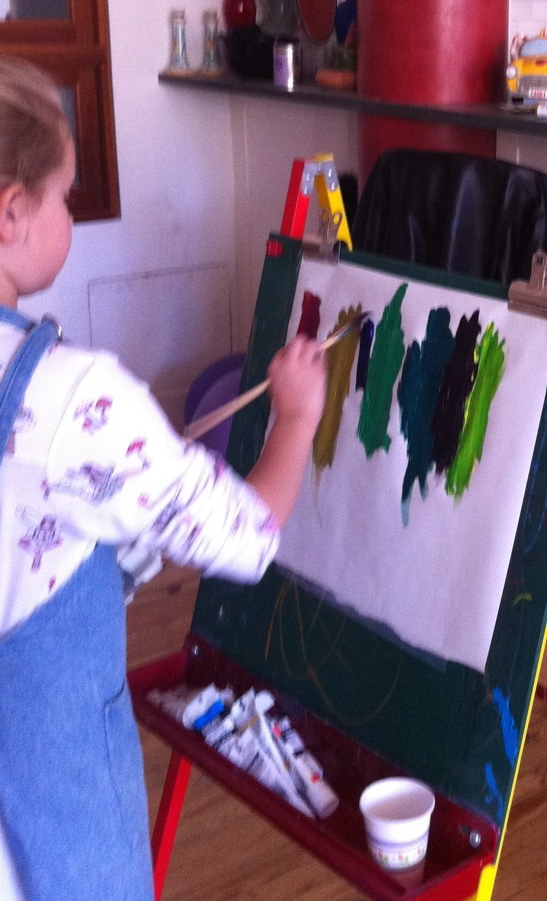
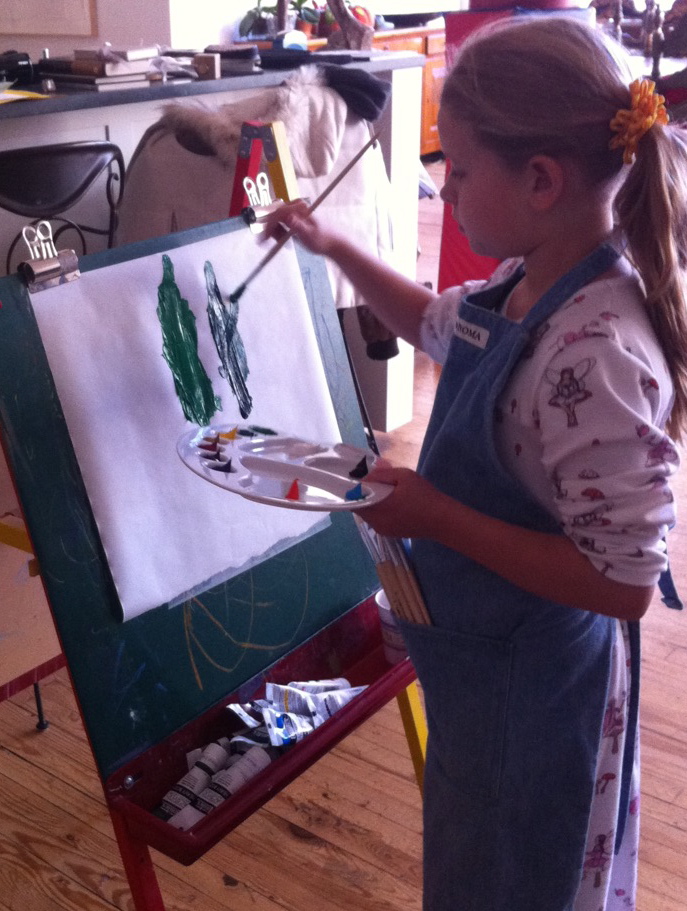
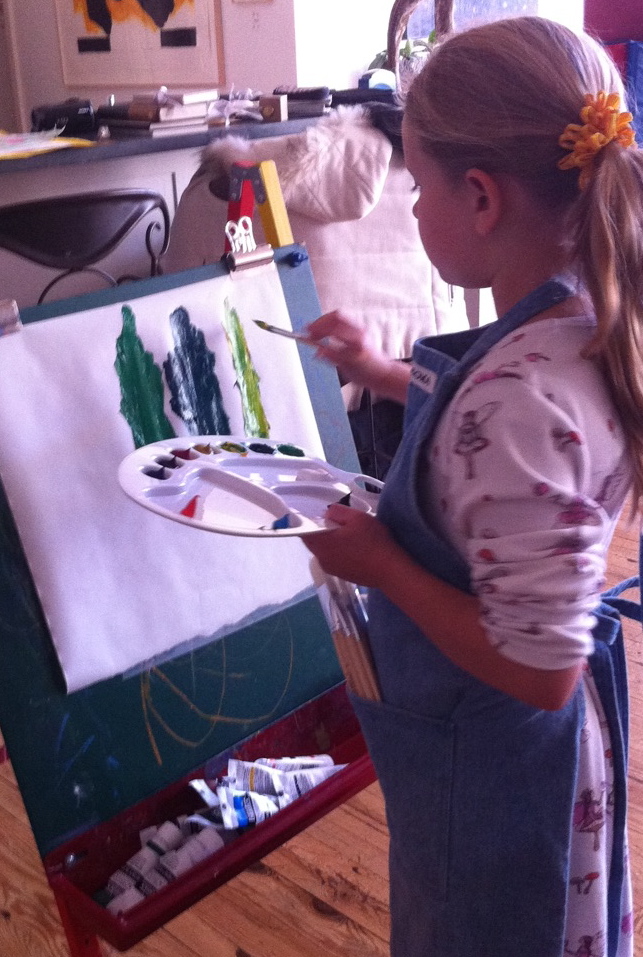
I showed Emma how to hold the palette in one hand with the paintbrush in the other and then stood back and watched.  It was fascinating.  She was very careful, methodical even, considered her choices before putting brush to paper.  This series of photographs show in chronological order her “process”.  The whole piece took about twenty to twenty five minutes to complete with neither Nic nor I saying a word.

Emma begins

The Final Touch

A Phone Call

The other day I received a phone call from Joe.  “We’re at the playground.  Emma asked to speak with you,” Joe said.

I could hear Emma crying in the background.  “You have to ask Mommy,” I heard her say.

“Hi Em.  What’s going on?” I asked.  I could hear her breathing into the phone.

“Mommy!  You have to ask Mommy.  Mommy?”  Emma said.

“What is it, Em?  Are you okay?”

“Mommy can I take off my other shoe?” Emma sobbed.

“Oh, Emmy.  It’s too cold outside.  You have to keep your shoes on, but when you get home you can take them off,” I said.  Emma’s wails of despair rose and fell.  “Em, it’s okay.  It’s going to be okay.”

“Mommy?  I want to take shoes off!” She cried.

“I know, Sweetie.  But it’s really cold out and you can’t take them off.  When you get home you can.”

“Mommy!  Mommy!  Come!”  Emma said.

I could hear Joe reasoning with her, offering her choices.  Asking her if she’d like to go to the bookstore or stay in the playground.  When she chose the playground he asked her if she’d like to go home and take her shoes off or stay in the playground and keep them on.

“No!  Stay in playground,” Emma said.

“Okay, she’ll be okay,” Joe assured me before hanging up.

I can count on one hand how many times I’ve had anything resembling a phone conversation with Emma.  That she asked to call me was exceptional.  Once the call was made she stayed and listened, didn’t like my answer, but responded to it without walking away.  I know it may seem I’m clutching at straws here, but the telephone is an abstract concept.  Add to that, the fact Emma has difficulty communicating through language and the phone becomes a formidable object.

Years ago when I was in Paris visiting my aunt, the phone rang while she was in the bathroom.   She asked me to find out who was calling.  I was absolutely terrified to pick up the receiver.  What if they spoke too quickly for me to understand?  What if they asked me a question I didn’t know the words to formulate a proper answer?  Hearing a voice without accompanying gestures or facial expressions to aid me made communicating in a language not my own all the more daunting.

Yet Emma asked Joe to call me.

It was a tremendous step forward.

Autism – Questions

How much does my child really understand?  What is she thinking?  What is it like to live in her body?  What sounds does she hear?  Does she know what she wants to say, but somewhere in between the thought and the attempt to verbalize it, the meaning becomes lost?  Does she believe she is saying something, only to have us respond with bewilderment?  What does she see?  What does she feel?

Many autistic children through various communication devices have allowed us to see and hear what they are thinking and feeling.  What they are able to tell us is both heartbreaking as well as miraculous.  Heartbreaking because they are aware of so much more than they appear, they know they are different, they know so much more than they are able to communicate, have complicated, busy inner lives, know anxiety, stress, depression, joy, boredom.

When Emma first spoke she said, Da-da, ah-done, and a series of other words and phrases typical of a baby learning to speak.  There was little to give us concern.  What was unusual was the language acquired did not serve as building blocks upon which more language was added.  At the age of 18 months Emma said – Chase me – we heard her say that for a few months, then it disappeared, never to be heard again.  There were many words acquired then seemingly forgotten.

In the field of autism, this is referred to as regressive autism.  Typically a child follows a neuro-typical child’s development, but at around 15 – 30 months begins to regress.  However we continue to see our eight-year old Emma “learn” things, only to forget them later.  Emma’s progress is not the steady progress one sees with neuro-typical children.  Hers is more of a hic-cup.  She paints with her brother, we document it, take photographs, exult in what amazing progress this means, only to have her never repeat the action.  Countless times my husband and I have recounted to one another something Emma has said or done only to see it never repeated.  The idea of a base of knowledge being constructed, the logical progression of a skill acquired, leading to another and another has not been Emma’s path.  We are teased into believing something has been learned only to see our expectation and hope thwarted.  We are left waiting.  Yet some other action will then occur – wholly unexpected – to raise our hopes anew.

Once when Emma was about three I took her to the dentist where it was found she had one tooth more on the bottom than is usual and one less than the norm on the top.

“Is this unusual?” I asked the dentist.

“Why shouldn’t it be?  Everything else about her is,” the dentist smiled.

I think of Emma’s progress and often despair.  Yet why should her progress follow the same path as a neuro-typical child’s?   Emma leap frogs where other children slowly, methodically climb.  Emma shows tremendous bursts of cognition followed by lethargy and meltdowns.  This is Emma’s way.  Hers is not the path of other children.  But it is a path, nevertheless.  One I feel privileged to accompany her on.

Kisses

It was 1:48AM when Emma appeared at the side of the bed this morning.  Ever cheerful she said, “You have to ask Mommy.  Mommy?  Can I come get you in the other room?”

“But Emmy, it’s the middle of the night.”

“Good job asking Mommy!” Emma said brightly.  Then in a more subdued tone she said, “You have to wait til it’s light out.  Is it light out?  Yes!”

“Em, it’s not light out.  Look.  It’s dark.  It’s pitch black,” I said grumpily.  “You have to go back to your room and go to sleep.”

I felt Emma’s face near mine, her breath on my cheek as she bent down and kissed me.  “Kiss Mama,” she whispered.

“Ah, Emmy.  Thank you.  Come on.  Go pee and then you have to go back to your bed,” I said holding her body close to mine.

“You have to go pee,” Emma said as she ran off to the toilet.  As we made our way back to her bedroom she said, “You didn’t wake Nic.  You have to ask Mommy!”

“That’s right Em.  You didn’t wake Nic.  Thank you.  He needs to sleep.”  I held her hand as we walked toward her bedroom.

She hopped into bed, “Mommy!  Can I get you in the other room?”

“No, Em.  You have to go back to sleep in your own bed.  Remember?  You have to try to sleep now.”

Wide-awake and fully alert Emma sat up in bed.  “Mommy?  Mommy?”

“Yes Em?”

Emma leaned over and gave me another kiss.   “Emma kiss Mommy,” she said, proudly.

“Emmy, that is so nice.  I love when you give me kisses,” I stroked her head.  “Now come on, let’s lie down.”

“Mommy stay with Emma?” she asked wriggling down under the duvet.

“Yes, I’ll stay with you for a little while, but you have to go back to sleep.”

“The flushing carousel is closed,” Emma said sadly.  “The horses are sleeping.  Shhhh, you cannot go there.  You have to wait.”

“Are the horses sleeping, Em?”

“Yes.  The horses are sleeping now.  It’s broken,” she said.  Then she leaned over and kissed me again.  “Kiss Mommy.”

An hour and a half later and after many more kisses, Emma finally fell back to sleep, one leg draped over mine, an arm wrapped around my body, her face so close to mine I could feel every exhalation on my face.  As I lay there with her, I remembered how as a baby Emma was so uncomfortable with human touch.  It was as though it was physically painful for her to have skin-to-skin contact.  Now, Emma seeks out what once repelled her.

I read once years ago of a doctor who theorized all children, no matter their cognitive issues had to develop through a specific set of behaviors or would suffer the consequences later on.  For example if the child didn’t crawl, it would show in their development in other unexpected ways, learning disabilities, fine motor issues, etc.  He hypothesized the reverse was therefore true as well.  If a child no matter how delayed, was encouraged to go through a missed stage or came to it on their own, the child would show signs of positive cognitive development elsewhere.

Hope.  One must always hope.

Trick or Treat?

Halloween, wildly anticipated by our son Nic, was an occasion for dress up followed by cake for Emma.  “Have Halloween party and cupcake?” Emma asked yesterday afternoon.

“We aren’t having a party, but we will go out trick or treating and we can get you a cupcake while we’re out,” I said, knowing Emma wouldn’t care about the candy she acquired while trick or treating.

“Get cupcake?  Have cupcake now?” Emma said.

“In a little while, Emma.”

“Go trick or treating,” Emma said with a bit less enthusiasm.

For Emma it was all about the cupcake.  The cupcake, which would give her the opportunity to sing – Happy Birthday, regardless of the fact no one was celebrating a birthday.  Cupcakes = Birthdays = singing = joy, pure and simple.

Emma insisted on wearing her one-and-a-half-inch heeled, pointy-toed witch’s shoes, her black witch’s hat and completed the entire outfit by carrying a black broom.  “Mommy carry candy bag?”  Emma asked when we got outside.

“No Em.  This is for you.  You have to hold the bag and when we get to the first house you open the bag and say – Trick or Treat!” I coached.  We went through the same routine last year and the year before that.

“Trick or treat!” Emma repeated happily while Nic rolled his eyes.

“Mom, she doesn’t even care about the candy,” Nic said in a tone of resigned disbelief.

“I know Nic,” I said.

As we made our way out to join the quickly gathering crowds in Chelsea, Emma ran ahead.  Her head down, witch’s hat with its purple band jutting upward, her little heels clicking as she went.  “Em!  Em!  Wait!” One of us would periodically yell.

It was cold last night.  But Emma seemed impervious to the chill.  She accompanied us for the 20 blocks we roamed, up and down, back and forth, without complaint.  We stopped along the way to buy her a cupcake, where one of the customers standing in line upon seeing us, was heard to say, “This is what I love about New York City – the people have such commitment!”

We attempted to teach Emma to say Trick or Treat and either take a piece of candy from the bowl being offered or open her bag so that the offerings could be dropped inside.  She never really got either action down and by the end of the night I stopped trying to coach her.  She was content to walk along with us, watching Nic dart in and out, filling his bag.

Nicky!  Nicky L!” Emma occasionally shouted when she lost sight of him.  By the time we returned home, Emma struggled out of her witch’s costume, replacing it with one of her many princess dresses, where upon she dug into her cupcake with relish.

“Yum, yum!”  Emma said, smiling broadly, her face covered in icing.

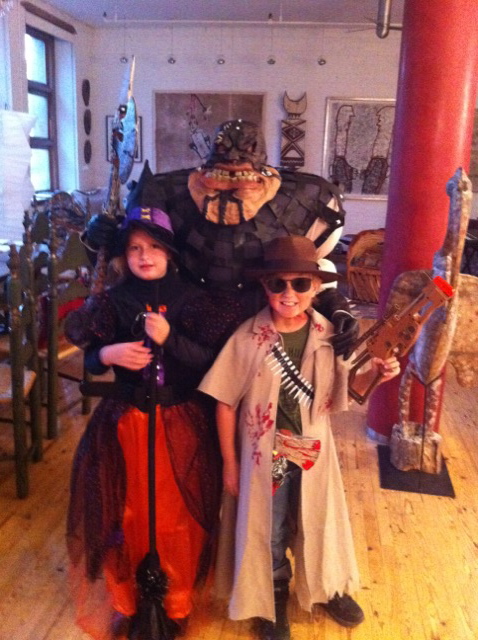
Halloween 2010 – Emma, Richard & Nic