
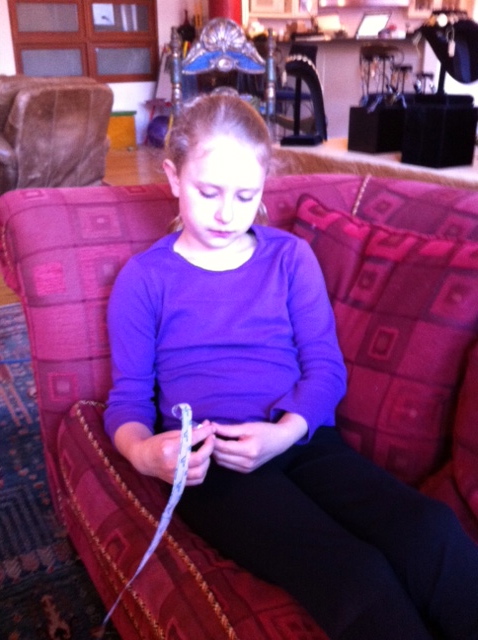
Emma’s balloon string has been officially replaced. She now carries a long plastic strip, the kind you peel off a self adhesive velcro strip. How such a bizarre and unlikely item came into her possession is anyone’s guess.
Emma with her plastic velcro strip this morning before going to school.
Over the past year or more Emma has become attached to an assortment of long, thin objects. The first was a stick she picked up on a playground near the Bronx Zoo. One can never know when an object will become a coveted one. But I remember that stick because she wouldn’t let go of it, even when she swung on the monkey bars at the playground. It was an odd thing to watch her movements so clearly hindered by her refusal to let go of that long stick. When we made our way to the subway for the long ride home, we told her she could not bring the stick with her. She didn’t put up a fight and I thought nothing more of it until I saw her, upon our return home, reach down to pick up another stick from the planter outside our building’s front door.
” No Em. The stick stays outside,” I told her and she complied.
But it became a habit, each and every time we left the house she would find a stick and carry it with her. A few months later she found a long plastic strip used to bind packages and began carrying, twirling and waving that around while inside our home.
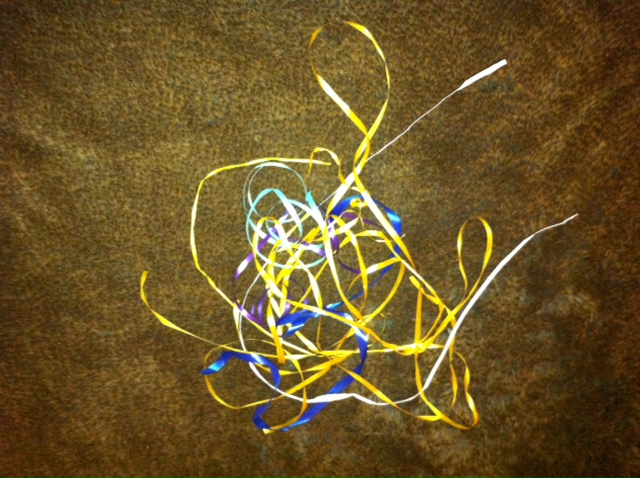
Emma’s assortment of “strings”.
There are a few thoughts on this sort of behavior with autistic children. Some believe the items should be removed. The idea being the child should not be allowed to have them as they increase “stimming”. Stimming – shorthand for self-stimulation is a word, which is much used when speaking of autism. It is the repetitive behavior the child/person uses to soothe, calm or regulate themselves. The objects are varied and can be anything from spoons to things like running water. But some children do not engage an object at all. These children do things like hand flapping, twirling, spinning, rocking and even head banging, while others stare at their own fingers that they wave in front of their eyes, others tap their fingers rapidly, hum or grunt, bite or twirl their hair, lick surfaces or smell things. What marks their behavior from so called neuro-typical behavior such as pacing, doodling and thumb twirling is the child who is autistic may engage in these behavior for hours at a time, often getting in the way of daily living and learning.
Others believe the child should be allowed to stim and feel it is better to allow the child to self regulate. They believe it is, in fact, cruel to remove the source of comfort for these children/adults who are autistic. Many people believe learning can take place despite the stimming.
I don’t fall squarely into either camp. Richard and I have done our best to give her the freedom to have some objects – balloon strings, velcro strips etc. while telling her she cannot bring sharp, pointed or objects we think might accidentally hurt her into the house. We do not allow her to have her “Coqui” aka scraps of blanket outside her bedroom because she can sit for hours at a time sucking her thumb, which is doing untold damage to her teeth. When I am working with Emma she may not have anything in her hands as I need her hands free to type, write etc. But when she has gotten dressed, brushed her teeth, straightened her room, she can race around the house on her scooter, carrying whatever long piece of string/plastic/packaging tape she likes. It’s difficult to know whether we are doing the right thing, but for the moment this middle ground seems to work or, at the very least, not cause too much damage.
Earlier this morning when I was trying to take a picture of Emma with her velcro strip, she wouldn’t look at the camera.
“Hey Em. Can you look at the camera?” I asked.
“Say cheeeeese!” Emma said scrunching her face up into a hapless and obviously forced “smile”.
“No not like that. Think of something happy. What makes you happy?” I asked, pointing the camera at her.
“Mommy makes me happy,” she whispered.
And that makes me happier than she can ever know.
For more on Emma’s journey through a childhood of autism and arbitrary items that hold her interest go to: www.EmmasHopeBook.com

 Emma's Hope Book