Tag Archives: parenting an autistic child

Em & The 4-Wheeler

Emma on the 4-wheeler
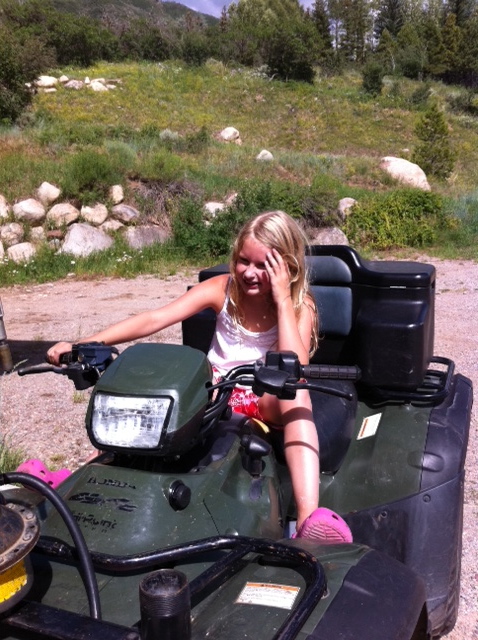
Perhaps more exciting than even the ARC (Aspen Recreational Center) is the 4-wheeler kept up on the ranch.  For those who are not familiar with this piece of machinery, it is a cross between a kind of Hummer version of a motorcycle and an open air golf cart.  My two nephews, Colter and Bridger, are cringing at this crude and citified description of mine, because it is actually an essential piece of powerful ranch equipment used to change sprinkler heads, and to haul a variety of other things.  Things I do not pretend to know about.  To me, it is the vehicle we use to go looking for coyote, fox and other wild life up on the ranch.  Last summer we found a den of coyote pups, so cute(!) whose mom lay basking on a nearby rock, unruffled by our intrusion, she didn’t move a muscle as we rode by within ten feet of her pups.  (I know Colter and Bridger – you guys might want to just shut your computer down at this point – it’s got to be painful to read this description.)

Now that I have thoroughly humiliated my fabulous nephews with my utter ignorance in all things to do with ranching, I will attempt to move on.  When Emma arrived in Aspen the night before last, one of the first things out of her mouth was – “Go on the 4-wheeler?”  Followed by, “Go to DuBrul’s (my cousins’s) house?”

When we told her she couldn’t do either of those things, she then went for her back up list.  “Go see motorcycle bubbles?”  (This requires interpretation as this is what Emma calls the 4th of July fireworks, which we missed this year as we were in New York.

“No not going to see motorcycle bubbles.  Go swimming in indoor pool.  Yeah, go to the ARC.”

When we informed her that as it was almost 9:00PM, this wouldn’t be possible, but promised to take her the following day, she said, “Go to outdoor pool?”  (Meaning the Snowmass rec center’s outdoor saline water pool)

Finally tired of our feeble excuses about the late hour and how everything was closed, she conceded sadly, “Time for bed.”

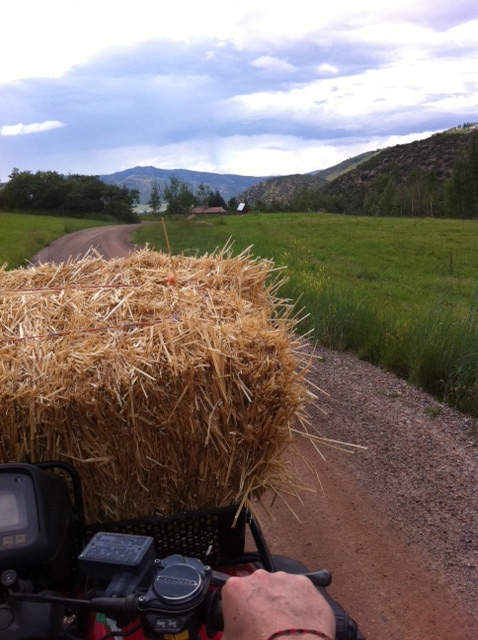
But the following morning the list was proffered up and there wasn’t much we could say as our excuses of it’s too late, no longer held any weight and she knew it.  So off to the ARC Emma went and then a trip to the grocery store where she was able to procure her favorite chocolate milk from Horizon, before getting the 4-wheeler from the barn.  We were also able to load a bale of hay into the front to carry back to the house to set up with a bull’s eye so that Nic can practice his archery skills.

Bringing hay back to the house for Nic
It’s good to be home with the family!

For more on our escapades and Emma’s journey through a childhood of autism, go to:  www.EmmasHopeBook.com

Bliss

I am sitting here writing this, with Emma to my left singing “Three Little Elephants” in Spanish.  Okay, so you might not know that was what she was singing even if you were a native spanish speaking person, but I know the song, because the tune is exact even if her pronunciation is not.  Richard and the children arrived in Aspen last night.  To say that I was pleased to see them, really doesn’t sum up my excitement and happiness.  I am blissfully happy!

Last night Emma was so excited to be here that she didn’t want to go to bed.  As my husband, now to be referred to as the man-of-the-decade (MOD – I tried “century” whose acronym then became MOC and have opted for “decade” simply because of the acronym and not because there’s a time limit on my admiration for him and all he does) was unpacking, I got Em into her nightie and brushed her teeth.  When she finally felt it was time for bed, at around 10:00PM (that’s midnight by New York time) she said, “Time for reading and bed!”

“Are you ready for bed, Em?” I asked.

“Yes.  Mommy come,” she replied.

I am reading a book written by a wonderfully talented friend of ours – Dan Elish – whose book is entitled “The School for the Insanely Gifted” and Emma is enjoying it immensely, as am I.  As I read to her, Emma snuggled up against me, putting her head on my shoulder as I read.  I use to do the exact same thing when my mother used to read to me and it filled me with joy.  When her little body succumbed to sleep I lay with her, not wanting to move, just relishing her head on my shoulder, her body pressed up next to mine.

This morning Nic and Emma woke at the rousing hour of 5:30AM – in part because the dogs began barking at a particularly tenacious coyote who has a habit of coming right up to the house and yelping.  The dogs, in a spectacular display of frenzied aggression twirl around barking and ramming their bodies against the door in an effort to get outside.  My mother’s voice shouting from her bedroom, “be quiet!” does nothing to calm them.  And in fact, may just rile them up further, though I’d never say this to her directly.  The whole thing has a comedic aspect to it – dogs making more noise than one would think possible, coyote howling, children bolt upright in bed, Mom shouting for quiet in a kind of exaggerated stage whisper and Richard covering his ears with a pillow.

Once downstairs Emma and I made chocolate pudding, while Nic proceeded to play his newest composition on the piano.  By the way – Piglet – if you’re reading this – any tips on how to keep the instant pudding from turning into soup after an hour or so in the frig?  I think it has something to do with the altitude, as this doesn’t happen to us in New York.  But I digress…  After making pudding, Nic proceeded to demonstrate his newly acquired skill of blowing bubbles and Emma went upstairs only to return wearing her bathing suit.  “Time to go to the indoor pool!” she cheerfully announced.

Nic proudly blowing a bubble

The aftermath of another bubble

“But Em, it’s not open yet.”

“We have to wait.  Then going to go to the indoor pool, jump off the diving board, go down the slide, go in the carousel.  Go with Mommy?”

“I can go later today or tomorrow Emmy,” I told her.

“Okay,” she said.  “Mommy has to work,” she added in a serious tone.

“How about getting dressed so you’re all ready to go?”

Emma returns wearing her swimsuit and clothing over her suit.


“Playing bells,” Emma explained as she pounded on the keys of the piano.

Everyone is together and I am in bliss.

For more on our crazy family and Emma’s journey through a childhood of autism, go to:  www.EmmasHopeBook.com

A Phone Conversation With Emma

Speaking on the phone with Emma has always been challenging.  She tends to forget that there is a person on the other end and often walks away, leaving the phone dangling there before someone either abruptly hangs the phone up, not realizing I’m still there or answers it in a harried sounding voice.  Sadly, since I’ve been out here in Aspen working, both my children and husband remain in New York City, so the only communication I have with any of them is by phone.  This morning I called before the children left for camp – which meant calling them at 5:45AM Rocky Mountain time.  The following was my conversation with Emma.

A rustling sound followed by, “Hi Joe!”

“No, Emmy.  It’s me, Mommy.”

“Oh!  Hi Mommy!”

“How are you Emma?”

“I’m fine.  Have so much fun at camp.  Last day.  Last day summer camp.”

“Two more days, Em.  You have two more days and then it’s Saturday and then you and Daddy and Nicky and Jackie fly out to Aspen!”

“No more summer camp.  Fly to Granma’s house!”

“That’s right Em.  I can’t wait to see you.  I miss you so much.”

Silence.

“I’ll be at the airport, Em, waiting for you guys.  I am so excited to see you.”

Silence.

“Emmy, have you enjoyed camp?  What are you doing there today?  Anything exciting?”

Silence.  Then humming.

“Emmy?”

More humming of a carousel song – whose name I cannot remember.

“Hey Em?”

More humming and the sound of her moving away from the phone until the humming was from far away.

“Em?”

“Oh hi honey.  She took off.  Nic wants to talk with you though.   He was going to call you this morning,”  Richard said.

I then spoke with Nic who informed me that he missed me and Emma did too.  He now knows how to blow bubbles from a single piece of gum, a proud accomplishment and something he had become convinced he would never be able to do.  He’s practicing his Alto Sax and loves it, is playing the piano and is working on a blues composition for it, while learning the guitar, so he is not as good at it, but is still enjoying it.  The sax he is shipping out to Aspen so he can practice while out here and his skateboard he intends to leave in New York.  He explained to me that he plans to buy another one for Aspen so he’ll have one here as well as in New York.  He requested that I find him a bail of hay so he can set up a bulls eye to practice his archery, which I’ve promised to look into.  As he told me all of this I could hear Emma in the background, talking, singing and laughing.  I could hear that Joe had arrived.  As I spoke to Nic, mining him for more information there was silence.

“Hey Nicky!”

Silence.

“Nic!”

Silence.

“Nic!  NIC!”

“Oh yeah, Mom?”

“Nicky, I was talking to you.”

Sorry.  Joe’s here, playing with Emma.  I got kind of distracted.”

Shrieks of laughter were then heard along with running and more laughing.  Talk about feeling out of the loop!  But also relieved everyone is having a good time and I will get to see them in another four days.  Just four more days…

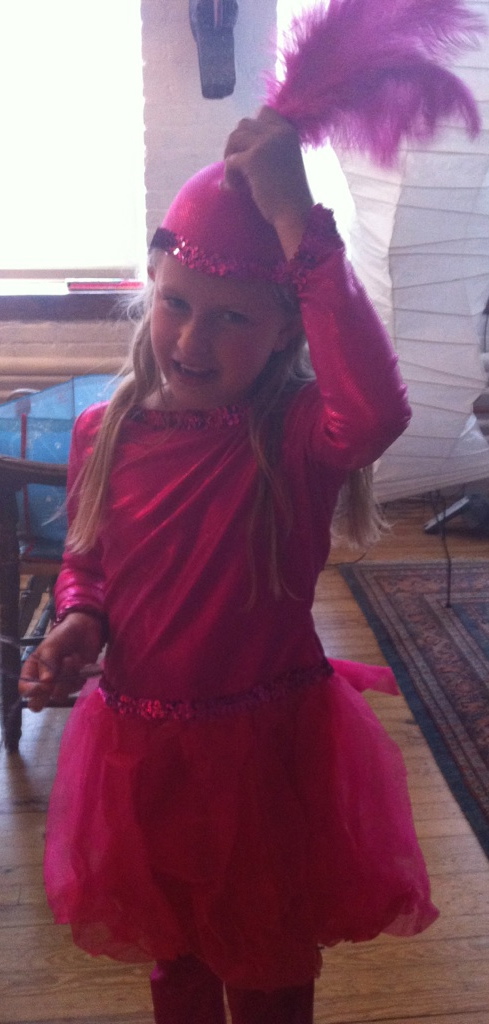
Emma in her Pink Flamingo costume

For more on Emma’s journey through a childhood of autism, go to:  www.EmmasHopeBook.com

What is Normal?

Having a child diagnosed with autism, one inevitably comes up against this question – What exactly is normal?

According to Dictionary.com – “Normal:  1. conforming to the standard or the common type; usual; not abnormal; regular; natural.  2. serving to establish a standard.  Psychology – a. approximately average in any psychological trait, as intelligence, personality, or emotional adjustment.  b. free from any mental disorder; sane.”

Autism is a neurological disorder, yet interestingly, if one goes to dictionary.com and looks up autism, the word “neurological” never shows up in it’s definition.  In fact, it is defined as:  1. Psychiatry – a pervasive developmental disorder of children, characterized by impaired communication, excessive rigidity, and emotional detachment.  2.  a tendency to view life in terms of one’s own needs and desires.”

Okay  – so the definition certainly suggests something outside of “normal”, though “a tendency to view life in terms of one’s own needs and desires” certainly describes a great many people I’ve come in contact with over the course of my life.  In fact, couldn’t one even say that this is one of the great flaws of being human?  We all tend to view our lives as our own private universe, and though we have grown to understand we are not the center of it, a great many still wish we were.

Have you ever engaged in a conversation with another person only to begin lamenting the problems of the world, our government, other governments only to conclude that if everyone just listened to us, the world would be a better place?  How many times in a relationship have you thought, if only the other person would listen to me, do as I wish, everything between us would be so much easier?

It all comes down to the degree.  I didn’t bother to look up narcissism, but I’m pretty sure people who have that tendency would fall under the second definition of autism – though the resemblance stops there.

When I think about my daughter, Emma, she is the antithesis of narcissism.  Emma is without ego.  She is also without malice.  It would never occur to Emma to tease or set out to hurt another person’s feelings.  These are not things she is cognitively capable of.  I remember the first time she told a lie, I was ecstatic.

“Did you hear her?” I asked my husband, Richard.  ”I asked her if she’d brushed her teeth and she told me she had, but when I went into the bathroom, her toothbrush hadn’t been used!”

“Things are all falling into place,” Richard said with a grin.

The idea that Emma understood that if she told me what she knew I wanted to hear, even though it wasn’t true, it might allow her to get away with not doing something she didn’t want to do, was a huge step toward “normalcy”.

I have grown to dislike these definitions and labels.  I find them utterly unhelpful.  Perhaps in the beginning when I knew nothing about PDD-NOS – the diagnosis first given to Emma when she was two – I had no idea what people in the field were talking about, and so it was imperative that I learn what these labels meant.  But now, some seven years later, those same labels do little to help us help our daughter.

For more on Emma’s journey through a childhood of autism, go to:  www.EmmasHopeBook.com
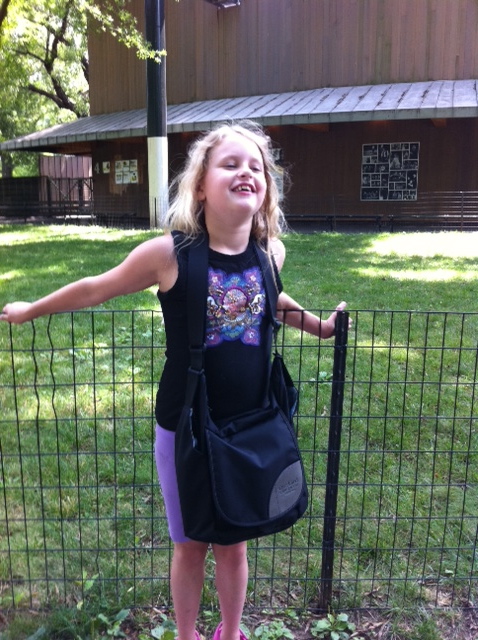
Emma in Central Park carrying her dad’s “man bag.”

Sunday with Emma

Yesterday Richard and I took the children to the park, where Emma played in the sprinklers, while Nic sat with us in the shade and talked.

Emma in Union Square Park

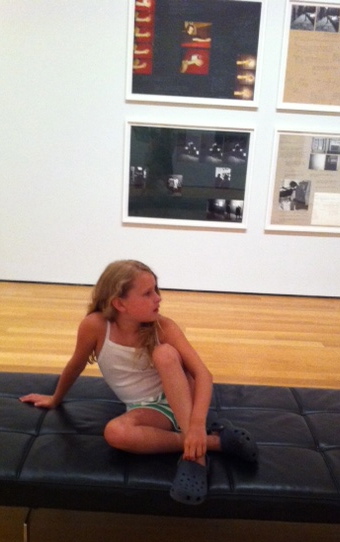
Then off to Toys R Us to return a Nerf gun that was faulty, then to MOMA (Museum Of Modern Art) where we watched several video installations by the Belgian artist – Francis Alӱs.  Emma wasn’t interested in the video of him pushing a huge block of melting ice through the streets until it disappears, but she was fascinated with the video of him chasing tornadoes, particularly when he entered the tornado.  Another video she liked was one in which he is driving a VW Bug up a very steep dirt road, but never makes it to the top, instead rolls backwards, before attempting to climb the hill over and over again.  Talk about the trials of Sisyphus…

When we went to a lower floor Emma pointed to a giant collapsed fan and said, “Telephone.”

“Look Em.  It’s a huge fan!”

“Fan,” Emma said, before going to the next sculpture with wheels, “Bicycle,” she said.  Then she turned and pointed to an enormous sculpture of a man holding a steering wheel.  “Bus driver!” she said, jumping up and down.  And on it went.  When she didn’t know what something was or if it didn’t look like any recognizable object she would point out it’s color.  “Red!” She said.  Or, “Green!”

“Hey Em.  Look.”   I pointed to two sculptures that resembled melting metal.

“Blobs,” she said nodding her head before running over to a sculpture of a vaguely female form.  “Mommy,” she said, pointing and smiling at me.

Emma at MOMA

After the museum we made our way to the swimming pool at the Vanderbilt YMCA, where we went swimming.

Prior to our leaving the house that morning, I’d made a list of all the things we planned to do and went over it with Emma.  “Okay so first we’re going to go to Union Square, then the museum, then the pool and then Toys R Us.”  I pointed to each item on the list as she repeated all our activities.  Except when we got to Union Square and saw how hot it already was and how heavy Nic’s Nerf gun was we amended out list.

“I think we better unload this thing,” Richard said gesturing toward Nic who was barely able to lift the bag carrying his broken toy far enough off the ground so that he could carry it.

Once we got to Toys R Us and Nic found a newer, bigger, better and even heavier Nerf gun, Richard turned to me and said, “I guess we’re going to have to take this thing home before we go to the museum.”

Meanwhile the list I’d painstakingly made and gone over with Emma was no longer relevant.  I worried with each change that a meltdown was imminent.  But the meltdown never came.  In fact Emma was great, took each change in stride, repeating the change of plans to me, before cheerfully going along with the next activity.

“Well that was a great day!” Richard said as we headed home.

Everyone agreed.

For more on Emma’s journey through a childhood of autism, go to:  www.EmmasHopeBook.com
Empathy and Autism

My thinking on this topic has changed since I last posted about Emma and Empathy over a year ago.  I am not convinced that Emma “has a terrible time figuring out what another person is thinking or feeling.”  Today that is not something I would say.  I often wonder if Emma feels things in the extreme rather than not at all.  I have read a great many articles written by people on the spectrum who describe their feelings and responses to other people’s emotions as being too much for them.

One young woman, Dora, says:  “I often feel things too deeply or have too much empathy and have to run away, not because I am callous, but because I feel so strongly it causes my brain to shut down or freak out.”    Her statement is similar to another woman with autism, who’s amazing mother, Clara Claiborne Park wrote two books about her daughter, Jessy.  She describes how Jessy would cover her ears and could not tolerate certain words because they were “too good”.

When one of us is upset and Emma appears to completely disregard our emotional state, whether by ignoring it or making sympathetic comments, which to our ears strikes us as insincere, I have to question whether our interpretation is accurate.  How can we know what she is really experiencing?  We cannot.    I choose to believe Emma is deeply sensitive to her  own and our emotions, but just as she has trouble expressing herself verbally, she may express her feelings differently as well.

Dora goes on to point out:  “The notion that we don’t have feelings frees up people to commit atrocities against us without accountability.”

When I hear neuro-typical people discussing autism I am often surprised by the conclusions they come to.  How differently might we treat someone if we believed them to be fundamentally unintelligent?  How would we speak to them?  What things would we say because we believed they have a low IQ, lack empathy, could not understand us?  How would we treat them as a direct result of our assumptions?   If we decide a child’s behavior is a form of manipulation or because the child is “spoiled” or because they “think they can get away with it”, do we not treat them differently?  Isn’t it true we can behave in some pretty horrific ways when we make assumptions about other’s actions?  Isn’t it easy to rationalize our behavior when we’ve decided a person or child is “dumb”, “less than”, “inferior”, cognitively unaware”?  And what if all those assumptions we’ve so quickly and easily come to are completely wrong?  How does our response stand up under further scrutiny?  Have we not behaved with callous disregard?  Have we not completely “disregarded” their “feelings”?

For more on Emma’s journey through a childhood of autism and her relationship with her brother, Nic go to: www.EmmasHopeBook.com

Emma in Union Square Park – Summer, 2011

“I’m Home” – Autism

When I opened the door to our loft, Emma came tearing up on her scooter shouting, “Mommy’s back!  It’s Mommy!”

As I dropped my bags and opened my arms to greet her, she sped away.  Nic meanwhile rushed up to me and threw his arms around my waist.  “Mommy!” he cried, “It’s so good to have you home.  I missed you so much!”

As I hugged Nic and then Richard, I said to Emma, “Hey.  I want a hug from you too.  Come over here, Em!  Remember?  Put your arms around and …”

“Squeeze!”  she shouted, while complying.  She peered up at me, with an odd expression on her face.  Then she pointed to my face and said, “It’s Mommy.  Mommy came back,” as though she hadn’t been sure I would.

“I’m back Emmy.  It’s so good to be back.”

“Yeah, Mommy came back.  Mommy stayed at Granma’s house.  Mommy had to go away,” she said, nodding her head sympathetically.

“It’s okay, Em.  Now I’m home.  I’m not going anywhere.”

Nic then played five different songs on his new Alto Sax for me, two new songs which he composed for the piano and then plugged his electric guitar into his amp and riffed on several more.  Emma scooted around on her scooter and eventually it was time for everyone to go to bed.

“Mommy come to Emma’s room,” Emma said, taking me by the hand.

“Yes!” I said following her.

“Mommy’s back,” Emma whispered as she snuggled down under her blanket.

“Yes, Em.  I’m home,” I said stroking her cheek.

Later Nic expressed his upset that I was away for almost three weeks.  He was able to tell me that he didn’t like that I was gone for such a long time.  But Emma…  Emma doesn’t have the words to express her upset nor does she have the ability to ask me why I was away.  I can only hope she understands I had to go for work, but I don’t know that she does understand.  When she looked up at me earlier it was with a mixture of shock at seeing me again and happiness.  I don’t know whether I’m reading more into her expression than was actually there, but given that she isn’t able to ask me, who knows what reasons she applied to my absence.

“Go swimming with Mommy,” Emma whispered.

“Yes,” I said.  “We’ll do that tomorrow.”

“No, not going to go back to Aspen,” she said, holding my hand.

“Nope.  Tomorrow we’re going to spend the whole day together.”

We were quiet then.  “Mommy sing?” Emma said after awhile.

“Sure, Em.  Which one – Swing Low, Sweet Chariot or Summertime?”

“Swing Low first, then Summertime,” Emma said.

“I love you Em,” I whispered.

“So much,” Emma finished.

For more on Emma’s journey through a childhood of autism, go to:  www.EmmasHopeBook.com
Amusement Parks & Autism – Continued

Emma’s entire system was crashing.

“You have to ask Mommy!  Mommy can I go on the roller coaster with Gaby, please?”   She cried over and over again through screams and tears.

It was heart breaking and anyone with a neuro-typical child would think – oh just let her go on it one more time and then go home.  I even thought this a number of times as I tried to peel her off the pavement where she had fallen in a heap of tears, snot pouring from her nose, her hands made into tight fists while hitting herself in the head, on her chest, legs, arms wherever she could before I, or any of us could stop her.  The biting is horrible because it can break the skin and then there’s blood, and later scabs and enormous angry blue and purple bruises that can last for more than a week, reminding all of us of her agony.  But the hitting – a quick, violent punch to the face is shocking to witness and as a parent, it’s difficult not to feel one has done something horribly, horribly wrong.  How can this sweet, blissful child do this to herself?

Emma waiting for Joe, Nic and Gaby while they ride on the Corkscrew

Richard and I have always said to the children – hitting is wrong.  We don’t do it, we don’t want them to ever do it to each other and until Emma began hitting herself, it hadn’t occurred to us to add – we don’t hurt ourselves.  We don’t hit others or ourselves.  We say it, but I don’t know that it makes a difference.  When Emma’s brain has become set on something, no amount of calm, reassuring logic seems to help her.  No amount of soothing, we just have to vacate the premises.  It’s our only hope.  Kind of like shutting the whole system down, a kind of reboot.  We have tried the other option, which is to let her go on one more ride or do whatever it is one more time and the misery, the abject misery continues.  Like an addict who has to have that drink or that drug even while bringing them no real solace.  There’s no relief to be had at a certain point.

“Emmy it’s going to be okay.  We’re going to go home now.  We can ride the little roller coaster one more time and you can sit with Gaby and then we have to go home,” we told her.

But Emma’s brain couldn’t take in this information it was already in lock down mode.  I gave her a banana to eat and then everyone, our once cheerful little group, now more weary warriors than a family intent on having a lovely day at an amusement park trooped along.  She was able to sit with Gaby on the little roller coaster for one last ride and then we trudged back to the car while Emma kept looking over her shoulder at the wooden roller coaster named Roar.  As we headed home Emma said, “It’s okay, we’ll come back tomorrow.”

“No Em.  Tomorrow we’re going to traintown where there are different rides and then we’re going to Uncle Andy’s wedding,” we told her.

“Different rides,” Emma repeated, sadly.  “We’ll come back soon,” she said.  There was a wistful tone to her words, and we knew it wasn’t likely that we would ever come back to this part of the world.  But there would be other amusement parks and maybe one day Emma’s massive sensory issues will have abated to such a degree that these kinds of episodes will become rarer.

We can only hope.

For more on Emma’s journey through a childhood of autism go to:  www.EmmasHopeBook.com

Cooking with Emma

Emma seems to have lost interest in her velcro strip.  It was actually the plastic back to the self adhesive velcro that she liked, but her yellow balloon string has replaced it for the past few weeks.  Instead of holding it in her hand, she puts it between her front teeth, like an enormous piece of floss, allowing her hands free.  She races around on her scooter, the balloon string held in her teeth, the rest of it undulating after her.  It reminded me of a Turkish woman I encountered years ago in Ezurum, Turkey.  She was wearing a shawl like head covering the size of a bed sheet and had one corner hooked on one of her front teeth.  The fabric was loosely around her face, but kept slipping off her head.  I remember watching her move along an alley, the fabric billowing out, as she hurried away.  She turned, at one point and looked directly at me, many of her teeth were missing, but her upper incisor was intact and she used it to secure the fabric so that it couldn’t blow away, leaving her hands free.

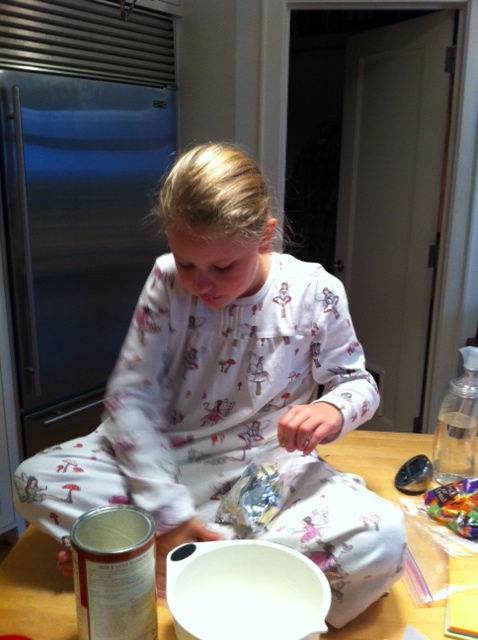
Yesterday evening when Emma asked that we make pancakes, she climbed up onto the kitchen island, the balloon string secured between her front teeth.  “Mixing bowl,”  Emma said, despite the presence of the yellow string in her mouth.

“Emma!” I laughed.  “You can’t cook with that balloon string.”

“Have to put it down!” Emma said, pulling it from her teeth and tossing it to the floor.

“Pancakes with chocolate chips please!”  Emma said.

As I rummaged around to locate the chocolate chips I heard Emma say, “Uh-oh!”

“What happened Em?” I asked turning around.  Emma sat with about a cup of pancake mix in her lap, a dusting of mix covered her arms and legs.

“You have to pour it in the bowl!”  Emma observed with a slightly irritated tone.

“Here you go Em.  Let’s clean that up.”  I handed her a damp paper towel which she used to dab at her face.

“Okay, but we have to clean up all this mix,” I said, pointing to the flour covering her and the counter.

“Mommy help?”  Emma said, half heartedly patting at the mix creating little clouds that then spread out over ever increasing areas of the counter.

“Yes.  I’ll help.  Here, look.  Let’s clean it like this.”  I brushed mix into my hand and threw it in the sink.  “Now you do it,” I said as I got out the milk.  When Emma had finished cleaning up most of the mix I said, “Here, you measure the milk.”  I handed her the measuring cup and gave her the milk.  Carefully she poured the milk into the measuring cup until it filled it about half way.

“Dit,dit, dit, dit, dit, pour in!”  Emma sang.  She always says this when she is measuring something during our cooking together.  I don’t know where the “dit, dit, dit” comes from or even what it means, but it’s part of the process now and so she always says it.

I held the whisk in front of her.

“Mommy, can I have the whisk, please?”

“Yes!  Here you go,” I said, handing it to her.

“Whisk, whisk, whisk, the pancakes, mix, mix, mix the pancakes,” Emma sang as she stirred, while occasionally dipping her finger into the batter to eat large dollops of it.  ‘Yum, yum!”  she said.

Emma making pancakes

For more on Emma’s journey through a childhood of autism and cooking, go to:  www.EmmasHopeBook.com

Emma’s older brother, Nic

Yesterday I took Nic and Emma to a relatively new carousel on the refurbished park along the Hudson River.  It’s unlike other carousels in that it has a wide variety of animals, fish and insects instead of the traditional horses one usually sees.  Emma likes to ride on the Atlantic Sturgeon, with the Unicorn and Wild Turkey coming in second and third.

Emma riding on the unicorn

I’d ride on the hyena or the coyote,” Nic told me when Emma chose the Atlantic Sturgeon for a second time.  “What would you ride on?”

“I’d have to go with the Harbor Seal,” I answered.

“Yeah, that would be a smooth ride,”  he said.  We watched Emma go around and around.  Every now and again she’d use the waist strap to tap the sturgeon, as though she were urging it on.  “Mom?”

“Yeah Nic?”

“So how do you blow bubbles with your gum anyway?”

“Okay, here I’ll show you,” I said, taking a piece of gum from his remaining pack.

“Emma blows huge bubbles.  I just don’t get it,” he said as I chewed the gum, trying to get it to the right consistency.

“Well she chews a lot of gum…”

Nic interupted me, “Yeah, I know, because of her ears.”

“Exactly, so she’s had a lot of practice.   But here, watch.”  I tried several times to demonstrate how to blow a bubble, which is quite a bit more difficult to explain than one might think.

After several attempts Nic said, “I think it’s a girl thing.”

We watched Emma for awhile on the carousel.

“Hey Mom?”

Yeah, Nic?”

“It’s weird.”

“What is, Nic?”

“I mean Emma’s so good at some things, but so bad at others.  Like she can blow bubbles and taught herself to swing and she’s really good on the scooter, but she still can’t read or write very well.  I think it’s interesting,” he said.

“Well, you’re right Nic.  There are things that are much easier for her and then lots of other things that are really hard.”

“But I don’t get it.”  He looked at me expectantly.

“Yeah.  I know.  It’s difficult to understand.  It’s the wiring in her brain.  It makes a great many things really, really difficult for her.”

Nic kept trying to blow bubbles with his gum.

“Does that make sense?” I asked.

“No,” he said, shaking his head.  “Not really.”

“Yeah, I know.  It’s really hard for us to understand.  There’s so much more we don’t know about autism than there is we do.”

“Mom?”

“Yeah Nic?”

“Do you think I’ll ever be able to blow a bubble?”

“Yes.  You just have to keep practicing.”

“But you don’t let me chew gum that much.”

“Yeah, that makes it harder.”

Nic stared at me with a little half smile on his face.

“Hey, you get to do all kinds of other things that Emma doesn’t get to do, and the only reason we let her chew gum is because of her ears.”

Nic kept grinning at me.

“What?”

“Nothing, Mom.  Nothing.”

For more on Emma’s journey through a childhood of autism and her older brother, Nic’s experiences along the way, go to: www.EmmasHopeBook.com

Que Sera, Sera

I’m the silent partner. On Emma’s Hope Book anyway. It’s been a long time since I posted an entry. Ariane has always been the driving (and writing) force of Emma’s Hope Book, but I’ve been completely MIA lately. I went on interferon/ribovirin treatment two months ago. I knew the side effects were going to be extreme, but it turned out to be much worse than I could have imagined – one of those cases where if the disease doesn’t kill you, the cure will. I was basically an invalid, physically and mentally. I had to quit the treatment just so I could function and it took a month before I felt well again.

Ariane did an amazing job holding down the fort while I was laid up. She does an amazing job all the time. I’m very lucky and very grateful. Frankly, it’s been a rough patch for all of us lately. “We’ll get through this,” Ariane said a few minutes ago, kissing the top of my head as she scurried back and forth, preparing for a jewelry trunk show.

“Yep,” I nodded, “we always do.”

Of course, exactly what “this” means is open to debate. I guess it means “today”, because our lives never seem to get less complicated, difficult or worrisome for any significant length of time. This is true of any family I imagine, but Emma’s autism contributes greatly to our never-ending “whack-a-mole” game.

Her progress with language, reading and writing continues at a steady pace – a daily miracle from my perspective. Yet at the same time, she has had a recurrence of her difficulties with being able to go to the bathroom, which we thought was long behind us. Two steps forward, one step back.

I finished my novel a while ago and it is being shopped around by my agent. Ariane submitted a proposal for a book about Emma and our family. Both of us are stressed, bracing ourselves and hoping for good news. The day before I went on the interferon treatment, a conflict with my business partner developed that seems irresolvable, adding to the career pressure. Obviously, I would prefer to have enough success as a writer to provide well for the family, just as Ariane would like her jewelry business and her own writing efforts to be wildly prosperous. I’m sure they will be. It’s a lot easier for me to have faith in Ariane’s talents and potential for good fortune. I come from Irish stock.

Every night for the last week Emma has gone to bed listening to a CD of lullabies recorded by the talented and lovely Alycea Ench. The first song is “Que Sera, Sera.”

The second is “Somewhere Over the Rainbow.” I sit in bed with Emma and listen to these incredibly poignant melodies and lyrics, so full of hope and unattainable longing. Do they speak to Emma with the same desperate yearning I hear? Does she question whether she will ever have a chance to experience the normal phases of life the rest of us take for granted? Or does she just like listening to the Alycea’s lovely voice as she sings:

Que Sera, Sera

When I was just a little girl

I asked my mother, “What will I be?”

“Will I be pretty? Will I be rich?”

Here’s what she said to me:

Que Sera, Sera

Whatever will be will be

The future’s not ours to see

Que Sera Sera

What will be will be.

When I was young I fell in love

I asked my sweetheart, “What lies ahead?”

“Will we have rainbows day after day?”

Here’s what my sweetheart said:

Que Sera Sera

Whatever will be will be

The future’s not ours to see

Que Sera Sera

What will be will be.

Now I have children of my own

They ask their mother, “What will I be?”

“Will I be handsome? Will I be rich?”

I tell them tenderly:

Que Sera Sera

Whatever will be will be

The future’s not ours to see

Que Sera Sera

What will be will be.

Somewhere over the rainbow

Somewhere over the rainbow

Way up high,

There’s a land that I heard of

Once in a lullaby.

Somewhere over the rainbow

Skies are blue,

And the dreams that you dare to dream

Really do come true.

Someday I’ll wish upon a star

And wake up where the clouds are far

behind me.

Where troubles melt like lemon drops

away above the chimney tops.

That’s where you’ll find me.

Somewhere over the rainbow

Bluebirds fly.

Birds fly over the rainbow.

Why then, oh why can’t I?

If happy little bluebirds fly

Beyond the rainbow

Why, oh why can’t I?

As Ariane said yesterday in her post, unless Emma is stressed out about one of her OCD issues or unable to attain her most basic needs, she is so incredibly happy in the moment. Blissful. So I doubt very much that she questions what the future holds in store for her — any more than she wonders what lies over the rainbow. She is here. Now. It is Ariane and I that so achingly desire for her to feel and experience all the things kids her age normally go through: having friends, playing games, chattering back and forth.  And as she grows older: dating, falling in love, raising her own family.

Just trying to imagine that kind of normal life for Emma and the rest of us is almost impossible for me. As I write this, I cannot clearly picture it. Even as a fantasy, this truly lies over the rainbow. But even if I can’t visualize it, I have never lost hope that it is possible. In fact, I believe with all my heart that it will happen — someday, somehow – and our little bluebird will fly.

In the meantime, we will get through this — today. As for tomorrow? Que, Sera, Sera.

Emma’s State of Bliss

It was this state, this blissfulness in Emma that caused us tremendous existential concern.  When Emma was first diagnosed she was two, just three months shy of her third birthday.  She was an exceedingly happy, though quiet and increasingly isolated child.  If left alone, she was content to putter around, seemingly unaware of dangers, which led her to cross the street without looking, wander into a raging surf at the beach, go off by herself never looking back to see if anyone knew or was following, etc.  When one of us tried to interact with her, she immediately made us aware of her displeasure – we were rejected, pushed away.  Emma was happiest in the company of herself.  It was this state of apparent blissfulness, we realized, we would have to break through in order to have any hope of connecting with our daughter.

Parents often describe their child diagnosed with autism as “slipping away” from them, the bizarre sense that their child “was disappearing” or “fading.”  These are the words we use to describe the inexplicable distance and disconnect we feel from a child who appears not to need nor want anything from us or the world.   These words cannot adequately describe the inexpressible grief, the feelings of impotence that inevitably arise from parenting such a child.  The bizarreness of Emma’s “autism” is beyond description.  Our decision to break into Emma’s state of bliss was not without land mines.  We were aware that the world we wished her to enter (ours) was both a selfish desire on our part, but also selfless, in that if we didn’t, it seemed likely she would only sink deeper into a world of her own making, isolated, alone and silent, making it impossible for her to survive.

I am reminded of the poem by John Donne – “No man is an island entire of itself; every man is a piece of the continent, a part of the main…”  That she was unaware of this, seemingly incapable of grasping what this meant was something we knew we would have to teach her.  It is something we continue to work on.

Emma’s sixth birthday

For more on Emma’s journey through a childhood of autism, go to:  www.EmmasHopeBook.com
Bonding

I gave birth to Emma in a birthing center here in Manhattan.  It was a relatively “short” labor being just shy of 20 hours, compared to Nic who took more than 38 hours to appear.  Okay, it wasn’t remotely “short”, but that was the word everyone kept using when predicting how long it would take, and compared to Nic, it was certainly short-er, but that’s really the only way you can use any version of the word “short” in describing my labor with either of my children.  Richard caught Nic, as he likes to say, as if he were a football being hiked during a long, boring and tedious game.  The first hands Nic felt were Richard’s.  The first face he became aware of was Richard’s and they bonded immediately.  Not so with little Em.

First of all the labor was more painful or maybe it was just that I wasn’t as exhausted and so I can remember it better.  Richard was comforting me and holding my shoulders when I began to push.  When Emma appeared the midwife was the one pulling her from me before placing her onto my chest.  Richard missed that “father/daughter” moment of connection those first few seconds of her life.  Later, when he didn’t feel the same kind of innate bonding he’d had with Nic, we assumed it was because he wasn’t there to catch her.  For years I felt badly that I’d asked him to hold me and as a result he wasn’t able to be there to hold her.  But as with so many things in life – it’s easy to look back and see things differently when you know the outcome.

When Emma was diagnosed it kind of closed the book on the whole – I should have let Richard catch her during her birth – it was the one bit of guilt the diagnosis freed me of.  As time went on we saw how Emma seemed aloof around friends and other family members.  We came up with ways to rationalize her seeming indifference.  She was independent, she liked doing things on her own, she was her own person, she knew what she wanted, had a mind of her own, etc.  These were all things we said to ourselves and each other as we tried to make sense of Emma during those early years.

Yesterday Emma said to me, “Go swimming at the Y with just Mommy?”

“Yeah.  Okay.  Just the two of us,” I agreed.

Later when we returned home I said to Richard, “I’m not sure why Em wanted just me to go with her.  She pretty much ignored me every time I tried to engage her at the Y today.”

“You’re the only one she’s ever really physically bonded with, Ariane.  You’re the only one whose lap she likes to sit in.  You’re the only one she really likes to be held by.  It’s always been that way,” Richard said.

This morning as I was getting ready to take Nic down to his bus, I heard Emma giggling and Richard laughing, “Emma!  What are you doing?”

I turned around to see Emma climbing from the window sill onto her dad’s shoulders, unprompted, of her own volition and utterly happy.

Everything changes.

For more on Emma’s journey through a childhood of autism and our attempts to keep up, go to:  www.EmmasHopeBook.com
Emma and The Peach Gum

Last night Emma arrived home in tears.  It turns out she had swallowed a piece of peach flavored gum and her therapist, Joe, who had warned her that if she swallowed the gum he would not give her another piece, wouldn’t allow her to have another.  He offered her two other flavors to no avail.

“No!  Peach gum!” Emma cried when I went into her bedroom to sit with her.

“But Em, you swallowed it and Joe told you, you couldn’t have another piece if you swallowed it,” I said, stroking her hair.

“No!” Emma shouted, tears streaming down her face.  “NO!  Peach gum!”

“How about a different flavor?  But you can’t swallow it or you won’t be able to have another piece of any kind,” I offered.

“No, no, no, no.  Peach,” Emma insisted.

I often wonder, when Emma is derailed by something, seemingly rather insignificant, if there isn’t a whole series of events – perhaps unrelated – that have lead up to this kind of monumental upset.  It reminds me of days I’ve had, when everything that could go wrong does.  I get to work and my printer won’t scan, the cartridge is out of ink and I don’t have a back up, I can’t remember my password to upload images that have been requested to my FTP site, my merchant account isn’t showing my latest sales transaction, my gem setter calls to tell me he’s chipped a stone, I forgot to bring some documents I need from home, etc.  and then after all that I go home, having put in nine or ten hours of work, tired and grumpy and find a light bulb has blown in the living room. It just seems too much.  Meanwhile my husband wanders in, sees me and says innocently, “Hey, what’s going on?”

Those words are what flip the switch and suddenly I feel nothing but rage.

Is that what it’s like for Emma sometimes?  Only she can’t take a deep breath and explain that her day has been a nightmare of frustrations and mishaps, while the other person nods their head and says things like, “God that sounds awful.  Here why don’t you put your things down and let’s talk about it.”  Or “I know just what you mean.  It’s been a hell of a day.”  Poor Emma can’t say any of those things.  She doesn’t have the words to tell me how she’s feeling she can’t keep it together for one more second, so she just screams and cries and if things are really bad, bites or hits herself.

This morning one of her therapists emailed me, telling me about some of her frustrations at school yesterday.  I thought about how upset she was when she came home and it all began to make sense.  She had a bad day.  I can relate to that.  I have bad days from time to time too.  But I can pick up the phone and rant about it to one of my girlfriends or I can call my husband and tell him or I can sit and try to be quiet for a few minutes, “sit with the discomfort of it all”, as a meditation teacher I knew referred to those moments when it all feels unbearable.  The point is I don’t have to be alone with those feelings of frustration.  I can reach out and by reaching out I mitigate the feelings.

“You were frustrated, you scream, you bite,”  Emma told her therapist yesterday.  Emma was doing what we all do when we’re upset, trying to communicate her feelings with another human being.

Emma on a good day when she was seven.

For more on Emma’s journey through a childhood of autism and how that effects her older brother, go to: www.EmmasHopeBook.com

Emma’s Handwriting

As those of you who follow this blog know, Joe (click on “Joe” to read an entire post devoted to him regarding his tireless efforts and hard work with our daughter, Emma) and I have been working diligently with Emma on her reading and writing skills and comprehension.  So when she requested Sunday morning to “go to the study room”, I wasn’t particularly surprised.  Just as she inquired however, Nic and his friend Max, who had spent the night, wandered into the kitchen asking for french toast.

“Hang on, Em.  Let me make the boys breakfast and then we’ll do study room,” I said.

“Study room now?”  Emma replied.

“Would you like to write something?” I asked pulling a pad of writing paper out.

“Yes.” Emma said, much to my surprise as handwriting is by far the most challenging aspect of the literacy program we’ve implemented for Emma.

“Okay.  Here.  Go ahead while I make breakfast.”  As I began the preparations for french toast I could see Emma at the dining room table writing.  I quelled the urge to go over and look.

After a few minutes Emma said, “Good job drawing hand!”

I went over to see and saw that above the drawing of her left hand she had written, “This a kid”.

What was remarkable about this was that she came up with this sentence on her own, did not copy it from anywhere, initiated the whole thing, used an upper case “T” to begin the sentence and other than the absence of the “is” and a period at the end, wrote a complete, grammatically correct sentence.  This is not a child who is learning their alphabet, this is a child who is reading and writing.  It was breathtakingly exciting.

“Good drawing hand!” Emma said when she saw me staring down at her work.

“Em!  You wrote – This a kid – that’s fantastic!” I answered.  “Look, you just forgot the is,” I said pointing to the space between this and a.  It’s fantastic!  And this has is in it, so it’s easy to forget.”

“Yeah!” Emma said, smiling broadly.

“I love how you wrote that, Em.  It’s so great!” I said staring at her handwriting and feeling tremendous pride.

“You writing,” Emma said.

“You have to say – I’m writing,” I told her.

“I’m writing,” she said.

“Hey, let’s write – This is a hand,” I said while writing the words to the right of her hand drawing.  “Now you write – hand,” I instructed.

Emma carefully took the marker and wrote – hand – underneath mine.

“That’s great.  And look, let’s write – Emma’s hand – here,” I said.

“Yeah.  That’s Emma’s hand!” she said, pointing.

“Wow, Em.  This is terrific,” I told her.

“Study room now?” Emma asked.

“Yes!  Let’s do your study room now,” I said.  “But first let’s write – This is a kid – again.”

Very methodically Emma took a separate piece of paper and wrote – This is a kid.  Then she reached over and made the toy kid sit on the edge of the page.

“Em, I’m so proud of you,” I told her.

“Emma’s writing!” Emma said, happily.

“I’m writing.  You say – I’m writing,” I said.

“I’m writing!”  Emma repeated.

Yes, she is.

For more on Emma’s journey through a childhood of autism go to:  EmmasHopeBook.com