Tag Archives: living with autism

Que Sera, Sera

I’m the silent partner. On Emma’s Hope Book anyway. It’s been a long time since I posted an entry. Ariane has always been the driving (and writing) force of Emma’s Hope Book, but I’ve been completely MIA lately. I went on interferon/ribovirin treatment two months ago. I knew the side effects were going to be extreme, but it turned out to be much worse than I could have imagined – one of those cases where if the disease doesn’t kill you, the cure will. I was basically an invalid, physically and mentally. I had to quit the treatment just so I could function and it took a month before I felt well again.

Ariane did an amazing job holding down the fort while I was laid up. She does an amazing job all the time. I’m very lucky and very grateful. Frankly, it’s been a rough patch for all of us lately. “We’ll get through this,” Ariane said a few minutes ago, kissing the top of my head as she scurried back and forth, preparing for a jewelry trunk show.

“Yep,” I nodded, “we always do.”

Of course, exactly what “this” means is open to debate. I guess it means “today”, because our lives never seem to get less complicated, difficult or worrisome for any significant length of time. This is true of any family I imagine, but Emma’s autism contributes greatly to our never-ending “whack-a-mole” game.

Her progress with language, reading and writing continues at a steady pace – a daily miracle from my perspective. Yet at the same time, she has had a recurrence of her difficulties with being able to go to the bathroom, which we thought was long behind us. Two steps forward, one step back.

I finished my novel a while ago and it is being shopped around by my agent. Ariane submitted a proposal for a book about Emma and our family. Both of us are stressed, bracing ourselves and hoping for good news. The day before I went on the interferon treatment, a conflict with my business partner developed that seems irresolvable, adding to the career pressure. Obviously, I would prefer to have enough success as a writer to provide well for the family, just as Ariane would like her jewelry business and her own writing efforts to be wildly prosperous. I’m sure they will be. It’s a lot easier for me to have faith in Ariane’s talents and potential for good fortune. I come from Irish stock.

Every night for the last week Emma has gone to bed listening to a CD of lullabies recorded by the talented and lovely Alycea Ench. The first song is “Que Sera, Sera.”

The second is “Somewhere Over the Rainbow.” I sit in bed with Emma and listen to these incredibly poignant melodies and lyrics, so full of hope and unattainable longing. Do they speak to Emma with the same desperate yearning I hear? Does she question whether she will ever have a chance to experience the normal phases of life the rest of us take for granted? Or does she just like listening to the Alycea’s lovely voice as she sings:

Que Sera, Sera

When I was just a little girl

I asked my mother, “What will I be?”

“Will I be pretty? Will I be rich?”

Here’s what she said to me:

Que Sera, Sera

Whatever will be will be

The future’s not ours to see

Que Sera Sera

What will be will be.

When I was young I fell in love

I asked my sweetheart, “What lies ahead?”

“Will we have rainbows day after day?”

Here’s what my sweetheart said:

Que Sera Sera

Whatever will be will be

The future’s not ours to see

Que Sera Sera

What will be will be.

Now I have children of my own

They ask their mother, “What will I be?”

“Will I be handsome? Will I be rich?”

I tell them tenderly:

Que Sera Sera

Whatever will be will be

The future’s not ours to see

Que Sera Sera

What will be will be.

Somewhere over the rainbow

Somewhere over the rainbow

Way up high,

There’s a land that I heard of

Once in a lullaby.

Somewhere over the rainbow

Skies are blue,

And the dreams that you dare to dream

Really do come true.

Someday I’ll wish upon a star

And wake up where the clouds are far

behind me.

Where troubles melt like lemon drops

away above the chimney tops.

That’s where you’ll find me.

Somewhere over the rainbow

Bluebirds fly.

Birds fly over the rainbow.

Why then, oh why can’t I?

If happy little bluebirds fly

Beyond the rainbow

Why, oh why can’t I?

As Ariane said yesterday in her post, unless Emma is stressed out about one of her OCD issues or unable to attain her most basic needs, she is so incredibly happy in the moment. Blissful. So I doubt very much that she questions what the future holds in store for her — any more than she wonders what lies over the rainbow. She is here. Now. It is Ariane and I that so achingly desire for her to feel and experience all the things kids her age normally go through: having friends, playing games, chattering back and forth.  And as she grows older: dating, falling in love, raising her own family.

Just trying to imagine that kind of normal life for Emma and the rest of us is almost impossible for me. As I write this, I cannot clearly picture it. Even as a fantasy, this truly lies over the rainbow. But even if I can’t visualize it, I have never lost hope that it is possible. In fact, I believe with all my heart that it will happen — someday, somehow – and our little bluebird will fly.

In the meantime, we will get through this — today. As for tomorrow? Que, Sera, Sera.

Derailed Plans

The best of plans can often get waylaid, it seems.  In fact, whenever I have some preconceived notion of what we are going to do, where we might go with Emma, things have a tendency to get derailed.  As was the case this weekend.  We had decided to go to various water parks in the city on Sunday as temperatures rose to around 90 degrees and so many people were out of town for the weekend, making it one of our favorite weekends to stay in the city.

Sunday is a lazy day, typically.  We get up, read the paper, have a latte, talk.  Nic often plays video games or finishes up his homework, Emma plays, listens to music and dances around.  Eventually Emma and I go to her “study room”, which is actually the dining room table, where we work on her reading and writing for an hour or more.  This Sunday we did some review and Emma did well with all three sessions I introduced.  Her writing is coming along, the letters can still be somewhat erratic and over sized, but for the most part she is progressing nicely.  When we had finished I said, “Okay, Em, let’s get ready for the water park!”

“One more minute.  Lie in bed,”  Emma said, with which she wandered off into her bedroom and shut the door.

Thinking that odd, I followed her.  “Hey Em.  What’s going on?”  I peered into her bedroom.  Emma was curled up on her side, holding her blanket and sucking her thumb.  “Come on!  Let’s go out.  Look, it’s beautiful outside,” I pointed out the window.

“No.  One more minute,” came Emma’s reply.

I went back out into the living room to find Richard.

“She has to go to the bathroom,” he said.  Without going into graphic detail, it became clear that Emma had not gone to the bathroom for a few days and was now in physical pain as a result.  There’s a history here that must be mentioned.  Almost exactly a year ago, I wrote a post describing in detail what we use to go through with Emma on a daily basis and how things have slowly gotten better.  If any are interested in reading it, click on “post” which will take you to that original post.  I don’t have the energy to rewrite about it all this morning.

Suffice it to say, “poop hell” was once again upon us this past Sunday.  Emma could not go, was in physical pain, and kept crying/screaming, “It hurts! Mommy!  Mommy!  Help!  Help!  It hurts!”  I spent more than two hours in the bathroom with her, trying to encourage and reassure her it would be okay, to no avail.  At one point I left the bathroom and said to Richard, “This is beyond belief.  Is this what we’re back to now?  It’s all going to begin again?”

“I just don’t see how this kind of thinking is in any way helpful,” he said.

Of course he was right.  It’s not helpful. It’s where I almost instantly go, to a place of abject fear.  This will be our lives, this will be what we must cope with each and every day for the rest of our lives.  I vacillate between terror to despair and back to terror.  None of this is helpful.  I know that.  Still, it is very difficult to move my thinking beyond the downward spiral.  Fear is like that, it just feeds upon itself.  I try to remember it’s just a feeling, it has nothing to do with anything other than the insanity in my head.  I get that.  None of it takes away from the fact that my daughter is sitting in the bathroom, crying in pain and I can do little other than sit with her.  We’ve been through this hundreds and hundreds of times.  Each and every time it feels as though we’ve entered hell.  I am sure it must feel that way to Emma even more.

Finally, Richard came into the bathroom and said, “Go out with Nic.  I’ll stay with her.  Go take a walk.”

I looked up at him.  “Really?”

“Yeah.  Go.”

As I reached for the keys to the apartment, Nic said, “Hey Mom?”

“Yeah Nic?”

“Umm.. you might want to change before we go.”

“Yeah?  Why’s that?”

“You kind of smell like poop,” he said, looking up at me apologetically.  “I mean, it’s pretty bad.  I think she got it on your clothes, maybe.”

“Really?” I asked looking down at my t-shirt.  “Okay.  Wait, I’ll be right back.”  I changed my clothes and returned to the front door where Nic was waiting for me.  “Is that better?” I asked.

“Yeah,” he said sniffing the air.

When we got outside, Nic said, “Boy it’s nice to just be outside, without all that screaming.  Just take a nice deep breath, Mom.  Isn’t it great?”

“Yeah, Nic.  It is.  Thank you for reminding me.”

“No problem, Mom,” he said as we walked toward the high line.

Later that evening, Emma felt well enough to go outside, so I took her to “Seal Park”, one of her favorites.

Emma “petting” the seal.

For more on Emma’s journey through a childhood of autism, go to:  www.EmmasHopeBook.com

Hide and Seek

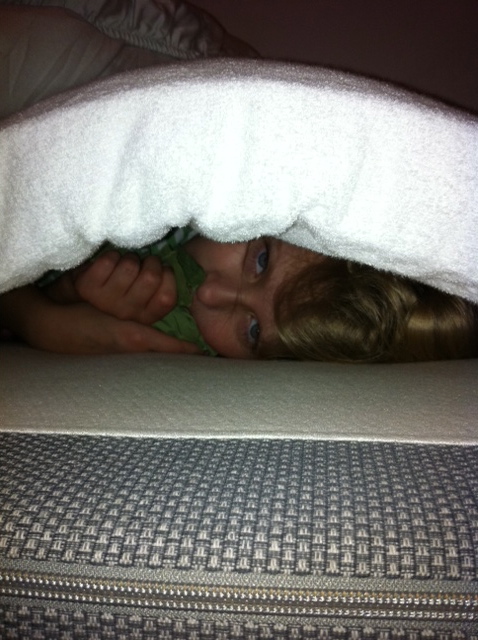
Like many children, Emma loves nothing more than a rousing game of Hide and Seek.  Except Emma doesn’t like to look for anyone, she just wants to be the one to hide, always.  She also only likes to hide in one place.

Which kind of defeats the whole purpose of the game.  Because not only is she utterly predictable, she’s also really hard to miss.  Never-the-less, we do our best to play the part of surprised “seeker”.
“Hmm, I wonder where Emma is?  Let’s see…  could she be in here?”  Dramatic throwing open of various closet doors and curtains, followed by, “No.  Not in here.  I wonder where she could be hiding?!”  There’s a great deal of crouching down, looking under chairs, the bed, her desk, while muttering, “Gosh, I can’t imagine where she could be!”

All of this is done while Emma variously – sings, hums, makes loud breathing noises or whispers to herself , “No, not going to find Emma under the mattress!”

That she is also squirming around makes her hard to miss, still we do our best to play the part given us.  Eventually if we are taking a very long time to “find” her, she’ll give us a little help.

By yanking off the fitted sheet to reveal herself and yelling, “There she is!”

In the theatre world, this would be called stealing lines, hogging the stage or any number of disparaging phrases.  But to Emma she’s simply trying to help us out and we appreciate it.

“Oh!  There you are,” we shout before grabbing a limb and tickling her mercilessly.

“Let go!  Let go, let go, let go!”  Emma squeals.

“No, no, no.  I’m not going to let go.  I’m going to tickle you and tickle you and tickle you..”

The other day while in the midst of just such a moment, Nic appeared in the doorway to Emma’s bedroom, “What are you guys doing?”

“We’re playing hide and seek, want to play?” I asked.

“Yeah okay,” Nic agreed, somewhat reluctantly as he knew Emma would only want to hide underneath her mattress again.

“Should I count or do you guys want to find me?” I asked.

“You and Nicky hide?” Emma said.  Meaning she wanted to hide with Nic.

But I pretended not to understand as every interaction can be an opportunity to teach (we’re trying to help Emma with her pronoun reversal problems), “Oh okay.  So you’re going to find me and Nic?”

“NO!  Mommy find.  Emma and Nic hide!”

“Emma you have to say, Nic and I are going to hide.”  Nic took her finger and made her point to herself, “Me, Emma.  You say me,” then he looked up at me with an expression of mild exasperation.  “No wait, that’s not right.”

I nodded my head.  “It’s okay, Nic.  You’re doing great.”

“Okay, okay,” Nic said, starting over again.  “Em, you have to say I.  I’m going to hide with Nic or Nic and I are going to hide.”

At this point Emma had lost all interest and was trying to get one of her favorite youtube videos up on her computer.

“Come on Em.  One last game,” I encouraged.

“Five minutes then computer,” Emma said.

“Yes. One, two, three, four, five…”

For more on Emma’s journey through a childhood of autism and an interview with her older brother Nic, go to: www.EmmasHopeBook.com

“When Did You Know?”

People often ask this question and the answer is complicated.  Looking back it’s easy to see the signs, things we never associated with autism, but now know were clues.  As a baby she was like any other colicky baby, cheerful in the morning and early afternoon, cranky by late afternoon, screaming by evening and inconsolable by midnight.  She would scream and fuss until 2:00AM or 3:00AM when she would finally fall asleep.  After about three months she was better and began sleeping longer.  Our pediatrician told us this was typical with babies who have colic and from all that I’ve read, it is.  Except that many autistic children also have digestive problems that plague them well beyond infancy.  Some believe GI issues occur more frequently in children who are diagnosed with autism than in neuro-typical children.  Others believe there is absolutely no connection and dispute the studies showing a slight increase in GI issues with autistic children.

I can’t speak for other families, but Emma has always had GI issues something we had confirmed when we took her to Boston for a colonoscopy and endoscopy showing us her multiple ulcerations and inflammations.  When she was a toddler she was a “good eater”, basically ate anything I put in front of her.  I noted in her baby journal when she was 12 months old that she loved the mushroom barley soup I made one snowy winter day.  Talk about random, as Nic would say.  The only thing she really disliked were peas.  Hated them, spat them out and threw the bowl to the floor.  But other than strained peas, Emma had a varied and healthy diet at that time.   As she grew older and the “autism” became more pronounced, her diet became more “autistic” too.  In other words she became less willing to try new things, more rigid in her desire for sameness and eventually became the picky eater that she is today.  People who blame GI issues on picky eating, haven’t met Emma.  Her GI issues have plagued her since the first day of her life.

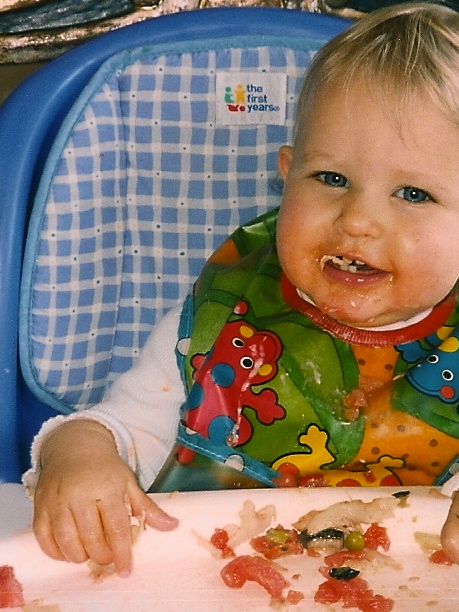
Emma with a variety of food on her tray including one hated pea.  This was taken before she tossed the pea to the ground.

The most telling clue, was the fact that Emma seemed so utterly indifferent to friends and other family members.  I remember when Nic was still a baby, maybe eight months old, my mother came to visit us.  We told him she was coming and he was very excited to see his Granma.  The last time he’d seen her was when he was three months old.  When she arrived, I went to greet her at our elevator, with Nic in my arms, he was so excited he began bouncing up and down, and reaching for her.  It was incredible to witness as he seemed to really know her.  Yet, when Emma saw my mother as a baby she seemed neither happy nor upset by this new person’s presence.  My mother’s arrival seemed to make little difference to her.  I remember making a mental note of this at the time and as with so many things one cannot understand, I chalked it up to her independence.

Rationalizing behaviors I couldn’t make sense of became commonplace.  It was a skill I fine tuned over the coming days, weeks and months.

I didn’t know.

For more on Emma’s journey through a childhood of autism and first clues, go to:  www.EmmasHopeBook.com

Emma and The Peach Gum

Last night Emma arrived home in tears.  It turns out she had swallowed a piece of peach flavored gum and her therapist, Joe, who had warned her that if she swallowed the gum he would not give her another piece, wouldn’t allow her to have another.  He offered her two other flavors to no avail.

“No!  Peach gum!” Emma cried when I went into her bedroom to sit with her.

“But Em, you swallowed it and Joe told you, you couldn’t have another piece if you swallowed it,” I said, stroking her hair.

“No!” Emma shouted, tears streaming down her face.  “NO!  Peach gum!”

“How about a different flavor?  But you can’t swallow it or you won’t be able to have another piece of any kind,” I offered.

“No, no, no, no.  Peach,” Emma insisted.

I often wonder, when Emma is derailed by something, seemingly rather insignificant, if there isn’t a whole series of events – perhaps unrelated – that have lead up to this kind of monumental upset.  It reminds me of days I’ve had, when everything that could go wrong does.  I get to work and my printer won’t scan, the cartridge is out of ink and I don’t have a back up, I can’t remember my password to upload images that have been requested to my FTP site, my merchant account isn’t showing my latest sales transaction, my gem setter calls to tell me he’s chipped a stone, I forgot to bring some documents I need from home, etc.  and then after all that I go home, having put in nine or ten hours of work, tired and grumpy and find a light bulb has blown in the living room. It just seems too much.  Meanwhile my husband wanders in, sees me and says innocently, “Hey, what’s going on?”

Those words are what flip the switch and suddenly I feel nothing but rage.

Is that what it’s like for Emma sometimes?  Only she can’t take a deep breath and explain that her day has been a nightmare of frustrations and mishaps, while the other person nods their head and says things like, “God that sounds awful.  Here why don’t you put your things down and let’s talk about it.”  Or “I know just what you mean.  It’s been a hell of a day.”  Poor Emma can’t say any of those things.  She doesn’t have the words to tell me how she’s feeling she can’t keep it together for one more second, so she just screams and cries and if things are really bad, bites or hits herself.

This morning one of her therapists emailed me, telling me about some of her frustrations at school yesterday.  I thought about how upset she was when she came home and it all began to make sense.  She had a bad day.  I can relate to that.  I have bad days from time to time too.  But I can pick up the phone and rant about it to one of my girlfriends or I can call my husband and tell him or I can sit and try to be quiet for a few minutes, “sit with the discomfort of it all”, as a meditation teacher I knew referred to those moments when it all feels unbearable.  The point is I don’t have to be alone with those feelings of frustration.  I can reach out and by reaching out I mitigate the feelings.

“You were frustrated, you scream, you bite,”  Emma told her therapist yesterday.  Emma was doing what we all do when we’re upset, trying to communicate her feelings with another human being.

Emma on a good day when she was seven.

For more on Emma’s journey through a childhood of autism and how that effects her older brother, go to: www.EmmasHopeBook.com

Autism & Emma’s Loose Tooth

I forgot to mention in yesterday’s post, Emma yanked her tooth out at some point in the movie theatre as we watched Hoodwinked Too this past Sunday.  I don’t know when, all I know is that when we proceeded out of the theatre into the light of early evening, I looked over at her and saw the gaping bloody hole in her gum once occupied by a tooth, her lower left incisor, to be exact.

“Oh my gosh, Em.  What happened to your tooth?”  I asked.

“Pulled out your tooth!” She said happily, bouncing up and down.

“I can see that.  But where is it?  Where did you put your tooth?”

“You threw it.  In the movie theatre, yeah,” Emma said, nodding her head up and down.

“God, Emma.  I can’t believe you just chucked it,” Nic said, no doubt thinking of the money she had essentially just tossed away, being well versed in the ways of the “tooth fairy.”

As a quick aside here, Nic caught on to the whole tooth fairy thing years ago.  “Mom, you can stop telling me about the tooth fairy.  I’m not stupid,” he said to me several years ago.

“I don’t know what you’re talking about, Nic,” I said, feigning shock.

“I know you and dad sneak into my room at night,” he pantomimed tiptoeing like a cat burglar with an evil expression on his face as he said this,  “and leave money.”  He looked at me, but I kept my face blank.  Exasperated he said triumphantly, “You guys are the tooth fairy!”  He said this with the kind of flourish one might expect from Hercule Poirot or Columbo as they sum up a particularly tricky mystery.  Okay, I’m dating myself, but you get the picture.

“You threw it!”  Emma said, evidently pleased with herself.

I looked over at Richard who shrugged and kept walking.

“I think we have three of her teeth.  All the others are on the floor of various school buses and now the floor of the movie theatre,” I said.

“I think there’s one somewhere in the vicinity of the Central Park carousel,” Richard added, thoughtfully.

“She’s never really taken to the whole tooth fairy concept,” I said.

“Yeah, right,” Nic laughed and rolled his eyes.

In fairness to Emma, it is an odd concept, one we tried to explain to her when her first baby tooth looked as though it might come out soon.

“So Em, when your tooth comes out you have to save it, okay?” I said, kneeling down so I was eye level to her.

She ignored me.

“And you give it to Mommy, okay?  We’ll put it under your pillow and the tooth fairy will come and take it and leave you money,” I said, realizing how bizarre this sounded to someone who takes things literally and has no concept of money, before I’d even finished.  “Okay, Em?”  I asked as she squirmed away from me.

Later that day the tooth was gone, where she put it we have no idea.  As with all of Emma’s teeth, there is a ruthless quality to her handling of her baby teeth.  They become loose and she will often say, “Pull it out!”  I’m never sure if that’s a direct request, though she did ask Joe once, about a year ago, but he refused.  The next time  I notice the tooth, it is inevitably gone.  How she manages to yank it out, without us knowing, without a sound or cry of pain, is one of the many mysteries of all things Emma.  The way she experiences pain is exemplified in all those missing teeth.  I can still remember the agony of loosing my baby teeth, the days of pain I would endure.  Emma, apparently feels none of this.

“Tooth missing!” she exclaimed  when she returned home from school yesterday.  She opened her mouth and pointed at the place her tooth once inhabited.  “You threw it!”  Then she laughed and jumped up and down.  “You threw it in the movie theatre!”  She laughed, whipping her plastic velcro strip around her head like a lasso.

Emma wielding her plastic strip

For more on Emma’s tolerance for pain and her continuing journey through a childhood of autism go to:  www.EmmasHopeBook.com

Our Family & Autism

Yesterday I slept in.  It was lovely.  When I woke Emma and Nic greeted me with a Happy Mother’s Day song (complete with pompoms and a loosely choreographed dance) that was so wonderful I wished I’d recorded it.  My thoughtful and doting husband made me a fabulous breakfast and then Emma and I went to her study room.  We are working on the concept of two or more as in – “Some frogs”, “What are these?”  “These are trucks.” etc.  After the study room we went swimming at the Y, something Emma has been requesting we do for weeks now.  It was completely empty and for the first half hour we had the entire pool to ourselves.  This is unheard of in New York City!  We then went to see Hoodwinked Too – a movie Nic has wanted to see since it came out, followed by dinner at a restaurant.  A little something for everyone.

For those of you who do not have an autistic family member this must seem like a perfectly normal way to spend a day.  But for those of you who are like us, you already know without me saying another word, how incredibly, gutsy and insane it is to even attempt the things I’ve just casually listed.  Let me explain.

Because of the issue of transitions, never easy for Emma, her very specific sensory issues coupled with her need for routine and sameness, a day as I’ve described can be a veritable minefield of upsets and cause untold anxiety for Emma. With this in mind we prepared Emma for the day by going over the key points with her – study room, lunch, swimming, movie in the movie theatre, dinner, cupcakes at home – and repeated this list throughout the day, often with Emma interjecting for clarification, “not movie at home, movie in movie theatre!”

The swimming was easy, it is something Emma absolutely loves to do and we try to arrange at least one day a week when she can go, though this isn’t always as simple in New York City as it may sound.  Needless to say we do not live in one of those coveted buildings in New York City with an indoor pool.  However, there are a number of excellent pools throughout Manhattan and so it is not impossible to arrange.  After we swam, (Emma was ecstatic and we all had a great time) we made our way to the movies.  This transition can be tough for Emma ending with protests, tears or worse.  Movies are not something she particularly enjoys and even though this was a kid friendly animated movie, Emma was just as likely to find it intolerable.  It is difficult for her to sit still through the trailers, she doesn’t like the 3-D glasses (I don’t either) and unless it has lots of music, the movie usually does not hold her interest for long.  Emma then will begin standing up in her chair, looking at the people sitting in back of us and saying in a very loud voice, “NO!  You have to be quiet!”  which they find utterly confusing as none of them have spoken.   Emma is just as likely to put her index finger to her lips and make a loud “SHHHHHHHH!” noise, followed by “You have to be quiet!”  Other movie goers find this equally baffling, as we do our best to quiet her.  We always come prepared knowing one of us may have to leave with her, taking her to a nearby playground until the movie is over.  But yesterday she sat through the entire movie, with very little squirming and no audible protest.

After the movie we walked to a restaurant, a little trendy upscale diner with loud rock and roll music (a plus for Emma & Nic who knew all the songs) and with fast service.  Even so, going out to eat is not something we do often as a family as it can end with drinks knocked over, loud utterances of “Time to go now!” from Emma or she will simply get up and leave with one of us racing after her.  This restaurant was one of those places that doesn’t really get crowded until after 8:00PM so we had no trouble securing one of their much sought after booths at 6:30PM.  Emma has such a limited number of foods she’ll eat, we came prepared with her favorites, which she happily ate when our food was served and then patiently waited for us to finish.

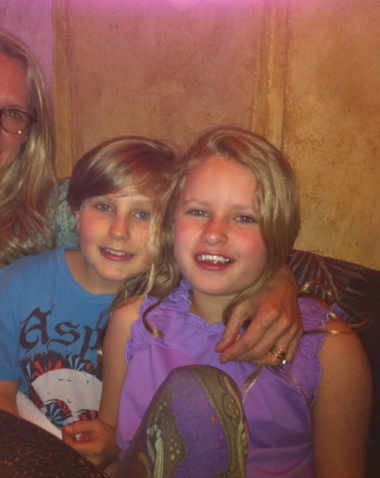
Nic and Emma sitting in a booth at the restaurant.

Richard, ever the thoughtful boy scout had bought cupcakes from Magnolia Bakery the day before, thinking Emma was more likely to get into the celebratory spirit if there were cupcakes for dessert waiting for us at home.  So after we ate our dinner we made a pit stop at a playground across the street before going home to eat cupcakes.

Except when we returned home and brought out the cupcakes Emma said, “No thank you,” and wandered off to her bedroom.

“Wow, that’s new!  She doesn’t want one?” I looked at Richard incredulous.

“Hey, everything changes,” Richard said with a shrug.

By 8:00PM both children were in their pj’s, teeth brushed and flossed and in bed.

It was a perfect Mother’s Day.

For more on Emma’s journey through a childhood of autism go to:  www.EmmasHopeBook

The Velcro Strip

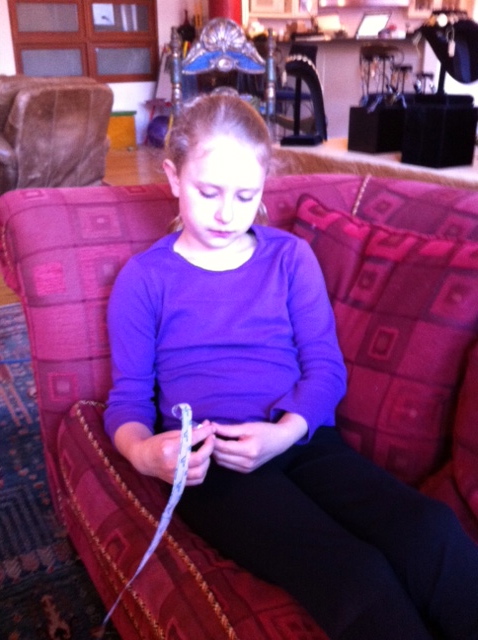
Emma’s balloon string has been officially replaced.  She now carries a long plastic strip, the kind you peel off a self adhesive velcro strip.  How such a bizarre and unlikely item came into her possession is anyone’s guess.

Emma with her plastic velcro strip this morning before going to school.

Over the past year or more Emma has become attached to an assortment of long, thin objects.  The first was a stick she picked up on a playground near the Bronx Zoo.  One can never know when an object will become a coveted one.  But I remember that stick because she wouldn’t let go of it, even when she swung on the monkey bars at the playground.  It was an odd thing to watch her movements so clearly hindered by her refusal to let go of that long stick.  When we made our way to the subway for the long ride home, we told her she could not bring the stick with her.  She didn’t put up a fight and I thought nothing more of it until I saw her, upon our return home, reach down to pick up another stick from the planter outside our building’s front door.

” No Em.  The stick stays outside,” I told her and she complied.

But it became a habit, each and every time we left the house she would find a stick and carry it with her.  A few months later she found a long plastic strip used to bind packages and began carrying, twirling and waving that around while inside our home.

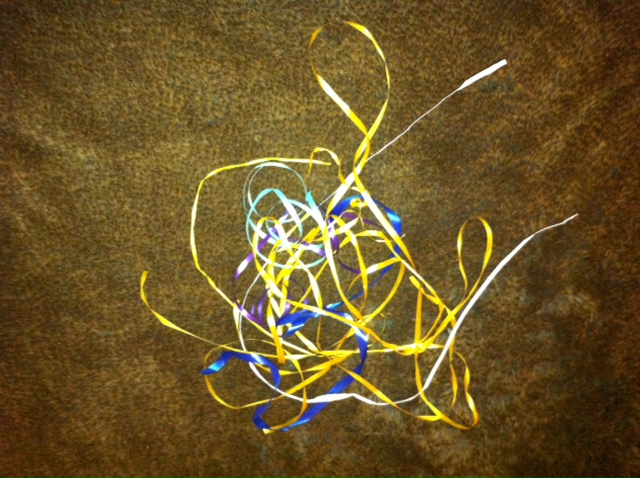
Emma’s assortment of “strings”.

There are a few thoughts on this sort of behavior with autistic children.  Some believe the items should be removed.  The idea being the child should not be allowed to have them as they increase “stimming”.  Stimming – shorthand for self-stimulation is a word, which is much used when speaking of autism.  It is the repetitive behavior the child/person uses to soothe, calm or regulate themselves.  The objects are varied and can be anything from spoons to things like running water.  But some children do not engage an object at all.  These children do things like  hand flapping, twirling, spinning, rocking and even head banging, while others stare at their own fingers that they wave in front of their eyes, others tap their fingers rapidly, hum or grunt, bite or twirl their hair, lick surfaces or smell things.  What marks their behavior from so called neuro-typical behavior such as pacing, doodling and thumb twirling is the child who is autistic may engage in these behavior for hours at a time, often getting in the way of daily living and learning.

Others believe the child should be allowed to stim and feel it is better to allow the child to self regulate.  They believe it is, in fact, cruel to remove the source of comfort for these children/adults who are autistic.  Many people believe learning can take place despite the stimming.

I don’t fall squarely into either camp.  Richard and I have done our best to give her the freedom to have some objects – balloon strings, velcro strips etc. while telling her she cannot bring sharp, pointed or objects we think might accidentally hurt her into the house.  We do not allow her to have her “Coqui” aka scraps of blanket outside her bedroom because she can sit for hours at a time sucking her thumb, which is doing untold damage to her teeth.  When I am working with Emma she may not have anything in her hands as I need her hands free to type, write etc.  But when she has gotten dressed, brushed her teeth, straightened her room, she can race around the house on her scooter, carrying whatever long piece of string/plastic/packaging tape she likes.  It’s difficult to know whether we are doing the right thing, but for the moment this middle ground seems to work or, at the very least, not cause too much damage.

Earlier this morning when I was trying to take a picture of Emma with her velcro strip, she wouldn’t look at the camera.

“Hey Em.  Can you look at the camera?” I asked.

“Say cheeeeese!”  Emma said scrunching her face up into a hapless and obviously forced “smile”.

“No not like that.  Think of something happy.  What makes you happy?” I asked, pointing the camera at her.

“Mommy makes me happy,” she whispered.

And that makes me happier than she can ever know.

For more on Emma’s journey through a childhood of autism and arbitrary items that hold her interest go to:  www.EmmasHopeBook.com

Sliver Abilities in Autism

The other day while waiting for Emma’s bus we sat together.  Emma recounted, as she often does, what she planned to do that day and what she looked forward to in the days ahead.  “Get on school bus, Becky’s class, Joe, see Mommy, sleep, wake up, sleep, wake up, sleep wake up, sleep, wake up, Throwback Sports, sleep, wake up, make pancakes!”

Our neighbor took this photograph of me and Em waiting for her school bus.

I’m always astonished that Emma almost always gets the right number of “sleep, wake ups” before she can have pancakes on the weekend.  I have even seen her count on her fingers, making me wonder whether we shouldn’t start implementing a math program – if I can find one – as it’s clear she is counting and figuring out how many times she’ll sleep and then wake up before Saturday morning.

Much has been said about autism and “sliver” abilities, the sorts of things autistic children seem to be able to do at age level or above while most other things lag far behind.  I am not referring to the much publicized, but rare, savants.  I’m talking about the abilities many autistic children have that surprise us, their parents.  In Emma’s case it is her unbelievably accurate memory for people, places and things.  She will talk about a preschool teacher she had when she was three and she has an uncanny ability to know when a favored object or photograph is missing.  She seems to know immediately that not only a photograph is missing, but she knows which one with a glance at the pile of over 200 photographs.  I have no idea how this is even possible.

“Carousel photo?”  Emma will cry.

“But Em, here’s the photo.  Look!  There’s you and…”

“No!  Other one!” She’ll cry in frustration.

We no longer doubt her.  I cannot remember Emma ever being wrong about a missing photograph from her box of photos.  She keeps them in a box the size of a shoe box and there are over two hundred photographs.

I am constantly amazed with Emma’s mind.  It can retain massive amounts of information and yet I still must remind her that she needs to dry her body off when she gets out of the shower.
“Okay, Em.  Now get a towel.  You have to dry your arms and legs.  Now dry your stomach and back,” I will say.

What has become clear to me is that Emma’s mind is not something I can predict.  I cannot assume she will know how to do something – rinse her hair after she puts shampoo in it – while at the same time I cannot not assume anything either.

“Mona Lisa!”  Emma said, pointing to a book with the portrait of the Mona Lisa on the cover.

“Yeah, Em.  That’s right.  Who painted it?”

“Leonardo,” Emma answered happily.

“What’s his last name?” I asked.

“Vincy” She said.

“That’s right Em.  His name was Leonardo Da Vinci.”

When we were at MOMA a few years ago, Emma astonished all of us when she pointed to a painting and said, “Picasso!  Man with Guitar.”

Just around the time Emma was diagnosed I showed Emma a book on famous painters and their paintings.  Over six years later she still could remember them.

For more on Emma’s “splinter abilities” and her journey through a childhood of autism go to:  www.EmmasHopeBook.com

Emma’s Dolls Get A Bath

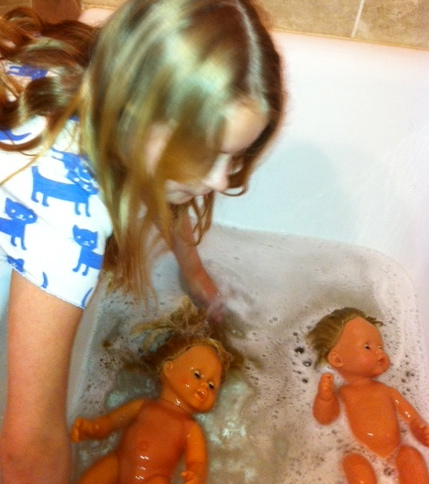
Two nights ago as Nic was helping me clean the dishes, I heard the sound of water running in Emma’s bathroom.  “Hey Nic, hang on a second.  I want to see what Emmy’s doing.”

Nic held out his hand for the scrub brush so that he could take over.

As I rounded the corner I could hear Emma singing.

“Hi Em.  What are you doing?”  I asked surveying the scene.

“Mommy go away!”  Emma said.

This is what Emma says when she thinks she may be doing something we might object to.

“Em!  You’re giving your dolls a bath!”  I said.

“Mommy go away, go away!”  Emma said while trying to close the bathroom door with her foot.

“Okay, don’t worry Em.  I’m gong to go finish the dishes with Nic.  But can I come back a little later?”

“Yes,” Emma said and closed the door on me.

“What’s she doing, Mom?” Nic asked me when I reappeared.

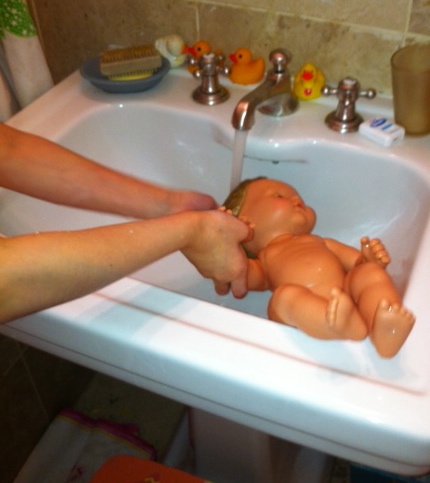
“She’s giving her dolls a bath,” I said.  “It’s so great!”  When I returned to the bathroom I said, “Em, that is so thoughtful of you to put the rubber ducks in the tub with your dolls!”

“And bubbles,” Nic added.

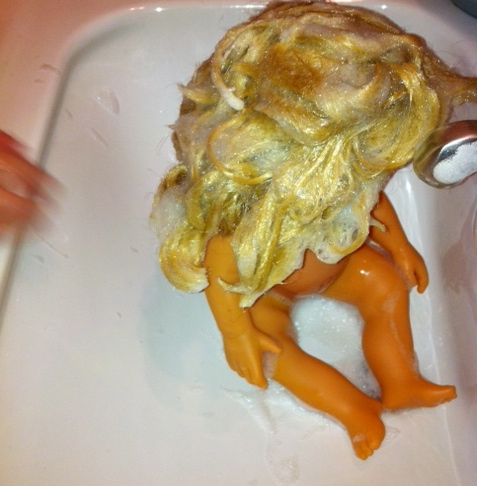
“Doing great job washing doll’s hair,”  Emma said, nodding her head and reaching for the bottle of shampoo.

“Yeah, you’re doing a great job!”  Nic said.

As Nic said this, Emma squirted an enormous amount of shampoo onto each of her doll’s heads.

“Okay, maybe that’s too much,” Nic commented, looking at me with concern.

Oblivious, Emma happily massaged the shampoo into each of her doll’s hair and then pulled one of them from the tub and sat her in the sink.  “Have to rinse hair,” she announced as water sprayed from the sink faucet out into the bathroom onto her and her brother.  “Uh-oh!”  Emma said, cheerfully as she struggled out of her now soaked nightgown.

“Oh boy,” Nic said, retreating from the spray.

Emma carefully gathered all the rubber ducks from the bathtub and sat them on the edge of the sink, then rinsed each of her dolls before putting them on a towel on the floor.

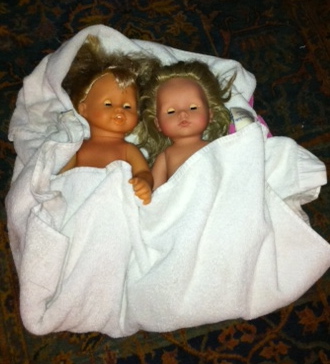
“Dolls all done!”  Emma said, as she wrapped her dolls in several towels.

“Awesome job drying off dolls!”  Emma said.  “Now time for bed,” she added.

I often find myself looking for little clues, the small details in what Emma does as reasons for hope. The washing of her dolls is such a great example, I think, of Emma’s continued development.  That she thought to include the rubber ducks was such a wonderful display of thoughtfulness and pretend play.  Emma still doesn’t cuddle her dolls the way I used to when I was a little girl, but in her own way she is caring for them, giving them a bath, washing their hair, rinsing them off and then drying them, wrapping them in towels before leaving them on the floor.  She has, in the past, put them in bed as well, though she seemed to lose interest before that thought occurred to her.

Emma even remembered to drain the water from the tub before shutting off the light and leaving the bathroom.  Sometimes I think I am clutching at straws, I mean, really what’s the big deal?  So she gave her dolls a bath.  But to me, it is a big deal.  Or I choose to make it one, because really what’s the alternative?  I can find the positive in the things she does, see them as hopeful examples of progress or I can shrug my shoulders and say – So what?

I’ve never been the “so what?” type, so I can’t imagine I’ll start now.

For more on Emma’s journey through a childhood of autism go to:  EmmasHopeBook.

“No Braid!”

Combing through the tangled knot that was Emma’s hair this morning, she cried, “I don’t like hurt.  Ouch, use brush.”  She grabbed the brush next to her and began brushing her hair.  Only Emma’s “brushing” her own hair consists of placing the brush arbitrarily on some portion of her head and pulling down, which is fine if her hair isn’t tangled.  If her hair is tangled, as it was this morning, Emma’s attempts to brush it, only serves to make it more so.

“Okay, Em.  I’m sorry, I didn’t mean to hurt you,” I said, plying the brush from her.

“It doesn’t hurt,” Emma responded.  Which meant it did hurt.

“Here, I’ll use the brush, see?” I said, being careful to not pull on her hair.  How about I make a braid today?”

“NO!  No braid.  Ponytail!”  Emma cried grabbing the brush again.

“Okay.  How about I make pigtails?” I asked.

“Yes.  Pigtails!” Emma said.  She made her hand into a fist and put each fist on either side of her head, indicating where she wanted the pigtails.

“Perfect.  I’ll do that,” I promised.  After I put the pink frilly hair ties in place I said, “Let me see!”

Emma turned toward me and tossed her head from side to side making her hair whip around.  With a huge grin, she shouted,  “Pigtails!”

“Oh Emma you look great.  I love those pigtails.”

“You’re so pretty!” Emma said jumping up and down.

“Yes you are.  Now let’s go brush your teeth.”

When we went into the bathroom, Emma looked at her reflection in the mirror.  “Look at you!” she squealed, grinning at herself.  “You’re so cute!”

As we left to catch her school bus, Emma carefully put her hat on over her pigtails, only the pigtails were so high on her head it made her look as though she had little horns.  I smiled at her as we got into the elevator.

Emma jumped up and down and waved her arms while making a kind of whooping noise, something she does when she’s excited.

“Are you happy?” I asked, smiling at her.

“Are you happy?”  Emma repeated.   After a pause, Emma shouted, “YES!”

“Why?”

Answering “why” questions is usually quite difficult if not impossible for many autistic children.  Emma is no exception.  Usually a conversation, which starts with “Why?” ends as abruptly as it began.

“Hey Em, why do you want to do that?”  “Why do you want to go there?”  “Why are you screaming?” “Why are you sad?” “Why are you hitting yourself?” etc.

99.9% of the time when asked “why?” Emma will either – walk away, not answer or will answer by repeating the question.

“Why?” Emma will respond in a high-pitched voice edged with anxiety.  “Why you hitting,” or “Why want to?”

Repeating the question does not produce positive results.  Repeating the question in a louder voice also does not make a difference.  After all there is nothing wrong with Emma’s hearing.  She hears the question she just has a difficult time responding.  So it was noteworthy when Emma responded to a “why” question the other day.

Emma wanted to have a pair of scissors so as to cut the gym mat we had tied around a standing beam for Nic to use when practicing his karate punches and kicks.

“Emma why do you want to take it down?” Richard asked.

“Because I want to jump into the swimming pool,” came Emma’s surprising response.

Now many of you reading this may be confused by her words, but to us, who understood she meant she wanted to turn the multi-colored gym mat on it’s other side, which happens to be all blue, and pretend it’s a swimming pool, we were in shock that she answered a “why” question and answered it so beautifully with a clear, concise, complete sentence.

When Richard told me I couldn’t believe it.  “Really?” I said, barely able to contain my excitement.  “Really?  She said because?”

Richard nodded his head.

“But that’s amazing!”

“Yup,” Richard said.

So Richard cut the mat down, told her to put on her swimsuit and let her “dive” into the “swimming pool”.

Ah life at the Zurcher-Long’s… it just never gets boring around here.

“Caesar Stop the Music!”

These are the words Emma sings, to the Rihanna song, Please Don’t Stop the Music, which despite our corrections, she insists on singing her way.

“Emma!  It’s not Caesar, it’s Please don’t stop the music!”  We have said on more than one occasion.

Often she will correct herself, only to return to – “Caesar stop the music”, and then she’ll laugh and continue the song.   “Caesar stop the music, Caesar stop the music, Caesar stop the music, Caesar stop the music!”

What follows is pretty garbled and since I don’t know the words to the song, impossible for me to decode.  But after the garbled words she will usually hum, keeping the tune intact, before singing, “I wanna take you away, let’s escape…” more garbled words and humming, before launching into the grand finale, “Caesar stop the, Caesar stop the, Caesar stop the, Caesar stop the music!”

This is Emma at her silliest and yet most endearing.  I know she knows the lyrics.  We’ve corrected her dozens of times.  I know she can say the correct words as I’ve heard her on rare occasion say them.  But “Caesar stop the music” is the way she prefers to sing the song.

That Emma “plays” with words – although that may be a gross misreading of what is actually going on – is something I’ve always found fascinating.  As a toddler, she would say things none of us could understand, but over time we were able to decipher.  Often they were nonsense words, which in no way resembled the actual word used for the object she was referring to, such as “Cokie” for blanket.  For months we thought she was asking to eat a cookie.  And then there are the words she uses to describe things, a kind of poetic beauty, as when she called rain, “bubbles”.  There is a literalness to that – if you examine the rain as it falls from the sky it does resemble tiny bubbles and when it falls to the ground it will often form a bubble, but it isn’t something I would ever have come up with.

Emma also uses words, both descriptive as well as strangely similar to the actual words as she does with the stars in the night, “sorry bubbles”, “cheese solos” for cheese doodles.  It’s interesting to note, for a child who is so literal she cannot come up with a name for her baby doll, but instead calls her, “baby” or “doll” or “girl” that Emma creates such unusual words to describe other things.  It is, perhaps, this literal application to things which we take for granted or do not even notice that makes her choice of words so interesting.

As always I am left wishing I could be inside her body and mind for an hour to feel, hear, see and experience the world as she does.

A Zen Koan

Living with an autistic child, forces one to “think out of the box.”  Emma’s mind is, to a neuro-typical person, a tangled web of odd phrases, misplaced pronouns, questions posed that may be statements or may be questions, interchangeable tenses, words used literally within non literal contexts.   I often find myself feeling I have been given a Zen koan when I’m with Emma.  For those who may not know what a koan is, it is a non-answerable verbal puzzle.  One of the most famous Zen koans is:  Two hands clap to make a sound.  What sound does one hand make?  The answer is – there is no answer and if you attempt to verbalize one you miss the point.

Emma’s behavior is often perplexing, her speech difficult to decipher, her desires often impossible to understand.  And just as with a Zen koan, if one attempts to apply intellect and reasoning to Emma’s actions, one will have missed the point.  My best, most joyful moments with Emma are when I am simply present.  No agenda, no preconceived plan of action, no desired outcome, just present in her company, enjoying her without judgment.

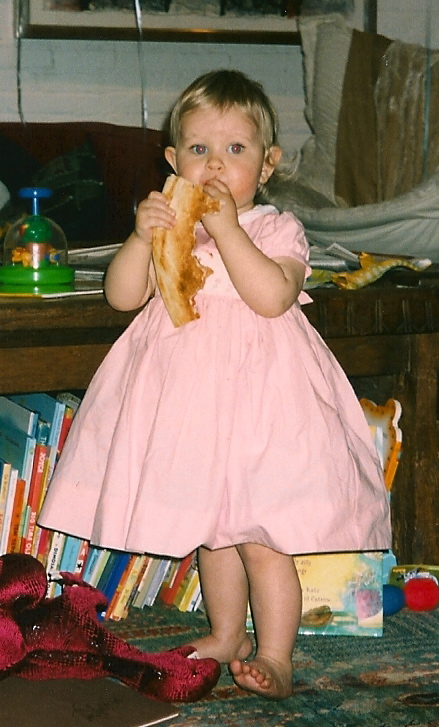
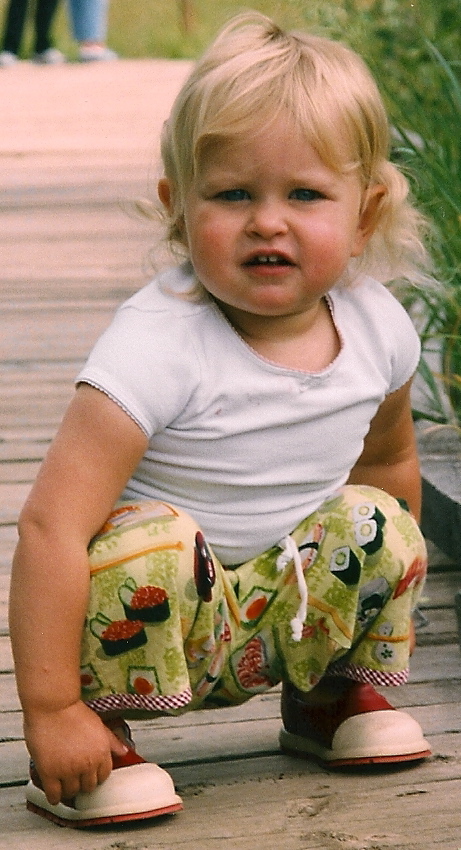
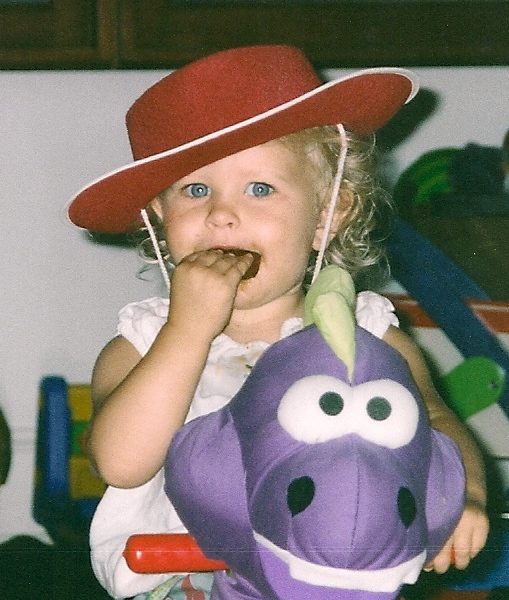
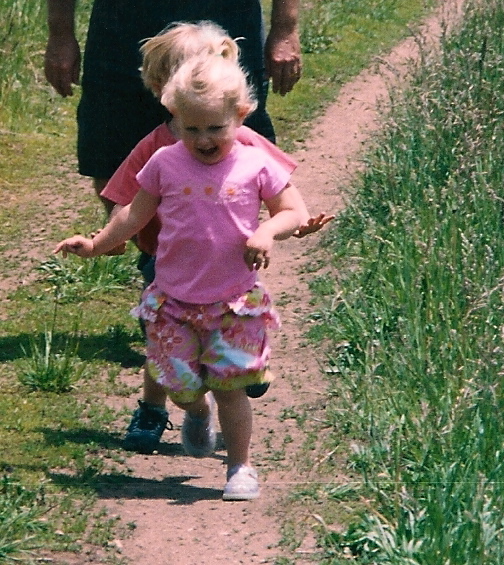
Here are some of my favorite photos of Emma when she was young before all eye contact went away and one taken over the weekend now that her eye contact has returned.

Theories

Autism is nothing without theories.  Specialists, doctors, scientists, geneticists, parents, everyone has a theory when it comes to autism.

Richard claims I have more theories regarding autism than the most versed specialist.  And he’s right, I do.  The only difference is, I freely admit 95% of them turn out to be wrong and the remaining 5% have no validity because while they may prove right for Emma on any given day, they do not hold up long term or within the larger autism population.

Richard and I have a running joke about my desire, my need for theories.  When we are confronted with any new behavior from Emma, Richard will look at me and say, ”And your theory is?”

The beauty of having theories is, autism remains an enormous question mark and so the most impractical of theories hold weight if for no other reason than because they are difficult to prove wrong.  There is so much more we do not know than we do.  The other thing about theories is they give us  (me anyway) hope.  Hope that we’re moving forward.  Hope that maybe this line of thinking is going in the right direction.  Hope that the theory will lead to another theory, which in turn will prove to be true, leading us to a cure, a cause, something, anything…  No matter how crazy, the theory stands until proven otherwise and with autism that may be for a long time.  It’s something, anything, to go on amidst the great expanse of unknown.

Richard usually leaves the theorizing to me, so I was surprised when he said to me last night, “I have a theory.’

“Really?” I said looking at him to be sure he wasn’t making fun of me.

“Yes,” he said.

“Great!  Tell me more.” I said.

“Emma is doing great. “

“And your theory is?” I prodded.

“That is my theory.  She’s doing great.  The other day she and I were walking down the street.  I passed her and stepped off the curb to hail a taxi, but she didn’t see me.  She looked around, her eyes got really big and then she said something, I can’t remember what.  But she was scared and didn’t know where I was.  I called out to her – Emma!  I’m right here!  When she saw me, she cried out – There’s Daddy!  There’s Daddy!  I found you!  That’s never happened before,” Richard paused.  “She was really frightened when she thought I wasn’t there,” he said.

Suddenly I remembered when Emma was three and we went to New Paltz for the weekend.  We stayed at a huge rambling hotel right out of The Shining.  Richard and I in one room, the children with Joe in an adjoining room.  At around 2:00AM I heard a door slam, thinking nothing of it I started to go back to sleep.  Five minutes later our door opened and Joe said, “Is Emma with you guys?”  In a panic all of us threw on clothes and began searching the labryinthian hallways calling for Emma.  We split up hoping we might cover more ground that way, I ran to the front desk and reported her missing to the hotel staff.  It was the dead of winter, snow drifts piled up around the hotel, I was terrified Emma might open one of the self locking doors to the outside and not be able to get back in.  She was bare foot with just her nightgown on.  After about 20 minutes when panic had turned to ice – when your body no longer feels it is your own – one of us found her.  It was either Joe or Richard, I can no longer remember, but I know I began to cry in relief.  She was holding hands with some man who worked for the hotel.  He was quietly talking to her – at that time she had almost no language – and leading her back to the front desk.   I was in tears, thinking of all the horrible things that might have happened to her.  But Emma acted as though nothing unusual had occurred.

Richard continued, “Her sentences are becoming more complex, she’s become much more engaged, she talks all the time now and it’s not just because she wants something.  She’s talking to connect with us.  She wants to connect with us.  And except for the other night, she hasn’t wet the bed in almost a month now.”  He looked at me and then added, “She’s doing great.”

I remember when Emma turned four we had a big birthday party for her, hired a musician to come and play the guitar and sing kid friendly songs.  Emma was dressed up in one of her “party” dresses with a tiara on.  She spent most of the party trying to lie down inside of the musician’s guitar case, ignoring all the other children and the music.  I remember plastering on a smile for our guests, at one point I excused myself and wept in the back, giving myself two minutes to cry before returning to the party and pretending everything was fine.  I didn’t fully understand her sensory issues; I hadn’t developed any theories at that point.  I was still in the process of reading everyone else’s theories regarding autism.

“It’s a good theory,” I said to Richard.

“Yup.  I like it,” he said.