Tag Archives: autistic children

Amusement Parks & Autism – Continued

Emma’s entire system was crashing.

“You have to ask Mommy!  Mommy can I go on the roller coaster with Gaby, please?”   She cried over and over again through screams and tears.

It was heart breaking and anyone with a neuro-typical child would think – oh just let her go on it one more time and then go home.  I even thought this a number of times as I tried to peel her off the pavement where she had fallen in a heap of tears, snot pouring from her nose, her hands made into tight fists while hitting herself in the head, on her chest, legs, arms wherever she could before I, or any of us could stop her.  The biting is horrible because it can break the skin and then there’s blood, and later scabs and enormous angry blue and purple bruises that can last for more than a week, reminding all of us of her agony.  But the hitting – a quick, violent punch to the face is shocking to witness and as a parent, it’s difficult not to feel one has done something horribly, horribly wrong.  How can this sweet, blissful child do this to herself?

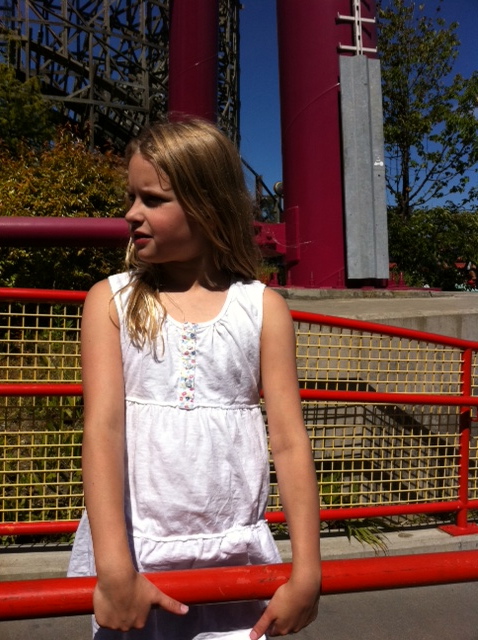
Emma waiting for Joe, Nic and Gaby while they ride on the Corkscrew
Richard and I have always said to the children – hitting is wrong.  We don’t do it, we don’t want them to ever do it to each other and until Emma began hitting herself, it hadn’t occurred to us to add – we don’t hurt ourselves.  We don’t hit others or ourselves.  We say it, but I don’t know that it makes a difference.  When Emma’s brain has become set on something, no amount of calm, reassuring logic seems to help her.  No amount of soothing, we just have to vacate the premises.  It’s our only hope.  Kind of like shutting the whole system down, a kind of reboot.  We have tried the other option, which is to let her go on one more ride or do whatever it is one more time and the misery, the abject misery continues.  Like an addict who has to have that drink or that drug even while bringing them no real solace.  There’s no relief to be had at a certain point.

“Emmy it’s going to be okay.  We’re going to go home now.  We can ride the little roller coaster one more time and you can sit with Gaby and then we have to go home,” we told her.

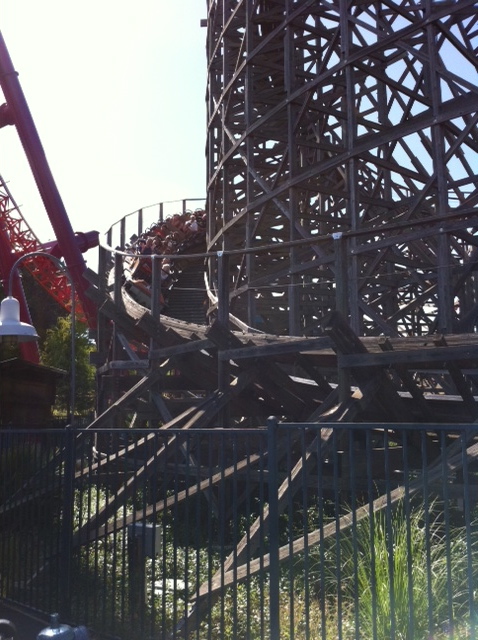
But Emma’s brain couldn’t take in this information it was already in lock down mode.  I gave her a banana to eat and then everyone, our once cheerful little group, now more weary warriors than a family intent on having a lovely day at an amusement park trooped along.  She was able to sit with Gaby on the little roller coaster for one last ride and then we trudged back to the car while Emma kept looking over her shoulder at the wooden roller coaster named Roar.  As we headed home Emma said, “It’s okay, we’ll come back tomorrow.”

“No Em.  Tomorrow we’re going to traintown where there are different rides and then we’re going to Uncle Andy’s wedding,” we told her.

“Different rides,” Emma repeated, sadly.  “We’ll come back soon,” she said.  There was a wistful tone to her words, and we knew it wasn’t likely that we would ever come back to this part of the world.  But there would be other amusement parks and maybe one day Emma’s massive sensory issues will have abated to such a degree that these kinds of episodes will become rarer.

We can only hope.

For more on Emma’s journey through a childhood of autism go to:  www.EmmasHopeBook.com
Amusement Parks – Autism

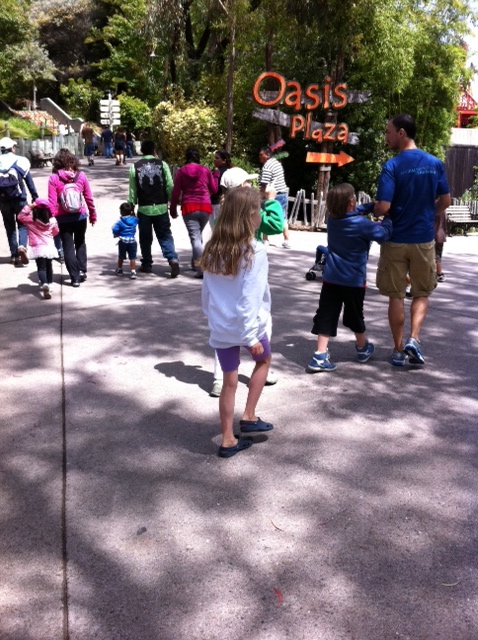
Emma loved our day spent at Six Flags near Napa, California last week.  Typically Emma can be counted on to ride the most terrifying looking rides, but on this trip she immediately said – no.  She wanted to go on the little roller coaster, the one you get to before the rides called: The Corkscrew, Velocity and Medusa.  While Nic and their cousin Gaby ran off to get in line for a ride that looked as though it went up so high it might require an oxygen mask, Emma insisted she stay and “just watch” with Richard and me.

Emma entering the park

“Really Em?  But it’s going to be a lot of fun,” Richard urged, even though it didn’t look like it would be fun at all, unless you enjoy sky diving.  Gone are the days of the old traditional roller coasters where you actually could put your hands up without fearing death, where the vertiginous climb and then dizzying descent didn’t cause your entire life to pass before your eyes, where you exited the ride feeling intact and not as though you’d just avoided a heart attack or stroke.

“No, no, no, just watch.  Just watch with Mommy and Daddy?”

“Yeah.  Okay.”  Smart girl I thought to myself.  Still it was unusual and the first time Emma has shown anything other than excitement at an amusement park.

“It’s weird.  I can’t understand why she doesn’t want to go with Nic and Gaby,” Richard said, peering up at the tangled mess of metal rails called – Velocity.

“I don’t know.  Maybe it’s her ears…”

“I think she has to go to the bathroom.”

“Or maybe she was scared the last time Joe took the kids to that park a couple of weeks ago.  Remember?  He said that one ride, even Emma was scared.”

We continued to debate what could have gone wrong, but Emma stood firm.  She was very specific about which rides she’d go on and which ones she wouldn’t.  Any ride that caused her to be upside down, was rejected.  Not that I blamed her.  I felt slightly ill just watching the other kids shrieking and whipping around as though they’d been tossed into a human blender, without the blades.

But then we found the roller coaster called “Roar”.  An old style wooden roller coaster, the kind I remember from my childhood and even I felt a little jolt of enthusiasm.

“You could ride this one, Mom,” Nic said to me, patting my arm.

“You think?” I asked.  The thing was huge, but it did resemble the roller coaster I used to love riding when I was young.

“Totally, Mom.  You could do this one,” Nic said.

“I’m going to go too,” I announced.

“You are?”  Richard asked.

“Yeah, I used to love these,” I said.

Roar

When the ride was over, Richard said, “I think I broke my neck.”

“I thought I was going to have a heart attack,” I said.

“I’m not going on that thing again,” Richard said.

“That was horrifying,” I added.

“I can’t believe the kids want to go again.”  Richard shook his head in dismay.

“I think I have to sit down,” I said, motioning to a nearby bench as the children ran to get back in line.

By the fourth ride, Emma was beginning to get perseverative, which means she had become obsessive about riding and didn’t want to stop.

“Okay Em.  One more time, but this is the last ride.  Except it was too late, Emma couldn’t take waiting in the line, even though we had a disability pass allowing her to go to the head of the line, there were other children with disabilities also waiting.  She began to bite herself and scream.  Joe managed to keep her somewhat calm but by the time they were at the front of the line, Emma was miserable.

When she gets like this it’s as though her entire system crashes, like a computer.  There is nothing one can do to console her.

To be continued.

For more on Emma’s journey through a childhood of autism, go to:  www.EmmasHopeBook.com
Travel Plans Gone Awry

To pick up from where I left off, Emma did extremely well on the airplane and on the long car trip up to Napa, California.  She was ecstatic, if not more than a little tired when we finally reached the Bed and Breakfast that night.  There were others of us who did not fare as well.

The airlines arbitrarily changed all of our reserved seats, so that each of us now occupied a middle seat and no two of us were seated together.  When Richard called to complain and have our former seats restored, they professed confusion and ultimately said we would have to figure it out, despite the fact that we told them we were traveling with two children, one of whom was AUTISTIC!   Richard spent a good three hours on the phone Thursday afternoon, instead of packing, not an ideal way to spend the day.  I had a moment, during the second or third phone call to the airlines, when I wondered how it was even legal, let alone ethical for them to split up a family and not have even the children seated next to their parent.

But we got through it, though not because the airline did anything to help us.  I sat in the back of the airplane with Nic and my cousin, Alexandra.  Richard, Joe and Emma were able to snag seats together closer to the front.  A number of kind people were willing to change their seats to allow this to happen.  At one point we narrowly avoided a full melt down when Emma lost a piece of her blanket, now a three inch square of green fabric, which had inadvertently fallen on top of an elderly woman’s neatly coiffed hair who had fallen asleep in front of Emma.  Joe managed to deftly pluck the missing shred from the top of the woman’s head without waking her and returned it to a whimpering Emma.  Disaster averted.

The B&B was lovely.  Cedar Gables, whose wonderful owners prepared delicious breakfasts of homemade apple fritters, muffins and scones accompanied by eggs, bacon, sausages and fresh fruit each morning.  Because the entire place was overrun with my family members, Emma was able to run around in her nightdress, slide on the wooden bannister and blow up her balloons, then release them so they made a screeching noise as they whipped over the heads of unsuspecting relatives before resting on various ledges and window sills.

My brother’s wedding was lovely and Monday we headed back to the airport where I had to leave my family to return to Aspen, where I am reopening my store for the summer, while Richard returned home to New York with the children.

For more on Emma’s journey through a childhood of autism, go to:  www.EmmasHopeBook.com

Traveling with Emma

We are going to Northern California tomorrow for my brother’s wedding.  Emma is very excited to see her Uncle Andy and because we rarely travel anywhere new, this is a particularly appealing trip.  Other than visiting her Granma in Colorado, we have only traveled to places that required us to travel because of medical treatments for Emma.  Panama and Costa Rica for Emma’s three stem cell treatments and Boston to meet with Dr. Timothy Buie, a specialist in autism and GI tract issues.  When we flew to Boston a year later for one of my cousin’s wedding, Emma was convinced we were returning to the hospital where they’d performed a colonoscopy and endoscopy on her.  It wasn’t until we actually got to the wedding and she saw the guests did she relax.  We use to go to Cape Cod every August for a couple of weeks, but haven’t been, since we got Emma’s diagnosis.  In fact it was on that last trip almost seven years ago that we came to the conclusion we needed to get her evaluated.  Even if it were easier to travel with Em, Cape Cod sadly, holds painful memories for me and so I’ve not been eager to return.

However this trip is one Emma is anticipating with great excitement.

“Sleep, wake up, get on airplane, go see Uncle Andy!” Emma said this morning, while bouncing up and down.

“Yeah, Em.  We’re going to have fun!”

“No.  Not going to go on the school bus.  Going to see Uncle Victor, Grandma, Uncle Nic, Gaby, Lili, Liesl …”  she went through the list of all the people we would undoubtedly see at my brother’s wedding.

“Are you excited?” I asked.

“Yes!  So excited!”  Emma shouted and then ran out of the room.

There’s a certain degree of anxiety that comes with traveling with Emma.  Though she rarely has melt downs any more on the airplane, in fact she’s become a wonderful traveler, we always brace ourselves for the unexpected.  Because we aren’t allowed to pack any liquids or her yogurt (she’ll only drink Mott’s apple juice or Apple & Eve Apple juice and only if it comes from a plastic bottle, not a can) we have limited options when it comes to what she’ll drink and eat.  Usually she doesn’t eat anything other than her Pirate’s Booty, though last time we flew back from Colorado I did manage to get her to drink a small amount of the apple juice they served on the airplane.  It felt like a victory.  She use to eat fruit leathers and as they also helped her ears during landing and take off, we used to pack about ten of them.  She has recently been refusing to eat them, but I’ll bring some anyway on the off chance she’ll eat one.

We will be staying in an inn and thankfully the entire place has been taken over by my extended family.  Even if Emma does lose it, at least the people effected by her screams know of her situation and will hopefully be patient and kind.  Even so, it’s tough not to worry.  Richard scoped out the different day trips we can take while there this weekend and there seem to be a great many of them.  He found a pool she can swim in and an amusement park.

“Well we’ve got Saturday and most of Sunday until the wedding covered,” Richard announced earlier.

We’re sitting in the back of the plane, which is a good news/bad news situation.  The good news is, we’re next to the bathrooms, the bad news is we’ll be the last to get off and Emma has a difficult time sitting still after the plane is at the gate.  She wants to get off the plane NOW and can’t understand why we have to wait to let everyone in front of us off first. But who knows, maybe she’ll be able to tolerate the wait this time.

So while Emma is ecstatic and without any anxiety about traveling to see her Uncle Andy, Richard and I are anxiously making sure we’re well prepared and haven’t forgotten anything.  I use to be a very casual traveler, often late to the gate, the last one on board before they shut the doors and pulled away from the gate, winging it when it came to where I might stay the night.  In my twenties and thirties I often traveled alone, to all sorts of places all over the world.  But since I had children, I am a nervous wreck when traveling.

I’ll try to take a page from Emma’s book.  Relax, look out the window, chew on a fruit leather and enjoy the journey.

For more on Emma’s travel adventures through a childhood of autism, go to:  www.EmmasHopeBook.com
Cooking with Emma

Emma seems to have lost interest in her velcro strip.  It was actually the plastic back to the self adhesive velcro that she liked, but her yellow balloon string has replaced it for the past few weeks.  Instead of holding it in her hand, she puts it between her front teeth, like an enormous piece of floss, allowing her hands free.  She races around on her scooter, the balloon string held in her teeth, the rest of it undulating after her.  It reminded me of a Turkish woman I encountered years ago in Ezurum, Turkey.  She was wearing a shawl like head covering the size of a bed sheet and had one corner hooked on one of her front teeth.  The fabric was loosely around her face, but kept slipping off her head.  I remember watching her move along an alley, the fabric billowing out, as she hurried away.  She turned, at one point and looked directly at me, many of her teeth were missing, but her upper incisor was intact and she used it to secure the fabric so that it couldn’t blow away, leaving her hands free.

Yesterday evening when Emma asked that we make pancakes, she climbed up onto the kitchen island, the balloon string secured between her front teeth.  “Mixing bowl,”  Emma said, despite the presence of the yellow string in her mouth.

“Emma!” I laughed.  “You can’t cook with that balloon string.”

“Have to put it down!” Emma said, pulling it from her teeth and tossing it to the floor.

“Pancakes with chocolate chips please!”  Emma said.

As I rummaged around to locate the chocolate chips I heard Emma say, “Uh-oh!”

“What happened Em?” I asked turning around.  Emma sat with about a cup of pancake mix in her lap, a dusting of mix covered her arms and legs.

“You have to pour it in the bowl!”  Emma observed with a slightly irritated tone.

“Here you go Em.  Let’s clean that up.”  I handed her a damp paper towel which she used to dab at her face.

“Okay, but we have to clean up all this mix,” I said, pointing to the flour covering her and the counter.

“Mommy help?”  Emma said, half heartedly patting at the mix creating little clouds that then spread out over ever increasing areas of the counter.

“Yes.  I’ll help.  Here, look.  Let’s clean it like this.”  I brushed mix into my hand and threw it in the sink.  “Now you do it,” I said as I got out the milk.  When Emma had finished cleaning up most of the mix I said, “Here, you measure the milk.”  I handed her the measuring cup and gave her the milk.  Carefully she poured the milk into the measuring cup until it filled it about half way.

“Dit,dit, dit, dit, dit, pour in!”  Emma sang.  She always says this when she is measuring something during our cooking together.  I don’t know where the “dit, dit, dit” comes from or even what it means, but it’s part of the process now and so she always says it.

I held the whisk in front of her.

“Mommy, can I have the whisk, please?”

“Yes!  Here you go,” I said, handing it to her.

“Whisk, whisk, whisk, the pancakes, mix, mix, mix the pancakes,” Emma sang as she stirred, while occasionally dipping her finger into the batter to eat large dollops of it.  ‘Yum, yum!”  she said.

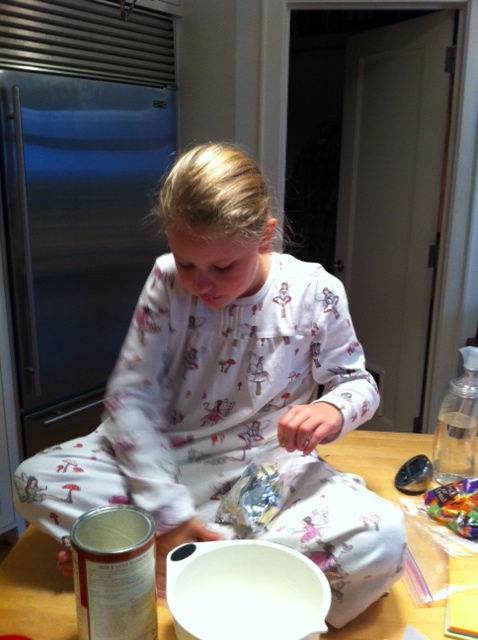
Emma making pancakes

For more on Emma’s journey through a childhood of autism and cooking, go to:  www.EmmasHopeBook.com
Emma’s older brother, Nic

Yesterday I took Nic and Emma to a relatively new carousel on the refurbished park along the Hudson River.  It’s unlike other carousels in that it has a wide variety of animals, fish and insects instead of the traditional horses one usually sees.  Emma likes to ride on the Atlantic Sturgeon, with the Unicorn and Wild Turkey coming in second and third.

Emma riding on the unicorn

I’d ride on the hyena or the coyote,” Nic told me when Emma chose the Atlantic Sturgeon for a second time.  “What would you ride on?”

“I’d have to go with the Harbor Seal,” I answered.

“Yeah, that would be a smooth ride,”  he said.  We watched Emma go around and around.  Every now and again she’d use the waist strap to tap the sturgeon, as though she were urging it on.  “Mom?”

“Yeah Nic?”

“So how do you blow bubbles with your gum anyway?”

“Okay, here I’ll show you,” I said, taking a piece of gum from his remaining pack.

“Emma blows huge bubbles.  I just don’t get it,” he said as I chewed the gum, trying to get it to the right consistency.

“Well she chews a lot of gum…”

Nic interupted me, “Yeah, I know, because of her ears.”

“Exactly, so she’s had a lot of practice.   But here, watch.”  I tried several times to demonstrate how to blow a bubble, which is quite a bit more difficult to explain than one might think.

After several attempts Nic said, “I think it’s a girl thing.”

We watched Emma for awhile on the carousel.

“Hey Mom?”

Yeah, Nic?”

“It’s weird.”

“What is, Nic?”

“I mean Emma’s so good at some things, but so bad at others.  Like she can blow bubbles and taught herself to swing and she’s really good on the scooter, but she still can’t read or write very well.  I think it’s interesting,” he said.

“Well, you’re right Nic.  There are things that are much easier for her and then lots of other things that are really hard.”

“But I don’t get it.”  He looked at me expectantly.

“Yeah.  I know.  It’s difficult to understand.  It’s the wiring in her brain.  It makes a great many things really, really difficult for her.”

Nic kept trying to blow bubbles with his gum.

“Does that make sense?” I asked.

“No,” he said, shaking his head.  “Not really.”

“Yeah, I know.  It’s really hard for us to understand.  There’s so much more we don’t know about autism than there is we do.”

“Mom?”

“Yeah Nic?”

“Do you think I’ll ever be able to blow a bubble?”

“Yes.  You just have to keep practicing.”

“But you don’t let me chew gum that much.”

“Yeah, that makes it harder.”

Nic stared at me with a little half smile on his face.

“Hey, you get to do all kinds of other things that Emma doesn’t get to do, and the only reason we let her chew gum is because of her ears.”

Nic kept grinning at me.

“What?”

“Nothing, Mom.  Nothing.”

For more on Emma’s journey through a childhood of autism and her older brother, Nic’s experiences along the way, go to: www.EmmasHopeBook.com

Que Sera, Sera

I’m the silent partner. On Emma’s Hope Book anyway. It’s been a long time since I posted an entry. Ariane has always been the driving (and writing) force of Emma’s Hope Book, but I’ve been completely MIA lately. I went on interferon/ribovirin treatment two months ago. I knew the side effects were going to be extreme, but it turned out to be much worse than I could have imagined – one of those cases where if the disease doesn’t kill you, the cure will. I was basically an invalid, physically and mentally. I had to quit the treatment just so I could function and it took a month before I felt well again.

Ariane did an amazing job holding down the fort while I was laid up. She does an amazing job all the time. I’m very lucky and very grateful. Frankly, it’s been a rough patch for all of us lately. “We’ll get through this,” Ariane said a few minutes ago, kissing the top of my head as she scurried back and forth, preparing for a jewelry trunk show.

“Yep,” I nodded, “we always do.”

Of course, exactly what “this” means is open to debate. I guess it means “today”, because our lives never seem to get less complicated, difficult or worrisome for any significant length of time. This is true of any family I imagine, but Emma’s autism contributes greatly to our never-ending “whack-a-mole” game.

Her progress with language, reading and writing continues at a steady pace – a daily miracle from my perspective. Yet at the same time, she has had a recurrence of her difficulties with being able to go to the bathroom, which we thought was long behind us. Two steps forward, one step back.

I finished my novel a while ago and it is being shopped around by my agent. Ariane submitted a proposal for a book about Emma and our family. Both of us are stressed, bracing ourselves and hoping for good news. The day before I went on the interferon treatment, a conflict with my business partner developed that seems irresolvable, adding to the career pressure. Obviously, I would prefer to have enough success as a writer to provide well for the family, just as Ariane would like her jewelry business and her own writing efforts to be wildly prosperous. I’m sure they will be. It’s a lot easier for me to have faith in Ariane’s talents and potential for good fortune. I come from Irish stock.

Every night for the last week Emma has gone to bed listening to a CD of lullabies recorded by the talented and lovely Alycea Ench. The first song is “Que Sera, Sera.”

The second is “Somewhere Over the Rainbow.” I sit in bed with Emma and listen to these incredibly poignant melodies and lyrics, so full of hope and unattainable longing. Do they speak to Emma with the same desperate yearning I hear? Does she question whether she will ever have a chance to experience the normal phases of life the rest of us take for granted? Or does she just like listening to the Alycea’s lovely voice as she sings:

Que Sera, Sera

When I was just a little girl

I asked my mother, “What will I be?”

“Will I be pretty? Will I be rich?”

Here’s what she said to me:

Que Sera, Sera

Whatever will be will be

The future’s not ours to see

Que Sera Sera

What will be will be.

When I was young I fell in love

I asked my sweetheart, “What lies ahead?”

“Will we have rainbows day after day?”

Here’s what my sweetheart said:

Que Sera Sera

Whatever will be will be

The future’s not ours to see

Que Sera Sera

What will be will be.

Now I have children of my own

They ask their mother, “What will I be?”

“Will I be handsome? Will I be rich?”

I tell them tenderly:

Que Sera Sera

Whatever will be will be

The future’s not ours to see

Que Sera Sera

What will be will be.

Somewhere over the rainbow

Somewhere over the rainbow

Way up high,

There’s a land that I heard of

Once in a lullaby.

Somewhere over the rainbow

Skies are blue,

And the dreams that you dare to dream

Really do come true.

Someday I’ll wish upon a star

And wake up where the clouds are far

behind me.

Where troubles melt like lemon drops

away above the chimney tops.

That’s where you’ll find me.

Somewhere over the rainbow

Bluebirds fly.

Birds fly over the rainbow.

Why then, oh why can’t I?

If happy little bluebirds fly

Beyond the rainbow

Why, oh why can’t I?

As Ariane said yesterday in her post, unless Emma is stressed out about one of her OCD issues or unable to attain her most basic needs, she is so incredibly happy in the moment. Blissful. So I doubt very much that she questions what the future holds in store for her — any more than she wonders what lies over the rainbow. She is here. Now. It is Ariane and I that so achingly desire for her to feel and experience all the things kids her age normally go through: having friends, playing games, chattering back and forth.  And as she grows older: dating, falling in love, raising her own family.

Just trying to imagine that kind of normal life for Emma and the rest of us is almost impossible for me. As I write this, I cannot clearly picture it. Even as a fantasy, this truly lies over the rainbow. But even if I can’t visualize it, I have never lost hope that it is possible. In fact, I believe with all my heart that it will happen — someday, somehow – and our little bluebird will fly.

In the meantime, we will get through this — today. As for tomorrow? Que, Sera, Sera.

“Too Good?”

We have a bedtime routine, which Emma because she loves routines, helps us implement.

“Okay Em, time to brush teeth!”  One of us will tell her.

“Mommy come,” Emma often replies.

“I’m right behind you, Em,” I tell her.

Once in the bathroom she’ll walk us through the steps of teeth brushing.  “First, floss,” she will remind me, grabbing the floss from me.  “Now brush,” she’ll say making little brushing noises in a sing-songy voice.

“Wait, you have to go slower Em.  You have to get all your teeth,” I’ll remind her.

“Now fluoride!”  Emma will say, swishing the fluoride around  in her mouth dramatically, before spitting it out into the sink.

“Okay, now pee,” I will say.

“Already did pee,” Emma said, last night when I reminded her to.

“Oh.  Okay.  Let’s get into bed then.”  Most evenings I read to Emma before going to bed.  We’ve gone through dozens of short non-fiction books ranging in topics as diverse as the first moon landing to the discovery of King Tut’s tomb.  We’ve read about wild life in Northern America, we’ve studied carnivorous plants, we’ve learned about General Washington’s love of dogs, we’ve studied the works of daVinci, Degas, Renoir and O’Keefe.

Then one evening Emma said, “Alice?”

“You mean Alice in Wonderland?” I asked.

“Yes,” Emma said burrowing down beneath the covers.

“Really?”

“Yes,” she replied.

“Well, okay.”  I found Alice in Wonderland on my ipad, downloaded it and within minutes was reading to her about Alice falling down the rabbit hole.  When we finished Alice we moved on to The Wizard of Oz.  When Dorothy and her haphazard group arrive in the Emerald City, Emma seemed less interested.  “Do you want me to keep reading?” I asked.

“Yes,” Emma said.  She always answers yes to that question.  But in less than a minute she was asleep.

Then the other night, Richard put her to bed and I heard music playing so I poked my head into her bedroom.  “What are you guys listening to?”

“Lullabies, Alycea,” Emma told me.

The oh so talented Alycea Ench made Emma a CD of lullabies for Emma’s last birthday.  Alycea sings like an angel, her voice is about as beautiful as any I’ve ever heard and she also happens to play the guitar beautifully.  There are only a few vocalists I am moved to tears by when listening to them sing and Alycea is one of them.

So for the past week and a half Emma has chosen to listen to Alycea sing before going to sleep.

As Em and I lay in bed together last night, listening to Alycea I thought about how happy Emma is when left to her own devices.  Her median state is one of tranquility.  When she was a baby we use to describe her as being in her own hippy dippy acid trippy little world.  She was just so happy all the time.  (That this should have been our first tip that something was “off” is an interesting comment on what we believe is “good”.)  As I lay next to Emma contemplating all of this, Alycea began to sing the John Lennon song, Beautiful Boy, written for his son, Sean.  Except Alycea changed the words to “Beautiful Girl.”  In Alycea’s version the song ends with – “Beautiful girl, Darling, Darling, Darling Emma.”  (I can’t even write this without feeling a little weepy.)

But every night, Emma jumps out of bed when she hears the first “Darling” and turns the music off.

“Wait Em.  Let’s wait and hear the last part,” I protested.

“No.  Music all done,” Emma said firmly, while removing the CD.

So I began to sing the last words – “Darling Emma.”

But Emma clamped her hand over my mouth and said sternly, “Mommy no!  Be quiet!”

Now one could interpret this to mean that my voice in no way able to reproduce the ethereal beauty of Alycea’s and that in comparison Emma simply cannot tolerate it or one can try to muddle one’s way through the puzzle of why those last few words Emma cannot listen to.  It reminds me of my favorite book written on autism, by Clara Claiborne Park called Exiting Nirvana My Daughter’s Life With Autism.  Her daughter explains to her, when she’s much older and more verbal that certain things were intolerable to her because they were “too good.”  I wondered for a moment whether these last few words in Emma’s lullaby are “too good” and so Emma can’t hear them.

Until Emma can tell me, this question will be filed under – questions to ask Emma – along with all the others.

For more on Emma’s journey through a childhood of autism and to hear her sing Que Sera, Sera with Alycea, go to: www.EmmasHopeBook.com

Emma wearing another “pretty dress”.

Derailed Plans

The best of plans can often get waylaid, it seems.  In fact, whenever I have some preconceived notion of what we are going to do, where we might go with Emma, things have a tendency to get derailed.  As was the case this weekend.  We had decided to go to various water parks in the city on Sunday as temperatures rose to around 90 degrees and so many people were out of town for the weekend, making it one of our favorite weekends to stay in the city.

Sunday is a lazy day, typically.  We get up, read the paper, have a latte, talk.  Nic often plays video games or finishes up his homework, Emma plays, listens to music and dances around.  Eventually Emma and I go to her “study room”, which is actually the dining room table, where we work on her reading and writing for an hour or more.  This Sunday we did some review and Emma did well with all three sessions I introduced.  Her writing is coming along, the letters can still be somewhat erratic and over sized, but for the most part she is progressing nicely.  When we had finished I said, “Okay, Em, let’s get ready for the water park!”

“One more minute.  Lie in bed,”  Emma said, with which she wandered off into her bedroom and shut the door.

Thinking that odd, I followed her.  “Hey Em.  What’s going on?”  I peered into her bedroom.  Emma was curled up on her side, holding her blanket and sucking her thumb.  “Come on!  Let’s go out.  Look, it’s beautiful outside,” I pointed out the window.

“No.  One more minute,” came Emma’s reply.

I went back out into the living room to find Richard.

“She has to go to the bathroom,” he said.  Without going into graphic detail, it became clear that Emma had not gone to the bathroom for a few days and was now in physical pain as a result.  There’s a history here that must be mentioned.  Almost exactly a year ago, I wrote a post describing in detail what we use to go through with Emma on a daily basis and how things have slowly gotten better.  If any are interested in reading it, click on “post” which will take you to that original post.  I don’t have the energy to rewrite about it all this morning.

Suffice it to say, “poop hell” was once again upon us this past Sunday.  Emma could not go, was in physical pain, and kept crying/screaming, “It hurts! Mommy!  Mommy!  Help!  Help!  It hurts!”  I spent more than two hours in the bathroom with her, trying to encourage and reassure her it would be okay, to no avail.  At one point I left the bathroom and said to Richard, “This is beyond belief.  Is this what we’re back to now?  It’s all going to begin again?”

“I just don’t see how this kind of thinking is in any way helpful,” he said.

Of course he was right.  It’s not helpful. It’s where I almost instantly go, to a place of abject fear.  This will be our lives, this will be what we must cope with each and every day for the rest of our lives.  I vacillate between terror to despair and back to terror.  None of this is helpful.  I know that.  Still, it is very difficult to move my thinking beyond the downward spiral.  Fear is like that, it just feeds upon itself.  I try to remember it’s just a feeling, it has nothing to do with anything other than the insanity in my head.  I get that.  None of it takes away from the fact that my daughter is sitting in the bathroom, crying in pain and I can do little other than sit with her.  We’ve been through this hundreds and hundreds of times.  Each and every time it feels as though we’ve entered hell.  I am sure it must feel that way to Emma even more.

Finally, Richard came into the bathroom and said, “Go out with Nic.  I’ll stay with her.  Go take a walk.”

I looked up at him.  “Really?”

“Yeah.  Go.”

As I reached for the keys to the apartment, Nic said, “Hey Mom?”

“Yeah Nic?”

“Umm.. you might want to change before we go.”

“Yeah?  Why’s that?”

“You kind of smell like poop,” he said, looking up at me apologetically.  “I mean, it’s pretty bad.  I think she got it on your clothes, maybe.”

“Really?” I asked looking down at my t-shirt.  “Okay.  Wait, I’ll be right back.”  I changed my clothes and returned to the front door where Nic was waiting for me.  “Is that better?” I asked.

“Yeah,” he said sniffing the air.

When we got outside, Nic said, “Boy it’s nice to just be outside, without all that screaming.  Just take a nice deep breath, Mom.  Isn’t it great?”

“Yeah, Nic.  It is.  Thank you for reminding me.”

“No problem, Mom,” he said as we walked toward the high line.

Later that evening, Emma felt well enough to go outside, so I took her to “Seal Park”, one of her favorites.

Emma “petting” the seal.

For more on Emma’s journey through a childhood of autism, go to:  www.EmmasHopeBook.com

Emma & Water

Emma loves water, she always has.  As an infant, we use to bathe her in the kitchen sink in one of those plastic tubs they make specifically for babies.  She loved it.  Later she took baths in the big tub, almost always insisting on lots of bubbles.  Now Emma takes showers.  But she pursues her love of water by going to her favorite playgrounds, all of which have water features:  the water park near the West Side Highway, Madison Square Park with the giant rotating sprinklers, the 59th Street park just south of the “big carousel”.  Because New York (unlike say, Southern California where there is really only one climate, warm) has seasons, the water is shut off at some point in the fall and turned back on sometime around or near Memorial Day weekend, or at least that’s what I always thought and had been told by a couple of parks and recreation employees.  Upon further research however, this is incorrect.  The water is turned on when the temperature climbs to 85 degrees, though some parks will turn the water on when it’s above 80.

“Go to water park,”  Emma suggested a few weeks ago.

“No, Em.  It’s not open yet.”

“Open next weekend,” Emma said.

“No.  Not next weekend, in a couple of weeks.  They’ll turn the water on over Memorial Day Weekend,” we told her, not realizing we were  incorrect.

Last weekend, Emma said, “Turn water on next weekend, Memorial Day weekend?”

“Yeah, Em.  That’s right.  Next weekend we can go to the water park.”

Which is exactly what we are planning to do as it is suppose to be in the 80’s and beautiful!

Emma at the Glenwood Pool in Colorado this past March.  (During a weirdly warm spring day)

Em jumping into the lake at her summer camp last year.

Emma running through the sprinklers at Granma’s house

For more on Emma’s journey through a childhood of autism and her adventures with her dad in various water parks, go to:  www.EmmasHopeBook.com

Hide and Seek

Like many children, Emma loves nothing more than a rousing game of Hide and Seek.  Except Emma doesn’t like to look for anyone, she just wants to be the one to hide, always.  She also only likes to hide in one place.

Which kind of defeats the whole purpose of the game.  Because not only is she utterly predictable, she’s also really hard to miss.  Never-the-less, we do our best to play the part of surprised “seeker”.
“Hmm, I wonder where Emma is?  Let’s see…  could she be in here?”  Dramatic throwing open of various closet doors and curtains, followed by, “No.  Not in here.  I wonder where she could be hiding?!”  There’s a great deal of crouching down, looking under chairs, the bed, her desk, while muttering, “Gosh, I can’t imagine where she could be!”

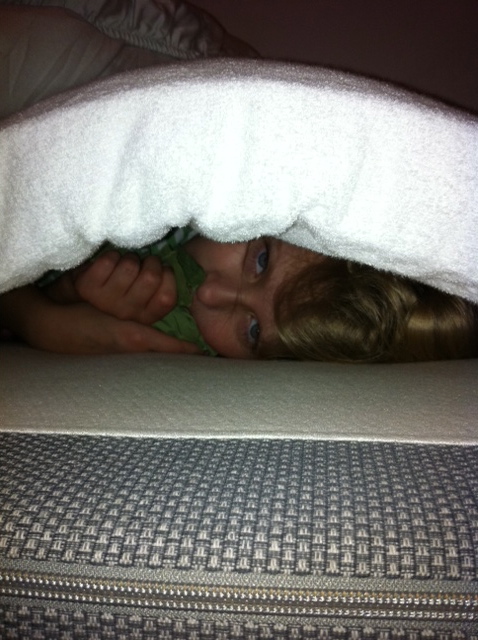
All of this is done while Emma variously – sings, hums, makes loud breathing noises or whispers to herself , “No, not going to find Emma under the mattress!”

That she is also squirming around makes her hard to miss, still we do our best to play the part given us.  Eventually if we are taking a very long time to “find” her, she’ll give us a little help.

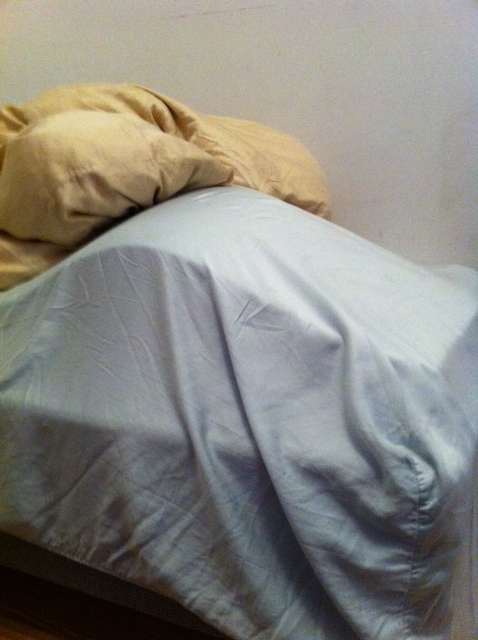
By yanking off the fitted sheet to reveal herself and yelling, “There she is!”

In the theatre world, this would be called stealing lines, hogging the stage or any number of disparaging phrases.  But to Emma she’s simply trying to help us out and we appreciate it.

“Oh!  There you are,” we shout before grabbing a limb and tickling her mercilessly.

“Let go!  Let go, let go, let go!”  Emma squeals.

“No, no, no.  I’m not going to let go.  I’m going to tickle you and tickle you and tickle you..”

The other day while in the midst of just such a moment, Nic appeared in the doorway to Emma’s bedroom, “What are you guys doing?”

“We’re playing hide and seek, want to play?” I asked.

“Yeah okay,” Nic agreed, somewhat reluctantly as he knew Emma would only want to hide underneath her mattress again.

“Should I count or do you guys want to find me?” I asked.

“You and Nicky hide?” Emma said.  Meaning she wanted to hide with Nic.

But I pretended not to understand as every interaction can be an opportunity to teach (we’re trying to help Emma with her pronoun reversal problems), “Oh okay.  So you’re going to find me and Nic?”

“NO!  Mommy find.  Emma and Nic hide!”

“Emma you have to say, Nic and I are going to hide.”  Nic took her finger and made her point to herself, “Me, Emma.  You say me,” then he looked up at me with an expression of mild exasperation.  “No wait, that’s not right.”

I nodded my head.  “It’s okay, Nic.  You’re doing great.”

“Okay, okay,” Nic said, starting over again.  “Em, you have to say I.  I’m going to hide with Nic or Nic and I are going to hide.”

At this point Emma had lost all interest and was trying to get one of her favorite youtube videos up on her computer.

“Come on Em.  One last game,” I encouraged.

“Five minutes then computer,” Emma said.

“Yes. One, two, three, four, five…”

For more on Emma’s journey through a childhood of autism and an interview with her older brother Nic, go to: www.EmmasHopeBook.com

Emma’s Pretty Dress

This morning I asked Emma,  “Hey Em.  Come over here and help me pack your lunch.”

“Okay, okay, okay,” she said while running over to the open frig.  “Hmmm… let’s see,” she said, peering into the refrigerator as though she was contemplating the delicious short ribs with coconut rice, Ceci made for us the other day or maybe the sliced turkey, to make a sandwich.  (Emma doesn’t eat meat, not because she’s a vegetarian, though she is, or because of some political or ethical statement, but because in her rigidity she only eats about seven different foods, which made this scene all the more comical.  After a pause she reached for her old stand-by, caramel yogurt and soy pudding.  “Caramel yogurt,” she said, as though this were something new that she just thought she might try for a change, dropping it into the bag I held open for her.  “Soy pudding,” she added.  This is what Emma has for lunch every single day, unless the store has run out or we haven’t had time to get to the store to replenish her stock.

“Do you want any cheese?” I asked, despite the fact the cheese usually comes home in her back pack and when it doesn’t I imagine she’s opened the red wrapping, taken off the wax and then thrown everything away.  None of us have actually seen her eat the cheese in a long time, so I was surprised when she answered, “Yes.  Cheese.”  It may be that Emma is so used to having the cheese, it’s no longer a matter of wanting to actually eat it as much as it’s been going into her lunch every day for so long, she feels it should be there, whether she wants to eat it or not is beside the point.

“How about some grapes?” I opened the drawer with fruit in it.

“Yes, yes, grapes,” Emma grabbed the bag and tossed it on the counter.  “And…” she paused, looked around, “How about some pirate’s booty?”

“Do you want one bag or two?”

“Two?” Emma said in that questioning way of hers.  “There,” she said, as she watched me add two bags of Pirate’s Booty to her lunch.  “Now we have to get dressed,” she reminded me.

“Okay Em.  What do you want to wear to school today?”  I opened her closet.

“No, no, no, no!  This one!” she said, grabbing hold of one of two party dresses she has.

“Oh that’s a pretty dress!” I pulled it off the hanger for her and handed it to her.  “Do you want the flouncy under skirt that makes it poofy?”

“No, no!” Emma laughed, as though this question was altogether too ridiculous to contemplate.

Emma wearing her pretty dress this morning.

Emma looked at herself in the mirror.  “Wow!  You’re so pretty!” Emma said, twirling around.

For more on Emma’s journey through a childhood of autism from Richard’s perspective, go to:  www.EmmasHopeBook.com

Vestibular & Proprioceptive Movement

From the moment Emma could walk (14 months – she went from crawling to running) she would do what we used to call, Emma’s circuit training.  This was before we knew she was autistic and didn’t realize that this was Emma’s very specific way of trying to get the kind of vestibular and proprioceptive movement she so craved.  In fact, it all looked so “normal” or “not autistic” that it took me a long time to understand this was a kind of stimming.  For more on stimming from previous posts, go to:  Compulsions & The Velcro Strip.

I was always trying to find something that might engage Emma.  When we were at the toy store, I found a mermaid finger puppet with long black hair and a blue sequined tail.  I brought it home and to my delight and surprise Emma grabbed hold of it and ran from the living room down the hallway to the front door.  When she reached the front door she swiveled around and raced back to the living room.  This went on for quite sometime and I was so excited I’d found a toy that she liked, I didn’t spend too much time wondering at the peculiarity of her “play”.  A few weeks later I found another mermaid finger puppet and a doll’s stroller and brought both home, only to have Emma completely ignore the new blonde mermaid finger puppet, but she loved the baby stroller.

Emma’s favorite circuit training, which was also how we came to call it that, was the obstacle course she would do in our living room, over and over and over and over again.  She ran from the living room couch into the TV area, jumped up on the couch there, crawled through a tunnel we had set up, ran into the kitchen, around the butcher block island, down the hall to the front door and back again.  Even better was to do all of this with the baby stroller, which she pushed along her route, knocking things over as she sped along.  I wasn’t alarmed by her circuit training, after all, Emma’s older neuro-typical brother, Nic used to spin around until he became so dizzy he’d fall down.  Kids do these things, right?  Right?!

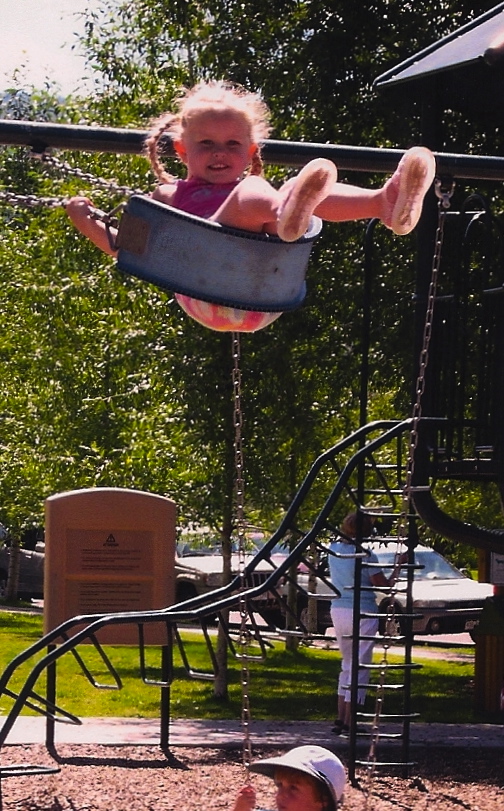
When I took the children to the playground, Emma wanted to go on the swings for as long as she could before the lines became so long she had to get off to give another child the chance to swing, at which point she would get off only to get back in line. She wasn’t much interested in playing with other children.  She wanted, needed to swing.  At her special education school she is allowed to go to the sensory gym periodically, the idea being that children who crave vestibular and proprioceptive movement become more regulated when given the opportunity to swing, have their bodies pressed in the squeeze machine, etc.  Only Emma never seems to get more regulated.

The principal at her school laughed and said, “I’ve never seen a kid who didn’t get tired… ever!”

And she doesn’t.  When we are in Aspen during the winter, Emma will ski for five hours, go to the Aspen Recreational Center where she’ll swim for another two to three hours, then climb on the climbing wall before going grocery shopping, where she’ll push the “customer in training” shopping carts, then stop up at the barn where she will do a weight lifting workout before coming home and demanding that we play a couple dozen games of hide and seek.  Even then she’ll get up bright and early the next morning at 6:00AM sharp if we’re lucky, 5:00AM, if we’re not.

Emma – age 5

For more on Emma’s journey through a childhood of autism and our exhausted attempts to keep up, go to:  www.EmmasHopeBook.com

An Inability to Generalize

I first heard that term used in reference to Emma almost seven years ago now.  It was one of those things people say, in this case her early intervention therapists, where you hear the words, you know what they are saying, but how exactly this is being applied to one’s own child suddenly doesn’t seem clear at all.

Emma, like many children diagnosed with autism, has a difficult time applying something she’s learned in different situations and settings.  For example when she was much younger, I tried to teach her what a t-shirt looked like by holding up an actual t-shirt, one of hers with a pink heart on it, she was able to remember what that particular t-shirt looked like and called it a “t-shirt”.  If I then took out a different t-shirt, one of mine or a different colored t-shirt from her drawer, she was not necessarily able to understand that this too was called a “t-shirt”.  If I showed her a flashcard with a green t-shirt and explained that this was the color green and then pointed to a slightly different shade of green, and perhaps on a chair, she wasn’t able to tell me that the color I was pointing to was green.  Temple Grandin, speaks about this at length, she calls it “thinking in pictures.”  She says she stores images in her mind and then flips through the images to come up with the correct one to fit the word being used.  She then goes on to describe how problematic this retrieval system is for her.  One can easily understand how difficult that must be.

Over the weekend I worked with Emma on two words:  “yes” and “not”.  “Yes” was a bit easier for her to incorporate into her writing, but “not” completely threw her.  If I said, “Emma, what are these?” and pointed to a picture of three trucks.  She answered correctly, “These are trucks.”  If I then asked her, “Are these trucks?” pointing to the trucks, she was able to understand that if you answer, “Yes, these are trucks” it didn’t change the structure of the sentence, one just needed to add “yes” to the beginning of the sentence.  But if I then asked, “Emma, are these trucks?” while pointing to three frogs, she had a terrible time answering, “These are not trucks.”  When I asked her, “Emma, give me the one that cannot walk,” from a field of four objects: a bus, a truck, a plane and a kid,” she handed me the kid.

I know Emma understands what “not” means, but in this context she was baffled.  It reminded me of those first few years when we were new to all of this, and almost constantly perplexed by almost everything she said and did.  I remember watching in dismay as she proceeded to memorize several hundred flashcards that her therapists used with her.  The therapist would hold up a card with a picture of a bike, and Emma would shout, “bike!”, the card with a dress, Emma would yell, “dress!” and on it went.  I fully expected her to go on to a regular kindergarten, at the rate she was going.  But very quickly I realized that though she had no trouble with her memory, could memorize some 400 flashcards, she could not use the information beyond the flashcards.  In other words, the information wasn’t being translated across a larger field.  She did not use the words, we now knew she knew in everyday sentences.  If we went out into the park and I saw a kid on a bike and said, “Em, look!  What’s that kid riding on?” she couldn’t tell me it was a bike.  It didn’t look exactly like the flashcard with a bike.  For one thing it was a kid’s bike and for another it had pink plastic tassels on the handlebars and a little bell with a picture of Dora on it.  This bike looked completely different from the bike on the flashcard and so Emma was at a loss as to what this new thing was called.

The good news is, Emma now can identify a bike, any bike, but it took awhile.  This is what we are up against when trying to teach Emma.

For more on Emma’s courageous journey through a childhood of autism and our admiration for her, go to: www.EmmasHopeBook.com

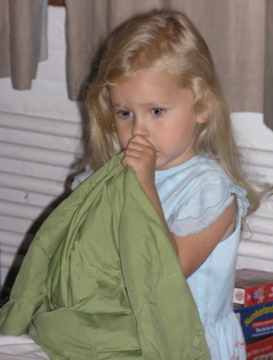
Emma with her green blanket when she was 3.

The Early Signs of Autism

I have been thinking a great deal about those first clues, the things Emma did that we now know were the first warning signs of what ended in a diagnosis of autism.  The CDC has a website with a checklist – “Learn the Signs” .

According to their checklist, at 3 months, Emma was developing as any neuro-typical child, by seven months there were only one or two things on the checklist that she didn’t do.  Both fall under the “Language” category.

“Responds to own name” is the first and at 7 months Emma did respond to her own name, but not all the time.  I remember a friend reassuring me that her kids, who were older than Emma, didn’t respond every time she called to them either.  Still, it was the first red flag.

“Can tell emotions by tone of voice” – this is difficult.  I made some notes in her baby journal that she seemed preoccupied, but I can see how I and others would have dismissed this as being overly worried.

Everything else on the checklist were things Emma was doing – Ability to track moving objects, transfers object from hand to hand, sits with, and then without, support on hands, rolls both ways, (front to back, back to front.)

The 1 year checklist has more things that Emma was clearly not doing, but again, they were not black and white, such as:  “Shy and anxious with strangers.”

Emma wasn’t shy or anxious around anyone.  In fact, I remember thinking, with a certain degree of pride that this was an expression of her self confidence and independence.

“Cries when mother or father leaves.”  Again, a sign of her independence, I thought and sometimes she would cry when I left, just not often.

“Shows specific preferences for certain people and toys.”  She did, but not to the degree Nic had.  She seemed indifferent to people and rarely asked for toys, something I attributed to her solid sense of self.

“Maybe fearful in some situations.”  Emma showed no fear toward anyone or anything.  We had no idea this was not a good thing.

“Does not search for objects that are hidden while he or she watches.”  I remember Nic loved a picture book by Richard Scarry.  It had a little animal (I can’t remember what kind) that was somewhere on every page, but often difficult to find.  He loved scanning the picture and pointing to the mouse.  When Emma was his age, she had no interest in the book, let alone locating the tiny hidden creature.  It was the same with the mouse in “Good Night Moon”.  Nic loved pointing out the mouse that is always somewhere on each and every page.  Emma would push my hand away when I said, “Emma!  Where’s the mouse?”

I told myself it was because the book didn’t interest her and not because it was indicative of a larger problem.  I remember being baffled by her degree of disinterest.  But I also remember telling myself that children are different and she just wasn’t as interested in books the way Nic had been.  Finding the hidden animal, something Nic and I spent hours doing, was not enjoyable for Emma and while it made me sad that I couldn’t share this with her, I shrugged it off as yet another example of her temperament.

When I look at these checklists I am still struck by how many more things Emma did do than didn’t.  Even on the 2 year checklist, the majority of bullet points were things she did.

Which is why diagnosing autism is so tricky.  Many believe “autism” is a misnomer.  They believe it is actually a word being used to house a wide variety of different issues.  If they are right it would explain the intractable nature of “autism” and why it continues to confound.

For more on Emma’s journey through a childhood of autism and a trip down memory lane, go to:  www.EmmasHopeBook.com