Tag Archives: autistic children

A Brilliant Mind

I have maintained in previous posts, that I continue to believe in my daughter’s brilliance.  Current IQ tests do not account for children who are non-verbal or with limited or impaired speech.  I have no way of knowing what Emma’s IQ is, but I can tell you there are things Emma does, on a daily basis, indicating her mind is capable of some pretty astonishing leaps.  What follows are a number of examples.

Our refrigerator light is out.  The first thing I did was replace the bulb, only to find that wasn’t the problem.  A little later Emma opened the refrigerator door and pressed a switch on the ceiling of the refrigerator and immediately all the lights came back on.

“Wow Em!  How did you know to do that?” I asked incredulous.

“Lights broken,” Emma said, nodding her head up and down as she removed her caramel yogurt from the frig.

“Yeah, but how did you get them back on?” I went over to her and watched as she reopened the door and pressed on the little white button that activates the lights when the door is opened, something I did not realize until Emma showed me.  The lights flickered for a second and then went out.  Emma reached up and matter-of-factly jiggled the switch and the lights came back on.

“There,” she said, with a certain degree of satisfaction.

After a few days of all of us wiggling the switch, the lights flickered on and off feebly one last time before remaining permanently off and I had to call the company to get the light switch replaced.  Now to many of you, this may seem completely commonplace, but I can tell you, I had spent quite a bit of time trying to figure out what was causing the problem.   I should have saved my time and just asked Emma.

Yesterday while Emma and I worked on her literacy program requiring her to choose the word “leg” from several options, she positioned the cursor over the correct button then clicked on the space bar.  Then she looked over at me with a mischievous grin as if to say – did you see that?

Again, hitting the space bar instead of clicking on the mouse or the return key never would have occurred to me.

Another thing I’ve noticed while working with Emma is that she has an amazing ability to see patterns.  So, for example, if I show her a series of “words” but with only parts of the letters showing such as:  _a_s,  r_ _ _, _e_ _, _ _s_ and ask her to find the one that can be “eats” she will find the correct one immediately, less than a second, faster than I am able to.  I am consistently amazed by this.  It is in keeping with her ability to know instantly when a photograph is missing from her pile.

Emma’s box of photographs – over 200
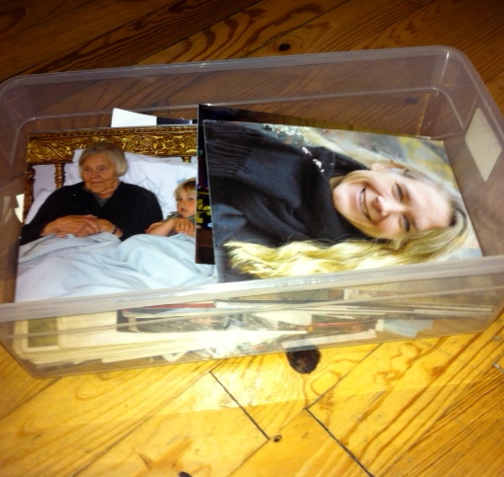
The other day Emma was singing while shooshing around on her scooter.  Richard was reading in the rocking chair, Merlin happily nestled in his lap.  “You know what she’s doing right?” Richard said looking over his reading glasses at me.

“Yeah,” I said without looking up.

“She’s created her own carousel.  Do you hear her?  She’s singing all the songs they play on the carousel.  And watch.  She’s going around and around on her scooter in the same direction as the carousel.”

I stopped reading and watched and listened.  Emma was currently singing “Georgy Girl” one of the many songs they play at the Central Park Carousel.

“I wonder if she’s singing the songs in the correct sequence,” he wondered out loud.  “We’ll have to make a note of that next time we go.”

Emma riding on the Central Park Carousel

These are only a few examples of Emma’s brilliant mind.  There are countless others.

We, as a society have a tendency to view ourselves and others with a critical eye.  We are taught early on to look at our deficits and then do all we can to take corrective measures to make up for those deficits.  I don’t believe this kind of thinking is helpful with children diagnosed with autism.  The deficits pile up unbidden until that’s all we can see.  Our children are routinely viewed as “less than” as we struggle to help them.  I feel strongly a more balanced approach is necessary.  Our children are often brilliant.  If I approach Emma with this in mind, I am able to more fully help her, by focussing on her talents, on the things that are easy for her and using those assets to help her with the things that are more difficult.   In addition I find I can learn a great deal from her.

For more on Emma’s journey through a childhood of autism, go to:  www.EmmasHopeBook.com

Emma’s Ears – Autism

Monday night Emma was up at midnight screaming.  Her ears were bothering her.  This has been an ongoing problem for many months now.  She is highly sensitive to the changing air pressure.  As a result of Emma’s sensitivity, I too have become increasingly aware of it and am surprised that I have lived this long without noticing how often it changes, causing my ears to “pop”, as Emma describes the sensation, too.  Still, just to be safe we have taken her to her pediatrician who assured us her ears were fine and referred us to an ear specialist.  To date Emma has gone to the ear specialist three times.  Her ears are fine, we’ve been repeatedly told.  She’s just extremely sensitive to the air pressure which is constantly fluctuating.

“I need help!”  she screamed.  “Ears popping, have to unpop!  Mommy!  Mommy I need help?”

This can go on – as it did Monday night for hours.  That night she was up until past 4:00AM, I don’t know when she finally fell asleep as I eventually lapsed into a kind of restless state of unconsciousness.  When I woke it was just past 7:00AM and Emma was fast asleep, arms spread out like Christ on the cross, blonde hair fanned out on the pillow beside me.  Richard had long since relinquished his place in our bed and gone to her bed.  Merlin, preferring the rocking chair in the living room, was happily curled up away from all of us when I came into the kitchen to begin preparing the children’s breakfast.

I reminded myself that Emma used to regularly wake up at around 2:00AM only to finally fall back asleep somewhere between 4:00 or 5:00AM.  How we managed to get through those middle of the night awakenings month after month is something I cannot fathom given how exhausted I was yesterday.  The combination of crying in pain and screaming for help, help I am unable to give, is what breaks my heart.  I try to remind myself that being there, just sitting with her, even though I cannot change the air pressure, is a kind of help too.  Still it’s difficult not to feel the rising panic and accompanying helplessness that come with witnessing ones child in such obvious pain.

“Please Mommy.  You have to unplug.  Ears!  Ears!”  she continued to cry while twisting her blanket up and trying to push it down her ear canal.

“Em, try to yawn,” I told her opening my mouth in an exaggerated yawn.

“NOOOOOOOO!”  Emma screamed, pounding the side of her head with her hand.  “Nooooo!  Mommy!  Mommy!  I need help!”

It is during moments like these that I want to scream.  I want to hit the wall with my fist.  I want someone or something to help my daughter.  So I go wake up my blissfully sleeping husband, Richard and get him to help me.

“I got this,” he told me after I woke him, waving me away.  “Go back to sleep.”

Only I couldn’t go back to sleep so I followed him into her bedroom where he had ingeniously pulled out a balloon and told her to blow into it for a few seconds.  He also had the foresight to bring some nasal spray which the ear specialist had given us for her.

And while none of these things were “magical” cures for her popping ears, his calm demeanor helped settle her and me down.

“I’m going to lie down with her, you go back to bed,” I told him.  As he got up to leave, I said, “And thank you.”  To say I feel gratitude that I have a husband who is so completely in the trenches with me, who is more than willing to do his share and often does much more than that, who isn’t afraid to submerge himself in all things that make up our crazy family, would be a vast understatement.

An hour later, Emma, still in pain, but at least not screaming like an air raid siren, whimpered, “Ears still popping.  Go to Mommy’s bed?”

“Okay Em.  Come on.”  I led her through the hallway into our bedroom and climbed into bed with her.

Last night, exhausted and concerned that we might have a repeat episode, I went to sleep early.  Miraculously Emma slept until almost 7:00AM.

For more on Emma’s journey through a childhood of autism, go to:  www.EmmasHopeBook.com
Dreams For Emma – Autism

A follower of this blog and mother of two children on the spectrum asked me if Emma used an ipad.  I wrote about Emma’s ipad last fall for both this blog as well as the Huffington Post, so in responding to her email, I reread both those posts.  The one for Emma’s Hope Book is entitled Emma and Lists.  What struck me was how far Emma has come since then.  I looked at the date – September 24th, 2010 – and while yesterday I was feeling a bit discouraged with Emma’s ongoing struggles with handwriting, I cannot help but feel incredibly optimistic with her progress after reading those posts.  It’s funny how rereading something I’d written less than a year ago can have such an impact, but it has.

Emma has certainly come a long, long way.  In the post “Emma and Lists” I write about how when I am feeling a little sad or discouraged I make lists.  I go on to recount my current lists, (hopes) for Emma.  “Help Emma with Reading,”  “Help Emma with writing,” are two such items.  I remember when I wrote that post, thinking that these were dreams, perhaps dreams I might not ever see accomplished.  And yet, here I am in July of 2011 and not only are both these dreams coming true, but so are others that I hadn’t even thought to put on my list.  Things like:  beginning math concepts, writing in full sentences, learning to type, following three and four step commands.  These are all things Emma is in the process of learning.

I will try to remember to take a photograph of Emma’s handwriting this afternoon.  She is coming along.  She is learning, she is progressing.  It’s easy to forget, though.  I forgot that last September I could only hope Emma might one day learn to read and write.  That she is now doing so is remarkable and wonderful.  Last fall we were still riding on the wave of our success with having finally gotten her out of diapers at night.  We were still struggling with getting her to sleep through the night.  I’d forgotten all of that.  It seems so much longer than ten months ago.  It feels as though years have slipped by.

I haven’t dared dream for awhile now.  But rereading those posts reminds me of how important it is to have dreams, for ourselves, for our children.

For more on Emma’s journey through a childhood of autism, and to see how far she’s come in one year go to:  www.EmmasHopeBook.com

Summer Camp For Emma

For the last three summers we have enrolled Emma in summer camp with her therapist, Joe shadowing her.  The director of the camp has been incredibly accommodating, allowing Joe to shadow Emma and doing all he can to provide Emma with a “typical” camp experience among her neuro-typical peers.  Each year the other children, while often not exactly clear on why Emma behaves as she does, have been incredibly patient and eager to help when Joe told them she was  just learning to speak and sometimes didn’t understand all that was going on.  Each summer one or two little girls have taken it upon themselves to help Emma, self assigning themselves to her, urging her to join in and making sure she stayed with the group.  The first two summers we signed her up for two weeks and since it went so well, we went ahead and signed her up for a full month, just like her brother, Nic this year.  Yesterday was her first day.

Summer Camp last year

“No not going to go to Becky’s class.  Going to go on the bus to summer camp!”  Emma said yesterday morning as I fixed her breakfast.

“Are you excited, Em?”  I asked.

“Yes!” she shouted.  Then, “Going to go to summer camp with Nicky and Joe.  Going to go swimming in the lake!  Not going to take the school bus, no!  Going on different bus.”

“Yeah, Em.  That’s right.  It’s a different bus.  Which one do you want to wear?” I asked, holding up three different skorts.

“This one!” she grabbed hold of a pink skirt with shorts attached.  “And this one!” she said taking a white t-shirt from me.  “And this one,” she added, pulling a white and blue striped two piece bathing suit from the drawer.

“Okay, and how about we take this one for back up?” I held up a colorful one-piece suit in front of her.

“No, no, no!  This one.”

“Yes, I know you want that one, but we’ll just bring another one in case you need it too.”

“No mommy.  Just this one,” she insisted, jabbing her finger at the two piece.

Emma often reminds me of the children’s book character, Olivia.  Olivia is a pig who loves clothes, particularly accessories with stripes and shoots around on her scooter.  Which is where the similarities end – not the pig part, just the scooter and love of clothing and striped accessories.

When the bus arrived, Emma, Nic and Joe climbed the stairs amid shrieks of excitement and greetings.  Several children from last summer were riding the bus again and as the bus moved away from the curb, I could still hear the excited voices of the children.

When everyone arrived home yesterday afternoon, I asked Emma if she had fun.

She literally jumped up and down she was so happy.  But even during the summer, we must continue to work with Emma on her reading, writing and now, math.  Joe and I worked out that if he came early each morning, he could work one session of math in before they left for camp, while every afternoon I will do a session of her reading and writing.  Yesterday we worked on the word cat/cats.  Emma is coming along beautifully with increasingly difficult sentences which she now types out on the computer using her two index fingers or writes by hand – something that is by far the most challenging for her.  Pointing to an illustration of a man, I said, “This is not a kid.  This is a man.”  Then she was to write these two sentences from memory.  It was the only one which tripped her up, all the other exercises she did, often without hesitation, beautifully.  Such as when I pointed to a group of frogs jumping and asked, “Are these frogs jumping?”

Emma then typed – Yes, these frogs are jumping.

Progress, lots of wonderful progress!

For more on Emma’s journey through a childhood of autism, go to:  www.EmmasHopeBook.com

“I’m Home” – Autism

When I opened the door to our loft, Emma came tearing up on her scooter shouting, “Mommy’s back!  It’s Mommy!”

As I dropped my bags and opened my arms to greet her, she sped away.  Nic meanwhile rushed up to me and threw his arms around my waist.  “Mommy!” he cried, “It’s so good to have you home.  I missed you so much!”

As I hugged Nic and then Richard, I said to Emma, “Hey.  I want a hug from you too.  Come over here, Em!  Remember?  Put your arms around and …”

“Squeeze!”  she shouted, while complying.  She peered up at me, with an odd expression on her face.  Then she pointed to my face and said, “It’s Mommy.  Mommy came back,” as though she hadn’t been sure I would.

“I’m back Emmy.  It’s so good to be back.”

“Yeah, Mommy came back.  Mommy stayed at Granma’s house.  Mommy had to go away,” she said, nodding her head sympathetically.

“It’s okay, Em.  Now I’m home.  I’m not going anywhere.”

Nic then played five different songs on his new Alto Sax for me, two new songs which he composed for the piano and then plugged his electric guitar into his amp and riffed on several more.  Emma scooted around on her scooter and eventually it was time for everyone to go to bed.

“Mommy come to Emma’s room,” Emma said, taking me by the hand.

“Yes!” I said following her.

“Mommy’s back,” Emma whispered as she snuggled down under her blanket.

“Yes, Em.  I’m home,” I said stroking her cheek.

Later Nic expressed his upset that I was away for almost three weeks.  He was able to tell me that he didn’t like that I was gone for such a long time.  But Emma…  Emma doesn’t have the words to express her upset nor does she have the ability to ask me why I was away.  I can only hope she understands I had to go for work, but I don’t know that she does understand.  When she looked up at me earlier it was with a mixture of shock at seeing me again and happiness.  I don’t know whether I’m reading more into her expression than was actually there, but given that she isn’t able to ask me, who knows what reasons she applied to my absence.

“Go swimming with Mommy,” Emma whispered.

“Yes,” I said.  “We’ll do that tomorrow.”

“No, not going to go back to Aspen,” she said, holding my hand.

“Nope.  Tomorrow we’re going to spend the whole day together.”

We were quiet then.  “Mommy sing?” Emma said after awhile.

“Sure, Em.  Which one – Swing Low, Sweet Chariot or Summertime?”

“Swing Low first, then Summertime,” Emma said.

“I love you Em,” I whispered.

“So much,” Emma finished.

For more on Emma’s journey through a childhood of autism, go to:  www.EmmasHopeBook.com

Going Home

I was suppose to be on the first plane out of Aspen this morning.  Which meant, if all went well, I would be on an 8:30AM flight out of Denver heading back to New York.  Barring any unforeseen delays I might even have gotten home before my children returned from their various summer activities.  To say, I was excited to see them this afternoon would be an understatement.  And that doesn’t include the excitement I feel in anticipation of seeing my husband, Richard who has single handedly shuttled one child or the other to camp, picked up said child, taken Emma to the doctor for her ongoing ear problems, dealt with all the daily problems that inevitably arise in caring for a family and home, fed both children, fed Merlin (our adored cat), watered my orchids, done the laundry, the grocery shopping, and did I mention he also managed to work?  Can I just say here that he is a man of all men?  Put the guy on a pedestal and allow me to genuflect.

As it turns out, I will not be on that first flight out of Aspen, nor on any flight leaving Aspen today.  In fact I cannot get a flight out until tomorrow.  I received the fateful call at around 11:30PM last night and my heart sank the minute I heard the phone ring.  I then called United to rebook my cancelled flight only to be told there was not a single seat anywhere that would eventually get me to New York.  So tomorrow I will (hopefully) be home and able to finally see my husband and children.

It will be interesting to see Emma.  Will I see progress?  I do not expect her to greet me with more than a passing – Hi Mommy!  She can be pretty casual about seeing one of us again, even if it’s been awhile.  It’s hard not to assume that means she doesn’t care or didn’t miss the person.  I think of it as more an expression of her autism than any suggestion of disregard.  I know a mother of a child with autism who hates when people label her child “autistic”.  She said – if someone has cancer, I don’t say, oh they are cancer.  My child is so much more than “autistic.”  Similarly Emma is not autism.  Emma is a little girl who has a series of neurological irregularities, which make her behave in a way that we call “autism”.  And it’s that wonderful little girl, my little Em, who happens to have been diagnosed with autism, whom I cannot wait to see.

Just one more day and a few thousand miles, before I can come home.

For more on Emma’s and our journey through her childhood of autism, go to:  www.EmmasHopeBook.com

Aspen Ideas

The word “autism” was never spoken at the session of the Aspen Ideas Festival I attended yesterday.  After it was over I wondered if I’d somehow been mistaken and reread the email I’d received .  This is the email I was sent describing the session:

“How to Recognize Happiness  June 29, breakfast,

Happiness as an ongoing state of mind–rather than a fleeting pleasurable sensation–could be recognized by the predominance of positive affects, by an ongoing freedom from inner conflicts that express themselves in obviously tormenting ways, by a sense of inner calmness, and by attitudes that reflect some kind of benevolence toward others, even though in the case of autistic children, all these may not be expressed in the usual ways.”

My guess is one of the speakers was unable to make it and so it became a more general discussion surrounding conflict, suffering and cultivating a practice to help with that.  The moderator was late, having gone for a hike in the woods and found herself lost.  But the Buddhist monk, Matthieu Ricard, director of the Karuna-Shechen a non-profit headquartered in Kathmandu, Nepal, who in France anyway has been given the label of – happiest man on earth – questioned that title, suggesting perhaps this was a difficult thing to test for, given the world’s current population of over 6 billion people.   It was a perfectly pleasant way to spend an hour of one’s morning, especially if one had come to Aspen specifically for the Ideas Festival and didn’t have any expectations. Certainly there is much to be said about cultivating compassion and putting oneself at the service of others.  Just talk to any parent of a child with autism.

What bothers me about all of this is the lack of conversation, the reluctance to feature autism as a worthy topic. It is something I see all the time.  The people, like myself who are talking about it, are doing so because we are parents of children with autism.  Perhaps it’s seen as a downer, after all there’s no cure, we don’t know the cause, so let’s just not discuss it, let’s not have any conversations about it, let’s not even bring it up.  Maybe it’ll go away if we ignore it enough.  It’s got to be such a drag listening to someone who goes on about autism, the statistics, news stories about the rampant abuse of autistic people, it’s intractable nature, blah, blah, blah.  Why can’t I talk about something more cheerful?

Like happiness, for example.

And here’s the thing – actually I can.  In fact most of the parents with children with autism can.  We parents of autistic children have found ourselves elated by a word, a single word coming from the mouth of our child.  It doesn’t take much for us to feel joy.  Our child can hug us and that lone hug is something we remember as though we had received the Nobel Prize.  Maybe, just maybe, we don’t know the cause, we don’t know the best way to treat it, because autism isn’t viewed with the same sort of panic the avian flu received or mad cow disease or any of a number of topics which swept all of us up in a frenzy of terror.

According to the CDC at least 1% of our population has been diagnosed with autism.  That’s over 60,000,000 autistic people world wide.  60 MILLION!  And yet, autism, gets a big yawn.  So here’s an idea, let’s keep ignoring it, let’s all agree not to discuss autism, because what’s the point really?

By the way, just in case anyone’s wondering, I’m the mother of a beautiful little girl who’s Great-grandfather began the Aspen Institute and who’s hope for the future gets dimmer by the second.

For more on Emma’s journey through a childhood of autism go to:  www.EmmasHopeBook.com

The Aspen Ideas Festival & Autism

I am going to a lecture at the Aspen Ideas Festival this morning at 7:45AM in the Doerr-Hosier building called: How to Recognize Happiness.  I am going because I’ve been told this session will include something about autism, though if one goes to the AIFestival web site it doesn’t mention autism.  But my source is a good one – in fact she is the one who organized the entire week long program, so I’m fairly confident she knows what she’s talking about.

If you don’t know about the Aspen Ideas Festival, it is a week long summer camp for adults.  Every day is packed with lectures, panel discussions, interviews, readings, film, videos, etc beginning at 7:45AM and ending well into the night, every day for seven days.  I’ve been lobbying for Ideas to include autism in their program now for the past year, so was pleased when I was informed they were doing one talk which would include autism.  I will report back tomorrow.

Meanwhile, Emma announced on the phone last night that:  “Mommy’s staying with Granma.  Mommy is in Colorado.”

To which I replied, “Yes, I am, Em.  But I’m coming home in three days!  Tomorrow’s Wednesday, then Thursday, then it’ll be Friday and I’ll be home!”

There was dead silence and then after about ten seconds she said, “Bye Mommy!”  I could hear Richard saying, “Wait Em!   Don’t hang up, don’t hang up!”

Apparently my promise that I’ll be returning home on Friday is one of those – I’ll believe it when I see it – situations.  Emma was not impressed.

A friend of mine suggested I stay in Aspen over the Fourth.  “I need to get home before my kids forget what I look like,” was my response.

Friday, Em.  I promise.

For more on autism and Emma’s journey through a childhood of it, go to:  www.EmmasHopeBook.com

Searching

In three more days I will be home.  Home with my two children, Nic and Emma, my husband, Richard and our black cat, Merlin.  Everyone but Emma and Merlin understand that I’ve been away for so long because of work.  I guess I should rephrase that – I don’t actually know whether Emma understands I’ve been away because of work.  Perhaps the reason why I’ve been gone so long is meaningless to her, she just knows I’m not there.  But on Friday when she returns home, I will be waiting for her with open arms.  I don’t like being away this long.  I don’t like having so many miles between me and my family.

When I spoke to Emma on Sunday she said, “No, you cannot spit.  If you spit Mommy will leave.”

“Oh Em, you didn’t spit.  I didn’t leave because of anything you did,” I said.

“There is no spitting!”  Emma shouted into the phone.

“Okay Em.  I’m really glad to be speaking with you, tell me about your day.”

“No you cannot spit.  There is no spitting or Mommy leaves.”

“Sweetie, tell me about your day.  What did you do today?”

“No spitting.  Bye Mommy,” she said before casually putting the phone down and walking away.

Sometimes one waits then, hoping the chaos that constitutes our life in New York city isn’t so much that everyone forgets about the phone and the person on the other end.  Sometimes one has no other choice than to eventually hang up.  Once, after hanging up, I tried to call back only to receive a rarely heard busy signal.

But this time after a few moments Richard returned.  “Do you think she thinks I’m gone because I’m angry with her?”  I asked.

“No.  I heard her, I don’t know what that was about,” he tried to reassure me.

Being away is like entering an alternate universe.  It’s familiar, a bit like seeing an old friend from high school.  It’s easy to fall back into a kind of routine, but my children and husband are always there in my head.  I am here to work, so I do.  But I still have time to socialize with friends, Sunday I even took the entire day off and went for a much needed long, long walk with a friend.  I can say yes when someone asks me to have a coffee with them.  My life is completely different here from my life in New York.  In many ways it’s wonderful, calm, relaxing, yet I’ve been weepy ever since I arrived.  Being able to have feelings and have the time to look at them, talk about them, it’s all a luxury really.  One needs the time and space to indulge them.  So I’ve been blogging about some of those things – the existential quest that most of us feel at certain times in our life, the searching.  That too is something that needs time, a certain silence to be able to fully indulge.

I have no answers, I continue to search though.

For more on my family and Emma’s journey through a childhood of autism go to:  www.EmmasHopeBook.com

Anger

The invisible hand grenade being tossed into a room – anger – whether it explodes or is a slow simmer, it is something I feel when I think of my daughter, Emma’s diagnosis.  To admit this, by the way, is something I rarely do.  It is unseemly, impolite, not what we do and certainly not what we admit to feeling.

But I do feel it.

I wish it weren’t so.  I’d like to think I could think it away.  However the fact remains – I am angry.  I would take away her autism, all the things that make up that word, all the behaviors, the neurological blips, the tangled mess that make her both hyper and hypo sensitive to pain, to noise, her internal inflammations, ulcerations, her rigidity, the obsessive compulsive tendency, all those things when added up that equal autism, I would prefer it was all gone, in an instant.

I went hiking with a friend yesterday who was telling me jokes.  One, about a guy who is allowed three wishes, which a genie promises to fulfill, made me think about my one wish.  Just one, I don’t need three, thank you very much.  My one wish is for Emma to have a neuro-typical brain.  That’s it.  Just the one wish.  I’m like everyone else, I can always add a couple other wishes if pressed, but that has always been and remains my one wish, the wish that blows all the others out of the water.  Please.  Let her brain repair itself.

I know my anger, the slow simmering rage I feel covers a whole ocean of sadness.  But honestly I prefer not to feel any of it.  And I usually don’t.  I either am too busy or I make the conscious decision to turn it off.  Yesterday though, while hiking, it all came surging back.  Like the flood gates had been pried open and try as I might, they were unwilling to be shut, until they’d had their say.  It is in this state that I reject God.  The God so many turn to is one I turn my back on.  I reject, actively reject, angrily reject.  I know this.  And yet, Emma’s autism, perhaps like nothing else, has created such a feeling of need for something beyond myself.  It is beyond a desire, it is beyond a craving, it feels larger than all of that.  It is a need for something, something I can lean on.  I have no sense of it beyond these words.  Perhaps one day I will.

For more on Emma’s journey and ours through her childhood of autism, go to:  www.EmmasHopeBook.com

Autism and Parenting

I have been away from my family for eleven days now.  I am in Aspen, Colorado where I needed to reopen my store for the season.  There have been a great many things I needed to attend to, so here I am.

And there they are.

In New York city, my family – Richard, our son, Nic and Emma, the star of this blog.  To say I miss them would be an understatement.  I hear from Emma’s teachers.   They email with updates and about how Emma had a rough day the other day because the rest of her class was allowed to go to the roof to swim, but Emma had to have her final session with her music teacher, and so stayed behind.  Emma loves nothing more than water and swimming.  So she was beside herself, upset, crying and my guess is she hurt herself, though I haven’t confirmed this suspicion.

Later, an old classmate came to the school to visit and Emma was so excited to see her.  She kept saying, “Maddie’s back, Maddie go home on the bus on Wednesday, Maddie in Becky’s class”.

When they tried to explain that Maddie was only visiting and would not return, Emma kept insisting Maddie was back.

These kinds of things are hard for me to hear, the distance between me and Em making it all the more so.   I can’t hold her, I can’t be there to lessen the load for my husband, I can’t really do much other than call and listen.

People say – you’re changing diapers one day and then you’re helping load up their u-haul with their things.  It all goes by so quickly.   But whether one has children or not, it still goes by quickly.  Children are just larger than life markers of it.

Stop and look around, I tell myself, you’re in one of the most beautiful places in the world.

And then I remind myself to breathe.

For more on Emma’s impact on our lives and how we cope, go to www.EmmasHopeBook.com

Autism

I have avoided writing about something I think about a great deal when it comes to Emma and her autism.  It is something some people bring up when they hear of Emma.  Thankfully most people do not.

It is – God.

There, I’ve said it.

When Emma was first diagnosed more than a few people said things like, “Everything happens for a reason.”  The first time I heard that comment I felt as though someone had punched me in the solar plexus.  The air was knocked out of me.  I stood there as they went on about whatever they believed, the reasons they felt this had happened, but I couldn’t hear them.  I watched their mouths open and shut, forming words, but they may as well have been speaking in another language.

The second time someone evoked God, as in, “We only get what we can handle,”  followed by, “God must think you very strong.”   I had the where-with-all to reply, “You might want to check the current suicide rates, as clearly the God you believe in, is giving those people far more than they can handle.”  And then I walked away.  Touche.

These comments, the ones that upset me the most always refer to God.  People with strong, solid faith seem to have a strength or determination that I do not possess.  It is more than a decision that’s been made, it seems they believe they have some sort of power, a knowledge the rest of us can only hope for.  They come across as knowing, as though they had a special private line to God, a kind of state of the art communication device that the rest of us do not own.  Perhaps what they do not understand is how superior they seem or perhaps they do, I don’t know.  I know most are trying to be kind.  That they are not, does not seem to occur to them.

When people have said to me, “I could never handle having an autistic child,” and then they go on to their next thought – “It makes me think we are given what we can handle.”  I understand what they are trying to say, they are expressing their relief that their children are neuro-typical.  “There but for the grace of God go I.”  I know someone who I like very much who made just such a comment, I was surprised when she said it, but I knew she hadn’t meant it to be cruel.  I know many people don’t know what to say when confronted with something that frightens them.  Disease, terminal illness, death, what can any one of us say?  Most of us do want to express our sorrow, we want to be there for the person who is going through the difficult time.  We want to bond with them, show them we are there for them.  Often our attempts are nothing short of just lame.  We end up saying something stupid, we walk away thinking to ourselves – Boy that was dumb.  Why did I say that?  But when people bring God into the mix, as though they need to bolster their thoughts, then it becomes more complicated and hurtful.

I get it.

I do.  I know none of the people who have said these things have meant harm.  They mean quite the opposite.  Still I wish they would think through their comments before they utter them.

For more on my family’s journey through my daughter, Emma’s childhood of autism, go to: www.EmmasHopeBook.com

Dinner With The President – Autism

I received a form letter from Vice President Joe Biden yesterday.  It was one of those mass emails one gets, but rarely reads.  For some reason I glanced at it and read that the president will be having dinner with one person who makes a small donation of five dollars.  Their name will be thrown into a hat and one name will be drawn.

I thought about what I would say to the President were I to have the opportunity to have dinner with him.  And of course I knew what the answer was without hesitation.  I would speak with him about the rising numbers of children diagnosed with autism.  I would direct him to the countless news stories regarding the rampant abuse of those same children and adults living in group homes and institutions.  I would ask him to help set up communities where individuals with autism would have more control over how they lived, allowing them to pursue their interests, encouraging them to follow their dreams.  I would tell him about our trips to Central America with our daughter, Emma for stem cell treatments.  I would encourage him to put more funding into stem cell research, umbilical cord stem cells, using the patients own stem cells, and any other form of stem cells that might prove viable in restoring the lives of hundreds of thousands, even millions.

As I continued to think about all the things I wanted to say and ask for, in the name of autism, I thought of the families like mine who have been affected.  I don’t just mean on an emotional level, but financially as well.  A diagnosis of autism is devastating to any family financially.  We have chosen to pursue a more aggressive route than many can or want, but any family, even those who have not taken their child to foreign countries for stem cell treatments has found the cost of caring for a child with autism staggering.  For those who have little or no resources, who have to rely on social services to help them, who cannot afford to have a caregiver come to their home to give them a break, they live in a world starkly different from those with similar financial constraints who have neuro-typical children.

So Mr. President, on the off chance my name isn’t chosen and I don’t have the opportunity to sit down with you, can you please help galvanize the medical community and make autism a priority in research, can you look at what we’re doing when we cut so much funding from our already overwhelmed schools, can you earmark autism as something we need to find answers to?

To read about the genesis of this blog and Emma’s journey through a childhood of autism, go to:  www.EmmasHopeBook.com

Slow Progress – Autism

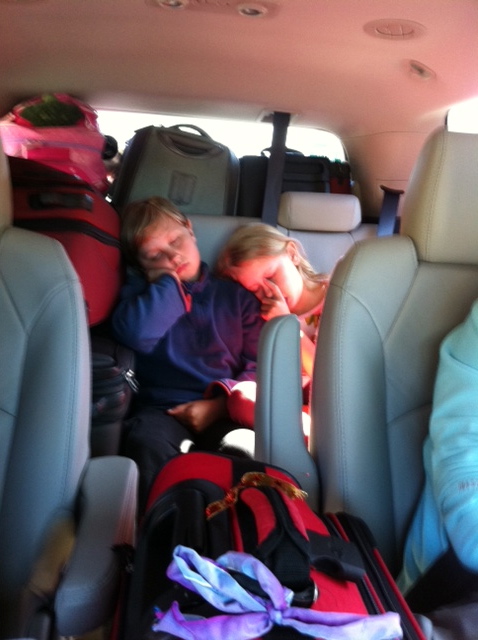
Nic and Emma driving back to the San Francisco airport last week.

I love this photograph because you wouldn’t know anything was amiss.  It was taken on our drive back to the airport as we were leaving Napa, California last week.

I don’t know whether other parents of children with autism feel this way or not, but any time I see Emma interacting with another child in “typical” or more typical ways, my heart soars.  Whenever Emma acknowledges Nic’s presence, plays with him, tries to be with him or shows a desire to be with one of her cousins I am filled with hope.  These tiny moments are like little beacons in an often dark tunnel.

“Without motivation she will not try,” one of the many specialists we took Emma to once said to us.

When I decided I was going to teach Emma how to hug a family member, it was with the hope that she might find she liked the sensation and might take the initiative to hug one of us without being prompted to do so.

“Put your arms around and squeeze,” I instructed her.  Sometimes she seemed happy to do so, other times, she didn’t.  Usually she put her arms around the person while keeping her body from having direct contact, her head jutting away at an odd angle.  I probably would have had more luck teaching her the art of the air kiss, she would like that (which says something about my waspy heritage).

As much as Emma does not appear to derive much pleasure from hugging while standing, she loves to get into Richard and my bed in the mornings and cuddle.  She aligns her body with mine and lies as close to me as she physically can.  Often she will pull my arms around her so they are holding her in a snug embrace.  Other times she will run up to one of us and give one of us a kiss or will climb into our lap.  I take it as progress.  It reminds me of a blog post I wrote over a year ago now when Emma embraced me as I was standing in the kitchen.  I was in shock because it was unprecedented.  Now those sorts of spontaneous embraces are more commonplace.  But it shows progress.  Or what I think of as progress.

One of the things about an autism diagnosis that makes me sad is the thought that my child may not have the experience of friendships.  But as Emma matures, I have learned to redefine what “friendship” means.  And I have seen that in Emma’s own way she does have friends, children she prefers to be with.  Emma’s friendships do not include secrets or talking or sleepovers.  They do not include making bracelets for each other and excluding other children in a show of preference.  Emma does not know about cliques, gossip, comparing, jealousy or what it means to be “cool”.  Emma is thankfully oblivious to all of those social constructs we try so desperately to shield our neuro-typical children from.

Emma is present, almost always in the moment.  I don’t think she worries a great deal about the future, she just is.

For more on Emma’s journey through a childhood of autism and her first spontaneous embrace, go to: www.EmmasHopeBook.com

“Go Back” – Autism

Last week Emma began crying and said, “Go back to hotel.”  Richard felt she was missing me, as I had to leave my family to return to Colorado for work when we left California instead of returning with them to New York City.  We also felt she was wishing we could have stayed longer and spent more time with my extended family, all of whom she loves being with.  She had such a wonderful time with so many family present at the Bed & Breakfast in Napa, California where we stayed for my brother’s wedding.

There’s a mistaken thought by many people that because a great number of children and adults with autism cannot express themselves well and often do not show tremendous emotional attachment to those they love, that they do not love.  Some people believe they do not feel the same intensity of emotion that we neuro-typicals do.  I disagree with this thinking.  I believe Emma loves and misses people as much as any neuro-typical child.  I believe she misses them with the same aching as any of us do.  The difference is, Emma doesn’t have the same neuro circuitry or the ability to put into words her feelings.  She lives in a world that must be incredibly confusing so much of the time.

I wonder, when I get on the phone with her, how much does she understand?  Does she understand that I am in Colorado and not in New York with her, Nic and Richard because I have to work?  Because time is a difficult concept for her, does she really understand when I will be returning?  When she wakes up in the morning does she wonder if I might be there only to find I’m not?   Our phone conversations are limited.  When speaking with Nic, I can reassure him that I will be home in another couple of weeks.  We can discuss what he did, he can describe the breakfast he fixed for his dad yesterday for Father’s Day.  We can talk about things.  With Emma, who does not and cannot ask questions, I ask – How are you?  She tells me she’s fine, even if she isn’t, because it’s the conversation we always have on the phone.  She may add some random thing such as – “Seal park, Chelsea piers carousel” and I can deduce that Richard took the children there yesterday.  I always ask her – What did you do today?  To which I can receive an accurate list of what she did, but just as easily I can receive a somewhat confusing version of events that may or may not have taken place.  I then will verify with Richard to get a clearer idea.

Yesterday was Father’s Day and Richard spent it with the children.  There was no sleeping in for Richard as I’m not there to give him a break.  Nic made him a special breakfast and then Richard took the children to various parks.  I know it wasn’t the day Richard would have liked.  I know how hard it is being the sole parent taking care of everything, especially for such an extended period of time.  And particularly tough when it’s a day designated to celebrate fatherhood.  When I spoke to Emma yesterday I said, “Be sure to tell Daddy – Happy Father’s Day and give him a hug, Em.”

“Happy Father’s Day,” Emma said into the phone.  I have no idea where Richard was or if he overheard her.  I can only hope he did.  I know Emma loves her dad.  She isn’t able to express it in the typical ways we are used to, but she does.

For more on Emma’s journey through a childhood of autism, go to:  www.EmmasHopeBook.com