Tag Archives: autism spectrum

Emma’s Struggle with Pronouns

I have written about this before – Emma’s continuing struggle with using the correct pronouns.  It is something one sees in children on the spectrum.  Pronoun confusion, lack of pointing at an early age, a lack of engagement or initiating play, these are all warning signs in small children and almost all children diagnosed with autism share at least a couple of these.

Emma uses the word “you” when speaking about herself, but also when speaking about someone else.  It’s a word she uses for anyone, herself included.  As in “You want to go on the 4-wheeler?”  Someone who doesn’t know Emma would assume she’s inviting them to go with her and the response is often an enthusiastic, “Yes, I do want to go on the 4-wheeler!”

Emma, then happily runs outside, turns the engine on and waits for the unsuspecting person to join her.  This scenario actually happened with our cousin Max, whom neither of the kids had ever met until last summer.  But when Emma says things like, “Bye Emma!” to the person she has just been introduced to, things get a bit more confusing.

So last night when Richard and Emma picked me up from my store in town, she said, “No not going to see July fireworks.  They’re too scary.  Mommy has to pick you up.”  Then she paused and said, “No, Mommy has to pick me up!”  We were surprised and pleased.

“That’s right Em!”  And then as an aside to Richard, “Wow!  That was pretty great.  She corrected herself!”

Emma then repeated herself several times, “Fireworks too scary.  Mommy will pick me up.”  She looked from Richard to me proudly.  “Good talking!” she said, before leaping into the car.

During the ride back to the ranch she tried various variations on this theme.  Each time using “me” correctly.

It was a proud moment for all of us.

For more on Emma’s journey through a childhood of autism, go to:  www.EmmasHopeBook.com

Em & The 4-Wheeler

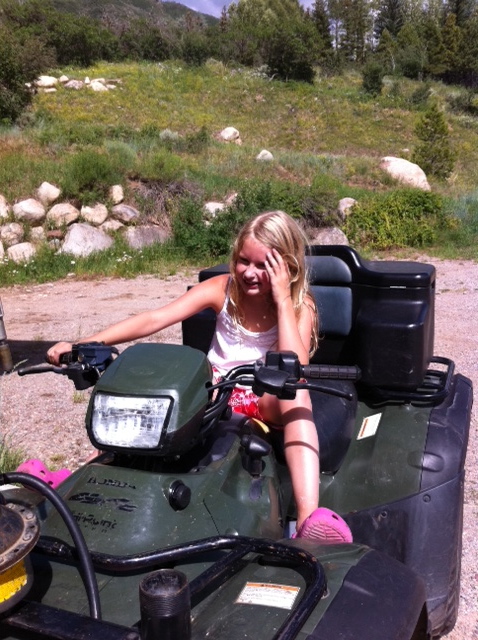
Emma on the 4-wheeler

Perhaps more exciting than even the ARC (Aspen Recreational Center) is the 4-wheeler kept up on the ranch.  For those who are not familiar with this piece of machinery, it is a cross between a kind of Hummer version of a motorcycle and an open air golf cart.  My two nephews, Colter and Bridger, are cringing at this crude and citified description of mine, because it is actually an essential piece of powerful ranch equipment used to change sprinkler heads, and to haul a variety of other things.  Things I do not pretend to know about.  To me, it is the vehicle we use to go looking for coyote, fox and other wild life up on the ranch.  Last summer we found a den of coyote pups, so cute(!) whose mom lay basking on a nearby rock, unruffled by our intrusion, she didn’t move a muscle as we rode by within ten feet of her pups.  (I know Colter and Bridger – you guys might want to just shut your computer down at this point – it’s got to be painful to read this description.)

Now that I have thoroughly humiliated my fabulous nephews with my utter ignorance in all things to do with ranching, I will attempt to move on.  When Emma arrived in Aspen the night before last, one of the first things out of her mouth was – “Go on the 4-wheeler?”  Followed by, “Go to DuBrul’s (my cousins’s) house?”

When we told her she couldn’t do either of those things, she then went for her back up list.  “Go see motorcycle bubbles?”  (This requires interpretation as this is what Emma calls the 4th of July fireworks, which we missed this year as we were in New York.

“No not going to see motorcycle bubbles.  Go swimming in indoor pool.  Yeah, go to the ARC.”

When we informed her that as it was almost 9:00PM, this wouldn’t be possible, but promised to take her the following day, she said, “Go to outdoor pool?”  (Meaning the Snowmass rec center’s outdoor saline water pool)

Finally tired of our feeble excuses about the late hour and how everything was closed, she conceded sadly, “Time for bed.”

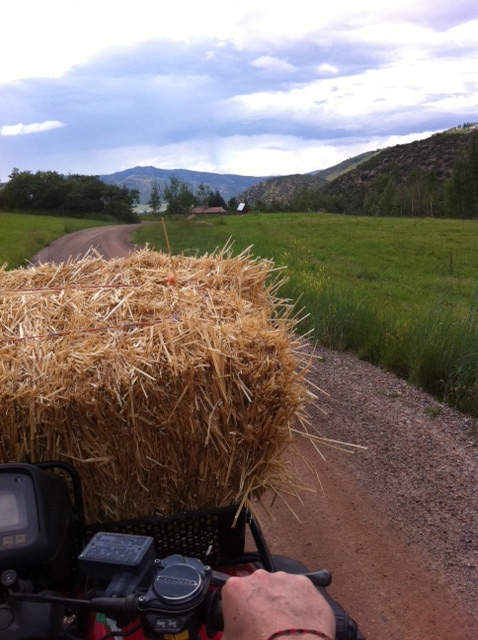
But the following morning the list was proffered up and there wasn’t much we could say as our excuses of it’s too late, no longer held any weight and she knew it.  So off to the ARC Emma went and then a trip to the grocery store where she was able to procure her favorite chocolate milk from Horizon, before getting the 4-wheeler from the barn.  We were also able to load a bale of hay into the front to carry back to the house to set up with a bull’s eye so that Nic can practice his archery skills.

Bringing hay back to the house for Nic

It’s good to be home with the family!

For more on our escapades and Emma’s journey through a childhood of autism, go to:  www.EmmasHopeBook.com

Slow Progress – Autism

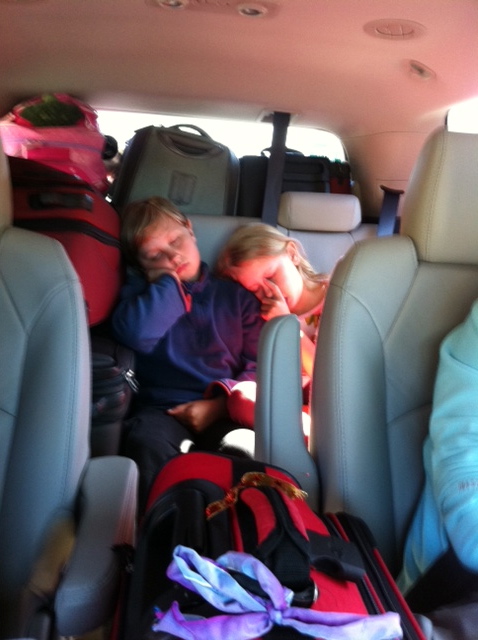
Nic and Emma driving back to the San Francisco airport last week.

I love this photograph because you wouldn’t know anything was amiss.  It was taken on our drive back to the airport as we were leaving Napa, California last week.

I don’t know whether other parents of children with autism feel this way or not, but any time I see Emma interacting with another child in “typical” or more typical ways, my heart soars.  Whenever Emma acknowledges Nic’s presence, plays with him, tries to be with him or shows a desire to be with one of her cousins I am filled with hope.  These tiny moments are like little beacons in an often dark tunnel.

“Without motivation she will not try,” one of the many specialists we took Emma to once said to us.

When I decided I was going to teach Emma how to hug a family member, it was with the hope that she might find she liked the sensation and might take the initiative to hug one of us without being prompted to do so.

“Put your arms around and squeeze,” I instructed her.  Sometimes she seemed happy to do so, other times, she didn’t.  Usually she put her arms around the person while keeping her body from having direct contact, her head jutting away at an odd angle.  I probably would have had more luck teaching her the art of the air kiss, she would like that (which says something about my waspy heritage).

As much as Emma does not appear to derive much pleasure from hugging while standing, she loves to get into Richard and my bed in the mornings and cuddle.  She aligns her body with mine and lies as close to me as she physically can.  Often she will pull my arms around her so they are holding her in a snug embrace.  Other times she will run up to one of us and give one of us a kiss or will climb into our lap.  I take it as progress.  It reminds me of a blog post I wrote over a year ago now when Emma embraced me as I was standing in the kitchen.  I was in shock because it was unprecedented.  Now those sorts of spontaneous embraces are more commonplace.  But it shows progress.  Or what I think of as progress.

One of the things about an autism diagnosis that makes me sad is the thought that my child may not have the experience of friendships.  But as Emma matures, I have learned to redefine what “friendship” means.  And I have seen that in Emma’s own way she does have friends, children she prefers to be with.  Emma’s friendships do not include secrets or talking or sleepovers.  They do not include making bracelets for each other and excluding other children in a show of preference.  Emma does not know about cliques, gossip, comparing, jealousy or what it means to be “cool”.  Emma is thankfully oblivious to all of those social constructs we try so desperately to shield our neuro-typical children from.

Emma is present, almost always in the moment.  I don’t think she worries a great deal about the future, she just is.

For more on Emma’s journey through a childhood of autism and her first spontaneous embrace, go to: www.EmmasHopeBook.com

“Go Back” – Autism

Last week Emma began crying and said, “Go back to hotel.”  Richard felt she was missing me, as I had to leave my family to return to Colorado for work when we left California instead of returning with them to New York City.  We also felt she was wishing we could have stayed longer and spent more time with my extended family, all of whom she loves being with.  She had such a wonderful time with so many family present at the Bed & Breakfast in Napa, California where we stayed for my brother’s wedding.

There’s a mistaken thought by many people that because a great number of children and adults with autism cannot express themselves well and often do not show tremendous emotional attachment to those they love, that they do not love.  Some people believe they do not feel the same intensity of emotion that we neuro-typicals do.  I disagree with this thinking.  I believe Emma loves and misses people as much as any neuro-typical child.  I believe she misses them with the same aching as any of us do.  The difference is, Emma doesn’t have the same neuro circuitry or the ability to put into words her feelings.  She lives in a world that must be incredibly confusing so much of the time.

I wonder, when I get on the phone with her, how much does she understand?  Does she understand that I am in Colorado and not in New York with her, Nic and Richard because I have to work?  Because time is a difficult concept for her, does she really understand when I will be returning?  When she wakes up in the morning does she wonder if I might be there only to find I’m not?   Our phone conversations are limited.  When speaking with Nic, I can reassure him that I will be home in another couple of weeks.  We can discuss what he did, he can describe the breakfast he fixed for his dad yesterday for Father’s Day.  We can talk about things.  With Emma, who does not and cannot ask questions, I ask – How are you?  She tells me she’s fine, even if she isn’t, because it’s the conversation we always have on the phone.  She may add some random thing such as – “Seal park, Chelsea piers carousel” and I can deduce that Richard took the children there yesterday.  I always ask her – What did you do today?  To which I can receive an accurate list of what she did, but just as easily I can receive a somewhat confusing version of events that may or may not have taken place.  I then will verify with Richard to get a clearer idea.

Yesterday was Father’s Day and Richard spent it with the children.  There was no sleeping in for Richard as I’m not there to give him a break.  Nic made him a special breakfast and then Richard took the children to various parks.  I know it wasn’t the day Richard would have liked.  I know how hard it is being the sole parent taking care of everything, especially for such an extended period of time.  And particularly tough when it’s a day designated to celebrate fatherhood.  When I spoke to Emma yesterday I said, “Be sure to tell Daddy – Happy Father’s Day and give him a hug, Em.”

“Happy Father’s Day,” Emma said into the phone.  I have no idea where Richard was or if he overheard her.  I can only hope he did.  I know Emma loves her dad.  She isn’t able to express it in the typical ways we are used to, but she does.

For more on Emma’s journey through a childhood of autism, go to:  www.EmmasHopeBook.com

The Velcro Strip

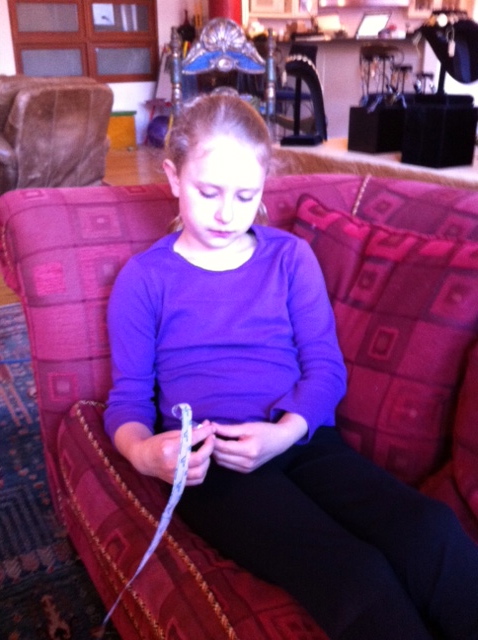
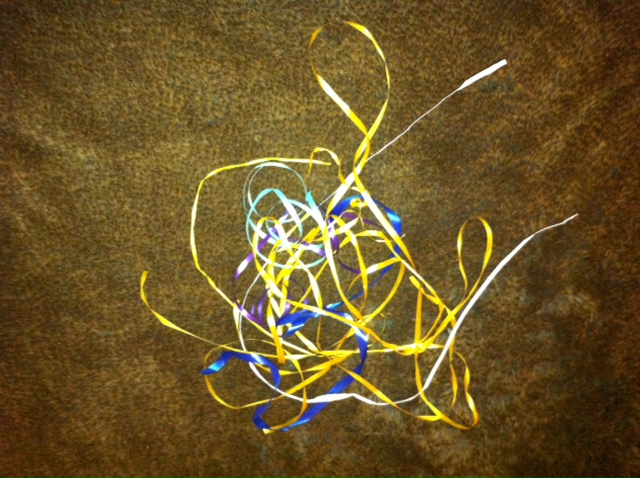
Emma’s balloon string has been officially replaced.  She now carries a long plastic strip, the kind you peel off a self adhesive velcro strip.  How such a bizarre and unlikely item came into her possession is anyone’s guess.

Emma with her plastic velcro strip this morning before going to school.

Over the past year or more Emma has become attached to an assortment of long, thin objects.  The first was a stick she picked up on a playground near the Bronx Zoo.  One can never know when an object will become a coveted one.  But I remember that stick because she wouldn’t let go of it, even when she swung on the monkey bars at the playground.  It was an odd thing to watch her movements so clearly hindered by her refusal to let go of that long stick.  When we made our way to the subway for the long ride home, we told her she could not bring the stick with her.  She didn’t put up a fight and I thought nothing more of it until I saw her, upon our return home, reach down to pick up another stick from the planter outside our building’s front door.

” No Em.  The stick stays outside,” I told her and she complied.

But it became a habit, each and every time we left the house she would find a stick and carry it with her.  A few months later she found a long plastic strip used to bind packages and began carrying, twirling and waving that around while inside our home.

Emma’s assortment of “strings”.

There are a few thoughts on this sort of behavior with autistic children.  Some believe the items should be removed.  The idea being the child should not be allowed to have them as they increase “stimming”.  Stimming – shorthand for self-stimulation is a word, which is much used when speaking of autism.  It is the repetitive behavior the child/person uses to soothe, calm or regulate themselves.  The objects are varied and can be anything from spoons to things like running water.  But some children do not engage an object at all.  These children do things like  hand flapping, twirling, spinning, rocking and even head banging, while others stare at their own fingers that they wave in front of their eyes, others tap their fingers rapidly, hum or grunt, bite or twirl their hair, lick surfaces or smell things.  What marks their behavior from so called neuro-typical behavior such as pacing, doodling and thumb twirling is the child who is autistic may engage in these behavior for hours at a time, often getting in the way of daily living and learning.

Others believe the child should be allowed to stim and feel it is better to allow the child to self regulate.  They believe it is, in fact, cruel to remove the source of comfort for these children/adults who are autistic.  Many people believe learning can take place despite the stimming.

I don’t fall squarely into either camp.  Richard and I have done our best to give her the freedom to have some objects – balloon strings, velcro strips etc. while telling her she cannot bring sharp, pointed or objects we think might accidentally hurt her into the house.  We do not allow her to have her “Coqui” aka scraps of blanket outside her bedroom because she can sit for hours at a time sucking her thumb, which is doing untold damage to her teeth.  When I am working with Emma she may not have anything in her hands as I need her hands free to type, write etc.  But when she has gotten dressed, brushed her teeth, straightened her room, she can race around the house on her scooter, carrying whatever long piece of string/plastic/packaging tape she likes.  It’s difficult to know whether we are doing the right thing, but for the moment this middle ground seems to work or, at the very least, not cause too much damage.

Earlier this morning when I was trying to take a picture of Emma with her velcro strip, she wouldn’t look at the camera.

“Hey Em.  Can you look at the camera?” I asked.

“Say cheeeeese!”  Emma said scrunching her face up into a hapless and obviously forced “smile”.

“No not like that.  Think of something happy.  What makes you happy?” I asked, pointing the camera at her.

“Mommy makes me happy,” she whispered.

And that makes me happier than she can ever know.

For more on Emma’s journey through a childhood of autism and arbitrary items that hold her interest go to:  www.EmmasHopeBook.com

A Gift

Last night we all settled into the family room to watch Groundhog Day, a family favorite and movie some of us have seen more than a few times.  Toward the end of the movie there is a scene where Bill Murray’s character climbs up onto a stage to be auctioned off to the highest bidder during a party.  Emma, who was sitting to my right with her legs folded, torso leaning against me suddenly said, “It went up, up, up high into the air.  I said I can’t reach, it’s too high,” she reached her arm up as though trying to grab something.  “You have to pull on Mommy’s shirt and ask for help,” as she said this she pulled on my robe.  “Mommy – I need help!  You have to get it down.  Daddy go up the stairs to get it.  Uh-oh it’s up on the ceiling.  We cannot reach it.  You have to reach!  Reach high up.   Jump!  Daddy gets it!  It comes down, down, down, then bump!  Now we have to hold on.  You cannot let go or it goes up, up, up to the ceiling, up into the sky.” Emma looked from Richard to me.  The depth of her eye contact took my breath away.  Her face, filled with sadness, her eyes steady seeking out mine showed understanding.

“This is incredible,” Richard said watching her.  “Do you remember this?”

I nodded my head.  “Oh Em.  Were you sad?” I asked.

“It was a long time ago.  It was a long, long time ago,” She said.

After the movie ended we sat in the living room and Emma continued, repeating the first part of the story and now adding, “You have to hold on, you cannot let go.  If you let go it will fly away.  You have to tie the string,” she gestured with her hands tying a string around her wrist.  “You go to Gaby’s house.  It’s Lili’s birthday party!  We cannot get another balloon.  You cannot let go.  If you let go, it’s all gone.  Emma so upset.”  Emma touched the outer corners of her eyes to show she had once cried over this.  It was absolutely astonishing to witness.  The scene Emma was describing took place either last year or the year before.  Her cousin Lili, who was spending the summer just down the road, was celebrating her birthday, which falls on August 15th.

There is so much to say about Emma’s words last night I hardly know where to begin.  The sheer length of her sentences and the way in which she was relating and putting together a series of events was something I have never seen before, not to this degree.  There was the recognition that it happened around the same time of year as now, and the comment “It was a long time ago”, both of which suggest a depth to her thinking we have rarely if ever seen as well as the understanding of something so abstract as time.  I just posted two days ago regarding Emma’s inability to understand time, and yet here she was referring to an event, which occurred over a year ago and she clearly understood it was “a long time ago”.  I could not imagine these were words she understood much less knew to use in a sentence within an appropriate context had I not heard her last night.

Joe, Richard and I looked at each other in astonishment as Emma continued to talk about Lili’s party and how she had once lost a helium balloon, once there at their house and a couple of times here at ours.  The events were conflated, but the meaning, the emotional weight she felt as a result of loosing the balloons and how she lost them were all correct and factual.

As we climbed the stairs to our bedrooms Richard said, “Hey Emma!  Do you know what tomorrow is?!”

Without turning around or with any hesitation Emma shouted, “It’s Mommy’s birthday!”

This too is noteworthy as Emma is just as likely to have said it was Folgen’s (one of my mother’s two German Shepherds) birthday or Nic’s or hers or Granma’s or my brother Victor’s or his wife Susan’s, who in fact just celebrated her birthday or any number of people who currently occupy the house.  That she has been hearing about the birthday celebrations and activities surrounding today are not so unusual.  What is unusual is the fact she was able to answer Richard’s question without hesitation, demonstrating she has heard us discussing the birthday planning and knew for whom they were for.

Today is my birthday.  I am celebrating half a century.

Emma’s monologue last night was a gift surpassing my wildest dreams.

Questions

“Do you think Emma will ever ask us a question?”

When Ariane asked me that question, I had to pause and think about it. Had Emma ever asked us any questions? After a few more seconds of scouring the memory bank, I answered.

“She asks us questions all the time,” I said. “They’re just simple questions.”

“Go to snake bite museum?”

“Watch Elmo movie?”

“Take a plane, see Grandma?”

“Have some apple juice?”

As far as I can remember, all of her questions are requests to have her needs met or requests for information or clarification, which are also needs-related.

“Go to snake bite museum?”  Request for needs to be met.

“Take a plane, go see Grandma?” Request for information related to needs.

She will also frequently make statements that are stealth questions, often with her voice rising up slightly at the end of a sentence like you do when asking a question.

“No see Becky today. No school bus.” Then she will look up at you expectantly, requesting an affirmation.

“That’s right Emma, today’s Saturday, there’s no school today.”

We probably say “That’s right Emma” more than any single phrase to her. As a consequence, she also says “That’s right” all the time.

“No take the bus.”

“That’s right Emma, no school bus today.”

“That’s right! No school bus today!”

“So what do you want to do Emma?”

“Make pancakes?”

“Sure Emma, let’s make pancakes.”

“Yaaaaaaay!”

When Ariane asked me the question about Emma asking a question, I instantly knew what she really meant by that. That’s why I had to pause a few seconds and think about whether she had or not.

“Why does Grandma live so far away?”

“How do they get all the music into an iPod?”

“Where is California? How long does it take to get there?”

“Why are the buildings so tall here?”

“How come they keep all the animals in cages at the zoo?”

“When am I going to be a grown-up?”

These are all simple questions you might hear from any four-year old child. They seem light years away from Emma’s capabilities right now. Why? When? How? Where? What? These questions never seem to materialize, at least not in that form.

“Can I?” “Have some?” “Go there?” Yes, they are all questions, but not the kind you expect to hear from a girl who is eight years old. Her teachers at school have told us she has made progress in asking questions, and will even tell us examples of the what, where, when, how and even some why questions she has asked. I can cite some examples too, though they don’t use the actual W words.

When and where questions are the easiest:

“Get on a plane, go see grandma?” That’s a when question in disguise. She wants to know when we are going.

If we are in an unfamiliar area she might ask a where question like, “Go find swimming pool?” Most kids would ask, “Where can we find a swimming pool around here?”

“Get on a plane, go to hospital (hosspull)?” That’s a when and sort of a where question. She wants to know when we are going for the stem cell treatment and where are we going, which foreign country do we have to fly five hours to reach because our government can’t get it together to have these treatments available here. Ha. Ha.

“Daddy, movie is broken. Daddy help?” That’s a when and how question. How can you get this thing working again? When can I watch Mary Poppins?”

What questions are a rare breed, at least the kind of what questions normal kids ask that stem from curiosity about something unfamiliar. She doesn’t seem to have that curiosity for more information about what something is, how it works, or why it is the way it is.

The rarest of the rare are why questions, and the rarest of the why questions, the albino elephants of the question world, are why questions related to abstract thought.

“Why do bad things happen to good people?”

If we ever hear Emma ask a question like that, we are home free!

Presto, chango. “That’s a normal kid you got there mister!”

Why questions related to feelings are the low hanging fruit we strive to harvest, planting the seeds for them by asking her why she feels the way she feels, usually when her emotions are very intense – intensely happy, or intensely upset.

“Why are you so upset Emma? Why are you so sad (or angry, or frustrated)?

“Emma is so upset (…because…) Emma can’t find cokie.” (her blanket).

If she can truly understand a why question like that, and she does hallelujah, then she can ask one too. Since her receptive language (comprehending what we say) is stronger than her expressive language (communicating her thoughts), this is how we practice with her.

I know she asked me a why question once, related to my feelings. Probably something like “Why is daddy upset?” but I can’t remember exactly what it was.

Maybe Ariane, Joe or one of her teachers or therapists could add more examples they have witnessed in the comments section below. The more we can list, the more hope we have. Hope is the name of the game here (and the name of the blog).

I’d be lying to you if I didn’t have a great deal of hope that this next stem cell treatment will yield a few how and what questions.

If we get a few whysGravy.

Theories

Autism is nothing without theories.  Specialists, doctors, scientists, geneticists, parents, everyone has a theory when it comes to autism.

Richard claims I have more theories regarding autism than the most versed specialist.  And he’s right, I do.  The only difference is, I freely admit 95% of them turn out to be wrong and the remaining 5% have no validity because while they may prove right for Emma on any given day, they do not hold up long term or within the larger autism population.

Richard and I have a running joke about my desire, my need for theories.  When we are confronted with any new behavior from Emma, Richard will look at me and say, ”And your theory is?”

The beauty of having theories is, autism remains an enormous question mark and so the most impractical of theories hold weight if for no other reason than because they are difficult to prove wrong.  There is so much more we do not know than we do.  The other thing about theories is they give us  (me anyway) hope.  Hope that we’re moving forward.  Hope that maybe this line of thinking is going in the right direction.  Hope that the theory will lead to another theory, which in turn will prove to be true, leading us to a cure, a cause, something, anything…  No matter how crazy, the theory stands until proven otherwise and with autism that may be for a long time.  It’s something, anything, to go on amidst the great expanse of unknown.

Richard usually leaves the theorizing to me, so I was surprised when he said to me last night, “I have a theory.’

“Really?” I said looking at him to be sure he wasn’t making fun of me.

“Yes,” he said.

“Great!  Tell me more.” I said.

“Emma is doing great. “

“And your theory is?” I prodded.

“That is my theory.  She’s doing great.  The other day she and I were walking down the street.  I passed her and stepped off the curb to hail a taxi, but she didn’t see me.  She looked around, her eyes got really big and then she said something, I can’t remember what.  But she was scared and didn’t know where I was.  I called out to her – Emma!  I’m right here!  When she saw me, she cried out – There’s Daddy!  There’s Daddy!  I found you!  That’s never happened before,” Richard paused.  “She was really frightened when she thought I wasn’t there,” he said.

Suddenly I remembered when Emma was three and we went to New Paltz for the weekend.  We stayed at a huge rambling hotel right out of The Shining.  Richard and I in one room, the children with Joe in an adjoining room.  At around 2:00AM I heard a door slam, thinking nothing of it I started to go back to sleep.  Five minutes later our door opened and Joe said, “Is Emma with you guys?”  In a panic all of us threw on clothes and began searching the labryinthian hallways calling for Emma.  We split up hoping we might cover more ground that way, I ran to the front desk and reported her missing to the hotel staff.  It was the dead of winter, snow drifts piled up around the hotel, I was terrified Emma might open one of the self locking doors to the outside and not be able to get back in.  She was bare foot with just her nightgown on.  After about 20 minutes when panic had turned to ice – when your body no longer feels it is your own – one of us found her.  It was either Joe or Richard, I can no longer remember, but I know I began to cry in relief.  She was holding hands with some man who worked for the hotel.  He was quietly talking to her – at that time she had almost no language – and leading her back to the front desk.   I was in tears, thinking of all the horrible things that might have happened to her.  But Emma acted as though nothing unusual had occurred.

Richard continued, “Her sentences are becoming more complex, she’s become much more engaged, she talks all the time now and it’s not just because she wants something.  She’s talking to connect with us.  She wants to connect with us.  And except for the other night, she hasn’t wet the bed in almost a month now.”  He looked at me and then added, “She’s doing great.”

I remember when Emma turned four we had a big birthday party for her, hired a musician to come and play the guitar and sing kid friendly songs.  Emma was dressed up in one of her “party” dresses with a tiara on.  She spent most of the party trying to lie down inside of the musician’s guitar case, ignoring all the other children and the music.  I remember plastering on a smile for our guests, at one point I excused myself and wept in the back, giving myself two minutes to cry before returning to the party and pretending everything was fine.  I didn’t fully understand her sensory issues; I hadn’t developed any theories at that point.  I was still in the process of reading everyone else’s theories regarding autism.

“It’s a good theory,” I said to Richard.

“Yup.  I like it,” he said.

M

I took Emma whitewater rafting today, while Ariane attended a seminar. Emma asked me to go rafting a few days ago, so I booked it for today and we slathered on the sunscreen. We went rafting last summer, all four of us, with Nic and Emma riding in the front of the raft, getting soaked and laughing like crazy. Nic was attending day camp today, so he didn’t join us. Just me and Em.

I assumed that Emma would want to ride in the front again and asked the guide to accommodate us (and perhaps prevent a meltdown if she was denied her preferred seat selection). The guide said sure, but when we climbed in the raft Emma wanted to ride in the middle instead. I was surprised and a little disheartened to be honest, thinking she had lost her gung-ho enthusiasm.

It was a gorgeous, crystal clear, blue-sky day. The river was running fast with lots of great rapids. Emma sat in the middle of the seat in the middle row. I was behind her to the left, the guide in the stern to her right. In the formerly coveted front row was a mother and father and their daughter Sydney, who looked about three years younger than Emma, but who of course, was talking like she was three years older. They were all laughing and screaming and squealing as they got soaked to the bone in the 40˚ mountain-fed water — acting pretty much like Emma and Nic and Ariane and I did when we rode together last summer.

Emma sat silently for most of the hour long ride, looking around, or maybe not looking around at all. Maybe just staring off in space. It’s hard to tell. I tried to get her more engaged and excited by alerting her to upcoming waves and waterfalls, whooping it up. She seemed to get slightly more jazzed, but not enough to laugh or scream like she would on a carnival ride, or like she did in our last raft ride. I got a little bummed but then I thought about how much Nic’s and Ariane’s company means to her — how much she laughs when we all play together.

“She misses Nic,” I thought. “Misses mommy too.”

It made enough sense that I stopped worrying about her autistic detachment and just enjoyed the ride, which was about as perfect as a raft ride could be. When we hit a calmer stretch, Emma started singing and grabbed the strap they gave her to hold, leaning way back until her head was resting on the seat next to me, whereupon I tickled her chin and elicited those squeals I wanted to hear. This was repeated many more times between the rapids.

I asked, “Are you having a good time Em?”

She replied, “Yeah,” with a smile as convincing as the eager tone of her voice.

“Me too Em,” I said, smiling back at her.

I noticed how much I’d been calling her ‘Em’ lately, instead of Emma. For some reason, the thought popped into my head that Em should be her stage name when she becomes a huge rock star a few miles further downstream. Then I thought ‘M’ would be even better, out-abbreviating Madonna and Cher and other one-named divas — assuring her charismatic status with a single letter. I pictured what the T-shirt ‘M’ logo would look like – maybe a graceful art nouveau scroll – then I got concerned that Bette Midler, ‘The Divine Miss M’ might claim trademark infringement.

SPLASH! My daydreaming came to an abrupt end as I got soaked head-to-toe by a big wave that blasted over the side. Emma sat upright, placid and unconcerned in her self-selected (and very dry) seat in the middle of the boat. “Em, you’re not even wet!” I laughed and the guide laughed too.

“Yeah, looks like she picked the right seat after all,” he added.

Mmm hmm. I guess she did.

Emma’s School Bus

Emma came home this evening and said, “Sad.”  This was in answer to my question, “How are you?”

“Why Emma?  What happened?” I asked.

“Emma have to go on the school bus.  Emma make you sad,” she said, frowning and nodding her head.

“What do you mean?” I asked kneeling down so my eyes were on the same level as hers.

“You have to wait!  You have to sit!  Emma cry.  Emma bite yourself,” Emma looked directly at me as she said this.

“Why do you have to wait, Emma?” I asked.

“Want to go to Becky’s class.”

“Did your bus come to school early?”  I asked trying to piece together what Emma was trying to tell me.

“You have to wait.  Want to go to Becky’s class.”

“Did someone tell you, you had to wait?” I asked.

Emma nodded her head.  Shouting and pointing her finger she said, “I told you! SIT DOWN!”

At this point I was more than a little alarmed.  “Emma, who said that to you?”

Emma didn’t answer at first, then nodded her head.  “Yeah,” she said in a sad voice.

These kinds of responses from Emma only highlight how difficult it can be to communicate with her and understand her.

“Did the bus driver say that to you or the bus matron?” I asked, knowing these were the only two people on the school bus.

“Bus driver said – I told you NO!  Sit down!”  Emma said in a loud stern voice.  Then in a quieter voice she said, “Emma cry.  Emma so upset.”

I think it was at this point in the conversation when I went to the computer and wrote an email to our lawyer, ccing Richard and Emma’s head teacher, the head master and social worker.  I have no idea what kind of recourse is available to us and so we need advice.  What I do know is that we have had to deal with the Office of Public Transportation since Emma began going to school five years ago.  Emma’s bus arrives between 7:20AM and 7:40AM to take her some fourteen blocks to her school, which begins at 8:30AM.  When I called to complain about the early pick up time, insisting that it cannot possibly take an hour to drive fourteen blocks even if three of them are cross town blocks, I was told the bus picks up many other children who go to several nearby special education schools before Emma is eventually dropped off at her school.  In other words, Emma is driven around the city for close to an hour.  For years now I have questioned the logic in this and have been:  hung up on, yelled at or told this is the way the route is mapped out and there’s nothing that can be done.

A few years ago I was determined to have the bus change their pick up time from 7:15AM to something later.  For two months I went back and forth with various people at the Office of Public Transportation, sometimes calling three and four times in a single day.  By the time they finally agreed to change Emma’s pick up time the semester was coming to an end and we started anew with a new bus company and driver after the break.  Which is another bizarre thing.  Are special needs children the only ones who have a new bus company, new bus driver, new bus route every three to four months?  How is it that neuro-typical children in New York City have the same bus for the entire school year, often for several years in a row?

In the past few weeks I have noticed when the bus pulls up that there seem to be only one or two other children on the bus as was the case Thursday morning, no other children.  Emma was the only child.  So unless the bus is picking up children after Emma, it is driving fourteen blocks (which should take about ten minutes depending on traffic.  If the bus arrives early, (picks Emma up at 7:25AM drives ten minutes to her school, getting there by 7:35AM) it sits idling outside the school until the school’s doors open at 8:25AM.  Which means (if I am correct) Emma is waiting in the bus alone for almost an hour.

What makes all of this particularly horrifying to me is we put Emma on the school bus and cross our fingers she will be treated well and with respect, she will arrive safely at her school in a timely manner, but we cannot know what really goes on because Emma cannot tell us.  We have to trust.  And at this moment I no longer trust.

Emma’s Language

Emma’s language continues to fascinate.  What follows are a number of examples demonstrating Emma’s creative use of the English language.

This morning she said tearfully, “ Rope?”

I now know she was asking me to help her find Merlin’s cat toy, which Emma has become particularly fond of.  It resembles a fishing rod, only it’s plastic and at the end of a thinner plastic “line” is a cat’s version of a fishing fly.  The “fly” has feathers in royal blue and black though ours, or I should say, Emma’s no longer has any feathers.  Just a few defeated bristles are all that remain.  I tried to get Emma to call the toy “Merlin’s cat catcher”.  Emma repeated the words and then said, “rope,” in a matter-of-fact tone.  Fair enough, saying rope is certainly easier than the tongue twister I was suggesting.  Emma’s interest in Merlin’s toy is not to engage Merlin in any sort of play.  She likes to hold it and chew on the thinner plastic line.  Merlin, under the misguided impression it is still his toy, leaps at the bristled end and tries to grab it in his mouth.  Emma ignores him unless prompted by one of us to use it to play with him.  At which point she will whip the thing around her head so violently Merlin runs away.  Mission accomplished.  No one can accuse Emma of not being able to creatively problem solve.

“Leash?” Emma said the other day.  “Leash” is short hand for any number of things:  tape measure, jump rope, belt or dog’s leash.  It began out in Colorado where she loves to hold the leash attached to one of my mothers’ two German Shepherds.  She is actually terrified of most dogs, including my mother’s.  Giving her the leash to hold is one way to calm her when we are taking the dogs for a walk.  But since we do not own a dog in New York City I know when she asks, she is looking for my tape measure or less frequently her jump rope.

This morning Emma sat on the floor and looked at some work sheets that had been sent home in her backpack.  There were a series of numbers referring to corresponding red dots.  Emma looked at the number and said, “What’s that letter?”  She then counted the red dots, ” One, two, THREE!”

“What’s that number, Emma?”  I said.  “It’s a number.”

Dutifully Emma repeated, “What’s that number?  One, two, three, four.  FOUR!” She looked up at me and smiled.  “What’s that letter?”  She said pointing to the number 6 on the next work sheet.

“It’s a number, Em.  Look these are numbers and this,” I drew the letter A, “is a letter.  Can you see the difference?”

Emma nodded her head.  “A”, she said.

It was not clear she understood the difference.

As I watched her counting and naming the numbers I thought about how it must all seem so arbitrary to her.  A number, a letter, a rope, a leash, a toy…  All things we learn to identify at a very young age and never think about again.  But for Emma this is not the case.  Why would the symbol for a quantity – say the number 3 – be any different than the letter G if one does not understand quantity?  If one continues along this line of thinking all the names we apply to letters in the alphabet must seem incomprehensible.  Why is the letter H called “Aich”?  It’s phonetic sound doesn’t offer any clues either as it’s the sound one makes when hit in the solar plexis or something resembling a whispered “huh”.   As anyone knows who has attempted to learn the English language, for every rule there is an exception, making it an exceedingly difficult language to learn.

The other night Emma was recounting our trip to Costa Rica, something she often does.  She tapped her stomach and said, “Now go bang-bang!”  Which means she was remembering how her stomach hurt.  “Now see thunder.” She added.  Meaning she remembered her headache.  “Make you cry.”  She said and proceeded to pretend cry while looking at her reflection in the mirror.

We have an African Senufo Bird in our loft which is a primitive statue carved from wood.  It stands about five and half feet tall and Emma refers to it as – “giraffe”.  I have corrected her on numerous occasions, but she remains unconvinced.

Yesterday, seated next to Emma while she ate her breakfast, she looked at my upper arm and said,  “Ahhhh… you bit.”  She made a sad face while pointing to three scars on my arm, which I received when I broke my shoulder about 14 years ago.  The doctors inserted three metal rods into my arm to facilitate the mending of the broken bones.  Emma has never mentioned the scars, so it was interesting that she took notice and then showed genuine compassion for what she imagined must have happened – that I bit myself.  Something Emma does to herself when her frustration becomes unbearable.  That Emma was relating the scars on my arm to an action she often takes and was identifying with it was remarkable and very hopeful.

I have come to appreciate Emma’s use of language.   I would like to become fluent in it.

Emma’s Language

I am lying in bed reading.

Emma comes running in looking for me.  She stops when she sees me.  Huge smile.  In her hand she has two pieces of what are left of her blanket she calls“cokie”.   She drapes the smaller piece on my arm and says, “That one Binky, mine!  Ohhhhh!” She runs to the other side of the room.

“Emma!” I say in an animated voice.  “Are you letting me have your cokie?!”

“Wait a second.  That one cokie,” she says holding the larger piece of her old blanket in her hand.  She jumps up and down.

“Is this piece mine?” I ask.

“That one Binky.  Awww…” She says in her sing-songy voice.

“I have Binky and you have Cokie?” I ask.

Emma twirls around holding her blanket.  “What’s boy?”

I put my ipad away and sit up.  “What is boy, Emma?”

Emma seems to not hear me.  “What’s ee- day? Boy gone.  Yes!” She says while continuing to twirl in place.  “Booooooy..” She says the word as though it were several syllables.  Her voice rising in the middle of the “o” sound and coming down at the end, stretching it out, playing with the sounds.  She pauses and stops twirling.  “Ee-day is gone.” She begins to twirl again.

“Who’s ee-day? “ I ask.

“Ee-day move away.  Ee-day is gone.”

“Emma, do I know ee-day?

“Ee-day move away.”  She begins to jump up and down.  “That’s right.  Boooooy, ee-day gone.  Ee-day is gone.  Ee-day is gone.”  Emma stands still and continues twirling a piece of her hair around her finger.  “What’s watch your finger?  What’s boys?  What’s watch your?  What’s watch, wash your finger?”

“Are you saying watch or wash, Emma?”

“Booooy – wash your finger’s gone,” Emma sings the words.

“Emma, is it wash – like washing soap or watch, like you watch Elmo?”

Emma says nothing.  She stands still with her head cocked to one side and twirls the lock of hair. Twirl, twirl, twirl.   She stares at the piece of hair as she twists it around.

“Or are you saying watch out!” I ask.

Emma looks at me, “WATCH OUT!  WATCH YOUR FINGER!  BE CAREFUL!!”  She shouts while jumping up and down.  Then she begins to laugh.

“Did someone at school tell you to watch your finger because it might get caught in something?” I ask.

“You have to be careful.  Watch your finger!” Emma says.  She runs over to me and yanks away the piece of her blanket still draped on my arm.  She runs away and then comes back and gently places the scrap on my head.  “Ahh, it’s your Binky.”

Earlier that day Emma was taking a shower.  “Emma make sure you use the soap,” I tell her.

She dutifully washes her body with soap.

“Now make sure you rinse your body off.”

Emma stands just to the side of the spray, soap covering her.

“Wash the soap, Emma,” I say.

Emma holds the bar of soap under the water.

Okay, that makes sense, my mistake, I think.  “No not the bar of soap, the soap on your body,” I explain.

Emma moves under the spray and proceeds to wash the soap off of her body.

I don’t know what Emma hears or what goes on for her when she is being spoken to.  I do know she takes things literally, as when I told her to wash the soap, meaning wash the soap off her body.  Often, as in the first conversation, Emma seems to be working through something, though it’s not clear to me what.  Either that or she likes the sounds and is playing with the sounds of the words and their various meanings.  My guess is there is much more going on than I am able to figure out.  I am almost always perplexed by Emma’s language.  It is foreign to me and while I am learning to speak a little of it, I have a long, long way to go.

Soma Mukhopadhyay’s Workshop

A number of people contacted me regarding the documentary – A Mother’s Courage – the documentary about an Icelandic woman’s search to help her autistic son.  The documentary tracks the journey of a mother who interviews many and eventually goes to Austin, Texas where Soma Mukhopadhyay has created the Halo Clinic.  Soma is the mother of a non-verbal autistic child, Tito.  (Tito is no longer a child.) Soma developed a program, Rapid Prompting Method, to teach her son to read and write.  Tito has gone on to write several books, despite being non-verbal.

Joe, Emma’s therapist and I drove out to the Bronx this past Saturday where Soma was leading a workshop.  Soma described RPM as a method to “empower the student and express himself.”  Soma’s method takes a non-judgmental view of self-stimulatory behaviors.  She believes they are clues that can help us interact and teach the autistic child.  Soma never once implied nor does her website that her method is a “cure” for autism.   RPM is a means by which autistics can learn to communicate.

For those of us who parent an autistic child, that is an amazing and wonderfully hopeful prospect.  There is not a day that passes when I do not have the thought – I wish I knew what Emma was thinking.  I wish I had a window into her world.  The idea that Emma might one day be able to read and write is something I have hardly dared to wish for.

Toward the end of the workshop, Soma’s son Tito wrote on the large pad of paper Soma had propped up on an easel:  “I think you are talking too loud.”  Soma had been speaking into a microphone.  She held the microphone to his mouth so he could hear how he sounded as he made a noise into it.   It was a light hearted moment, a moment of a teenager commenting on his mother.

Tito writes in his book – The Mind Tree:  “One day I dream that we can grow in a matured society where nobody would be ‘normal or abnormal’ but just human beings, accepting any other human being – ready to grow together.”

I have ordered Soma’s book describing in detail her Rapid Prompting Method.  I am guardedly optimistic.

For more information on Soma and her work with her son Tito, go to:  www.halo-soma.org

Rules

Emma can be very strict.  She is a stickler for rules.  Merlin (see yesterday’s post) is not supposed to jump up onto the counters or dining room table.  If he does, Emma shouts, “Merlin!  Get down!”  Even if he hasn’t jumped up on the counter (yet) Emma will remind him, “Merlin!  You may not get up on the table.”

If we have a vase of flowers on the dining room table Emma will repeatedly warn Merlin (whether it applies or not) “Merlin, kitty, you cannot eat the flowers!”  Then she’ll laugh.

These are all things she has heard us say at some point and Emma is a terrific mimic.  She will not only repeat the things she hears us say, but she will mimic the tone.  There’s a word for what she does.  It is – echolalia – common among autistic children.  Echolalia is the parroting or echoing of sentences and phrases heard.   Emma does not make the sorts of linguistic mistakes commonly heard in young children.  She does not say things like – I bringed it to her – something often heard from young neuro-typical children as they try their best to navigate the English language.  On the other hand Emma will say – Bye Emma! When saying good-bye to someone, whose name is definitely not Emma.  It is what she hears them say to her when they or she is leaving.  Why would she say anything else!?  To Emma “Bye Emma” means a parting of ways.  Or, as in the case of a dinner party we had a few months ago, Emma felt it was time for everyone to leave, she announced – “Dinner is all done!  Bye Emma!”  When our guests, understandably confused, said, “Oh!  Are you going now?” but did not themselves show any sign of leaving, Emma began bringing them their coats, saying, “Bye! Bye Emma!”  while vigorously waving her hand good-bye.  Needless to say she cleared the place out within minutes, despite our reassurances that it was not time to go yet and wouldn’t they like to stay and have some coffee or tea.

For Emma, however, we had eaten, she had patiently waited while this occurred.  She knew there would be dessert after which she would be allowed to blow out the candles on the dinner table while singing “Happy Birthday” (Any party is a birthday party and remarkably some guest almost always is about to have or has just had a birthday – so it confirms Emma’s ‘party = birthday party’ theory.)  Once Emma has sung Happy Birthday, usually several times and with all of us joining in for the third or fourth “last time” rendition – it is time to go to bed.  Emma has a difficult time understanding that we may not be ready for bed.  We may want to move into the living room to talk, have some tea or coffee and enjoy each other’s company.  This, for Emma, is not how it should be, it is her bedtime now and so it should be everyone elses too.  This sort of flexibility does not fit into her “rules”.  The guests should leave and if they do not, then Emma must remind them.

When Emma was beginning to talk she did not say single words, but whole sentences.  See previous post – “Emma at Ten Months Old”.  As Emma grew older, she would repeat things she heard others say.  But the things she latched on to were things said with a great deal of emotion, or, as Stanley Greenspan used to say, “high affect”.  Sometimes these comments were in context, but other times they were arbitrary.  A dear friend of mine who has two children just a bit younger than mine admonished her son in the playground one day while we were there.

“Rogan NO!”  She shouted, as her son dashed toward the gate leading out onto 10th Avenue.  Emma, for the next four years mimicked her in all sorts of situations.  Often it was when she wanted to go somewhere, but knew she shouldn’t, but just as often it was arbitrary.  Emma would shout, “Rogan NO!”   Sometimes she would add  “You have to come back!”  And sometimes she would just use the short hand version  “NO!”  But we knew from the way she said it, the tone she used who she was mimicking.  She had captured the voice perfectly.  A few years ago we ran into my friend with her children in the park and Emma upon seeing her, immediately said, “Rogan, NO!”  Fortunately my friend has a good sense of humor and didn’t take offense.

Emma does the same thing with another friend of ours.

“Jack!” Emma will shout in a stern voice.  Then “Jack!  Jack!  Jack!”  Said in rapid succession.  She captures the child’s name and the anxiety ridden pitch perfectly.  At Nic’s birthday party a few years back, Emma, upon seeing Jack’s father, started shouting – Jack!  Jack! Jack!

“I guess that’s how I sound, huh?” The father said, looking slightly embarrassed.

How to explain?

For Emma, rules help her cope in a world run riot.  Rules provide sameness and from that, Emma derives comfort.  Though Emma has been known to question some of the rules she does not like.  “We cannot make pancakes,” Emma will say, knowing it is a school day.  She hopes maybe we will make pancakes anyway and this is as close to a question as we often get.  But once confirmed, “No we cannot make pancakes this morning.  It’s Wednesday,” one of us will say, Emma will begrudgingly accept this.  It is our rule after all.

“Sleep, wake up, sleep wake up, sleep wake up, pancakes!” Emma will respond.

“Yes.  That’s right.  Pancakes on Saturday and Sunday.”

“Make pancakes with Mommy?”  Emma will say with a sly grin, trying one last time to see if this ‘rule’ can be suspended if for only one day.

“Pancakes with Mommy on Saturday.  Today is Wednesday.”

“Okay,” Emma will say.

Go Away, Big Green Monster!

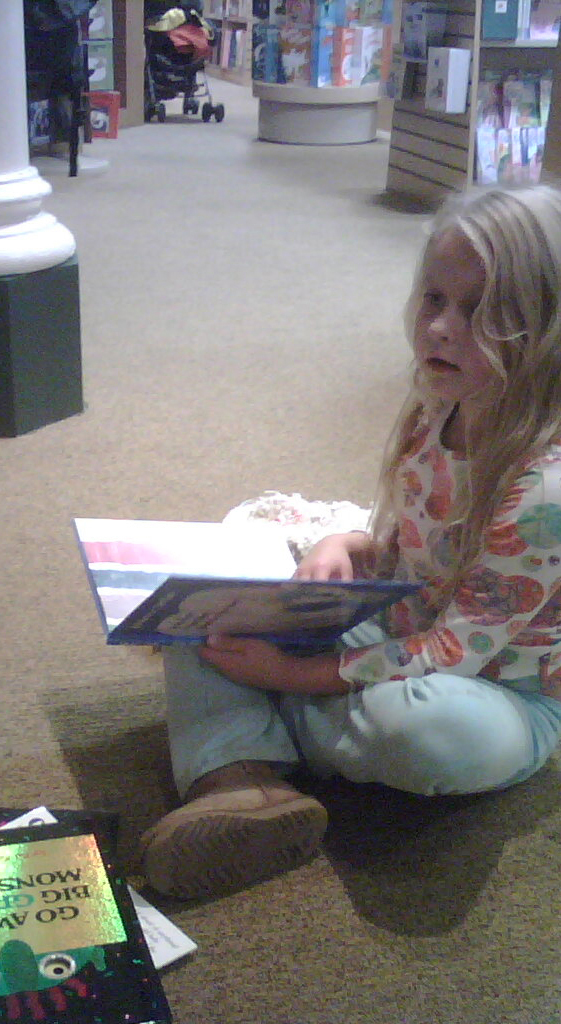
This photo was taken a few years ago at the local bookstore near where we live.   Emma has never shown much interest in books.  When she was a baby she would squirm and wimper when I tried to read to her.  As she grew older, she allowed me to read to her as long as she was able to hold the book and turn the pages.  Often she didn’t wait for me to finish reading before turning the page.  Much the way she flips through photographs, so quickly it’s hard to believe she is really able to see what and who are in the photo, she does the same with books.  I often wonder if Emma sees in patterns.  In other words, her brain picks up the entire scene and creates an instant pattern, allowing her to “see” the image instantly, any variation is immediately recognized.  I don’t know that she sees in this way, but I wonder.

Years before this photo was taken, I took Emma to the bookstore.  She couldn’t have been older than three.  She wriggled out of the stroller and ran to the back of the store.  We hadn’t been inside this particular bookstore for at least six months.  I followed Emma, calling out to her, “Emmy, where are you going?”  As was typical, she ignored me and kept running.  To her left was a floor to ceiling bookcase, filled with large picture books.  Emma attempted to scale the bookcase.

“No! No!  Emma!”  I cried.  “You can’t climb that.  What do you want?”

Emma jumped up and down, making noises.

“Is there a book you want to see?” I asked, looking at the shelves for a familiar book, which she might like.  Emma doesn’t like new books.  Whenever we are in a bookstore and I offer a new book, one that she hasn’t seen before, she shakes her head no.  Then goes over to a book she knows and pulls it from the shelf and hands it to me.  A few of her favorites:  “Chicka, Chicka Boom Boom”,  “Gossie”, “Gossie and Gertie”, “Brown Bear, Brown Bear” etc.  On this particular day she wasn’t interested in any of those books.  She was determined to climb the book shelf.  I picked her up, bringing her close to the books so they were in her reach.  “Do you want any of these?”  I asked.  Emma reached above my head, so I lifted her higher.

On the second to highest shelf, at about seven feet tall, Emma pulled a single book by it’s spine down from the shelf.  “Is that what you wanted?” I asked.  I set Emma down on the floor with her new book.  The book was “Go Away, Big Green Monster!”  I had never seen the book before.  As I stood watching Emma flip through the pages, reciting each and every word, I felt a chill.  It was eerie.  Where had she seen this book?  Who had read it to her?  She knew every word of that book by heart and spent the next hour “reading” it over and over again.

When we returned home (with the book) I related to Richard what had happened.  “It was bizarre, ” I said.  “I mean have you ever seen this book?”

“No, really weird,” he said.  “Maybe one of her therapists has it.”

“But she never lets them read to her.  And how did she know where it was in the bookstore?  She ran straight to it.  The therapists don’t take her outside.”

“I don’t know.  It’s really strange,” Richard said, looking at me.

“It was the only copy, Richard.  She knew it from it’s spine.  It wasn’t like it was out on display.  And I haven’t taken her to that bookstore in months.  She immediately knew where to find it.”

During the following weeks I asked everyone who came in contact with Emma, but no one had read her or lent her the book.

After a few months I stopped trying to figure it out.  To this day, I have no idea how she found that book, or even knew of it’s existence.  It remains one of the many unsolved mysteries of Emma’s mind.