Tag Archives: autism & parenting

Monster Bugs

Last night I pulled out the dozen or more non-fiction children’s books I have for Emma.
“Pick two,” I instructed, fanning them out for Emma to see.

Emma pointed to Monster Bugs & Escape North – The Story of Harriet Tubman, bypassing Volcanos, Whales, Big Cats, Thomas Jefferson and George Washington’s Dog. “This one?” Emma said.

“Okay.  Monster Bugs and Harriet Tubman, it is!”

“Say it with your mouth closed,” Emma said, putting her hand over my mouth.  “Monster Bugs!” she demonstrated with her lips together so that it sounded more like “mummerbum.”

I began reading in an animated voice, lips sealed as Emma shrieked with laughter.  “Hab you eber looked ab a bug up clobe?” I read.  Every time I opened my mouth to annunciate the words she would cover my mouth with her hand.  “Emmy stop!” I said, twisting away from her hand.

“Mouth closed!” Emma laughed.

“Okay, one more sentence with my mouth closed and then we’re going to read it the other way,” I told her.

Nic, who came to see what all the laughter was about, sat next to me on Emma’s bed.  “Don’t worry Mom.  I’ll make sure she doesn’t cover your mouth again,” he reassured me.

“You might see horns…” I began, as Emma clapped her hand firmly over my mouth.

“Emma!  Let Mommy read the story,” Nic said, laughing.

“But the beetle fires boiling-hot gas from its rear end,” I read.

“I love this book,” Nic said, peering over my shoulder at the picture of the beetle shooting gas into an unsuspecting mouses mouth and nose.  “That is so awesome!”

“Mummerbum!”  Emma laughed.

As we continued to make our way through the book, with Nic asking for clarification on specific bugs, particularly the more gruesome and scary ones and Emma repeating the words with her mouth closed, I thought of how when I was pregnant with Emma I looked forward to reading stories to both the children.  When Emma was little she didn’t have any patience for books and only was interested in them if we allowed her to hold them so she could flip through their pages.  The book and its pages interested her, the act of flipping the pages methodically without really looking at the pictures seemed far more interesting to her than the story within the book.  But in the last few years her interest in books has increased and now she seems to genuinely want us to read to her, even requesting specific books while rejecting others.  It was wonderful to see her looking at the illustrations, pointing to the hairy tarantula while saying, “Maranmula!” with her mouth closed.

Nic was impressed with the Stink bug and the Praying Mantis who cleans its face like a cat after consuming a baby bird.

When I finished reading Monster Bugs, we moved onto Escape North!  A quarter of the way through, Nic nudged me and pointed to Emma.

I looked over to see she had fallen asleep.

“We’ll finish this one tomorrow night,” I whispered to Nic.

“No!  Read me the rest,” he said.

“Okay.  I’ll read it again to Emma tomorrow.”

“Good idea, Mom,” Nic said snuggling down next to me.
Pain

When Emma was a toddler, about a year old, maybe two years old, she had a little scratch from the tag on the back of her shirt.  It seemed so insignificant, hardly worth noticing, except that Emma screamed as though her entire body had been scalded.  I remember at the time thinking it strange, that her response seemed too extreme for such a tiny scratch.

There were other incidences which also caught my attention for the very opposite reason.  She would stub her toe or get scratched by a cat or have a huge knot in her hair, none of which would cause her to even gasp.  When she grew older I was terrified of the day when she would start to lose her baby teeth, convinced this would set off such cries of pain, with no remedy other than to wait until the tooth came out of it’s own accord.  However this was not to be the case.  In fact, Emma grabbed hold of the loose tooth and simply yanked it out of her mouth, dropping it to the ground, as though it were nothing more than an irritant, like a pebble in ones shoe.  Evidently her school bus is littered with her baby teeth as she would board the bus in the morning with a loose tooth only to come home and announce, “Threw it away,” when asked what happened to her tooth.

“Where?  Where did your tooth go?” we would ask.

“On the bus,” Emma replied matter-of-factly more than once.

About six months ago Emma was reported to have said to Joe, “Joe!  Pull it out!” and then opened her mouth so that he could remove the offending tooth, which he didn’t, so she did.  Joe was able to intercept the tooth before she was able to toss it in the gutter.

I don’t think we have more than two or maybe three of Emma’s baby teeth, despite the fact she’s lost at least eight or more by this point.  We tried to tell her about the tooth fairy, but she was utterly uninterested and wandered away before we had finished.  The idea a “fairy” would come to gather up her loose teeth, leaving behind money, was not a concept Emma had any use for.

Last Friday Joe called to tell me Emma was whimpering and saying her ear hurt.  I immediately called the pediatrician then looked at Emma’s throat for signs of strep.  Sure enough there was the tell tale white spot on one side of her throat.

“No say AHHH!” Emma said, pointing at her throat.

“Well, let’s wait and see what the doctor says, Em.  Does your throat hurt?”

“Yes.  Ears.”  Emma replied.

“Your throat and your ears hurt?” I asked.

“Yes.”

I remembered the last time I’d taken her to the pediatrician because her ears were bothering her, only to be informed that in fact she had strep, again.

Upon our arrival I proudly stated that I was sure it was strep and went on at length about how I couldn’t believe Emma had somehow contracted strep making this the third time since the school year began.  The pediatrician smiled and nodded her head as she examined Emma who kept insisting “No AHHHH!”  Meaning she didn’t want to have the doctor swab the back of her throat.

“Just ears,” Emma said repeatedly.

The instant the pediatrician looked in Emma’s left ear she looked up and said, “Raging ear infection.”

“What?” I asked, thinking I’d misheard, so convinced was I that Emma had strep.  “But what about that white dot on her throat?”

The pediatrician shrugged.  “Could be food, not sure, but her ear is bright red.  An ear this red should be extremely painful.”  She said looking at Emma.  “I’m surprised she isn’t complaining more.  It’s a really bad infection.”

I watched as Emma played cheerfully with the doctor’s stethoscope.  Observing her, one would never know her little body was host to a horrific ear infection.

“So that’s it?” I asked, still unable to believe she didn’t have strep.

“Yup.  Antibiotics will clear it up, but give her children’s advil in the meantime, that ear has got to hurt,” the pediatrician said.

By the time I had procured the prescription and the children’s advil and returned home, Emma was running around, playing happily.

“Hey Em.  How do you feel?  Does you ear hurt?”

“Yes.” Emma said before racing off down the hall with Joe in hot pursuit.  Shrieks of laughter could be heard.

One of autisms defining features is what specialist call sensory integration issues.  They can range from hypo to hyper and are often a mixture of the two.  In Emma’s case she has both and we still cannot anticipate which one we are witnessing.

Intelligence

How can we know what’s really going on inside of a child’s mind who is unable to adequately express themselves?  For neurotypical children we have tests, we ask questions – all verbal or written ways of finding out what they know, whether they’ve learned whatever it is we are trying to teach them.  But what of non-neurotypical children?  How can we really know what they know?

It is this question which causes more confusion than perhaps any other.  Our methods of rating intelligence are deeply flawed.  IQ tests are notoriously incorrect when attempting to gauge the intelligence of a non-verbal person.  Over the years other tests have been created to gain a better idea of intelligence, but nothing we’ve come up with can adequately give us an accurate view of what these children know, what they may be thinking if they could only express themselves.

When confronted with a non-verbal person most of us immediately assume they do not understand and conclude they are not very bright.  Have you ever been to a country whose language you do not speak and noticed how you are treated?  Often it is as though you were an imbecile.  People tend to repeat the same words over and over again, turning the volume up in the mistaken belief your problem is one of hearing as opposed to understanding or being unable to verbalize a response.  We rate intelligence by verbal acuity.

Every now and then we hear of communication devices children have been taught to use, allowing them to communicate in ways they had not been able to previously.  We are astonished at what they say, how lucid and mature they sound.  I’ve read numerous accounts of sessions in which children “speak” to one another in complex sentences, children we would never assume had it in them.  Just because we cannot understand doesn’t mean the person we can’t understand isn’t intelligent or has nothing of interest to say.  All it means is we are not able to understand them.

When Emma was diagnosed with autism at the age of two years and eight months, much of the evaluation conducted by the therapist was directed at us. I remember at the time thinking the process a curious one.  They were evaluating our daughter by asking Richard and me questions which we often had very different answers to.

How many words does she speak?

“Between ten and fifteen,” I’d answer.

“No, no, she knows many more than that,” Richard would say.

And the truth was she did know a great many more than she was articulating, but the actual word count of recognizable words was probably closer to my answer.  So whose answer was more accurate?

Most of us want to feel understood and heard.  Can you imagine what it must be like to know that no matter what you said, it would be met with confusion?  Can you imagine trying to make your needs known only to have them ignored or misunderstood?  Can you imagine what it must be like to have a very complex thought process only to realize no one understands you?

I cannot imagine.  Everyday I am with Emma, I try to and I cannot.

What I do understand is how very lonely it must be.

Some thoughts

I have school photos of our two children on my desk in my studio, both are smiling, their blonde hair, much lighter than it is now.  Emma, like her older neurotypical brother, Nic, is looking directly at the camera.  Her two front baby teeth are missing, the adult teeth yet to show themselves.  It is one of the rare photos from that age when she was just five where she is looking at the camera.  I have spent hours staring at that photograph, as though if I looked long enough, some part of her mind will reveal itself to me.

I try to apply logic or project my own emotions onto Emma in explanation of her behavior and find I am wrong time and time again.  When I look at Emma’s brain scans and see the lack of symmetry, the bright colors, which should be dark, like a strange Rorschach test gone wildly awry, I try to detect patterns.  I try to make sense of what I’m seeing, but cannot.

“Emma’s brain is not like ours,” I remind my son, Nic in times of upset.  She does not think as we do.  She is decidedly “other.”  I feel as though I am a perpetual intruder in her life.  At times welcome, just as often not.

The stem cell treatments, like the myriad treatments that came before may not help her in the end.  Or they may not help her to the degree we would like.  Emma may not progress enough to allow her to live an independent life.  But I do not want to look back on these years and feel regret.  Regret we might have done more.  So we continue to wait and watch.

And while we do so, we work on her handwriting, her receptive skills, sequencing, her enunciation, we are teaching her to use a typewriter and we read to her.  It was suggested to us that we read books written for children that are non-fiction instead of the usual array of stories available to beginning readers.  At first I was reluctant to give up the Olivia books, which she took such pleasure in, Dr. Seuss, Go Away Big Green Monster, books Emma has been looking at and heard hundreds of times and which she continues to hear at school.  But at home out came the Learning To Read series about Pompeii, The Titanic, Dolphins, Hungry Plants, then I found other books written for children on such topics as Balto and Helen Keller.   She loves all of them.  She requests them, has asked me to read some of her favorites over again.  I am amazed.  But if I think about it, it makes perfect sense.  For a child who takes things so literally, non-fiction is a perfect fit.  The stories I am reading are for her age level and she enjoys them, which fills me with hope and happiness.

Just because Emma doesn’t process things or communicate the way we neurotypicals do, doesn’t mean she’s not intelligent.  Emma is exceedingly bright.  It’s figuring out how to tap into that intelligence in a way that speaks to her, captivates her and interests her – that’s the challenge.

Emma and her Singing

“Sing Zoo Zoo Zoo with your mouth closed?”  Emma said this morning as she was getting ready for school.

“Good idea!” I said.  And then began to sing one of her favorite songs with my mouth closed.

She waited patiently until I had finished the first refrain and then said, “Emma’s turn!”

I knew, before I began singing that she meant she wanted to sing the song with her mouth closed, but since repeatedly correcting her over the years hasn’t made a dent in her continued use of “you” in place of “I” or “me,” I have begun taking her words more literally and seeing how that works.  Other than mildly irritating her, I’m not sure it’s making much of a difference.  The elusive pronoun continues to trip her up.

In addition there are words which she finds impossible to articulate.  A few of them can be found in another of her favorite songs – “Fabulous”.  Emma says – Sandy lot – or something that sounds suspiciously like that, in place of Fabulous as well as humming the word “imported” which is used repeatedly in the song, instead of making an attempt to say some version of the word.

Yesterday I tried more than a few times to have her repeat my enunciation of “imported” first by singing the lyrics “towels imported from Turkey, Turkey imported from Maine…” but when that didn’t help I tried to have her say “imported” all by itself.  I could see how hard she was trying, she watched my mouth as I said the word, she tried her best to mimic me, all to no avail and eventually wandered off into our bedroom where I could hear her singing loudly her own special version of the song, the tune utterly recognizable even as the words were not.

Richard found the lyrics of the song online and printed out several copies so each of us could review and sing along with her when she launched into yet another rousing rendition of it, which happens more than a few times over the course of a day.  Emma articulates a few lines of the song beautifully – “I want MORE!” and”Excuse Me Thank You” then lapses into her “Emmalish” – impossible for anyone to decipher.  Sometimes Emma will allow all of us to join her in singing, but often, particularly when it is her brother, Nic who is singing along she will stop abruptly and yell, “Nicky L. stop singing!”  or “Nic!  Stop talking!”

To which we respond, “No Emma.  Nic can sing too if he wants.”

“Forget it, it’s no fun now,” Nic will say as we wait for him to continue.  “She ruined it.”

Or if Nic does have the fortitude to continue, Emma will stand silently for a moment before seeking refuge in her bedroom and shutting the door.  It seemed as though it was as much a gesture of contempt for the whole unruly scene as a desire to escape the singing.  Nic usually shrugs and returns to whatever it was he was doing before the whole thing began.

I cannot hold a tune.  This is a fact I came to terms with early on in junior high school when I was contently singing along to “Angie” by the Rolling Stones and was ridiculed for my off key trilling.  My ego bruised, I was careful to hum or sing quietly under my breath or in the privacy of my own room.  Something I have continued to do ever since.  Emma however, did not inherit my tin ear.  Hers is the voice of an angel or Broadway singer, (depending on the song) as she belts out songs in decibels I didn’t know were possible.

The other week when we gathered to sing Happy Birthday, the one song anyone can sing off key with abandon, with no fear of ridicule, Emma out sang all of us put together.

“She’s  got a set of pipes on her,” Richard said, proudly when the song had come to it’s end.

“Yup.  She sure does,” we agreed.

“No Braid!”

Combing through the tangled knot that was Emma’s hair this morning, she cried, “I don’t like hurt.  Ouch, use brush.”  She grabbed the brush next to her and began brushing her hair.  Only Emma’s “brushing” her own hair consists of placing the brush arbitrarily on some portion of her head and pulling down, which is fine if her hair isn’t tangled.  If her hair is tangled, as it was this morning, Emma’s attempts to brush it, only serves to make it more so.

“Okay, Em.  I’m sorry, I didn’t mean to hurt you,” I said, plying the brush from her.

“It doesn’t hurt,” Emma responded.  Which meant it did hurt.

“Here, I’ll use the brush, see?” I said, being careful to not pull on her hair.  How about I make a braid today?”

“NO!  No braid.  Ponytail!”  Emma cried grabbing the brush again.

“Okay.  How about I make pigtails?” I asked.

“Yes.  Pigtails!” Emma said.  She made her hand into a fist and put each fist on either side of her head, indicating where she wanted the pigtails.

“Perfect.  I’ll do that,” I promised.  After I put the pink frilly hair ties in place I said, “Let me see!”

Emma turned toward me and tossed her head from side to side making her hair whip around.  With a huge grin, she shouted,  “Pigtails!”

“Oh Emma you look great.  I love those pigtails.”

“You’re so pretty!” Emma said jumping up and down.

“Yes you are.  Now let’s go brush your teeth.”

When we went into the bathroom, Emma looked at her reflection in the mirror.  “Look at you!” she squealed, grinning at herself.  “You’re so cute!”

As we left to catch her school bus, Emma carefully put her hat on over her pigtails, only the pigtails were so high on her head it made her look as though she had little horns.  I smiled at her as we got into the elevator.

Emma jumped up and down and waved her arms while making a kind of whooping noise, something she does when she’s excited.

“Are you happy?” I asked, smiling at her.

“Are you happy?”  Emma repeated.   After a pause, Emma shouted, “YES!”

Wake Up Calls

Last night Emma came into our bedroom every few hours.  The first time was just after midnight, then again at 2:30AM or thereabout, again sometime after 3:00AM and once more, only I was so tired, I can no longer remember what time it was.  The last time she came in, standing beside the bed and looking at me, we told her she had to go back into her room and that we would come get her when it was time to wake up.  When she left, whispering, “Mommy, Mommy come into the other room,” I stayed awake waiting for her return.  Only she didn’t return.  She went back to her room and managed to fall back asleep, something I was unable to do.

So I’m tired.

And when I’m tired things can look a bit bleak.

I know this about myself.

This post is therefore about countering that exhaustion induced bleakness with a more balanced view of Emma and how far she’s come in the last year.

At this time last year, Emma was still wearing a diaper at night.  She was often awake in the middle of the night, unable to go back to sleep without one of us, usually me, lying next to her for the remainder of the night.  Or she would come into our bed, forcing Richard to sleep in her twin bed in her bedroom.  The feeling of utter exhaustion I am currently experiencing was commonplace a year ago.

In addition to the nocturnal awakenings, Emma had a habit of sucking on a strand of her hair, returning home with an encrusted lock, which I had to soak in lukewarm water before brushing out.  Emma was unable to shower by herself, brush her teeth, floss or brush her hair and needed reminders to go to the bathroom. Emma showed no interest in most toys and her language was not as complex as it is now.  Her utterances were in the three to five word category and often were difficult to understand.  Her difficulty distinguishing between pronouns such as “you”, “me”, “I”, “him” and “her” was all too apparent.  More often than not she referred to herself in the third person and often referred to others by calling them – “Emma”.

In the last few months, Emma has become enthralled with one of her baby dolls.  Each night for the past week, she comes home, bathes and washes her baby doll’s hair with shampoo, then wraps her in a towel and puts her to bed.  Her pretend play continues to be somewhat literal, in other words she doesn’t pretend to talk for her doll, she isn’t able to “name” her dolls beyond calling them things like:  doll, girl, baby, etc.  But Emma is showing an increased interest in playing with them, taking on the role of “mother” and spends longer periods doing “motherly” things with them.
This is the first year Emma has shown even a remote interest in Christmas and likewise with her birthday.  She has been talking about her birthday and the party we are giving her for over a month now.  Sadly, few children are able to come to her party, as it falls on a three-day weekend and almost everyone is busy or away.  But despite this, we are making sure she and her birthday are celebrated.

Sometimes it takes exhaustion and numerous wake up calls to remind me of just how far Emma has come.

Emma’s Birthday

This coming Sunday we are giving Emma a birthday party.  In years past this has been a dubious endeavor, often met with initial excitement on Emma’s part, only to end with complete indifference or worse.

When Emma turned four, we hired a musician to come to the house and play kid friendly music before eating pizza and cake.  Emma spent the entire hour and a half trying to lie inside the musician’s guitar case, while Richard and I tried, with little success, to entice her to join the party.  The other children, many of whom were also diagnosed with autism, ran around, danced, sang along with the music or sat watching and listening with their mother or caregiver.  Richard and I took turns excusing ourselves and each went separately into our bathroom where we allowed ourselves a few minutes to cry, before mustering up the strength to return to our guests, doing our best to act as though everything was fine.

It was also the year we had been called into a parent/teacher conference at her special education pre-school only to be told our daughter was a “red flag” and that she had “flat-lined” in her development.  It was a tough year.  A year Richard and I still refer to when we feel doubtful of Emma’s current progress.  That year marked a time of desperation, sadness and a general feeling of impotence on our part.   It seemed whatever therapy we tried, whatever medical interventions we took on, nothing made a difference.

This year, Emma not only told me where she wanted to have her party she also told me which of her friends she wanted to attend her party.  Before she left Aspen (where I am currently snowed in) she listed all the people she wanted to invite.  She was very specific.  When I asked about a couple of children, she said simply, “No.”  It was the same with the place.  She wanted a specific place where she can play and do gymnastics with her friends.  Afterwards we will order pizza, which Emma won’t eat, and cupcakes, which Emma will.  I expect it will be a very different kind of party than five years ago when she turned four.  Emma has come a long way in five years.

“Sorry Bubbles”

Emma calls the stars in the sky – Sorry Bubbles – it has a certain poetic beauty to it.  She used to call fireworks, rain and the noise motorcycles make, “bubbles”.  But “sorry bubbles” remain my favorite.  This New Year’s Eve she referred to the fireworks, which showered Aspen Mountain as “fireworks”.

“Look!  Look at the fireworks!” she cried.  Then she made noises, which sounded a bit like the noise fireworks make.

“Does the noise bother you?” I asked.

“Yes!” she said, covering her ears.

“Does it scare you?” I asked.

“Noooo!” she said, laughing.

“Do you want to go outside with Daddy and watch them?”

“Do you want to stay inside the boy’s house?” she answered.  Which meant she wasn’t asking a question, she was stating a fact.  She wanted to stay in our friend’s house and most definitely did NOT want to go outside in the 10 below zero cold to watch the fireworks with her Dad.  Richard stayed close to the house and occasionally jumped up and down to keep himself warm.

“Dance, Richard!  Do your dance,” Nic’s friend, Eli said, from the warmth of the kitchen.

“Daddy’s jumping!” Emma commented.

“He’s trying to stay warm,” we told her.

“Daddy wants to see the fireworks.  Daddy’s cold,” Emma said.

Later as we made our way back to our house and after the fireworks had ended, Emma looked up at the sky and said, “Sorry bubbles!  Look at sorry bubbles!”

“Is that what you call the stars, Em?” I asked, confirming what I suspected.

“Yeah!”

“Spitting? Nooooo! You cannot spit!”

“That’s just gross,” Joe said, when we told him about Emma spitting at her bus driver, who was, presumably trying to drive the bus. Or perhaps Emma spit in her direction and not actually on her, in any event, it was upsetting to all of us and I’m sure even more so to the poor bus driver.
We decided an all out assault was in order. Joe was contacted, Richard and I emailed Emma’s school, and a plan was formulated. Emma would not get a cupcake when she returned home from school, it was decided. By the time Emma arrived home, the cupcakes had been stowed away in an undisclosed place and all of us were prepared for the melt down we assumed would be forth coming. Except there was no tantruming, in fact, Emma, though not happy with our pronouncement she was not getting a cupcake for dessert, did not do much more than look sad, and peer into the frig, saying, “Cupcakes all gone.” Then she nodded her head and pursed her lips.
“If you don’t spit, you can have a cupcake tomorrow when you come home from school,” we told her.
“It’s okay. Cupcake tomorrow,” she said.
This morning, Emma didn’t even ask for a cupcake. Upon seeing the empty space on the shelf in the frig they normally occupy, she nodded her head and said to no one in particular, “Cupcake? Noooooo! You cannot spit.”
When I took her down to the bus, I spoke again to the matron and bus driver, emphasizing how they should say in a stern, but calm voice, “No spitting,” when and if she did so. I told them we had spoken to Emma and she understood there would be consequences. I asked them to call me immediately if she spit. I am pleased to report, no call came. Later this afternoon, we received an email from her school saying not only had Emma not spit on the bus, where she was given loud cheers and high fives upon drop off, but she also did not spit at school in the class room.
We will continue to work on this with her, but for this afternoon, she gets a cupcake!

Kisses

It was 1:48AM when Emma appeared at the side of the bed this morning.  Ever cheerful she said, “You have to ask Mommy.  Mommy?  Can I come get you in the other room?”

“But Emmy, it’s the middle of the night.”

“Good job asking Mommy!” Emma said brightly.  Then in a more subdued tone she said, “You have to wait til it’s light out.  Is it light out?  Yes!”

“Em, it’s not light out.  Look.  It’s dark.  It’s pitch black,” I said grumpily.  “You have to go back to your room and go to sleep.”

I felt Emma’s face near mine, her breath on my cheek as she bent down and kissed me.  “Kiss Mama,” she whispered.

“Ah, Emmy.  Thank you.  Come on.  Go pee and then you have to go back to your bed,” I said holding her body close to mine.

“You have to go pee,” Emma said as she ran off to the toilet.  As we made our way back to her bedroom she said, “You didn’t wake Nic.  You have to ask Mommy!”

“That’s right Em.  You didn’t wake Nic.  Thank you.  He needs to sleep.”  I held her hand as we walked toward her bedroom.

She hopped into bed, “Mommy!  Can I get you in the other room?”

“No, Em.  You have to go back to sleep in your own bed.  Remember?  You have to try to sleep now.”

Wide-awake and fully alert Emma sat up in bed.  “Mommy?  Mommy?”

“Yes Em?”

Emma leaned over and gave me another kiss.   “Emma kiss Mommy,” she said, proudly.

“Emmy, that is so nice.  I love when you give me kisses,” I stroked her head.  “Now come on, let’s lie down.”

“Mommy stay with Emma?” she asked wriggling down under the duvet.

“Yes, I’ll stay with you for a little while, but you have to go back to sleep.”

“The flushing carousel is closed,” Emma said sadly.  “The horses are sleeping.  Shhhh, you cannot go there.  You have to wait.”

“Are the horses sleeping, Em?”

“Yes.  The horses are sleeping now.  It’s broken,” she said.  Then she leaned over and kissed me again.  “Kiss Mommy.”

An hour and a half later and after many more kisses, Emma finally fell back to sleep, one leg draped over mine, an arm wrapped around my body, her face so close to mine I could feel every exhalation on my face.  As I lay there with her, I remembered how as a baby Emma was so uncomfortable with human touch.  It was as though it was physically painful for her to have skin-to-skin contact.  Now, Emma seeks out what once repelled her.

I read once years ago of a doctor who theorized all children, no matter their cognitive issues had to develop through a specific set of behaviors or would suffer the consequences later on.  For example if the child didn’t crawl, it would show in their development in other unexpected ways, learning disabilities, fine motor issues, etc.  He hypothesized the reverse was therefore true as well.  If a child no matter how delayed, was encouraged to go through a missed stage or came to it on their own, the child would show signs of positive cognitive development elsewhere.

Hope.  One must always hope.

Emma’s Pal Muzzy and the Porkmepine

While Ariane was taking a break, I took Emma for a ride on the ‘four-wheeler’, a small ATV that’s good on the unpaved roads here and the big fields beyond. We like to go early in the morning and late in the afternoon after a long day of swimming, walking, bowling, bungee cord jumping — in other words, all things physical and fun.

On our 4-wheeling adventures, it’s not uncommon to spot a variety of wildlife; deer, foxes, a family of coyotes (with four baby cubs!) and unexpected surprises, like today’s sighting of a large, chubby porcupine who was wobbling around behind the barn. Like most of the animals here, he/she? was fairly inured to human contact, but when we approached within fifteen feet I cut the engine, to see if he might stick around long enough for a good visit.

“Look Emma, see that? That’s a porcupine!”

No response.

He started wobbling in the opposite direction, crawling beneath the barn, which I assumed was his new living quarters from the practiced ease with which he hid away. Before he vanished I pointed to him again and said, “Emma, can you say porcupine?”

“Morepickpine,” she said, or something to that effect.

“No Emma, PORC-U-PINE,” I slowly enunciated.

“Porkmepine,” she replied.

“No Emma, not porkmepine, porc-ya-pine!” I smiled, shaking my head, changing my pronunciation of the second syllable so she didn’t think I was somehow talking about her (“you”) when identifying the animal.

“Porkapine,” she said.

“That’s right Emma,” I said, starting up the engine.

It was pretty funny, a little frustrating and a little encouraging. Frustrating because she still has such a hard time making distinctions in simple labeling. Encouraging because she was at least grasping the distinction between the words “you” and “me” when it came to identifying herself. Most of the time, she still talks like Elmo when she speaks of herself.

“Emma go on four wheeler?”

Sometimes I’ll just nod and answer, “sure Emma, let’s go for a ride.” But it’s better if I remember to correct her and suggest a more appropriate response:

“Emma, you can say, ‘Daddy, I want to go on the four-wheeler.'”

She will usually echo that response and occasionally (very occasionally) remember to phrase a question correctly. She has the same trouble with “you, I, me, she, he.” So we will often correct her when she says “you” when she means “me”, or “he” when she’s talking about a girl, etc.

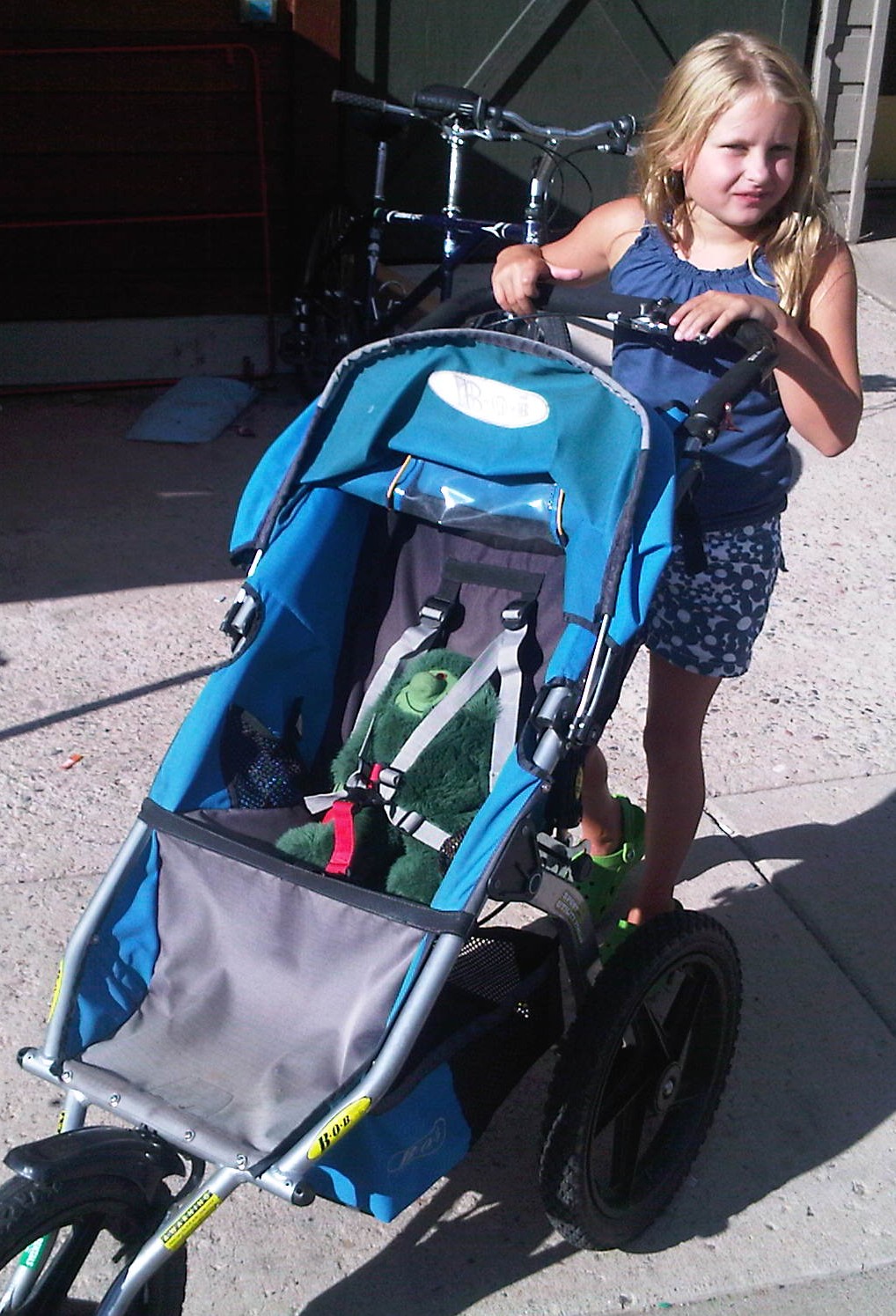
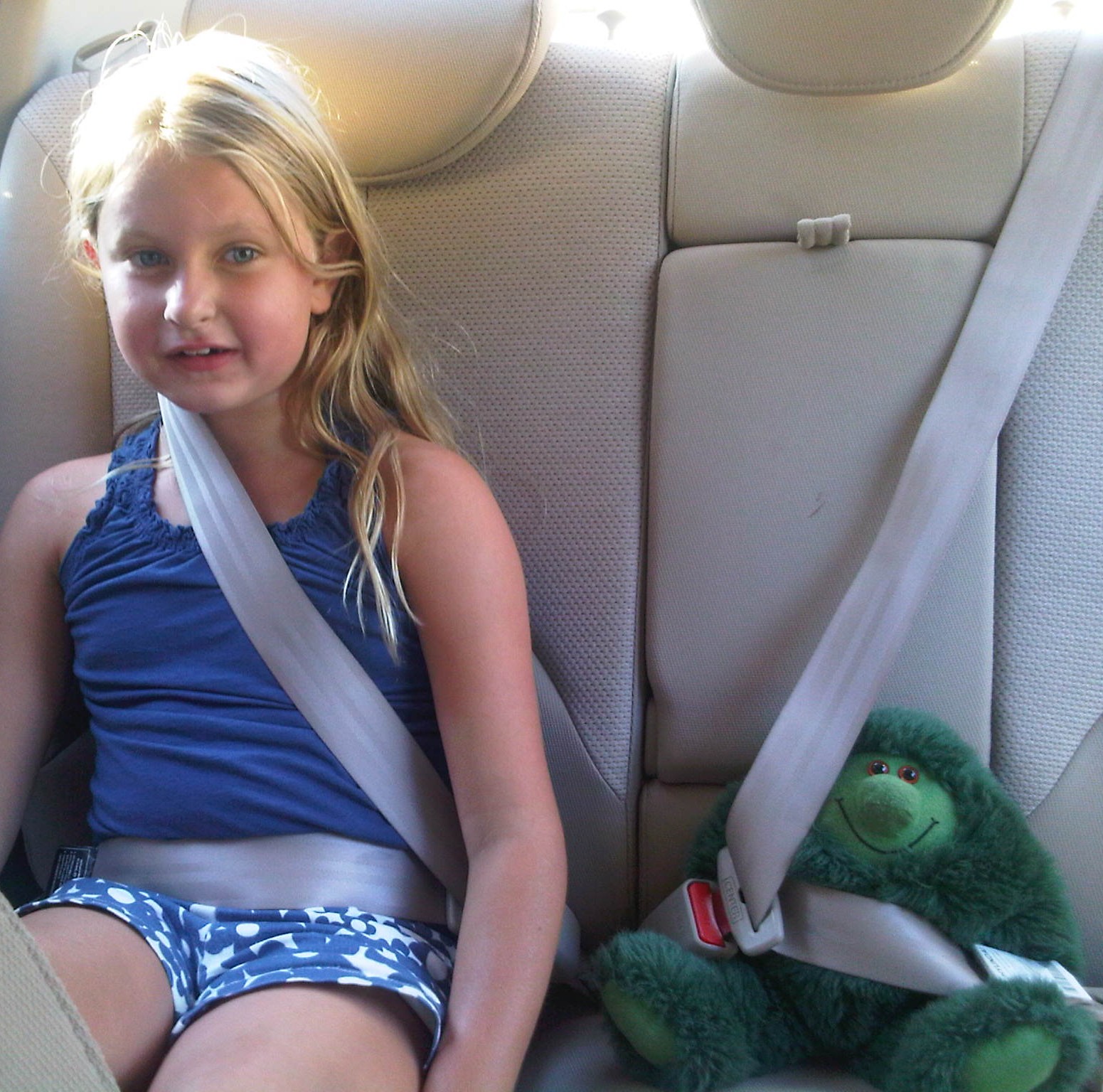
Later in the afternoon, Joe took her out to play. She insisted on bringing her stuffed animal Muzzy along. See the attached photos Joe took after Emma buckled Muzzy’s seat belt in the car and then strapped him into a jogger, pushing him down one of the local bike paths. This new affectionate attachment to her stuffed monster-animal pal is another very encouraging sign. Muzzy recently accompanied her in a hospital bed, and now that he seems to have fully recuperated, she’s taken him for an outing in the countryside.

Emma may not care much about prickly porkmepines, but she sure does love her fuzzy Muzzy. And that’s just fine with you.

The Path of Most Resistance

“No more camp,” Emma said, sitting near my face on the bed. It was sometime between 5:30 and 6:00 AM — my morning wake-up call.

“Camp all gone. Get on the plane, go see grandma,” she added hopefully.

“No Emma. One more week of camp, then we get on the plane and go to the hospital, meet mommy, then go to grandma’s house,” I corrected her.

Then came her inevitable follow-up: “Pancakes?”

I’m guessing she really misses mommy and Nic from her first-thing-in-the-morning declaration that camp needed to be over right now, and it was time to get on a plane. I’m flying solo with Emma this week. Actually Joe is my copilot, working the day shift, taking her to camp until we fly to Panama Sunday and meet up with Ariane.

We spent the morning après pancakes getting ready for our Central Park outing. I’d offered to take her to Coney Island but she surprisingly passed, opting for Victoria Gardens instead. We rode the rides, had lunch and then Emma wanted to “go to the sprinklers” – which meant a nearby playground with a water spray.

On the way over we passed by the carousel, which was closed for repairs. She took it well, no crying, no screaming, no meltdown – she seemed to ‘get it’ that it was closed and that was that. I thought of all the times I’d been in the park with her and she had one of those spectacular tantrums because she wanted to do something and I said no, because we had to do something else or go home. She was so well behaved this time, and we had such an easy day in the park thus far that I wondered if maybe those tantrums were a thing of the past now – that she had mastered another level of growth and maturity — that she had learned how to cope with frustration and disappointment without going haywire.

We went to the playground. She splashed and romped for quite a long while then said she wanted to go home. As we left she started walking north toward 72nd street. “No Emma, we’re going this way,” I said, pointing downtown.

“No this way!” she shouted, almost instantly frantic. “Take the orange train!”

“Emma, the orange train doesn’t run on weekends, we have to take the red train,” I said, trying to sound as reasonable as I could, but already feeling a tsunami of dread cresting above my head.

“NOOOOOOOO! TAKE THE ORANGE TRAIN!” she screamed, then followed it up with an instant cascade of crocodile tears followed by ear-splitting screams when I said, once again as calmly as I could, “Emma there’s no orange train today.”

And so it goes.

That was always one of my favorite Kurt Vonnegut lines. Such a perfect synopsis of life’s ceaseless challenges, fleeting success and predictable disappointment.

She kept screaming for the next half hour while I weathered, for what seemed like the millionth time, the looks of panic, concern, confusion, irritation and scowling judgment, or more accurately, indictment. Why was this pretty little girl screaming like that? What is that awful man doing to her? Who is he? Why isn’t he comforting her? Is she crazy? Some kind of spoiled brat?

And on and on and on. I could have ended it all instantly by simply doing what she wanted, walking where she wanted to walk, doing what she wanted to do, whether there was an orange train running or not. It sure would have made both our lives easier, not to mention the lives of all the traumatized onlookers.

And then what? Emma is a smart little girl who wants what she wants, like any other kid. But if I rewarded her tantrum with the gift of doing exactly what she wanted when she wanted it, the only lesson that would be learned was that screaming works, and the louder you scream, the more you cry, the better it works. I could have taken the path of least resistance, and believe me, I would have definitely preferred to — if my comfort were the only thing that mattered. But my comfort was as expendable as my desire to look virtuous or shield myself from embarrassment. I had to do the right thing for her and for me, regardless of the incriminating glares and withering head shakes.

I went to the nearest bench and sat down. Eventually Emma followed and sat next to me, still crying and screaming. I asked her if she wanted to take a taxi or the red train. More screams and crying. I explained over and over that the orange train wasn’t running and it made me wonder whether she is capable of understanding something even that simple. Ultimately she calmed down and said, “Take a taxi?” Part question, part capitulation.

“Okay Emma, we’ll take a taxi. Do you want to listen to your iPod?”

“Yes daddy.”

And so it goes.

A Wish

The parent of a severely disabled child asked me a few weeks ago what I wanted for Emma.  She was referring to the long term, the far off future.

“I’m assuming you’re not expecting her to go to Harvard,” she said.

Well no, I thought.  That has never been a goal for either of my children, but I didn’t say that to her.  Instead I said, “I want her to be able to live independently.  I would like her to have friendships, to be able to find something she loves doing and takes pride in.  I would like her to be a kind, thoughtful person who is able to contribute in some way to society and our world,” I stopped for a minute.  “I guess I want her to feel good about who she is in the world.”

She nodded her head.

When Richard and I decided we wanted to try to have children we spent many hours discussing our views on parenting and childrearing.  We were in agreement with almost everything.  Neither one of us cared what college our child went to or even if they went to college.  We both agreed we were more concerned with our children finding a career they loved.   We agreed we wanted them to be kind, to be generous, to consider others and to behave in ways which foster that.  We agreed we did not care what their sexual orientation turned out to be and we did not own them.  We both felt strongly our children, if we were lucky enough to have any, were not an extension of ourselves, but independent beings.  We agreed it was our duty to guide and advocate for them until they were old enough to advocate for themselves.

When I was pregnant with Nic I asked my mother if she had any advice for me.  She said, “Love them with all your heart, tell them how much you love them as often as you can and one day they’ll forgive you.”

It was the single best piece of advice anyone has ever given me.  We as parents will make mistakes, we will use a harsher tone than we meant to or are even aware of, we will say things in anger we didn’t mean, we will model behavior that is not always exemplary, we will do things we wish we hadn’t.  But we can say – I’m sorry.  I made a mistake.  And we can convey our love for our children as often as we are able to.

When Richard and I first received Emma’s diagnosis we were given a barrage of information.  We were told to get Emma between 35-40 hours a week of ABA therapy.  We trained with the ABA coordinator so we could continue using ABA with Emma after the therapists left.  I remember thinking after the hundredth flashcard maybe I should just hold her.  Emma wouldn’t let anyone else hold her, but if I sat in the rocking chair she would crawl into my lap.  I would put my arms around her with her head resting on my chest and we would sit like that together for up to an hour sometimes more.  During that early period it was the one thing I felt I could do with Emma, which no one else was able to do.  It seemed more important than forcing her to do yet another puzzle or one more sequencing game.  I reasoned, for a child who appeared emotionally cut off from other human beings, holding her was a kind of therapy too and perhaps as essential if not more essential than any of her other therapies.

Those hours spent with Emma in my lap were bliss.   Whether the physical affection made a difference or not I cannot know for sure.  My guess is it did and continues to make a difference.  To this day I remember as a little girl sitting between my mother’s legs by our swimming pool and leaning my small body against hers, her arms wrapped around me.  There is something about physical touch, which promotes a state of well being unlike anything else.

It is that state of well being I wish for both my children.

The Washing Machine

“Should we put Emma in the washing machine?!” Emma asked, while pointing to the washing machine filled with clothing.  Then before I could answer, she shouted gleefully, “NO!!   We cannot put Emma in the washing machine!”  At which point Emma began to laugh hysterically.  “Should we put Mommy in the washing machine?” Emma asked, still laughing and pointing at me.

“Good idea, Em.  But will I fit?” I asked.

“NO!”  Emma shrieked with laughter.  “You cannot fit in the washing machine.  Mommy’s too big!”

“But maybe I could squeeze inside if I scrunched down into a teeny little ball,” I said, sucking my cheeks in and curling my arms up next to my sides.

“NO!”  Emma shouted.  “You cannot fit inside the washing machine.  Emma’s too big!”

“Emma’s too big?  Or Mommy’s too big?”  I asked, laughing along with her.

“Emma AND Mommy too big!  We cannot put Emma in the washing machine,” Emma said.

This went on for quite some time, with me asking if we should put a whole variety of people in the washing machine:  Daddy, Nic, Granma, Uncle Andy, Uncle Victor, Aunt Toni, Uncle Chris…  the list went on.

Each time Emma would answer, “NO!  We cannot put  Nic in the washing machine. Nic is too big!” or “NO!  We cannot put Daddy in the washing machine.  Daddy’s too big!”

“What about Merlin?  Should we put Merlin in the washing machine?” I asked, expecting the same answer from her.

But Emma surprised me by saying, “Yes.”

Taken aback I didn’t say anything for a second.  Then I repeated, “We should put Merlin in the washing machine?”

“Yes!”  Emma said.

“Are you sure?” I asked buying for time and trying to figure out how to save poor Merlin from such a murky fate.

“YES!”  Emma shouted.  “We can put Merlin in the washing machine!”

“Nooooooo!  We cannot put Merlin in the washing machine,” I said.

Emma threw her head back and laughed and laughed.  I don’t know that I have seen her derive so much joy from anything in days.

Poor Merlin.