The Aspen Ideas Festival & Autism

I am going to a lecture at the Aspen Ideas Festival this morning at 7:45AM in the Doerr-Hosier building called: How to Recognize Happiness.  I am going because I’ve been told this session will include something about autism, though if one goes to the AIFestival web site it doesn’t mention autism.  But my source is a good one – in fact she is the one who organized the entire week long program, so I’m fairly confident she knows what she’s talking about.

If you don’t know about the Aspen Ideas Festival, it is a week long summer camp for adults.  Every day is packed with lectures, panel discussions, interviews, readings, film, videos, etc beginning at 7:45AM and ending well into the night, every day for seven days.  I’ve been lobbying for Ideas to include autism in their program now for the past year, so was pleased when I was informed they were doing one talk which would include autism.  I will report back tomorrow.

Meanwhile, Emma announced on the phone last night that:  “Mommy’s staying with Granma.  Mommy is in Colorado.”

To which I replied, “Yes, I am, Em.  But I’m coming home in three days!  Tomorrow’s Wednesday, then Thursday, then it’ll be Friday and I’ll be home!”

There was dead silence and then after about ten seconds she said, “Bye Mommy!”  I could hear Richard saying, “Wait Em!   Don’t hang up, don’t hang up!”

Apparently my promise that I’ll be returning home on Friday is one of those – I’ll believe it when I see it – situations.  Emma was not impressed.

A friend of mine suggested I stay in Aspen over the Fourth.  “I need to get home before my kids forget what I look like,” was my response.

Friday, Em.  I promise.

For more on autism and Emma’s journey through a childhood of it, go to:  www.EmmasHopeBook.com

Searching

In three more days I will be home.  Home with my two children, Nic and Emma, my husband, Richard and our black cat, Merlin.  Everyone but Emma and Merlin understand that I’ve been away for so long because of work.  I guess I should rephrase that – I don’t actually know whether Emma understands I’ve been away because of work.  Perhaps the reason why I’ve been gone so long is meaningless to her, she just knows I’m not there.  But on Friday when she returns home, I will be waiting for her with open arms.  I don’t like being away this long.  I don’t like having so many miles between me and my family.

When I spoke to Emma on Sunday she said, “No, you cannot spit.  If you spit Mommy will leave.”

“Oh Em, you didn’t spit.  I didn’t leave because of anything you did,” I said.

“There is no spitting!”  Emma shouted into the phone.

“Okay Em.  I’m really glad to be speaking with you, tell me about your day.”

“No you cannot spit.  There is no spitting or Mommy leaves.”

“Sweetie, tell me about your day.  What did you do today?”

“No spitting.  Bye Mommy,” she said before casually putting the phone down and walking away.

Sometimes one waits then, hoping the chaos that constitutes our life in New York city isn’t so much that everyone forgets about the phone and the person on the other end.  Sometimes one has no other choice than to eventually hang up.  Once, after hanging up, I tried to call back only to receive a rarely heard busy signal.

But this time after a few moments Richard returned.  “Do you think she thinks I’m gone because I’m angry with her?”  I asked.

“No.  I heard her, I don’t know what that was about,” he tried to reassure me.

Being away is like entering an alternate universe.  It’s familiar, a bit like seeing an old friend from high school.  It’s easy to fall back into a kind of routine, but my children and husband are always there in my head.  I am here to work, so I do.  But I still have time to socialize with friends, Sunday I even took the entire day off and went for a much needed long, long walk with a friend.  I can say yes when someone asks me to have a coffee with them.  My life is completely different here from my life in New York.  In many ways it’s wonderful, calm, relaxing, yet I’ve been weepy ever since I arrived.  Being able to have feelings and have the time to look at them, talk about them, it’s all a luxury really.  One needs the time and space to indulge them.  So I’ve been blogging about some of those things – the existential quest that most of us feel at certain times in our life, the searching.  That too is something that needs time, a certain silence to be able to fully indulge.

I have no answers, I continue to search though.

For more on my family and Emma’s journey through a childhood of autism go to:  www.EmmasHopeBook.com

Anger

The invisible hand grenade being tossed into a room – anger – whether it explodes or is a slow simmer, it is something I feel when I think of my daughter, Emma’s diagnosis.  To admit this, by the way, is something I rarely do.  It is unseemly, impolite, not what we do and certainly not what we admit to feeling.

But I do feel it.

I wish it weren’t so.  I’d like to think I could think it away.  However the fact remains – I am angry.  I would take away her autism, all the things that make up that word, all the behaviors, the neurological blips, the tangled mess that make her both hyper and hypo sensitive to pain, to noise, her internal inflammations, ulcerations, her rigidity, the obsessive compulsive tendency, all those things when added up that equal autism, I would prefer it was all gone, in an instant.

I went hiking with a friend yesterday who was telling me jokes.  One, about a guy who is allowed three wishes, which a genie promises to fulfill, made me think about my one wish.  Just one, I don’t need three, thank you very much.  My one wish is for Emma to have a neuro-typical brain.  That’s it.  Just the one wish.  I’m like everyone else, I can always add a couple other wishes if pressed, but that has always been and remains my one wish, the wish that blows all the others out of the water.  Please.  Let her brain repair itself.

I know my anger, the slow simmering rage I feel covers a whole ocean of sadness.  But honestly I prefer not to feel any of it.  And I usually don’t.  I either am too busy or I make the conscious decision to turn it off.  Yesterday though, while hiking, it all came surging back.  Like the flood gates had been pried open and try as I might, they were unwilling to be shut, until they’d had their say.  It is in this state that I reject God.  The God so many turn to is one I turn my back on.  I reject, actively reject, angrily reject.  I know this.  And yet, Emma’s autism, perhaps like nothing else, has created such a feeling of need for something beyond myself.  It is beyond a desire, it is beyond a craving, it feels larger than all of that.  It is a need for something, something I can lean on.  I have no sense of it beyond these words.  Perhaps one day I will.

For more on Emma’s journey and ours through her childhood of autism, go to:  www.EmmasHopeBook.com

Autism and Parenting

I have been away from my family for eleven days now.  I am in Aspen, Colorado where I needed to reopen my store for the season.  There have been a great many things I needed to attend to, so here I am.

And there they are.

In New York city, my family – Richard, our son, Nic and Emma, the star of this blog.  To say I miss them would be an understatement.  I hear from Emma’s teachers.   They email with updates and about how Emma had a rough day the other day because the rest of her class was allowed to go to the roof to swim, but Emma had to have her final session with her music teacher, and so stayed behind.  Emma loves nothing more than water and swimming.  So she was beside herself, upset, crying and my guess is she hurt herself, though I haven’t confirmed this suspicion.

Later, an old classmate came to the school to visit and Emma was so excited to see her.  She kept saying, “Maddie’s back, Maddie go home on the bus on Wednesday, Maddie in Becky’s class”.

When they tried to explain that Maddie was only visiting and would not return, Emma kept insisting Maddie was back.

These kinds of things are hard for me to hear, the distance between me and Em making it all the more so.   I can’t hold her, I can’t be there to lessen the load for my husband, I can’t really do much other than call and listen.

People say – you’re changing diapers one day and then you’re helping load up their u-haul with their things.  It all goes by so quickly.   But whether one has children or not, it still goes by quickly.  Children are just larger than life markers of it.

Stop and look around, I tell myself, you’re in one of the most beautiful places in the world.

And then I remind myself to breathe.

For more on Emma’s impact on our lives and how we cope, go to www.EmmasHopeBook.com

Autism

I have avoided writing about something I think about a great deal when it comes to Emma and her autism.  It is something some people bring up when they hear of Emma.  Thankfully most people do not.

It is – God.

There, I’ve said it.

When Emma was first diagnosed more than a few people said things like, “Everything happens for a reason.”  The first time I heard that comment I felt as though someone had punched me in the solar plexus.  The air was knocked out of me.  I stood there as they went on about whatever they believed, the reasons they felt this had happened, but I couldn’t hear them.  I watched their mouths open and shut, forming words, but they may as well have been speaking in another language.

The second time someone evoked God, as in, “We only get what we can handle,”  followed by, “God must think you very strong.”   I had the where-with-all to reply, “You might want to check the current suicide rates, as clearly the God you believe in, is giving those people far more than they can handle.”  And then I walked away.  Touche.

These comments, the ones that upset me the most always refer to God.  People with strong, solid faith seem to have a strength or determination that I do not possess.  It is more than a decision that’s been made, it seems they believe they have some sort of power, a knowledge the rest of us can only hope for.  They come across as knowing, as though they had a special private line to God, a kind of state of the art communication device that the rest of us do not own.  Perhaps what they do not understand is how superior they seem or perhaps they do, I don’t know.  I know most are trying to be kind.  That they are not, does not seem to occur to them.

When people have said to me, “I could never handle having an autistic child,” and then they go on to their next thought – “It makes me think we are given what we can handle.”  I understand what they are trying to say, they are expressing their relief that their children are neuro-typical.  “There but for the grace of God go I.”  I know someone who I like very much who made just such a comment, I was surprised when she said it, but I knew she hadn’t meant it to be cruel.  I know many people don’t know what to say when confronted with something that frightens them.  Disease, terminal illness, death, what can any one of us say?  Most of us do want to express our sorrow, we want to be there for the person who is going through the difficult time.  We want to bond with them, show them we are there for them.  Often our attempts are nothing short of just lame.  We end up saying something stupid, we walk away thinking to ourselves – Boy that was dumb.  Why did I say that?  But when people bring God into the mix, as though they need to bolster their thoughts, then it becomes more complicated and hurtful.

I get it.

I do.  I know none of the people who have said these things have meant harm.  They mean quite the opposite.  Still I wish they would think through their comments before they utter them.

For more on my family’s journey through my daughter, Emma’s childhood of autism, go to: www.EmmasHopeBook.com

Dinner With The President – Autism

I received a form letter from Vice President Joe Biden yesterday.  It was one of those mass emails one gets, but rarely reads.  For some reason I glanced at it and read that the president will be having dinner with one person who makes a small donation of five dollars.  Their name will be thrown into a hat and one name will be drawn.

I thought about what I would say to the President were I to have the opportunity to have dinner with him.  And of course I knew what the answer was without hesitation.  I would speak with him about the rising numbers of children diagnosed with autism.  I would direct him to the countless news stories regarding the rampant abuse of those same children and adults living in group homes and institutions.  I would ask him to help set up communities where individuals with autism would have more control over how they lived, allowing them to pursue their interests, encouraging them to follow their dreams.  I would tell him about our trips to Central America with our daughter, Emma for stem cell treatments.  I would encourage him to put more funding into stem cell research, umbilical cord stem cells, using the patients own stem cells, and any other form of stem cells that might prove viable in restoring the lives of hundreds of thousands, even millions.

As I continued to think about all the things I wanted to say and ask for, in the name of autism, I thought of the families like mine who have been affected.  I don’t just mean on an emotional level, but financially as well.  A diagnosis of autism is devastating to any family financially.  We have chosen to pursue a more aggressive route than many can or want, but any family, even those who have not taken their child to foreign countries for stem cell treatments has found the cost of caring for a child with autism staggering.  For those who have little or no resources, who have to rely on social services to help them, who cannot afford to have a caregiver come to their home to give them a break, they live in a world starkly different from those with similar financial constraints who have neuro-typical children.

So Mr. President, on the off chance my name isn’t chosen and I don’t have the opportunity to sit down with you, can you please help galvanize the medical community and make autism a priority in research, can you look at what we’re doing when we cut so much funding from our already overwhelmed schools, can you earmark autism as something we need to find answers to?

To read about the genesis of this blog and Emma’s journey through a childhood of autism, go to:  www.EmmasHopeBook.com

Slow Progress – Autism

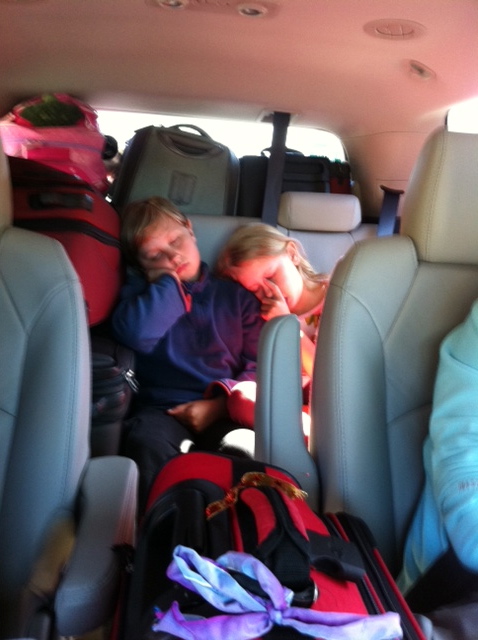
Nic and Emma driving back to the San Francisco airport last week.

I love this photograph because you wouldn’t know anything was amiss.  It was taken on our drive back to the airport as we were leaving Napa, California last week.

I don’t know whether other parents of children with autism feel this way or not, but any time I see Emma interacting with another child in “typical” or more typical ways, my heart soars.  Whenever Emma acknowledges Nic’s presence, plays with him, tries to be with him or shows a desire to be with one of her cousins I am filled with hope.  These tiny moments are like little beacons in an often dark tunnel.

“Without motivation she will not try,” one of the many specialists we took Emma to once said to us.

When I decided I was going to teach Emma how to hug a family member, it was with the hope that she might find she liked the sensation and might take the initiative to hug one of us without being prompted to do so.

“Put your arms around and squeeze,” I instructed her.  Sometimes she seemed happy to do so, other times, she didn’t.  Usually she put her arms around the person while keeping her body from having direct contact, her head jutting away at an odd angle.  I probably would have had more luck teaching her the art of the air kiss, she would like that (which says something about my waspy heritage).

As much as Emma does not appear to derive much pleasure from hugging while standing, she loves to get into Richard and my bed in the mornings and cuddle.  She aligns her body with mine and lies as close to me as she physically can.  Often she will pull my arms around her so they are holding her in a snug embrace.  Other times she will run up to one of us and give one of us a kiss or will climb into our lap.  I take it as progress.  It reminds me of a blog post I wrote over a year ago now when Emma embraced me as I was standing in the kitchen.  I was in shock because it was unprecedented.  Now those sorts of spontaneous embraces are more commonplace.  But it shows progress.  Or what I think of as progress.

One of the things about an autism diagnosis that makes me sad is the thought that my child may not have the experience of friendships.  But as Emma matures, I have learned to redefine what “friendship” means.  And I have seen that in Emma’s own way she does have friends, children she prefers to be with.  Emma’s friendships do not include secrets or talking or sleepovers.  They do not include making bracelets for each other and excluding other children in a show of preference.  Emma does not know about cliques, gossip, comparing, jealousy or what it means to be “cool”.  Emma is thankfully oblivious to all of those social constructs we try so desperately to shield our neuro-typical children from.

Emma is present, almost always in the moment.  I don’t think she worries a great deal about the future, she just is.

For more on Emma’s journey through a childhood of autism and her first spontaneous embrace, go to: www.EmmasHopeBook.com

“Go Back” – Autism

Last week Emma began crying and said, “Go back to hotel.”  Richard felt she was missing me, as I had to leave my family to return to Colorado for work when we left California instead of returning with them to New York City.  We also felt she was wishing we could have stayed longer and spent more time with my extended family, all of whom she loves being with.  She had such a wonderful time with so many family present at the Bed & Breakfast in Napa, California where we stayed for my brother’s wedding.

There’s a mistaken thought by many people that because a great number of children and adults with autism cannot express themselves well and often do not show tremendous emotional attachment to those they love, that they do not love.  Some people believe they do not feel the same intensity of emotion that we neuro-typicals do.  I disagree with this thinking.  I believe Emma loves and misses people as much as any neuro-typical child.  I believe she misses them with the same aching as any of us do.  The difference is, Emma doesn’t have the same neuro circuitry or the ability to put into words her feelings.  She lives in a world that must be incredibly confusing so much of the time.

I wonder, when I get on the phone with her, how much does she understand?  Does she understand that I am in Colorado and not in New York with her, Nic and Richard because I have to work?  Because time is a difficult concept for her, does she really understand when I will be returning?  When she wakes up in the morning does she wonder if I might be there only to find I’m not?   Our phone conversations are limited.  When speaking with Nic, I can reassure him that I will be home in another couple of weeks.  We can discuss what he did, he can describe the breakfast he fixed for his dad yesterday for Father’s Day.  We can talk about things.  With Emma, who does not and cannot ask questions, I ask – How are you?  She tells me she’s fine, even if she isn’t, because it’s the conversation we always have on the phone.  She may add some random thing such as – “Seal park, Chelsea piers carousel” and I can deduce that Richard took the children there yesterday.  I always ask her – What did you do today?  To which I can receive an accurate list of what she did, but just as easily I can receive a somewhat confusing version of events that may or may not have taken place.  I then will verify with Richard to get a clearer idea.

Yesterday was Father’s Day and Richard spent it with the children.  There was no sleeping in for Richard as I’m not there to give him a break.  Nic made him a special breakfast and then Richard took the children to various parks.  I know it wasn’t the day Richard would have liked.  I know how hard it is being the sole parent taking care of everything, especially for such an extended period of time.  And particularly tough when it’s a day designated to celebrate fatherhood.  When I spoke to Emma yesterday I said, “Be sure to tell Daddy – Happy Father’s Day and give him a hug, Em.”

“Happy Father’s Day,” Emma said into the phone.  I have no idea where Richard was or if he overheard her.  I can only hope he did.  I know Emma loves her dad.  She isn’t able to express it in the typical ways we are used to, but she does.

For more on Emma’s journey through a childhood of autism, go to:  www.EmmasHopeBook.com

Amusement Parks & Autism – Continued

Emma’s entire system was crashing.

“You have to ask Mommy!  Mommy can I go on the roller coaster with Gaby, please?”   She cried over and over again through screams and tears.

It was heart breaking and anyone with a neuro-typical child would think – oh just let her go on it one more time and then go home.  I even thought this a number of times as I tried to peel her off the pavement where she had fallen in a heap of tears, snot pouring from her nose, her hands made into tight fists while hitting herself in the head, on her chest, legs, arms wherever she could before I, or any of us could stop her.  The biting is horrible because it can break the skin and then there’s blood, and later scabs and enormous angry blue and purple bruises that can last for more than a week, reminding all of us of her agony.  But the hitting – a quick, violent punch to the face is shocking to witness and as a parent, it’s difficult not to feel one has done something horribly, horribly wrong.  How can this sweet, blissful child do this to herself?

Emma waiting for Joe, Nic and Gaby while they ride on the Corkscrew

Richard and I have always said to the children – hitting is wrong.  We don’t do it, we don’t want them to ever do it to each other and until Emma began hitting herself, it hadn’t occurred to us to add – we don’t hurt ourselves.  We don’t hit others or ourselves.  We say it, but I don’t know that it makes a difference.  When Emma’s brain has become set on something, no amount of calm, reassuring logic seems to help her.  No amount of soothing, we just have to vacate the premises.  It’s our only hope.  Kind of like shutting the whole system down, a kind of reboot.  We have tried the other option, which is to let her go on one more ride or do whatever it is one more time and the misery, the abject misery continues.  Like an addict who has to have that drink or that drug even while bringing them no real solace.  There’s no relief to be had at a certain point.

“Emmy it’s going to be okay.  We’re going to go home now.  We can ride the little roller coaster one more time and you can sit with Gaby and then we have to go home,” we told her.

But Emma’s brain couldn’t take in this information it was already in lock down mode.  I gave her a banana to eat and then everyone, our once cheerful little group, now more weary warriors than a family intent on having a lovely day at an amusement park trooped along.  She was able to sit with Gaby on the little roller coaster for one last ride and then we trudged back to the car while Emma kept looking over her shoulder at the wooden roller coaster named Roar.  As we headed home Emma said, “It’s okay, we’ll come back tomorrow.”

“No Em.  Tomorrow we’re going to traintown where there are different rides and then we’re going to Uncle Andy’s wedding,” we told her.

“Different rides,” Emma repeated, sadly.  “We’ll come back soon,” she said.  There was a wistful tone to her words, and we knew it wasn’t likely that we would ever come back to this part of the world.  But there would be other amusement parks and maybe one day Emma’s massive sensory issues will have abated to such a degree that these kinds of episodes will become rarer.

We can only hope.

For more on Emma’s journey through a childhood of autism go to:  www.EmmasHopeBook.com

Amusement Parks – Autism

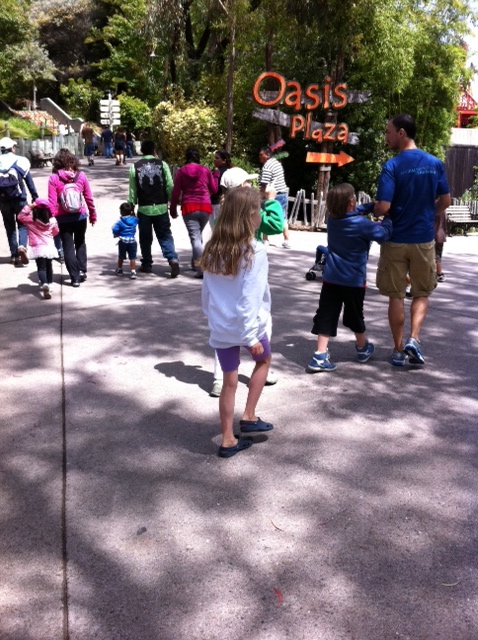
Emma loved our day spent at Six Flags near Napa, California last week.  Typically Emma can be counted on to ride the most terrifying looking rides, but on this trip she immediately said – no.  She wanted to go on the little roller coaster, the one you get to before the rides called: The Corkscrew, Velocity and Medusa.  While Nic and their cousin Gaby ran off to get in line for a ride that looked as though it went up so high it might require an oxygen mask, Emma insisted she stay and “just watch” with Richard and me.

Emma entering the park

“Really Em?  But it’s going to be a lot of fun,” Richard urged, even though it didn’t look like it would be fun at all, unless you enjoy sky diving.  Gone are the days of the old traditional roller coasters where you actually could put your hands up without fearing death, where the vertiginous climb and then dizzying descent didn’t cause your entire life to pass before your eyes, where you exited the ride feeling intact and not as though you’d just avoided a heart attack or stroke.

“No, no, no, just watch.  Just watch with Mommy and Daddy?”

“Yeah.  Okay.”  Smart girl I thought to myself.  Still it was unusual and the first time Emma has shown anything other than excitement at an amusement park.

“It’s weird.  I can’t understand why she doesn’t want to go with Nic and Gaby,” Richard said, peering up at the tangled mess of metal rails called – Velocity.

“I don’t know.  Maybe it’s her ears…”

“I think she has to go to the bathroom.”

“Or maybe she was scared the last time Joe took the kids to that park a couple of weeks ago.  Remember?  He said that one ride, even Emma was scared.”

We continued to debate what could have gone wrong, but Emma stood firm.  She was very specific about which rides she’d go on and which ones she wouldn’t.  Any ride that caused her to be upside down, was rejected.  Not that I blamed her.  I felt slightly ill just watching the other kids shrieking and whipping around as though they’d been tossed into a human blender, without the blades.

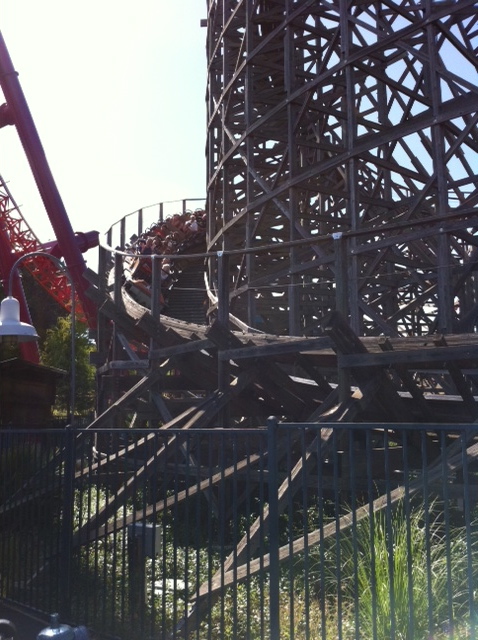
But then we found the roller coaster called “Roar”.  An old style wooden roller coaster, the kind I remember from my childhood and even I felt a little jolt of enthusiasm.

“You could ride this one, Mom,” Nic said to me, patting my arm.

“You think?” I asked.  The thing was huge, but it did resemble the roller coaster I used to love riding when I was young.

“Totally, Mom.  You could do this one,” Nic said.

“I’m going to go too,” I announced.

“You are?”  Richard asked.

“Yeah, I used to love these,” I said.

Roar

When the ride was over, Richard said, “I think I broke my neck.”

“I thought I was going to have a heart attack,” I said.

“I’m not going on that thing again,” Richard said.

“That was horrifying,” I added.

“I can’t believe the kids want to go again.”  Richard shook his head in dismay.

“I think I have to sit down,” I said, motioning to a nearby bench as the children ran to get back in line.

By the fourth ride, Emma was beginning to get perseverative, which means she had become obsessive about riding and didn’t want to stop.

“Okay Em.  One more time, but this is the last ride.  Except it was too late, Emma couldn’t take waiting in the line, even though we had a disability pass allowing her to go to the head of the line, there were other children with disabilities also waiting.  She began to bite herself and scream.  Joe managed to keep her somewhat calm but by the time they were at the front of the line, Emma was miserable.

When she gets like this it’s as though her entire system crashes, like a computer.  There is nothing one can do to console her.

To be continued.

For more on Emma’s journey through a childhood of autism, go to:  www.EmmasHopeBook.com

Travel Plans Gone Awry

To pick up from where I left off, Emma did extremely well on the airplane and on the long car trip up to Napa, California.  She was ecstatic, if not more than a little tired when we finally reached the Bed and Breakfast that night.  There were others of us who did not fare as well.

The airlines arbitrarily changed all of our reserved seats, so that each of us now occupied a middle seat and no two of us were seated together.  When Richard called to complain and have our former seats restored, they professed confusion and ultimately said we would have to figure it out, despite the fact that we told them we were traveling with two children, one of whom was AUTISTIC!   Richard spent a good three hours on the phone Thursday afternoon, instead of packing, not an ideal way to spend the day.  I had a moment, during the second or third phone call to the airlines, when I wondered how it was even legal, let alone ethical for them to split up a family and not have even the children seated next to their parent.

But we got through it, though not because the airline did anything to help us.  I sat in the back of the airplane with Nic and my cousin, Alexandra.  Richard, Joe and Emma were able to snag seats together closer to the front.  A number of kind people were willing to change their seats to allow this to happen.  At one point we narrowly avoided a full melt down when Emma lost a piece of her blanket, now a three inch square of green fabric, which had inadvertently fallen on top of an elderly woman’s neatly coiffed hair who had fallen asleep in front of Emma.  Joe managed to deftly pluck the missing shred from the top of the woman’s head without waking her and returned it to a whimpering Emma.  Disaster averted.

The B&B was lovely.  Cedar Gables, whose wonderful owners prepared delicious breakfasts of homemade apple fritters, muffins and scones accompanied by eggs, bacon, sausages and fresh fruit each morning.  Because the entire place was overrun with my family members, Emma was able to run around in her nightdress, slide on the wooden bannister and blow up her balloons, then release them so they made a screeching noise as they whipped over the heads of unsuspecting relatives before resting on various ledges and window sills.

My brother’s wedding was lovely and Monday we headed back to the airport where I had to leave my family to return to Aspen, where I am reopening my store for the summer, while Richard returned home to New York with the children.

For more on Emma’s journey through a childhood of autism, go to:  www.EmmasHopeBook.com

Traveling with Emma

We are going to Northern California tomorrow for my brother’s wedding.  Emma is very excited to see her Uncle Andy and because we rarely travel anywhere new, this is a particularly appealing trip.  Other than visiting her Granma in Colorado, we have only traveled to places that required us to travel because of medical treatments for Emma.  Panama and Costa Rica for Emma’s three stem cell treatments and Boston to meet with Dr. Timothy Buie, a specialist in autism and GI tract issues.  When we flew to Boston a year later for one of my cousin’s wedding, Emma was convinced we were returning to the hospital where they’d performed a colonoscopy and endoscopy on her.  It wasn’t until we actually got to the wedding and she saw the guests did she relax.  We use to go to Cape Cod every August for a couple of weeks, but haven’t been, since we got Emma’s diagnosis.  In fact it was on that last trip almost seven years ago that we came to the conclusion we needed to get her evaluated.  Even if it were easier to travel with Em, Cape Cod sadly, holds painful memories for me and so I’ve not been eager to return.

However this trip is one Emma is anticipating with great excitement.

“Sleep, wake up, get on airplane, go see Uncle Andy!” Emma said this morning, while bouncing up and down.

“Yeah, Em.  We’re going to have fun!”

“No.  Not going to go on the school bus.  Going to see Uncle Victor, Grandma, Uncle Nic, Gaby, Lili, Liesl …”  she went through the list of all the people we would undoubtedly see at my brother’s wedding.

“Are you excited?” I asked.

“Yes!  So excited!”  Emma shouted and then ran out of the room.

There’s a certain degree of anxiety that comes with traveling with Emma.  Though she rarely has melt downs any more on the airplane, in fact she’s become a wonderful traveler, we always brace ourselves for the unexpected.  Because we aren’t allowed to pack any liquids or her yogurt (she’ll only drink Mott’s apple juice or Apple & Eve Apple juice and only if it comes from a plastic bottle, not a can) we have limited options when it comes to what she’ll drink and eat.  Usually she doesn’t eat anything other than her Pirate’s Booty, though last time we flew back from Colorado I did manage to get her to drink a small amount of the apple juice they served on the airplane.  It felt like a victory.  She use to eat fruit leathers and as they also helped her ears during landing and take off, we used to pack about ten of them.  She has recently been refusing to eat them, but I’ll bring some anyway on the off chance she’ll eat one.

We will be staying in an inn and thankfully the entire place has been taken over by my extended family.  Even if Emma does lose it, at least the people effected by her screams know of her situation and will hopefully be patient and kind.  Even so, it’s tough not to worry.  Richard scoped out the different day trips we can take while there this weekend and there seem to be a great many of them.  He found a pool she can swim in and an amusement park.

“Well we’ve got Saturday and most of Sunday until the wedding covered,” Richard announced earlier.

We’re sitting in the back of the plane, which is a good news/bad news situation.  The good news is, we’re next to the bathrooms, the bad news is we’ll be the last to get off and Emma has a difficult time sitting still after the plane is at the gate.  She wants to get off the plane NOW and can’t understand why we have to wait to let everyone in front of us off first. But who knows, maybe she’ll be able to tolerate the wait this time.

So while Emma is ecstatic and without any anxiety about traveling to see her Uncle Andy, Richard and I are anxiously making sure we’re well prepared and haven’t forgotten anything.  I use to be a very casual traveler, often late to the gate, the last one on board before they shut the doors and pulled away from the gate, winging it when it came to where I might stay the night.  In my twenties and thirties I often traveled alone, to all sorts of places all over the world.  But since I had children, I am a nervous wreck when traveling.

I’ll try to take a page from Emma’s book.  Relax, look out the window, chew on a fruit leather and enjoy the journey.

For more on Emma’s travel adventures through a childhood of autism, go to:  www.EmmasHopeBook.com

Cooking with Emma

Emma seems to have lost interest in her velcro strip.  It was actually the plastic back to the self adhesive velcro that she liked, but her yellow balloon string has replaced it for the past few weeks.  Instead of holding it in her hand, she puts it between her front teeth, like an enormous piece of floss, allowing her hands free.  She races around on her scooter, the balloon string held in her teeth, the rest of it undulating after her.  It reminded me of a Turkish woman I encountered years ago in Ezurum, Turkey.  She was wearing a shawl like head covering the size of a bed sheet and had one corner hooked on one of her front teeth.  The fabric was loosely around her face, but kept slipping off her head.  I remember watching her move along an alley, the fabric billowing out, as she hurried away.  She turned, at one point and looked directly at me, many of her teeth were missing, but her upper incisor was intact and she used it to secure the fabric so that it couldn’t blow away, leaving her hands free.

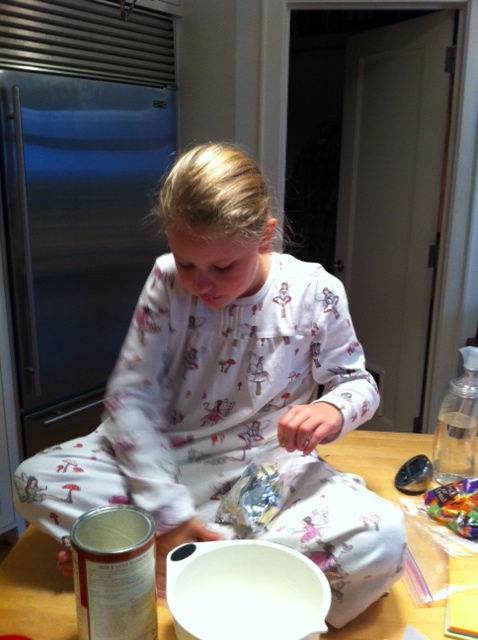
Yesterday evening when Emma asked that we make pancakes, she climbed up onto the kitchen island, the balloon string secured between her front teeth.  “Mixing bowl,”  Emma said, despite the presence of the yellow string in her mouth.

“Emma!” I laughed.  “You can’t cook with that balloon string.”

“Have to put it down!” Emma said, pulling it from her teeth and tossing it to the floor.

“Pancakes with chocolate chips please!”  Emma said.

As I rummaged around to locate the chocolate chips I heard Emma say, “Uh-oh!”

“What happened Em?” I asked turning around.  Emma sat with about a cup of pancake mix in her lap, a dusting of mix covered her arms and legs.

“You have to pour it in the bowl!”  Emma observed with a slightly irritated tone.

“Here you go Em.  Let’s clean that up.”  I handed her a damp paper towel which she used to dab at her face.

“Okay, but we have to clean up all this mix,” I said, pointing to the flour covering her and the counter.

“Mommy help?”  Emma said, half heartedly patting at the mix creating little clouds that then spread out over ever increasing areas of the counter.

“Yes.  I’ll help.  Here, look.  Let’s clean it like this.”  I brushed mix into my hand and threw it in the sink.  “Now you do it,” I said as I got out the milk.  When Emma had finished cleaning up most of the mix I said, “Here, you measure the milk.”  I handed her the measuring cup and gave her the milk.  Carefully she poured the milk into the measuring cup until it filled it about half way.

“Dit,dit, dit, dit, dit, pour in!”  Emma sang.  She always says this when she is measuring something during our cooking together.  I don’t know where the “dit, dit, dit” comes from or even what it means, but it’s part of the process now and so she always says it.

I held the whisk in front of her.

“Mommy, can I have the whisk, please?”

“Yes!  Here you go,” I said, handing it to her.

“Whisk, whisk, whisk, the pancakes, mix, mix, mix the pancakes,” Emma sang as she stirred, while occasionally dipping her finger into the batter to eat large dollops of it.  ‘Yum, yum!”  she said.

Emma making pancakes

For more on Emma’s journey through a childhood of autism and cooking, go to:  www.EmmasHopeBook.com

Taking a Stand

This blog is about Emma.  It has always been about Emma.  Every now and again I post something about statistics or links to other children or adults who have been diagnosed with autism, the occasional news item, but for the most part, Emma is the star of this blog.  Today however, I feel compelled to write about the children and adults with disabilities who have been institutionalized.  The defenseless portion of our population who do not have parents or families to advocate and defend them for whatever reason.

Yesterday I happened upon an article in the New York Times about a 13 year old boy with autism who was sat on and ultimately crushed to death in the back seat of a van while being taunted, “I could be a good king or a bad king,” by a state employee who was hired to care for the child.  The article goes on to describe in graphic detail the abuse that occurred, the repeated hospitalizations, the horrifying conditions of the Oswald D. Heck Developmental Center,  a state run home for children and people with disabilities near Albany, New York.  An institution which routinely hires high school drop outs, people with criminal records, histories of drug and alcohol abuse and little or no training to care for our most vulnerable.

It is difficult not to console oneself, while reading such an article, with the idea that this was an isolated incident or at least a problem within this specific institution.  Sadly it is not.  Another article, also in the New York Times, which ran a few months ago about the systematic abuse that continues in several group homes was equally horrifying.   The BBC ran a piece just last week on the terrifying cruelty and abuse in homes caring for the disabled in the UK.  In fact, once I began digging around it wasn’t hard to find countless articles about rampant abuse taking place in group homes, state run facilities, institutions, privately run group homes all for the disabled, those diagnosed with autism, downs syndrome, cerebral palsy and the like.  What was incredible was the amount of actual video footage of the abuse, testimony from witnesses, doctors, nurses, hospital records, irrefutable proof and yet it continues.

We talk about torture, the horrors of genocide all in the context of war and yet we have people, here in America, doing unspeakable things to our disabled population and it goes unnoticed, in fact it is even condoned within many of these homes.  There is a “keep your eyes open and your mouth shut” policy at many of these homes.  We have a burgeoning population of defenseless, often non-verbal children and adults who are being raped and tortured.  If you object to the use of the words “rape and torture” consider this from the NY Times on March 12, 2011 by Danny Hakim:

“At a home upstate in Hudson Falls, two days before Christmas in 2006, an employee discovered her supervisor, Ricky W. Sousie, in the bedroom of a severely disabled, 54-year-old woman. Mr. Sousie, a stocky man with wispy hair, was standing between the woman’s legs. His pants were around his ankles, his hand was on her knee and her diaper was pulled down.  The police were called, and semen was found on the victim. But the state did not seek to discipline Mr. Sousie. Instead, it transferred him to work at another home.”

The BBC report on May 31, 2011 – “…Wayne restrained Simone, an 18-year-old who suffers from a genetic abnormality, by pinning her down under his chair for half an hour. Another member of staff holds her in a headlock, despite the fact she shows no signs of resistance.

The footage also shows Simone being subjected to two cold showers in a single day with staff pouring mouthwash and shampoo over her she screams, saying: “It’s cold mum”.

That afternoon, with temperatures just above freezing, Wayne is filmed taking Simone into the garden and pouring a jug of cold water over her head. He only relents and takes her inside after she lies listlessly on the ground, convulsing with cold.

When Simone is unable to sleep that night staff repeatedly pour cold water over her in the corridor, before holding a cold fan to her face.

The day ends with staff dragging her into her room and forcing her to take a paracetamol while Graham, another member of staff, plays the role of German commandant shouting: “Nein, nein, nein”. Despite the serious nature of the abuse Kelvin, a senior nurse, refuses to intervene.”

We say things like – “never again,” we want to believe we learn from our mistakes, from history and yet there is no evidence to support this kind of thinking.  The population that is being abused in all of these reports are our most vulnerable – children and adults who cannot speak out, who cannot accuse, who cannot defend themselves.  And yet it goes on.  There is nothing new about any of this.  The reports of abuse are haunting, horrible, beyond description, the brutality, the sadism, the cruelty is inhuman, all the more so because it is children and adults with disabilities being victimized.

And yet it continues.

What can any one of us do?

We can begin by confronting and honoring what is happening by speaking out against it, by demanding the politicians we vote into office are aware and are willing to take a stand.  This is not a problem that will go away because we want it to, because it’s too painful to read about.  It will only end when we decide it deserves our attention as much as the populations of various countries we have chosen to defend by sending our troops to.

Emma’s older brother, Nic

Yesterday I took Nic and Emma to a relatively new carousel on the refurbished park along the Hudson River.  It’s unlike other carousels in that it has a wide variety of animals, fish and insects instead of the traditional horses one usually sees.  Emma likes to ride on the Atlantic Sturgeon, with the Unicorn and Wild Turkey coming in second and third.

Emma riding on the unicorn

I’d ride on the hyena or the coyote,” Nic told me when Emma chose the Atlantic Sturgeon for a second time.  “What would you ride on?”

“I’d have to go with the Harbor Seal,” I answered.

“Yeah, that would be a smooth ride,”  he said.  We watched Emma go around and around.  Every now and again she’d use the waist strap to tap the sturgeon, as though she were urging it on.  “Mom?”

“Yeah Nic?”

“So how do you blow bubbles with your gum anyway?”

“Okay, here I’ll show you,” I said, taking a piece of gum from his remaining pack.

“Emma blows huge bubbles.  I just don’t get it,” he said as I chewed the gum, trying to get it to the right consistency.

“Well she chews a lot of gum…”

Nic interupted me, “Yeah, I know, because of her ears.”

“Exactly, so she’s had a lot of practice.   But here, watch.”  I tried several times to demonstrate how to blow a bubble, which is quite a bit more difficult to explain than one might think.

After several attempts Nic said, “I think it’s a girl thing.”

We watched Emma for awhile on the carousel.

“Hey Mom?”

Yeah, Nic?”

“It’s weird.”

“What is, Nic?”

“I mean Emma’s so good at some things, but so bad at others.  Like she can blow bubbles and taught herself to swing and she’s really good on the scooter, but she still can’t read or write very well.  I think it’s interesting,” he said.

“Well, you’re right Nic.  There are things that are much easier for her and then lots of other things that are really hard.”

“But I don’t get it.”  He looked at me expectantly.

“Yeah.  I know.  It’s difficult to understand.  It’s the wiring in her brain.  It makes a great many things really, really difficult for her.”

Nic kept trying to blow bubbles with his gum.

“Does that make sense?” I asked.

“No,” he said, shaking his head.  “Not really.”

“Yeah, I know.  It’s really hard for us to understand.  There’s so much more we don’t know about autism than there is we do.”

“Mom?”

“Yeah Nic?”

“Do you think I’ll ever be able to blow a bubble?”

“Yes.  You just have to keep practicing.”

“But you don’t let me chew gum that much.”

“Yeah, that makes it harder.”

Nic stared at me with a little half smile on his face.

“Hey, you get to do all kinds of other things that Emma doesn’t get to do, and the only reason we let her chew gum is because of her ears.”

Nic kept grinning at me.

“What?”

“Nothing, Mom.  Nothing.”

For more on Emma’s journey through a childhood of autism and her older brother, Nic’s experiences along the way, go to: www.EmmasHopeBook.com