Category Archives: Siblings

Camp

For the past two summers Emma has gone to camp for a couple of weeks.  She attends the same camp her older brother Nic goes to.  It’s about an hour outside of the city with two lakes where the children can go fishing, boating and kayaking, a climbing wall, swimming pool and log cabins.  Last year when we signed Nic up we drove up to see the camp and meet the owner.  Emma was ecstatic when she saw the lakes and the owner said, “Do you think she’d like to come too?”

We discussed her autism and agreed Joe would need to shadow her and facilitate interactions with the other children if it was going to work.  The owner was amenable to everything and willing to take a chance.  The camp also had a strong anti-bullying policy, which appealed to us and so after further discussion we signed her up, agreeing that she should take the bus with the other neuro-typical children.

Last summer turned out to be a huge success.  The other girls in Emma’s unit were kind and inclusive.  Two little girls even took a special interest in helping Emma out with things she didn’t seem to understand and held her hand as they went from one activity to another.  Joe reported to us each afternoon as did the camp manager.  I am, to this day, incredibly grateful to those two little girls in particular who took it upon themselves to help Emma and include her in the group.  Children can so often be cruel to one another particularly if one child is “different” so it was particularly heart-warming to hear of children being so generous and kind.  As a result we signed both Nic and Emma up again for this summer.  Emma began asking about camp in April.

By May, unable to contain her excitement she said to me one morning, “Sleep, wake up, sleep, wake up, go to camp by the lake!”

“No, Em.  Not yet.  The water in the lake is too cold.”

“It’s too cold,” Emma said.

In June Emma said, “No not going to go on the school bus.  Sleep wake up go to camp!”

“Not yet, Em.  In another month and a half,” I said.

“It’s too cold,” she said.

“Well, probably not, but it’s not open yet.”

“It’s closed.  Daddy has to fix it,” Emma said.

“No.  You have to wait.  After we get back from Colorado,” I said.

“You have to wait,” Emma repeated.

When we returned from Colorado each morning she woke up and said, “Sleep wake up sleep wake up, sleep wake up, go to camp!”

“Not for another two weeks Em,” I said.

To which she revised her script, “Sleep wake up sleep wake up sleep wake up sleep wake up sleep wake up sleep wakeup sleep wake up sleep wake up sleep wake up,” she said as she counted out on her fingers how many sleep wake ups there were before the blessed day.  When there were too many or if she forgot where she was in her counting she began to laugh and said very quickly, “Sleepwakeupsleepwakeupsleepwakeupsleepwakeupsleepwakeupsleepwakeup…” until I would stop her.

“Em I can’t keep up!” I said.

She laughed, “Whoa!  Whoa!  You’re gong too fast!”

“That’s right, Em.  You’re saying it so quickly I don’t know how many you’ve said.”

“Pancakes?” Emma said with a sly grin.  As if by squeezing in “pancakes” among all the “sleepwakeupsleepwakeups” she thought I might not notice and actually make them with her.  “Noooooooo!  We cannot make pancakes!  We don’t have time,” She answered herself before I was able to say anything.

Pancakes and camp became a running theme. Entangled in her mind – they are her two most anticipated activities other than going to see her Granma in Colorado.

“Camp?” Emma said as she opened her eyes Monday morning.

“Yes!” I said.  “You’re going to camp with Nickey and Joe!” I said.

“No not going to go on the school bus,” Emma said just to be sure she had the correct information.

“No you’re not going to go on the school bus.  What bus will you take?”

“Going on the bus with Joe and Nickey!” Emma shouted.

“Yes!  And where are you going?”

“You’re going to camp, go swimming in the lake!” Emma said jumping up and down on the bed.

“That’s right!” I agreed.

When Emma returned home from camp the first day I asked her, “So Em.  How was camp?”

Emma didn’t answer.

“Hey Em, did you have fun at camp today?”

“YES!”  Emma said bouncing up and down.

“What did you do?” I asked.

“Swam in the lake!  Emma had so much fun!”  Emma said.

“I’m so glad, Em.  Do you want to go back tomorrow?”

“YES!”  Emma shouted.  “Sleep wake up get on the bus with Nickey and Joe go swimming in the lake!”  She said very quickly.

“Sounds like an excellent plan,” I said.

And that’s exactly what she did.
A Wish

The parent of a severely disabled child asked me a few weeks ago what I wanted for Emma.  She was referring to the long term, the far off future.

“I’m assuming you’re not expecting her to go to Harvard,” she said.

Well no, I thought.  That has never been a goal for either of my children, but I didn’t say that to her.  Instead I said, “I want her to be able to live independently.  I would like her to have friendships, to be able to find something she loves doing and takes pride in.  I would like her to be a kind, thoughtful person who is able to contribute in some way to society and our world,” I stopped for a minute.  “I guess I want her to feel good about who she is in the world.”

She nodded her head.

When Richard and I decided we wanted to try to have children we spent many hours discussing our views on parenting and childrearing.  We were in agreement with almost everything.  Neither one of us cared what college our child went to or even if they went to college.  We both agreed we were more concerned with our children finding a career they loved.   We agreed we wanted them to be kind, to be generous, to consider others and to behave in ways which foster that.  We agreed we did not care what their sexual orientation turned out to be and we did not own them.  We both felt strongly our children, if we were lucky enough to have any, were not an extension of ourselves, but independent beings.  We agreed it was our duty to guide and advocate for them until they were old enough to advocate for themselves.

When I was pregnant with Nic I asked my mother if she had any advice for me.  She said, “Love them with all your heart, tell them how much you love them as often as you can and one day they’ll forgive you.”

It was the single best piece of advice anyone has ever given me.  We as parents will make mistakes, we will use a harsher tone than we meant to or are even aware of, we will say things in anger we didn’t mean, we will model behavior that is not always exemplary, we will do things we wish we hadn’t.  But we can say – I’m sorry.  I made a mistake.  And we can convey our love for our children as often as we are able to.

When Richard and I first received Emma’s diagnosis we were given a barrage of information.  We were told to get Emma between 35-40 hours a week of ABA therapy.  We trained with the ABA coordinator so we could continue using ABA with Emma after the therapists left.  I remember thinking after the hundredth flashcard maybe I should just hold her.  Emma wouldn’t let anyone else hold her, but if I sat in the rocking chair she would crawl into my lap.  I would put my arms around her with her head resting on my chest and we would sit like that together for up to an hour sometimes more.  During that early period it was the one thing I felt I could do with Emma, which no one else was able to do.  It seemed more important than forcing her to do yet another puzzle or one more sequencing game.  I reasoned, for a child who appeared emotionally cut off from other human beings, holding her was a kind of therapy too and perhaps as essential if not more essential than any of her other therapies.

Those hours spent with Emma in my lap were bliss.   Whether the physical affection made a difference or not I cannot know for sure.  My guess is it did and continues to make a difference.  To this day I remember as a little girl sitting between my mother’s legs by our swimming pool and leaning my small body against hers, her arms wrapped around me.  There is something about physical touch, which promotes a state of well being unlike anything else.

It is that state of well being I wish for both my children.

Joe

Yesterday Richard, Emma, Nic and I went to a post wedding party for Joe, Emma’s therapist and Joe’s wife, Angelica.  It is always interesting going to a function together as we never know how Emma will behave.   Will she have a meltdown?  Will she insist on leaving right away?  Will she be so utterly unmanageable that we spend the entire party racing around after her?  When it is a dressy affair, one with speeches and food, which she will have no interest in, it becomes all the more worrisome.  We knew we had a better chance things would go well by the very fact that this was a party for Joe and Emma adores Joe.

Still, we did our best to prepare her before we left.

“We are going to get dressed up, then take a taxi and see Joe!” We told her.

“See Joe!” Emma repeated, nodding her head and twirling in place.

“That’s right Joe and Angelica,” I said.

“It’s a birthday party,” Emma concluded.

“No.  It’s Joe and Angelica’s party celebrating their marriage,” I said, not sure how else to describe a post wedding brunch.

“A wedding-birthday party,” Emma said.

“Well, sort of.  But it’s to celebrate their getting married,” I explained.

“Okay,” Emma said.

“There’s going to be food there and lots of people…” I said.

“And Joe and Angelica!” Emma interrupted me.

“That’s right.  Joe and Angelica will be there.”

“Angelica!  Angelica!”  Emma sang as she twirled in place.

“And there will be a few speeches and we will see a video and then we will come home and change,” I continued.

“Go to Chelsea gym bowling,” Emma said.

“Yeah.  Okay.  We can go bowling at Chelsea Piers afterward,” I said.

“Go with Mommy and Nickey and Daddy,” Emma said.

“Exactly,” I said.

“Okay!  Emma put on a party dress,” Emma said.

“Yes,” I said.

The party was lovely and Emma was terrific, on her best behavior.  Joe’s niece was there, an adorable two-year old in a party dress similar to Emma’s.   They ran around together, though in truth it was Victoria’s exuberant friendliness, undeterred by Emma’s less than attentive response to her, which kept their interactions going.  If Emma sat down, Victoria sat down next to her.  When Emma took her shoes off, off came Victoria’s shoes.  When Emma ran around the room waving her arms, Victoria followed waving her arms as well.  It reminded me of how neuro-typical children behave.  They follow the older child and often mimic them.  Emma never did that.

People ate and chatted with one another.  Both Nic and Emma ran around with the two other children there.  Then Joe stood up to give his speech.  Emma sat down and remained quiet as he spoke.  It was a heart felt speech, incredibly moving and left many of us in tears.

When it was my turn to give a speech, I pulled out my notes.  I had decided, when considering what to say, that perhaps I would use at least some of my time explaining exactly what it is Joe does.  I think it’s easy for people who know nothing about autism to assume he is a glorified babysitter.  Someone who hangs out with Emma and takes her to the park.  This could not be farther from the truth.

When Richard and I went to Bethesda to train in the DIR/floortime method with Stanley Greenspan, who invented it and his son Jake, we were exhausted before the day had ended.  Attempting to engage and evoke language from an essentially non-verbal child who is uninterested in any form of interaction is like nothing I have ever done.  It is physically and emotionally exhausting.  It requires a creativity, quick-thinking, concentration, focus and patience most people simply do not have.  Richard and I have met hundreds of therapists over the years, some have it and many more who do not.  The idea that anyone can effectively work with autistic children is just not true.

Joe is the ninja master, the autism whisperer.  He has a talent for it, an intuitive sense, which I have had the pleasure of observing many, many times.  Joe is not just a gifted floortime therapist, he is also a well trained one.  It is a formidable pairing.

And yet, what I have witnessed time and time again is how Joe and others like him are undermined, their work is seen as little more than babysitting, their profession consistently undervalued.  Devoting ones life to helping children with special needs is a noble calling.  Joe is royalty among the noble.

It was with these sentiments that I rose to give my speech.  I cannot say I got through it flawlessly because I did not.  I stumbled and I had to refer to my notes, I choked up several times and at one point had to stop speaking, as I was completely overwhelmed with emotion.  But mostly I wanted others to understand the importance of what Joe does everyday.   Joe has transformed Emma’s life in untold ways.  His commitment to her, his dedication to her has formed who she is and who she will become.

One story I forgot to mention yesterday was when we were having a hearing with the Board of Education.   Joe had testified as to what he does with Emma.  Richard and I had also testified regarding Joe’s contribution.  During the final cross-examination by our attorney of the attorney for the Board of Education regarding some of her arguments, she looked up from her notes and said, “Well I don’t know.  I’m not a Joe Kennedy.”

When I am with Emma during one of her legendary meltdowns I am fortunate if I have a momentary reprieve when I am able to ask myself – what would Joe say or do in this situation?  The times when I am able to emulate Joe are the times I know I’ve done the right thing.

M

I took Emma whitewater rafting today, while Ariane attended a seminar. Emma asked me to go rafting a few days ago, so I booked it for today and we slathered on the sunscreen. We went rafting last summer, all four of us, with Nic and Emma riding in the front of the raft, getting soaked and laughing like crazy. Nic was attending day camp today, so he didn’t join us. Just me and Em.

I assumed that Emma would want to ride in the front again and asked the guide to accommodate us (and perhaps prevent a meltdown if she was denied her preferred seat selection). The guide said sure, but when we climbed in the raft Emma wanted to ride in the middle instead. I was surprised and a little disheartened to be honest, thinking she had lost her gung-ho enthusiasm.

It was a gorgeous, crystal clear, blue-sky day. The river was running fast with lots of great rapids. Emma sat in the middle of the seat in the middle row. I was behind her to the left, the guide in the stern to her right. In the formerly coveted front row was a mother and father and their daughter Sydney, who looked about three years younger than Emma, but who of course, was talking like she was three years older. They were all laughing and screaming and squealing as they got soaked to the bone in the 40˚ mountain-fed water — acting pretty much like Emma and Nic and Ariane and I did when we rode together last summer.

Emma sat silently for most of the hour long ride, looking around, or maybe not looking around at all. Maybe just staring off in space. It’s hard to tell. I tried to get her more engaged and excited by alerting her to upcoming waves and waterfalls, whooping it up. She seemed to get slightly more jazzed, but not enough to laugh or scream like she would on a carnival ride, or like she did in our last raft ride. I got a little bummed but then I thought about how much Nic’s and Ariane’s company means to her — how much she laughs when we all play together.

“She misses Nic,” I thought. “Misses mommy too.”

It made enough sense that I stopped worrying about her autistic detachment and just enjoyed the ride, which was about as perfect as a raft ride could be. When we hit a calmer stretch, Emma started singing and grabbed the strap they gave her to hold, leaning way back until her head was resting on the seat next to me, whereupon I tickled her chin and elicited those squeals I wanted to hear. This was repeated many more times between the rapids.

I asked, “Are you having a good time Em?”

She replied, “Yeah,” with a smile as convincing as the eager tone of her voice.

“Me too Em,” I said, smiling back at her.

I noticed how much I’d been calling her ‘Em’ lately, instead of Emma. For some reason, the thought popped into my head that Em should be her stage name when she becomes a huge rock star a few miles further downstream. Then I thought ‘M’ would be even better, out-abbreviating Madonna and Cher and other one-named divas — assuring her charismatic status with a single letter. I pictured what the T-shirt ‘M’ logo would look like – maybe a graceful art nouveau scroll – then I got concerned that Bette Midler, ‘The Divine Miss M’ might claim trademark infringement.

SPLASH! My daydreaming came to an abrupt end as I got soaked head-to-toe by a big wave that blasted over the side. Emma sat upright, placid and unconcerned in her self-selected (and very dry) seat in the middle of the boat. “Em, you’re not even wet!” I laughed and the guide laughed too.

“Yeah, looks like she picked the right seat after all,” he added.

Mmm hmm. I guess she did.

Nic Teaching Emma to Play the Piano

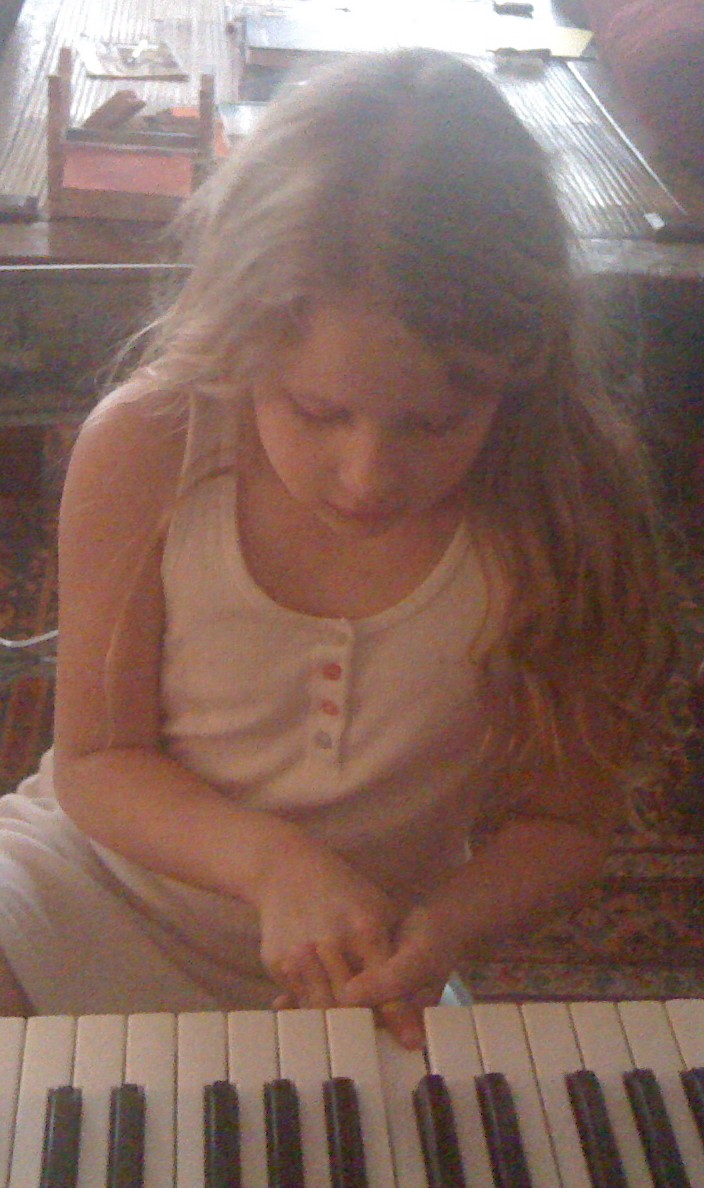
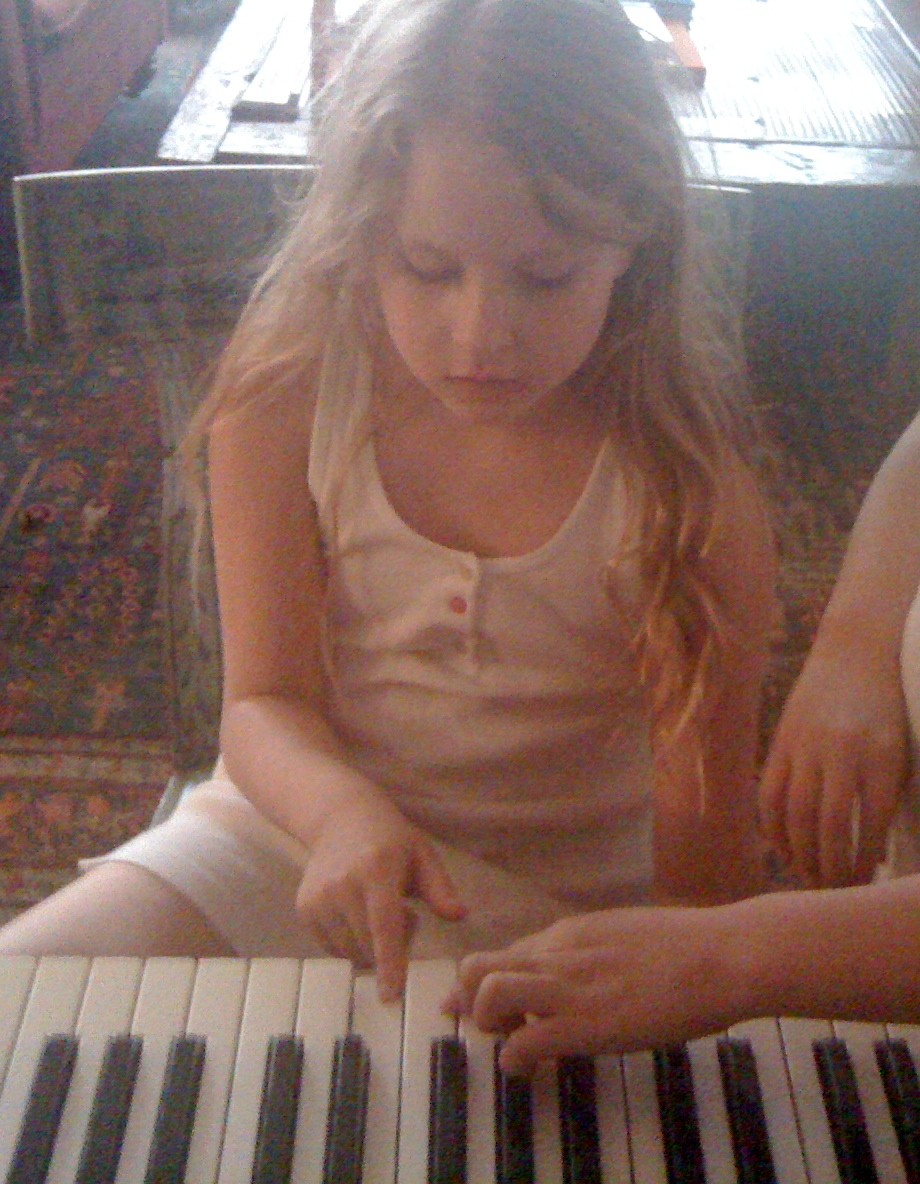
A few weeks ago Nic was playing “Hey Jude” on the piano.  “Hey Jude” happens to be one of Emma’s favorite songs, so Emma sang along as Nic played.  A little later, maybe the fifth or sixth time Nic ran through the first verse, Emma wandered over and stood beside him at the keyboard.  Every now and then she would play a note and look at him.  Within a few minutes she was seated at the piano and Nic was teaching her the notes.  (That’s Nic’s hand on the right side of the photo showing Emma which note to play.)

In the beginning Nic helped her by prompting her to find the correct notes, but after a few times, she was “prompting” herself.

This is an instance when her ‘perseverative’ behavior pays off.  After much practicing the notes Nic showed her, Emma was able to play the first verse of “Hey Jude”!


Marriage (Part II)

When Emma was diagnosed I threw myself into researching autism.  I was determined to find out everything I could.  I quit my job and devoted every spare second to reading books, trolling the internet for information, talking with specialists, etc.  It was Richard who, one night said to me, “Ariane this isn’t healthy.”

“What are you talking about?” I said indignantly.

“You can’t even see it…  this searching, every second spent reading about autism.”

I remember I was furious with him.  Here I was devoting every second of my free time trying to help our daughter and he was telling me it wasn’t healthy?!

Richard took a deep breath and continued, “You have to go back to work, do something with your creativity. Do something that has nothing to do with autism.”

He was right.  My life had lost all semblance of balance.  And so I did.  I found the career and creative outlet I had been looking for my entire adult life.

The summer after the diagnosis Richard was under tremendous pressure at work. I told him I would take the kids with me to stay with my mother in Colorado for a few weeks so he could have a break and not worry about showing up for the children and me.  The point is we watch out for each other and we encourage each other to have some balance in our lives.

Early on we realized the importance of down time.  Because with an autistic child, all the therapies, no matter which one works for your child, emphasize constant involvement with your child during their waking hours.  I cannot remember ever, in the last six years, sitting down to read the paper without feeling a tiny tremor of guilt.  I should be engaging Emma in some sort of “play” no matter how tired I am.  In addition, not only are you suppose to interact with your child every waking moment, but you are suppose to interact with a child who often does not want to be interacted with.  Despite this, you must pursue them or as Stanley Greenspan used to coach, seduce them.  Add to the mix the lack of sleep, a full work week with all the stresses which come with owning several businesses and… okay you get the picture.  It’s tough.

So Richard and I decided we each needed an evening out.  We picked a night, mine is Tuesday, Richard’s Friday. On my night off I go out with a friend, see a movie or often, just stay at my studio and work late into the night.  We also have a standing date night.  It is sacrosanct.   We have a caregiver booked for the same evening every week.  Both of these nights have been crucial to the well being of our marriage and family.

Over a decade ago during a particularly difficult time in my life I took a walk along 23rd Street where I lived.  It was a clear beautiful spring day and a single crocus had pushed its way up and out of a crack in the sidewalk, a single flowering plant amidst concrete.  I remember thinking how strange it was I hadn’t noticed it before.  After all it was right outside the front door of the building I lived in.

Last week, as I was taking Nic down in the elevator to catch his school bus, he was grumbling about Emma waking him up in the middle of the night.  I reached over and affectionately tousled his hair.

“Mom!  Stop fluffing me!” he said.

I smiled, “I am not fluffing you.”

“You’re trying to make me look like a daffodil,” he laughed, shoving his hoodie over his head.

And I thought of that crocus so long ago pushing up through the great expanse of concrete against all odds.

At a dinner party years ago someone asked each of us to use one word to describe our partner/spouse.  When it was my turn I said, “Kind.”  Richard is of course many things, but that is the word I still think of which sums him up better than any other.

I am a better person as a direct result of being with Richard.  I am pretty sure he feels the same.  We push each other to do the right thing.  We encourage each other to stretch beyond what is comfortable.  We challenge each other.  I can say the same thing about both Nic and Emma.  Each of them pushes me to show up in ways I could not have imagined.  Each of them challenges me to dig deeper, to practice more patience, to stretch, to work a bit harder.  Emma has taught me to appreciate seemingly insignificant things, a hug, a kiss, the unexpected laugh and my life and marriage are the better for it.

A few weeks ago a friend of mine, who is going through a stressful time in her marriage said, “Life is hard, suffering is optional.”

Being able to see the crocuses makes it a bit less so.

Marriage (Part I)

(*I have come to regret beginning this post with these statistics as I think it takes away from the main point.  ALL marriages will inevitably encounter stresses that will place a strain on the best of marriages.  It is not about blaming autism.  It is life.)

The divorce rate of parents with an autistic child is said to be 80%.  However I have found no studies to support this statement or even any articles showing where this seemingly arbitrary number came from.  Challenges of any kind can strain relationships.  As the parent of an autistic child in addition to the stress and financial strain, there are the legal hoops one must jump through to get ones child basic services with the Board of Education, the Board of Public Transportation, insurance companies, the lawyers, the hearings, the paper work and the sheer bureaucracy of advocating for your child.  It is the workload equivalent to running a small business if not more.  When you add the fact that many autistic children have disruptive sleep patterns causing further complications to a family already struggling to cope, you have a situation that will test the strength of any marriage, no matter how solid.

Richard and I have certainly had to weather our disagreements, though fortunately around the big issues:  methodologies, treatments, our vision and hopes for Emma – we agree.  I know of a couple of instances in which one of the couple just couldn’t cope any more and the diagnosis pushed them over the edge and out of the marriage.   I remember early on after we had received Emma’s diagnosis I looked at Richard and said, “How are we going to get through this?”

Richard replied, “Together.”

And for us in many ways it’s that simple.  (Though I need to be reminded of this from time to time.)  We don’t do it alone.  When I am having a moment usually in the middle of the night perseverating on some worry about something I have little control over or which simply hasn’t happened yet – will Emma ever live independently or who will take care of her when we die or will she ever be able to read and write or will she need tens of thousands of dollars worth of dental work because she still sucks her thumb (yes) or will she ever be out of diapers (these are a few examples from my current playlist) or any number of concerns ricocheting around in my head like a pinball, Richard will reassure me, “It’s going to be okay, we’ll get through this.”  There are times when I feel as though I am trying to claw my way out from a dark abyss of fear that ambushes me, pulling me down.  Richard and I have a kind of short hand for this.

“You’re spinning out,” he’ll say after listening to me for a while.

“I know,” I will reply and I do know.  The knowledge doesn’t help me stop myself.

And then he talks me down or if that fails, because I can be stubborn, he will listen a while longer before finally interrupting me with, “Okay, my turn.  You’re totally out of control.”  His is the blunt, direct approach.  It can be quite productive.  He will then go on to point out why my thinking is deranged.  90% of the time I can listen to him and calm down.  Richard has his own version of spinning out, but it’s usually work-related.  Which isn’t to say he doesn’t worry about Emma or Nic, he does, it’s just he is better at having some perspective on them and doesn’t get as easily thrown into the “doomsday pit” of despair.

When Emma is having a melt down, which can go on for quite some time, we pitch hit.  One of us will try to soothe her and when the other sees it isn’t going well – our patience is fraying – the other will jump in.  Most of the time one of us is able to maintain a calm the other is lacking.  Of course this leaves poor Nic fending for himself.  Though Nic, too, has gotten quite adept at calming things down.  “Here’s what you guys need to do,” he’ll say, looking up from his latest drawing of some fanged, blood dripping, all powerful monster.  “You can’t let her get away with this.  She won’t stop and she needs to learn she has to stop.”

Richard and I look at each other with raised eyebrows.

“You need to choose the thing that’s most important and work with her on that first.  Because otherwise it’s just too much,” he’ll add.

Smart kid.  (A post devoted to siblings of autistic children next week.)

Entering Emma’s World

Early on I knew if I wanted to have a relationship with Emma I needed to enter her world as much as possible.  I tend to project – feelings, thoughts, abstract concepts – none of which are helpful.  Emma’s world does not include the kinds of “feelings” I tend to apply.

For example, upon much urging from Emma, we adopted a cat last November.  Emma rarely expresses a desire for things and so when she began asking to go to various animal shelters and saying, “Now take kitty home,” we felt we needed to oblige.  We went to a rescue shelter together and after about three hours left with Merlin, a black male, just under a year old.  I know Emma enjoys Merlin and is glad we brought him home.  She stopped asking to go to animal shelters or the pet store.  So whatever it was she wanted from having a cat of her own, Merlin has accomplished.  Yet it remains a mystery to the rest of us as to why she was so insistent on having a cat.  Particularly as now that we have one, she seems content that he has been brought into the fold, but by no means appears enamored by him as the rest of us have become.

If Merlin is sleeping in his favorite spot – the rocking chair – the single most coveted piece of furniture in our home, Emma will simply tip the chair over until he falls out.  Nic is horrified by her matter of fact actions and always cries out – “Poor Merlin!  She’s doing it again, Mom.”

Having removed Merlin, Emma then plops down into the rocking chair and proceeds to happily suck her thumb.  We attribute all sorts of “feelings” to her actions.  She doesn’t care about Merlin.  She doesn’t love him as we do.  And in Nic’s case – he feels she is “mean” to Merlin.  But to Emma, Merlin is occupying the place she wants to be and so he must be removed.  It’s pretty simple.  I don’t think she is thinking of Merlin’s feelings.  My guess is she cannot understand why the rest of us react the way we do.  “Poor Merlin!” we say and now she laughs and tips the chair at an even more precarious angle.

When Emma “plays” with Merlin she will whip his toy around her head, rather than try to engage him in play.  His toy is interesting to her, but the idea that it is his toy and one to be used to play with him is something Emma doesn’t seem to understand.  If one considers that “playing” for Emma is an abstract concept, one she does not come to easily then all of this starts to make more sense.  And yet, Emma continues to surprise us.  There are times when Emma clearly is playing with Merlin and enjoying it.  She will grab one of his “mice” which is attached to a string and run through the house, the mouse rocketing along behind her with Merlin hot on her heels.  She squeals with laughter as do I while watching her.  Emma is taking pleasure in something she loves to do – running – but is also taking pleasure in Merlin running too.  It suggests an awareness of “other” which denotes tremendous progress.

Friendships with her peers are not easy for Emma.  They are something she needs help with.    I believe she desires the interactions, but people are unpredictable, particularly young children.  Her head teacher recently sent home this photo of Emma holding hands, (unprompted by any adult) with her classmates while out on an outing.  It is wonderful to see.  (In this photo Emma is wearing a weighted dress, which her school encourages her to wear, as it calms her.)

Emma has a number of “friends” now, much to our pleasure and dismay.  But Emma does not play with her friends as a neuro-typical 8-year-old girl would.  There are no whispered “secrets” or friendship bracelets being exchanged.  She clearly cares deeply for a number of friends, but when they are thrown together she isn’t always sure what to do with them.  Her “best” friend is an adorable little boy named Ben and they often sit together during lunch, sometimes even hold hands.  I cannot begin to express the joy it gives me to know that Emma has a special friend, one whom she looks forward to seeing and wants to sit next to.  How she feels, what she thinks, I cannot begin to know.  What does “friend” mean to her?  I do not know.

In order to know Emma, one must try to toss aside any preconceptions about intent or feelings.  In fact, I have learned over the years, I must put aside all of what I think I “know” about human behavior and enter a state of “what is”.  “What is” =  my description of Emma’s mind.  There is no “good” or “bad” – it simply is.  If  one has ever attempted meditation one will know how difficult it is for most of us to enter a state of non-judgement.  A state of just being present.  People spend thousands of dollars and years of their life attempting to gain mastery over this “practice”.  Emma comes to it naturally.

Emma At Ten Months Old

I sat in the pediatrician’s office with Emma squirming on my lap.  “She’s not really talking.  I mean she says words grouped together, but not single words.”

“Like what?” the pediatrician asked.

“Ba-bye, Da-da, Ah-done… things like that.”

“Smart kid,” the pediatrician said, checking Emma’s reflexes.

“So there’s nothing to worry about?” I asked.

“She looks great,” the pediatrician laughed, as Emma scooted across the room one leg jutted out in a crab-like crawl.

Thirteen Months

“So I shouldn’t worry, right?” I asked the young master’s degree student, studying speech therapy, who was Nic’s ‘teacher’ at his pre-school.

She nodded, “Some kids, especially the ones who are more athletic often have delayed speech.”  She looked at me with a smile.  “And her brother is pretty precocious, sometimes their younger siblings are slow to speak.  I’m sure it’ll come in time.”

I was turning into one of those neurotic New York moms.  It was classic.  I needed to stop worrying, Emma was fine, I told myself as Nic and I walked home from his pre-school.

Twenty-two Months

“Do you think she might have a hearing problem?” I asked my girl friend.

“But she looked up when that siren went by,” she reasoned.

“Yeah, I know,” I said, watching Emma push an empty swing.  “Watch this.  Hey Emma!” I called out.

No response.

Louder, “Hey Emma!”

Nothing.

Now shouting, “Emma!  Emma!  Look at Mommy!”

But Emma continued to play with the empty swing.

“Okay, but half the time my kids don’t look at me when I call them either.  Kids do that,” my friend said.  “Don’t they?”  She looked at me with half a smile.   “Anyway who wouldn’t be mesmerized by that swing?” she added, putting her arm around me and giving me a squeeze.

Thrity-One Months

“When was the last time you heard Emma say, Chase me?” Richard asked.

I thought for a few seconds.  “When was the last time you heard Emma say anything?” I asked in answer.

This was the conversation that poked the final hole in my bubble of denial.   It was August and we had rented a house in Cape Cod.   I remember standing in the living room, looking outside, watching the children.  Nic and Emma were on the porch in their ‘swimming pool’ a make-shift plastic tub we’d filled with water.

The mask I had so meticulously constructed for myself and my family fell away revealing something I couldn’t identify and could not understand.  I remember telling myself to breathe through the rising panic that threatened to consume me.   And then I remember feeling the feeling that I would feel many times in the ensuing years.  Failure.  Something was terribly wrong with my child and I had failed to see it, failed to do something about it.

As often happens when I feel overwhelmed, I began to make a mental list of actions I would take the instant we returned to New York.    The first two items on my list were:  get a hearing test done and get an evaluation.

The Playground

I use to take the children to a number of playgrounds in the city when they were young.  We went to Union Square Park (before the renovation), Washington Square Park, Seal Park which is way over on 10th Avenue between 22nd & 21st Streets, Madison Square Park and Triangle park (a little playground nestled in the triangle created by Hudson becoming 8th Avenue.  There were others, but these were the ones we went to more often than not.  Washington Square was a particular favorite because of the large sand box and there was a smaller playground close by for younger children, where we would stop, on our way home.  In addition there was the huge water fountain in the center of the square and when the weather was very hot, the children loved to splash around in it.

One summer day while at the playground in Washington Square, Nic was playing in the sand box with his trucks and Emma wanted to swing.  Typically there were lengthy lines for the swings, particularly in the mid morning and mid afternoon.  I learned to repeatedly remind Emma she would have to wait for the swing, something she seemed increasingly unable to do.  More and more frequently I would have to pull her from the ground where she had crumpled in a sobbing heap and strap her into her stroller kicking and screaming to leave the playground with Nic, reduced to tears, in tow because she refused to wait in the line.  Anyone who has spent time with small children in a playground knows cutting in line for the swings is tantamount to declaring war on the other parents and children.

On this particular day we were waiting I counted each time a child vacated a swing.  “Okay, Emma, five more children ahead of us.  Remember we have to wait.  Let’s count. “  And then I would count while Emma stared fixedly ahead.  Eventually when it was Emma’s turn she leaped onto the swing and waved me away so that I couldn’t push her.  I stepped back, wondering what she would do.  Then with her feet scuffing the ground she pushed off and began to pump her legs.  It was amazing to watch such a little girl able to swing herself.  A small crowd of moms and caregivers gathered around, watching.  One of them asked, “How old is she?”

“Eighteen months,” I replied, as Emma soared high in the air and back down again.

Much later I learned many autistic children have what are termed splinter talents.  Things they are good at, though they remain delayed in most other things.  Emma has always been coordinated even though she began walking late – at fourteen months – and needs more time than a normally developing child to learn things.

But on that warm summer day, Emma found something she was able to do, and do really well.

Food

As Emma began to regress, starting at around 13 months old, it was not just what I believed to be typically “autistic” behaviors – lack of eye contact, delayed speech, obsessive-compulsive behavior, rigidity – that regressed, but things I didn’t expect, such as the restriction of  foods.  Slowly, just as her speech began to disappear, so did her ability to try new foods and after a few years, a paring down of foods that were a staple to her diet fell away as well.

The following is a list of the foods Emma will eat.  Anything else she refuses.

Cheerios

Mango Fruit Leathers

Red Grapes

Bananas

Apples

Wheat toast with Organic Raspberry Jam (must be the red labeled wheat toast from Whole Foods & The Organic Raspberry Jam from Whole Foods)

Horizon Vanilla Milk – occasionally she will drink the Horizon Chocolate Milk

Stonyfield Chocolate Yogurt (She use to eat the caramel yogurt as well, but they discontinued it.)

Motts Apple Juice (this was an issue in Costa Rica as they had a different brand and she refused to drink it, though eventually did, cut with water)

Pirate Booty

Baby Bel Cheese

Grated Cheddar Cheese – must be orange

Pancakes

Maple Syrup

Chips Ahoy (she will not eat any other kind of cookie)

As a baby Emma was a healthy eater and tried just about anything I put in front of her.  At 9 months she ate a mushroom-barley soup I made.  I recorded this milestone in her baby book.

Many people believe that autistic children are unable to process gluten and dairy, others believe that their child has food intolerances which adversely effect their behavior and some believe that a gluten free/casein free diet has cured their child of autism.  While I have never met a cured autistic child or personally know anyone who has, I do know of one child who clearly functions better without dairy in their diet and a number of autistic children who are allergic to a variety of foods.

In October of 2004, we began working with a DAN (acronym for Defeat Autism Now) doctor who was also a pediatric nutritionist/allergist.  We removed all dairy and wheat from Emma’s diet.  At that point she was eating a limited, but varied amount of foods such as scrambled eggs with cheese, a wide variety of fruits, all flavors of yogurt, ham, turkey, chicken, dried fruits, carrots, etc.  In retrospect her diet seemed limitless in comparison to what she whittled it down to.

Once on the gluten free/casein free diet she refused to eat any new foods to substitute for the old.  I stayed up, often until after midnight, baking wheat-free breads made from rice flour, almond flour, and almond butter.  I found web sites that specialized in casein free/gluten free products and recipes.  I developed a way to make my own organic pureed fruit leathers, which I spread onto baking sheets and dried in a low heated oven for 10 hours or over night.  To celebrate her third birthday I made an entire menu of gluten free/casein free foods.  Emma would not touch any of it.  Even refusing the birthday cake I made, which everyone else seemed to like, including Nic.  Though he confided in me later that he didn’t like it as much as a ‘normal’ cake, but didn’t want to hurt my feelings.

After three and a half months and no change in her behavior, other than a 10% loss of body weight, we took her off the diet and slowly introduced her old foods that she once loved.  Only now she refused to eat most of the old “fail-proof” foods too.  It was as though she never liked them to begin with.  The DAN doctor advised us to introduce one food we knew she liked – we chose cheddar cheese – and to give her a great deal of it and then wait to see if we saw a discernable change.  I gave her several ounces of cheese, which she ate and then waited to see what would happen.  After several days and no change, the nutritionist advised us to introduce yet another food.  We repeated this exercise over and over again.

Occasionally now Emma will take a ‘bite’ of some other food – say grilled chicken – with great reluctance and protest.  I remember a friend telling me about her sister who refused to eat any foods that were not “white”.  I was horrified by the story and remember thinking I would never have a child like that, as I prided myself in being an excellent cook and would never tolerate that sort of “behavior.”  I have since come around to the pick-your-battles way of thinking.  The food battle is one I am just not willing to engage in any longer.

Late at night when I am caught in a cycle of worries, I console myself with the idea that there are certain indigenous populations that survive quite well on extremely limited foods, such as a group of Eskimos who survive on whale blubber and little else.  For now that consolation will have to do.

Toys

When Nic was a toddler, I would frequently take him to our favorite local toy store, Kidding Around, where he would play with the elaborate train set, Tina, the owner, had in the back of the store.  Very popular with the four and under crowd, particularly in the afternoons, we would go in the morning and often, Nic would have the train set all to himself.  Each day of our visit when Nic was just beginning to talk, he would point to something as we were leaving, “That!” he would say, which meant he wanted to take it home with him.

When Emma was about the same age, I took her to Kidding Around, but nothing caught her attention.  I tried to entice her, “Look Emma!  What a pretty doll!  Do you like it?”

She ignored me and wandered off.

Undeterred I went over to the two wooden tree stands filled with large plush hand puppets.  They were lovely and soft, in bright colors and came in a variety of different species, toucans, leopards, dogs cats, horses, as well as mythical creatures and monsters – a favorite of Nic’s.

I thrust my hand in one, a beautiful white unicorn with flowing mane and purple horn, “Emma!  Look!  I’m a unicorn,” I said, in what I imagined a unicorn’s voice would sound like if they existed and could talk.

Emma showed no interest.

The one toy Emma was attracted to was the miniature doll’s stroller, which came in pink and blue.  I placed a baby doll in one of them when I saw her looking at it.  “Look Emmy it’s for the baby doll,” I said.

Emma pulled the baby doll out of the stroller and proceeded to try and sit in it herself.  Terrified that she would break it, I said, “No Emmy!  That’s not for you!  It’s for the baby doll.  You’re too big for this stroller.” Again I placed the doll into the stroller.

Emma threw the doll onto the floor, took hold of the doll’s stroller and careened around the store, heading toward the door.  I chased after her and herded her back inside, admonishing her that she couldn’t go out into the street.  Each time we returned to Kidding Around, out the door she would tear, steering the doll’s stroller around, and a few times into people who were in her path.  It got so that I would block the front door while Nic played in the back, every now and again his little voice calling out, “Mommy!  Emmy’s taken the stroller again!”  I would position myself in front of the only exit, while she would try to maneuver around me, fixated on getting that stroller and herself outside.

“She just doesn’t like toys,” I reported to Richard that evening.  “My sister never played with dolls,” I said when he didn’t say anything.  “Emma’s athletic, just like my sister,” I finished, unsure of why I suddenly felt so defensive.

Talent Show

I was listening to Emma and Lee singing ‘Que Sera, Sera’ after Ariane posted it and was moved to tears as I always am when I hear how heartbreakingly pure and sincere her voice is. It is so sweet that I can’t think of any word to describe it other than angelic.

I first played her ‘Que Sera Sera’ on You Tube about two years ago after hearing a slow and somewhat melancholy version of the song in a Francis Ford Coppola film. I’ve always loved this song, even in the brighter Doris Day version, which Emma prefers, though the way she sings it brings out the poignancy of the lyrics and melody in a way Doris could never even dream of.

Emma has near-perfect pitch and a set of lungs an opera diva would envy. But so much more powerful and affecting than those qualities is the sheer sweetness of her voice, like everything that was good and kind and happy and wonderful in the world was distilled in a golden elixir that pours out whenever she sings that song.

Most of the time, her singing is loud and raucous, though no less heartfelt and touching in its own way, at least to my ears. Emma loves to perform, though there isn’t any trace of ego in her desire to strut her stuff. I guess that’s part of her condition to some extent, a reduced sense of self.

Last night before bedtime she said, “Talent show?” very loudly while I was playing chess with Nic.

“Sure Emma, we’d love a talent show,” I replied, smiling at Nic who smiled back with a “here we go again” sigh and headshake that seemed to sum up all his conflicting feelings – amusement, love, frustration, exhaustion, mild embarrassment. There was no one else in the house, so I’m not sure he felt any embarrassment, other than perhaps a conditioned response to similar, more public displays.

Myself, I was very much looking forward to the show, which turned out to be a medley of Carole King songs for children, culminating in ‘Chicken Soup with Rice’, which she belted out like a Broadway veteran. She always goes for the big finish and this particular song jumps up an octave or two at the end. She totally nailed it. Nic and I laughed and I applauded as loudly as she sang.

People often ask me whether Emma has any special talents. When anyone asks a question like that I figure they’ve been watching “Rain Man” and want to know if she has any savant abilities. I usually say that those types of abilities are associated with what has traditionally been called Asperger’s Syndrome – though I recently read that the medical community wants to abolish that term and use ‘Autistic Spectrum Disorder’ for everyone.

After that disclaimer, I will typically add that she does have an incredible memory and will mention things that happened to her when she was two or three years old. She can also remember very specific catalogues of objects, particularly photos. She really likes photos and home movies – I think they help her talk about and identify people, things and activities she enjoys. She has a shoe box with 100 or more photos inside and she will know instantly if one is missing, setting off a frantic household hunt for the lost picture in order to stave off a total meltdown or some self-injurious behavior, like biting her arm as hard as she can.

She is also extremely advanced in a wide variety of physical activities: skiing, climbing, balancing, jumping, swimming.
And of course, she loves to sing and dance.

There was an award-winning documentary that came out a while back called ‘Autism: The Musical’. It was a very inspiring movie and we thought this might be something Emma would enjoy given her showbiz leanings. When they started a program called ‘The Miracle Project’, based on this concept at her special ed school, we enrolled her and are very excited to see what might come out of it.

Every year at her school they have a talent show and every year, Emma has been the star of the show, soloing in ‘A Spoonful of Sugar’ from Mary Poppins in her debut performance.  Since then she has referred to any of her singing performances as a talent show, which I love. I bought her a number of karaoke video games with microphones but she has been much more enthusiastic about singing along from memory to a DVD or You Tube clip. She has quite an impressive set list for her concerts now, which routinely take place at birthday parties or dinner parties (which are also birthday parties as far as she’s concerned), or whenever the mood strikes her. An audience of one or two is enough, though like most performers she likes to play a full house.

I’ve always thought that she’s a total rock star and someday she’ll be cranking it up on a big stage – leaving our ‘dinner theater’ circuit far behind. Time will tell. For now, I revel in her impromptu serenades and every time she says, “Talent Show?!” my heart skips a beat in happy anticipation.