Category Archives: Parenting

Entries about what it means to be the parents of an autistic child.

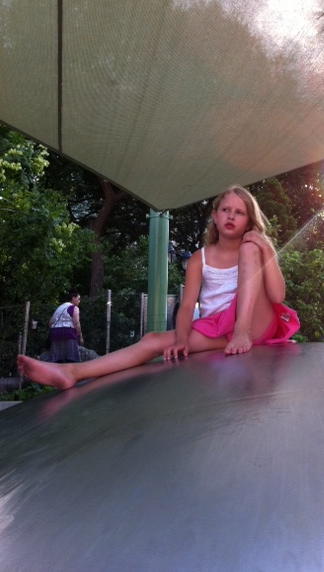
Sunday with Emma

Yesterday Richard and I took the children to the park, where Emma played in the sprinklers, while Nic sat with us in the shade and talked.

Emma in Union Square Park
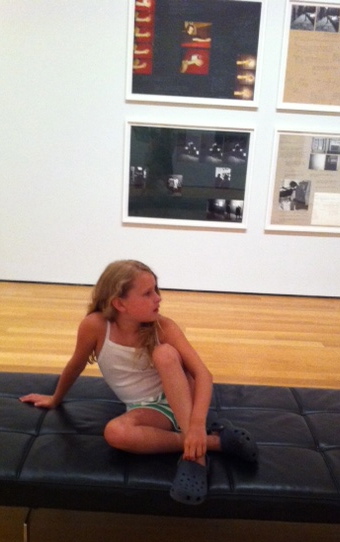
Then off to Toys R Us to return a Nerf gun that was faulty, then to MOMA (Museum Of Modern Art) where we watched several video installations by the Belgian artist – Francis Alӱs.  Emma wasn’t interested in the video of him pushing a huge block of melting ice through the streets until it disappears, but she was fascinated with the video of him chasing tornadoes, particularly when he entered the tornado.  Another video she liked was one in which he is driving a VW Bug up a very steep dirt road, but never makes it to the top, instead rolls backwards, before attempting to climb the hill over and over again.  Talk about the trials of Sisyphus…

When we went to a lower floor Emma pointed to a giant collapsed fan and said, “Telephone.”

“Look Em.  It’s a huge fan!”

“Fan,” Emma said, before going to the next sculpture with wheels, “Bicycle,” she said.  Then she turned and pointed to an enormous sculpture of a man holding a steering wheel.  “Bus driver!” she said, jumping up and down.  And on it went.  When she didn’t know what something was or if it didn’t look like any recognizable object she would point out it’s color.  “Red!” She said.  Or, “Green!”

“Hey Em.  Look.”   I pointed to two sculptures that resembled melting metal.

“Blobs,” she said nodding her head before running over to a sculpture of a vaguely female form.  “Mommy,” she said, pointing and smiling at me.

Emma at MOMA
After the museum we made our way to the swimming pool at the Vanderbilt YMCA, where we went swimming.

Prior to our leaving the house that morning, I’d made a list of all the things we planned to do and went over it with Emma.  “Okay so first we’re going to go to Union Square, then the museum, then the pool and then Toys R Us.”  I pointed to each item on the list as she repeated all our activities.  Except when we got to Union Square and saw how hot it already was and how heavy Nic’s Nerf gun was we amended out list.

“I think we better unload this thing,” Richard said gesturing toward Nic who was barely able to lift the bag carrying his broken toy far enough off the ground so that he could carry it.

Once we got to Toys R Us and Nic found a newer, bigger, better and even heavier Nerf gun, Richard turned to me and said, “I guess we’re going to have to take this thing home before we go to the museum.”

Meanwhile the list I’d painstakingly made and gone over with Emma was no longer relevant.  I worried with each change that a meltdown was imminent.  But the meltdown never came.  In fact Emma was great, took each change in stride, repeating the change of plans to me, before cheerfully going along with the next activity.

“Well that was a great day!” Richard said as we headed home.

Everyone agreed.

For more on Emma’s journey through a childhood of autism, go to:  www.EmmasHopeBook.com

Empathy and Autism

My thinking on this topic has changed since I last posted about Emma and Empathy over a year ago.  I am not convinced that Emma “has a terrible time figuring out what another person is thinking or feeling.”  Today that is not something I would say.  I often wonder if Emma feels things in the extreme rather than not at all.  I have read a great many articles written by people on the spectrum who describe their feelings and responses to other people’s emotions as being too much for them.

One young woman, Dora, says:  “I often feel things too deeply or have too much empathy and have to run away, not because I am callous, but because I feel so strongly it causes my brain to shut down or freak out.”    Her statement is similar to another woman with autism, who’s amazing mother, Clara Claiborne Park wrote two books about her daughter, Jessy.  She describes how Jessy would cover her ears and could not tolerate certain words because they were “too good”.

When one of us is upset and Emma appears to completely disregard our emotional state, whether by ignoring it or making sympathetic comments, which to our ears strikes us as insincere, I have to question whether our interpretation is accurate.  How can we know what she is really experiencing?  We cannot.    I choose to believe Emma is deeply sensitive to her  own and our emotions, but just as she has trouble expressing herself verbally, she may express her feelings differently as well.

Dora goes on to point out:  “The notion that we don’t have feelings frees up people to commit atrocities against us without accountability.”

When I hear neuro-typical people discussing autism I am often surprised by the conclusions they come to.  How differently might we treat someone if we believed them to be fundamentally unintelligent?  How would we speak to them?  What things would we say because we believed they have a low IQ, lack empathy, could not understand us?  How would we treat them as a direct result of our assumptions?   If we decide a child’s behavior is a form of manipulation or because the child is “spoiled” or because they “think they can get away with it”, do we not treat them differently?  Isn’t it true we can behave in some pretty horrific ways when we make assumptions about other’s actions?  Isn’t it easy to rationalize our behavior when we’ve decided a person or child is “dumb”, “less than”, “inferior”, cognitively unaware”?  And what if all those assumptions we’ve so quickly and easily come to are completely wrong?  How does our response stand up under further scrutiny?  Have we not behaved with callous disregard?  Have we not completely “disregarded” their “feelings”?

For more on Emma’s journey through a childhood of autism and her relationship with her brother, Nic go to: www.EmmasHopeBook.com

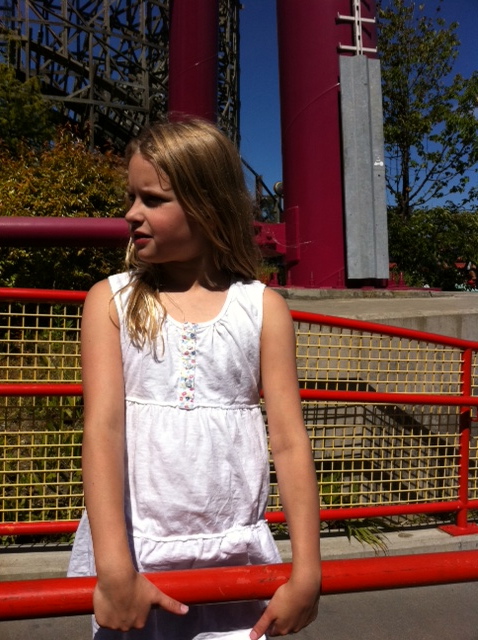
Emma in Union Square Park – Summer, 2011

A Brilliant Mind

I have maintained in previous posts, that I continue to believe in my daughter’s brilliance.  Current IQ tests do not account for children who are non-verbal or with limited or impaired speech.  I have no way of knowing what Emma’s IQ is, but I can tell you there are things Emma does, on a daily basis, indicating her mind is capable of some pretty astonishing leaps.  What follows are a number of examples.

Our refrigerator light is out.  The first thing I did was replace the bulb, only to find that wasn’t the problem.  A little later Emma opened the refrigerator door and pressed a switch on the ceiling of the refrigerator and immediately all the lights came back on.

“Wow Em!  How did you know to do that?” I asked incredulous.

“Lights broken,” Emma said, nodding her head up and down as she removed her caramel yogurt from the frig.

“Yeah, but how did you get them back on?” I went over to her and watched as she reopened the door and pressed on the little white button that activates the lights when the door is opened, something I did not realize until Emma showed me.  The lights flickered for a second and then went out.  Emma reached up and matter-of-factly jiggled the switch and the lights came back on.

“There,” she said, with a certain degree of satisfaction.

After a few days of all of us wiggling the switch, the lights flickered on and off feebly one last time before remaining permanently off and I had to call the company to get the light switch replaced.  Now to many of you, this may seem completely commonplace, but I can tell you, I had spent quite a bit of time trying to figure out what was causing the problem.   I should have saved my time and just asked Emma.

Yesterday while Emma and I worked on her literacy program requiring her to choose the word “leg” from several options, she positioned the cursor over the correct button then clicked on the space bar.  Then she looked over at me with a mischievous grin as if to say – did you see that?

Again, hitting the space bar instead of clicking on the mouse or the return key never would have occurred to me.

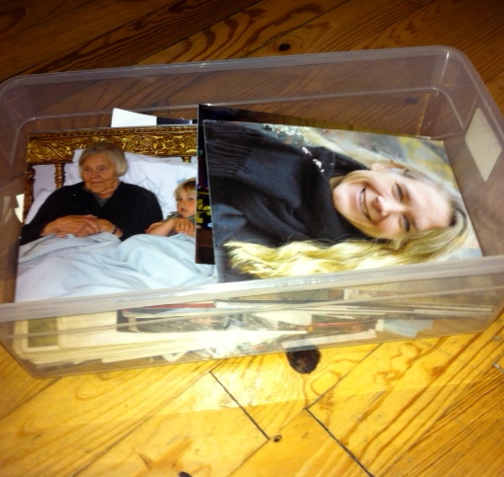
Another thing I’ve noticed while working with Emma is that she has an amazing ability to see patterns.  So, for example, if I show her a series of “words” but with only parts of the letters showing such as:  _a_s,  r_ _ _, _e_ _, _ _s_ and ask her to find the one that can be “eats” she will find the correct one immediately, less than a second, faster than I am able to.  I am consistently amazed by this.  It is in keeping with her ability to know instantly when a photograph is missing from her pile.

Emma’s box of photographs – over 200

The other day Emma was singing while shooshing around on her scooter.  Richard was reading in the rocking chair, Merlin happily nestled in his lap.  “You know what she’s doing right?” Richard said looking over his reading glasses at me.

“Yeah,” I said without looking up.

“She’s created her own carousel.  Do you hear her?  She’s singing all the songs they play on the carousel.  And watch.  She’s going around and around on her scooter in the same direction as the carousel.”

I stopped reading and watched and listened.  Emma was currently singing “Georgy Girl” one of the many songs they play at the Central Park Carousel.

“I wonder if she’s singing the songs in the correct sequence,” he wondered out loud.  “We’ll have to make a note of that next time we go.”

Emma riding on the Central Park Carousel

These are only a few examples of Emma’s brilliant mind.  There are countless others.

We, as a society have a tendency to view ourselves and others with a critical eye.  We are taught early on to look at our deficits and then do all we can to take corrective measures to make up for those deficits.  I don’t believe this kind of thinking is helpful with children diagnosed with autism.  The deficits pile up unbidden until that’s all we can see.  Our children are routinely viewed as “less than” as we struggle to help them.  I feel strongly a more balanced approach is necessary.  Our children are often brilliant.  If I approach Emma with this in mind, I am able to more fully help her, by focussing on her talents, on the things that are easy for her and using those assets to help her with the things that are more difficult.   In addition I find I can learn a great deal from her.

For more on Emma’s journey through a childhood of autism, go to:  www.EmmasHopeBook.com
Emma’s Ears – Autism

Monday night Emma was up at midnight screaming.  Her ears were bothering her.  This has been an ongoing problem for many months now.  She is highly sensitive to the changing air pressure.  As a result of Emma’s sensitivity, I too have become increasingly aware of it and am surprised that I have lived this long without noticing how often it changes, causing my ears to “pop”, as Emma describes the sensation, too.  Still, just to be safe we have taken her to her pediatrician who assured us her ears were fine and referred us to an ear specialist.  To date Emma has gone to the ear specialist three times.  Her ears are fine, we’ve been repeatedly told.  She’s just extremely sensitive to the air pressure which is constantly fluctuating.

“I need help!”  she screamed.  “Ears popping, have to unpop!  Mommy!  Mommy I need help?”

This can go on – as it did Monday night for hours.  That night she was up until past 4:00AM, I don’t know when she finally fell asleep as I eventually lapsed into a kind of restless state of unconsciousness.  When I woke it was just past 7:00AM and Emma was fast asleep, arms spread out like Christ on the cross, blonde hair fanned out on the pillow beside me.  Richard had long since relinquished his place in our bed and gone to her bed.  Merlin, preferring the rocking chair in the living room, was happily curled up away from all of us when I came into the kitchen to begin preparing the children’s breakfast.

I reminded myself that Emma used to regularly wake up at around 2:00AM only to finally fall back asleep somewhere between 4:00 or 5:00AM.  How we managed to get through those middle of the night awakenings month after month is something I cannot fathom given how exhausted I was yesterday.  The combination of crying in pain and screaming for help, help I am unable to give, is what breaks my heart.  I try to remind myself that being there, just sitting with her, even though I cannot change the air pressure, is a kind of help too.  Still it’s difficult not to feel the rising panic and accompanying helplessness that come with witnessing ones child in such obvious pain.

“Please Mommy.  You have to unplug.  Ears!  Ears!”  she continued to cry while twisting her blanket up and trying to push it down her ear canal.

“Em, try to yawn,” I told her opening my mouth in an exaggerated yawn.

“NOOOOOOOO!”  Emma screamed, pounding the side of her head with her hand.  “Nooooo!  Mommy!  Mommy!  I need help!”

It is during moments like these that I want to scream.  I want to hit the wall with my fist.  I want someone or something to help my daughter.  So I go wake up my blissfully sleeping husband, Richard and get him to help me.

“I got this,” he told me after I woke him, waving me away.  “Go back to sleep.”

Only I couldn’t go back to sleep so I followed him into her bedroom where he had ingeniously pulled out a balloon and told her to blow into it for a few seconds.  He also had the foresight to bring some nasal spray which the ear specialist had given us for her.

And while none of these things were “magical” cures for her popping ears, his calm demeanor helped settle her and me down.

“I’m going to lie down with her, you go back to bed,” I told him.  As he got up to leave, I said, “And thank you.”  To say I feel gratitude that I have a husband who is so completely in the trenches with me, who is more than willing to do his share and often does much more than that, who isn’t afraid to submerge himself in all things that make up our crazy family, would be a vast understatement.

An hour later, Emma, still in pain, but at least not screaming like an air raid siren, whimpered, “Ears still popping.  Go to Mommy’s bed?”

“Okay Em.  Come on.”  I led her through the hallway into our bedroom and climbed into bed with her.

Last night, exhausted and concerned that we might have a repeat episode, I went to sleep early.  Miraculously Emma slept until almost 7:00AM.

For more on Emma’s journey through a childhood of autism, go to:  www.EmmasHopeBook.com

Dreams For Emma – Autism

A follower of this blog and mother of two children on the spectrum asked me if Emma used an ipad.  I wrote about Emma’s ipad last fall for both this blog as well as the Huffington Post, so in responding to her email, I reread both those posts.  The one for Emma’s Hope Book is entitled Emma and Lists.  What struck me was how far Emma has come since then.  I looked at the date – September 24th, 2010 – and while yesterday I was feeling a bit discouraged with Emma’s ongoing struggles with handwriting, I cannot help but feel incredibly optimistic with her progress after reading those posts.  It’s funny how rereading something I’d written less than a year ago can have such an impact, but it has.

Emma has certainly come a long, long way.  In the post “Emma and Lists” I write about how when I am feeling a little sad or discouraged I make lists.  I go on to recount my current lists, (hopes) for Emma.  “Help Emma with Reading,”  “Help Emma with writing,” are two such items.  I remember when I wrote that post, thinking that these were dreams, perhaps dreams I might not ever see accomplished.  And yet, here I am in July of 2011 and not only are both these dreams coming true, but so are others that I hadn’t even thought to put on my list.  Things like:  beginning math concepts, writing in full sentences, learning to type, following three and four step commands.  These are all things Emma is in the process of learning.

I will try to remember to take a photograph of Emma’s handwriting this afternoon.  She is coming along.  She is learning, she is progressing.  It’s easy to forget, though.  I forgot that last September I could only hope Emma might one day learn to read and write.  That she is now doing so is remarkable and wonderful.  Last fall we were still riding on the wave of our success with having finally gotten her out of diapers at night.  We were still struggling with getting her to sleep through the night.  I’d forgotten all of that.  It seems so much longer than ten months ago.  It feels as though years have slipped by.

I haven’t dared dream for awhile now.  But rereading those posts reminds me of how important it is to have dreams, for ourselves, for our children.

For more on Emma’s journey through a childhood of autism, and to see how far she’s come in one year go to:  www.EmmasHopeBook.com

“I’m Home” – Autism

When I opened the door to our loft, Emma came tearing up on her scooter shouting, “Mommy’s back!  It’s Mommy!”

As I dropped my bags and opened my arms to greet her, she sped away.  Nic meanwhile rushed up to me and threw his arms around my waist.  “Mommy!” he cried, “It’s so good to have you home.  I missed you so much!”

As I hugged Nic and then Richard, I said to Emma, “Hey.  I want a hug from you too.  Come over here, Em!  Remember?  Put your arms around and …”

“Squeeze!”  she shouted, while complying.  She peered up at me, with an odd expression on her face.  Then she pointed to my face and said, “It’s Mommy.  Mommy came back,” as though she hadn’t been sure I would.

“I’m back Emmy.  It’s so good to be back.”

“Yeah, Mommy came back.  Mommy stayed at Granma’s house.  Mommy had to go away,” she said, nodding her head sympathetically.

“It’s okay, Em.  Now I’m home.  I’m not going anywhere.”

Nic then played five different songs on his new Alto Sax for me, two new songs which he composed for the piano and then plugged his electric guitar into his amp and riffed on several more.  Emma scooted around on her scooter and eventually it was time for everyone to go to bed.

“Mommy come to Emma’s room,” Emma said, taking me by the hand.

“Yes!” I said following her.

“Mommy’s back,” Emma whispered as she snuggled down under her blanket.

“Yes, Em.  I’m home,” I said stroking her cheek.

Later Nic expressed his upset that I was away for almost three weeks.  He was able to tell me that he didn’t like that I was gone for such a long time.  But Emma…  Emma doesn’t have the words to express her upset nor does she have the ability to ask me why I was away.  I can only hope she understands I had to go for work, but I don’t know that she does understand.  When she looked up at me earlier it was with a mixture of shock at seeing me again and happiness.  I don’t know whether I’m reading more into her expression than was actually there, but given that she isn’t able to ask me, who knows what reasons she applied to my absence.

“Go swimming with Mommy,” Emma whispered.

“Yes,” I said.  “We’ll do that tomorrow.”

“No, not going to go back to Aspen,” she said, holding my hand.

“Nope.  Tomorrow we’re going to spend the whole day together.”

We were quiet then.  “Mommy sing?” Emma said after awhile.

“Sure, Em.  Which one – Swing Low, Sweet Chariot or Summertime?”

“Swing Low first, then Summertime,” Emma said.

“I love you Em,” I whispered.

“So much,” Emma finished.

For more on Emma’s journey through a childhood of autism, go to:  www.EmmasHopeBook.com
Going Home

I was suppose to be on the first plane out of Aspen this morning.  Which meant, if all went well, I would be on an 8:30AM flight out of Denver heading back to New York.  Barring any unforeseen delays I might even have gotten home before my children returned from their various summer activities.  To say, I was excited to see them this afternoon would be an understatement.  And that doesn’t include the excitement I feel in anticipation of seeing my husband, Richard who has single handedly shuttled one child or the other to camp, picked up said child, taken Emma to the doctor for her ongoing ear problems, dealt with all the daily problems that inevitably arise in caring for a family and home, fed both children, fed Merlin (our adored cat), watered my orchids, done the laundry, the grocery shopping, and did I mention he also managed to work?  Can I just say here that he is a man of all men?  Put the guy on a pedestal and allow me to genuflect.

As it turns out, I will not be on that first flight out of Aspen, nor on any flight leaving Aspen today.  In fact I cannot get a flight out until tomorrow.  I received the fateful call at around 11:30PM last night and my heart sank the minute I heard the phone ring.  I then called United to rebook my cancelled flight only to be told there was not a single seat anywhere that would eventually get me to New York.  So tomorrow I will (hopefully) be home and able to finally see my husband and children.

It will be interesting to see Emma.  Will I see progress?  I do not expect her to greet me with more than a passing – Hi Mommy!  She can be pretty casual about seeing one of us again, even if it’s been awhile.  It’s hard not to assume that means she doesn’t care or didn’t miss the person.  I think of it as more an expression of her autism than any suggestion of disregard.  I know a mother of a child with autism who hates when people label her child “autistic”.  She said – if someone has cancer, I don’t say, oh they are cancer.  My child is so much more than “autistic.”  Similarly Emma is not autism.  Emma is a little girl who has a series of neurological irregularities, which make her behave in a way that we call “autism”.  And it’s that wonderful little girl, my little Em, who happens to have been diagnosed with autism, whom I cannot wait to see.

Just one more day and a few thousand miles, before I can come home.

For more on Emma’s and our journey through her childhood of autism, go to:  www.EmmasHopeBook.com
Aspen Ideas

The word “autism” was never spoken at the session of the Aspen Ideas Festival I attended yesterday.  After it was over I wondered if I’d somehow been mistaken and reread the email I’d received .  This is the email I was sent describing the session:

“How to Recognize Happiness  June 29, breakfast,

Happiness as an ongoing state of mind–rather than a fleeting pleasurable sensation–could be recognized by the predominance of positive affects, by an ongoing freedom from inner conflicts that express themselves in obviously tormenting ways, by a sense of inner calmness, and by attitudes that reflect some kind of benevolence toward others, even though in the case of autistic children, all these may not be expressed in the usual ways.”

My guess is one of the speakers was unable to make it and so it became a more general discussion surrounding conflict, suffering and cultivating a practice to help with that.  The moderator was late, having gone for a hike in the woods and found herself lost.  But the Buddhist monk, Matthieu Ricard, director of the Karuna-Shechen a non-profit headquartered in Kathmandu, Nepal, who in France anyway has been given the label of – happiest man on earth – questioned that title, suggesting perhaps this was a difficult thing to test for, given the world’s current population of over 6 billion people.   It was a perfectly pleasant way to spend an hour of one’s morning, especially if one had come to Aspen specifically for the Ideas Festival and didn’t have any expectations. Certainly there is much to be said about cultivating compassion and putting oneself at the service of others.  Just talk to any parent of a child with autism.

What bothers me about all of this is the lack of conversation, the reluctance to feature autism as a worthy topic. It is something I see all the time.  The people, like myself who are talking about it, are doing so because we are parents of children with autism.  Perhaps it’s seen as a downer, after all there’s no cure, we don’t know the cause, so let’s just not discuss it, let’s not have any conversations about it, let’s not even bring it up.  Maybe it’ll go away if we ignore it enough.  It’s got to be such a drag listening to someone who goes on about autism, the statistics, news stories about the rampant abuse of autistic people, it’s intractable nature, blah, blah, blah.  Why can’t I talk about something more cheerful?

Like happiness, for example.

And here’s the thing – actually I can.  In fact most of the parents with children with autism can.  We parents of autistic children have found ourselves elated by a word, a single word coming from the mouth of our child.  It doesn’t take much for us to feel joy.  Our child can hug us and that lone hug is something we remember as though we had received the Nobel Prize.  Maybe, just maybe, we don’t know the cause, we don’t know the best way to treat it, because autism isn’t viewed with the same sort of panic the avian flu received or mad cow disease or any of a number of topics which swept all of us up in a frenzy of terror.

According to the CDC at least 1% of our population has been diagnosed with autism.  That’s over 60,000,000 autistic people world wide.  60 MILLION!  And yet, autism, gets a big yawn.  So here’s an idea, let’s keep ignoring it, let’s all agree not to discuss autism, because what’s the point really?

By the way, just in case anyone’s wondering, I’m the mother of a beautiful little girl who’s Great-grandfather began the Aspen Institute and who’s hope for the future gets dimmer by the second.

For more on Emma’s journey through a childhood of autism go to:  www.EmmasHopeBook.com

Searching

In three more days I will be home.  Home with my two children, Nic and Emma, my husband, Richard and our black cat, Merlin.  Everyone but Emma and Merlin understand that I’ve been away for so long because of work.  I guess I should rephrase that – I don’t actually know whether Emma understands I’ve been away because of work.  Perhaps the reason why I’ve been gone so long is meaningless to her, she just knows I’m not there.  But on Friday when she returns home, I will be waiting for her with open arms.  I don’t like being away this long.  I don’t like having so many miles between me and my family.

When I spoke to Emma on Sunday she said, “No, you cannot spit.  If you spit Mommy will leave.”

“Oh Em, you didn’t spit.  I didn’t leave because of anything you did,” I said.

“There is no spitting!”  Emma shouted into the phone.

“Okay Em.  I’m really glad to be speaking with you, tell me about your day.”

“No you cannot spit.  There is no spitting or Mommy leaves.”

“Sweetie, tell me about your day.  What did you do today?”

“No spitting.  Bye Mommy,” she said before casually putting the phone down and walking away.

Sometimes one waits then, hoping the chaos that constitutes our life in New York city isn’t so much that everyone forgets about the phone and the person on the other end.  Sometimes one has no other choice than to eventually hang up.  Once, after hanging up, I tried to call back only to receive a rarely heard busy signal.

But this time after a few moments Richard returned.  “Do you think she thinks I’m gone because I’m angry with her?”  I asked.

“No.  I heard her, I don’t know what that was about,” he tried to reassure me.

Being away is like entering an alternate universe.  It’s familiar, a bit like seeing an old friend from high school.  It’s easy to fall back into a kind of routine, but my children and husband are always there in my head.  I am here to work, so I do.  But I still have time to socialize with friends, Sunday I even took the entire day off and went for a much needed long, long walk with a friend.  I can say yes when someone asks me to have a coffee with them.  My life is completely different here from my life in New York.  In many ways it’s wonderful, calm, relaxing, yet I’ve been weepy ever since I arrived.  Being able to have feelings and have the time to look at them, talk about them, it’s all a luxury really.  One needs the time and space to indulge them.  So I’ve been blogging about some of those things – the existential quest that most of us feel at certain times in our life, the searching.  That too is something that needs time, a certain silence to be able to fully indulge.

I have no answers, I continue to search though.

For more on my family and Emma’s journey through a childhood of autism go to:  www.EmmasHopeBook.com

Anger

The invisible hand grenade being tossed into a room – anger – whether it explodes or is a slow simmer, it is something I feel when I think of my daughter, Emma’s diagnosis.  To admit this, by the way, is something I rarely do.  It is unseemly, impolite, not what we do and certainly not what we admit to feeling.

But I do feel it.

I wish it weren’t so.  I’d like to think I could think it away.  However the fact remains – I am angry.  I would take away her autism, all the things that make up that word, all the behaviors, the neurological blips, the tangled mess that make her both hyper and hypo sensitive to pain, to noise, her internal inflammations, ulcerations, her rigidity, the obsessive compulsive tendency, all those things when added up that equal autism, I would prefer it was all gone, in an instant.

I went hiking with a friend yesterday who was telling me jokes.  One, about a guy who is allowed three wishes, which a genie promises to fulfill, made me think about my one wish.  Just one, I don’t need three, thank you very much.  My one wish is for Emma to have a neuro-typical brain.  That’s it.  Just the one wish.  I’m like everyone else, I can always add a couple other wishes if pressed, but that has always been and remains my one wish, the wish that blows all the others out of the water.  Please.  Let her brain repair itself.

I know my anger, the slow simmering rage I feel covers a whole ocean of sadness.  But honestly I prefer not to feel any of it.  And I usually don’t.  I either am too busy or I make the conscious decision to turn it off.  Yesterday though, while hiking, it all came surging back.  Like the flood gates had been pried open and try as I might, they were unwilling to be shut, until they’d had their say.  It is in this state that I reject God.  The God so many turn to is one I turn my back on.  I reject, actively reject, angrily reject.  I know this.  And yet, Emma’s autism, perhaps like nothing else, has created such a feeling of need for something beyond myself.  It is beyond a desire, it is beyond a craving, it feels larger than all of that.  It is a need for something, something I can lean on.  I have no sense of it beyond these words.  Perhaps one day I will.

For more on Emma’s journey and ours through her childhood of autism, go to:  www.EmmasHopeBook.com
Autism and Parenting

I have been away from my family for eleven days now.  I am in Aspen, Colorado where I needed to reopen my store for the season.  There have been a great many things I needed to attend to, so here I am.

And there they are.

In New York city, my family – Richard, our son, Nic and Emma, the star of this blog.  To say I miss them would be an understatement.  I hear from Emma’s teachers.   They email with updates and about how Emma had a rough day the other day because the rest of her class was allowed to go to the roof to swim, but Emma had to have her final session with her music teacher, and so stayed behind.  Emma loves nothing more than water and swimming.  So she was beside herself, upset, crying and my guess is she hurt herself, though I haven’t confirmed this suspicion.

Later, an old classmate came to the school to visit and Emma was so excited to see her.  She kept saying, “Maddie’s back, Maddie go home on the bus on Wednesday, Maddie in Becky’s class”.

When they tried to explain that Maddie was only visiting and would not return, Emma kept insisting Maddie was back.

These kinds of things are hard for me to hear, the distance between me and Em making it all the more so.   I can’t hold her, I can’t be there to lessen the load for my husband, I can’t really do much other than call and listen.

People say – you’re changing diapers one day and then you’re helping load up their u-haul with their things.  It all goes by so quickly.   But whether one has children or not, it still goes by quickly.  Children are just larger than life markers of it.

Stop and look around, I tell myself, you’re in one of the most beautiful places in the world.

And then I remind myself to breathe.

For more on Emma’s impact on our lives and how we cope, go to www.EmmasHopeBook.com

Slow Progress – Autism

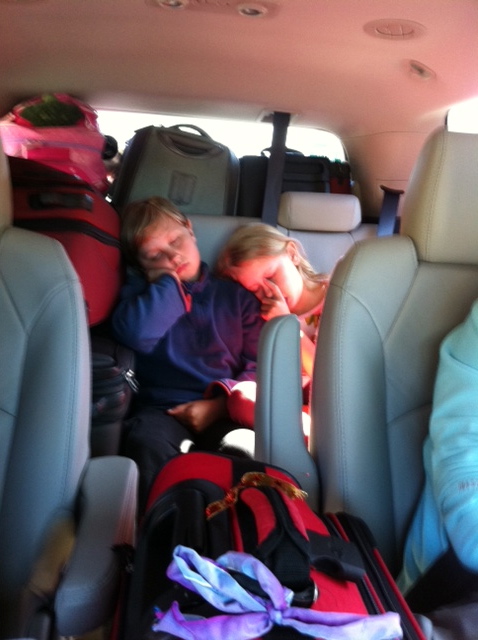
Nic and Emma driving back to the San Francisco airport last week.

I love this photograph because you wouldn’t know anything was amiss.  It was taken on our drive back to the airport as we were leaving Napa, California last week.

I don’t know whether other parents of children with autism feel this way or not, but any time I see Emma interacting with another child in “typical” or more typical ways, my heart soars.  Whenever Emma acknowledges Nic’s presence, plays with him, tries to be with him or shows a desire to be with one of her cousins I am filled with hope.  These tiny moments are like little beacons in an often dark tunnel.

“Without motivation she will not try,” one of the many specialists we took Emma to once said to us.

When I decided I was going to teach Emma how to hug a family member, it was with the hope that she might find she liked the sensation and might take the initiative to hug one of us without being prompted to do so.

“Put your arms around and squeeze,” I instructed her.  Sometimes she seemed happy to do so, other times, she didn’t.  Usually she put her arms around the person while keeping her body from having direct contact, her head jutting away at an odd angle.  I probably would have had more luck teaching her the art of the air kiss, she would like that (which says something about my waspy heritage).

As much as Emma does not appear to derive much pleasure from hugging while standing, she loves to get into Richard and my bed in the mornings and cuddle.  She aligns her body with mine and lies as close to me as she physically can.  Often she will pull my arms around her so they are holding her in a snug embrace.  Other times she will run up to one of us and give one of us a kiss or will climb into our lap.  I take it as progress.  It reminds me of a blog post I wrote over a year ago now when Emma embraced me as I was standing in the kitchen.  I was in shock because it was unprecedented.  Now those sorts of spontaneous embraces are more commonplace.  But it shows progress.  Or what I think of as progress.

One of the things about an autism diagnosis that makes me sad is the thought that my child may not have the experience of friendships.  But as Emma matures, I have learned to redefine what “friendship” means.  And I have seen that in Emma’s own way she does have friends, children she prefers to be with.  Emma’s friendships do not include secrets or talking or sleepovers.  They do not include making bracelets for each other and excluding other children in a show of preference.  Emma does not know about cliques, gossip, comparing, jealousy or what it means to be “cool”.  Emma is thankfully oblivious to all of those social constructs we try so desperately to shield our neuro-typical children from.

Emma is present, almost always in the moment.  I don’t think she worries a great deal about the future, she just is.

For more on Emma’s journey through a childhood of autism and her first spontaneous embrace, go to: www.EmmasHopeBook.com

“Go Back” – Autism

Last week Emma began crying and said, “Go back to hotel.”  Richard felt she was missing me, as I had to leave my family to return to Colorado for work when we left California instead of returning with them to New York City.  We also felt she was wishing we could have stayed longer and spent more time with my extended family, all of whom she loves being with.  She had such a wonderful time with so many family present at the Bed & Breakfast in Napa, California where we stayed for my brother’s wedding.

There’s a mistaken thought by many people that because a great number of children and adults with autism cannot express themselves well and often do not show tremendous emotional attachment to those they love, that they do not love.  Some people believe they do not feel the same intensity of emotion that we neuro-typicals do.  I disagree with this thinking.  I believe Emma loves and misses people as much as any neuro-typical child.  I believe she misses them with the same aching as any of us do.  The difference is, Emma doesn’t have the same neuro circuitry or the ability to put into words her feelings.  She lives in a world that must be incredibly confusing so much of the time.

I wonder, when I get on the phone with her, how much does she understand?  Does she understand that I am in Colorado and not in New York with her, Nic and Richard because I have to work?  Because time is a difficult concept for her, does she really understand when I will be returning?  When she wakes up in the morning does she wonder if I might be there only to find I’m not?   Our phone conversations are limited.  When speaking with Nic, I can reassure him that I will be home in another couple of weeks.  We can discuss what he did, he can describe the breakfast he fixed for his dad yesterday for Father’s Day.  We can talk about things.  With Emma, who does not and cannot ask questions, I ask – How are you?  She tells me she’s fine, even if she isn’t, because it’s the conversation we always have on the phone.  She may add some random thing such as – “Seal park, Chelsea piers carousel” and I can deduce that Richard took the children there yesterday.  I always ask her – What did you do today?  To which I can receive an accurate list of what she did, but just as easily I can receive a somewhat confusing version of events that may or may not have taken place.  I then will verify with Richard to get a clearer idea.

Yesterday was Father’s Day and Richard spent it with the children.  There was no sleeping in for Richard as I’m not there to give him a break.  Nic made him a special breakfast and then Richard took the children to various parks.  I know it wasn’t the day Richard would have liked.  I know how hard it is being the sole parent taking care of everything, especially for such an extended period of time.  And particularly tough when it’s a day designated to celebrate fatherhood.  When I spoke to Emma yesterday I said, “Be sure to tell Daddy – Happy Father’s Day and give him a hug, Em.”

“Happy Father’s Day,” Emma said into the phone.  I have no idea where Richard was or if he overheard her.  I can only hope he did.  I know Emma loves her dad.  She isn’t able to express it in the typical ways we are used to, but she does.

For more on Emma’s journey through a childhood of autism, go to:  www.EmmasHopeBook.com

Amusement Parks & Autism – Continued

Emma’s entire system was crashing.

“You have to ask Mommy!  Mommy can I go on the roller coaster with Gaby, please?”   She cried over and over again through screams and tears.

It was heart breaking and anyone with a neuro-typical child would think – oh just let her go on it one more time and then go home.  I even thought this a number of times as I tried to peel her off the pavement where she had fallen in a heap of tears, snot pouring from her nose, her hands made into tight fists while hitting herself in the head, on her chest, legs, arms wherever she could before I, or any of us could stop her.  The biting is horrible because it can break the skin and then there’s blood, and later scabs and enormous angry blue and purple bruises that can last for more than a week, reminding all of us of her agony.  But the hitting – a quick, violent punch to the face is shocking to witness and as a parent, it’s difficult not to feel one has done something horribly, horribly wrong.  How can this sweet, blissful child do this to herself?

Emma waiting for Joe, Nic and Gaby while they ride on the Corkscrew

Richard and I have always said to the children – hitting is wrong.  We don’t do it, we don’t want them to ever do it to each other and until Emma began hitting herself, it hadn’t occurred to us to add – we don’t hurt ourselves.  We don’t hit others or ourselves.  We say it, but I don’t know that it makes a difference.  When Emma’s brain has become set on something, no amount of calm, reassuring logic seems to help her.  No amount of soothing, we just have to vacate the premises.  It’s our only hope.  Kind of like shutting the whole system down, a kind of reboot.  We have tried the other option, which is to let her go on one more ride or do whatever it is one more time and the misery, the abject misery continues.  Like an addict who has to have that drink or that drug even while bringing them no real solace.  There’s no relief to be had at a certain point.

“Emmy it’s going to be okay.  We’re going to go home now.  We can ride the little roller coaster one more time and you can sit with Gaby and then we have to go home,” we told her.

But Emma’s brain couldn’t take in this information it was already in lock down mode.  I gave her a banana to eat and then everyone, our once cheerful little group, now more weary warriors than a family intent on having a lovely day at an amusement park trooped along.  She was able to sit with Gaby on the little roller coaster for one last ride and then we trudged back to the car while Emma kept looking over her shoulder at the wooden roller coaster named Roar.  As we headed home Emma said, “It’s okay, we’ll come back tomorrow.”

“No Em.  Tomorrow we’re going to traintown where there are different rides and then we’re going to Uncle Andy’s wedding,” we told her.

“Different rides,” Emma repeated, sadly.  “We’ll come back soon,” she said.  There was a wistful tone to her words, and we knew it wasn’t likely that we would ever come back to this part of the world.  But there would be other amusement parks and maybe one day Emma’s massive sensory issues will have abated to such a degree that these kinds of episodes will become rarer.

We can only hope.

For more on Emma’s journey through a childhood of autism go to:  www.EmmasHopeBook.com

Cooking with Emma

Emma seems to have lost interest in her velcro strip.  It was actually the plastic back to the self adhesive velcro that she liked, but her yellow balloon string has replaced it for the past few weeks.  Instead of holding it in her hand, she puts it between her front teeth, like an enormous piece of floss, allowing her hands free.  She races around on her scooter, the balloon string held in her teeth, the rest of it undulating after her.  It reminded me of a Turkish woman I encountered years ago in Ezurum, Turkey.  She was wearing a shawl like head covering the size of a bed sheet and had one corner hooked on one of her front teeth.  The fabric was loosely around her face, but kept slipping off her head.  I remember watching her move along an alley, the fabric billowing out, as she hurried away.  She turned, at one point and looked directly at me, many of her teeth were missing, but her upper incisor was intact and she used it to secure the fabric so that it couldn’t blow away, leaving her hands free.

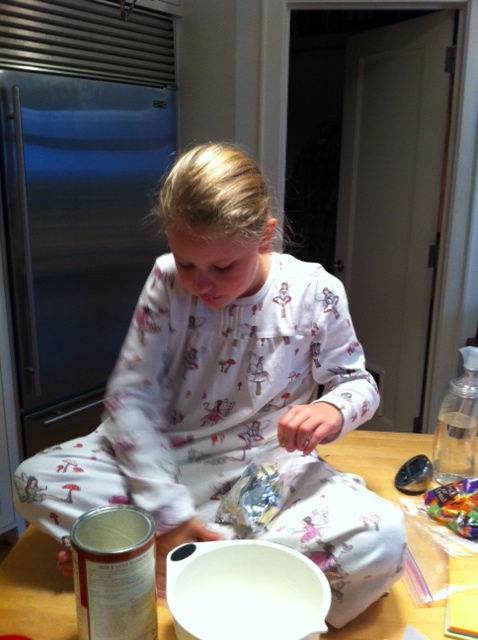
Yesterday evening when Emma asked that we make pancakes, she climbed up onto the kitchen island, the balloon string secured between her front teeth.  “Mixing bowl,”  Emma said, despite the presence of the yellow string in her mouth.

“Emma!” I laughed.  “You can’t cook with that balloon string.”

“Have to put it down!” Emma said, pulling it from her teeth and tossing it to the floor.

“Pancakes with chocolate chips please!”  Emma said.

As I rummaged around to locate the chocolate chips I heard Emma say, “Uh-oh!”

“What happened Em?” I asked turning around.  Emma sat with about a cup of pancake mix in her lap, a dusting of mix covered her arms and legs.

“You have to pour it in the bowl!”  Emma observed with a slightly irritated tone.

“Here you go Em.  Let’s clean that up.”  I handed her a damp paper towel which she used to dab at her face.

“Okay, but we have to clean up all this mix,” I said, pointing to the flour covering her and the counter.

“Mommy help?”  Emma said, half heartedly patting at the mix creating little clouds that then spread out over ever increasing areas of the counter.

“Yes.  I’ll help.  Here, look.  Let’s clean it like this.”  I brushed mix into my hand and threw it in the sink.  “Now you do it,” I said as I got out the milk.  When Emma had finished cleaning up most of the mix I said, “Here, you measure the milk.”  I handed her the measuring cup and gave her the milk.  Carefully she poured the milk into the measuring cup until it filled it about half way.

“Dit,dit, dit, dit, dit, pour in!”  Emma sang.  She always says this when she is measuring something during our cooking together.  I don’t know where the “dit, dit, dit” comes from or even what it means, but it’s part of the process now and so she always says it.

I held the whisk in front of her.

“Mommy, can I have the whisk, please?”

“Yes!  Here you go,” I said, handing it to her.

“Whisk, whisk, whisk, the pancakes, mix, mix, mix the pancakes,” Emma sang as she stirred, while occasionally dipping her finger into the batter to eat large dollops of it.  ‘Yum, yum!”  she said.

Emma making pancakes

For more on Emma’s journey through a childhood of autism and cooking, go to:  www.EmmasHopeBook.com