Category Archives: communication

An Analogy – Communication via Violin

*This is a guest post by a friend of mine who is brilliant and thoughtful and compassionate and patient and, well, all-around fabulous.

*Guest Post by DYMPHNA

This blog post is a brainstorm I had after reading several posts (‘here‘ and ‘here‘) on this blog regarding the idea of communication, particular why spoken language, which seems so natural for some, is more difficult for others.  First, I must own the fact that I have a pretty strong relative privilege in this vein.  Spoken language comes naturally to me, so I am writing all of this with the caveat that I might be totally wrong.  If Autistics who are less inclined to spoken language correct me on anything I write in this blog post, listen to them, not me.  Secondly, this is an analogy and all analogies are imperfect; my hope is that this might provide an accurate framework through which people who grasp spoken language easily might be able to understand the difficulties of those for whom it does not come so easily.  (This process for learning music is way out of order from how people actually learn music.  Please don’t kill me, music educators.)

Okay, so, in this analogy, you are going to take this page of information and realize it into meaningful sound:
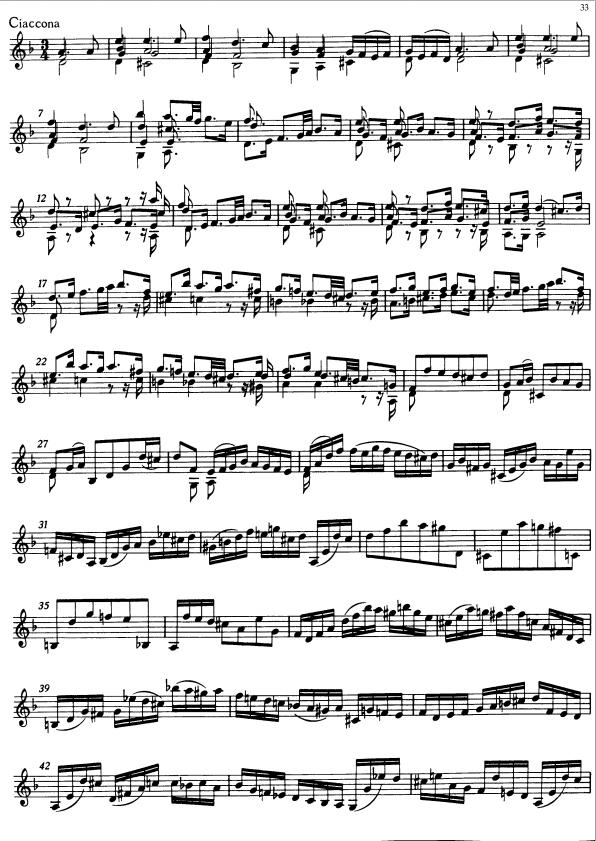

[Image description: Picture is the first page of the Chaconne
from Bach’s Violin Partita No. 2 in D Minor, BWV 1004.]

Now, for many of you who haven’t learned anything about musical notation, you are already at a loss.  The picture above is literally meaningless to you.  There are some horizontal lines and there are dot’s connected to vertical lines and there are these weird symbols that look like a lowercase b and a #.  If you haven’t learned to read musical notation, the only things on this page that you even recognize are some arabic numerals that you have no idea how to interpret and this Italian word at the top “Ciaconna”, which the dictionary defines as, “a slow, stately dance of the 18th century or the music for it,” a definition which is not particularly helpful.  With the resources available to you, you have established that this is an Italian dance from the 1700s.  So in order to realize the page I put above you, you need to become fluent in musical notation and have the ear training necessary to understand what the pitches are and how to keep time properly, a process which many people find quite difficult.

So, having learned all you need to know about musical notation, you’re ready to perform the Chaconne, right?  Well, probably not, as you have no idea how to play the violin.  (Violinists, you are playing the piece on the piano.  If you are also a pianist, you’re playing it on the flute.  If you’re also a flautist, you are playing it on the musical saw.  If you also play the musical saw, you need to just accept the premise of this analogy and move on.)  If you are not a violinist, and I imagine that most of you are not, you don’t even know how to set up, hold, or tune the instrument, let alone produce a decent sound and then connect those sounds into a meaningful piece of music.  So now that you understand what the notation means, you need to tackle the actual physical reality of learning how to play the instrument, a skill that takes years to do competently, decades to do proficiently, and half a lifetime to do masterfully.  You need to learn how to hold the instrument and the bow and all sorts of skills about how to make the correct sounds come out of the instrument.  Likewise, before you can do any of that, you have to learn to set up and tune the instrument, skills which are quite challenging to the beginning player.  (As someone who has attempted to play the violin on several occasions, I can attest to this.)  The process usually involves tedious work on many minute elements of technique that are by themselves very difficult, such as using different bow strokes, crossing strings, and pressing the fingerboard in the correct location.  Moreover, you have to keep track of all of these elements of technique while attempting to accurately realize a score of music, so in addition to the difficulty of playing the music, you are simultaneously applying the skills you’ve learned in step one.

Congratulations!  Having done that, you have the skills needed to accurately realize the first page of Bach’s Chaconne, a skill that will land you zero audiences and communicate very little.  What most people don’t realize is that very little information is actually given to the musician by the composer.  Many elements, such as the subtle ebb and flow of time, the varying loudness of any given instant of music, vibrato, etc., the elements that make music expressive and, if you’ll pardon the expression, musical, are not given to the performer by the composer.  If the performer performs the work exactly as written on the page, it will sound mechanical and banal.  This is why proficient musicians spend a great deal of their time focusing on interpretation.  They are trying not only to reproduce the pitches and rhythms indicated on the page, but also subtlety that music needs to be truly compelling and persuasive.

All right, having done all of that, you can now convincingly convey great musical ideas.  Musical ideas written by Johann Sebastian Bach.  While you certainly bring something of yourself to the table, none of these are ideas that you originally had.  The basis for all of these ideas was written almost three centuries ago.  In speaking, this is analogous to someone being able to convincing recite a work by Shakespeare.  A great skill in its own right, but all the while we’ve still fallen short of our actual goal, which is to communicate our own ideas effectively to others.  Right now we are only equipped to communicate other people’s ideas, albeit with our own twist.

I would like to pause here and draw some of the analogies between playing the violin and speaking.  First of all, there is the process of developing a rudimentary understanding of what music is, which corresponds to having a crude and basic understanding of the English language.  I will discuss the full understanding in just a moment.  Next, we have to negotiate the physical reality of playing the instrument.  We might have a fantastic conception of what the Bach Chaconne should sound like, but that means nothing if we lack the ability to realize it on the instrument, which is an inherently physical process.  This, not surprisingly, corresponds to the actual motor process of forming words.  For many of us, those processes seem pretty simple, but imagine what it would be like if they didn’t come naturally to you.  Imagine if everyone seemed to have this innate aptitude for holding the violin and producing pleasant sounds on it while you are struggling to get notes out.  Most people, having able or neurotypical privilege, take this ability for granted, so I want you to imagine a world where, instead of speaking, we communicated by playing the violin, a skill for which many people do not have the natural aptitude.  This is where the Social Model of Disability comes into play.  For those who find speech easy but playing the violin difficult, this world is fine for them while they would be disabled in the violin world.  Likewise, those who find playing the violin easy and speech difficult are disabled in this world but fine in the violin world.

Resuming our violin analogy, there is a lot more to speech than playing the Chaconne by J.S. Bach.  As I stated before, most people seek not to reproduce the ideas of others, but rather to convey their own ideas, which they do in real-time.  In music, this equates to improvising, a skill that isn’t necessarily that difficult provided you don’t seek to convey anything that complex.  However, there are still things to consider.  First, you want to have the semantics of what you are improvising accurately reflect what you are trying to convey.  I cannot think of an accurate analogy for this, so please leave an idea in comments if you have one.  On top of that, you have the elements of music theory, which is essentially the grammar of music.  Certain notes in certain contexts convey specific meanings that might not be conveyed in another context.  Without using this correct syntax, what you are trying to convey will start to sound random and disorganized or possibly just “wrong”.  This process comes very easily to most people, but understanding grammar is no simple task, a fact which anyone who has tried to learn a foreign language can testify.  In our native language, we can just say what “sounds right” without having to put too much thought into it.  In the same way, a native tonal musician might be able to tell you that a C-Sharp and a G need to resolve to D and F intuitively without explaining the theoretical reason behind this in the same way that you know whether to use “me” or “I” in a sentence.  However, just because this process comes to us intuitively doesn’t mean it isn’t going on and it’s something we oughtn’t take for granted when thinking about communication.

So what is the point in all of this?  I’ve drawn all of these parallels about how spoken language is like playing the violin.  The point in all of this is the following:

First, the process that we think of as intuitive and easy is not necessarily that easy or intuitive for others.  I don’t find playing the piano very difficult, but most people would struggle to play something rudimentary on the piano because they are dealing with all of the things I mentioned above.  Moreover, at the piano, you at least have the reassurance that if you press a key, a musically sounding sound will come out, something that isn’t guaranteed on a violin or when speaking (which is why I chose the violin for this analogy).

Second, I want people who find things to be easy and intuitive to think about what it might be like for those who don’t find the process so intuitive.  As many people are not instrumental musicians, I challenge you to think about what challenges you would face in the world if, instead of communicating via mouth sounds in natural language, we communicated by instrumental music.  Hopefully this exercise will expand your empathic process so that you can understand what it means to be disabled without medicalizing us or assuming we have a deficit.

Third, I want everyone to think about some of the strategies you might employ in this alternative violin world where you are struggling with many of the rudimentary elements of communication.  Maybe, since you don’t want to have to deal with the challenge of writing a syntactically correct and semantically accurate statement while dealing with the difficulty of playing the instrument, you might instead use an existing melody that approximates what you want to say instead of attempting to improvise something of your own.  Maybe in this violin world, you’ll get special education for doing this, seeing that you have musical echolalia and your ability to use spoken natural language, a skill that frustrates you as you want to use it to express yourself while no one uses that skill, is seen as a “splinter skill”, not inherently useful, but rather a means to develop your violin skills, which are the “correct” way to communicate.

I think this exercise in empathy is much more effective than the wholly appropriative and mocking “Be Disabled for an Hour” idea that many people try out.  Of course, you need to recognize that this will not give you a perfect view into our world.  Being that you don’t live in this culture in which you are disabled, there are things that might not occur to you that are realities that disabled folks have to deal with every day.  Thus is the nature of privilege.  But I hope this has expanded your notion about how disabilities impact your life and how society defines what is and is not a disability.
Sensing Another

Last week I wrote a post, Speaking vs Typing, which sparked a terrific discussion about language, communication and how we interpret what others say and do.  My friend Barb, who wrote (with Lois Prislovsky) the not-to-be-missed book, I might be you commented:

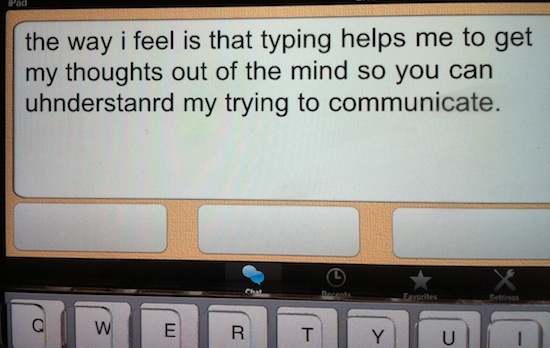
“my dear neurotypical friends, first, let me say i love that you all are putting your heads together to break down this truth into practical ideas to help me and my autistic peers who struggle mightily with spoken language communications. em is right, “language is an awkward way to communicate” and i argue that is true for everyone but highly challenging for those of us who are autistically wired in the “vanilla cake” or “mail truck” way that em and i are. it took me years to think in language. but prior to that my thinking was not faulty it was just not language based. thinking in language is not efficient for me. i wish i could give you a pretty little fact package about what works so folk like me could get such treatment and soar socially and academically. of course, the problem is…it is hard to say in language. typing makes it way easier, because i can control the speed of each thought and break it down to smaller parts to be better described by letters one peck at a time. speaking requires a rather unnatural process for me perhaps like you singing a song you heard in another language. u may be able to imitate the sounds but the meaning in each mimic is not precise. since most folk are not yet well practiced in telepathy the best way for me now is to communicate through typing. but still my thinking is not easily translated in to words. feelings, sensations, visions and perceptions that are cleanly processed in my mind dont fit well into letter symbols. there i said it – or something close. thanks for caring. trying b”

Barb’s comment made me wonder whether my daughter is able to “hear” my thoughts, even if just a little.  And that if she were able to, it would make sense that either typing or speaking would feel like an inferior, less efficient form of communication, perhaps it would be viewed as somewhat barbaric, and certainly a less sophisticated way of communicating.  So I asked her, “Can you hear my thoughts?”  To which she answered, “No.”  Not undone, I asked, “Do you feel them?”  To which she did not reply.  This post is not about mental telepathy, but is more about how we sense each other.  Some of our senses we are taught to fine-tune and others society either doesn’t recognize or doesn’t place as much importance on.

But what if we lived in a culture that did encourage sensing another’s presence and feelings?  What if, from the time we were born, our sense of other people’s state of mind, their feelings, was nurtured.  Would that change how we communicated with each other?  What if spoken language took a back seat to our intuition?  What if we lived in a society that placed more importance on our presence, than on our words?

All of this reminded me of a conversation I had with a couple of friends, both of whom are Autistic, about disability and society’s role.  I wrote a post about that, ‘here‘.  One friend said that if we lived in a world where everyone used a variety of alternate forms of communication, where a longer time period was allowed and expected between words, and supports were anticipated and provided, then people who do not speak would not be considered disabled, just as I am not considered disabled because I cannot juggle or jump as high as an Olympic high jumper.

If children were taught at an early age to sense each other without relying on language, would we evolve into a species where language was viewed as unreliable and untrustworthy?  Does my daughter view language as a lesser form of communication?  Is she not as motivated to communicate, either through typing or verbally because her other senses are more finely tuned?  Does motivation even enter into all of this?  My brain is constantly looking for intent, motivation, but what if this isn’t what’s going on at all?  What if this has nothing to do with any of that?  What if she is trying so hard to communicate by typing and speaking because she understands I want her to, but not because she has the same need that I have?  Does music call to her because it is less about the lyrics and more about the beauty of the music, the feelings the music evokes?

Is all of this way too esoteric and ethereal?  EmTypes ICI


A Few Thoughts…

I haven’t written anything on this blog for an entire week, the longest I have gone without posting something since I began blogging over three years ago.  A combination of things kept me from my routine, the first being – Emma and I were away, traveling to a new place with food we do not usually eat, people, most of whom we did not know, sleeping on beds we weren’t use to.  Everything about our environment was different, but there was something else too.  Something I can’t completely explain because I haven’t figured it all out yet.  Something that was more than just a disruption to routine, something about identity and society and how the two intersect and influence each other, what that means and how that changes the way we live our lives.  These are all thoughts that are more like wisps of random words than fully formed structures I am able to describe.  I am in the midst of these words, loosely pieced together ideas; I am twirling among them, investigating, looking, feeling and trying to be still in my discomfort of not knowing or being able to define.

Em and I traveled to a place that was created, organized and for Autistic people.  I took Emma because I wanted her to experience being in a place where her neurology was in the majority.  I wanted her to meet others who are more like her than not.  Em has not commented on our time away other than to say she had fun.  I, however, have a great many thoughts and feelings about being in such a place.  And I suppose the thing I felt more than anything else was how much more alike we humans are no matter our specific neurology.  But there is always a danger in making such a statement.  I have been accused of “sugar-coating” autism.  I have been told my daughter must be “high functioning” because surely if she were like their child it would not be possible for me to have come to a place of not just acceptance, but celebration of all that makes her who she is.  Some people have written that by accepting I am giving up.  They equate acceptance with resignation and doing nothing.  Others have said that acceptance will not get my daughter and others like her the services needed, that the negative rhetoric is necessary.

People have written me that they want to hear about the hardship, the difficult times, the pain…  they wonder at my decision NOT to talk about that.  To all those who come to this blog hoping to hear about the gory details of parenting an Autistic child – better to move along, you aren’t going to find that here.  There are countless blogs that do that far better than I ever could, even if I wanted to.  I lived too many years of my life neck-deep in pain and all that was wrong with this planet and my life.  And by the way, I did that well before I had an Autistic child.  I am more than capable of seeing the world as a dark and miserable place.  I don’t need a great deal of encouragement to go there.  Perhaps one of the greatest gifts I have been given is that I was once in such tremendous pain and know how easy it is to live in a place that feeds off that misery.  I have no desire to return to that mindset.

I am interested in hope.  I am interested in both being the recipient of and the giver of hope.   Hope gives me energy.  I feel invigorated by it.  When my daughter types something I have never heard her communicate to me before I am filled with joy. When she says something I have never heard her say, I am filled with happiness.  When she performs a new song, in Greek, no less, I feel proud, I feel excitement, I feel the beauty of her voice fill my soul, I feel bliss.  When my daughter reads something and makes a comment about what she’s just read I am euphoric.  When she tries something new, I am cheering her on.  None of this erases the moments of pain.  None of this means everything is simple or easy or that there are never moments of sadness or difficulty.

I will and do write about my own challenges, not because of my children, but because of who I am.  Placing blame on others for my issues and challenges is not something that helps me change and it definitely does not make me feel any degree of happiness.  My best moments with my daughter are spent when I have no expectations and greet each moment with wonder and curiosity.

“Type three colors,” I said this morning.

“…Violet, slate blue and red,”  Emma typed.

I’m in awe.

Emma’s ever-changing “string”

Em's String

When Insights are Speculation

One of the things I’ve felt particularly confused by is why my daughter sometimes resists communicating.  My thinking has been – why would she resist doing the one thing that will help her get along in this world more than perhaps anything else?  The other day, I had a moment of clarity.  I came a step closer to “getting it”.  And now, I think I understand.  Not only do I think I understand, but I am able to identify and relate to that resistance, because, I realized, I do it too!  There are a number of things I resist doing, even while knowing that if I just did them I’d feel better and would be able to weather the vicissitudes of daily life a bit better.  I’d be happier, calmer, less anxious, and yet knowing this, intellectually understanding that this is true, does not make my resistance any less.

know being mindful and in the present gives me clarity and a sense of calm, I do not otherwise have.  I know this, and yet find it extremely difficult to be completely present for more than moments at a time.  My daughter has little problem with this.  In fact, Emma is far more comfortable in the moment than anywhere else.  I remember when we were inundated with therapists coming and going during those early years of fear and panic.  Richard and I used to comment on the irony that Emma was completely present and in the here and now far more easily than we were and yet we were constantly encouraging her to talk about tomorrow or yesterday or any number of other topics that had little to do with NOW.    We were pushing her to move away from the bliss of this moment to join us in the fear and anxiety of the non-present moment, all for the sake of the larger picture, which in our minds was to have her join us in our world.  Even though our world was fraught with expectations, hopes, dreams, wishes and the inevitable disappointment those things often bring.

We used to joke that if we could bottle what Emma came to naturally we would have no cause for worry.  And that really is the crux of most conversations.  They are usually not about the here and now.  They are almost always about some other time, some other idea, some other person, some other concern that is not now.  And yet…  

I resist being in the present and Emma resists being pulled out of it.   And yet, we non-Autistics continue to insist our world is better, or superior even as many spend thousands of dollars going on spiritual retreats, reading books about meditation and going to workshops to teach us how to “sit”.  So the question I am now asking myself is this:  Can I find the grey area of encouraging Emma to communicate with me, something that is difficult for her and pulls her from the bliss of now, while giving her plenty of time to be present and just be?  And what about my own resistance?  Can I learn to meet Emma in her blissful place of now and resist the urge to go off in my mind to somewhere else?

Of course there’s always a danger in interpreting my daughter’s behavior as any one thing.  Her resistance, like mine, is probably made up of many things, and this could be just one reason.  Or I may have this entirely wrong and her resistance is about something that hasn’t even occurred to me.  Or perhaps it isn’t resistance at all and is something else or I may find, next time we type together and when I ask her why, she will tell me something I hadn’t considered.  And that’s the beauty of all of this, I can’t and don’t know until she tells me.  Until then it’s just speculation and me projecting my stuff onto her.   So that’s more for me to be aware of – seeing when and if I do that and understanding that I am.

Henry and I sharing a moment of laughter at Emma’s antics

H & A