Monthly Archives: November 2014

Autism ≠ Developmental Delay

There were few things that led us more astray than the idea of autism being a developmental delay.  Last week Emma wrote, “Autism is not a developmental delay, rather it is a different road entirely.” I was reminded of this last night as I watched a video from 2006 when we took Emma, who was then four-years old, to meet the late Stanley Greenspan.  (This post is not about Stanley Greenspan or his method.  His name is brought up only because of the video that inspired this post.)

Watching that video last night was brutal.  The private hell of regret is a cruel place to linger.  Emma described her experience of watching the video last night as “wading into the marsh of worry and fear, but quiet love was there even when the days were dark.”   In typical Emma-fashion she generously and compassionately reminded me that it was not all an unmitigated hell.  Unable to communicate her complex and insightful thoughts with spoken language, she languished for years in an abyss of being constantly underestimated and misunderstood.  Because people assumed  she spoke what she intended and meant, she was penalized for the words she managed to utter.  “Do you want to go fast or slow?”  “Do you want to stop or go?”  “Do you want to open the door or close it?”

Again and again the video shows us making assumptions about her actions.  We assume she has no interest in engaging.  We assume she doesn’t want to spend time with us.  We assume she is “in her own world.”  We make assumptions and we behave according to those mistaken beliefs.  We believed each word was a milestone, paving the way for more language acquisition.  We believed it made sense.  Lay the foundation, create a strong base of words for more to follow…  Use your words, use your words, use your words…

The assumption that her spoken language represented her comprehension and intelligence and therefore we needed to push for more was never disputed.  This idea of a developmental delay bled into every single aspect of her being.  It was believed that her speech was delayed, as were her fine and gross motor skills.  Therapies were structured around this concept.  All held the promise that if we did intensive, ongoing therapy she would one day, catch up, particularly if we did this during that brief window of opportunity, before she turned three, and then four, maybe if we were lucky, we hoped, the window would still remain open at five, what about six?  At the time we didn’t question any of this.  Had we known then that she probably already knew how to read, had we understood that what she said, was not representative of her intelligence or indicative of what she understood or knew, if we’d known that autism was not a developmental delay, but rather a “different road entirely”, it would have changed the path we proceeded down.

As it was, we did not know.  We listened to the many professionals we consulted.  Well meaning professionals, often incredibly kind and thoughtful, a few even brilliant, but none, not a single one ever mentioned the concept of a body/mind disconnect or how that might apply to our daughter.  It never once occurred to me that maybe, just maybe what she said was not what she intended to say.  It did not enter my mind that when she didn’t answer a question it was because she knew the answer, but couldn’t say the words, this thought, this idea was not something I even knew to consider.  We would learn about all of this much, much later and when we did hear these ideas, it came from the most unexpected source – our own daughter, Emma.  Not only was she the person we least expected to enlighten us, but she did so, not through spoken language, but by typing.  Eight years ago, I don’t know that I would have believed any of this, let alone that Emma would write about all of this in such detail, as she has in these posts:

Emma’s Presentation

Tomorrow’s Presentation

“Rethinking Your Beliefs About Autism”

When the Body Does not Obey the Mind

Parents who are just getting a diagnosis for their young children have so many more resources available to them than we had in 2004.  The most important being, blogs written by Autistic people of all ages, non-speakers, speakers, semi-speakers and everyone in between.  It is the writings and friendships I now am fortunate enough to enjoy, that have helped me more than anything else.  One day I hope the professionals parents are introduced to will be Autistic professionals.

My friend Bridget of the blog, It’s Bridget’s Word said to me, “The ‘delay’ concept is a trap. Development is not linear no matter how many folk whose livelihood depends on timetables try to make it.”

Cynthia Kim, author of Nerdy, Shy and Socially Inappropriate ,  I Think I Might be Autistic, the blog Musings of An Aspie and owner of StimTastic said, “That waiting to catch up feeling is so insidious and one that I subconsciously lived with for a long time.”

My friend Ibby, educator and author of the blog, Tiny Grace Notes, who is like family to me, said, “Speaking now as an education professor: “developmental delay” is an actual category under the IDEA which is not allowed to be used after the age of eight. The purpose of it was to give people with conditions in which they might “catch up” a chance to do so, and the doctors more time to pinpoint their diagnostics if not. If you look at the lists for most states of what conditions might cause “developmental delay” to be diagnosed before age 5 (as it has to be in most states) it makes some sense as being this sort of thing. Autism is not a “delay” but a condition causing atypical (as opposed to delayed but still on the same track of typical) development.”

Ibby added, “In short, this is not only dangerous and unhelpful but technically ignorant even if separated from the consequences.”

So what are the consequences of believing autism is a developmental delay?

Well, for us it meant constantly comparing our daughter to her non autistic peers (using their development, and not hers, as the ideal).  It meant pursuing all kinds of therapies that never questioned the push for spoken language.  It meant not considering AAC devices, because she “had language.”  It meant encouraging my daughter to “use your words.”  It meant asking her to focus on things that made it impossible for her to concentrate on what was being taught.  It meant looking at her through the lens of deficits, so much so that they became blinders shutting out everything else.

There are so many things Emma can do, that I cannot.  Her mind, as she so beautifully described it, is a “wonder, channel changing, multi-screened on fast forward” thing of beauty that defies all limits placed upon it.  My daughter amazes me every, single day.  As always, Emma said it best and it bears repeating, “Autism is not a developmental delay, rather it is a different road entirely” and what an amazing road it is!
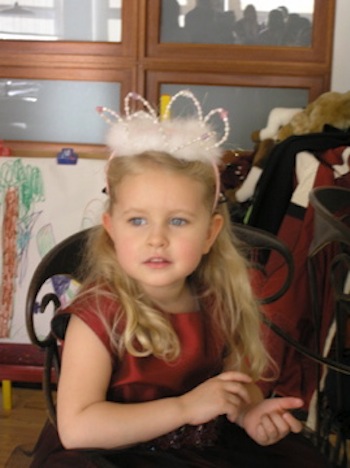
Emma - 2006

Emma – 2006

Advice for Parents With a Newly-Diagnosed Autistic Child – By Rina

The other day I read a wonderful piece of advice written by Rina, a friend of mine, who is Autistic.  Rina’s thoughts were what I wish I’d been told when Emma was first diagnosed, so I asked Rina if I could share them and she, very generously, gave me permission.  Rina’s words also reminded me of Kamila and Henry Markram’s Intense World Theory for Autism, which was the first “theory” I read that finally made any sense to me or even remotely reflected back what I was seeing in my child.

Rina told me she self-diagnosed early in 2007 after reading “The Curious Incident of the Dog in the Night-Time and was formally diagnosed in 2009.  Rina wrote, “…knowing this about myself has been the revelation of my life. I am exponentially happier, healthier, and more confident since learning this about myself. Now I understand myself!” A little later as we were discussing this post, Rina said, “I was over 40 when I discovered I was autistic, so I spent a large part of my life just thinking I was broken, weird, wrong…” Then she wrote,  “I was bullied terribly in public school, like most of our tribe, it demolished my self-esteem, I was depressed and suicidal…but not now. I am autistic and proud, awesome and I know it!”

I read Rina’s advice to parents to Emma before posting here.  Emma typed, “It nicely states what is important.”  So with that endorsement, here you go and thank you Rina for allowing me to reprint your words.

“You know what? I have lots of thoughts, and I’ve had them for a while, about what I’d like to tell parents of newly-diagnosed autistic children. Maybe I’m talking out of my ass. But this is what I’d tell them. (assuming a boy in this example, for ease of writing…)

Your child is autistic. His brain is wired differently than yours. Autism is a disability. He will have challenges, but with the proper supports, he will have a happy, healthy, fulfilling life.

He will follow his own developmental schedule. Ignore the usual “markers”. Throw them out the window. They will be of no use to you.

Try to remember, always, that your son is experiencing the world in far more detail, and with far more intensity, than you are. It will take a lot of time for him to learn to regulate sensory input. His experience of the world (meaning sights, smells, sounds, peoples’ energy, conversation, others’ expectations of him) will overwhelm him on a daily basis. Have compassion for your son. He will be unlike any other child, even any other autistic child. If you pay close attention, with a compassionate open mind, he will tell you what he needs.

There are four things that can be of most help to your son, especially while he is very young: quiet, calm, consistency, and comfort. More than any recommended (and expensive) therapies, these will be of most help to your son. He may have repetitive and/or sensory-rich behaviors, such as rocking, squeezing a favorite toy, repeating favorite words–these help him to find some order in the chaos of the world–if they do not harm him or others, please allow him these behaviors, no questions asked. If they embarrass you–well, quite honestly, that’s your problem and you need to find a way to deal with it.

If your son is nonverbal or semi-verbal, trust me that he is looking for ways to communicate with you. Behavior *is* communication. If there is behavior that upsets you, that seems tantrum-like, there are probably reasons in the environment, there are things that are causing your son pain–again: try to make his world quiet, calm, consistent, and comfortable.

Consistency: I cannot emphasize how important this is. If days cannot be consistent, give your son warning whenever something unexpected is going to happen. I am an adult, and it is still one of my stated accommodations that I need a head’s up whenever something new comes along, or I need a break so I can process the change. If you’re planning to take him along to his sibling’s baseball practice, to stop by a friend’s house, to go to a yard sale, whatever…plan in advance, tell him about it, tell him what to expect and how long it will last. You know what, I think this is common courtesy. Understand what your son needs and be courteous by giving it to him!”

compassion-energy

An Autistic Child is Murdered

Another Autistic child has been murdered by one of his parents.  This time it is a six-year old, little boy named London McCabe.  London joins a growing list of Autistic children who have been murdered in recent years.

A psychology professor who runs an “education” group for mothers of autistic children in California said, “quite frankly, I am surprised this doesn’t happen more often.”

Wow.

“I am surprised this doesn’t happen more often.”

The casual nature of this comment stunned me.

She then went on to say, “These children are really unable to be in a reciprocal relationship and the moms don’t really experience the love that comes back from a child — the bonding is mitigated.”  This horrifying statement is untrue, but beyond that, the suggestion that if our feelings are not reciprocated, it makes sense that we become murderous, is to make us so narcissistic, so incredibly monstrous as to be unbelievable.   This is Bruno Bettelheim’s famous “refrigerator mother” theory reapplied to Autistic children and it is just as awful in this new version as it was in the original.

Most Autistic children feel love for their parents, just as most non-autistic children do.  Even when their parents behave horribly toward them, even when they’ve been treated with contempt, ignored, bullied, ridiculed and publicly shamed by those who say they love them, even then, most children still love their parents.  As they grow older many may have more complicated feelings of despair, abandonment, become distrustful, anxious and terrified.  The idea that Autistic children do not feel intensely is an outrageously, misinformed idea.  Just because someone does not reciprocate in a way non-autistics understand, recognize or expect does not mean the feelings do not exist. 

It is extremely disturbing to read such a statement coming from someone who is treated with deference and as though she is an authoritative voice on the topic of autism and Autistic people.  This professor is one of a number of people who has a degree in psychology and has made inaccurate, misinformed and mistaken statements about autism and Autistic people, yet none stop to ask what the psychological damage is to the Autistic children and adults they demonize with their incorrect statements, not to mention the impact such statements have on a misinformed public.  Unfortunately, few seem to be asking any questions about any of this or even bothering to find out if such statements are true, including the newspaper that published her comments.

There is an increasing number of Autistic men, women, teens and even younger people who are writing about their experience of life, their relationships and the world.  I am surprised when I meet someone in the field of autism who does not follow at least some of the blogs so many Autistic people are writing.  The Resources page of Emma’s Hope Book has dozens of links to Autistic people’s writing.  The first 28 blogs listed are written by non-speaking Autistics.  One of those people is my daughter, Emma.  After a presentation Emma gave in New York City a few months ago, she and I had the following conversation:

Emma:  I hope people will question what they have been told.
Ariane:  I do too.
Emma:  Horrible ideas about people, cause many to do terrible things…
A little later in that same conversation, Emma typed, “Worry and fear are fueled by furious words spoken harshly.  Humor soothes, shining sunny rays spreading hope.”

As the mother of an Autistic daughter who cannot communicate fluently with spoken language, but communicates beautifully by typing, I am continuously shocked by the inaccurate information that is rampant on the topic of autism and Autistic people.  Yesterday Emma typed, “Understanding that all human beings want connection is natural and fundamentally human.”  And last week Emma wrote, “The people of this world need to be exposed to difference and then shown compassion for their ignorance and limited thinking.”

For people who do not have the ability to communicate with spoken language and/or have sensory issues that impact each individual differently, expecting them to respond the way people who do not have any problem speaking and have never been assaulted by their environment, is relying on a false idea.  It is this false idea that continues to misrepresent so many.  It is this false idea that serves to hurt Autistic people.

The psychology professor told NBC News that mothers do not have the experience of their love returned by their child.   “That is one of the most difficult things for mothers” she told the reporter.

If this were true, it would be hard.  Years ago, when I once believed a great many things about my daughter, that I now know are not true, it was an awful feeling.  But it is far worse to be that child who loves, but is believed incapable of love.  It is far worse to be so thoroughly misunderstood, to be constantly misrepresented in public, to be thought so problematic that people sympathize with the mother who murders you… that is far more horrific than anything I will ever experience in this world.

London McCabe

London McCabe

Ideas, Insights and Discovery

This morning I had an idea, which turned out to be something I thought was a good idea, only to find that what might seem like a good idea to me, is not necessarily a good idea to my daughter, and the reasons why were not something that ever occurred to me.

I am continually surprised by the insights Emma, so patiently, gives me and am reminded again and again that my assumptions limit my views.  Thank you Emma for giving me permission to post our conversation.

Ariane:  I thought we could begin the day by discussing who you might like to interview and about what topic?

Emma:  Is the way here, thinking, knowing, and asking about another, helpful?

Ariane:  I think it’s interesting and certainly can be helpful to get to know other people’s experiences of life.  Asking is a great way to understand another’s perspective.  Who would you like to interview?

Emma: Using questions to sing truths meaningfully speaks to all.

Ariane:  That’s so true!  Music is a universal language that can transcend words.

Emma:  What did those we cannot ask, say?

Ariane:  Who are you thinking of, Emma?

Emma:  Those who cannot speak and have no one who believes in their ability to communicate in other ways.

Ariane:  Here’s the thing though, we can ask.  We may not get an answer we understand, but we can still ask and I think that’s the beginning, right?  We ask anyway and then do everything we can to understand the answer, even if it’s not in spoken language or in ways we understand at first.

Emma:  Understanding that all human beings want connection is natural and fundamentally human.

Ariane:  I agree.  So Em, what was it like before you were able to type?

Emma:  Days bloated with tears, frustration, anxiety and raging questions that only made daily living harder.

Ariane:  Ah…  can you tell me more?

Emma:  Thinking and wanting to ask questions, but knowing the words would come out wrong was too painful, best to silence asking than to be in the smothering feelings of tremendous frustration.

Ariane:  I imagine interviewing someone must be hard, even now that you can type.  Would you say that’s true?

Emma:  Sometimes ease is not an option.

Ariane:  You do not need to ask any questions unless you choose to, Emma, I wasn’t considering any of this when I first introduced the idea.  I’m sorry.  What else should we do right now?

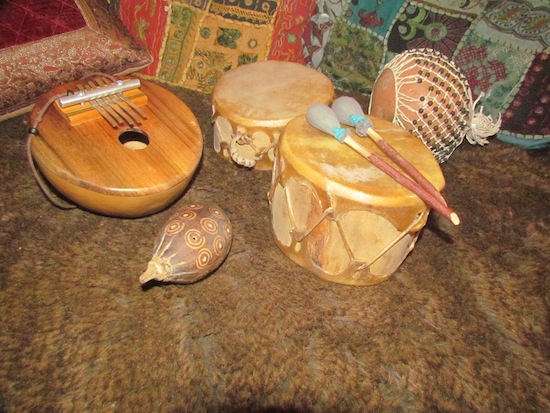
Emma:  How about a conversation using music and no words?

Ariane:  Great idea!

Some of the instruments Emma chose for us to use in our "conversation."

Some of the instruments Emma chose for us to use in our “conversation.”

An Interview with Emma About Halloween

What follows is an interview I did with Emma regarding her thoughts about Halloween.

Ariane:  What do you like best about Halloween?

Emma:  The excitement of dressing up in costumes with no attention paid for oddities.

Ariane:  There were a great many people out.  What was it like to be among such large crowds of people?

Emma:  Wanting to be a part of the crowd and not necessarily the same.  There is acceptance in that.

Ariane:  Did you like going from house to house and interacting with the people?

Emma:  Yes, I like having one day when I am not penalized by strangers for being me.

Ariane:  What else about Halloween that you like or do not like?

Emma:  I mostly enjoy being with so many, on a night when individuality is celebrated.

Family Photo - Halloween 2014

Family Photo: (from left to right) Ariane, Emma, Richard & N. – Halloween 2014

Heading out while it's still light...

Heading out while it’s still light…

Many others had the same idea...

Many others had the same idea…

Richard terrified small children everywhere.

Richard takes a seat.  It’s hard work being this frightening.

A night when individuality is celebrated.  (Random stranger who was happy to pose with dogs.)

A night when individuality is celebrated. (Random stranger who was happy to pose with dogs.)

The dead rises… and gives out candy to all who ask.

The dead rises… and gives out candy to all who ask.

Heading home...

Heading home…