Monthly Archives: May 2013

Where There’s Anger There’s Fear

It’s taken me decades to figure out that whenever I am angry, fear is lurking.  All kinds of people talk about the association between anger and fear, but it was not a thought I was able to appreciate.  It’s still not the first thought I have when I am angry about something.  It’s not even the second thought.  In fact, I’m lucky if it’s something I can remember at all when I’m angry.  Yet, if I look back on all those years when I was so very frightened of my daughter’s diagnosis and what I assumed that meant for her future, I see how linked the two were.  But it was the fear that grabbed me by the throat and no matter what I did, it seemed unaffected and unwilling to let me go.  It was the fear that made itself known to me; the anger was far more subtle and insidious.

“When you sense a threat  your mind generates fear and anger.  The fear you generate is part of a flight response from your physiology. Anger is the emotional energy you generate for the fight against that perceived threat.  What can be confusing is that your mind creates fear and anger even when the threat is just imagined.” ~ Pathway to Happiness

I understood things like the above paragraph.  In a calm state of mind, it made perfect sense that my anger was rooted in tremendous fear, even if imagined.  What did the future hold for my daughter?  How was she going to get through life?  How would we be able to keep her safe?  How would she fend for herself?  Would she be able to fend for herself?  Who would take care of her once we were gone?  Fear.  Fear.  Fear and more fear.  And then, without even realizing it, I would find myself furious.  Enraged.  And my rage found the perfect target.  Autism.  Autism was what I was furious with.  Autism was what the problem was, so it stood to reason that if I could remove it, all would be well.  So this is what I set out to do.  Except that my daughter happened to be Autistic.  But if I didn’t say it that way I could continue to separate the two.  I could continue to tell myself I was fighting the autism and not her.  I could continue to believe that my anger with autism would not affect her.

“Anger is the natural emotional reaction to what the mind and imagination are doing.  The way to overcome anger is to change  how the mind imagines stories and how much you believe them.  When the mind imagines painful scenarios you naturally produce anger.  To reduce and eliminate the anger it is necessary to shift the stories that the mind imagines.” ~ Pathway to Happiness, Understanding Anger

That quote more than any other sums up exactly what happened.  I had to change the story that my mind was imagining.  Instead of thinking – my daughter is locked inside an autistic cage that I need to find the key to free her from – I had to examine everything I thought I believed and start from scratch.  I had to rethink how I viewed autism, my daughter and how the two were completely intertwined and one.  I had to dissect all my preconceived ideas about autism and Autistic people and what I thought that meant.  I had to be open to other ideas about it.

For me that began with reading books.  First books like Representing Autism by Stuart Murray, Unstrange Minds by Roy Richard Grinker and Autism and Representation Edited by Mark Osteen and then I found blogs written by Autistic people, see the Resources page on this blog.  From there I began developing relationships with Autistic adults, not just the occasional interaction, but real friendships.  People I have grown to love deeply.  I had to find people who were non-speaking, or spoke intermittently.  I had to find people who were obviously Autistic and couldn’t “pass”, I had to spend time with those people.  And what I found was that far from being miserable, these people were living their lives, doing things, had found purpose and meaning and were active in their communities.  The very things I had been told could not, would not be possible for my child.

Between stimulus and response, there is a space. In that space lies our freedom and power to choose our response. In our response lies our growth and freedom.” ~ Victor Frankl, Man’s Search for Meaning 
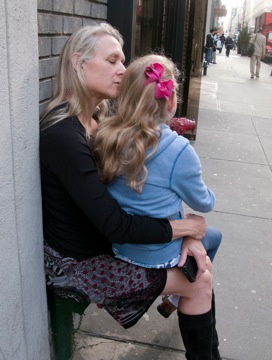
A and E_2185And so I found I had a choice.  I could choose to continue to live in fear of autism and all that people were telling me Autism meant or I could choose to embrace my Autistic child, learn, enjoy and let go of all that anger and fear as it came up, as it continues to come up.  Each time I feel fear and anger, and I do on a daily basis, I now know I have a choice.  I can fall into the fear and anger or I can step back from it, realizing it’s a mirage, realizing that as painful and real as it feels it is not a fact, it is a construct of my thinking and I can sit with it and not react to it.  Because my fear has me running away and my anger has me shouting, either action keeps me apart from others.  I have learned that the answer to both is to do something else.  And that is this – walk towards instead of away, speak lovingly instead of shouting and pushing away.

Rethinking Unhappiness

I was alerted to an article written by Dr. Michael Oberschneider entitled, Ask Dr. Mike: Expecting and Anxious About Autism.  In the piece he writes, “Some of the happiest parents I know (both personally and professionally) have children on the Autistic Spectrum.”  In the comments section people weighed in with their thoughts.   Many parents wrote of their outrage (and a few of their disbelief) that Dr. Mike suggest “happy” parents of Autistic children even exist.  They seemed to equate happiness with a lack of concern.  A number of parents suggested that Dr. Mike was simply wrong and refused to believe that he could actually know such parents.  One person went so far as to suggest he was trying to trump up more clients, which is an interesting idea, but the logic of that argument eludes me.

Before I go any further, I have to say this – there was a time, not so very long ago – when I was one of those parents who was incredulous that anyone could be “happy” and have an Autistic child.  I no longer feel that way and the reason is, I stopped trying to cure my child of herself.  I feel sad that this was my experience.  I wish it hadn’t been.  I know it negatively affected my daughter.  I know it negatively affected my entire family.  I know now that the depression I felt was because I believed I could cure her.  I was angry, I was depressed, I believed that no one could truly understand.  I felt alone and isolated in my sadness and rage.  I was engaged in a war only to realize I was fighting myself.  I know this now, but I didn’t then.  I wish I could hit the rewind button and do it over differently, knowing what I know now.  But I can’t.  I have to move forward.  In moving forward I am aware that I owe it to my daughter to make a living amends to her for my past mistakes.  Mistakes that I cannot know and will never know how badly they impacted her. Part of my living amends to her, beyond trying my best to be the best mother to her (presume competence) that I am capable of is to counter the negativity and fear that continues to swirl around the very mention of autism.

Today I am one of those happy parents Dr. Mike mentions.  I have two beautiful children, one who happens to be not autistic and one who happens to be Autistic.  And yes, there are times when I worry about both their futures.  There are times when one of them does something or is going through something and I find myself concerned.  Concern is one of those feelings, like worry, that actually does not help my child.  These are things I feel and it is up to me to figure out what to do about them.  Are there actions I need to take that will help my child get through whatever it is that is troubling them or causing problems?  Are those problems something I can control or are they things that require patience, compassion, love and support?  What can I do to accommodate my child so that they might better cope with whatever is going on?

The single biggest issue I confront repeatedly with having a child who is Autistic, with unreliable verbal language, is the misinformation, the fear, the misperceptions and the ignorance of those who meet her and what they then assume because of what they see.  Fear coupled with ignorance = prejudice.  We fear that which we do not know or understand.  We make judgments, we believe ourselves to be superior, we then behave accordingly.  None of this helps anyone.

It makes me sad that I was once so unhappy and that I attributed my unhappiness to my child.  I know now this was not true.  It wasn’t my child who made me so unhappy, it was my perception of her and what I believed that meant that caused my unhappiness.  I assumed things about her that I now know are not true.  They are not fact.  What is true, what is a fact is this:  My Autistic child is far more capable than most people give her credit for.  My autistic child does not use language the way most people expect.  Through a great deal of hard work and over the course of many years my daughter is learning to communicate through typing.  She has proven repeatedly that she is not only aware of what goes on around her, but she is extremely intelligent and capable.  At the moment she requires support to communicate, though we believe she will not require that level of support in the future.

My happiness or unhappiness has nothing to do with either of my children or my husband or my marriage.  My ability to feel joy is an inside job.  It takes work to excavate all those old beliefs, to throw everything you think you know and believe and start over.  I encourage anyone who is suffering and believes their suffering is directly the result of their child’s neurology to examine their beliefs.  Throw it all out.  It isn’t serving you and your suffering isn’t helping you help your child.  Isn’t that ultimately what all of this is about?  Aren’t we all trying to be the very best person we can each be?  Isn’t that what we hope and want to model for our children?  Isn’t that the point?

April 2013 – With my beautiful friend Lauri, another “happy” parent 

A & L

Love

For those who missed the fun, yesterday was the #AutismPositivity2013 Flashblog where people sent in thoughts about the theme “1,000 Ausome Things” in an effort to counter at least some of the ongoing negativity surrounding autism and those who are autistic.  All the posts have been compiled ‘here‘.  I helped tweet, share, google+ and pinned the posts as they came flooding in and WOW!  It was exhilarating to read so many words written by Autistic people, young and not so young, non-autistic parents, Autistic parents, siblings, cousins, educators and everything in between.  There were bullet points, numerical lists, stories, photos and even a couple of videos!

It was wonderful to see so many coming together over a shared idea.  A moment when the common goal was to rejoice.  A tiny moment when it wasn’t about anything other than what was AUSOME about a neurology we have come to call autism.  And it reminded me of something.  It reminded me of a time in my marriage when a therapist suggested Richard and I make a note every night, not of all that was wrong, or a list of our grievances, but a list of all the other had done right.  A list of all that was ‘good’.  These are subjective words, but we understood the goal was to look for the positive in the other.  And guess what?  It was the single best advice anyone ever gave us!  When we concentrated on that which the other was doing that was kind, took notice of the little gesture made, the loving glance, the dish that was put away, the trip to the store for the milk that no one had remembered to buy, all those little acts each person did, when those were noticed, they added up to something bigger.  They added up to an expression of love neither of us could have voiced.

That’s what yesterday’s Flashblog was about…  love.  Self love, love of another, hundreds of voices expressing love.

This image was created by the very talented Lori Miller Degtiarev of the blog A Quiet Week

Lori Miller Degtiarev